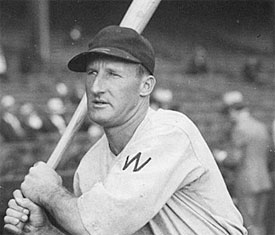
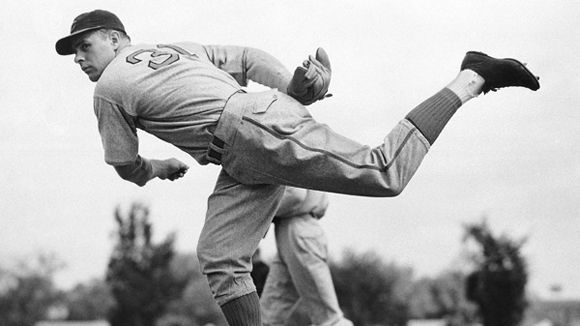
The 1930's saw many teams struggle financially as the country suffered through the Great Depression. With professional football still in the infant stages and mostly considered a college sport, and hockey considered a winter sport, baseball had little competition in the sports world. The biggest competition came from boxing and horse racing.
In horse racing, the people's champion Seabiscuit took on the proven winner War Admiral in 1938. Seabiscuit was the underdog given little chance to succeed but did anyways. The American people, fighting to survive through the pain of the depression needed an underdog. Baseball gave the country their own versions of the underdogs in the 1930's in the 1933 Washington Senators. Having fallen off considerably after the 1924-1925 World Series teams, Washington replaced their original "boy wonder " manager, Bucky Harris, with the living legend,
Walter Johnson. Johnson did well as a manager but fighting against the Yankees and Athletics in the early 1930's meant you were finishing a distant third at best. When the Senators replaced Johnson with another "boy wonder", Joe Cronin in 1933, few expected much. Just as Harris took the Senators to the World Series in his first year as manager, Cronin drove the Senators in their fight with the Yankees. They literally fought with the Yankees on several occasions, always coming out on top. Cronin gambled by starting his #3 starter, a lefty, in game 1 of the World Series. It backfired as the left handed batters of the Giants pounded Senators pitching to end the Cinderella story before the happy ending. It would be the last great year for Washington baseball until 2012.
In the 1930's Major League baseball had moved past the scandal of the Black Sox. Through the iron fist rule of Judge Kennesaw Mountain Landis, the first commissioner of baseball, the league had reached prosperity that no one thought possible for a sport. As the Depression worsened, attendance fell drastically and the writing started to appear on the wall that cities could no longer support two successful teams. It would take another 20 years but Boston, Philadelphia and St. Louis would all lose one of their two teams.
The decade started with one of the greatest collections of talent ever seen in the game fighting for the American League pennant with another of the greatest collections of talent ever seen in the game. The
Philadelphia Athletics of 1929-1931 included four future members of the Hall of Fame, as well as several others who were borderline Hall of Fame players. Their offense was led by the great Al Simmons, Jimmie Foxx and Mickey Cochrane, while their pitching staff was anchored by the greatest pitcher of the era, Lefty Grove. Their biggest opponent in the American League was the Yankees of Ruth, Gehrig, Bill Dickey, Tony Lazzeri and Frankie Crosseti. As the decade progressed and the Depression deepened, Connie Mack could not afford to keep his talent and sent Simmons to the White Sox, Cochrane to the Tigers and Gomez and Foxx to the Red Sox. The Yankees did not have the same problems. As Ruth, Earl Coombs and Herb Pennock began to age the Yankees sought new talent, and found it in Joe DiMaggio, Lefty Gomez and Ben Chapman.
Although the Yankees and Athletics dominated the decade, the Tigers had a pretty good collection of talent known as the "G-men" for Charlie Gehringer, Goose Goslin and Hank Greenberg. Along with the "G-men" was Mickey Cochrane, traded from the Athletics to the Tigers, who was not only the Catcher but also the manager. The Tigers were able to reach the World Series in 1934 and 1935, winning the 1935 World Series.
The National League saw a similar domination by a few teams and the end of the greatest managerial career the sport has ever known. The Cardinals, Cubs and Giants dominated the league. The 1934 Cardinals, known as the "Gashouse Gang" were one of the most colorful teams in the history of the game. With players like Pepper Martin, Dizzy Dean and Leo Durocher, they were constantly making headlines for fighting (either the opposition or each other). Dizzy Dean was, without a doubt, the dominant pitcher in the decade. The game came so easy to him that he was able to tell batters what was coming and still make them look foolish. He was also known as a bit of a goof. He often made headlines for his silly personality and was routinely the object of reporters' jokes. In the 1934 World Series, "Ole Dizz" decided to pinch run (no one gave him the order to do it, he just went out to pinch run). The next play was a ground ball, easy double play ball, to the secondbaseman Charlie Gehringer. Gehringer flipped to Billy Rogell for the force at second and Rogell, instinctively turned and cut loose a throw to Greenberg at first. The throw didn't make it to Greenberg because it caromed off Dean's head. Dean went down like he was shot. He was taken to the hospital for precautions and to make sure there was no fracturing of the skull. The headline came out the next morning (it has been paraphrased so many times the exact wording is difficult to determine) in big bold letters: "X-RAY OF DEAN'S HEAD REVEALS NOTHING." Dizzy's career ended sadly. He was traded to the Cubs and continued to dominate until the 1937 All Star Game. Earl Averill connected on a Dean pitch that went right back up the middle and connected with Dean's foot, shattering his big toe. Dean tried to come back and pitch before he was completely healed. The pain in the foot caused him to alter his mechanics and damage his arm leading to an early retirement.
If Dean had any competition for the pitcher of the decade in the NL it was "King" Carl Hubbell. Carl developed a new pitch (although some said it was just Christy Matthewson's old "fadeaway" pitch) called the screwball. Carl mastered it and threw it so often that his arm was permanently damaged. Because of the pressure put on the arm in throwing the pitch, Hubbell's arm became permanently twisted. Hubbell dominated the league with the new pitch leading to many pitchers trying to duplicate the pitch. The pitch also led to one of the most memorable All Star Game moments in history (it's a great story so I think we'll save that one for another week and give it a little more detail).
Hubbell pitched for the Giants, who dealt with a tremendous shift in the team's fortunes in the decade.
John McGraw had managed the Giants since 1902. He was the most successful manager in history. He had led the Giants to the World Series in 1905, 1911, 1912, 1913, 1917, 1921, 1922, 1923 and 1924 and he was tired. McGraw is legendary as a hard fighting, cantankerous, crafty manager but by 1932 he had lost the spirit of fighting. It was no longer fun for him and he was suffering through some health problems. A month and a half into the 1932 season McGraw called Bill Terry, the Giants' firstbaseman, into his office. Terry assumed he was getting called in to get chewed out over some small infraction that angered "Mugsy". Terry was fairly used to these "meetings". What McGraw told him was a shock. He was retiring and he wanted Bill Terry to take over as manager. The shock for Terry was that McGraw had chosen him. He always thought McGraw hated him. He did just fine as the Giants manager. He held the position for ten years and took the Giants to three World Series, winning the 1933 World Series.
The greatest addition to the game during the decade started in 1933. For years fans, press and owners had dreamed of creating a team built of all the stars in the National League and playing that team against another team built of all the stars in the American League. The 1933 World's Fair in Chicago gave one reporter a bigger incentive to push for this event. He convinced the owners and the players to hold an All Star Game with the best players from the American League against the best players in the National League and, best of all, they would let the fans choose who would be able to participate. The rosters read like the greatest of the greatest of all time: Ruth, Gehrig, Foxx, Simmons, Cochrane, Gehringer, Gomez, Grove, Cronin, Frisch, Traynor, Waner and Hubbell. The American League won the first mid-summer classic 4-2. Frisch hit a solo home run for the NL in the 6th. It knocked in the second run for the NL. The AL got the scoring started in the second when Lefty Gomez singled in Jimmy Dykes. The AL took a 3-0 lead with a two run Home Run by Babe Ruth, the game winning RBI.
Although the names of Babe Ruth, Hank Greenberg, Carl Hubbell, Dizzy Dean and Joe Cronin will be the names that are remembered thirty, forty or fifty years from now (or more), every decade has tremendously talented, successful players who make wonderful contributions to the success of their teams, organizations and the league as a whole. Unfortunately many of the players who fall into this category will be forgotten, overlooked and generally ignored. Here are 12 players (+) from the decade you may not remember but you definitely should:
Catcher
Clyde Sukeforth
Career Teams: Cincinnati Reds (1926-1931), Brooklyn Dodgers (1932-1934 and 1945)
All Star Appearances*: None
MVP Voting#: None
Clyde Sukeforth played less than 500 career games in the major leagues but he impacted the game more than most people who have played three or four times as many games. He hit a career total of 2 home runs, never had more than 94 hits in a season and never drove in more than 33 runs in a season yet Clyde Sukeforth was intimately involved in one of the most polarizing, important and game changing moments in any sport. After his playing days were done Branch Rickey signed Sukeforth as a scout. He gave him a special project. Go to Kansas City, there was no concept of the major leagues in Kansas City at that time, scout a player and report back to Branch Rickey. He wanted him to talk to the man, get a sense of not just the player but the character of the man. Could he handle the majors? There was one thing about this man...he was an African American playing in the Negro Leagues and no African American had ever played in the majors. Sukeforth could very easily have told Rickey that the man, a Shortstop, had a weak arm, that he had a temper, that he had a weak bat or exaggerated some flaw, underestimated or dismissed the talent (or honestly missed the talent as many scouts do). Sukeforth went to the man after the game and spoke with him, had a real man to man conversation not as a white man to African American man but as baseball player to baseball player. He reported back to Branch Rickey that the man was ready for the major leagues. Rickey told Sukeforth to bring the man in for a personal interview as part of Rickey's grand plan. The three men met and Branch Rickey agreed with Sukeforth's assessment. Jackie Robinson was ready for the major leagues.
Ernie Lombardi
Career Teams: Brooklyn Robins (1931), Cincinnati Reds (1932-1941), Boston Braves (1942) and New York Giants (1943-1947)
All Star Appearances*: 1937, 1938, 1939, 1940, 1942 and 1943
MVP Voting#: 1935 (13th), 1936 (30th), 1938 (1st), 1940 (9th), 1943 (13th)
There are many times we see a Hall of Fame player get traded early in their career before they have really had a chance to show what they can do. Pee Wee Reese was traded by the Red Sox, John Smoltz was traded by the Tigers,
Nellie Foxx was traded by the Athletics, Ryne Sandberg was traded by the Phillies and Ernie Lombardi was traded by the Dodgers. The most common question we ask is who did they get in return? (In Lombardi's case they picked up Tony Cuccinello, Joe Strip and Clyde Sukeforth from the Reds).
Sometimes the bigger question is: Who did the team have at that position that made them so confident they could get rid of him? In Lombardi's case it was
Al Lopez. Lopez at that point was a rookie catcher with a lot of potential. Lombardi also had a lot of potential but the Dodgers felt Lopez had a bigger upside. The trade worked out for both sides. The Dodgers got the man who would eventually find Jackie Robinson in Sukeforth. They kept the best defensive (and smartest) catcher in Lopez and got Cuccinello who would start a life long friendship with Lopez. The Reds probably won the deal over all as Lombardi anchored their World Series teams in 1939 and 1940. Catchers normally are low average, high power hitters with high numbers in strikeouts. Occasionally there are exceptions to the rule and you find a Catcher who can actually hit. Lombardi was the exception to every rule. His career average was .306 and he won batting titles in 1938 (.342) and 1942 (.330). When Lombardi won his batting title in 1938 (he also won the MVP that year) he was the first catcher to do so since Bubbles Hargrave (also for the Reds) had done it in 1926. These two catchers remained the only two to win batting titles until Joe Mauer did in 2006 (Mauer also did it in 2008 and 2009). In 2012 Buster Posey did it for the World Champion Giants. Ernie Lombardi was the original Joe Mauer.
Firstbase
Charlie "Jolly Cholly" Grimm
Career Teams: Philadelphia Athletics (1916), St.Louis Cardinals (1918), Pittsburgh Pirates (1919-1924), Chicago Cubs (1925-1936)
All Star Appearances*: None
MVP Voting#: 1925 (13th), 1929 (14th) and 1931 (8th)
When his playing career was over Charlie Grimm became known as a bit of a clown. They guy who everyone had a goofy story about. During his playing days, Charlie was a great firstbaseman mostly with the Chicago Cubs. He often hit over .300 and as the leader of the great Cubs teams of the decade. Grimm took over as manager in mid-1932 and led the Cubs to the World Series where they were crushed by Babe Ruth's "called shot". The Cubs teams with Grimm in charge were notorious for trying to distract the other team by screaming obscenities, racial slurs and insults at them. The vernacular of the time period would be "bench jockeying". During the 1935 World Series against the Tigers, the comments against Hank Greenberg got extremely vicious and disgusting, mostly aimed at Greenberg's Jewish heritage. It got so vicious that umpire George Moriarty threatened to eject the entire Cubs bench (from a World Series game) if it didn't stop. Several Cubs were fined after the game for the incident. Grimm remained a part of the Cubs organization for decades (close to fifty years total) as a broadcaster, occasional manager and often as a coach. There are some stories out there (unconfirmed) that Grimm was among a group of coaches who blocked
Buck O'Neil from becoming a Cubs manager during the 1962 season. Grimm's success as a manager makes him the most successful manager in the Cubs history, just ahead of the legendary Frank Chance.
Second base
Max Bishop
Career Teams: Philadelphia Athletics (1924-1933) and Boston Red Sox (1934-1935)
All Star Appearances*: None.
MVP Voting: 1933 (21st)
The 1929 Athletics are considered by many to be the greatest team of all time. With Hall of Famers Al Simmons, Jimmie Foxx, Mickey Cochrane, Lefty Grove and Eddie Collins as well as borderline Hall of Famers George Burns, Jimmy Dykes and George Earnshaw it was easy to lose track of Max Bishop. Max had one of the toughest jobs in the world, something very few people can relate to: replace the person everyone acknowledges as the greatest player at his position in the history of the game. As Eddie Collins, the greatest secondbase man in the history of the game, started to move towards retirement, Max Bishop was pushed into the position. He was no Eddie Collins but he was a key link in the Athletics dynasty from 1929-1931. His biggest contribution was on defense. He often made plays that made people question if they were possible. In his 12 seasons at second base Bishop averaged less than 15 errors per season. For a middle infielder constantly involved in tough chances that's a pretty good fielding percentage.
Shortstop
Mark Koenig
Career Teams: New York Yankees (1925-1930), Detroit Tigers (1930-1931), Chicago Cubs (1932-1933), Cincinnati Reds (1934) and New York Giants (1935-1936)
All Star Appearances*: None
MVP Voting#: None
The 1926 Yankees came into their season with some major questions. Babe Ruth had missed most of the 1925 season with what has become known as the "bellyache heard 'round the world" and it was questionable whether or not he would ever be the same. They were also starting two rookies in the middle infield: Tony Lazzeri and Mark Koenig. The questions were answered with an American League pennant and a 7 game loss to the Cardinals in one of the great World Series of the decade. The 1927 Yankees were known as Murderer's Row and Koenig was a big part of that assault, although his fielding often gave Miller Huggins fits (he was benched briefly during that rookie year because of his fielding issues). When the Yankees signed Frankie Crosseti to play Shortstop Koenig became expendable and was shipped to Detroit. He was picked up by the Cubs half way through the 1932 season he helped the Cubs to the World Series. The Cubs and Yankees were constantly taunting, yelling, cursing each other during that series. Some said it was because the Yankees were angered that the Cubs had failed to vote Koenig a full share of the World Series winnings. Koenig played in only 2 of the 4 games in the Series but had a run scoring triple.
Thirdbase
Marv Owen
Career Teams: Detroit Tigers (1931 and 1933-1937), Chicago White Sox (1938-1939) and Boston Red Sox (1940)
All Star Appearance*: None.
MVP Voting: 1934 (9th)
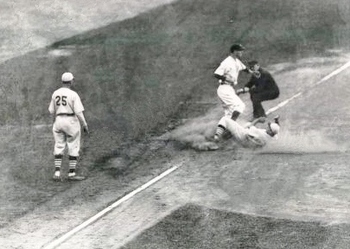
They were all frustrated by the time the 6th inning rolled around. It was already 6-0 in the seventh game of the 1934 World Series and they had another 3 full innings to play out the string. Marv wasn't particularly happy about his own play to that point in the game. He failed to take advantage of a Cardinals error in the 2nd and flew out in the 5th. He watched as the ball flew off of "Ducky" Joe Medwick's bat. He knew it was hopeless and the frustration boiled higher. The frustration kept boiling as Medwick rounded second and headed toward him. This might be close and he was tempted just to use the ball and punch Medwick with it just to get rid of some of the anger. The throw came in and Medwick hit the bag, or more accurately hit Marv. The spikes were high and Marv got spiked, then kicked, then knocked to the ground. That was it. If Owen was going to lose a game, 8-0 (11-0 by the end of the day) at home, he sure as hell wasn't going to take it lightly. He launched back at Medwick and, after rolling in the dirt for a few moments, they were separated. Order was restored (temporarily) but as Medwick headed to left field for the bottom of the inning the frustration of the fans erupted as well. They threw bottles, food and garbage at Medwick. In the footage of the game you can see a head of lettuce or cabbage roll across the field at Medwick's feet as he takes it all in. He later said "I understood why they threw it, I just never understood why they brought it with them to the ballpark in the first place." Owen had his best season in 1934 hitting .317 and driving in 96 runs but he hit only .069 with 5 strikeouts in the 1934 World Series. Owen did slightly better (.147) in the 1935 World Series as the Tigers beat the Cubs in 6 games. Owens was part of a Tigers infield that played together as a unit (Greenberg at Firstbase, Charlie Gehringer at Secondbase, Billy Rogell at Shortstop and Owen at Thirdbase) through the Tigers great years of the 1930's.
Outfield
Chuck Klein
Career Teams: Philadelphia Phillies (1928-1933), Chicago Cubs (1934-1936), Philadelphia Phillies (1937-1939), Pittsburgh Pirates (1939) and Philadelphia Phillies (1940-1944).
All Star Appearances*:1933 and 1934
MVP Voting#: 1929 (11th), 1931 (2nd), 1932 (1st) and 1933 (2nd)
Phillies fans who visit Ashburn Alley at Citizen's Bank Park will see initials CK with the retired numbers. Chuck Klein was certainly one of the top 5 Phillies in the history of the organization, unfortunately he played for the team during truly terrible times. Klein led the league in Home Runs four times in his career, including a career high 43 in his first full season of 1929. He led the league in runs three times, led the league in hits twice, stolen bases once, hits twice, doubles twice and won a batting title. The year he won the batting title he also led the league in RBI and Home Runs for baseball's triple crowns. With a career .320 average and an MVP to go with all of these single season numbers, Klein was an easy choice for the Hall of Fame. He was lucky enough to get moved out of Philadelphia to the Cubs after the 1933 season and in 1935 he played in his only World Series. He had a good series hitting .333 with a Home Run and 2 RBI, unfortunately for Klein it was for the losing Cubs. He then went back to the terrible Phillies, onto the Pirates for a brief stint and finally ended his career with the Phillies in 1944. Klein is one of the top five players of the decade who would be compared with players like Greenberg and Frisch if only he had played for winning teams.
Goose Goslin
Career Teams: Washington Senators (1921-1930), St. Louis Browns (1930-1932), Washington Senators (1933), Detroit Tigers (1934-1937) and Washington Senators (1938)
All Star Appearances*: 1936
MVP Voting#: 1926 (9th), 1927 (6th) , 1928 (6th), 1931 (20th), 1932 (17th) and 1934 (14th)
The Tigers had lost the 1934 World Series Game 7 in embarrassing fashion. They were determined not to reach a Game 7 this year and to finish the Cubs here. As Goose Goslin sat on the bench with Eldon Auker about the 6th or 7th inning, he leaned over and said "I got a feeling I'm gonna come up to bat with a chance to win this thing... and if I do, boy, we gonna be World Champions." Auker stared out at the field, nodded his head, didn't say anything, just thought. World Champs. Nothing less was acceptable. There were two outs in the bottom of the ninth of the tie game and Mickey Cochrane stood on second. He looked in at Goose. Clapped his hands. Yelled in "Let's go Goose. One good rip." Goslin got one good rip and drove a single to right field. With 2 outs Cochrane took off on contact and scored the World Series winning run. It was the first World Series win for Rogell, Marv Owen, Hank Greenberg and Pete Fox. It was the second World Series victory for Goslin and the fifth time he had reached the fall classic. Goslin was the best hitter on the great Washington Senators teams of the 1920's. When fate intervened to give the 1925 Senators a freak Game 7 victory, Goslin had hit .344 with 3 Home Runs in the seven game series. The next year when the Senators lost a 7 game World Series to the Pirates, Goslin had hit .308 with another 3 Home Runs. He won a batting title, barely, in 1928. Going into the last day of the season he was leading the league by a few percentage points. He couldn't sit out the game or he would be accused of being afraid of losing the lead. He didn't want to play but he knew he had to be in the lineup and he really wanted to win that batting title. He had the perfect idea. As he stepped up for his first at bat he watched the first pitch go by, ball one. He turned to the umpire and called him a few names. It isn't often an umpire gets cursed out by a player for calling a ball. Goslin took the second pitch, strike 2. Now he turned and really gave it to the ump. Surprisingly, the umpire just stood there and took the abuse for a few moments. Goslin thought he could get kicked out before a official at bat, thus preserving his average. After a few moments of abuse the umpire stopped Goslin and said "You can call me every name in the book but at some point you're going to have to get in there and hit so why not just get it over with." Goslin ended up winning the batting title that day. Goslin was a fan favorite in Washington but he and Walter Johnson couldn't get along when Johnson took over as the manager. Goslin vowed never to play in Washington again as long as Johnson was manager. He was traded to the St.Louis Browns and the Senators fans were furious. When Johnson was fired after the 1932 season, the Senators immediately traded to get Goslin back. All he did was lead them back to the World Series, the last time the Senators would reach the post season, and hit .250 with a Home Run in the series, though the Senators lost to the Giants. They say you can never go home again and Goslin's return was just a visit. He was traded to Detroit after the 1933 season and helped the Tigers reach the World Series. In the 1934 World Series Goslin hit .241 (none of the Tigers could hit Dizzy Dean), but he drove in a run and had a double. The Tigers group were determined not to lose a second year in a row and thanks to Goose's premonition, they got the job done.
Hack Wilson
Career Teams: New York Giants (1923-1925), Chicago Cubs (1926-1931), Brooklyn Robins (1932-1934) and Philadelphia Phillies (1934)
All Star Appearances*: None.
MVP Voting#: 1926 (5th), 1927 (12th), 1928 (7th), 1929 (8th) and 1932 (13th)
191. It's an astounding number regardless of what it applies to on the back of your baseball card. 191 RBI. It's more than Gehrig, Ruth, Bonds, McGwire, Sosa, Juan Gonzalez, Ken Griffey Jr, Henry Aaron, Willie Mays or Mickey Mantle ever reached. 191 RBI in one season. Hack Wilson entered the league as part of a New York Giants dynasty that was on the decline and took over the outfield. Wilson was notorious for his nightlife activities and John McGraw got tired of it so he made Wilson the Cubs' problem. Four years later, Hack Wilson had one of the most unbelievable offensive seasons in history. 56 Home Runs, 105 walks (how can you get 191 RBI when you walk 100+times?), .356 average, 85 strikeouts (how can you hit .356 and still strike out 85times?) and a.723 slugging percentage. Similar to
Mickey Owen, Wilson is best known for one mistake. In Game 4 of the
1929 World Series the Cubs were set to tie up the heavily favored Philadelphia Athletics. The Cubs had an 8 run lead in the bottom of the 7th with their ace Charlie Root on the mound. Al Simmons led off with a Home Run 8-1. No big deal. This was followed by four straight singles resulting in 2 runs. 8-3. Still no big deal. Then a pop out to short, 1 out and the Cubs seemed to be back on track. Another run scoring single and it was 8-4. Still ok. Just to be safe the Cubs brought in a new pitcher. The first batter he faced, with two runners on, hit a routine fly ball to center field. Wilson started to track it. Then stopped. He couldn't find the thing. It was a terrifying feeling. By the time he found the thing it was over his head, rolling toward the wall. Wilson had turned a second out into a three run, inside the park home run. A walk, 2 singles, a hit batter and a double later the Athletics led the game 10-8, still with only one out. Hack Wilson gets blamed for losing the World Series, however, the entire team collapsed. Similar to the
1985 Cardinals, what causes the chaos is not important, it is how you react to the chaos that matters. The Cubs could not recover. They lost the game and the next day to end the series. Wilson was constantly blamed for the loss.
George "Twinkletoes" Selkirk
Career Teams: New York Yankees (1934-1942)
All Star Appearances*: 1936 and 1939
MVP Voting#: None
The 1936 Yankees had a powerful team: Frankie Crosetti, Bill Dickey, Joe DiMaggio, Lou Gehrig, Tony Lazzeri. When Bill Terry and the New York Giants planned their pitching strategy for the 1936 World Series, they focused on the frightening players that everyone knew. They ignored the 8th place hitter, George Selkirk. It would cost them. In just his second full season in the majors Selkirk had hit only 11 Home Runs. He would 2 Home Runs in the Yankees 6 Game victory over the Giants. In all Twinkletoes would play in 6 World Series and win 5 of them. His best World Series was his first against the Giants. Selkirk was not a Hall of Fame caliber player but playing along DiMaggio, he covered a lot of outfield ground and was greatly involved in the Yankee run of the 1930's and was often the forgotten man in the powerful Yankees lineup.
Pitcher
Charlie Root
Career Teams: St.Louis Browns (1923) and Chicago Cubs (1926-1940)
All Star Appearances*:None.
MVP Voting#: 1926 (16th), 1927 (4th), 1931 (20th), 1937 (12th) and 1938 (25th)
Charlie Root was one of the best pitchers in the 1930's (and late 1920's for that matter) but he is forever remembered for throwing two pitches. The 1932 World Series between the Cubs and Yankees was one of the most contentious ever played. The Cubs were notorious for having a group of players who would relentlessly ride the other team in an attempt to intimidate them. When Babe Ruth stepped in to face Root in the 6th inning of the third game of the 1932 World Series he had already hit a three run home run to put the Yankees up. When Root's first pitch was called a strike Ruth disagreed and the Cubs bench erupted with shouts at Ruth. The second pitch came in the same way with the same result. Everyone agrees to this point. What happened next will never be settled. Ruth said he pointed to left field and yelled to the Cubs bench "I'm going to hit the next one past the flag pole." The Cubs bench said he gestured to them and said "It only takes one goddamn pitch to hit it out of the park." Root said he pointed right back at him and said "I'm going to hit the next one right down you're
f#@$ing throat!" Whatever he said, he definitely pointed somewhere, said something to someone, then swung at the 0-2 pitch and drilled it over the left field fence for "the called shot". As he crossed home plate Ruth shook hands with Lou Gehrig and told him "Now you do the same thing." Gehrig did. Unfortunately for Root he would be remembered for those two pitches completely overshadowing what was a great career. Root won a total of 201 games and pitched in 4 World Series with the Cubs. His best season came in 1927 when he won 26 games with a 3.76 ERA. With a career won-loss percentage of only .557 he certainly doesn't belong in the Hall of Fame but it is unfair to judge his career on those two famous pitches.
Johnny Vander Meer
Career Teams: Cincinnati Reds (1937-1943 and 1946-1949), Chicago Cubs (1950) and Cleveland Indians (1951)
All Star Appearances: 1938, 1939, 1942 and 1943
MVP Voting: 1938 (18th), 1942 (20th), 1946 (24th) and 1948 (19th).
In the 2010 season Roy Halladay pitched a perfect game in the regular season. He later followed this up with a no-hitter in his first ever playoff appearance against the Cincinnati Reds. It was amazing. Two no hit games in one year. On June 11, 1938 Johnny Vander Meer pitched a no-hit game. It was a great accomplishment but it had been done before and would be done many times after. Not to say that it is not a great feat or downplay the event, but many pitchers have done it over the last 100 years. Four days later Vander Meer's turn came up in the rotation again. He faced Brooklyn and threw a second no-hitter. No one had ever before (or since) thrown no-hitters in consecutive starts. Vander Meer's numbers were not eye-popping but he contributed greatly to the Reds' success in the late 1930's.
Frank McCormick was their hitting star and Ernie Lombardi was their anchor but Vander Meer was one of their pitching masters. Vander Meer pitched in only one game in the 1940 World Series (3 innings pitched in a no decision) but the Reds counted on his help to get them to that point. Vander Meer lost two years of his career to World War II. His two consecutive no-hitters is a feat that will never matched.
*-The All Star Game was not started to 1933. Many of the players in this weeks articles likely would have made numerous additional All Star Game appearances if the game had been in effect their entire career.
#-Various forms of the MVP Award were given out between the start of the league and 1931. Between 1911 and 1914 the award was given out in both leagues but disappeared until 1922. When it returned, only the American League chose a winner in 1922 and 1923 and from 1924-1928 both leagues awarded the MVP. The AL failed to choose an MVP winner in 1929 and in 1930 neither team chose a winner. The award returned for good in 1931. From 1922-1929 the leagues did not allow a player who had already won the MVP to be considered for a second award. Had this rule not existed Babe Ruth likely would have won all of the awards during that time period. Because of this rule, when Ruth hit 60 Home Runs in 1927, he received 0 MVP Votes.
+-
Author's Note: Just as in the last few weeks, and as may be seen in the next few weeks as we move through this series of articles, I did my best to keep this to one player per position, however, the farther we move from these eras, the easier it is to forget these types of players (and even some hall of fame players). It is important to remember as we follow the sport that the superstars are not the only ones making contributions to the success of a team. This is not a comprehensive list of players who fall into this category from this era, it is simply my choice of players who best represented their position and have become forgotten. Your list is probably different. Email me yours or leave a comment.