Showing posts with label Beatles Kansas City Concert. Show all posts

Saturday, December 13, 2014

Beatles Baseball Tour

I was recently fortunate enough to go see Paul McCartney perform at Dodger Stadium.  Yes.  I do have interests other than just baseball.    As I watched  Sir Paul perform "I Saw Her Standing There", one of the earliest Beatles songs, I started to wonder had the Beatles played Dodger Stadium?  Had the four Liverpudlians ever stood on the mound where Sandy Koufax would have been pitching the day before or after?  After all, they had toured the country during the same years that the Dodgers were trying to win three straight World Series.

From there my thoughts led me to wonder what other baseball stadiums the Fab Four would have played.  What years were they in each one and what were the teams' fortunes when they appeared there?  Had they played in a stadium of a World Series Champion?

Why don't we take a look at their tour schedule and see what we can find about their tour of baseball stadiums:

1/12/64:  The Beatles had been riding the success of "She Loves You" as they toured the UK in late 1963.  Their new single, "I Want to Hold Your Hand" was released in the UK on 11/29/1963, just about a month before the US release.  There had been a million pre orders for the song and when it was actually released in the US on 12/26/1963  it stood at #45 on the charts.  The Beatles had already conquered  Germany and Sweden and were wrapping up a UK tour.  The boys were home For the holidays in 1963, playing Liverpool on 12/22 and London on 12/24 and 12/26.  The London stay extended trough the first few weeks of January and on 1/12 they played the second night of a two night stand at the Palladium in London.  It was the last stop on the UK tour.  The next leg would be in France.

2/4/1964:   The tour was enjoying success in France as they had in Sweden, Germany and at home.   The tour kicked off in France in Versailles on 1/15.  While they played France for a few weeks the US was starting to suffer from Beatlemania.  The demands for the Beatles was increasing and on 2/1 the US charts revealed the Beatles were a the top, ahead of "You Don't Own Me" by Leslie Gore.  On 2/4 the Beatles played the last show of their French tour. On 2/7 they boarded Pan Am Flight 101, known as the  "Yankee Clipper" and left for America.  Of course they played the Ed Sullivan Show. They later moved on to play the Washington Coliseum, Carnegie Hall and the Deauville Hotel in Florida.  Don't forget this was a winter time tour, mostly in the northeast and before Major League Baseball was played in Florida so there were no baseball stadium stops on their first trip.


8/19/1964:  After a brief return to England it was off to Scotland, Denmark and Hong Kong then on to Australia and New Zealand.  Beatlemania was now a world wide phenomenon.  On June 3 Ringo had been admitted to the hospital and missed part of the Australian tour, replaced by Jimmy Nicol.  Realizing it had only been a few years since he had replaced Pete Best, Ringo rushed to return to the group. The tour continued back to England with a few days here and there in Sweden and it was time to return to the US.  The first US visit had focused on the east coast.  Now they would move on to the west coast.  Their first stop this time was Daly City, CA.  It was only a month  after the release of the "Something New" US album but the set list did not reflect the new album.  The set featured "Things We Said Today" from the new album but the US Single (set for release in a week) "Matchbox" and the B-side "Slow Down" were not featured. Instead, Ringo performed "Boys".  Heavily featured were songs from their current film "A Hard Days Night" including the title track, "Can't Buy Me Love" and "If I Fell".  From Daly City it was on to Vegas, Seattle and Vancouver but still no baseball stadium visits

8/23/1964: On August 23rd in Los Angeles the Dodgers took on the Reds at Dodgers Stadium.  It was a Sunday afternoon game.  The Dodgers were having a poor season thanks to arm problems for Koufax and Drysdale.  The Reds, on the other hand, were in second place behind the surprising Phillies.  The Reds were red hot, having won six straight, but were in a tumultuous season.  Their fiery leader Fred Hutchinson had announced on 1/3/1964, just before the Beatles headed off to France, that he had been diagnosed with throat cancer.  On 8/12, just before the start of the current winning streak, a weak and tired Hutch stepped down.  The Reds now had a purpose and a rallying cry.  On 8/23 they faced the Dodgers at the stadium.  The Reds sent Jim O'Toole to the mound to keep the streak alive.  The Dodgers countered with Phil Ortega, Not exactly Koufax.  The game was scoreless in the bottom of the third when Nate Oliver opened the inning with a double.  Phil Ortega sacrificed Oliver to third and the Reds walked Maury Wills.  Dick Tracewski singled scoring Oliver. It would be the only run of the game and the Reds winning streak ended.  As the Dodgers fans left the stadium their euphoria may have quickly melted into frustration.  The 101 freeway would have been a parking lot.  Just 8 miles away just off the same 101 that feeds into Dodger Stadium, Beatlemania was erupting at the Hollywood Bowl.  Of course the Hollywood Bowl is not a baseball stadium.  although this concert would be one of the most famous in the Beatles history.  In 1977, as the world was still clamoring for anything new from The Beatles, who had disbanded nearly a decade before, Capitol Records released "The Beatles Live at the Hollywood Bowl".  The album would include the 8/23/1964 performances of "Things We Said Today", "Roll Over Beethoven", "Boys", "All My Loving", "She Loves You" and "Long Tall Sally".


From Hollywood it was on to Red Rocks Amphitheatre in Colorado, Cincinnati (they did not make a stop at Crosley Field where the Reds had lost to the lowly Mets the day before), two nights at the Forest Hills Tennis Stadium in New York (just three weeks before Bob Dylan had debuted on the same stage with a backing band known as "The Hawks" but would later go on to become The Band), Atlantic City, Convention Hall in Philadelphia, the Indiana State Fair, Milwaukee Arena, the International Amphitheatre in Chicago, Olympia Stadium in Detroit, Maple Leaf Gardens in Toronto.  The tour seemed to go on forever. Montreal, Jacksonville, Boston  (The Gardens, not Fenway), Baltimore, Pittsburgh, Cleveland and New Orleans.  By now it was mid September.  The Beatles baseball stadium tour was about to make the first ever stop.

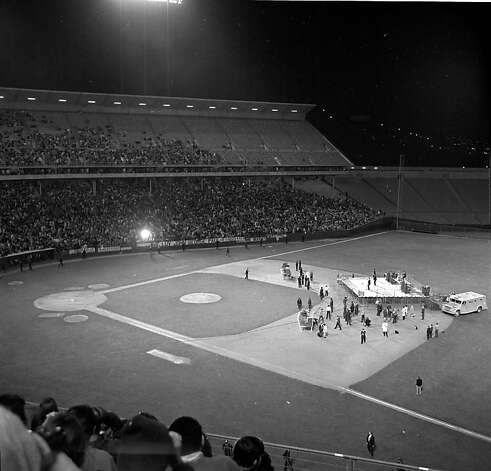
9/17/1964: Kansas City has long been a baseball town, although it was not always a Major League baseball town.  As far back as 1884 the Kansas City Cowboys played in the Union Association.  The Kansas City Monarchs proudly represented the city in the Negro Leagues with players like Buck O'Neil and Jackie Robinson.  As the 1940' turned to the 1950's cities could no longer support two teams.  Boston now belonged to the Red Sox and the Braves moved on to Milwaukee.  St.Louis now was only Cardinal territory as the Browns moved to Baltimore.  Philadelphia was no different.  The once powerful Athletics of Connie Mack were now a financial mess.  They were purchased by banker Arnold Johnson and moved to Kansas City in 1955.  Five years later, as Johnson was watching the A's spring training camp, he passed away. Enter Charles O. Finley. One of the least liked owners in the game (by commissioners, owners and players) Finley made his fortune in insurance sales.  When Johnson passed away Finley swooped in and bought the struggling franchise.  He knew the A's were not very good and he knew there had to be ways to bring fans to the stadium.  He would invent ways, some called them gimmicks, to get attention.  There was the mechanical rabbit named Harvey that popped up behind home plate to hand the new balls to the umpire.  There was the Donkey for a mascot named Charlie O (leading to the obvious joke of Finley naming a jack ass after himself).  Finley wanted to get people to the stadium and nothing in the world could draw people like the Fab Four.  The Beatles had one open date on their tour: September 17.  The tour had become a long nightmare.  Ear splitting screams.  Trains, Cars, Planes.  Hotels.  Hiding from fans.  They were all looking forward to the day off.  Finley didn't care.  The Beatles reluctantly signed on, giving up their off day.  Not only was it a work day, it was a long one.  It started with a press conference.  In proper Beatle fashion the boys gave quick, humorous answers.  When a reporter began to ask what they would do after the mania ended,  George finished his question with "after the bubble bursts?" Paul said that he and John would continue songwriting but George would go on to play basketball.  "Or roller skating.  I haven't decided yet," George continued. So why basketball and not baseball?  One reporter asked if they liked baseball.  John responded "Not particularly." Paul responded with "Ooh, very good game Mr. Finley.  Very nice."  John explained himself "only on TV."  Ringo was more direct.  "You throw the ball and then another ten minutes you smoke a cigarette then throw another ball."  Whether they liked baseball or not, they liked Kansas City enough to open up the Municipal Stadium set with "Kansas City/Hey Hey Hey".  It was followed with "You Can't Do That", "All My Loving", "She Loves You", "Things We Said Today", "Roll Over Beethoven", "Can't Buy Me Love", "If I Fell", "I Want to Hold Your Hand", "Boys", "A Hard Day's Night" and "Long Tall Sally".  The set lasted roughly thirty minutes meaning the boys were paid about $5000 per minute.


As the baseball season moved along so did the tour.  In the American League the White Sox fought the Yankees down to the wire with the Yankees narrowly winning the pennant.  In the National League the Phillies had one of the greatest collapses of all time as the Reds and Cardinals closed the gap in one of the tightest races ever.  On the tour the Beatles juggernaut was wrapping up.  They played Dallas on September 18 and New York on September 20.  Then it was back to Australia briefly before returning home to the UK.

Their 1965 tour would take them all over Europe.  Italy, Spain, Germany, France.  They would return to the United States for another concert tour and another appearance on the Ed Sullivan Show on 8/14.  The next concert would be one of their most iconic.

8/15/1965:  The Beatles had released the US version of their soundtrack for their film "Help!" the day before (the UK version had been released on 8/6) and their popularity had never been higher.  The Beatles were having every moment of their lives documented setting a new precedent for hysteria over celebrity.  A film crew followed them as they prepared for a concert at Shea Stadium.  To this point in the history of the stadium there were few positive memories.  There was Opening Day of the stadium in 1964.  Then of course there was the All Star Game in 1964.  Other than that it had only seen a lot of losing baseball by the home team.  The Mets play got more laughs than a Beatles press conference.  In their fourth season the Mets saw little improvement and just a month before the Beatles took the stage the New York icon Casey Stengel had stepped down as manager.While Stengel's legend was ending, The Beatles'  legend was about to grow.  On a hot summer New York night the band kicked off the evening with "Twist and Shout".  The set list that followed heavily reflected their recent release with songs from the soundtrack.  The set included "Everybody's Trying to Be My Baby", "Act Naturally", "Help!", "Ticket to Ride" and "Dizzy Miss Lizzy". The final song of the evening provided an iconic Beatles moment.  As Paul sang "I'm Down" John started playing the organ with his elbow causing the other members to break into hysterics.


8/20/1965: The tour continued and the traveling strain must have been tremendous.  They went to Toronto, Atlanta (still a year from getting the Braves) and Houston.  On 8/20 they played in Chicago.  The home town White Sox were on the road and were red hot.  In fact, while the Beatles were playing in Comiskey Park, the White Sox were busy in Kansas City winning their seventh straight in what would become a ten game winning streak.  The fifth place White Sox, who had finished a close second the year before, would finish the 10 game winning streak by climbing into second place but were still  6 1/2 games out of first. The team they were chasing would be the resident of the next stop for the tour.

8/21/1965:  Baseball in Minnesota was relatively new.  In 1961 The state had attracted the failing Washington Senators, a team that had not reached the post season since 1933.  Although they had left the nation's capital as a joke, they actually had a nice collection of talent.  They would not immediately compete in their new surroundings but they were building to something.  1965 was when it all came together.  The Twins took over first place in the American League on July 3 and would not relinquish the lead.  On August 21, as the Beatles played Metropolitan Stadium, the home town Twins were beating the Angels to maintain an 8 game lead over first.  A few months later, this same facility would see one of the great Game 7 pitching duels in World Series history.

The 1965 tour would wind up with stops in Portland, San Diego (still a minor league town), two nights at the Hollywood Bowl and ending in Daly City, CA.  By the time the Beatles came back to the states the attitude of fans would be drastically different.

For the next several months the group stayed close to home playing all over England and recording their next album, Rubber Soul.  The summer tour would start in England but quickly headed to Germany and Japan followed by the infamous stop in Manila.

In March of 1966 John Lennon had made a comment in an interview in London claiming that at that time the Beatles were more popular than Jesus.  The discussion was about the issues the Catholic Church in England was having with attendance at services and not about Lennon's inflated view of the band.  The discussion was taken out of context in the United States as the band prepared for their tour of the states.  In early August the southern states erupted in a fury over the interview and "Beatle Burning" parties were very popular events.  The tour went on  regardless. It kicked off on 8/12 in Chicago then on to Detroit (though they again avoided Tiger Stadium).

8/14/1966: Their next stop was Cleveland where they played at Municipal Stadium.  The Indians were in 3rd place, although at 13 games behind the league leading Baltimore Orioles they were not exactly in contention.  The Indians had been on the downward trend over the last few years and it was a slide that would continue for quite some time. While the Beatles were more popular than Jesus, the Indians were struggling for popularity in their own backyard.  The Beatles played 11 songs, none of which came from the Revolver album which had been released just a few weeks before.

8/15/1966: While the Beatles tour left Cleveland and landed in DC, the new Senators landed in Cleveland.  The Senators were a struggling team.  They had been added to the league when the original Senators left for Minnesota.  They would lose that night, something they would do 88 times that year.  The Beatles would give fans at Washington Stadium (later renamed Robert F. Kennedy Stadium) something to cheer about.  Playing a set identical to the one in Cleveland the night before the Beatles continued to thrill the young fans, although the band themselves were growing tired.  They moved on to Philadelphia where they played JFK Stadium.

8/21/1966:   The next stop for the Beatles was Crosley Field in Cincinnati.  While the Beatles were having their ears blown out by ear piercing screams, the Reds were in Houston getting blown out by the Astros. The Reds had traded their star Frank Robinson before the start of the year and the results this season were not what they expected.  The Reds sat in 6th place.  They would finish in 7th.  For the Beatles, they were focusing on an end to the tour that had become a burden to them rather than an exciting adventure.  They played the same set as they had in Cleveland and DC.

8/22/1966: It was now on to St.Louis and Busch Stadium.  It was the same set of songs.  It was the same process.  The tour was getting to be a nightmare.  The Cardinals were suffering through a nightmare season themselves.  Just two years removed from a World Series title, the Cardinals now sat in 5th place, nearly ten games out of first.

8/23/1966: From Busch it was on to New York and a return to Shea Stadium.  While the Beatles' had suffered a tumultuous year since they had last played there, the Mets' fortunes had taken a slight upturn.  Very slight.  They were still a very bad team but at least they were not in last place.  Even better, they lost less than 100 games this year.

8/28/1966: The tour moved on to Seattle on 8/25 then moved to southern California for an 8/28 stop at Dodger Stadium.  Los Angeles was the defending World Champion.  While the Beatles were ready to set up the stage in the outfield the Dodgers were engaging in a struggle with their rival, the San Francisco Giants.  The two teams were in a fierce struggle with the Pirates and were separated by only one game.  The Dodgers won that day, giving them two of the three games in the series.  The Beatles took to the stage that evening knowing that their tour was almost done.


8/29/1966: This was it.  While the Dodgers moved on to New York to play the Mets, the Giants moved on to play the Phillies in Philadelphia and the Beatles moved into Candlestick Park.  They had not told anyone yet, and had not really even discussed it as a group, but this was the end of the tour and the end of touring.  The set list was the same as it had been all tour, with one exception. the final song of the tour was "In My Life".


The Beatles would not play live in public again until January of 1969.  It would be their swan song on the rooftops of London.  The world had changed quite a bit in the time that the Beatles toured the US and so had the game of baseball.  When the Beatles came to the US the Yankees were the dominant team.  By the time they were done touring the Orioles and Cardinals were on their way to a league domination and the Yankees were headed into one of the darkest periods of their history.


TRIVIA QUESTION:
As the great American game, the majority of players in Major League Baseball history were born in the United States (nearly 88%).  How many players in MLB history were born in the UK?

Answer to Last Week's Question:
Congratulations to TJD for answering last week's trivia question.
A.L. East: Red Sox (71-91)
AL: Central:Twins (70-92)
A.L. West:Rangers (67-95)
N.L. East:Phillies (73-89)
N.L. Central:Cubs (73-89)
N.L. West: Diamondbacks (64-98)

Sunday, February 17, 2013

Catfish: The Birth of Free Agency and the Rebirth of the Yankees

Catfish
Music & Lyrics by: Bob Dylan
Performed by: Bob Dylan
Originally recorded:  1976

Lazy stadium night
Catfish on the mound.
"Strike three," the umpire said,
Batter have to go back and sit down.

Catfish, million-dollar-man,
Nobody can throw the ball like Catfish can.


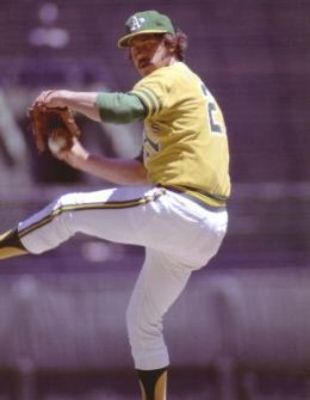
Baseball arrived in California in the late 1950's.  Just a few years after Walt Disney had been told he was throwing his money away by building a theme park based on characters from children's movies, now Walter O'Malley of the Dodgers and Horace Stoneham of the Giants were being told they were destroying their teams by moving them to California when no other team was west of Missouri.  They all ignored the critics and they all were right.  Stoneham and O'Malley not only succeeded, they inspired the American League to move west as well.  It started just a few years later with the expansion franchise, the Los Angeles Angels.  The problem was the American League now had only one team on the west coast and no one else west of Kansas City.  It made traveling logistics a nightmare.  Enter Charles Finley, owner of the Kansas City Athletics.  He saw an opportunity to get out of the empty stadium in Kansas City and bask in the California sun.  Just as the Angels were dropped into the Dodgers' Southern California market as direct competition, Finley moved into the Giants northern California neighborhood as direct competition in 1968.  There was only one problem.  Oakland was not a baseball town.  Football, hell yes.  Al Davis had that market wrapped up tight. But baseball?  The Athletics?  They hadn't been relevant since the 1930's in Philadelphia.  No one came out to watch the games.  They would be sorry.  Finley was growing something and it would soon blossom beautifully in an ugly stadium.  The Athletics in Kansas City were terrible but their last team there was young and inexperienced.  This team was growing up together, learning together, learning to play together, learning to fight together and learning to fight each other.  The 1968 Athletics, the first in Oakland, featured a little used player named Tony LaRussa, as well as two catchers named Dave Duncan and Rene Lacheman (both would be coaches for Tony LaRussa throughout his managerial career in Chicago, Oakland and St. Louis. ) It also featured some young talent like Bert Campaneris, Sal Bando, Joe Rudi, Rick Monday, Dick Green and a powerful 22 year old Outfielder named Reggie Jackson.  Playing in the Oakland Coliseum was tough.  It was a gigantic stadium.  The biggest problem with a gigantic stadium is that it looks even bigger when most of the seats are empty.  It was so empty, quiet, almost peaceful on any given night that the A's players modified the Coliseum to the Mausoleum.  The A's did transplant one All Star with them from Kansas City to Oakland:  James Augustus Hunter.  No one called him James, or even Jim, anymore.  They all called him Catfish.  1968 was the year of the pitcher with Denny McLain winning 30 games for the eventual World Series Champion Tigers and Bob Gibson dominating (that's an understatement) the National League batters.  Yet it was fairly widely accepted that no one could quite throw the ball like Catfish.  He took the mound on May 8, 1968 and the place was dead, as usual.  He could relax and just pitch.  It wasn't like the crowd would notice anyways.  There was only 6,298 people there to watch.  Most of them were probably given tickets or were family members of players.  This was the Athletics and the Twins.  Some might have joked that it was barely Major League Baseball (although these Twins would win the first two American League West division titles when the league went to division play starting in 1969).  Catfish opened the game with his, easy, lazy pitching motion.  It sometimes was hard to tell if you were watching him warm up, pitch batting practice or actually facing a real batter.  Hunter started off facing Cesar Tovar, Rod Carew (Hall of Fame) and Harmon Killebrew (Hall of Fame).  It was an easy inning.  Next inning was Tony Oliva, Ted Uhlander and Bob Allison.  Another easy inning.  Third inning was Jackie Hernandez, Bruce Look and Dave Boswell.  Three more easy outs.  He went through the whole lineup a second time.  Nine Batters. 4 strikeouts, 3 flyballs and 2 groundballs.  Six perfect innings.  The 7th and 8th came and went.  6 batters:  4 more flyballs, 1 more groundball and 1 more strikeout.  No walks, no hits, no errors, no nothing for the Twins.  Now the 9th inning. The funny thing about perfect games is that at the end the pitcher is facing the bottom of the lineup, usually the weak hitters who didn't scare him before the game started.  Now those last three hitters are the ones that are making the pitcher break into a cold sweat.  The A's were up 4-0.  John Roseboro pinch hit for Jackie Hernandez.  No problem for Hunter.  Ground ball.  1 out.  Two more to go.  Next up was Look and apparently that was all he did.  He struckout looking at strike three.  One more out.  Hunter had to face Rich Reese, pinch hitting in the pitcher spot.  He did the same as Look.  He struckout looking.  A perfect game for Catfish and the A's had their first identifiable moment in Oakland.  Too bad there was no one there to see it. 

Used to work on Mr. Finley's farm
But the old man wouldn't pay
So he packed his glove and took his arm
An' one day he just ran away.
Catfish, million-dollar-man,
Nobody can throw the ball like Catfish can.


Charles Finley was not well liked by the other owners.  He was not well liked by the commissioner.  He was not well liked by his managers and he was not well liked by his players.  Most owners were "gentlemen" who had the best interest of the game at heart.  They were interested in promoting the sport, not in promoting novelties.  Finley didn't care.  He had to find ways to get people into the stadium.  When his operations were still in Kansas City, Finley begged the Beatles to play in Kansas City during their 1964 tour.  The problem was they only had one open date and it was scheduled for a vacation to New Orleans.  Finley was insistent and paid $150,000 for them to appear.  No one had made that much for one concert before.  Coincidence or not, the next album, Beatles For Sale, included a recording of a song the Beatles had performed for years (and McCartney still performs) called Kansas City/Hey, Hey, Hey.  Finley's extravagance was worth it.  At the height of Beatlemania the stadium was overflowing.  He did other things that were not so well accepted by the baseball establishment.  He replaced the traditional White Elephant logo of the Connie Mack years with a live donkey named Charley O (makes you wonder if he realized he was naming a jack ass after himself). After the year of the pitcher in 1968 he argued for more offense in the sport  (ironic considering the size of his own stadium stifled offense). He argued for the introduction of bright orange  or gold colored balls to make it easier for  hitters to see the pitch.  He argued for replacing the pitcher's spot in the lineup with a player being designated as only a hitter, not a position player, in the lineup.  The designated hitter was born.  His crazy ideas were not only spread to the league as a whole, he tried to find ways to draw attention to the A's.  He installed a mechanical rabbit named Harvey that popped up behind the plate to present the umpires with a fresh set of baseballs when needed.  The traditional blue and white Athletics uniforms of Jimmie Foxx, Mickey Cochrane, Al Simmons, Lefty Grove and Bob Johnson were transformed into gaudy canary yellow and kelly green.  He paid bonuses to his players for growing unique mustaches, the winner clearly was Rollie Fingers.  The A's grew into the best team of the early 1970's.  As the league went to division play the A's dominated the west winning the division in 1971, 1972, 1973, 1974 and 1975 and winning the World Series in 1972, 1973 and 1974.  Usually players are happy when they win.  Not in Oakland.  It was the most miserable dynasty in baseball history.  Finley was not only known for his crazy ideas he was known for being cheap.  The team had won three World Series and were paid less than teams who had not been competitive for over a decade.   Hunter's contract was for $100,000, although it had a deferment clause.  He would receive $50,000 pay and the other $50,000 would be invested as Hunter specified. As a father Hunter wanted to invest in his children's education so he told Finley after the 1974 season to put the $50,000 into a college fund.  When Finley learned that he could not write off the deferred payment as he originally thought he handed Hunter a $50,000 check.  Hunter was smart and so were his lawyers.  when Hunter returned the check with instructions to immediately deposit the amount in an annuity, Finley returned the check again.  Wasn't $50,000 the same regardless of how it got there?  Not to Hunter's tax lawyers.  Finley refused to follow the directions and Hunter sued for breach of contract.  He won.  The court declared that Finley had failed to live up to his end of the contract and therefore the contract was voided.  The reserve clause in the contract did not apply because the contract did not exist anymore.  James Augustus Catfish Hunter, the 1974 Cy Young Award winner (25-12, 2.39 ERA and 6 Shutouts) became what the owners had long feared:  the first free agent in the history of baseball.  Everyone wanted this guy because it was clear that no one could throw the ball like Catfish Hunter.

Come up where the Yankees are,
Dress up in a pinstripe suit,
Smoke a custom-made cigar,
Wear an alligator boot.
Catfish, million-dollar-man,
Nobody can throw the ball like Catfish can.


This was unheard of in any sport.  An established star, at the absolute apex of his prime, with seemingly unlimited potential, available for any team without having to give something equal back to the competition.  Until now the only way to get a player of this caliber was through a trade.  Usually to get this type of player you had to give your direct competition an equally great player or some pretty amazing prospects.  Now, everything had changed.  Instead of a player begging the owners to give him a raise, the owners were lining up to beg the player to take their money.  Every team threw money at him.  Even the Padres offered to break the bank for him.  Hell, Ray Kroc offered to not only make him the highest paid player in the history of sports, but to give him a chain of McDonald's franchises.  The Red Sox, Orioles, Royals and Dodgers all tried to sign him.  Hunter still assumed that Finley would make an offer and he would end up back in Oakland.  It still had not sunk in that he could actually choose where he wanted to go.  His lawyers set up meetings in their North Carolina offices and the small town was overrun by baseball executives seemingly throwing money at Hunter.  The Red Sox thought they had the inside track, even having Ted Williams call Catfish to tell him how much he would like playing in Boston.  One team had something that no one else had:  Clyde Kluttz.  Clyde had played in the majors for ten years, well played may be a stretch.  He spent a lot of time on the bench.  Between 1942 and 1952 he played in less than 700 games and played for five teams (including the Browns twice).  After his final year in the big leagues Kluttz became a scout for the Kansas City Athletics and discovered Jim Hunter at a high school in North Carolina.  Kluttz signed him to his first contract.  Years later, working for the Yankees, Kluttz had the chance to bottle lighting twice.  The Yankees had been flat out bad since 1964, one of the truly dark periods of the franchise, but they were building a nice team.  They had young talent in the system with Thurman Munson, Roy White and a young pitcher coming up named Ron Guidry.  It was not a tremendous collection of talent but the new Yankees owner was certainly willing to spend the money necessary to bring glory back to the pinstripes.  Kluttz talked to Hunter and convinced him that the Yankees were a good fit.  The money didn't hurt.  It was a five year contract for $3.75 Million.  It was the start of a new baseball world and not all of the owners were looking forward to it.  Almost immediately players were trying to find loopholes in their contracts, clauses that would allow them to do what Catfish did.  Few succeded. 
 
Carolina born and bred,
Love to hunt the little quail.
Got a hundred-acre spread,
Got some huntin' dogs for sale.
Catfish, million-dollar-man,
Nobody can throw the ball like Catfish can.


Finley wanted his team to have character and characters.  He encouraged the mustache brigade, loved the spectacle of the clashing uniform colors and also developed an entire (fake) back story for one of his players from North Carolina.  The story was that this player, as a backwoods kid growing up in the south, ran away with a fishing pole one day and returned with two catfish under his arms.  From then on he was known as Catfish Hunter.  Problem was, Hunter was no dumb backwoods hick.  He was an intelligent, well spoken, polite and well liked young man. Anyone who met him knew immediately that Catfish didn't quite fit the personality but by that time the name had stuck.  Sure, he loved to go hunting, he often went with his brothers and several times invited Clyde Kluttz to go as well.  Before his 1964 rookie season one of his brothers accidentally discharged a rifle taking part of Jim's foot with it.  It was feared his career was over before it had started.  He proved it was not. 

Reggie Jackson at the plate
Seein' nothin' but the curve,
Swing too early or too late
Got to eat what Catfish serve.
Catfish, million-dollar-man,
Nobody can throw the ball like Catfish can.


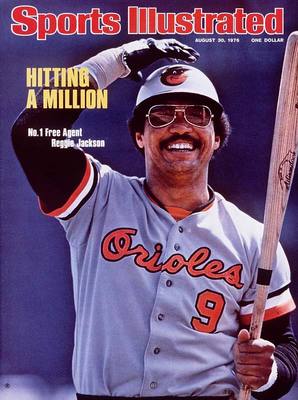
As Bob Dylan prepared material for what was his 1976 Desire album, released during one of his best creative periods, Reggie Jackson was looking for a way out of his Oakland contract.  Jackson was easily the best hitter in the American League at the time and was the lynch pin of the Oakland offense.  everything that happened centered around Reggie.  The problem was that Reggie seemed to always be at odds with everyone.  He and Mike Epstein had a clubhouse fight, not an argument, an actual fight with punches and everything.  After the 1973 season he told his owner he wanted a raise or he wouldn't play in  1974.  Finley was furious but Jackson, MVP of the regular season and the World Series, was irreplaceable.  He made himself intolerable to Finley and he got himself traded to Baltimore.  He didn't want to go to Baltimore so the Orioles made a deal with him.  Play for one year in Baltimore and then you can go where you want.  Earl Weaver was sure that one year in the winning environment of the Orioles would convince Reggie to stay.  Reggie couldn't buy into the team philosophy of the Oriole Way.  After a tumultuous 1976 season Reggie was ready to go. The Yankees were looking for help to get over the hump on the uphill journey to the summit of a championship.  They had made the World Series in 1976, thanks greatly to Catfish Hunter and Thurman Munson, but were swept out by the Big Red Machine.  Billy Martin wanted some offensive help to finally win it.  He wanted someone used to winning and set his sights on a member of the A's winning formula to team up with Hunter again.  He set his sights on Joe Rudi.  The Yankees management wanted Jackson.  "I don't want him I want Joe Rudi."  Martin told them.  He got Reggie.  Someone once said of Leo Durocher that he "had a habit of making a bad situation worse".  Jackson some how, intentionally or not, did the same in New York.  Unfortunately Billy Martin had the same character issue.  Immediately upon signing with the Yankees he gave an interview to Sport magazine.  His comments were probably not intended to disturb the team but nearly all of the Yankee players, especially Munson, took offense and the relationship started badly.  It got worse.  The Yankees won the 1977 World Series but no one could stand Reggie.  Munson refused to shake his hand after a home run, a very visible public snub.  In 1978 Martin replaced Reggie in the field in the middle of an inning in a game known as "the Boston massacre".  On national television Reggie went after Billy in the dugout.  They were separated by players and coaches but it was getting ugly.  Billy and Reggie were constantly at odds.  (As has happened in the past, there is way too much information here for a short synopsis. Check back for future detailed posts about the Yankees 1970's dynasty, the early years of the Steinbrenner era).

Even Billy Martin grins
When the Fish is in the game.
Every season twenty wins
Gonna make the Hall of Fame.
Catfish, million-dollar-man,
Nobody can throw the ball like Catfish can.


Bob Dylan may have used some poetic exaggeration to make his point in Catfish (much as he did in classic songs like The Lonesome Death of Hattie Carroll and Hurricane) when he sang "every season twenty wins".  Catfish's first year in the league was 1965.  He went 8-8.  That was followed by records of 9-11, 13-17 and 13-13 (the first year in Oakland) and 12-15.  The records are not very impressive but wins and losses do not always define how you have pitched.  Catfish was a special talent but, much like Felix Hernandez in Seattle, he was pitching for a very poor team that did not win many games overall.  As the A's improved so did Hunter's win-loss ratio. In 1970 the A's were competitive and Catfish won 18.  As Oakland went on their run of championships (starting in 1971 through 1974, Hunter's last one in Oakland) Catfish never won less than 21 and finished in the top five in Cy Young voting each year.  His first season in New York was amazing.  He won 23 and finished second in the Cy Young voting.  It was all down hill from there.  Dealing with shoulder issues, elbow issues and other health issues including symptoms of diabetes, the win totals started to drop.    He was still good in 1976 as his 17-15 record helped the Yankees to their first World Series appearance since 1964 but the wins dropped to 9 in 1977.  He was 12-6 in 1978 as the Yankees won their second straight World Series but 1979 was a horrendous 2-9 with a career worst 5.31 ERA.  His health issues had finally caught up with him and Hunter retired with a career 224-166 record and 3.24 ERA.  On top of that he was a five time World Series Champion and Cy Young Award winner.  In 1987 Catfish Hunter was elected to the Hall of Fame along with long time Chicago Cub Billy Williams.  In 1998 Hunter was diagnosed with ALS (commonly known as Lou Gehrig's Disease).  In September of 1999 Hunter fell down a flight of stairs in his house and passed away shortly after.  Hunter's legacy lives on in the Jim "Catfish" Hunter ALS foundation and the A's annually give out a "Catfish Hunter award" to the member of their team "whose play on the field and conduct in the clubhouse most exemplifies the courageous, competitive and inspirational spirit demonstrated by the late Hall of Fame pitcher Jim "Catfish" Hunter".