Showing posts with label Joe Adcock. Show all posts

Saturday, October 18, 2014

Almost a Dynasty: 1950's Braves

What actually makes a sports dynasty?  Obviously a team needs to be successful for a continuous amount of time.  Every sport has that one iconic dynasty that fits the Dynasty category.  The NBA had the Boston Celtics who won nine out of ten championships.  The Montreal Canadiens won 7 of nine Stanley Cups (including six straight).  The NFL had several dynasties including the 49'ers, the Steelers, the Cowboys and, most recently, the Patriots.  Baseball itself has had the Yankees dynasties in several incarnations including the 1930's, 1950's and 2000's.

So what actually makes a team a dynasty?  There can of course be several definitions since there are varying levels of success.  A team can dominate their division for a decade but be bounced out in the first round of the playoffs year after year.  We could of course consider that to be a divisional dynasty but you wouldn't call it an overall baseball dynasty.  So let us set the parameters for this series of articles.  A dynasty, for our purposes here, is a team that wins multiple World Series championships (above two as back to back is nice but not a dynasty) within a 5-10 year period.  That being defined, this series will explore those teams that may have been a divisional or league dynasty but for whatever reason could not get over the hump to that World Series dynasty.

This series will show an array of near dynasties.  Some are teams that made the World Series year after year but fell short.  Others will be teams that competed right down to the end of the regular season year after year just to be beaten out.  It will be a series of near misses and what could have beens.

Don't miss the other almost dynasty articles: The Detroit Tigers of the 1900's, The Chicago White Sox of the 1910's and the Pittsburgh Pirates of the 1920's, the Boston Red Sox of the 1940s and the Brooklyn Dodgers of the 1950s.  Now let's get started with this weeks "almost dynasty": The Milwaukee Braves of the 1950's.

Picking Up Stakes:
Boston had not been particularly kind to the Braves organization.  They had won a World Series in 1914 which was forever referred to as a "Miracle" implying the team could not possibly have actually achieved it without divine intervention.  Then there was the 1948 team that won a National League pennant but even then there was the derogatory refrain of "Spahn and Sain then pray for rain".  Again, the baseball world made it sound like the team could only win if one of two pitchers were on the mound.  Of course, sharing a city with the Red Sox is difficult.  The Sox may have had a long drought of World Series titles themselves, but they at least had a history of  winning before the drought.


Braves owner Lou Perini saw that his team was just an afterthought in his own town so after seeing that even reaching the World Series in 1948 still did little to help his bottom line he started looking for options.  Just four years after the World Series loss to Cleveland Perini did the unthinkable.  He moved a Major League Baseball team out of their original city.  The Boston Braves, members of the National League since 1876, became the Milwaukee Braves.

The Core Players:
Just as we saw with the Dodgers of the 1950's, there were key players at the heart of the Braves "almost dynasty" and just as with the Dodgers there were eight of them:

Del Crandall:  Del Crandall was the catcher for the Braves almost dynasty.  He signed with the Braves in 1948, too late to be part of the World Series team, and he missed the 1951 and 1952 seasons serving in the Korean War.  He returned to the states and joined the Braves organization in Milwaukee.  Crandall was an 8 time All Star.

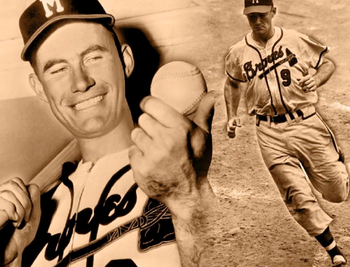
Joe Adcock
Joe Adcock entered the league as a rookie with the Cincinnati Reds in 1950.  The Braves picked up the First Baseman in a complicated four team trade including the Braves, Phillies, Reds and Dodgers.  He would be the key First Baseman in the "almost dynasty" although he would share time with Frank Torre.

Johnny Logan
Logan was the key middle infielder in the Braves "almost dynasty".  He was one of the few key players who came with the team from Boston.

Eddie Mathews
Mathews was the big boy in the lineup.  Although Aaron would come to be known as the "Home Run King", Mathews was the one known for slugging.  His achilles heel as the Third Baseman was his defense.


Henry Aaron
The last of the core group to join the team, he may have been the most important.  He joined the Braves in 1953 and finished 4th in the Rookie of the Year voting.  Aaron was originally a Short Stop but was converted to an outfielder.  He would be an All Star 21 times, win a batting title and set the career Home Run record.

Andy Pafko
Pafko was a veteran by the time he had come to the Braves in 1953.  Pafko was a leader by example.  He had already been a part of the Brooklyn "almost dynasty" and had watched helplessly as Bobby Thomson's Home Run sank Ralph Branca.

Warren Spahn
Spahnie, as he was known, was the ace of the Braves staff.  He was one of the top pitchers in the game and would be the face of the franchise.  Spahnie was one of a few stars from the 1948 World Series team that made the move to Milwaukee.

Lew Burdette:
Burdette started his career as a Yankee in 1950.  In 1951 he was traded to the Braves for the man who had become Spahn's partner.  Spahn and Sain were like Ruth and Gehrig.  Like Foxx and Simmons.  Like Tinker, Evers and Chance.  Replacing Sain was no easy task but Burdette would more than live up to the challenge.

Climbing from the Bottom:
The Braves left Boston and settled in Milwaukee in 1953.  The 1952 version of the Braves, the last season in Beantown, was a 7th place finish with a 64-89 record.  The people in Milwaukee seemed genuinely excited about the possibility of having a major league team and the support the team received felt almost in complete contrast to the situation the team had left.  The team reflected their new attitude and new hometown energy by climbing to second place.  1953 was, of course, the year the Dodgers ran away with the pennant.  The Braves finished a proud, but distant, second place, 13 games behind the top spot.  During the off season the Braves pulled off a big trade with the Giants that landed them a legend, Bobby Thomson.  Having picked up Pafko the winter before the Braves now had two of the men directly involved in the infamous Dodgers-Giants moment.

The 1954 Braves went 89-65 and fell one spot to third place behind the Dodgers and the eventual World Series champion Giants.  They stumbled to start the season and had fallen as low as 7th.  They fought back and reached second place in early September, just 4 games behind the leaders.  They of course looked for better but the hopes for the next season were even higher.

The 1955 edition started strong at 7-3 but the red hot Dodgers already had a 3 game lead.  Milwaukee cooled off over the next few weeks and the competition pushed them back as far as 5th.  That slow period would haunt them.  While they were able to recover and climb to second they were not able to catch the Dodgers.  Still, the confidence was growing.  Finishing in the top 3 of the league three years in a row, with the improvement of the young Aaron and Mathews as a 1-2 punch, the Braves were even more confident for the 1956 season.

The One That Got Away:
On June 1, generally considered the point where you can tell the contenders from the pretenders in the regular season, Milwaukee entered play in first place, one game ahead.  They lost June 1 but so did the competition.  They lost June 2 and fell into a tie.  They split a June 3 double header to remain tied.  They would lose another three straight to fall to fifth.  It was almost as though the calendar had finally woken up, given a big stretch, shuffling everything in the process and realized the Braves were not supposed to be that high.  On June 16 they lost 3-2 to the Dodgers to fall 3 1/2 games out of first.  They were in 5th place but they were only a good week away from jumping up to the top.  They quickly turned it around and won 11 straight, ending that streak two games ahead of the second place Dodgers.  It was a nice recovery but the season was far from over.

The Braves fought through August as the Dodgers struggled.  By mid August they were in first.  By September 3rd they were 3 1/2 games ahead.  The lead would not last.  Riding the arms of Spahn and Burdette the Braves fought to hold off the Dodgers.  Brooklyn, riding the late season acquisition of Sal Maglie, was charging hard.  With a chance to make some progress the Braves faced off against the Reds (who were surprising people in close third) and the last place Cubs.  Win both series and they would possibly gain ground.  Instead they went 1-3 against the Reds and split with the Cubs.  That was immediately followed by a split series with the Dodgers.  On September 15 the Braves and Dodgers were tied.  The next week saw the teams jockey back and forth, neither getting the upper hand for long.

On September 21 they were tied again. There was just  seven games left to go.  The Braves would face the Cubs and Cardinals with one make up game against the Reds.  They went 2-1 against the Cubs but the Dodgers kept pace and remained tied.  The Braves won the make up game giving them a half game lead on the idle Dodgers.  They lost the first game of the Cardinals series but remained one half game up on the Dodgers.  There were only two games left for the Braves and three for the Dodgers.  The Braves just needed to beat the Cardinals and they would be World Series bound.  The Dodgers won a double header on September 29.  If the Braves could win their game that day they would be tied at worst.


The Braves had Warren Spahn on the mound and all the confidence in the world. When Bill Bruton hit a first inning solo Home Run the Braves dugout erupted. Smiles all around.  They tried but could not add to the lead.  In the 6th the Cardinals struck back with back to back doubles scoring a single run.  The Braves had a runner on base in 6 of the next 8 innings but never truly threatened. Spahn remained tough and the game went into extras.  The bottom of the 11th looked like the Braves would make some noise.  After a fly ball to start the inning, Aaron singled and Matthews walked.  With Joe Adcock and Bobby Thompson due up a base hit seemed inevitable.  Adcock grounded to Third Base.  Aaron was able to reach third but Matthews was forced at second. All they needed was for the man who had shocked the Dodgers in 1951 to reach back for some more magic.  He made contact and the ball shot towards short.  Aaron ran down the line  toward home plate and the run that would clinch the pennant but Cardinals Shortstop Al Dark fielded the ball and threw to first to retire the side.  The Cardinals did not score in the bottom of the inning.  The Braves failed to score in the 12th.  In the bottom of the inning, with Warren Spahn in his 12th inning of work for the day,the Braves retired Al Dark to start the inning.  Stan Musial doubled and the Braves walked Ken Boyer putting men at first and second with one out.  Up to the plate stepped Rip Repulski.  He laced a double to score Musial and sink the Braves to second place with one to play.    The best they could hope for was a tie.  The Braves won on the final day of the season putting the pressure on the Dodgers.  Who said Don Newcombe  couldn't win a  big game?  He won on the last day of the season to send the defending World Champion Dodgers back to the World Series and the Braves home to think about the missed opportunities.

Score One for Bushville:
The Braves were angry about the way the season had ended the year before.  They took that anger out on the rest of the league.  They started by winning 5 straight before losing an extra inning game to the Cubs.  They won the next four putting them at 9-1.   After 14 games they were 12-2.  Just over two weeks into the year and the Cubs were already 9 games out of first in last place.  Normally 12-2 would give a team a confident lead.  Instead the Dodgers kept place and despite the hot start the lead was only 2 1/2.  By mid May the lead had disappeared but it was the Reds who sat atop the league with the Braves.  By the start of June, the Reds had jumped out to a 3 1/2 game lead.  While the Dodgers organization fought the city of Brooklyn, the Braves fought the Reds.  It seemed unfair that the Braves had fought the Dodgers so hard the last few years and the Reds were stealing what the Braves had rightfully worked for.

As June moved through July the Reds came back to the pack but the Cardinals had stolen the top perch.  The Braves had fallen 3 1/2 behind them.  If something was going to happen the team would need a jump start.  They got it in the form of a scrappy veteran second baseman.  Red Schoendienst had been a key part of the Cardinals 1940s dynasty but his best days were considered past him and he had spent the last few years with the Giants.  On June 15 the team sent Ray Crone, Danny O'Connell and Bobby Thompson to the Giants (Thompson was going home again) and in return received Red Schoendienst.  At one time it could not have been viewed as a blockbuster deal but now was more of a swap of over the hill players.  Instead Schoendienst infused the team with life.  They started August tied for first and after briefly falling one game back they took off again winning 11 of 12 to build an 8 game lead.  The Cardinals put a brief scare in the team by cutting the lead to 2 1/2 on September 15 but the Braves recovered with little effort and won another 8 straight.  They won the NL by 8 games.

Their opponent was the big bad actual dynasty of the New York Yankees.  While the city of Milwaukee was new to this baseball thing, New York was almost blase about the World Series.  It seemed to many in the big apple that the real season didn't start until October.  Many in New York didn't take the Braves seriously.  Casey Stengel, who had played minor league ball in Milwaukee in his younger years, called the city Bushville.  That was enough to get the Braves fighting mad.  To be truthful few gave the Braves a chance and when the Yankees won Game 1 and Game 3 to take a 2-1 series lead New York felt their 1956 World Series title would soon have a twin.  The Game 3 Yankee win was a convincing display of the mighty dynastic power, a 12-3 beating with two Home Runs by Tony Kubek and one by Mickey Mantle.  To have any chance the Braves would need to show the same fight they had shown to overtake the Reds, Dodgers and Cardinals.

Game 4 started poorly.  2 hits and a walk for the Yankees led to a 1 run lead and near heart failure for Braves fans.  The Braves fought back in the 4th.  Johnny Logan walked.  Eddie Matthews doubled and up to the plate strode Hank Aaron.  No one yet considered Aaron a challenge to Babe Ruth,  That would not come for another decade.  Although Henry had blossomed over the last two years.  He won the 1956 batting title and had led the league this season with 44 Home Runs.  He gave the Braves the lead with a three run Home Run. Two batters later Frank Torre hit a solo Home Run to make it a 4 run inning and a 4-1 lead.  They took that lead into the top of the 9th and the Series looked like it would be tied.  With two out Yogi Berra hit a harmless single.  That was followed by a single by Gil McDougald.  The harmless singles were not so harmless when Elston Howard hit a Home Run to tie the game and suddenly everything started over.  In the top of the 10th things looked worse when a Hank Bauer RBI triple gave the Yankees a lead.  In the bottom of the 10th Nippy Jones pinch hit for Spahn and led off by getting hit by a pitch.  He advanced on a sac bunt by Schoendienst and scored to tie the game on a Johnny Logan double.  With Logan in scoring position all Eddie Mathews had to do was hit the ball safely.  He did just that.  He hit the ball into Right Field where no one could get to it.  It was a 10th inning walk off Home Run to tie the series and now Milwaukee truly believed.

Game 5 was crucial.  Every player knew it.  The winner had the advantage.  The Yankees put runners on base in each of the first 4 innings but double plays helped erase them.  The Braves had put runners on in 3 of the first 5 innings but couldn't truly threaten.  This was a great pitching duel.  Burdette vs Whitey Ford.  The bottom of the 6th started like the others had with Ford retiring the first two.  Eddie Mathews, not known for his speed, hit a ground ball to second but beat it out.  Aaron followed that with a single.  This was the first real threat.  Adcock followed that with another single and Eddie Mathews scored from second giving Burdette a 1-0 lead.  Burdette was spectacular the rest of the way and the Braves took a series lead moving them one game from the ultimate goal.

With a chance to close it out the Braves sent Bob Buhl to the mound to face Bob Turley.  Buhl was gone after 2 2/3 and the Yankees up 2-0 on a Berra 2 run Home Run.  Ernie Johnson came on and quieted the Yankees while Aaron and Torre hit solo shots to tie it up in the 7th.  Braves fans sat on edge.  Could this be the year?  Could this be the game that won it?  The feeling lasted less than an inning when Hank Bauer, one of the greatest clutch hitters of all time, hit a solo Home Run to give the Yankees the lead and eventually the game.

So it all came down to this.  Game 7. In New York.  In Yankee Stadium.  The site of so many Yankee legends hoisting the trophy over vanquished foes.  Ruth.  Gehrig.  DiMaggio.  Now Bauer, Berra and Mantle.  The Yankees sent Don Larsen to the mound, the man who had shut down the Dodgers powerful lineup just a year before.  He would face Lew Burdette with Warren Spahn set to pitch in if needed.  Larsen was perfect through one inning.  Burdette was not, giving up a lead off double to Bauer and an intentional walk to Berra before escaping trouble.  Larsen lost his chance at another perfect game with the first batter of the second when Aaron singled.  He moved to second when Torre walked but they both stopped there.  Burdette was perfect in the bottom second and it looked like another pitcher's duel.  The tension was amazing.  The Yankees fans, confident after so many titles, had only to cast their memories back two short years to recall losing a Game 7 to the Dodgers.  Braves fans were praying for a win to show New York they were no longer a minor league town.  A one out single in the top of the 3rd appeared harmless when Logan grounded a double play ball to Tony Kubek but a wild throw to second gave the Braves a second life.  They took full advantage.  Matthews doubled to right scoring both runners and Larsen was gone.  Aaron greeted Bobby Shantz with a single scoring Matthews.  Before the inning was over it was 4-0 Braves.  There was still a long way to go but Burdette was again amazing.  He shut down the Yankees' powerful bats and the Braves added another run on a solo Home Run by Del Crandall.
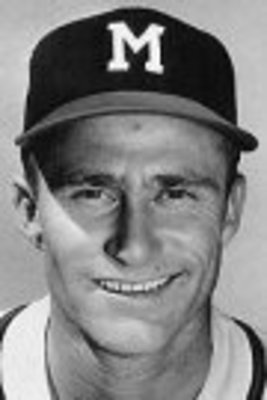


The Braves were now World Champions!

Defending the Title:
The Braves felt confident entering the 1958 season.  They were, after all, defending World Champions.  The league had changed drastically over the winter.  The Dodgers and Giants were now on the west coast.  Roy Campanella was paralyzed after a car accident and Jackie Robinson was retired.  The Dodgers sank to the bottom half of the league but the Giants stayed tough.  On June 10 the Giants were 1/2 game ahead of the Braves with those pesky Reds just behind.  The Braves would build a 3 1/2 game lead but a five game losing streak put them back into a tie with the Giants.  As hard as they tried they could not shake the Giants and on July 29 they trailed by 1/2 game.  It would be the last day they would spend out of first place.  They won the league by 8 games setting up a rematch with an angry Yankees team seeking to prove they were still the dynasty in the game.

It started as the exact opposite of the previous year.  The Braves led the series 2-1 after three games and in Game 2 they had crushed the Yankees 13-5 behind Burdette, who even hit a Home Run to help his own cause.  When Spahn shut out the Yankees 3-0 in Game 4 to give the Braves a 3-1 series lead they needed just one more win out of three remaining games (including two at home) to win their second title and establish a chance for a true dynasty.  With three chances to win one game, with Spahn and Burdette and  with two home games it looked bleak for the Yankees and all wrapped up for the Braves.

There's a reason you play these games even when it appears to be all over.

Burdette started Game 5 and Braves fans were sure this would be their day.  He retired 9 of the first 10 batters.  The one he didn't retire was Gil McDougald who led off the third with a Home Run.  No worries for Braves fans.  They still had Aaron, Adcock and Matthews.  And if they couldn't do it there was Crandall, Wes Covington, Torre and Logan.  It remained 1-0 into the 6th.  Bauer led off with a single but Burdette got Jerry Lumpe, who failed on a sac bunt attempt, for the first out.  Mantle singled sending Bauer to third.  Berra then doubled sending Mantle and Bauer home.  Before the inning was over the Yankees had scored 6 runs and chased Burdette.  They won 7-0.

No worries.  "We wanted to win at home anyways." said delusional Braves fans.  With Spahn on the mound for Game 6 they were a confident bunch.  Hank Bauer got to Spahn for a Home Run in the first but Aaron answered in the bottom.  Yankee ace Whitey Ford was chased in the bottom of the second.  Three straight singles and a walk gave the Braves a 2-1 lead with the bases loaded and one out.  With Logan, Schoendienst, Matthews and Aaron set to come up next Braves fans started counting their trophies.  Logan hit a fly all to Left Field and as quickly as the Braves fans counted to two the Yankees fans did the same.  In left field Elston Howard settled under the ball as Andy Pafko tagged up at third.  When Howard caught the ball Pafko took off and Howard threw home.  Pafko was out and the double play ended the inning.  Still, with Spahn on the mound and Ford having been demoralized the Braves were confident.  The Yankees tied it in the top of the 6th with a Berra sac fly and all of a sudden it was still in doubt.  In the top of the 10th Gil McDougald led off with a Home Run.  After two outs Howard and Berra singled and Howard scored on a Moose Skowron single giving the Yankees a two run lead.  This Braves team did not quit.  Logan walked with one out.  He scored on a two out Aaron single and Adcock singled sending Aaron to third.  One base hit and they were tied.  Frank Torre stepped in as the pinch hitter and lined a shot towards second.  Braves fans were loud but it got quiet quick as the line drive was caught.  See you tomorrow for Game 7.

The Braves scored first in the deciding game but the Yankees took a 2-1 lead in the second.  The Braves tied it at 2 in the sixth.  This would be another nail biter but with Burdette on the mound the Braves were positive they would prevail.  Turley got Burdette, Schoendienst and Bill Bruton on ground balls to close the 7th still tied at 2.  Burdette went back out to the mound with the whole world on his shoulders, just how he liked it.  McDougald flew out.  Mantle struck out looking and with Torre, Aaron  and Wes Covington due up next for the Braves there were no real worries until Berra doubled to right.  Howard followed with an RBI single.  Andy Carey singled to third and Moose Skowron launched a three run Home Run giving the Yankees a 6-2 lead.  It was again the opposite of 1957 and the Braves chance to take a giant step toward a dynasty took a giant step back.

Planting the Flag on the West Coast:
In retrospect we can see the 1959 season as one that would show a trend toward a major change at the top of the National League.  The Braves started off hot.  25-15 through their first 40 games was good enough for a 3 game lead. The newly transplanted Giants and Dodgers were close behind and the surprising Pirates were hanging tough.  The Braves played well through May and June.  They weren't red hot and didn't run off any tremendous win streaks but they also kept the losing streaks to two or an occasional three.  It was not good enough and by mid July they had fallen out of first place.  A six game losing streak (and seven of eight) in July led to a four game deficit.  Not to worry.  This was the Braves and they almost seemed to play better from behind.  They came right back and won 11 of the next 13 to cut the lead to just 1/2 game.  By August it was clear the Dodgers, Giants and Braves would pull away from the pack.  The Braves were still the favorites. Up and down the lead went with the Giants seeming to have the upper hand.  By the last week of August the Giants had a 3 1/2 game lead.  The Giants collapsed.  They went 12-19 the rest of the way.  During the same span the Dodgers went 18-12 and the Braves went 20-12.  On September 21, with a week left in the season, the Braves and Dodgers were tied with the Giants only one game back. The last few days were a see saw battle.

On September 22 the Giants lost to the Cubs, the Dodgers lost to the Cardinals and the Braves beat the Pirates.  The Braves were up one on the Dodgers and two on the Giants.

On September 23, the Giants lost in extra innings to the Cubs, the Dodgers beat the Cardinals but the Braves lost to the Pirates.  The Giants were still two back while the Dodgers and Braves were tied.

Thursday was an off day for all three but the Dodgers and Braves were back at it Friday for the start of a weekend series starting on September 25.   With only three games left the Dodgers beat the Cubs in 11 innings but the Braves lost to the Phillies.  The Dodgers took the lead.

Saturday, September 26 the Dodgers lost badly to the Cubs while the Braves beat the Phillies and the Giants shut out the Cardinals.  Tied again.  The Giants trailed by a game and a half with just one day left.  If the Giants could sweep their Sunday double header against the Cardinals and the Braves and Dodgers both lost it would be a three way tie to end the season.

Sunday, September 27.  The Giants lost both games of their doubleheader to the Cardinals, eliminating them after the first game.  The Braves beat the Phillies and the Dodgers crushed the Cubs.  With no regular season games left it meant one thing:  a best of three playoff with the winner heading to the World Series.

Having used their aces to try to win the season outright the Dodgers started Danny McDermott against Carl Willey of the Braves.  The Dodgers no longer had Campy, Jackie, Pee Wee or Big Newk.  They still had plenty. The Dodgers scored in the first inning on a Norm Larker single to score Charlie Neal.  A second inning walk by Logan, single by Crandall and single by Bill Bruton led to Milwaukee's first run.  A Dodger error led to a second Brave run and a 2-1 lead.  Gil Hodges drove in a run in the 3rd to tie the game for the Dodgers.  Despite trading scoring threats the game remained tied when John Roseboro stepped up to the plate in the 6th.  He had big shoes to fill as the Dodger Catcher to replace Campy.  He didn't need to fill Campy's shoes.  He left his own footprints in Dodger history and his legend started here.  He launched a solo Home Run to give Los Angeles the lead.  Larry Sherry came on to relieve McDermott in the 2nd and started what would be an unbelievable week for the reliever.  He allowed only one base runner after the Dodgers took the lead and gave the Dodgers a one game lead in the best of three series.

For the Braves it was win or go home. They pitched their best in Burdette.  Entering the bottom of the 9th the Braves and Burdette held a 5-2 lead.  It was a cinch that the series would be tied and the Braves dynasty still had life.  The Dodgers opened the ninth with three straight singles by Wally Moon, Snider and Hodges.  Burdette was replaced but Norm Larker kept the pattern going with a single scoring two and cutting the lead to one.  Spahn now came in to close out the game but gave up a game tying sac fly.  After allowing a single to Maury Wills, Spahn was relieved.  Two batters later the inning was over but the damage was done.  Neither team scored in the 10th or 11th.  The Braves went in order in the top of the 12th.  The Dodgers got two quick outs in the home half of the 12th before Hodges worked a walk and Jim Pignatano singled Hodges to second.  Three pitches later Carl Furillo delivered the Dodgers the first ever West Coast pennant.

The Braves almost dynasty was over.  It would take ten years for the organization to return to the post season.  By that time they were in Atlanta and Aaron was one of the few players left from the almost dynasty.  From 1969 the team would not see the playoffs until 1982.  The journey from 1982 to their next post season appearance will be part of another almost dynasty.  You'll see that one in a few weeks.

TRIVIA QUESTION:
Mentioned in this article was the old refrain in Boston when Warren Spahn and Johnny Sain were at their peak: "Spahn then Sain then pray for rain." In the late 1990's the Texas Rangers had two pitchers at the top of their rotation and a drastic fall off after.  The two pitchers were Rick Helling and Aaron Sele,  What was the refrain for that Rangers team?

Answer to Last Week's Question:
Sorry TJD.  Carl Furillo was a great guess but not accurate.  Furillo was on the down side of his career by that point but the Reading Rifle did manage to stay with the Dodgers through part of the 1960.  In fact, as you read today, Furillo got the big hit in the Braves-Dodgers playoff game.  Sandy Koufax joined the Dodgers in 1955.  The pitcher he replaced had appeared in 4 games that season (including one start), and would end the year with 4 innings pitched, 5 hits (including a Home Run), 6 earned runs, 6 walks, 4 k's, 1 hit batter, 4 wild pitches and an ERA of 13.50.  Koufax was a long way from  earning the nickname "The Arm of God" but the Dodgers had to keep him on the roster or lose him.  The pitcher with the 13.50 ERA was the victim and was sent to the minors.  Koufax played a big part in the Dodgers success in Los Angeles, but so did the pitcher who was sent down to the minors.  Tommy Lasorda would manage the Dodgers for 21 years, win 4 pennants and 2 World Series.


Saturday, December 22, 2012

14 Players You May Not Know from the 1950's but Should

Saying the 1950's were dominated by the New York teams would be putting it mildly.  New York owned the 1950's.  At least one of the three New York teams (Yankees, Dodgers and Giants) appeared in all but the 1959 World Series and that was because the Dodgers and Giants had moved to the west coast by then.  They were so dominant that the three New York teams won 16 (17 if you count the Dodgers 1959 pennant in LA) of the twenty league pennants (AL and NL combined) in the decade.  New York players also won 11 MVP awards, six rookies of the year and two of the four Cy Young Awards given out in the decade.


Although New York was the center of the baseball universe in the decade, it was not the only place baseball was played.  The Yankees may have won the American League almost every year of the decade but Al Lopez broke the Yankees stranglehold twice, amazingly, with two different teams.  Lopez was the manager of the decade without a doubt.  Casey Stengel constantly won with the Yankees big salaries (for that time period), strong scouting system and ability to trade strong young talent for players that filled needed holes.  Lopez had to build the team with his own judge of talent.  He worked with Hank Greenberg in both Cleveland and Chicago to build consistently strong teams.  Although the Yankees always seemed to finish far ahead, Lopez's teams often finished a distant second or third but far above the 4th-8th place teams. 

The 1950's were a decade of change and movement.  After having stayed relatively the same for decades teams started to migrate.  Cities were no longer able to support two major teams.  The Boston Braves moved to Milwaukee, the Washington Senators moved to Minnesota to become the Twins.  The Philadelphia Athletics became the Kansas City Athletics, the St.Louis Browns moved to Baltimore and became the Orioles and, most painful of all, the Dodgers left Brooklyn and the Giants left New York City.

It was the first full decade of baseball without segregation (on the field).  After the success of Jackie Robinson nearly every team signed an African American player, raiding the Negro Leagues for the stars and driving the league out of business.  Satchel Paige, Henry Aaron, Willie Mays, Monte Irvin, Ernie Banks, Frank Robinson, Don Newcombe, Roy Campanella.   These were the young players (although Paige was not so young) that infused the game with an energy and would carry it into the future.  Nearly every team was quick to follow the Dodgers and recognize the talent that was available in the Negro Leagues. Only the Phillies, Red Sox and Yankees failed to react to the new landscape and two of the three suffered for it during the decade (the Yankees would suffer for their slow movement in the late 1960's through the early 1970's).  The Phillies felt that their 1950's Whiz Kids team would be successful for the entire decade but their failure to consider scouting African American players kept them from being a competitive team the rest of the decade and by 1958 they were the worst National League team.  The Red Sox suffered a similar fate.  When Jackie Robinson entered the league the Red Sox usually were competing for a top spot (always coming up just short) but as the other teams began to accept the changes, and the Red Sox ignored them, they fell back into the middle of the pack and were only helped into the upper division by the habitually terrible teams of the Athletics and St. Louis Browns.


The saddest story of the fall of the Negro Leagues were the players who never had a chance to play in the Major Leagues once the color barrier was broken, not because of talent but because of age.  No player is represented better in this category than Buck O'Neil.  O'Neil played and managed in the Negro leagues and coached briefly for the Cubs after the Negro Leagues shut down but by the time Jackie Robinson had broken the color barrier O'Neil was too old to play and no team would dream about giving an African American a manager job (that was nearly thirty years away).  O'Neil loved the game, lived the game.  Seeing the love of the game in the smile of Dave Henderson, Hal McRae, or Chipper Jones seems almost gloomy compared to the love of the game that radiates from one word out of the mouth of Buck O'Neil.  There are hundreds of players who we can lament not having the chance to play in the Major Leagues but one of the biggest disappointments is that Buck O'Neil never got to manage in the Majors, let alone play.  Buck's knowledge of the game, passion for the game and ability to teach the game, might have ranked him with some of the greatest managers of all time. O'Neil was a gracious man.  His passion for the game came through in every word he spoke.  He had the right to be bitter.  Bitter that he was born too soon to get the opportunity to play.  Bitter that others had the opportunities that he didn't.  Bitter that others got the recognition he deserved.  He wasn't.  No better example exists than this: a few years before he passed away the Veteran's Committee of the Hall of Fame nominated a number of Negro League players to be inducted into the Hall of Fame.  Embarrassingly, unbelievably, O'Neill was not among them.  Not as a player.  Not as a manager. Not as a special ambassador of the game.   Unfortunately most of them had passed away or were not able to speak at the induction due to age.  To represent these players O'Neil was asked to speak on their behalf.  He could have spent the whole time saying what everyone else with a brain was saying: that he should have been included in the Hall of Fame.  Instead he said how happy he was to be able to speak for these players and how wonderful it was that these men were being recognized.  If you ever question that baseball is the national past time look up an interview with Buck O'Neil.  It will restore your faith in the game.


Although the names of Jackie Robinson,Willie Mays, Mickey Mantle,Yogi Berra, Duke Snider, Pee Wee Reese, Eddie Mathews and Henry Aaron will be the names that are remembered thirty, forty or fifty years from now (or more), every decade has tremendously talented, successful players who make wonderful contributions to the success of their teams, organizations and the league as a whole. Unfortunately many of the players who fall into this category will be forgotten, overlooked and generally ignored. Here are 14 players* from the decade you may not remember but you definitely should:


Catcher:
Sherm Lollar


Career Teams:  Cleveland Indians (1946), New York Yankees (1947-1948), St. Louis Browns (1949-1951) and Chicago White Sox (1952-1963)
All Star Appearances:  1950, 1954, 1955, 1956, 1958, 1959 and 1960
MVP Voting: 1950 (27th), 1955 (11th), 1956 (16th), 1957 (22nd) , 1958 (9th) and 1959 (9th)
Many people consider the Catcher to be the most important position on the field.  He is involved in every pitch of every game.  He calls every pitch and is usually the manager's representative on the field.  Very few players had more to do with the success of their team in the 1950's than Sherm Lollar.  The White Sox may have only cracked the Yankee dynasty once in the decade but they were consistently fighting the Indians for second place.  Lollar's best season coincided with the "Go-Go" White Sox's 1959 World Series appearance.  Lollar set career highs in home runs (22) and RBI (84) and although the Sox lost to the Dodgers in the World Series he hit one home run and drove in 5.  Lollar's biggest contribution was behind the plate and in the clubhouse.  Al Lopez trusted him completely and depended on him to run the team on the field.


Firstbase:
Joe Adcock


Career Teams:  Cincinnati Reds (1950-1952), Milwaukee Braves (1953-1962), Cleveland Indians (1963), Los Angeles/California Angels (1964-1966)
All Star Appearances: 1960
MVP Voting:  1954 (8th), 1956 (11th), 1958 (22nd) and 1960 (19th)
Although the decade was dominated by the three New York teams the Milwaukee Braves had some tremendous success.  They nearly made the World Series in 1956 but fell apart down the stretch and were overtaken by the Dodgers who won the pennant by one game.  The Braves had one of the great one-two pitching punches in history with Warren Spahn and Lew Burdette.  Their offense was extremely powerful with two of the greatest hitters in the history of the game:  Henry Aaron and Eddie Mathews.  It was easy for Joe Adcock to get lost in the big names.  Adcock was a truly powerful bat and even hit a ball clear out of Ebbett's Field, estimated as the longest ball hit in (or out of) Ebbett's Field.  Considering Duke Snider and Gil Hodges played there on a regular basis, it is a pretty impressive shot.  The Braves made the World Series two years in a row (1957 and 1958), both 7 game classics against the Yankees.  Playing in Milwaukee in a decade dominated by New York teams made it even more difficult to get attention.  Adcock could have made a name for himself while the world was watching the World Series but he didn't have eye popping numbers in the two World Series.  He had only 7 hits combined over the two series and had 0 extra base hits but Joe Adcock was a big reason for the Braves success.

Chuck "The Rifleman" Connors

Career Teams:  Brooklyn Dodgers (1949) and Chicago Cubs (1951)
All Star Appearances:  None.
MVP Voting: None.
Kevin Joseph Aloysius Connors played a total of 67 career games.  One of them for the Brooklyn Dodgers and 66 for the Cubs and hit just 2 home runs and .238.  All games were played at first base and he made 8 career errors.  It was a brief, unsuccessful career.  Connors did gain a lot of success after leaving the diamond by getting in front of a camera.  Connors became an actor and gained a lot of attention playing his signature character, "The Rifleman".  The show ran for five years on ABC debuting in 1958.  The show featured many big name guest stars including Buddy Hackett, Sammy Davis, Jr and Don Drysdale. CBS is currently considering a remake of the show but no cast or debut date has been announced.

Secondbase:
Nellie Fox

Career Teams:  Philadelphia Athletics (1947-1949), Chicago White Sox (1950-1963), Houston Colt .45's/Astros (1964-1965)
All Star Appearances:  1951, 1952, 1953, 1954, 1955, 1956, 1957, 1958, 1959, 1960, 1961 and 1963
MVP Voting:  1951 (17th), 1952 (7th), 1954 (9th), 1955 (7th), 1956 (14th), 1957 (4th), 1958 (8th), 1959 (1st), 1960 (18th) and 1963 (26th)
If Sherm Lollar was the field general of the White Sox in the 1950's Nellie Fox was the generals assistant.  He was the face of the White Sox during a dark period for the team and although he was considered one of the best in the game he played for a very poor team that made it difficult for anyone outside of Chicago to recognize his contributions.  In that sense he is very much like Tony Gwynn and Robin Yount.  Fox came up in the Philadelphia Athletics organization but was never recognized by Connie Mack as the talent he was.  There is a story that is usually told that when Mack waived Fox, Clark Griffith of the Washington Senators wanted to claim Fox's contract from Philadelphia but was cautioned by Connie Mack not to waste his $10,000 as Fox had no talent (it is usually explained that Mack was senile by this point but these stories are not always reliable).  Fox was then traded to Chicago for a Catcher named Joe Tipton who played a total of 417 career games.  Fox went on to a Hall of Fame career.  Similar to Yount and Gwynn, Fox did get a brief shot at the World Series.  He won the MVP in 1959 as the "Go-Go White Sox" dethroned the Yankee dynasty.  Fox was never a big power hitter but he had 34 doubles, scored 84 and drove in 70.  Along with Lollar, Fox was a clubhouse leader and was trusted heavily by Al Lopez.  Similar to Yount in 1982 Fox had a great Series and had the "Go-Go Sox" won the World Series he likely would have been considered for the MVP of the series.  Fox hit .375 with three doubles and four runs.  When he retired from the game Fox held several all time White Sox records.  He made the Hall of Fame but never quite got the nation wide recognition he deserved.


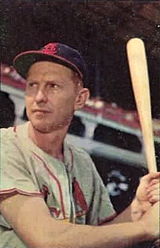
Red Schoendienst

Career Teams:  St. Louis Cardinals (1945-1956), New York Giants (1956-1957), Milwaukee Braves (1957-1960) and St. Louis Cardinals (1961-1963)
All Star Appearances:  1946, 1948, 1949, 1950, 1951, 1952, 1953, 1954, 1955 and 1957
MVP Voting: 1946 (26th), 1949 (10th), 1952 (10th), 1953 (4th), 1954 (13th) and 1957 (3rd).
Red Schoendienst played on three of the greatest teams in the history of the game (1946 Cardinals, 1957 and 1958 Braves) but each time he was overshadowed by the bigger names.  He played with names that are the most identifiable in the history of the game: Hank Aaron, Eddie Matthews, Warren Spahn, Stan Musial, Willie Mays, Willie McCovey.  Schoendienst was always overshadowed but always a strong presence in the lineup.  Similar to George Kell (keep reading you'll get to it) he made ten all star games in 15 years but unlike Kell he won the World Series twice and lost a third in seven games.  Schoendienst had his best series the year his Braves lost in seven games, hitting .300 with 9 hits and 3 doubles.  After retirement (and long after his entrance into the Hall of Fame) Schoendienst remained a legend in St. Louis.  He became a coach for the Cardinals as part of the legendary 1980's World Series teams.  Similar to Don Zimmer in the 1990's with the Yankees, seeing Schoendienst on the bench often brought a chuckle of the silly old man sitting on the bench.  Yet his comical appearance covered a brilliant baseball mind.

Shortstop:
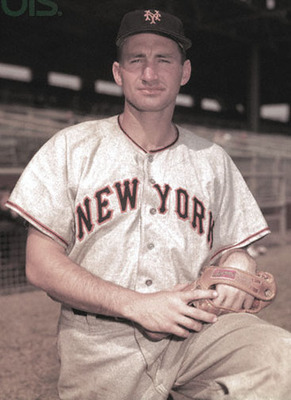
Alvin "The Swamp Fox" Dark

Career Teams:  Boston Braves (1946 and 1948-1949), New York Giants (1950-1956), St. Louis Cardinals (1956-1958), Chicago Cubs (1958-1959), Philadelphia Phillies (1960) and Milwaukee Braves (1960).
All Star Appearances: 1951, 1952 and 1954.
MVP Voting:  1948 (3rd), 1949 (25th), 1951 (12th), 1952 (12th), 1954 (5th) and 1957 (17th)
Every team needs a player with a Napoleon complex.  Someone who is not afraid to show his temper.  Someone who will fight back, if not for an insult done to him, then at least for an insult done to a teammate.  In hockey they're called the enforcers.  In baseball they're called "red asses". The A's in the 1970's had Bert Campaneris.  The Royals of the late 1970's and 1980's had George Brett.  The Giants in the 1950's had Al Dark.  Dark was never afraid to mix it up with the big guys, especially the Dodgers, though at 5'11" and 185 pounds Gil Hodges probably used bats bigger than Dark.  Anytime something went bad between the Dodgers and Giants you could bet Alvin Dark was at the start of it.  Although he was best known as a Giant, Dark was also a big contributor to the 1948 National League Champion Boston Braves.  Dark was the rookie of the year that year but fell flat in the World Series hitting only .148 as they lost to the Indians in 6 games.  He got his revenge in 1954 against the Indians.  The Indians were a heavy favorite in the Series but the Giants shocked everyone.  Dark had 7 hits and a .412 average to help lead the Giants to their last World Series victory in New York.

Thirdbase:
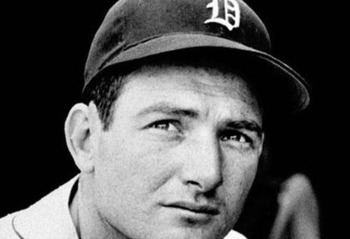
George Kell


Career Teams:  Philadelphia Athletics (1943-1946), Detroit Tigers (1946-1952), Boston Red Sox (1952-1954), Chicago White Sox (1954-1956) and Baltimore Orioles (1956-1957).
All Star Appearances:  1947, 1948, 1949, 1950, 1951, 1952, 1953, 1954, 1956 and 1957
MVP Voting:  1944 (22nd) , 1946 (16th), 1947 (5th), 1948 (16th), 1949 (8th), 1950 (4th), 1951 (15th) and 1953 (26th)
George Kell played for 15 years and appeared in close to 1800 career games.  He was an all star ten times, won a batting title and ended his career with 385 doubles and a .306 batting average.  Yet if you were to tell someone that George Kell is a Hall of Fame member the immediate response would probably be "Who the hell is George Kell?"  In 15 years he played in 0 postseason games and he rarely played on teams that finished closer than 15 games behind the first place team. Unlike Nellie Fox, who toiled in obscurity and finally got a shot at the World Series late in his career, Kell was the invisible superstar for his entire career, and his Hall of Fame status as well.

Al Rosen


Career Teams:  Cleveland Indians (1947-1956)
All Star Appearances:  1952, 1953, 1954 and 1955
MVP Voting:  1950 (17th), 1952 (10th), 1953 (1st) and 1954 (15th)
Star players of the Jewish faith in the early years of the game were few and far between.  There was Hank Greenberg then Al Rosen then Sandy Koufax.  The anti-Semitic stereotype of the day was that Jewish boys had no interest in sports.  Rosen once told the story of a high school football coach who questioned why he wanted to play the sport because he couldn't believe his people would want to play a contact sport.  When he was younger Rosen said he was glad his name was "ambiguously" Jewish so that it didn't draw attention to his religion.  As he got older he said he wished his name was more Jewish, like Rosenberg, so that no one would doubt it.  Regardless of his religion, Rosen was a great ballplayer. He won an MVP in 1953 leading the league with 115 runs, 43 home runs and 145 RBI.  He had a short playing career (only 10 years) but he went on to become a great executive for the Yankees and helped George Steinbrenner build the Yankees World Series teams in late 1970's.


Outfield:
Larry Doby


Career Teams:  Cleveland Indians (1947-1955), Chicago White Sox (1956-1957), Cleveland Indians (1958), Detroit Tigers (1959) and Chicago White Sox (1959).
All Star Appearances:  1949, 1950, 1951, 1952, 1953, 1954 and 1955
MVP Voting:  1948 (29th), 1950 (8th), 1952 (12th) and 1954 (2nd)
Everyone remembers the first person to accomplish a major feat but it is rare the second person to do it is recognized.  Jackie Robinson will forever be remembered for breaking the color barrier in the Major Leagues but few remember Larry Doby was the first African American to play in the American League.  Doby debuted in July 1947, just a few months after Robinson.  He didn't have the success of Robinson, but he also didn't have the support from his ownership that Robinson had and didn't have the talent that Robinson had (but no one had Robinson's talent). Doby had a very good career playing for the Indians and White Sox both under the management of Al Lopez.  Whereas Robinson gained a reputation for being a team player who got along with his teammates, Doby had a reputation for having a bit of a sour reputation and was not always liked in the clubhouse.  Doby's greatest season was the Indians' greatest season.  Doby led the league in home runs and RBI in 1954 as he finished 2nd in the MVP voting.  When the Indians slumped in the World Series Doby only hit .125.  Doby is often considered a failure because he didn't achieve the numbers that Robinson did but it is unfair to compare the two. 

Carl "The Reading Rifle" Furillo


Career Teams: Brooklyn/Los Angeles Dodgers (1946-1960)
All Star Appearances:  1952 and 1953
MVP Voting:  1946 (36th), 1949 (6th), 1950 (30th), 1951 (19th), 1953 (9th), 1955 (21st), 1956 (21st)  and 1958 (23rd).
The Dodgers clubhouse in the 1950's was a fun place to be.  Duke Snider, Pee Wee Reese, Jackie Robinson, Gil Hodges, Carl Erskine, Roy Campanella.  You can almost picture each one of them with a big smile on their face.  Who wouldn't smile when you got a World Series bonus check almost every year.  Apparently Carl Furillo didn't smile much.  In the histories of the Brooklyn Dodgers Furillo is alternately portrayed as dumb, angry and racist.  He denied all of these.  When the Dodgers announced they were signing Jackie Robinson several players decided to pass a petition that they would give to the Dodgers management expressing their disapproval.  Furillo swore to the day he died that he didn't sign it, though some claimed he did.  In the "Jackie Robinson Story" movie there was a character that Furillo felt was meant to portray him.  The character was portrayed as one of the players who fought against having Robinson join the team.  Furillo was furious and claimed that he had not done anything to hinder Robinson.  Regardless of the personality, Furillo was one of the great defensive players in the game.  No one played right field like Carl.  A local merchant named Abe Stark advertised on the right field wall with a sign that said "Hit Sign, Win Suit".  Stark never had to give away a single suit because Furillo patrolled rightfield so well.  Furillo should likely be in the Hall of Fame but is hurt by the fact that so many of his teammates have already been elected.

Cal Abrams

Career Teams:  Brooklyn Dodgers (1949-1952), Cincinnati Reds (1952), Pittsburgh Pirates (1953-1954), Baltimore Orioles (1954-1955) and Chicago White Sox (1956).
All Star Appearances:  None.
MVP Voting:  1954 (26th)
Visit Brooklyn in the 1960's and there are two names you never want to mention:  Walter O'Malley and Cal Abrams.  It would be like mentioning General Sherman in Atlanta, mentioning Scott Norwood in Buffalo or mentioning Bucky Dent in Boston.  Just a whisper of these names would probably spark some cursing, some angry looks and probably a spit just for good measure.  So what did Cal Abrams do to garner such hatred?  He took about three or four (or none depending on where you were sitting) extra steps and cost the Dodgers the 1950 pennant.  Philadelphia's "Whiz Kids" had shocked everyone by sticking with the Dodgers and Giants in the National League.  The Phillies led the Dodgers by two games with two games left to play in the season.  The last two games of the season were head to head in Brooklyn.  The Dodgers took game 1 cutting the lead to one game.  If the Dodgers won the last game of the regular season there would be a three game playoff to decide the National League pennant, lose and the Phillies would play the Yankees in the World Series.  The game was tied 1-1 in the bottom of the 9th when Cal Abrams led off the inning with a walk.  Pee Wee Reese sent him to second with a single.  2 on, 0 out and Duke Snider at bat.  Snider lined a single to center.  Abrams was moving on contact, it was clear it would fall.  Richie Ashburn, the Phillies centerfielder, did not have a great arm.  The third base coach didn't hesitate, he waved Abrams home.  Abrams hit the third base bag and made a wide turn.  He went about four steps wide as he headed home.  Ashburn fielded the ball on one hop and fired home on the fly.  Abrams was out at the plate.  The Dodgers failed to score, even with Reese on third and Snider on second with only one out and Robinson, Hodges and Furillo due up.  The game went to the top of the 10th tied when Dick Sisler hit a three run Home Run to give the Phils a 3 run lead and the National League pennant.  The reaction to Abrams was immediate and angry.  Cal played another season and a half in Brooklyn but he was forever blamed for the loss of the 1950 pennant just like Ralph Branca would be blamed for the 1951 loss.

Pitcher:
Johnny Podres


Career Teams:  Brooklyn Dodgers (1953-1966), Detroit Tigers (1966-1967) and San Diego Padres (1969)
All Star Appearances:  1958, 1960 and 1962
MVP Voting:  1961 (14th)
The Dodgers pitching staff in the 1950's had some names that are still remembered today:  Carl Erskine, Don Newcomb, Ralph Branca.  Very few remember Johnny Podres, yet he won the most important game in Brooklyn's history.  He was in only his third year as a major league pitcher and he was known more for his nightlife reputation than his pitching reputation.  Podres was given the job of doing what Newcombe and Erskine had never done before:  beat the Yankees in a Game 7 of the World Series.  The Dodgers had lost to the Yankees in the World Series in 1947, 1949, 1952 and 1953.  Each time they lost it seemed there was a cruel new way for it to happen.  This year would be even more cruel because they would lose without even having their best out there.  Podres had already won Game 3 but pitching when your team is 2 games down and 5 games left  is different than an all or nothing game.  Podres showed no signs of nerves.  He easily got the first 5 batters, then, after giving up a ground rule double to Moose Skowron he closed out the 2nd inning.  He had to work out of trouble a few times.  With 2 outs in the third he walked Rizzuto (nothing angers a pitcher more than a 2 out walk) and gave up a single to Billy Martin.  Gil McDougald hit a ground ball toward third and it looked like Rizzuto would score the first run.  He slid into third base and as he slid the ball hit Rizzuto.  He was out.  Inning over.  Still scoreless.  He gave up a leadoff double to Berra in the fourth but got the next three batters.  The biggest threat was in the 6th.  Berra hit a ball that looked like it would be a game tying base hit but Sandy Amoros made one of the great catches in World Series history then doubled off Billy Martin to end the threat.  With two on and one out in the 8th he worked his magic again.  In the 9th the Dodgers led by two and needed just three outs to win their first ever World Series.  Podres got Skowron on a ground ball, Bob Cerv on a fly ball and Elston Howard on a ground ball to Pee Wee Reese.  The Dodgers were finally World Champs and Johnny Podres was the World Series MVP.

Bob Lemon


Career Teams:  Cleveland Indians (1946-1958)
All Star Appearances:  1948, 1949, 1950, 1951, 1952, 1953 and 1954
MVP Voting:  1948 (5th), 1949 (9th), 1950 (5th), 1952 (8th), 1953 (16th), 1954 (5th) and 1956 (10th)
The 1954 Indians are legendary.  They did only one thing wrong all year.  They got upset in the World Series.  The greatest team in history  is rarely recognized as one of the best because the New York Giants swept them out of the post season.  Similar to the undefeated Patriots team who were upset by the Giants in the Super Bowl the Indians are now designated as "a very good team" but are not always spoken of with the great teams.  The Indians won 111 games.  21% of those games (23 wins overall, tied with Early Wynn for the most in the league) were won by  Bob Lemon.  Lemon was what would be called a "work horse" pitcher.  He routinely led the league in innings pitched and complete games.  The heavy work load may have had a lot to do with his short career.  He pitched only 13 years in the majors (only 9 as a full time starting pitcher) and won 207 games.  Lemon later became a manager and managed the 1978 Yankees (a team that his Cleveland teammate Al Rosen helped to build) to an unbelievable come from behind World Series Championship.


Early Wynn


Career Teams:  Washington Senators (1939-1948), Cleveland Indians (1949-1957), Chicago White Sox (1958-1962) and Cleveland Indians (1963)
All Star Appearances:  1947, 1955, 1956, 1957, 1958, 1959 and 1960
MVP Voting:  1943 (18th), 1947 (23rd), 1951 (16th), 1952 (5th), 1954 (6th), 1955 (20th), 1956 (13th) and 1959 (3rd)
Cy Young Voting:  1959 (1st)
Bob Lemon was one of the best pitchers of the American League during the 1950's.  Early Wynn was even better.  Al Lopez loved to have certain players with him wherever he went.  Early Wynn was player number one.  In both years where Lopez was able to get past the Yankees Early Wynn was his ace.  He won 23 for the 1954 Indians and 22 for the 1959 White Sox.  Wynn was also known for having a short fuse.  Umpires who gave Wynn a small strike zone were playing with fire.  One night when Wynn was positive he was being removed from the game (Lopez was coming out for his second visit of the inning) and was unhappy with the calls he was receiving ripped into the  umpire.  When the umpire told Wynn he was out of the game Wynn yelled back at him:  "What the hell do you think Lopez is coming out here for?  To bring me a sandwich?"

* Author's Note:  Just as you have seen over the last few weeks, and as may be seen in the next few weeks as we move through this series of articles, I did my best to keep this to one player per position. The summary of the decade is very short and is clearly missing some key information such as the Dodgers-Giants-Yankees rivalry, details on the move of the Dodgers and Giants as well as many other key points of the decade.  Because this was more about forgotten players than the decade as a broad point I have left these topics out and will likely cover many of them in the weeks to come. This is not a comprehensive list of players who fall into this category from this era, it is simply my choice of players who best represented their position and have become forgotten.  Your list is probably different.  Email me yours or leave a comment.