Showing posts with label Tim McCarver. Show all posts

Sunday, January 18, 2015

I Didn't Know He Played For: Boston Red Sox

This is the third article in the series "I didn't know he played for..."  Don't forget to check out the first two articles in the series:  Reading, PA and the Baltimore Orioles.

The Boston Red Sox are one of the most successful teams in the history of the game.  Starting with their win in the first ever World Series through their stunning 2013 win the Red Sox are essential to telling the history of the game.  Along with that healthy history comes an association of key players wearing the Red Sox uniform:  Babe Ruth, Tris Speaker, Ted Williams, Carl Yastrzemski, Carlton Fisk, Fred Lynn, Jim Rice, Wade Boggs, Roger Clemens, David Ortiz and many more.

Here are some players throughout the history of the organization you may have forgotten or never knew they wore the crimson hose:

Fred Mitchell:
As the Tinker, Evers and Chance era in Chicago ended, Fred Mitchell took over.  Each of the famous double play combo had taken a chance at the top of the team but only Chance was truly successful as a manager.  In 1917, Fred Mitchell took over as manager ending the most successful era of Cubs baseball officially.  Mitchell would manage the Cubs for four years, including an appearance in the 1918 World Series.  Before he became a manager Fred Mitchell  was a mediocre (to be kind) pitcher, his best year coming in 1903 with the Phillies (11-16, 4.48).  His professional career started with Boston in the newly formed American League.  Boston finished 6 games behind the White Sox in that first AL year and Mitchell went 6-6.  Apparently Boston thought little of his potential since after just 1 appearance (0-1, 11.25 ERA) he was "loaned" to the Philadelphia Athletics for the rest of the season.

Nick Altrock:
Nick Altrock came to be known as the "Clown Prince" of baseball for the comedy acts he would perform at stadiums around the American League after he retired.  Before that he was known as the White Sox ace on the staff of their first World Series winner in 1906.  Altrock had three straight tremendous years pitching for the Pale Hose but first he wore socks of a different color.  Altrock pitched in a total of four games for Boston (3 in 1902 and 1 in 1903).  In July of 1903 his contract was sold to the White Sox. The Red Sox would go on to win the World Series based on the pitching of their stars Bill Dinneen and Cy Young.  Altrock would go on to help the "Hitless Wonders" of Chicago beat the powerful crosstown Cubs.

Eddie Cicotte:
Eddie Cicotte, in the words of the Three Amigos, is "more than famous, he's infamous".  Cicotte will forever be known as the ace of the Black Sox staff.  He was one of the leaders of the World Series fix and one of the few who were known to have gotten paid what they asked.  But before his socks where white or black they were crimson.  Cicotte played four full seasons and part of a fifth in Boston before moving on to Chi-town.  He left Boston with a 52-46 record and 2.69 ERA.  In July of 1912, as the Red Sox rode the arm of Smokey Joe Wood to a pennant, they sold Cicotte to the White Sox where he would meet up with his co-conspirators.

Bill Wambsganns

Known to his teammates as "Wamby" for obvious reasons, Bill Wambsganns did something in the 1920 World Series that no one before or after him accomplished.  He turned an unassisted triple play.  But Wamby's career was more than that.  He was the double play partner of Ray Chapman.  He was a base stealing threat for the Indians first World Series Champions.  And, what few remember, he played for the Red Sox.  Wamby played 13 years in the league, 10 of those in Cleveland.  In January 1924 as Cleveland started to look for a younger group, Wamby was sent to the Red Sox along with Dan Boone, Joe Connelley and Steve O'Neill.  In exchange the Tribe received George Burns, Chick Fewster and Roxy Walters.  He played two full years with Boston but with the team still reeling from the fire sale to the Yankees there was little success.

Joe Judge:
When the Washington Senators were finally able to overcome that old joke about Washington (First in War, First in peace and Last in the American League) and win the American Leaue pennant two straight years, Joe Judge was their power hitting First Baseman in the middle of the lineup.  As that group of players started to age the Senators went with a youth movement and Judge was dispensed with.  He landed in Brooklyn for part of 1933 before being released.  After playing 2084 games in the Nation's capital and 42 in Brooklyn, Judge finished his career with 45 games in Boston (35 in 1933 and 10 in 1934).

Nels Potter:
As the Red Sox started to build their young team around Williams, Doerr, Pesky and DiMaggio, pitching always seemed to be the missing element.  Turns out they may have had it and let it get away.  Nels Potter was 22-41 in his five seasons with the Athletics but the record was partially a reflection of the terrible team behind him in Philadelphia.  The Red Sox purchased Potter's contract during the 1941 season where he went 2-0 in finishing 6 games.  He was sent to AA Louisville for the 1942 season and before returning to the Red Sox was chosen by the St.Louis Browns in the Rule 5 draft.  In 1944 as the Browns were charging to their first (and only) pennant, Potter was the ace of the staff winning 19 games.

Ken Keltner:
Ken Keltner had a long and successful career.  He is known as the man who stopped Joe DiMaggio's hitting streak.  He made 7  All Star Games and when the Indians won the 1948 World Series Keltner was the lineup's power.  He played 1526 games in his career.  1513 of those were with the Tribe.  As the Indians groomed young Al Rosen to take over at Third Base Keltner's playing time dipped.  At the end of the 1949 season Keltner was released and Rosen named the full time Third Baseman.  Keltner signed with the Red Sox who were looking for one last piece to put them ahead of the Yankees (they had lost to the Yanks on the final day of the 1949 season). He saw action in only 13 games.  He hit .321 in that time but his power was gone.  He had 0 Home Runs and drove in only 2.  By June 6 Keltner was released and gone from the game as a player.

Bobby Thomson
Bobby Thomson hit one of the most famous Home Runs in history, certainly the most famous in the Dodgers-Giants rivalry.  After leaving the Giants he played several years with the Braves in Milwaukee.  At the end of his time there he was sent back to the Giants for Red Schoendienst, who jump started the Braves to their only World Series title in Milwaukee.  Thomson then spent some time with the Cubs before being sent to the Red Sox before the 1960 season.  He played 40 games for Boston that year before being released in June.  He hit .263 there that year with 5 Home Runs but the Red Sox were starting to move toward a youth movement as Williams got ready for his final year.

Wilbur Wood

In the late 1960s and early 1970s Wilbur Wood was the face of the Chicago White Sox.  The team was not very competitive as the AL West was dominated by the A's and Royals (and even the Twins for a while).  For four straight years (1971-1974) Wood won more than 20 games.  He finished in the top 5 in Cy Young voting three times and made three All Star Games.  Before he became a star in Chicago, he was starting his career in Boston.  From the end of the 1961 season to the middle of the 1964 season Wood wore Red Sox not White Sox.  In his four years in Boston, Wood had a total record of 0-5.  In September of 1964 his contract was sold to the Pirates who would eventually trade Wood to the White Sox.

Tim McCarver
Tim McCarver is of course known today as the play by play announcer for FOX over the last several decades (and ABC before that).  Before heading into the broadcast booth McCarver was known for being an All Star Catcher for the St. Louis Cardinals when they dominated the mid 1960s and later for the Phillies in the mid 1970s. What few know is that after leaving the Cardinals he made a stop in Boston.  After leaving St.Louis he was sent to Philadelphia who then sent him to Montreal and a brief stop back in St. Louis.  In September 1974 the Red Sox purchased McCarver's contract as an insurance policy for an often injured Carlton Fisk.  He played in 11 games that year and stayed with the team to start 1975 and played 12 games with the team before being released.  He was signed by the Phillies where he would end his career.

Juan Marichal
The Hall of Famer Dominican Dandy made nine All Star Games, won 242 games and was the first Giants' ace on the west coast.  As the Giants offensive stars of Mays, McCovey and Cepeda moved on the talent level at Candlestick needed a revamp.  Marichal became expendable.  In December of 1973 the Giants sold Marichal's contract to the Red Sox.  Marichal pitched in 11 games for the Sox and went 5-1 but was released in October of that year.

Jack Clark:
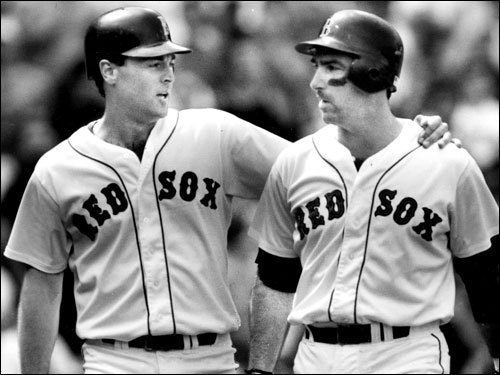
Jack Clark played for the Giants at the time Frank Robinson was the manager and was known for being in Frank's doghouse.  He was an All Star Firstbaseman and went on to be an All Star for the Cardinals in the late 1980s.  He had a well known big contract from the Yankees who were less than pleased with his results and shipped him to San Diego.  What few people remember is that he finished his career with the Red Sox.  Clark signed as a free agent for the 1991 season but couldn't help the Red Sox repeat as AL East Champs.  He hit only .249 but did blast an impressive 28 Home Runs.  Clark stuck around for the 1992 season but hit only .210 with 5 Home Runs.  His playing time dripped to 80 games as Boston got ready for their new young star, Mo Vaughn.

Frank Viola:
Frank "Sweet Music" Viola pitched the Twins to the 1987 World Series.  Two years later the Twins were looking to rebuild.  They traded Viola to the Mets in a shocking blockbuster trade that netted Minnesota Rick Aguilera, David West and Kevin Tapani.  Viola would be part of a dysfunctional, expensive and underachieving Mets team that imploded.  After the 1991 season Viola became a free agent and signed with the Red Sox.  During the 1992, 1993 and 1994 seasons Viola was 25-21 but this was the era of the Blue Jays and the Sox were not able to make the playoffs.  Viola left for Cincinnati following the strike year but was never able to pitch another full year.

Byung Hyun Kim

The press had a field day with Byung-Hyun Kim.  Their jokes were constant.  When Kim gave up game winning Home Runs in back to back games during the 2001 World Series he was devastated and it was seen by the entire world.  The headlines were brutal.  "Byung Hung a Curve", "There's No Crying in Baseball". Although the Diamondbacks went on to win the World Series over the Yankees, his career was remembered for two pitches.  But did you remember that Byung-Hyun Kim actually continued on a fairly successful career afterwards?  He stayed with Arizona through 2002 and the first part of 2003.  In late May 2003 with the Red Sox looking for a closer, they sent infielder Shea Hillenbrand to Arizona in exchange for Kim.  Kim would have a decent year working out of the pen going 8-5 with a 3.15 ERA.  Kim would appear in the ALDS for the Red Sox against the A's and would throw 2/3 of an inning.  Heading into the bottom of the 9th in Game 1 with a 4-3 lead Kim was brought in to protect the lead.  He faced four batters.  The first batter flew out to left field.  He then walked the second batter, hit the third with a pitch and struck out Mark Ellis.  With two out he was replaced by Alan Embree who gave up a run scoring single to tie the game.  The run was charged to Kim.  Kim stayed with Boston for 2004 but appeared in only 7 games.

Hanley Ramirez
Hanley Ramirez is a supestar in this league without question.  He was the 2006 Rookie of the Year, three time All Star, a batting champion, two time Silver Slugger winner and has finished in the top 10 in MVP voting three times (finishing second to Albert Pujols in 2009). Ramirez has done most of this with the Marlins (where he wore out his welcome and forced a trade) and the Dodgers.  This season he signed with the Red Sox, although it could be called a return, as Ramirez was once a member of Red Sox nation.  As a late season call up from the minor leagues in 2005, Ramirez appeared in 2 games.  He went 0-2 with 2 strikeouts in those two games.  In November of 2005 the Red Sox sent Ramirez, along with Jesus Delgado, Harvey Garcia and Anibal Sanchez to the Marlins.  In exchange they got Guillermo Mota, Mike Lowell and Josh Beckett.  Despite the way Beckett's time in Boston ended most Red Sox would likely say the trade was a success, with Lowell and Beckett both playing a big role in the 2007 World Series title.

Justin Masterson
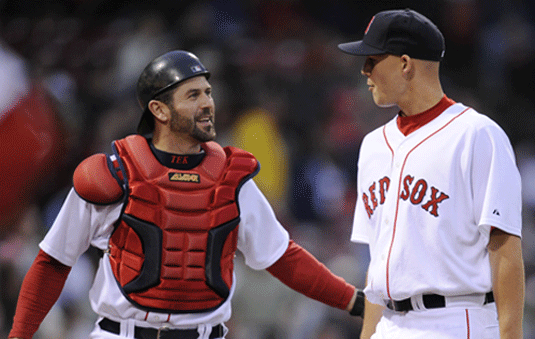
Over the last few seasons Justin Masterson had developed into the ace of the Indians' pitching staff.  As the tribe began to rebuild they did so with Masterson in mind (until they traded him at the deadline this year).  Just as they have with Hanley Ramirez, Boston has brought Masterson back in to the fold, resigning him this offseason. Masterson debuted with the Red Sox in 2008 and appeared in a few post season games for the Sox.  Masterson even won Game 5 of the ALCS in relief against Tampa Bay.  As the Red Sox tried to make a push for the playoffs in 2009, they were looking for offense.  They sent Masterson, Nick Hagadone and Bryan Price to the Indians in exchange for Victor Martinez.  It didn't quite work out the way Red Sox fans had planned.  They missed the 2009 post season.


TRIVIA QUESTION:
Byung Hyun Kim gave up Home Runs in Games 4 and 5 of the 2001 World Series against the Yankees.  These three famous Home Runs were hit by three key members of the Yankees dynasty and allowed the Yankees to take a 3 games to 2 lead in the Series.  What three Yankee legends hit these Home Runs?

Answer to Last Week's Question:
The Orioles traded for First Baseman Glenn Davis before the start of the 1991 season.  Davis hurt his back before ever playing a game for the Orioles and due to the injury was never truly effective.
The players given up by the Orioles went on to strong careers.

Curt Schilling made 6 All Star Games (1997, 1998, 1999, 2001, 2002 and 2004) and was a member of World Series teams with the Phillies, Diamondbacks and Red Sox.

Pete Harnisch, at one point considered the best player given up in the trade, made only one All Star Appearance in 1991, although he pitched in the league for another ten years.  Harnisch had several very strong years with the Astros, Mets and Reds but only made the All Star team once.  He did not reach a World Series.

Steve Finley made an impact in every city he played and was one of the most under rated outfielders of his time.  Finley would play in the post season with the Padres, Diamondbacks, Dodgers and Angels and hit one of the biggest Home Runs in Dodgers history.  He was a member of the 1998 Padres World Series team and the 2001 Diamondbacks World Series team.  Finley was a tremendous defensive outfielder and won 5 Gold Gloves.  Surprisingly, he only made two All Star teams in 1997 and 2000.

That gives us 6 for Schilling, 2 for Finley and 1 for Harnisch.  Davis had made two All Star Games (1986 and 1989) before being traded to Baltimore.  He made 0 after the trade.

Sunday, August 24, 2014

Players I Love More Than I Should: Pitcher: Bob Gibson

More than 18,000 players have appeared in Major League Baseball games since the start of the league.  Some players have short careers that last one at bat or one appearance in the field.  Others have 20+ year careers.  As I read more and more about baseball history there are certain players I find myself enjoying reading about more than others.  It is obviously illogical since many of them retired, or in some cases passed away, long before I was even born.  I have no first hand experience in watching some of them play but for whatever reason their personalities and perseverance strikes me above and beyond the other players I read about.  Over the next few weeks I will be giving you short biographical histories*of some of these players.  Some of them will be Hall of Fame players.  Some of them will be players only casual fans may know.  Regardless, I chose one player from each position for this series to explore.  This week we will explore one of the Pitchers I chose for the series and the final player in this series: Bob Gibson.

If you are just joining the blog don't miss the other players in the Players I Love More Than I Should series: Yogi BerraHank GreenbergJoe MorganCal Ripken, Frank "Home Run" Baker,  Frank Robinson and Larry Herndon, Carl Furillo and Walter Johnson.

287 1/3 regular season innings.  By today's standards he would have been over worked.  287 1/3 innings as the ace of the staff in the middle of a pennant race.  287 1/3 regular season innings with the gaining pressure of a team chasing down a curmbling team ahead of them that really only needed a few wins to end the conversation.  287 1/3 regular season innings plus 8 more in the pressure of the World Series.  Facing the unbeatable Yankees who beat him in Game 2 of the 1964 World Series.  287 1/3 regular season innings plus 8 pressure filled innings in  Game 2 plus 8 pressure filled innings so far today.


Now it was the 9th inning with a two run lead.  He needed just three outs.  Mantle led off and grounded to Dick Groat.  He breathed a sigh of relief.  One out...oh shit.  Groat bobbled the ball and Mantle was safe.  One on no one out.  No problem.  Elston Howard struck out and in sauntered Joe Peppitone.  No one had more confidence in Joe Peppitone than Joe Peppitone.  Gibson's arm was exhausted.  He had thrown nothing but fastballs. curves and sliders all day.  He decided to sneak a change up past Pepitone.

He went into his motion.  The leg, arms and body moved back, almost as though he were retreating.  The hand and glove almost met behind his back.  Then just as quickly and aggressively they swung forward, the leg went up and the body lunged, aggressively, straight towards the batter.  As he followed through his whole body was falling towards first base.  Pep swung, connected and lined a shot straight back towards Gibson.  Pepitone could not have aimed a shot any better.  With Mantle on the run, the ball hit Gibson on the hip and shot away from him towards third.  Think about it.  A hard, solid object, thrown at close to 90 miles per hour and shot solidly straight back at a human being connected solidly against the bone.  I don't know about you but my first thought would probably be "I think I just broke my hip."  Instead, Gibson thought this could mean the ball game.  He reacted immediately.  Turning, chasing down the ball, He scooped it bare handed, momentum carrying him away from first base.  His balance was off, his throw had to be hurried.  He was falling toward the ground and calmly, cooly, Gibson sidearmed the ball to first base to get Pepitone.  He was still in danger but as the game finished, the importance of the play on the game, on the series and on the legend of Bob Gibson would become clear.  He gave up a game tying two run Home Run to Tom Tresh immediately after but the play to retire Pepitone kept it from being a three run, game winning Home Run.  Instead, Tim McCarver hit a three run Home Run in the 10th and Gibson stopped the Yankees in the bottom of the inning for his first World Series victory.  It would be quite some time before he would lose another World Series game.

The Education of Bob Gibson
The greatest athletes off all time often have a heartbreaking experience they have overcome to reach the heights.  Babe Ruth grew up poor and was eventually sent to a reform school.  Mickey Mantle nearly lost his life several times to a rare blood disease and nearly had a leg amputated as a child.  Bob Gibson beat them all, in every sense of the phrase.  Three months before he was born his father died.  As a child he was nearly killed by pneumonia.  He grew up in a housing project where his mother worked long hours to keep her family fed.  

Luckily, Bob Gibson had a very special person in his life.  His brother was that special person.  He had a masters degree in history.  Unfortunately, in the society they were brought up in, an African American with a master's degree was qualified only to work in a factory for low wages.  Of course it bothered him but he had a special talent to teach and he would do it anyway he could.  Gibson's brother LeRoy coached the local YMCA baseball and basketball teams and what was more, he mentored the young kids he coached.

He taught Bob how to act in society.  He taught him not to smoke.  He taught him not to spit like the other ball players he would see and he pushed Bob to get the most out of his talent.  Bob was tealented at both baseball and basketball.  After being rejected by the University of Indiana because they had already met their quota of African American players (why would they need more than one?) LeRoy used his connections to help get Gibson accepted at Creighton University.  He was spectacular in both Baseball and Basketball.  He was offered a contract with the Harlem Globetrotters.  He rejected it. He graduated college and as he did his brother used another connection, a scout for the Cardinal's organization.  The scout saw potential in Gibson, and so did minor league manager Johnny Keane.  The question was not whether Gibson could play it was where should he play.  Keane told the Cardinals to start him as a pitcher because if he didn't make it as a pitcher he could start immediately as a shortstop.


Flying High
The Cardinals had a winning tradition.  The long list of legends of the National League included dozens of Cardinals players.  Frankie Frisch, Rogers Hornsby, Jim Bottomley, Dizzy Dean, Pepper Martin, Enos Slaughter, Red Schoendienst, Stan Musial.  The team started off poorly in the basement of the early days of the National League but since 1926 the team (along with the Giants and Dodgers) were one of the dominant teams in the league.  1926, 1928, 1930, 1931, 1934, 1942, 1943, 1944, 1946.  They had made the World Series in each of those years and when they didn't win the NL they were usually close on the heels of the other team.  As the years went on the big names grew older and the replacements could not keep up with the Dodgers and Braves.

A big part of that rebuilding was Bob Gibson.  He reported for his first professional season in 1957 and was told to pitch batting practice.  The point of batting practice is to let the hitters relax, see easy pitches and work on their swing.  So Gibson tried to oblige.  After the hitters continuously failed Gibson was told to start throwing breaking balls. The hitters still failed.  Not wanting to demoralize his team mates who couldn't even hit batting practice, Gibson was waived off the mound.  "Should I start to throw hard?" he asked as he was waived off.

Rookie ball and A level baseball is more important as a learning experience and Gibson was learning.  The Cardinals, although angering Gibson for years, made the right choice by under paying for his services.  While Sandy Koufax was required to stay on the Major League roster of a team in a constant pennant chase, he spent several years watching and getting little practical experience.  Gibson, meanwhile, was pitching in live games and learning how to control his pitches.  His first year numbers were not spectacular but the increased control was the main thing.

He played three and a half years in the Cardinals organization, even getting to play for his home town Omaha Cardinals for several years.  His manager there for the first two years was Johnny Keane, a man Gibson credited with helping him along greatly in his career and a man who would play a big part in Bob's career later on.  When Keane moved up to the big league club as a third base coach, he was replaced by the ill-fated Joe Schultz who would later manage the doomed Seattle Pilots in their only year.

By 1959 Bob was up in the majors and made his debut on on April 15, 1959.  The game was started by Larry Jackson, facing off against Don Drysdale and the Los Angeles Dodgers.  Gibson entered the game trailing 3-0.  He faced the Dodgers third baseman Jim Baxes as the first batter of his career.  Baxes would play one year in the Major Leagues.  He would hit a total of 17 Home Runs that year.  One of those Home Runs came on a 2-0 pitch against Bob Gibson.  That's right.  The first batter ever to face Bob Gibson in the major leagues took him deep.

It got better, obviously.  Other wise there wouldn't be a need for me to write this article.  Gibson would call it the worst point of his career and a big part of that had to do with the manager.  Solly Hemus was not a man easy to get along with.  He often had violent outbursts and would curse players out in front of the team.  Gibson was 3-5 in 1959, his first year in the majors.  He was 3-6 in 1960.  1961 saw him start off slow as well.  After a 2-0 start he was at 5-5 on July 4 when the Cardinals decided a change was in order.  Solly Hemus, at 33-41 for the season, was fired and replaced with Gibson's old minor league manager Johnny Keane.  On July 5, the very next day, Gibson won a  complete game against the Dodgers and finished the season with 13-12 record, including winning 5 of his last 7.

1962 saw the emergence of Gibson as a rising star.  He was starting to feel comfortable in the club house and starting to make a mark on the organization.  On July 8 Gibson pitched a complete game 3 hitter against the Mets.  It improved his record to 10-6 and he represented the Cardinals in the All Star game for the first time.  He went 15-13 (with five shut outs) for the year and topped 200  strikeouts for  the first time in his career.

1963 was an even better year. The team was still not great but Gibson was proving he was special.  Everything went up.  His wins (18), his innings (254 2/3) and one other number that was starting to raise eyebrows, his hit by pitch (13).  Gibson was getting a reputation for his willingness to throw at hitters.  He owned the plate and anyone with a bat in his hand was the enemy.  He hated seeing a batter dig in with his spikes.  It was insulting. It silently sent a message that said "I am comfortable at the plate, like I'm at home."  Gibson sent a silent message right back.  "Don't get too comfortable.  This is my territory."  He said it with a pitch aimed at the batter.  The reputation was well deserved.  He certainly was not shy about moving a hitter off the plate.  The reputation of meanness was not well deserved.  Away from the mound he was not the angry, hate filled, vicious man he was portrayed as on the mound.  He was an intelligent clubhouse leader and a family man.  He set the tone for the clubhouse.  He would let the young kids know what was expected of them without calling them out in public.  He also set the tone for the game.  It was his game to win, his game to lose and it belonged to him.  He hated when a catcher or manager came out to the mound.  It was a poor situation for McCarver being stuck between Keane and Gibson.  Keane wanted Gibson to slow down.  Gibson knew what he wanted to do and didn't want to wait.  He pitched like he was running a no huddle offense.  Get the ball, go into the wind up fire the ball.  Repeat.  When Keane would tell McCarver to get out there and slow him down Gibson would tell McCarver to get back behind the plate.  He once told McCarver "the only thing you know about pitching is that you can't hit it."  Once McCarver walked out to remind Gibson of the game situation and when he told Gibson there was a man on third Gibson yelled back "I know he's there. I put him there."


1964 started off as a tough year.  He was 4-0  to start but by the All Star Break he was 7-6 and the team was struggling.  With Koufax and Drysdale suffering, the Cardinals thought they had a real shot at the pennant.  Instead it was the Phillies who were out front of the league.  He fell to 8-9 on August 1st as the Phillies maintaiined their lead. Over the next two months he would rarely start on full rest and he would rarely lose.  He lost on October 2nd making it more possible the Phillies would be in the World Series.  He took the day off on October 3rd and then on October 4 he came back, pitched four innings and the Cardinals won 11-5.  It was enough to put the Cardinals in the World Series.  Gibson not only won the fifth game by going ten innings, he won Game 7 with a complete game victory.  The loss sent the Yankees into one of the darkest periods of their existence.

Despite the surprise World Series win, the Cardinals fired Johnny Keane, who went on to a disastrous term as manager of the Yankees.  His replacement in St.Louis was Red Schoendienst, former Cardinals and Braves second baseman and future Hall of Famer.  Gibson had another stellar year (20-12, 270 strikeouts and 6 shutouts) but Curt Simmons and Ray Sadecki, two big winners in the pennant run the previous year, fell off drastically. Simmons fell to 9-15 and Sadecki fell off to 6-15.  This, combined with a "healthy" Koufax and Drysdale led to a Dodgers victory.  St. Louis finished 7th at 80-81,  1966 was a better year for Bob. He went 21-12 and dropped his ERA from 3.07 in 1965 to 2.44 in 1966.   In both seasons he made the All Star Game and won two consecutive Gold Gloves.  The Cardinals finished sixth as the Dodgers again dominated the league.

1967 was looking like another strong Bob Gibson year.  He had just appeared in his fourth straight All Star Game and his Cardinals were four games ahead in the NL.  On July 15, with his record at 10-6, Gibson started against the Pittsburgh Pirates.  With one out in the fourth Roberto Clemente shot a ball straight back at Gibson which shattered his fibula.  After completing the inning Gibson collapsed in pain.  He would be out until September 7.  He would return and win three of his final four decisions for a 13-7 record.  Despite the missed time Gison won another Gold Glove and the Cardinals ran away with the NL title.  They faced the "Impossible Dream" Red Sox in the World Series.  As the clear ace of the staff Gibson started Game 1.  He allowed only six hits in the complete game, one of which was a solo Home Run to the opposing starter, Jose Santiago (who also pitched a great game) and Gibson won 2-1.  Gibson and Santiago faced off again in Game 4 with the Cardinals ahead 2-1 in the series.  Santiago lasted only 2/3 of an inning this time as he allowed four first inning runs. Gibson, on the other hand, continued to show he was the best pitcher in baseball.  He allowed only 5 hits, struck out 6, walked only one and shut out the Red Sox 6-0.  It looked like it would be his last game of the season as the Cardinals were now ahead 3-1.  A young Steve Carlton allowed only one run in seven innings in Game 5 but the Red Sox still beat him by a final score of 3-1.  Game 6 was much less of a pitcher's duel as the Cardinals used 8 pitchers and lost 8-4, setting up a final face off in Game 7.  Gibson started against the Red Sox ace Jim Lonborg.  Gibson was on top of his game. The Cardinals scored two in the top of the third while the Red Sox struggled to get a man on base.  In the top of the 5th, with the score still 2-0, Gibson helped his own cause with a solo Home Run.  Another run that inning gave the Cardinals a 4-0 lead.  The Cards would go on to win 7-2.  It was Gibson's fifth straight World Series win making him 5-1 in World Series play.  It was just a warm up for what was to come.


The Year of the Pitcher
There are certain years when players are able to put it all together and somehow create a special year that is talked about for generations.  Babe Ruth hit 60 Home Runs.  Joe DiMaggio hit in 56 straight.  Ted Williams hit .401.  Roger Maris hit 61 Home Runs.  1968 was known as the year of the pitcher and just as easily could have been called the year of Gibson.  In the American League, the Tigers won the title behind the 30 wins of Denny McLaine.  No one has won 30 games since. In the National League no one could touch Gibson.  Seemingly showing no effects from the broken leg the year before, Gibson was at the top of his game.  It was clearly his best year ever.  In fact it is arguably the best year of any pitcher ever.  What's more amazing is that if his team's offense (and defense) were better he would have had an even better year.  Gibson started opening day and left after 7 innings.  He had allowed one unearned run.  The team won 2-1 but the scoring came too late to give Gibson the win.  His second start was similar.  He pitched seven innings, allowed only three runs, the team won but he got a no decision.  In his third start he got his first decision, a loss, as he allowed only three earned runs but lost 5-3.  In fact, if you were following Gibson in the papers there was little in the first month to make anyone think this was a magical season.  By May 28 Gibson had a 1.48 ERA but his record stood at 3-5.  That is where the turn around began.  Through the rest of the year the Cardinals and Gibson would dominate the league.  He would finish with a record of 22-9 (giving him an unbeleivable 19-4 record from July through October) and his strike out total was 268.  Even more amazing was the fact that in over 300 innings he had allowed only 38 earned runs.  He threw 28 complete games. 13 of those were shutouts.  Of the five losses in the first months, twice his own team was shutout while he allowed 2 or less runs.

It was an unbelievable year but it was just getting started.  The World Series was still to come.  Gibson started Game 1 of the World Series aginst the Tigers ace Denny McLaine.  McLaine was sabotaged by Tigers fielding but it would have mattered little.  Dominant is too light a word to describe Gibson that day.  As he struck out his record 17th batter of the day the crowd went nuts.  Tim McCarver stood up to draw Gibson's attention to the feat but Gibson didn't care.  He still had a game to finish.  He did.  The Cardinals won and no one has approached the 17 k's in a single World Series game since.  He allowed only five hits and one walk in winning his sixth straight World Series game.  He would win a seventh straight World Series game to give the Cardinals a 3-1 series lead.  He again dominated allowing only 5 hits, although the Tigers did score on him this time.  Just like the Red Sox had done the year before, the Tigers came back to force a Game 7 and this time Gibson would face Mickey Lolich.  Each had won two games in the series but realistically the Cardinals had the best pitcher in the world on the mound.  He again dominated but just like the first month of the season, his team didn't score.  Lolich outpitched Gibson (barely) and with the help of some shadows leading to a misplay by the best fielding centerfielder in the game. the Tigers won by a final score of 4-1.  It ended Gibson's record World Series winning streak at 6 games and it was his last taste of the post season.  Regardless the 1968 season is still the benchmark that any successful pitching season is judged.  Gibson's 1.12 ERA has never really been approached and he won the MVP, Cy Young and his fourth straight Gold Glove.

The Legend
The Cardinals run at the top was finished as the Mets, Pirates and even Phillies would dominate the Eastern Division for the next ten years.  Gibson continued to pitch amazingly but the team around him continued to decline.  Curt Flood, Bill White, Roger Maris, Clete Boyer and even McCarver moved on and the players replacing them did not perform as expected.  Still Gibson performed at a high level.  He won 20 games in 1969 and 1970.  He continued to rack up a high number of innings, a high number of strikeouts and a low ERA.  His 1969 ERA was only 2.18.  He won his second Cy Young award in 1970 with a 23-7 record and a 3.12 ERA.   All the while he continued to be selected for the All Star Game and win Gold Gloves.

He struggled in 1974 to an 11-13 record and the years of high inning totals started to take their toll.  He fell off farther in 1975 to 3-10 with a 5.04 ERA and he decided it was time to walk away.  His career totals are nothing short of amazing.  251 wins, 56 shutouts, nearly 4000 innings pitched (he averaged 262 innings a year), 3117 strikeouts and a 2.91 ERA.  That does not include his amazing performances in the postseason bringing the Cardinals 2 World Series and nearly a third.  During the decade of the 1960's, in the post Stan Musial era, Bob Gibson defined the Cardinals as a class organization and class was the best way to describe Gibson himself.


Gibson sometimes had a rough relationship with the media.  He once told a reporter who asked him if he was a "money pitcher" that it was the dumbest question he had ever heard of.  Possibly because of this he received a low 85% vote in his first year of eligibility for the Hall of Fame.  It was enough to get him into the Hall of Fame (and I admit this is a petty complaint) but who the hell didn't think Bob Gibson was a Hall of Fame pitcher?  Gibson was the only player voted in that year (despite Harmon Killebrew and Don Drysdale on the ballot).  Gibson is still active in the Cardinals organization aBond can (fortunately for all of us) still be seen occasionally on MLB Network or in occassional appearances during Cardinal broadcasts.

Bob Gibson was truly one of the greatest pitchers of all time and one of the greatest ambassadors of the game that the sport has ever known.


*This is not intended as a full biography and due to space I have done my best to summarize the life of the players in this series.  For further information on Bob Gibson please check out
Videos:
Ken Burns Baseball
The Official World Series Film Collection

Websites:
http://www.baseball-reference.com/
http://www.baseball-almanac.com/
http://sabr.org/

Books:
October 1964 by Daid Halberstam
Five Seasons by Roger Angell
The Summer Game by Roger Angell

TRIVIA QUESTION:
Bob Gibson won seven World Series Games in his career tying him with Red Ruffing (1932, 1936, 1937, 1938, 1939, 1941 and 1942 Yankees)  and Allie Reynolds (1947, 1949, 1950, 1951 ,1952 and 1953 Yankees) for second on the All Time List.  What Pitcher has won the most World Series Games?

Answer to Last Week's Trivia Question:
Congratulations to TJD for again answering last week's trivia question right.  
The correct answer last week was  William Howard Taft