Each team finds a way to honor their legends, usually with the retirement of the player's number. For the fans of that team it is easy to sit in the stadium seats, look out on the display of retired numbers and feel pride in the part that number represents to their team's history. Unfortunately, fans of the visiting team stopping by to see a game may not know the meaning of those numbers.
So during this series we will explore what the retired numbers for each team mean and why they were retired.
This week we will look at the San Diego Padres.
JC

Jerry Coleman started his career in baseball as a Rookie of the Year in 1949 for the World Series Champion Yankees. His road to the majors had been slowed slightly by World War II, where he served in the military. Coleman would play a total of nine years, all with the Yankees, and was a member of six World Series teams. After retirement Coleman broadcast games for the Yankees, CBS and the Angels. His association with the Padres started in 1972. He broadcast for the Padres consistently from 1972 through 2013, although he did take over as manager during the 1980 season. Despite never playing a game for the Padres Coleman was elected into the Padres Hall of Fame in 2001. There is a statue in Coleman's honor at Petco Park. He passed away this past winter.
RK
Ray Kroc bought the Padres organization in 1974. He was already well known as the genius behind McDonald's restaurants. Before Kroc's ownership the team had never finished higher than 6th in a 6 team division. Following Kroc's purchase of the team they slowly (very slowly) started to turn things around. To be fair, during the first few years of his ownership they were playing in the same division as the Big Red Machine and the Dodgers of Garvey, Lopes, Cey and Russell. Kroc eventually built the team into a contender. He passed away in January of 1984. The Padres won their first ever Division and National League title that same year.
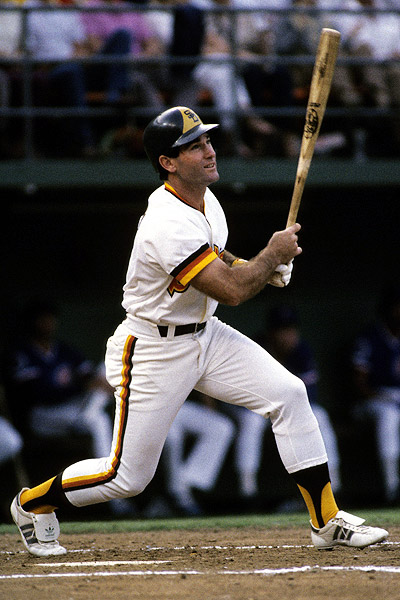
Steve Garvey is better known for his time with the Dodgers as an 8 time All Star, MVP winner and the face of the Dodgers of the 1970's. In 1983 Garvey joined the Padres organization where he would play a total of five years. Garvey's arrival in San Diego coincided with the improvement of the team's young players like Eric Show, Craig Lefferts and Tony Gwynn. Garvey's signature moment as a Padre came in Game 4 of the 1984 NLCS against the Cubs. With the game tied in the bottom of the 9th and the Cubs one win away from advancing to the World Series, Garvey launched a 2 run Home Run to send the series to a deciding 5th game. Garvey would win the NLCS MVP. Following Garvey's departure only Keith Moreland wore the number 6 for San Diego before Garvey's number was retired. Despite having his number retired Garvey does not appear in the top 10 of any major offensive category of the Padres' history.

This should speak for itself. #19 was Mr. Padre, Tony Gwynn. Gwynn leads the team's all time stats in WAR, Offensive WAR, Batting Average, Games Played, At Bats, Plate Appearances, Runs, Hits, RBI, Total Bases, Doubles, Triples, Walks, Stolen Bases, Singles, Extra Base Hits, Times on Base, Sac Flies and Intentional Walks. Gwynn made 15 All Star Games, received MVP votes 12 times, won 7 Silver Slugger Awards and 5 Gold Gloves. He also won 8 batting titles, hit over .300 every season except his first year when he played in only 54 games (he hit .289). Seven times he hit above .350 for the year and twice (1987 and 1994) he was a serious threat to hit .400 for the year. Gwynn was inducted into the Hall of Fame in 2007. Gwynn was a part of the only two World Series teams in Padres history. No player was issued the number 19 for the Padres between the time Gwynn retired and the retirement of the number.
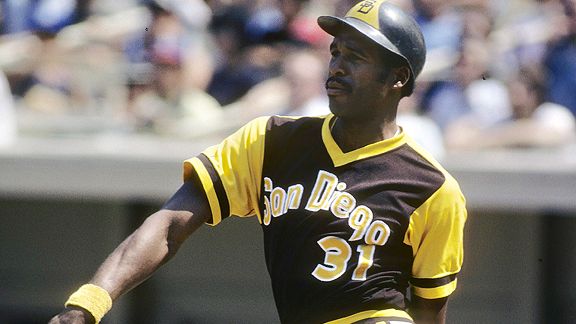
Dave Winfield played for the Padres from 1973 through 1980 before leaving for the Yankees as a free agent. In the days before Tony Gwynn, Winfield was the closest thing the Padres had to a Mr. Padre. With the Padres Winfield was a three time All Star, Gold Glove winner and twice received MVP votes finishing 3rd in 1979 behind Keith Hernandez and Willie Stargell. After leaving the Padres Winfield would go on to play with the Yankees, Angels, Blue Jays, Indians and his home town Twins. At the end of his career he had collected over 3000 hits and over 500 Home Runs. Winfield still ranks high in many Padres categories: WAR (2nd), Offensive WAR (2nd), Average (10th), Slugging % (7th), OPS (8th), Games (3rd), At Bats (3rd), Plate Appearances (3rd), Runs (2nd), Hits (3rd), Total Bases (2nd), Doubles (5th), Triples (3rd), Home Runs (4th), RBI (2nd), Walks (4th), Stolen Bases (7th), Singles (4th), Extra Base Hits (2nd), Times on Base (2nd), Sac Flies (2nd), Intentional Walks (3rd). Winfield was elected into the Hall of Fame in 2001. Following Winfield's departure seven players wore the number 31 for the Padres (LaMarr Hoyt, Ed Whitson, Dave Staton, Bill Beane, Bob Tewksbury, Trey Beamon and Matt Clement).

Randy Jones spent 8 years as a Padre. He finished his Padre career with a 92-105 record. In 1972, his first full season with the Padres, Jones finished with an 8-22 record. The following year he went 20-12 and followed that up with a 22-14 season. In both of those 20 win seasons he finished high in the Cy Young voting (2nd in 1975 and 1st in 1976). Jones was often referred to as a "junk ball" pitcher (his nickname was Junk Man) but he was one of the few pitchers that Pete Rose hated to see on the mound. Jones ranks high in many of the Padres' all time pitching categories: WAR (4th), ERA (8th), Wins (2nd), WHIP (7th), Walks per 9 inings (1st), Innings (1st), Strikeouts (8th), Starts (1st ) Complete Games (1st), Shutouts (1st), and Losses (1st). The Padres retired his number on 5/9/1997. Six players wore the number 35 for the Padres between Jones' retirement and when the number was honored (Luis DeLeon, Chris Brown, Walt Terrell, Rafael Valdez, Al Osuna and Jason Thompson).

During the Padres' only consistently competitive period of their history Trevor Hoffman was the team's closer. When opposing batters heard Hell's Bells chiming over the stadium speakers , they knew for whom the bells were tolling. From 1993 through 2008 Hoffman was consistently one of the best relief pitchers in the game. Hoffman saved a total of 601 games in his career. Hoffman's name is very prominent in the Padres record books: WAR for Pitchers (1st), ERA (1st ), Wins (10th), WHIP (1st), Walks per 9 IP (6th), K per 9 IP (1st), Games (1st), Saves (1st), Innings (9th) K's (3rd) and Losses (7th), Following Hoffman's departure no player was issued the #51.
42
The league retired the number 42 permanently for all teams in 1997. In total there were 13 players who wore the number 42 for the Padres. The final was Pedro Martinez from 1993-1994. It is not the Pedro Martinez pitcher of Red Sox fame but a pitcher who spent just two years with the Padres as a relief pitcher. The other players to wear 42 for the Padres were: Billy McCool (1969) , Earl Wilson (1970), Dick Kelley (1971), Ron Taylor (1972), Al Severinson (1972), Bob Miller (1973), Frank Snook (1973), Jerry Turner (1974-1976), Mark Lee (1978-1979), George Staberlein (1980), Sid Monge (1983-1984), Greg Harris (1984) and Rich Rodriguez (1990-1993).
TRIVIA QUESTION:
Trevor Hoffman is second all time in Major League Baseball history with 601. Although their numbers are not retired by the Padres, there are two Hall of Fame Relief Pitchers in the top 25 all time for saves, both of whom spent time in a Padres uniform. Who are these two players?
Answer to Last Week's Trivia Question:
The Pacific Coast League started in 1887 and consisted of four teams: Oakland (no team name), San Francisco (no team name), San Francisco A & G's and San Francisco Damianas.
The Pacific Coast League disappeared from 1887 to 1898. It returned for the 1898 season consisting of 8 teams: Fresno/Watsonville (bizarre pairing conisdering the distance between the cities), Oakland Reliance, Sacramento Giltedges, San Francisco (no team name), San Franciso Athletics, San Jose (no team name), Santa Cruz (no team name) and Stockton,
The league disappeared again until returning in 1903 (the year of the first World Series). Every year since then the Pacific Coast League has operated at various levels of the minor league.
The league retired the number 42 permanently for all teams in 1997. In total there were 13 players who wore the number 42 for the Padres. The final was Pedro Martinez from 1993-1994. It is not the Pedro Martinez pitcher of Red Sox fame but a pitcher who spent just two years with the Padres as a relief pitcher. The other players to wear 42 for the Padres were: Billy McCool (1969) , Earl Wilson (1970), Dick Kelley (1971), Ron Taylor (1972), Al Severinson (1972), Bob Miller (1973), Frank Snook (1973), Jerry Turner (1974-1976), Mark Lee (1978-1979), George Staberlein (1980), Sid Monge (1983-1984), Greg Harris (1984) and Rich Rodriguez (1990-1993).
TRIVIA QUESTION:
Trevor Hoffman is second all time in Major League Baseball history with 601. Although their numbers are not retired by the Padres, there are two Hall of Fame Relief Pitchers in the top 25 all time for saves, both of whom spent time in a Padres uniform. Who are these two players?
Answer to Last Week's Trivia Question:
The Pacific Coast League started in 1887 and consisted of four teams: Oakland (no team name), San Francisco (no team name), San Francisco A & G's and San Francisco Damianas.
The Pacific Coast League disappeared from 1887 to 1898. It returned for the 1898 season consisting of 8 teams: Fresno/Watsonville (bizarre pairing conisdering the distance between the cities), Oakland Reliance, Sacramento Giltedges, San Francisco (no team name), San Franciso Athletics, San Jose (no team name), Santa Cruz (no team name) and Stockton,
The league disappeared again until returning in 1903 (the year of the first World Series). Every year since then the Pacific Coast League has operated at various levels of the minor league.