Showing posts with label Vin Scully. Show all posts

Saturday, January 18, 2014

Rivalries: Bonds vs Kent

"No big deal."  Jeff Kent told the reporters in the aftermath of the insanity that had just occurred.  "Add this to the half dozen other times we've done it before."

Kent was answering questions just moments after his team had lost 10-7 to the San Diego Padres.   The loss dropped them four and a half games behind the division leading Dodgers and three games behind the Diamondbacks.  If Kent were speaking about the fact that the Giants were behind but within striking distance you could understand the lack of importance that Kent gave to the game.  In reality, Kent wasn't talking about the game at all.  His comments continued.
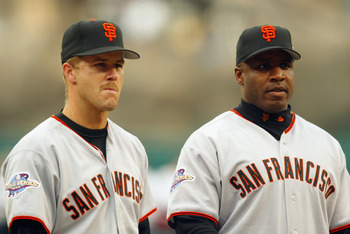


"Bonds and I have played together for five years.  If there is any dislike I don't think we'd be playing together.  So much has been made between the relationship between Barry and me.  We have a good relationship that I think works well on the field.  I think we do a lot of good things together on the field for this team that benefits him and benefits me.  I think you guys try to create a dysfunctional relationship, that's a farce too, because that's not true."

It seems funny that Kent should say that the implied poor relationship was a farce because Kent had previously and publicly said that Bonds was a selfish player who played by his own rules.  Sounds much less than a happy friendship to me.


So why was this being addressed now and why was Kent saying it was no big deal?

The Padres had scored first in the bottom of the first.  Reggie Sanders led off the Giants half of the second with a single but was stranded there.  Then things got bad.  The Padres part of the second started with a Bubba Trammell fly ball.  1 out.  Wiki Gonzalez singled to right and there was a runner on first.  Then things got worse.  There was one out and a runner on first.  Julius Matos hit a routine ground ball to David Bell at third base.  Jeff Kent assumed the play would be at first but Bell wanted to erase the lead runner.  So Kent jogged past second base.  He was shocked when the ball came to him and he was not in position to force the runner.

 Instead of a second out and runner on first, the Padres were in business.  When the next hitter struck out it looked like they might get away with everything.  Instead things got worse.  A single, a walk and two more singles and the Padres now led 5-0.  Mercifully Ray Lankford struck out looking to end the inning but the fun was about to begin.  Things had already gotten bad.  Now they got ugly.

Before Bell reached the dugout he could hear Kent barking.  The exact words were never disclosed but the intent and the meaning were clear.  Kent blamed Bell for the poor inning.  Bell barked right back and the dogs  were unleashed.  Say what you want about Bonds but he was not going to let Bell, or any of his team mates, be bullied.  Bonds stepped in to defend Bell and all hell broke loose. 

Kent and Bonds were arguing (again, no one knows who said what) and then came the push heard around the Bay Area.  Bonds pushed Kent.  Kent pushed back and the dugout was in full movement to separate the two.  Dusty Baker grabbed Kent and trainer Stan Conte grabbed Bonds and moved them towards the opposite ends of the dugout.  Apparently Kent wasn't done.  He said something to the normally quiet Baker and all of a sudden Baker was yelling at Kent.


All this happened while the Giants were supposed to be batting and fighting for a playoff spot.  The Giants batted in the top of the third and with one out Bell doubled.  Ramon Martinez walked and Bonds launched a three run Home Run to right-center.  Kent followed with a ground out and the Giants went on to lose the game.

The Giants would go on to success in the season.  They passed the collapsing Dodgers.  They took out the Braves in the Division Series.  They beat the Cardinals in the NLCS and advanced to the World Series for the first time since 1989.  They were heavily favored in the World Series against the Anaheim Angels.

Bonds, being one of the greatest hitters of all time, did what you would expect.  In his only World Series appearance Bonds hit .471, launched 4 Home Runs, drove in six runs and walked an amazing 13 times.  Kent wasn't terrible but his numbers didn't approach what Bonds did.  Kent hit three home runs, drove in 7 but struck out 7 times and hit .276.  (Just to be clear I am not blaming Jeff Kent for the World Series loss).  In Game 7 Bonds had one hit, Kent had none and the Angels shocked the heavens.


Following the off season the feuding teammates would be separated permanently.  Bonds continued to pound National League pitching into McCovey Cove while Kent moved on to play in Houston.  After two years in Houston Kent moved on to Los Angeles.  As Bonds neared Aaron's record and was well on his way to becoming hated by everyone outside of San Francisco, Kent was becoming hated by just as many.

As the Dodgers struggled toward the close of the 2004 season tensions in the clubhouse grew high.  On August 25th, with Milton Bradley on base, Kent doubled.  As he pulled into second he was shocked to see Bradley standing on third and not touching home plate.  Whatever his motivation, Kent confronted Milton Bradley in the clubhouse and according to the Los Angeles Times there was "an ugly confrontation".  The following day Bradley popped a ball up in the infield.  Bradley sprinted down to first in an exaggerated display of hustle.  After the out was recorded Bradley immediately turned and pointed at someone in the dugout.  The battle was just beginning.

The war of words flew.  Manager Jim Tracy called both players into a meeting and told them both to shut up and play.  Bradley gave an interview saying Kent was a "clubhouse trouble maker".  Kent fired back to defend himself.  Bradley had apparently accused Kent of not being able to deal with African American players because Kent's response was that he had plenty of former African American teammates that were close friends.  If you didn't believe him you could ask his close friend Joe Carter.  To paraphrase Joe Carter's response "Uh, what?  How did I get dragged into this?"  The confrontation ended when Bradley had season ending knee surgery and went home.

Kent remained in Los Angeles and Bradley moved on.  Kent continued to play well and put up near All Star numbers.  As the 2008 season dragged on and the Dodgers appeared to be underachievers yet again, they made a last minute trade deadline move by picking up Manny Ramirez.  Manny immediately destroyed National League pitching and as pitchers tried to avoid giving Manny pitches to hit, Kent's average skyrocketed.  A lot of people noticed, including someone who has watched nearly every Dodgers game since the 1950's, Vin Scully.  Kent heard what Vin thought, that Manny's presence led to Kent seeing better pitches, and he had a strong response.  Shut up Vin.


2008 was Kent's 17th and final season.  He retired as one of the best hitting Second Basemen in history.  His former sparring partner, Bonds had retired the previous season with the most Home Runs for a career (and a season) and a pending criminal case for perjury.  In an era where the public had changed from adoring athletes and overlooking their flaws, they were now villainizing them whenever possible.  Bonds became the most hated.  Every flaw the man had was magnified like the Bat Signal, while every good deed he ever did was ignored.

TRIVIA QUESTION:
Barry Bonds finished his career with 762 career Home Runs.  What three pitchers gave up a) Bonds' first career Home Run, b) Home Run 756 to pass Aaron and c) his final career Home run?

Answer to Last Week's Question:
The Dodgers and Giants moved to the West Coast to start the 1958 season.  The Dodgers faced the Yankees for the first time in the World Series as a West Coast team in 1963 with the Dodgers sweeping the series.  The Yankees faced the Dodgers in the World Series again in 1977, 1978 and 1981.  The Yankees won 1977 and 1978 but the Dodgers won 1981 making them even since the move.  The Giants faced the Yankees in the World Series once (1962) since leaving the East Coast.

Monday, July 1, 2013

Forgiving Baseball's Scapegoats: Bill Buckner

Don't forget to check out the other articles in the "Forgiving Baseball's Scapegoats" Series: Fred MerkleHack WilsonJohnny Pesky, Ralph Branca , Leon Durham and Donnie Moore.

Dave Henderson is always smiling.  At least that's the way every picture you will ever see of him portrays it.  He has one of the most infectious grins you will ever see and it just screams out how much fun this game is.  So you can forgive him if he smiled a little wider as he jogged out to Left Field in Shea Stadium for the bottom of the 10th inning of Game 6 of the 1986 World Series.  He had escaped the baseball grave yard that was Seattle with a late season trade on August 19 and now Dave Henderson had just saved the Red Sox's season for the second time in two weeks.  Just 13 days before the Red Sox were down to their last strike when "Hendu" took Donnie Moore deep to save the year.  Tonight, just a few moments before, Henderson led off the top of the 10th with the a Home Run off of Rick Aguilera.  Just like in Anaheim when he knew it was gone, he did a quick hop, smiled like a little boy, and jogged backwards towards first.  Four batters later the Red Sox added another run when Wade Boggs doubled and Marty Barrett singled him home. 


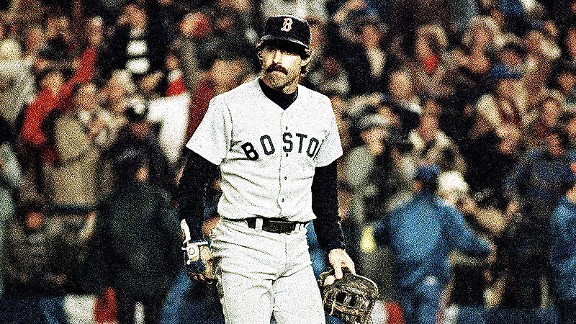
With Barrett on second Bill Buckner stepped in and was hit by a pitch. It hit him right in the hip and it stung.  On a cold October night that pitch hurt but it was fine.  The season was almost over.  As he reached first base he half expected a pinch runner.  With a two run lead and only three outs left he knew he wasn't coming back out for the bottom of the 10th and why take a chance that he would have to try and score if Jim Rice hit a ball in the gap.  There was no movement from the dugout so he stood on first.  When Jim Rice hit a fly ball to Left Field to end the inning he could relax.  In every important game this season, late in the game with a lead, Dave Stapleton took over first base.  Buckner took off his batting helmet and limped toward the visitors dugout but was stunned when the bat boy jogged his glove out to him. 

If you count the one game appearance at the age of 19 for the 1969 Dodgers, Buckner played for 22 years in the majors.  He had a lifetime average of .289 and 2715 hits.  Had he gotten just 13 more hits in each of his 22 years he would have broken the 3000 hit mark.  In 10 of his 22 years he played in less than 130 games, including only 92 during the prime of his career.  In fact, his 2715 hits put him just 6 hits behind Lou Gehrig.  It also places him ahead of at least 105 members of the Hall of Fame including Billy Williams, Fred Clarke, Nellie Foxx, Harry Heilman, Hank Greenberg, Yogi Berra and Ted Williams (2654).  His .289 average puts him ahead of at least 27 other Hall of Fame members including his contemporaries Andre Dawson, Robin Yount, Ryne Sandberg, Dave Winfield and Cal Ripken as well as legends Willie Stargell, Ernie Banks, Ron Santo and Billy Williams. If he had been healthy he surely would have reached the 3000 mark and the Hall of Fame.  He made an All Star team in 1981, received MVP votes five times and finished in the top 10 of MVP voting twice.  He knew, everyone knew, that this could be the end of a great career.  So John McNamara followed his heart, instead of his normal logic, and decided that when the final out of Boston's first World Series win since World War I was recorded Bill Buckner would be in the game at first base.


So there Buckner was.  In the cool Autumn evening in New York he saw the Mets fly out to Right Field and then center field on only seven pitches.  Now there was just one out left and Buckner stood at first.  Just moments from infamy.  Two run lead, two outs and no worries.  The video display board flashed a sign congratulating the Red Sox for their World Series win.  World Champion T-shirts and caps were being placed in each Red Sox locker.  Champagne was on ice and NBC Sports had Bob Costas in the locker room ready to interview the celebrating Red Sox.  The widow of Tom Yawkey was ready to let loose a torrent of emotions, finally celebrating what her husband had tried decades to achieve before succumbing to leukemia.

In the Mets' clubhouse Keith Hernandez sat in the trainers room, having flown out for the second out, with a beer and a cigarette waiting for the inevitable.  There was a shitty little television set and Hernandez sat sipping a beer, watching, thinking, wondering how this season had slipped away. 

Gary Carter kept the inning alive with a single.  Kevin Mitchell followed that with another single and suddenly things were uncomfortable.  Ray Knight singled for the third straight hit and Carter scored.  Boston still had a one run lead and needed only one out.  Even though Mitchell stood only 90 feet away the Mets had to have a clean base hit to score.  A sacrifice wouldn't do it. 


McNamara had seen enough.  He went to the mound and took the ball from Calvin Schiraldi and in came Bob Stanley.  He would face only one batter:  Mookie Wilson.  It was an epic at bat considering what was at stake. 

First pitch was a foul ball and the Mets had just two strikes left.   That was followed by ball one and it was all even.  Ball two and Mookie had the advantage.  Then a pitch fouled off Wilson's foot for strike two.  One strike left and the Red Sox were World Champions.  The next pitch was identical and was fouled off Wilson's foot a second time. That was followed by a third straight foul ball.

Then pitch number eight in the at bat changed everything.  Gedman, Boston's Catcher, set up on the outside corner expecting a pitch that would paint the black of the plate.  Wilson, to this point, had seemed to indicate that he could reach that pitch but not quite put it in play so if he got a hold of it he might do nothing worse than pop it up.  If he missed it or didn't swing at all it was strike three.  Gedman's target was set well before Stanley began his windup.  The pitch came in exactly the opposite of where Gedman, and Wilson, were looking for it.    The fact that it was so far inside confused Wilson.  The replay shows that it did not really come close to hitting him but as he spun out of the way he left his feet to avoid being hit.  As he left his feet the ball bounced off of Gedman's glove.  Wilson stayed on the ground but wildly motioned to Mitchell to run like hell.  Mitchell didn't need any help because he was barreling home.  Wilson gestured madly for Mitchell to slide but Mitchell was a big guy and he would be damned if he would be tagged out by Stanley.  If anything he would knock Stanley on his ass.  That plate was his.  But there was no throw to the plate.  Mitchell scored easily and the game was tied.


Ray Knight took second on the wild pitch and now a single from Wilson and the Mets might actually win it.  The crowd, quiet and sullen when Carter had stepped in to face Schiraldi, were crazed now.  The normal major league pitcher has about three pitches in his arsenal.  Some might have four but not usually more than that.  Having thrown 8 pitches already Wilson had seen everything Stanley had.  Now Gedman and Stanley just needed to catch Wilson guessing wrong on what was coming next.  Pitch number 9 of the at bat was fouled away and everyone settled in for what would possibly be a never ending at bat.  Then came the fateful pitch number ten.  It was put in play.  A small bouncing ground ball.  The kind you get in batting practice.

Have you ever heard 55,000 people go from loud to silent to deafening in a single breath?  Vin Scully had called nearly every great Dodger moment since the 1950's so he probably thought he had seen it all.  But what happened on pitch number 10 surprised even him. 

"Little roller up along first."  Ray Knight was running like hell to third not even looking at the play yet but he thought the game was probably over.  That was until he heard the crowd explode.  He turned his head to see what the hell had caused it.  He couldn't hear a thing except the third base coach yelling "Go! Go!"

"Behind the bag. It gets through Buckner!"  Vin was shocked.  Even he had never seen a game like this.  "Here comes Knight and the Mets win it!"


The Sox were stunned.  They silently gathered their things and walked to the clubhouse.  As Buckner walked off the field he may not have realized the importance of the play just yet.  There was still Game 7.  As the winter months moved on after the Game 7 loss the next night it became clear.  Bill Buckner's error was forever seen as the reason the Red Sox lost.  There are a million reasons you cannot blame Buckner for this loss but here are just a few:

1.  Buckner shouldn't have been on the field.  In games 1-5 Dave Stapleton became a defensive replacement for Buckner three times.  In each of those situations the Red Sox had a late inning lead.  It was fine to let Buckner bat for himself in the Top of the 10th but a pinch runner should have been sent out with the idea of a replacement fielder in the bottom of the 10th.  The pain that he was suffering through was evident to even the casual observer.  Every broadcast of every game pointed out the difficulty that Buckner had in moving around.  It is easy to see why McNamara wanted Buckner out there.  It would  have been a great thing  for Buckner to crown his career by being on the field for the last out but you have to win with the formula that got you there.

2.  Three runs scored in the bottom of the 10th. Only one of them was allowed by Buckner.  After two very quick outs the Mets sent only four more batters to the plate. Three of them scored.  Only one of them by benefit of a base hit.  Carter's base hit was followed by Mitchell's base hit which was followed by Knight's base hit. Carter scored on the single but Mitchell scored on the Wild Pitch . 

3. With Ray Knight at the plate and an 0-1 count he hit a slow roller down the third base line.  Wade Boggs had to make a quick decision: let it roll foul or try to make a play.  Knight was not the fastest runner in the world but he had decent speed.  Boggs decided to let the ball roll foul instead of making a play.  It was probably the smart play but knowing how things turned out it certainly would have changed things.  Had he fielded it and Knight had been safe the bases would be loaded with two outs but no runs would have scored.  Of course Boggs couldn't know that Knight would bang a single to center on the next pitch or that Mitchell would take the extra base and score on a wild pitch.  Had Boggs made the play Wilson may or may not have faced Stanley.

4.  Knight did a nice piece of hitting.  On an 0-2 count Knight had to protect the plate.  The pitch came in on the hands.  It was definitely a strike and Knight's swing was not the most beautiful but he fought off a very good pitch to drop a single into center field extending the inning and allowing Wilson to come to  the plate.

5.  In order for Buckner's error to lose the game Kevin Mitchell had to score from third on Stanley's wild pitch.  Mitchell, throughout history, has gained a reputation for being a difficult team mate, hard to deal with and not the brightest of baseball minds but you wouldn't be able to tell from this play.  When Knight knocked a  little bloop single into center with two outs Mitchell probably should have held at second.  Mitchell had good speed and he made a very smart aggressive decision in advancing to third base.  Aggressive base runners can sometimes appear foolish if they are thrown out but just like Enos Slaughter's mad dash, Mitchell decided to challenge the arms of the Red Sox outfielders and beat them easily.  A less aggressive runner would have stayed at second, meaning the Passed Ball  would have only advanced the runners to third and second.  It would not have tied the game.

6.  Wilson likely would have beaten the ball to the bag.   Wilson had great speed.  When the ball was hit he was tearing down the line.  With Buckner playing off the line he had to take several aching steps to reach the proximity of the ball.  Fielding the ball and beating Mookie to the bag was not an option.  He would have needed Bob Stanley over to the bag to cover.  On the video review Stanley appears to take a few steps towards first but for some reason he never enters the picture when Wilson is sprinting down the line.  That is because he has assumed Buckner has it.  Wilson knew that he could beat Buckner but  he felt that he would need to also beat Stanley to make it safely.  "My only thought was to beat the pitcher there.  I thought I had a good chance to beat the pitcher and I think Buckner saw that too and maybe he tried to rush a little bit."

7.  The Mets knew Calvin Schiraldi.  Calvin Schiraldi was drafted by the Mets in 1983 and played for them until 1985.  He had played with most of these same players. They clearly knew his tendencies and patterns.  They knew what pitches he had available and where he liked to throw them.  Schiraldi was put on the mound 7 times during the 1986 post season (including four against the Angels in the ALCS) and lost three games.  Schiraldi pitched just four innings in the World Series but gave up six earned runs. 

8.  The Red Sox had a lead late into Game 7 with their ace on the mound.  Just before the debacle that was the 10th inning of Game 6 turned into legend, an announcement had been made in the press box: Bruce Hurst had been named the World Series MVP. When the team collapsed over the next four batters Hurst was given a chance to improve on his already impressive numbers.  In the second inning the Red Sox jumped out to a 3-0 lead on back to back Home Runs from Dwight Evans and Barrett and an RBI single by Boggs.  At that point any momentum that was lost in Buckner's error the night before had swung back to the Red Sox.  Hurst was spectacular through 5 1/3 innings having allowed only one hit and no walks.  With one out in the bottom of the sixth it fell apart and he allowed three hits and a walk leading to three runs that tied the game.  He left after the sixth with the game tied and the Sox brought in none other than Calvin Schiraldi.  Schiraldi faced four batters only getting one out on a sacrifice bunt.  The other batters hit a solo home run, a single, a wild pitch scored a run, and another single. By the time Schiraldi left the game, the Mets had a two run lead.  One more of his runners would score after Schiraldi left giving him the loss in an 8-5 defeat.