Saturday, September 6, 2014

The End of an Era: Bud Selig's Retirement Tour

The office of baseball commissioner was created out of necessity.  As the Major Leagues tried to get a handle on what would result from the Black Sox gambling scandal they realized they needed to find a way to show the public that they were working to clean up the sport.  The fear was that the public would think the games they were watching were pre-determined or could be thrown at any time with no consequence and no one would want to go watch.

Both leagues already had League Presidents, however, petty personal arguments between individual owners and the League Presidents had led to embarrassing situations.  The leagues needed a higher authority that would bring all of the teams under one command.  The man they chose to do so was Judge Kennesaw Mountain Landis.  Landis was tough. He would accept no nonsense in his court and his say was final.  Landis changed baseball for the better in many ways.  He was dedicated to weed out the corrupt, although, some have felt that he went too far in some cases.  He suspended players like Mickey Owens of the Dodgers who went to play in the Mexican Leagues.  He told the public that there was no rules on the books saying that African Americans could not be signed to play in the majors but made sure the owners knew (as if most of them wanted to anyway) that it was not a good idea.  Landis served until 1944.


The role and the reception of the commissioner since Landis's term has changed.  Some commissioners have made major changes.  Some have fought to make sure there was no change.  Some made decisions that angered many people.  Ford Frick was the commissioner who decided to put the * next to Roger Maris's Home Run record.  Bowie Kuhn was the commissioner who allowed the American League to create the Designated Hitter while the National League refused.


The true path to Bud Selig's term in office began in 1989.  A. Bartlett Giamatti took over as Commissioner in April of that year and was immediately faced with the Pete Rose betting scandal.  This led to the unfortunate (but correct) decision of banning Pete Rose from baseball and the stress of the situation led to Giamatti having a heart attack.  His replacement, Fay Vincent, was a purist.  As the NFL, NHL and NBA gained in popularity, Vincent believed MLB could win fans by simply providing the same product that had always been provided.  No improvements, no changes, no pandering to less than traditional fans.


The owners saw the popularity of the sport diminishing and saw they needed to find a way to get back on top.  With a traditionalist like Vincent in office there was little chance of that happening.  They wanted someone who was open to change in situations where it would improve the game and not someone who would make change for change's sake.  While the league looked for someone to become that man, they placed H. Bud Selig, owner of the Milwaukee Brewers, in place as the acting commissioner in 1992.
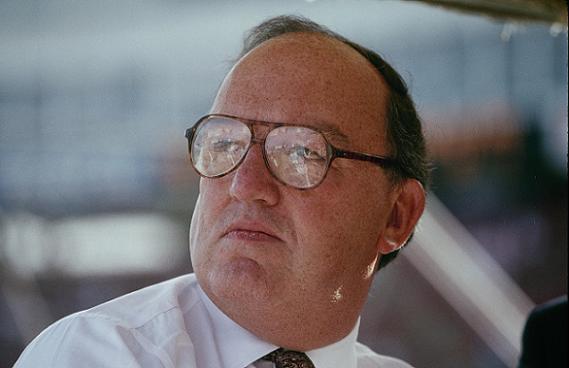


Bud Selig is truly a testament to what you can do if you work hard and persevere.  The Selig's lived in Milwaukee for years and when the Boston Braves came to town Selig couldn't wait.  He ran a successful car dealership in Milwaukee and bought as much public stock in the Braves as he could.  He became very close friends with many of the players including Hank Aaron and when the team moved  to Atlanta he was devastated.  He was determined to prove that the city was worthy of a Major League Baseball team.

The league expanded in 1969 creating the Kansas City Royals and the Seattle Pilots.  The Royals were not a contending organization in their first year but they were run so that they could stay afloat.  The Pilots, on the other hand, were not run efficiently. In Jim Bouton's book "Ball Four" he describes the fear of being part of an expansion team when he prays that they don't end up worse than the 1962 Mets.  In terms of play and  overall record his prayers were answered.  In terms of legacy, they are worse in some ways.  The ownership group was so ineffective that they lasted only one year.  At the 1969 World Series, while the Mets were shedding their reputation as lovable losers, the Seattle Pilots, only one year old, were being sold to Bud Selig of Milwaukee.  The Pilots were moved to Milwaukee and named the Milwaukee Brewers.

The team had their ups and downs through the years.  They struggled to find an identity at first but they drafted smart and built a core of young players with Robin Yount, Paul Molitor, Jim Gantner and Teddy Higuera.

Selig's tenure as acting commissioner started out rough.  Within two years of taking office he was faced with the crisis of the players' strike/lockout that ended the 1994 season without a World Series.  What is lost in the darkness of the strike is the progress that was made in the league in just the few short years that Selig took over.  The league expanded and added the Colorado Rockies and Florida Marlins to the league in 1993.  In 1994, although it did not get past the theoretical stage because of the work stoppage, the Wild Card berth was put in place as the league moved to the three division format.


Selig has guided the baseball ship through a time of rough waters in sports.  Selig took over at a time when sports figures like Charles Barkley were demanding that they not be treated as role models as they got into bar fights, got arrested for DUI's and spit on fans.  The NBA was in what could arguably be called the golden age with the rivalries of Bird, Magic, Jordan, Barkley, Drexel and Olajuwon.  The NFL was starting to see the rebirth of the Cowboys and 49'ers rivalry as well as a resurgence of classic champions in Pittsburgh and Green Bay.  Football started to dominate the airwaves in television and radio.  The NHL was even making strides with a national television contract with FOX network and the reign of Gretzky, Lemieux, Messier, Hasek and Roy.  Baseball was in danger of becoming the fourth major sport.

I will never claim to agree with every decision that Selig has ever made.  The biggest one I disagree with is the changes to the All Star Game, however, the game is clearly better off than it was when Selig took over.  He is the exact opposite of Faye Vincent.  I have nothing against Vincent.  I believe that Vincent had the best interest of baseball in mind when he was in charge, however, I also feel that he was a bit too much of a conservative.


Selig has been a bit of a cautionary visionary.  He has made the changes with what he has believed to be the best interest of the game in mind.  He has done it intelligently, logically and (for the most part) ethically.  Instead of just seemingly making snap decisions he has floated ideas to the public, listened to fan reaction and implemented a fair balance between what the fans wanted and what was best for the game.  Here are just some of the changes that have gone into effect during Selig's tenure:

  • National television contracts, Major League Baseball Network, Sirius/XM Satellite radio, MLB.com and MLB Deportes allowing everyone access to baseball at all times of the day.  There is literally not one second of your life that you cannot find baseball somewhere.
  • An improved MLB Video department that now (my personal opinion) has surpassed the legendary NFL Films.  Baseball now offers home video collections of full World Series, highlight packages and special documentaries.  They also produce tremendous documentaries exclusively for MLB Network.
  • Interleague Play.  I personally struggle with this at times as I think it sometimes takes away from the special match up of the World Series, however, Interleague Play has plenty of advantages as well.  Before Interleague Play, the only chance a fan in Seattle, as an example, would have had to watch a player like Albert Pujols or Tony Gwynn would have been on TV.  With Interleague Play every fan in every city has a chance to see every team at some point.  
  • Wild Card rounds. Until Selig took over the playoffs were the division winners.  As the league continued to grow it also became more and more competitive. Teams just entering the league were beginning to compete almost immediately.  As teams in one division were finishing second or third, they were still finishing with a better record than teams at the top of other divisions.  The Wild Card allowed additional worthy teams to continue their successful seasons.  It also allows cities that were out of the division race long before the end of the season the chance to stay in the playoff race and continue to generate excitement for the team.
  • Meaningful All Star Games.  Baseball has always been the sport that understood the point of the All Star Game.  It is an exhibition that  allows the sport to showcase the best and the brightest against each other.  It allows the country as a whole to see the best players in that season and to see what they can do.  While the NHL, who normally has scores of 3-2 in regular season games has an All Star Game with each team scoring double digits.  The NBA turns their All Star Game into a dunk contest and the NFL might as well take their defenses off the field for the Pro Bowl, MLB has always had an exciting, competitive and fun All Star celebration.  In 2002 the game was tied and all players had been used from both sides.  Selig had to make a decision and , in the situation, made the right one. He declared the game a tie.  Obviously, the fact that people were upset that neither side won proves that the league gets their All Star game right. If it was the Pro Bowl called a tie would anyone notice? The fact that Selig took into account the greater good of the long second half of the season and how extending the game could effect the teams in a pennant race shows that he understood the meaning of the game.  To avoid having this issue again, he decided to ratchet up the intensity of the All Star Game by giving home field advantage in the World Series to the representative of the winning team.
  •  42 retirement.  Baseball has always been the best league at celebrating the history of their sport.  Selig knew that it was impossible to ignore that the legacy of Jackie Robinson was one of the most important legacies in history (not just in sports).  Working with a number of groups, Selig paid tribute to Jackie and his impact on the sport as a whole, not just the Dodger organization,by retiring the number 42 league wide.
  • Steroid testing.  There were (and are) a lot of road blocks to having drug testing and a penalty system for violators.  It took too long to get this into place ( I will not argue that) but Selig is not the only one to blame for the delay.  The Player's Union refused to cooperate for a very long time.  The fans also play a big part in the delay as there was no outrage from the fans as the Home Run numbers started to climb.  In fact, it increased attendance.  Now that the league has been able to put the system in place they are able to strengthen the penalties as they go along.
  • Longest stretch of uninterrupted labor peace.  As mentioned before, the start of Selig's tenure was rocky with the 1994 strike.  Since then the NHL has had two strikes (and almost lost two full seasons), the NBA has had two strikes and lost a significant portion of several seasons and the NFL has had a strike which has caused many fans to lose interest in the sport.  The NFL strike has even opened more wounds between the players, league and fans that could lead to even bigger problems when the next CBA comes around.  Since 1994, however, despite the issues faced by the sport, the league has been able to find compromise between the owners, league and player's union and avoid lockouts and strikes.  That also does not mean that there are issues that could cause serious issues when the next CBA comes up but for now there is labor peace.
  • World Baseball Classic:  Some love the WBC.  Others (Dodgers fans were not thrilled when Hanley Ramirez got injured in the 2013 WBC) hate it.  Regardless, it is a great idea.  The point of the WBC is to celebrate the game of baseball worldwide.  While football is strictly an American sport, America's true national past time, baseball is an international sport that has branched far beyond the small town beginnings of America.
  • Instant Replay:  This is still an ongoing, growing process.  It started with plays like the Wild Card Playoff game between the Padres and Rockies in 2007 and the near perfect game by Armando Galaraga of Detroit.  The league first implemented a dispute system late in the 2008 season which has evolved into the new system put into place this year.  There are still significant flaws in the system that will be corrected as the process grows,
  • Community Outreach:  The league has obviously given back to the community long before Bud Selig took office as commissioner.  The scope of the league's involvement has dramatically increased under Selig.  The league now sponsors special events like the Breast Cancer Awareness week around Mother's Day where players use pink hats, shoes, wrist bands, etc.  Stand Up to Cancer campaigns.  Youth Baseball programs.  The construction of parks and ball fields around the country.  Environmental awareness campaigns.And many other.
  • Revenue Sharing:  It is not a perfect system, but when the league threatened to become the Yankees-Red Sox-Braves league smaller teams like the Twins, Brewers, Royals, Expos and Tigers came near to being obsolete.  There was threat of contraction with the Twins being the main focus of being left out of the league.  Revenue sharing has allowed for teams to more evenly compete for free agents and has allowed teams like The Nationals, Orioles, Reds, Brewers, Royals, Pirates, Rangers and even the Twins to build a successful team that could compete with the big money.
Not every move that Selig has made has worked out.  I don't agree with all of the decisions he has made.  You can dispute whether making the All Star Game count was right.  You can dispute whether Instant Replay will succeed.  You can debate whether suspending the final game of the 2008 World Series mid-game was the right decision.  What cannot be debated is that the league has changed for the better under Selig's watch because of Selig's ethical and well planned changes to the league with the best interest of the sport in mind.

TRIVIA QUESTION:
Judge Kennesaw Mountain Landis was the first baseball commissioner.  Who were the league presidents when he was appointed commissioner?

Answer to Last Week's Question:
Congratulations to TJD for answering correctly.
Bob Gibson won 7 World Series games tying him with Allie Reynolds and Red Ruffing (both Yankees) for second most all time.  Just behind them with six wins are Chief Bender of the A's, Waite Hoyt of the Yankees and Lefty Gomez of the Yankees.
But ahead of all of them with 10 World Series wins as a pitcher was Whitey Ford.  In 11 different World Series Ford went 10-8.

Sunday, August 24, 2014

Players I Love More Than I Should: Pitcher: Bob Gibson

More than 18,000 players have appeared in Major League Baseball games since the start of the league.  Some players have short careers that last one at bat or one appearance in the field.  Others have 20+ year careers.  As I read more and more about baseball history there are certain players I find myself enjoying reading about more than others.  It is obviously illogical since many of them retired, or in some cases passed away, long before I was even born.  I have no first hand experience in watching some of them play but for whatever reason their personalities and perseverance strikes me above and beyond the other players I read about.  Over the next few weeks I will be giving you short biographical histories*of some of these players.  Some of them will be Hall of Fame players.  Some of them will be players only casual fans may know.  Regardless, I chose one player from each position for this series to explore.  This week we will explore one of the Pitchers I chose for the series and the final player in this series: Bob Gibson.

If you are just joining the blog don't miss the other players in the Players I Love More Than I Should series: Yogi BerraHank GreenbergJoe MorganCal Ripken, Frank "Home Run" Baker,  Frank Robinson and Larry Herndon, Carl Furillo and Walter Johnson.

287 1/3 regular season innings.  By today's standards he would have been over worked.  287 1/3 innings as the ace of the staff in the middle of a pennant race.  287 1/3 regular season innings with the gaining pressure of a team chasing down a curmbling team ahead of them that really only needed a few wins to end the conversation.  287 1/3 regular season innings plus 8 more in the pressure of the World Series.  Facing the unbeatable Yankees who beat him in Game 2 of the 1964 World Series.  287 1/3 regular season innings plus 8 pressure filled innings in  Game 2 plus 8 pressure filled innings so far today.


Now it was the 9th inning with a two run lead.  He needed just three outs.  Mantle led off and grounded to Dick Groat.  He breathed a sigh of relief.  One out...oh shit.  Groat bobbled the ball and Mantle was safe.  One on no one out.  No problem.  Elston Howard struck out and in sauntered Joe Peppitone.  No one had more confidence in Joe Peppitone than Joe Peppitone.  Gibson's arm was exhausted.  He had thrown nothing but fastballs. curves and sliders all day.  He decided to sneak a change up past Pepitone.

He went into his motion.  The leg, arms and body moved back, almost as though he were retreating.  The hand and glove almost met behind his back.  Then just as quickly and aggressively they swung forward, the leg went up and the body lunged, aggressively, straight towards the batter.  As he followed through his whole body was falling towards first base.  Pep swung, connected and lined a shot straight back towards Gibson.  Pepitone could not have aimed a shot any better.  With Mantle on the run, the ball hit Gibson on the hip and shot away from him towards third.  Think about it.  A hard, solid object, thrown at close to 90 miles per hour and shot solidly straight back at a human being connected solidly against the bone.  I don't know about you but my first thought would probably be "I think I just broke my hip."  Instead, Gibson thought this could mean the ball game.  He reacted immediately.  Turning, chasing down the ball, He scooped it bare handed, momentum carrying him away from first base.  His balance was off, his throw had to be hurried.  He was falling toward the ground and calmly, cooly, Gibson sidearmed the ball to first base to get Pepitone.  He was still in danger but as the game finished, the importance of the play on the game, on the series and on the legend of Bob Gibson would become clear.  He gave up a game tying two run Home Run to Tom Tresh immediately after but the play to retire Pepitone kept it from being a three run, game winning Home Run.  Instead, Tim McCarver hit a three run Home Run in the 10th and Gibson stopped the Yankees in the bottom of the inning for his first World Series victory.  It would be quite some time before he would lose another World Series game.

The Education of Bob Gibson
The greatest athletes off all time often have a heartbreaking experience they have overcome to reach the heights.  Babe Ruth grew up poor and was eventually sent to a reform school.  Mickey Mantle nearly lost his life several times to a rare blood disease and nearly had a leg amputated as a child.  Bob Gibson beat them all, in every sense of the phrase.  Three months before he was born his father died.  As a child he was nearly killed by pneumonia.  He grew up in a housing project where his mother worked long hours to keep her family fed.  

Luckily, Bob Gibson had a very special person in his life.  His brother was that special person.  He had a masters degree in history.  Unfortunately, in the society they were brought up in, an African American with a master's degree was qualified only to work in a factory for low wages.  Of course it bothered him but he had a special talent to teach and he would do it anyway he could.  Gibson's brother LeRoy coached the local YMCA baseball and basketball teams and what was more, he mentored the young kids he coached.

He taught Bob how to act in society.  He taught him not to smoke.  He taught him not to spit like the other ball players he would see and he pushed Bob to get the most out of his talent.  Bob was tealented at both baseball and basketball.  After being rejected by the University of Indiana because they had already met their quota of African American players (why would they need more than one?) LeRoy used his connections to help get Gibson accepted at Creighton University.  He was spectacular in both Baseball and Basketball.  He was offered a contract with the Harlem Globetrotters.  He rejected it. He graduated college and as he did his brother used another connection, a scout for the Cardinal's organization.  The scout saw potential in Gibson, and so did minor league manager Johnny Keane.  The question was not whether Gibson could play it was where should he play.  Keane told the Cardinals to start him as a pitcher because if he didn't make it as a pitcher he could start immediately as a shortstop.


Flying High
The Cardinals had a winning tradition.  The long list of legends of the National League included dozens of Cardinals players.  Frankie Frisch, Rogers Hornsby, Jim Bottomley, Dizzy Dean, Pepper Martin, Enos Slaughter, Red Schoendienst, Stan Musial.  The team started off poorly in the basement of the early days of the National League but since 1926 the team (along with the Giants and Dodgers) were one of the dominant teams in the league.  1926, 1928, 1930, 1931, 1934, 1942, 1943, 1944, 1946.  They had made the World Series in each of those years and when they didn't win the NL they were usually close on the heels of the other team.  As the years went on the big names grew older and the replacements could not keep up with the Dodgers and Braves.

A big part of that rebuilding was Bob Gibson.  He reported for his first professional season in 1957 and was told to pitch batting practice.  The point of batting practice is to let the hitters relax, see easy pitches and work on their swing.  So Gibson tried to oblige.  After the hitters continuously failed Gibson was told to start throwing breaking balls. The hitters still failed.  Not wanting to demoralize his team mates who couldn't even hit batting practice, Gibson was waived off the mound.  "Should I start to throw hard?" he asked as he was waived off.

Rookie ball and A level baseball is more important as a learning experience and Gibson was learning.  The Cardinals, although angering Gibson for years, made the right choice by under paying for his services.  While Sandy Koufax was required to stay on the Major League roster of a team in a constant pennant chase, he spent several years watching and getting little practical experience.  Gibson, meanwhile, was pitching in live games and learning how to control his pitches.  His first year numbers were not spectacular but the increased control was the main thing.

He played three and a half years in the Cardinals organization, even getting to play for his home town Omaha Cardinals for several years.  His manager there for the first two years was Johnny Keane, a man Gibson credited with helping him along greatly in his career and a man who would play a big part in Bob's career later on.  When Keane moved up to the big league club as a third base coach, he was replaced by the ill-fated Joe Schultz who would later manage the doomed Seattle Pilots in their only year.

By 1959 Bob was up in the majors and made his debut on on April 15, 1959.  The game was started by Larry Jackson, facing off against Don Drysdale and the Los Angeles Dodgers.  Gibson entered the game trailing 3-0.  He faced the Dodgers third baseman Jim Baxes as the first batter of his career.  Baxes would play one year in the Major Leagues.  He would hit a total of 17 Home Runs that year.  One of those Home Runs came on a 2-0 pitch against Bob Gibson.  That's right.  The first batter ever to face Bob Gibson in the major leagues took him deep.

It got better, obviously.  Other wise there wouldn't be a need for me to write this article.  Gibson would call it the worst point of his career and a big part of that had to do with the manager.  Solly Hemus was not a man easy to get along with.  He often had violent outbursts and would curse players out in front of the team.  Gibson was 3-5 in 1959, his first year in the majors.  He was 3-6 in 1960.  1961 saw him start off slow as well.  After a 2-0 start he was at 5-5 on July 4 when the Cardinals decided a change was in order.  Solly Hemus, at 33-41 for the season, was fired and replaced with Gibson's old minor league manager Johnny Keane.  On July 5, the very next day, Gibson won a  complete game against the Dodgers and finished the season with 13-12 record, including winning 5 of his last 7.

1962 saw the emergence of Gibson as a rising star.  He was starting to feel comfortable in the club house and starting to make a mark on the organization.  On July 8 Gibson pitched a complete game 3 hitter against the Mets.  It improved his record to 10-6 and he represented the Cardinals in the All Star game for the first time.  He went 15-13 (with five shut outs) for the year and topped 200  strikeouts for  the first time in his career.

1963 was an even better year. The team was still not great but Gibson was proving he was special.  Everything went up.  His wins (18), his innings (254 2/3) and one other number that was starting to raise eyebrows, his hit by pitch (13).  Gibson was getting a reputation for his willingness to throw at hitters.  He owned the plate and anyone with a bat in his hand was the enemy.  He hated seeing a batter dig in with his spikes.  It was insulting. It silently sent a message that said "I am comfortable at the plate, like I'm at home."  Gibson sent a silent message right back.  "Don't get too comfortable.  This is my territory."  He said it with a pitch aimed at the batter.  The reputation was well deserved.  He certainly was not shy about moving a hitter off the plate.  The reputation of meanness was not well deserved.  Away from the mound he was not the angry, hate filled, vicious man he was portrayed as on the mound.  He was an intelligent clubhouse leader and a family man.  He set the tone for the clubhouse.  He would let the young kids know what was expected of them without calling them out in public.  He also set the tone for the game.  It was his game to win, his game to lose and it belonged to him.  He hated when a catcher or manager came out to the mound.  It was a poor situation for McCarver being stuck between Keane and Gibson.  Keane wanted Gibson to slow down.  Gibson knew what he wanted to do and didn't want to wait.  He pitched like he was running a no huddle offense.  Get the ball, go into the wind up fire the ball.  Repeat.  When Keane would tell McCarver to get out there and slow him down Gibson would tell McCarver to get back behind the plate.  He once told McCarver "the only thing you know about pitching is that you can't hit it."  Once McCarver walked out to remind Gibson of the game situation and when he told Gibson there was a man on third Gibson yelled back "I know he's there. I put him there."


1964 started off as a tough year.  He was 4-0  to start but by the All Star Break he was 7-6 and the team was struggling.  With Koufax and Drysdale suffering, the Cardinals thought they had a real shot at the pennant.  Instead it was the Phillies who were out front of the league.  He fell to 8-9 on August 1st as the Phillies maintaiined their lead. Over the next two months he would rarely start on full rest and he would rarely lose.  He lost on October 2nd making it more possible the Phillies would be in the World Series.  He took the day off on October 3rd and then on October 4 he came back, pitched four innings and the Cardinals won 11-5.  It was enough to put the Cardinals in the World Series.  Gibson not only won the fifth game by going ten innings, he won Game 7 with a complete game victory.  The loss sent the Yankees into one of the darkest periods of their existence.

Despite the surprise World Series win, the Cardinals fired Johnny Keane, who went on to a disastrous term as manager of the Yankees.  His replacement in St.Louis was Red Schoendienst, former Cardinals and Braves second baseman and future Hall of Famer.  Gibson had another stellar year (20-12, 270 strikeouts and 6 shutouts) but Curt Simmons and Ray Sadecki, two big winners in the pennant run the previous year, fell off drastically. Simmons fell to 9-15 and Sadecki fell off to 6-15.  This, combined with a "healthy" Koufax and Drysdale led to a Dodgers victory.  St. Louis finished 7th at 80-81,  1966 was a better year for Bob. He went 21-12 and dropped his ERA from 3.07 in 1965 to 2.44 in 1966.   In both seasons he made the All Star Game and won two consecutive Gold Gloves.  The Cardinals finished sixth as the Dodgers again dominated the league.

1967 was looking like another strong Bob Gibson year.  He had just appeared in his fourth straight All Star Game and his Cardinals were four games ahead in the NL.  On July 15, with his record at 10-6, Gibson started against the Pittsburgh Pirates.  With one out in the fourth Roberto Clemente shot a ball straight back at Gibson which shattered his fibula.  After completing the inning Gibson collapsed in pain.  He would be out until September 7.  He would return and win three of his final four decisions for a 13-7 record.  Despite the missed time Gison won another Gold Glove and the Cardinals ran away with the NL title.  They faced the "Impossible Dream" Red Sox in the World Series.  As the clear ace of the staff Gibson started Game 1.  He allowed only six hits in the complete game, one of which was a solo Home Run to the opposing starter, Jose Santiago (who also pitched a great game) and Gibson won 2-1.  Gibson and Santiago faced off again in Game 4 with the Cardinals ahead 2-1 in the series.  Santiago lasted only 2/3 of an inning this time as he allowed four first inning runs. Gibson, on the other hand, continued to show he was the best pitcher in baseball.  He allowed only 5 hits, struck out 6, walked only one and shut out the Red Sox 6-0.  It looked like it would be his last game of the season as the Cardinals were now ahead 3-1.  A young Steve Carlton allowed only one run in seven innings in Game 5 but the Red Sox still beat him by a final score of 3-1.  Game 6 was much less of a pitcher's duel as the Cardinals used 8 pitchers and lost 8-4, setting up a final face off in Game 7.  Gibson started against the Red Sox ace Jim Lonborg.  Gibson was on top of his game. The Cardinals scored two in the top of the third while the Red Sox struggled to get a man on base.  In the top of the 5th, with the score still 2-0, Gibson helped his own cause with a solo Home Run.  Another run that inning gave the Cardinals a 4-0 lead.  The Cards would go on to win 7-2.  It was Gibson's fifth straight World Series win making him 5-1 in World Series play.  It was just a warm up for what was to come.


The Year of the Pitcher
There are certain years when players are able to put it all together and somehow create a special year that is talked about for generations.  Babe Ruth hit 60 Home Runs.  Joe DiMaggio hit in 56 straight.  Ted Williams hit .401.  Roger Maris hit 61 Home Runs.  1968 was known as the year of the pitcher and just as easily could have been called the year of Gibson.  In the American League, the Tigers won the title behind the 30 wins of Denny McLaine.  No one has won 30 games since. In the National League no one could touch Gibson.  Seemingly showing no effects from the broken leg the year before, Gibson was at the top of his game.  It was clearly his best year ever.  In fact it is arguably the best year of any pitcher ever.  What's more amazing is that if his team's offense (and defense) were better he would have had an even better year.  Gibson started opening day and left after 7 innings.  He had allowed one unearned run.  The team won 2-1 but the scoring came too late to give Gibson the win.  His second start was similar.  He pitched seven innings, allowed only three runs, the team won but he got a no decision.  In his third start he got his first decision, a loss, as he allowed only three earned runs but lost 5-3.  In fact, if you were following Gibson in the papers there was little in the first month to make anyone think this was a magical season.  By May 28 Gibson had a 1.48 ERA but his record stood at 3-5.  That is where the turn around began.  Through the rest of the year the Cardinals and Gibson would dominate the league.  He would finish with a record of 22-9 (giving him an unbeleivable 19-4 record from July through October) and his strike out total was 268.  Even more amazing was the fact that in over 300 innings he had allowed only 38 earned runs.  He threw 28 complete games. 13 of those were shutouts.  Of the five losses in the first months, twice his own team was shutout while he allowed 2 or less runs.

It was an unbelievable year but it was just getting started.  The World Series was still to come.  Gibson started Game 1 of the World Series aginst the Tigers ace Denny McLaine.  McLaine was sabotaged by Tigers fielding but it would have mattered little.  Dominant is too light a word to describe Gibson that day.  As he struck out his record 17th batter of the day the crowd went nuts.  Tim McCarver stood up to draw Gibson's attention to the feat but Gibson didn't care.  He still had a game to finish.  He did.  The Cardinals won and no one has approached the 17 k's in a single World Series game since.  He allowed only five hits and one walk in winning his sixth straight World Series game.  He would win a seventh straight World Series game to give the Cardinals a 3-1 series lead.  He again dominated allowing only 5 hits, although the Tigers did score on him this time.  Just like the Red Sox had done the year before, the Tigers came back to force a Game 7 and this time Gibson would face Mickey Lolich.  Each had won two games in the series but realistically the Cardinals had the best pitcher in the world on the mound.  He again dominated but just like the first month of the season, his team didn't score.  Lolich outpitched Gibson (barely) and with the help of some shadows leading to a misplay by the best fielding centerfielder in the game. the Tigers won by a final score of 4-1.  It ended Gibson's record World Series winning streak at 6 games and it was his last taste of the post season.  Regardless the 1968 season is still the benchmark that any successful pitching season is judged.  Gibson's 1.12 ERA has never really been approached and he won the MVP, Cy Young and his fourth straight Gold Glove.

The Legend
The Cardinals run at the top was finished as the Mets, Pirates and even Phillies would dominate the Eastern Division for the next ten years.  Gibson continued to pitch amazingly but the team around him continued to decline.  Curt Flood, Bill White, Roger Maris, Clete Boyer and even McCarver moved on and the players replacing them did not perform as expected.  Still Gibson performed at a high level.  He won 20 games in 1969 and 1970.  He continued to rack up a high number of innings, a high number of strikeouts and a low ERA.  His 1969 ERA was only 2.18.  He won his second Cy Young award in 1970 with a 23-7 record and a 3.12 ERA.   All the while he continued to be selected for the All Star Game and win Gold Gloves.

He struggled in 1974 to an 11-13 record and the years of high inning totals started to take their toll.  He fell off farther in 1975 to 3-10 with a 5.04 ERA and he decided it was time to walk away.  His career totals are nothing short of amazing.  251 wins, 56 shutouts, nearly 4000 innings pitched (he averaged 262 innings a year), 3117 strikeouts and a 2.91 ERA.  That does not include his amazing performances in the postseason bringing the Cardinals 2 World Series and nearly a third.  During the decade of the 1960's, in the post Stan Musial era, Bob Gibson defined the Cardinals as a class organization and class was the best way to describe Gibson himself.


Gibson sometimes had a rough relationship with the media.  He once told a reporter who asked him if he was a "money pitcher" that it was the dumbest question he had ever heard of.  Possibly because of this he received a low 85% vote in his first year of eligibility for the Hall of Fame.  It was enough to get him into the Hall of Fame (and I admit this is a petty complaint) but who the hell didn't think Bob Gibson was a Hall of Fame pitcher?  Gibson was the only player voted in that year (despite Harmon Killebrew and Don Drysdale on the ballot).  Gibson is still active in the Cardinals organization aBond can (fortunately for all of us) still be seen occasionally on MLB Network or in occassional appearances during Cardinal broadcasts.

Bob Gibson was truly one of the greatest pitchers of all time and one of the greatest ambassadors of the game that the sport has ever known.


*This is not intended as a full biography and due to space I have done my best to summarize the life of the players in this series.  For further information on Bob Gibson please check out
Videos:
Ken Burns Baseball
The Official World Series Film Collection

Websites:
http://www.baseball-reference.com/
http://www.baseball-almanac.com/
http://sabr.org/

Books:
October 1964 by Daid Halberstam
Five Seasons by Roger Angell
The Summer Game by Roger Angell

TRIVIA QUESTION:
Bob Gibson won seven World Series Games in his career tying him with Red Ruffing (1932, 1936, 1937, 1938, 1939, 1941 and 1942 Yankees)  and Allie Reynolds (1947, 1949, 1950, 1951 ,1952 and 1953 Yankees) for second on the All Time List.  What Pitcher has won the most World Series Games?

Answer to Last Week's Trivia Question:
Congratulations to TJD for again answering last week's trivia question right.  
The correct answer last week was  William Howard Taft


Sunday, August 17, 2014

Baseball! Celebrating Our Great American Past Time


With apologies to readers who are outside the Southern California area, this week's article will be a bit of an advertisement for a great exhibit I recently experienced first hand.  The Ronald Reagan Presidential Library and Museum is currently presenting an exhibit titled "Baseball! Celebrating Our Great American Past Time".  The local NBC 4 station has been showing the NBC 4 Promo for Baseball Exhibit for weeks.  I had seen commercials on the local news for months leading up to my visit so it was just a matter of convincing the rest of the family that it was something we all needed to see.  The Reagan Library was the perfect place to host this exhibit since Reagan himself was such a big baseball fan.

My first instinct was to skip all the Reagan stuff and shuffle right through to the Baseball exhibit but I'm glad I took my time and went through the whole museum.  Immediately upon entering the Reagan family history section there were pictures of Reagan's father as a member of the local baseball team, as well as a young Ronald on the local team.

Reagan has a strong connection to the sport.  From 1933 through 1936 Reagan was the play by play announcer for the Chicago Cubs.  This stint included the Cubs 1935 appearance in the World Series where they lost to Hank Greenberg and the Detroit Tigers.  There is even an interactive option where visitors can recreate Reagan's call of Chuck Klein's game winning Home Run in the third inning of  Game 5 of that series.


As interesting as the Reagan section was, as a baseball fan I was obviously most interested in the baseball section.

When first entering the Baseball exhibit there is a section specifically related to Reagan and baseball.  It includes movie posters of "The Winning Team" where Reagan portrayed Grover Cleveland Alexander.  The display for this movie also included Alexanders actual glove as well as a ball used by Alexander.  The introductory section also included the authographed baseballs presented to the President by the World Series winners during his presidency.  These included: 1981 Dodgers, 1982 Cardinals, 1983 Orioles, 1984 Tigers, 1985 Royals, 1986 Mets, 1987 Twins and 1988 Dodgers.


As visitors move through the first section of the exhibit they find themselves in the presense of some amazaing memorabilia.  These include movie posters for the early silent movies, one of which starred Turkey Mike Donlin.  Donlin became successful enough in Hollywood that he was able to use that success in his contract negotiations with John McGraw and for a time was able to walk away from the game.  This section also includes vintage pop corn and hot dog vendor carts.


Moving through this first room you will encounter a room containing some truly amazing pieces:  

A quilt made by a fan featuring her favorite players.  Some of the players included Ted Kluszewski of the Reds, Gus Triandos of the Orioles, Bill Bruton of the Braves and (my favorite) "Puddin Head" Jones of the Phillies.


Home Run Crowns worn by Babe Ruth, Frank Robinson and Mickey Mantle.


Cigarette ads featuring the stars of the day including the Waner Brothers (Paul and Lloyd known as "Big Poison" and "Little Poison"), Yankees Second Baseman Tony Lazzeri, Athletics Pitcher Lefty Grove, MVP's Mickey Cochrane of the Athletics and Jim Bottomley of the Cardinals, Tigers batting star Harry Heilmann (seldom talked of today Heilmann had one of the greatest stretches of batting.  Over 7 seasons Heilmann's batting averages were .394, .356, .403, .346, .393, .367 and .398).  At the time the negative effects of cigarettes were not known.  You can see the selling points of the Lucky Strike.  Ads like these were very popular in the entertainment industry.  Stars such as Lucille Ball, Desi Arnaz, John Wayne and Rock Hudson promoted cigarettes.


These examples of Catcher's equipment are from the early days of the game.  The idea of using protective equipment for the Catcher was ridiculed at first.  In the early days of the game the Catcher stood much farther back until the batter had two strikes or there were runners on base. As the game developed Pitchers started throwing faster (and started throwing breaking pitches), Catchers needed more protection.  Roger Bresnahan of the New York Giants is considered to have revolutionized the Catcher's equipment when he added shin pads.  

This advertisement for Peach Gloves featured the stars of the day.  Based on the stars featured it probably would have been around 1910.  Featured in the ad are Johnny Kilng (Cubs), Frank Chance (Cubs), Jake Stahl (Red Sox), Chief Meyers (Giants), Christy Mathewson (Giants), Ed Walsh (White Sox), Ty Cobb (Tigers), Hal Chase (Highlanders), Chief Bender (A's), Honus Wagner (Pirates), Jimmy Archer (Cubs), Frank "Home Run" Baker (A's), George Gibson (Pirates), John McGraw (Giants) Connie Mack (A's), Nap Lajoie (Naps), Tris Speaker (Red Sox) and Walter Johnson (Senators).


My apologies for the poor photography.  Above are some examples of early versions of bats and gloves.  The idea of using a glove, much like using the Catcher's gear, was ridiculed at first.  For many years at the beginning of the game players were allowed to catch the ball on one bounce for an out.  Those who did not catch the ball on the fly became ridiculed for "unmanly play" and the rule was changed to enforce the fly rule.  Gloves originally were developed almost as skin color, with no padding, almost so that there was no hint the fielder was wearing one.  As the game developed the use of the glove became more common and padding was added.


This early ad for the Louisville Slugger model bat included some of the games early stars, including Hank Gowdy (Braves), Edd Roush (Reds), Tris Speaker (Indians), Frank Frisch (Cardinals), George Sisler (Browns), Eddie Collins (White Sox), Ty Cobb (Tigers), Babe Ruth (Yankees), Ken Williams (Browns), Harry Heilmann (Tigers) Jake Daubert (Reds) and George Kelly (Giants)


I had previously mentioned the odd shape of Heinie Groh's "bottle bat".  One of my favorite pieces of the exhibit was seeing the bat up close.  This was one of Groh's game used bats.


This field sweater was an example of the ones used by the 1926 St.Louis Cardinals.  When Grover Cleveland Alexander wandered in from the bull pen to face Tony Lazzeri in Game 7 of that famous series this is an example of the sweater he would be wearing.


This game worn Chicago Cubs sweater was from 1910.  This sweater is an example of what Tinker, Evers and Chance would be wearing as they took on the Philadelphia Athletics in the World Series that year.


This early pin set came with the purchase of Coral Tobacco.  The set included Joe Tinker (Cubs), Rube Oldring (A's), Tris Speaker (Red Sox) and Deacon Phillippe (Pirates star of the 1903 World Series).  It also included Zack Wheat of the Brooklyn club, referred to not as the Dodgers or Robins but still known at the time as the Superbas.

This Baseball quilt would have been from about 1914.  The squares include Nemo Leibold (Indians and later one of the "clean sox" of the infamous 1919 White Sox team), Max Carey (Pirates), Walter Johnson (Senators), Harry Covoleski (Tigers) and Chick Gandil (Senators and later master mind of the Black Sox).


This card set was part of  a "table top" game, what we would call a board game. It is an early version of APBA.  At the top of the Sam Crawford card you can see it says "a base hit".  This was pre-Ty Cobb days so Crawford was the absolute star of the Tigers.  


This series of cards were included in Cracker Jacks.  This series was likely from 1913 as it included Johnnny Evers on the Cubs, Shoeless Joe Jackson as a member of the Indians and Eddie Cicotte as a member of the White Sox.  The card featuring the man in the suit is Connie Mack.  He was famous for wearing a suit while managing, not the traditional baseball uniform.

This larger card featured the infamous Fred Merkle.

Living in the Los Angeles area there was a definite emphasis placed on the Dodgers in the exhibit, which I have greatly enjoyed.  One entire section was dedicated to the Dodgers' Brooklyn years.


This was the uniform worn by Johnny Podres in the 1955 World Series.  The award to the right is Podres' World Series MVP.

This satin uniform was worn by Leo Durocher during the 1944 season.


One of my favorite figures in the Brooklyn Dodgers history, this uniform was worn by Pete Reiser.


This Brooklyn road uniform was worn by Whit Wyatt.  Wyatt was a four time All Star (all representing Brooklyn) during his 16 year career.  Wyatt pitched in the 1941 World Series for the Bums and went 1-1.


This road jersey was worn by manager Charlie Dressen in 1952.  The Dodgers would win the National League Pennant that year.


This jersey was worn by Pee Wee Reese during the 1958 season.  It was Pee Wee's last season in the league and the Dodgers' first in Los Angeles.  The uniform would have been worn while the Dodgers were playing at the Los Angeles Coliseum.


This Dodgers jacket belonged to big Gil Hodges, the hard hitting First Baseman of the Bums.  He later managed the 1969 Mets to the World Series title.

This was Carl Erskine's jersey.  Erskine had Hall of Fame potential but severe elbow problems caused him to miss significant playing time.  Along with Don Newcombe, Erskine was the ace of the staff.

The Reading Rifle's jersey.  Carl Furillo played Right Field for the Dodgers during the glory days of Brooklyn baseball.


This 1935 Dodgers uniform belonged to Nick Tremark.  The Outfielder would only play for the Dodgers in parts of 3 seasons.  In 1935 he would see time in only 10 games.

This jersey from 1937 belonged to Van Lingle Mungo, pitching star of the Dodgers in the days before Brooklyn was a National League contender every year.  Mungo, along with Al Lopez, was the drawing card for Brooklyn fans in those days.

This 1939 jersey belonged to Cookie Lavagetto.  Cookie was a fan favorite of the local team.  One fan in particular brought balloons with Cookie's name on them everyday.  By the middle of the game the balloons would be floating around the stadium.  That same fan was famous for bellowing out "COOOOOKIE"

This jersey belonged to Preacher Roe.  Roe pitched for Brooklyn from 1948-1954 and was one of the team's top Pitchers.  Roe pitched in several big games for the bums, including the 1952 World Series.


These examples of the 1913 Home and Road uniforms are unidentified but would have been worn by the stars of that year such as Zack Wheat, Otto Miller, Jake Daubert, Nap Rucker and Casey Stengel.

This 1915 World Series program would have been sold before the Boston Red Sox took on the Philadelphia Phillies.  The Red Sox won 4 games to 1.  The only game won by the Phillies was pitched by Grover Cleveland Alexander, later portrayed by Ronald Reagan in "The Winning Team"


The exhibit also included game worn jerseys from some of the greatest of all time including Ruth, Williams, Aaron and Mays.


These two photos were part of a collection.  These two were particularly interesting as the showed Leo Durocher in his Yankees uniform and Fred Merkle in his Brooklyn uniform, likely from about 1915.  Note the horrendous uniform on Merkle.


The Babe Ruth collection was one of the big selling points of the exhibit.  This included his bat, traveling case, glove and fur coat.


The uniform that DiMaggio wore during his 56 game hitting streak and the ball that was hit to break the record at 45.  The season was 1941.  The black band on the shirt would have been in honor of Lou Gehrig who passed away on June 2.


The Dodgers were well represented in the exhibit.  Note the # 19 patch on the sleeve of Steve Garvey's.  That means this would be a post season jersey from 1978.  Dodger legend Jim Gilliam passed away on October 8, 1978, the day after the Dodgers defeated the Phillies to advance to the World Series.  The 19 patch represented Gilliam's number with the Dodgers.

Also well represented was the Yankees 1940's and 1950's dynasties:

Yogi Berra's 1962  uniform.


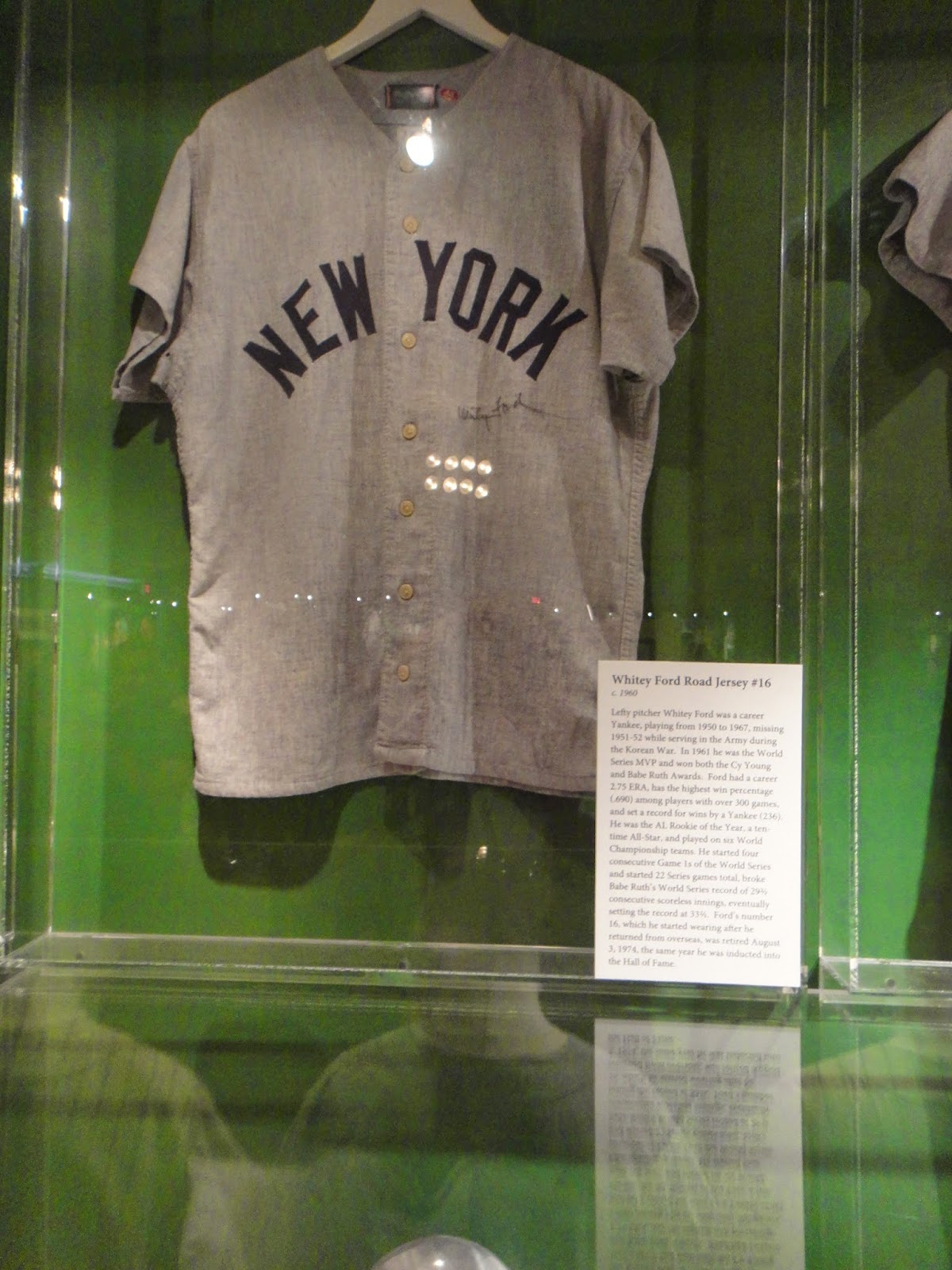
Whitey Ford's 1960 Uniform


Phil Rizzuto's 1952 Uniform


Mickey Mantle (1954), Don Larsen (1958) and Moose Skowron (1959)
Hank Bauer (1951)
Gil McDougald (1958)

Tommy Henrich (Also known as "Old Reliable")

Eddie Lopat (1951)

Frankie Crosetti (1951).  The Crow was a coach by this time in his career but spend more years than anyone (player and coach combined) in a Yankee uniform.
Johnny Mize (1951).  Although the Big Cat was known mostly for his time with the Cardinals and Giants he played a big role in the Yankees success.


This program was from opening day at Yankee Stadium.  The first game ever played there was in 1923  The Yankees would go on to win their third straight American League pennant and their first World Series.


Roy Campanella's 1957 jersey, 1955 MVP award and field jacket.


Drysdale (53) and Koufax (32) were always closely linked so of course both would be represented together here.


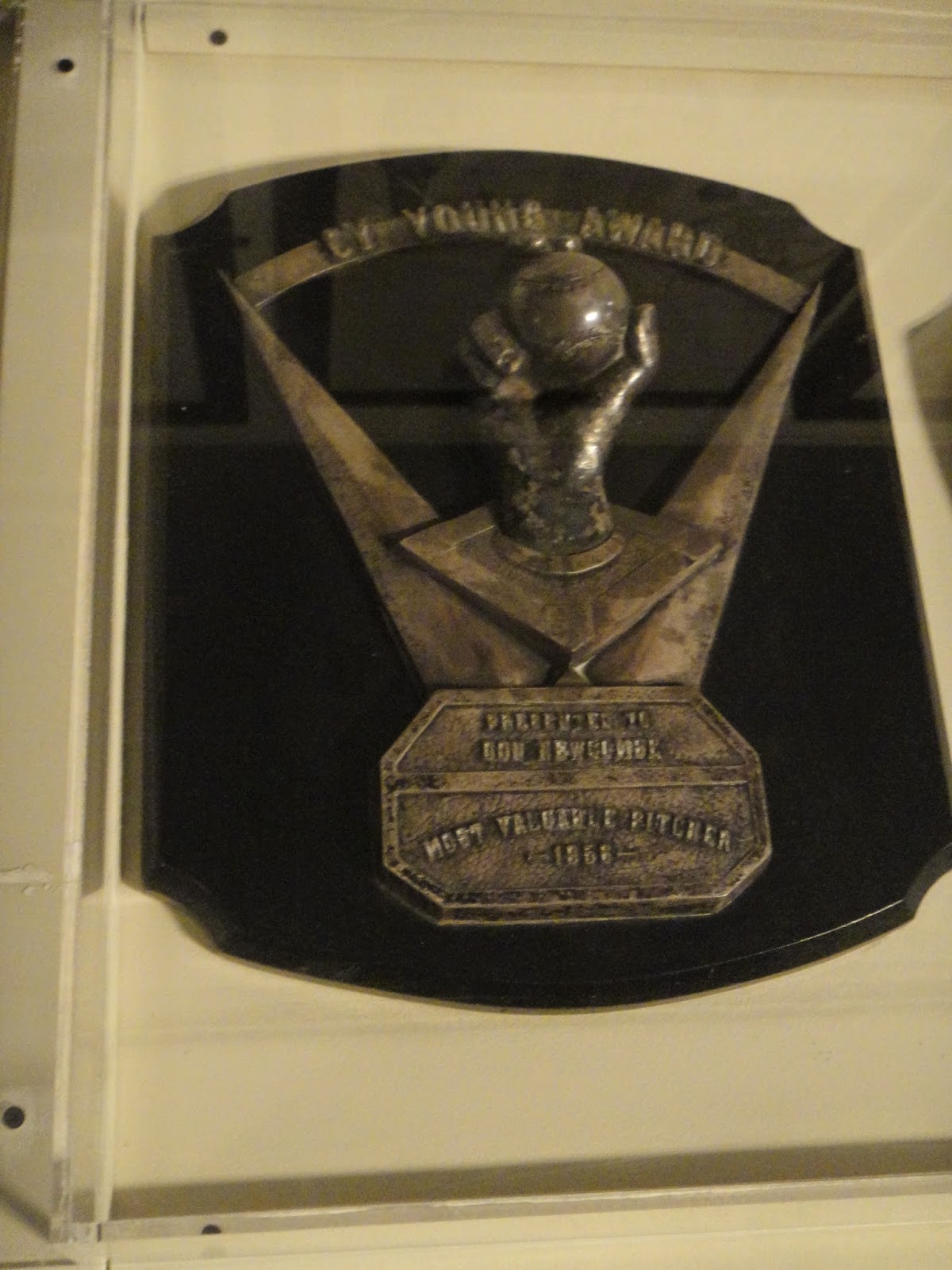
One of the most under rated and unfairly players in history, Don Newcombe.  A Rookie of the Year Winner, four time All Star, Cy Young Award winner and  MVP.  Newcombe missed more than 2 years to serve in the Korean-American War.

Mickey Mantle's 1957 MVP award.

 
Hideo Nomo was a fan favorite for the Dodgers for many years.  He made his debut in 1995


Another of my favorite sections was the one containing Jackie Robinson's uniform and 1949 player of the year award.  It also had the headlines from the Phillies' series in Jackie's rookie year.  This was the series where Ben Chapman famously led his players in verbal attacks on Jackie.

The Baseball exhibit is open until September 14, 2014

TRIVIA QUESTION:
To go with the Presidential theme today, we have a presidential baseball question.  One former president once owned stock in the Cincinnati Reds.  He is said to have been the inspiration for the 7th inning stretch.  He was such a big fan of the game that he was seriously considered for the first Commissioner's post following the Black Sox scandal in 1919. Who was it?

Answer to Last Week's Question:
Congratulations to TJD for correctly answering last week's question.
Similar to the previous week's question, this question was what American League teams have the longest World Series droughts:

Red Sox (2013, 0 years)
Yankees (2009, 5 years)
White Sox (2005, 8 years)
Angels (2002, 11 years)
Rays (No Titles Since 1998, 15 years)
Blue Jays (1993, 20 years)
Twins (1991, 22 years)
Athletics (1989, 24 years) 
Royals (1985,28 years)
Tigers (1984, 29 years)
Orioles (1983, 30 years)
Mariners (No titles since 1977, 36 years)
Astros (No titles since 1962, 51 years
Rangers/Senators (No titles since 1961, 52 years)
Indians (1948,  65 Years)