Showing posts with label Baltimore Orioles. Show all posts

Saturday, March 7, 2015

2015 American League East Preview

***The Division Preview that follows is not betting advice in any way shape or form.  Please do not bet any money based in any part on these predictions.***

Don't forget to check out the National League EastNational League Central and National League West previews and check back next week for the American League Central.


Toronto Blue Jays

Who's New?: 
CATCHER/INFIELDER
Russell Martin, C (free agent from Pirates)
Justin Smoak, 1B (Waiver claim from Mariners)
Chris Colabello, 1B (Waiver Claim from Twins)
Daric Barton, 1B (Free Agent from Athletics)
Josh Donaldson, 3B (Trade from Athletics)
Ramon Santiago, IF (Free Agent from Reds)
OUTFIELDER
Andy Dirks, OF (Free agent from Tigers)
Ezequiel Carrera, OF (Free Agent from Tigers)
Ryan Kalish, OF (Free Agent from Cubs)
Caleb Gindl, OF (Free Agent from Brewers)
Michael Saunders, OF (Trade from Mariners)
Chris Dickerson, OF (Free Agent from Indians).
Dayan Viciedo, OF (Free Agent from White Sox)
STARTING PITCHERS
Marco Estradada, SP (Trade from Brewers)
Jeff Francis, SP (Free agent from Yankees)
Liam Hendricks, SP (Trade from Royals)
Johan Santana, SP (Free Agent from Blue Jays)
RELIEF PITCHERS
Wilton Lopez, RP (Free Agent from Rockies)
Preston Guilmet, RP (Waiver Claim from Pirates)
Scott Barnes, RP (From Rangers
Luis Perez, RP (Free Agent from Braves)
Matt West, RP (Waiver Claim from Rangers)
Greg Burke, RP (Free Agent from Rockies)
Who Left: 
CATCHERS/INFIELDERS
Juan Francisco, 3B (Free Agent to Red Sox)
Adam Lind, 1B (Trade to Brewers)
Nessy Santiago, C (Trade to Royals)
Brett Lawrie, 3B (Trade to Athletics)
Dan Johnson, 1B (Free Agent to Astros)
George Kottaras, C (Free Agent to White Sox)
Brett Wallace, IF (Free Agent to Padres)
Andy LaRoche, IF (Free Agent to White Sox)
George Kottaras, C (Free Agent to White Sox)
OUTFIELDERS
Anthony Gose, OF (Trade to Tiger)
Cole Gilespie, OF (Free Agent to Marlins)
Dustin Mastroiani, OF (Free agent to Phillies)
Melky Cabrera, OF (Free Agent to White Sox)
John Mayberry, Jr, OF (Free Agent to Mets)
Colby Rasmus, OF (Free Agent to Astros)
Adron Chambers, OF (Free Agent to Cubs)
STARTING PITCHERS
Brad Mills, SP (Free agent to A's)
Kendall Graveman, SP (Trade to Athletics)
Brandon Morrow, SP (Free Agent to Padres)
Sean Nolin, SP (Trade to Athletics)
J.A. Happ, SP (Trade to Mariners)
Radhames Liz, SP (Free Agent to Pirates)
RELIEF PITCHERS
Cassey Jansen, RP (Free Agent to Nationals)
Dustin McGowan, RP (Free Agent to Dodgers)
Sergio Santos, RP (Free Agent to Dodgers)
Raul Valdes, RP (Unsigned Free Agent)
What to Expect?:
I feel as though I have been saying this for the last four years but the Jays could be on the verge of something special.  In 2013 they looked like they were going all in when they picked up R.A. Dickey, Mark Buehrle and Jose Reyes.  It didn't work out because it may have been to much change at once.  To their credit they stuck with it and started to see results last year. A sustained winning streak had them in the playoff race late into the season.  They have added Josh Donaldson, Russell Martin, Justin Smoak and Michael Saunders to the talent pool and this could be the tipping point. The lineup has a nice combination of speed (Izturis, Reyes and rookie Dalton Pompey) and power (Bautista, Encarnacion, Martin and Donaldson).
Why Should You Root for These Guys?:
Toronto has been putting everything they can into rebuilding this team.  They have shown that they are dedicated to this process and it would be nice to see them get the results they had been working towards
Why Might This Season Not Turn Out the Way Blue Jays Fans Want?:
For the same reason that it didn't work out the last two years.  Buehrle, Bautista and Reyes are injury prone and Justin Smoak is a big question mark.  Smoak could benefit from a change of scenery and reduced expectations or he could prove that his time in Seattle was the real Justin Smoak.
Don't Expect Too Much From Him:
R.A. Dickey had a Cy Young season with the Mets in 2012 but his two seasons in Toronto have been less than spectacular.  Expect him to eat innings, 200+, and to win about 15 but don't expect another Cy Young.
Expect Great Things From:
Russell Martin was the Dodgers' Catcher of the future until a serious hip injury led them to take a chance with A.J. Ellis as their new Catcher of the future.  Since then (with the exception of a few off years here and there with the Yankees) Martin has proven that he is a great Catcher.  Expect him to give the pitching staff the attitude it needs to win.
Is This His Last Chance?:
Justin Smoak was sent from the Rangers to the Mariners as part of the Cliff Lee deal  in 2010 and was immediately pointed to as the future of the franchise.  He failed to live up to those expectations.  A change of scenery and a reduced sense of expectations may be exactly what Smoak needs to succeed.
Prediction: 1st Place


Boston Red Sox
Who's New:  
CATCHERS/INFIELDERS:
Pablo Sandoval, 3B (Free Agent from Giants)
Hanley Ramirez, SS (Free Agent from Dodgers)
Juan Francisco, 3B (Waiver Claim from Blue Jays)
Ryan Hannigan, C (Trade from Padres)
Luke Montz, UT (Free Agent from Athletics)
Jeff Bianchi, IF (Free Agent From Brewers)
Humberto Quintero, C (Free Agent from Mariners)
Bryan LaHair, 1B (Free Agent from Indians)
OUTFIELDERS:
Quintin Berry, OF (Free Agent from Orioles)
STARTING PITCHERS:
Justin Masterson (SP, Free Agent from Cardinals),
Rick Porcello, SP (Trade from Tigers)
Wade Miley, SP (Trade from Diamondbacks)
Casey Crosby, SP (Free Agent from Tigers)
Dana Eveland, SP (Free Agent from Mets)
Felipe Paulino, SP (Free Agent from White Sox)
Robbie Ross, JR (Trade from Rangers)
RELIEF PITCHERS
Anthony Varvaro, RP (Trade from Braves)
Zeke Spurill, RP (Trade from Padres)
Mitchell Boggs, RP (Free Agent from Giants)
Craig Breslow, RP (Free Agent from Mets)
Alexi Ogundo, RP (Free Agent frm Rangers)
Jess Todd, RP (Free Agent from Diamondbacks)
Who Left:  
CATCHERS/INFIELDERS
Ryan Roberts, 3B (free agent to Royals)
Carlos Rivera, IF (Free agent to Mariners)
Ivan DeJesus, IF (Free Agent to Reds)
Ryan Lavarnway, C (Waiver Claim by  Dodgers)
Johnathan Herrera, IF (Free Agent to Cubs)
David Ross, C (Free Agent to CUbs)
Wil Middlebrooks, 3B (Trade to Padres)
Juan Francisco, IF (Free Agent to Rays)
Dan Butler, C (Trade to Nationals)
OUTFIELDERS
Corey Brown, OF (Free Agent to Rays)
Yoenis Cespedes, OF (Trade to Tigers)
STARTING PITCHERS
Allen Webster, SP (Traded to Diamondbacks)
Anthony Ranaudo, SP (Trade to Rangers)
RELIEF PITCHERS
Ryan Verdugo, RP (Free Agent to A's)
John Ely, RP (Free Agent to Brewers)
Alex Wilson, RP (Trade to Tigers)
Ruby De La Rosa, RP (Trade to Diamondbacks)
Brayan Villareal, RP (Free agent to Twins)
Burke Badenhop, RP (Free Agent to Reds)
Winter Headlines:
Sox make big moves to get back on top of weakening AL East.
What to Expect?:
This division is suddenly very weak.  What was once the terror of the Major Leagues is now full of average or below average teams.  With that in mind, the Red Sox have improved themselves  greatly and will likely be most experts picks to win the division.
Why Might This Season Not Turn Out the Way Red Sox Fans Want?:
Although the team has done quite a bit to improve themselves there are still quite a few questions. Age is starting to catch up with Victorino and Ortiz.  Rusney Castillo is a big question mark in center field and having Hanley Ramirez play the Green Monster in Left Field could be an adventure.
Don't Expect Too Much From Him:
Rich Porcello had a great rookie season in 2009. Since then he seems to have alternating spectacular and poor or average seasons. The Tigers relied on Porcello quite a bit last season but he is really more of a fourth or fifth starter.  The Sox depth chart currently show Porcello projected as the second starter behind Bucholtz.  Don't expect Porcello to replace John Lester's numbers.
Expect Great Things From:
Dustin Pedroia had a slow year in 2014 but is coming back healthy for 2015.  Although David Ortiz is generally considered the leader of the team, it is Pedroia who truly get them moving.
Is This His Last Chance?:
David Ortiz will turn 40 about a month after the 2015 season ends.  With a highly paid Hanley Ramirez playing out of position in Right Field and a highly paid but less than Gold Glove fielding Pablo Sandoval playing third, the team may be forced to move Sandoval to DH, limiting Big Papi's At Bats.
Prediction: 2nd place. Wild Card


Baltimore Orioles
Who's New:
CATCHER/INFIELDERS
Paul Janish, IF (Free Agent from Royals)
J.P. Arincibia, C (Free Agent from Rangers)
Everth Cabrera, SS (Free Agent from Padres)
OUTFIELDERS
Matt Tuiasasopo, IF/OF (Free Agent from White Sox)
Chris Parmalee, OF (Free Agent from Twins)
Nolan Reimold, OF (Free Agent rom Diamondbacks)
Jayson Nix, OF (Free Agent from Royals)
STARTING PITCHERS
None.
RELIEF PITCHERS
Pat McCoy, RP (Waiver Claim from Tigers)
Scott Barnes, RP (Trade from Indians)
Pat McCoy, RP (Waiver claim from Tigers)
Wesley Wright, RP (Free Agent from Cubs)
Chaz Roe, RP (Free Agent from Pirates)
Dane De La Rosa, RP (Free Agent from Angels)
Cesar Cabral, RP (Free Agent from Yankees)
Pedro Beato, RP (Free Agent from Braves)
Who Left: 
CATCHERS/INFIELDERS
Cord Phelps, IF (Free Agent to Phillies)
Numan Romero, IF (Free Agent to Athletics)
Nick Hundley, C (Free Agent to Rockies)
Kelly Johnson, IF (Free Agent to Braves)
David Adams, IF (Free Agent to Marlins)
Niuman Romero, IF (Free Agent to Athletics)
Alexi Casillia, SS (Free Agent to Rays)
Steve Lombardozzi, 2B (Trade to Pirates)
OUTFIELDERS
Nick Markakis, OF (Free Agent to Braves)
Nelson Cruz, OF (Free Agent to Mariners)
Quintin Berry, OF (Free Agent to Red Sox)
STARTING PITCHERS
Johan Santana, SP (Free Agent to Bue Jays
Joe Saunders, SP (Free Agent to Mariners)
Anthony Vasquez, SP (Free Agent to Phillies)
RELIEF PITCHERS
Josh Stinson, RP (Free Agent to Pirates)
Andrew Miller, RP (Free Agent to Yankees)
Julio DePaula, RP (Free Agent to Diamondbacks)
Robert Coello, RP (Free Agent to Giants)
Evan Meek, RP (Free Agent to Nationals)
Ramon Ramirez, RP (Unsigned Free Agent)
Winter Headlines:  
Machado, Wieters and Davis want to make up for missing the ALCS.
What to Expect?: 
The Orioles nearly reached the World Series last season with no real ace and without their starting First Baseman, Third Baseman and Catcher.  With a weak division the Orioles are looking to continue their success under Buck Showalter.
Why Should You Root for These Guys?:
Baltimore is a great baseball city and the fans there have been starved for success for decades.  It  would be great for the loyal O's fans to get enjoy what has not been seen in Baltimore in over 30 years.
Why Might This Season Not Turn Out the Way Orioles Fans Want?:
Pitching.  Plain and simple. Showalter is somehow able to get the most out of his players but there is not a true ace on this staff.  There are a few arms, including Dylan Bundy, in the minors that the team could need if they are going to improve on last year.
Don't Expect Too Much From Him:
Matt Wieters is a tremendously talented Catcher and Buck Showalter trusts him implicitly behind the plate.  What he cold have done to help this team last post season is something we can never know.  Expect Wieters to contribute to any success thisteam has but give him time to regain his form.
Expect Great Things From:
The Orioles hit close to rock bottom in 2007.  The one bright spot of the year was Erik Bedard. At   13-5 he was the future of the O's franchise.  When Bedard was shipped to Seattle in the offseason Orioles fans shook their head in confusion.  What they got in return were George Sherill (an Orioles All Star Representative), Chris Tillman (their current "ace") and Adam Jones.  Jones is now the leader and future of this franchise.  Some day he may be enshrined with the likes of Palmer, Murray, Ripken and the Robinsons.
Is This His Last Chance?:
Ubaldo Jimenez was a big 2014 free agent signing for the O's but the results were less than impressive.  After a very near Cy Young year with the Rockies in 2010, Jimenez's performance has steadily declined.  If he fails to perform again this year he could be out of chances.
Prediction: 3rd Place.  Wild Card


New York Yankees
Who's New: 
CATCHERS/INFIELDERS:
Didi Gregorious, SS (Trade from Diamondbacks)
Garrett Jones, 1B (Trade from Marlins)
Cole Figueroa, 2B (Free Agent from Rays)
Nick Noonan, IF (Free Agent from Giants)
OUTFIELDERS
Chris Young, OF (Free Agent from Mets)
STARTING PITCHERS
Nathan Eovaldi, SP (Trade from Marlins)
Scott Baker, SP (Free Agent from Rangers)
Kyle Davies, SP (Free Agent from Indians)
RELIEF PITCHERS
Justin Wilson, RP (Trade from Pirates)
Andrew Miller, RP (Free Agent from Orioles)
David Carpenter, RP (Trade from Braves)
Johnny Barbato, RP (Trade from Padres)
Chasen Shreve, RP (Trade from Braves)
Jared Burton, RP (Free Agent from Twins)
Chris Martin, RP (Trade from Rockies)
Who Left:
CATCHERS/INFIELDERS
Francisco Cervelli, C. (Trade to Pirates)
Derek Jeter, SS (Retired)
Brian Roberts, 2B (Retired)
Martin Prado, 3B (Trade to Marlins)
Zelous Wheeler, 3B (Unsigned Free Agent)
OUTFIELDERS
Zolio Almonte, OF (Free agent to Braves)
Alfonso Soriano, OF (retired)
Antoan Richardson, OF (Free Agent to Rangers)
Scott Sizemore, OF(Free Agent to Marlins)
Ichiro Suzuki, OF (Free Agent to Marlins)
Eury Perez, OF (Waiver Claim by Braves)
STARTING PITCHERS
Shane Green, SP (Trade to Tigers)
David Phelps, SP (Trade to Marlins)
Brandon McCarthy, SP (Free Agent to Dodgers)
David Huff, SP (Free Agent to Dodgers)
Hiroki Kuroda, SP (Unsigned Free Agent)
RELIEF PITCHERS
,Jeff Francis, RP (Free Agent to Blue Jays)
David Robertson, RP (Free Agent to White Sox)
Shawn Kelly, RP (Traded to Padres)
Josh Outman, RP (Free Agent to Braves)
Cesar Cabral, RP (Free Agent to Orioles)
David Robertson, RP (Free Agent to White Sox)
Chris LeRoux, RP (Free Agent to Brewers)
David Herndon, RP (Free Agent to Brewers)
Rich Hill, RP (Free Agent to Nationals)
Alfredo Aceves, RP (Unsigned Free Agent)
Matt Daley, RP (Unsigned Free Agent)
Jim Miller, RP (Unsigned Free Agent)
Heath Bell, RP (Free Agent to Natonals)
Preston Claiborne, RP (Waiver Claim by Marlins)
Winter Headlines:  
Jeter is gone, A-Rod is back.
Yankees to retire three more numbers of Pettite, Williams and Posada.  At what point will they go to triple digits?
What to Expect?:
This is not a very strong division which will play to the Yankees' advantage.  They do have some talent but they also have no proven leader and a lot of aging, injury prone players struggling to stay on the field.  This season could be the tipping point between another playoff run or the start of a 1980s era drought.
Why Should You Root for These Guys?: 
There are several players on this team that have played for years and, although coming close,  have never won a World Series.  For players like Brian McCann, Carlos Beltran, Garret Jones and  Chris Capuano it would be a nice touch to already successful careers.
Why Might This Season Not Turn Out the Way Yankees Fans Want?:
In the Yankees' universe the only successful season is a World Series.  This team, with age, injuries, and lack of leadership will fall far short of that goal.  They could surprise some and win a Wild Card spot but it would take a lot of things falling their way to advance in the playoffs.
Don't Expect Too Much From Him:
Alex Rodriguez has been away from the game for more than a year and was very concerned with a degenerative hip issue in his last season.  Alex is chasing 700 Home Runs for his career but would likely need at least three more years to do so.
Is this his last chance?:
Mark Teixiera is signed through the end of 2016 but his production numbers have been on  a consistent decline over the last few years.  With his career winding down Tex may not have mayny more opportunities to win it all.
Prediction: 4th Place


Tampa Bay Rays
Who's New: 
CATCHERS/INFIELDERS
Bobby Wilson, C (Free Agent from Diamondbacks)
Renee Rivera, C (Trade from Padres)
Eugenio Velez, UT (Free Agent from Brewers)
Asdrubal Cabrera, SS (Free Agent from Nationals)
Alexi Casillia, SS (Free Agent from Orioles)
Juan Francisco, IF (Free Agent from Red Sox)
Jake Elmore, IF (Free Agent from Reds)
John Jaso, C (Trade from Athletics)
OUTFIELDERS
Corey Brown, OF (Free Agent from Red Sox)
Steven Souza, OF (Trade from Nationals)
STARTING PITCHERS
None
RELIEF PITCHERS
Michael Kohn, RP (free agent from Angels)
Ernesto Frieri, RP (Free agent from Pirates)
Kevin Jepsen, RP (Trade from Angels)
Jose Dominguez, RP (Trade from Dodgers)
Jhan Marinez, RP (Free Agent from Dodgers)
Ronald Bellisario, RP (Free Agent from White Sox)
Who Left:
CATCHERS/INFIELDERS
Cole Figueroa, 2B (Free Agent to Yankees)
Jerry Sands, IF/DH (Free Agent to Indians)
Ali Solis, C (Free Agent to Dodgers)
Jose Molina, C (Unsigned Free Agent)
Ben Zobrist, IF (Trade to Athletics)
Yunel Escobar, Ss (Trade to Athletics)
OUTFIELDERS
Wil Myers, OF (Trade to Padres)
Matt Joyce, OF (Trade to Angels)
STARTING PITCHERS
Jeremy Hellickson, SP (Trade to Diamondbacks)
Erik Bedard, SP (Free Agent to Dodgers)
RELIEF PITCHERS
Cesar Ramos, RP (Trade to Angels)
Joel Peralta, RP (Trade to Dodgers)
Michael Kohn, RP (Free Agent to Braves)
Josh Lueke, RP (Unsigned Free Agents)
Juan Carlos Oviedo, RP (Free Agent to Rangers)
Winter Headlines:  
Loss of Maddon could be biggest loss in Rays short history.
What to Expect?:
Rays fans should expect a return to the pre-2008 days.  With the exception of Longoria and Desmond Jennings, the Rays have little proven talent on the team.  They are in a clear rebuilding mode and may have a long climb back to the top.  Working to their benefit is the mediocrity of the other teams in this division.
Why Should You Root for These Guys?:
With a small budget and heading into a rebuild the Rays are clear Cinderella Story material.
Why Might This Season Not Turn Out the Way Rays Fans Want?:
This team is heading into a rebuilding.  It is likely that the Rays will be on the down trend for the next few years.
Don't Expect Too Much From Him:
Drew Smyly was the big piece in the David Price deal and the Tigers thought very highly of him.  He will be a very good starter but the lack of support behind him will likely limit his success.
Expect Great Things From:
Evan Longoria is a special player.  Regardless of the won-loss record expect Longoria to represent the team with class and probably in the All Star Game as well.
Is This His Last Chance?:
James Loney came up to the Dodgers with high expectations but his lack of power production led to an exit from Los Angeles.  He has had a few moderately successful  seasons in Tampa Bay but with the Rays in rebuilding mode Loney may not have many opportunities to prove he is part of their future.
Prediction: 5th Place


*-Please be aware that these predictions are based on the rosters as set in the beginning of March.  There are still several key free agents unsigned which could alter these previews.  Also, injuries during spring training could alter my outlook.  Check back next week for the AL Central Preview and continue following to see my final predictions at the start of the season.


TRIVIA QUESTION:
The Orioles won the AL East in 2014 for the first time since 1997.  Including these two division titles, dating back to the start of division play in 1969, how many times has Baltimore won the East?

Answer to Last Week's Question:
The National League Central has had a player lead the league in RBI 7 times:
Jeff Bagwell (1994)
Sammy Sosa (1998)
Mark McGwire (1999)
Sammy Sosa (2001)
Lance Berkman (2002)
Prince Fielder (2009)
Albert Pujols (2010)

Sunday, June 15, 2014

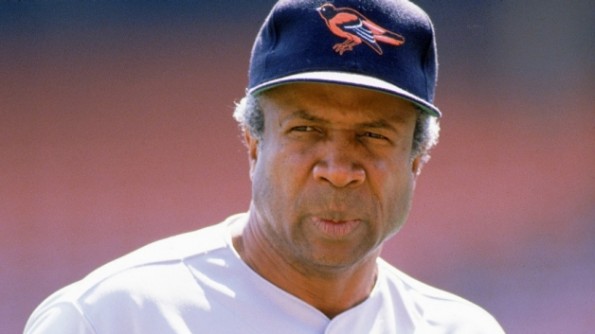
Players I Love More Than I Should: Outfield: Frank Robinson

If you are just joining the blog don't miss the other players in the Players I Love More Than I Should series: Yogi Berra, Hank Greenberg, Joe Morgan, Cal Ripken and Frank "Home Run" Baker

More than 18,000 players have appeared in Major League Baseball games since the start of the league.  Some players have short careers that last one at bat or one appearance in the field.  Others have 20+ year careers.  As I read more and more about baseball history there are certain players I find myself enjoying reading about more than others.  It is obviously illogical since many of them retired, or in some cases passed away, long before I was even born.  I have no first hand experience in watching some of them play but for whatever reason their personalities and perseverance strikes me above and beyond the other players I read about.  Over the next few weeks I will be giving you short biographical histories*of some of these players.  Some of them will be Hall of Fame players.  Some of them will be players only casual fans may know.  Regardless, I chose one player from each position for this series to explore.  This week we will explore one of the outfielders I chose for the series: Frank Robinson.

Of the more than 18,000 people to play Major League Baseball there are probably ten to fifteen players who could legitimately be considered for the title of "the greatest player ever".  Of course the names of Ruth, Willie Mays, Barry Bonds, Ken Griffey, Jr, Ty Cobb, Lou Gehrig, Ted Williams and Joe DiMaggio come to mind immediately.  Jackie Robinson, Rickey Henderson, Cal Ripken, Sandy Koufax, Rogers Hornsby, Stan Musial and Hank Aaron would probably get quite a few votes. Contemporaries like Jeter and Pujols may get some mention.

The question becomes what makes a great player?  Is it pure individual numbers?  Is it the number of rings you win?  Is it your ability to lead your team quietly behind the scenes when people don't necessarily see it?  Is it your ability to raise the level of accomplishments of the players around you?  Is it your ability to do things no one else has done before?

There is one player who did everything you would want from the greatest player of all time and yet is far too often overlooked in consideration as the greatest player of all time.

-----------------------------------------
"It went all the way out."  Boog Powell told Robby as he settled back on the bench.  "Yeah, right." was the unbelieving response.

540 feet.  180 yards.  Nearly two full football fields. 

Luis Tiant had started his wind up.  It was his normal twisting, turning, bending, contortionist wind up. The arms swung once, twice. The hands came together, the arms went up, the front leg lifted and straightened.  The back leg and the hips twisted towards center as the throwing hand fell by his back hip.  Every motion was disjointed until the whole body flew forward towards the hitter.  Few people could figure it out but Robby swung at the first pitch and it was crushed.  It flew.  Farther.   Faster.   Quicker than anyone in Baltimore had ever seen a ball fly before.  On Sunday, May 7, 1966 Frank Robinson launched the ball that would forever be marked for Orioles fans to remember.  The ball literally left Memorial Stadium, landing in the parking lot 540 feet away.

I can personally remember going to the stadium, sitting in the stands and looking out to the parking lot and seeing that black and orange flag hanging in the stadium parking lot.  It said one word.  "Here".   I can remember watching the thing flapping in the breeze and thinking "does that actually just say 'here'.  What does that mean?"  Then I asked my dad.  "What is that flag out there?"  That was when my dad explained about the day that Frank Robinson hit the ball "HERE" and officially left his mark in Baltimore.  Although it was one of the longest visible marks he left there, it was one of just a million that he left in Baltimore and many other cities throughout baseball history.

Early Success
A few weeks ago we reviewed the career of Joe Morgan, the great Reds second baseman.  Joe was born in Texas but very early in his life moved to the Oakland Bay area.  Frank Robinson had a very similar start in life, although Frank was a bit older than Joe.  Frank was born in Beaumont, TX in 1935.  When his parents divorced his mother moved the children to the bay area.  One can only imagine the discrimination, prejudice and torture the family endured.

Frank was too young to remember the time in Texas and he has said that during his time in the bay area he was unaware of prejudice or bigotry.  It was a tough area to be sure.  Frank told stories of having to fight his way to school and back.  Not far away, just a few years older than Frank, a young Billy Martin was growing up in Berkeley, CA, fighting in street gangs in a very racially charged community.  When Frank was 11 years old Jackie Robinson broke the color barrier and Frank's response at first was "so what?".  Frank loved the game of baseball, dreamed of being a pro player but it had never occurred to him that the game was segregated.  He soon learned the importance of Jackie Robinson. 

He was clearly better than most players in his age group, though he humbly wondered why players he played with never became better players. His father had once told his brothers that Frank would never be good enough to make a big league player.  It drove Frank, as doubts about him would always do, and he used it as motivation to prove his father wrong.  Frank signed with the Reds organization at the age of 17 and was sent to the Ogden, UT team in the Pioneer League and he quickly learned what racism was.  He was one of two non-white players on the team and while all other players had private homes, Frank and Chico Terry were forced to share a tiny hotel room.  As non-white they were not allowed to eat in the local restaurant, go to movies or do any number of things the white players could do.  He couldn't even talk to his roommate who Frank said knew only the word "coffee".


Frank loved nothing more than to play ball but hearing fans yell disgusting, unspeakable, unrepeatable things at a teenage kid for doing nothing more than trying to hit a ball made him question his place. The loneliness was nearly unbearable.  He had nothing to do but work on his game and think about baseball.  In the 1953 Pioneer League season Frank played in 72 games, hit .348 with 20 doubles, 6 triples and 17 Home Runs.  Not bad for a 17 year old kid far from home and facing the hate filled rages of hicks for the first time.

He moved on to Columbia of the South Atlantic League for next year and if he thought he faced racism in Ogden, it was just an appetizer for the main course of hatred he faced in the 1950's south.  Robby continued to improve his game but as would always be the case, the magnitude of his greatness was never really realized.  Frank would hit .336 with 32 doubles, 9 triples and an amazing 25 Home Runs.  In an era when Home Runs were not yet king, it was nearly unheard of for an 18 year old to hit with so much power.  He played 80 games for Columbia in 1955 and his numbers were not great but there was a reason.  There was a shoulder problem that plagued him.  He was forced to play first base for the first time in his life because, as Frank said, "I couldn't throw the ball ten feet".  Being an African American player in the south was bad enough.  Being an African American player who was performing far below the numbers that were expected was unforgivable.  The abuse he faced was severe and he nearly gave up.  Call it the intervention of the baseball gods.  Call it the determination that only the greatest of the great have.  Call it whatever you want,  Frank did not give up.  He pushed on and "in the last six weeks of the season I hit .390 and hit ten home runs...most important, after all I'd been through, I knew I could play this game, knew I'd never be tempted to quit again."

Ohio is a northern state but it is just across the river from Kentucky, a border state in the Civil War.  Don't forget it was in Cincinnati that Pee Wee Reese put his arm around Jackie Robinson in a silent gesture of support against vicious taunts. It was this city that Frank Robinson started his career and it was a start that few could ever equal.  On a team with Ted Kluszewski, Wally Post, Gus Bell and Ed Bailey, Frank Robinson led the team in almost everything.  He hit more home runs (38) than "Big Klu".  He drove in as many runs (83) as Wally Post.  He scored more runs than anyone else in the league and the Reds finished third in a very close National League race.  Frank Robinson was the youngest All Star player that year and finished in the top ten voting (7th) in the MVP award.  He also won the Rookie of the Year Award.  Who finished second?  No one.  There was no second choice.  A total of 23 votes were cast for the top rookie.  Each and every one was for Frank Robinson. 

Every Rookie of the year hears the same refrain:  watch out for the sophomore slump.  Frank had none of that.  His power numbers dropped (home runs went from 38 to 29) but his average raised from .290 to .322. He made the All Star team again and again finished in the top 10 in MVP voting.  The NL Champion Dodgers fell off dramatically in 1957 but the Reds couldn't seem to take advantage.  The Braves and Cardinals moved up and the Reds finished 4th.

Over the next few years the pattern seemed to be the same.  The Reds showed great talent, led by Robby, Big Klu and Vada Pinson.  They just could not compete with the top of the league as the Braves, Dodgers, Cardinals, Giants and even the Pirates finished ahead of the Reds.  Through these years Frank was still one of the top players in the league.  Considered the second generation of African American players following Jackie Robinson, Larry Doby, Roy Campanella, Don Newcombe, Willie Mays and Joe Black, Frank Robinson dominated the league with the likes of Hank Aaron, Ernie Banks, Willie McCovey and Monte Irvin.  Frank usually hit well above 30 Home Runs, drove in about 80-85 runs (he drove in 120 in 1959) and his average would fluctuate near .300, usually above that mark.


Robby and Dumb Wit
Robinson was a clear star in the league as 1960 turned to 1961.Any success the Reds could hope for would have to include Frank.  There was no question.  Robby was a star and a leader in the club house.  However, as a young man in a turbulent time he also had a bit of a temper.  Not one to look for a fight he would certainly protect himself when he was threatened.  Unfortunately, in the craziness of the time, if an African American protected themselves they somehow were in the wrong.  In February 1961 Frank and some friends went out for a night on the town and ended up in a diner late at night.  An altercation led to a friend being arrested and as Frank and another friend returned to retrieve their food the cook made a slashing motion with a butcher knife.  When the cook displayed his weapon of choice, Robby simply showed the cook that he was protected and flashed his pistol.  The cops were called and Frank was arrested.  Humiliated, angry that he did not receive any assistance from the team and left in a cell to think, Frank decided it was time to make some changes in his life.  It was time to grow up and focus all of his energy on fighting the other team.  It was the best news that the Reds could have gotten.  It was the worst news the opposition could have gotten.  Frank Robinson, already dangerous, was now more focused and more determined than ever.  The behind the scenes story of the arrest would lead to a lingering effect however.  When Bill DeWitt, the Reds General Manager,was notified that Robinson was in jail he decided to leave him there for the night.  Frank took great offense, feeling that had it been Kluszewski or another Reds star, DeWitt would have come to bail him out.  A rift was formed that led to Frank forever calling the GM DumbWitt.

The new focus led Frank to dominate even more as he led the Reds to their first World Series since 1940.  Frank hit 37 Home Runs, had a .323 average, drove in 124, scored 117 and even stole 22 bases.  It was a dominant performance and the former Rookie of the Year added a National League Championship and an MVP award to his already illustrious career.  In the World Series of 1961 Frank had a tough time of it.  He hit only .200 as the Yankees pitchers avoided giving him anything good to hit.  In the fifth and final game Frank drove a ball out of the park but the Reds lost 13-5.  It was a disappointing season for a man (and a team) that had their sights set on the ultimate goal.

Over the next three years the Reds would not have as much success.  Frank never dropped from his high standards.  He continued to improve and although the Reds failed to make the post season (they came very close in 1964 as the Phillies collapsed) Frank would continuously be an All Star and MVP candidate.  1965 was the turning point for the Reds, for Frank and for an unsuspecting American League.  His average dropped below .300 (he hit .296), he drove in "only" 113 runs and scored "only" 109. He finished 18th in the MVP voting. The rift between Robinson and Reds Management had only grown wider over the years as disputes over injuries and salary became more and more common.  On December 9, 1965 Bill DeWitt made a decision.  He would end the Frank Robinson era in Cincinnati.  DeWitt cited a youth movement as the key reason for the trade.  When it was pointed out that Frank was only thirty DeWitt responded that yes he was only 30 but it was "an old 30". These words would haunt DeWitt for the rest of his career.  On December 9, 1965 Frank Robinson was traded to the Baltimore Orioles for Jack Baldschun, Milt Pappas and Dick Simpson.  Like his father's statement that Frank would never make a major league player, DeWitt's words provided fuel for Frank's already burning desire to be the best.

The Lord of Baltimore
The Orioles were not known as winners.  They were the old Browns of St.Louis and they had rarely competed since they moved to Baltimore.  They did have a nice little team they were building with Brooks Robinson and Boog Powell and a good young pitching staff, but realistically there was still Mantle and Maris in New York,  Kaline and Cash in Detroit and Olivo, Kaat and Carew in Minnesota.  The Orioles seemed to be way behind the league. Even the Red Sox were starting to build a strong team with an Italian kid named Conigliaro, another named Petrocelli and a Polish kid  with an almost unpronounceable name of Yastrzemski.

When Frank arrived at spring training the Orioles resident star Brooks Robinson could have been a prima dona and staked his claim to the status he had already established.  Instead he walked up to Frank Robinson, stuck out his hand and said "You're just what we needed."  On the first pitch he saw in his first batting practice in Baltimore's spring camp Frank crushed a Home Run and a young Jim Palmer blurted out "I think we just won the pennant."  Frank was driven.  It was a great team.  A team that loved playing together.  They were jokers.  A fun group.  Having a white Southerner named Robinson star next to an African American Robinson lent itself to quite a bit of confusion.  When one reporter confused the two Frank said "can't you tell us apart?  We wear different numbers."  There were some not so funny confused moments.  When Frank moved to town, his wife tried to rent a house.  She called to set up an appointment to view the house and introduced herself as Mrs. Robinson, wife of one of the Orioles.  She was welcomed with open arms until it was realized it was Frank Robinson and not Brooks Robinson.  Due to the racial laws at the time Frank and his wife were rented a far inferior dwelling in "the black section" of Baltimore.  The previous tenants had left holes in the wall and dog shit on the floor.  They had no choice.  It was all they could get.


Almost immediately the Orioles took flight and shocked the American League.  Several Orioles said they were inspired by Frank's determination.  Several said they never saw a man work so hard.  Others said Frank's Home Run, the one forever marked 'HERE' was the turning point.  Regardless, that was just one of the great moments of Frank Robinson's great season.  On a team with Powell, Brooks Robinson, Paul Blair and Davey Johnson, Frank Robinson led the way and led the league in almost everything possible. He was first in Slugging Percentage, On Base Percentage, Runs Scored, Total Bases, Extra Base Hits, Times on Base.  That list also included batting average, Home Runs and RBI, the three categories of the Triple Crown.  Frank Robinson became the first player to win the Most Valuable Player award in both leagues.

The Orioles won their first AL pennant but the baby birds were a large underdog against Koufax, Drysdale and Maury Wills of the Dodgers.  The first post season game in the Orioles history started in Los Angeles.  Don Drysdale got Luis Aparicio to fly out to right then walked Russ Snyder.  Robby stepped in.  It was a bright LA fall afternoon.  He stood toward the back of the batters box.  Rested the bat on his hip, bent and rubbed some dirt on his hands.  He watched ball 1 come in high.  He had faced Drysdale what seemed like a million times.  Both were strong competitors.  Both were intense, fierce.  Both believed the plate belonged to them.  The second pitch came in and Frank turned on it.  He lifted the ball to left field.  Tommy Davis tracked it to the fence but it was five rows deep.  In classic Ruth-Gehrig fashion, Brooks Robinson followed Frank's blast with a solo of his own.  The O's led 3-0 and would win 5-2.  Game 2 had the Orioles facing Sandy Koufax.  The living legend.  It would be his final appearance in the Major Leagues but he was still Koufax.  Due to one of the most unfortunate innings ever in baseball history (poor Willie Davis) the Orioles took a 3-0 lead.  In the top of the 6th Frank led off with a triple and scored on Boog Powell's single as the O's won the game 6-0.  The Orioles won Game 3 1-0 on a Paul Blair Home Run.  Game 4 saw Don Drysdale take a second crack at the O's.  Robby got a second shot at Big D.  In the 4th with the game tied 0-0 Robby duplicated his Game 1 success with a solo homer to left.  The Orioles won their first World Series and Frank Robinson won the World Series MVP.


Injuries limited Frank over the next few years.  It was the knees, concussions, you name it.  It was the hazard of playing full throttle all the time.  The concussion came from a hard slide into second where his head was hit by the knee of the second baseman.  He still had solid numbers and he still was one of the best in the game.  He continued to make his impact on the team in the clubhouse.  He led the kangaroo court and became known as the judge.  He levied fines to players who made mental errors and no one was immune, not even Earl Weaver.  Famously Robinson said in kangaroo court. "Stand up when you address the judge Earl.  Oh, you are standing up."  Robby loved his time in Baltimore with the O's.

He loved playing for Earl Weaver.  The group of Orioles was an intense group, focused.  They would play hard on the field but they would have fun off it too.  In 1969 they finally returned to the top AL perch.  They won over 100 games, swept the first ALCS in history and went into the World Series facing the New York Mets.  Who could believe the Mets could beat the birds?  The Mets could.  The Orioles cruised through the first game and looked to keep going.  Then the miracle happened.  The Mets took games 2, 3 and 4 to take a 3-1 lead in the series. Earl Weaver got so frustrated that he even got kicked out of Game 4.  He almost got kicked out of Game 5 as well.  When Frank got hit on the belt buckle and headed toward first the umpire called him back to the plate and told him it was just a foul ball.  Frank was outraged.  He argued and even walked to the dugout in protest.  He delayed the game for several minutes.  When he went back to the plate he eventually struck out and the Orioles fell to the Mets.

1970 was the redemption season.  The Orioles were again top in the AL, beating the Twins in the ALCS again, and Frank again made the All Star Team and finished in the top 10 in MVP voting.  His numbers were down again as injuries continued to take their toll.  Yet, in the World Series Frank's bat again led the way.  He pounded Reds pitching getting revenge on the organization that discarded him.  Robby hit two home runs, drove in 4 and scored 5 times.  The real star as the O's reclaimed the World Series title was Brooks Robinson's glove.

The golden years of Orioles baseball ended the following year as the golden age of Oakland A's baseball began to dawn.  Frank battled injuries again as the Orioles again won the AL East.  They swept the ALCS, this time against the A's and faced the Pittsburgh Pirates led by Bob Robertson and Roberto Clemente.  Although Frank, fighting, limping and straining, scored a game winning run in the bottom of the 10th of Game 6, The Orioles lost to the Pirates, led by Clemente, in a deciding Game 7.  The golden age of Orioles baseball was over.

Southern California
If Bill DeWitt thought the Orioles were getting an "old 30" when he sent them Frank in 1966, The Orioles found Frank to be an older 35 after the 1971 World Series.  With a young Don Baylor set to spread his wings in Baltimore, the Orioles had to make room in the outfield.  On December 2, 1971 Frank Robinson was traded with Marv Reichert to the Los Angeles Dodgers for Doyle Alexander Bob O'Brien, Sergio Robles and Royle Stillman.  The team that Frank joined was similar to the Orioles team he had joined in 1966.  They were building a strong young team with players like Davey Lopes, Steve Garvey, Ron Cey, Bill Russell and Joe Ferguson.  Drysdale and Koufax were gone replaced by Tommy John and Don Sutton.  Frank poured every ounce of his body into that 1972 season but the Dodgers fell behind the Reds and finished 10.5 games back in second place.  The Dodgers had a strong core and Frank Robinson did not fit in to their future plans.

Still known as a clubhouse leader and still known as a drawing card, the California Angels felt they were getting close to something good in Anaheim.  They sent Ken McMullen and Andy Messersmith to the Dodgers and in return received Frank, Billy Grabarkewitz, Bill Singer, Mike Strahler and Bobby Valentine.  Fortunately for Frank an old friend, former Orioles GM Harry Dalton was now GM in Anaheim and Frank felt he could contribute at the big A.  Another old friend, Vada Pinson, was playing for the Angels as well.  Nolan Ryan won 21 games, Frank was reborn as a DH and finished 15th in MVP voting.  The Angels, however, did not finish so well.  Entering 1974 with the youth of the Angels it was hoped that Frank's intensity would translate into a winning team.

What happened instead was a disaster.  Manager Bobby Winkles was apparently convinced that Harry Dalton had brought Frank in with the idea of making him the manager.  Although Winkles and Frank had some troubles in the first year, Winkles told Dalton in the winter that he had to trade Robinson.  Dalton refused and the environment of the clubhouse was tense and uncomfortable.  The Angels struggled and when Winkles finally called a team meeting he called out Frank specifically and told the entire team that he had demanded that Frank be traded a few months prior.  "I didn't like it at all.  To me, what Winkles was saying was that he couldn't manage with me on the team.  He didn't want me here.  But I haven't asked to be traded, and I wouldn't like for him to be fired."  Winkles was fired and Dick Williams was hired. This relationship started off nicely with Williams naming him  captain but Williams's style of managing and Frank's view on how to run a team clashed.    He didn't have to worry about it long.  In mid September, with the Angels clearly out of the pennant race, Robinson was traded to Cleveland.

Leading the Tribe
He finished 1974 as an Indian with an assurance from the front office that he would receive a contract for the next year.  The contract he received was not what he expected.  It was not just a contract as a player but as a manager as well.  Frank rejected it at first.  Not because he didn't want to manage but because he was being paid the same amount to manage and play as he had received the year before just to play.  He finally worked out an acceptable amount and Frank Robinson, already the first man to win an MVP in both leagues, became the first African American manager.


Those who read the blog often will remember my earlier question about Lloyd McClendon.  Why do bad teams happen to good people?  The 1975 Indians certainly fit that mold.  They picked up Boog Powell from the Orioles and they had a great pitcher in Gaylord Perry but they had some serious problems.  Frank had seen the problems at the end of the 1974 team when he saw that the African American players and coaches stayed away from the white players and vice versa.  Frank did what he could to change this culture but his journal from this season shows some serious divide on the team.  From the day Frank joined the team in 1974 Gaylord Perry seemed to show resentment at being paid less than Frank.  The resentment increased when Frank became Perry's boss.  Perry refused to do the running required in spring training.  He spoke about his manager and teammates in the press and demanded a trade.  Finally, on June 13, after demanding a trade again, Perry was traded.  It was too late, the Red Sox, Orioles and Yankees were too far ahead.  The Indians were in last place, eight games out of first.  They would finish fourth that year and the following year.  Frank was acknowledged as a great manager but the talent on the team was terrible.  Midway through the 1977 season the Indians made a decision to fire Frank Robinson.

He was a coach for Earl Weaver in Baltimore for several years before his next opportunity came along.  It was in San Francisco, not far from  where he grew up across the bay in Oakland.  He worked hard and expected the same from his players.  He had trouble with some of the players but the bigger problem was something all managers were dealing with at the time.  He was hired by the Giants for the 1981 season and the Giants had rising stars like Jack Clark and Darrell Evans and established stars like Vida Blue.  Frank had to deal with players earning more than he could have imagined as a super star and producing well below the expectations.  Evans and Clark were very unhappy.  Often Frank would call them into his office, talk to them one on one to make sure they were on the same page and get confirmation that the issues were resolved.  He woke up the next morning and saw new quotes from the players blasting the team.  The other problem at the time was drugs.  Frank talked often in his auto biography "Extra Innings" of the moodiness of several players, Vida Blue among them, and the frustration of knowing how good some of these players were not knowing what was stopping them  from reaching their potential.  He later found out that cocaine, amphetamines and steroids were running rampant in the game.

He had great players on the team like Joe Morgan and Reggie Smith, who he knew were the types of players needed to win.  Jack Clark may put up great numbers but Joe Morgan played the game the way you needed if you want to win.  Darrell Evans may hit long Home Runs but so did Reggie Smith and Smith helped the younger players along.  Unfortunately, the management and Frank were not on the same page so Smith moved on to Japan, Morgan moved on to help the 1983 Phillies  win a pennant and Frank was given a poor team.  By the time 1984 ended Darrell Evans was a World Champion with the Tigers, Jack Clark would move on to St. Louis and Frank Robinson was unemployed.

Manager of the Year
"The great irony in all this is that I'm a much better manager than I ever was before and I'm out of a job".  It was true and the statement spoke volumes about Frank.  He knew the game. He had played it better than nearly anyone ever had in the history of the game and yet he still had learned more since he retired as a player.  While Frank was learning to manage the Orioles were learning what life was like A.W. (After Weaver).  Earl Weaver had retired after the 1982 season.  The Orioles immediately hired Joe Altobelli and won the World Series. A year and a half later, half way through 1985, Earl Weaver was back to pick up the pieces but the pieces didn't quite fit the puzzle.  In 1987 Cal Ripken, Sr took over a bad team as manager and the ownership knew it was not a good team.  The team was flat out terrible except for Cal Jr and Eddie Murray.  John Shelby had potential but he was gone by next year and Fred Lynn was well beyond his prime.  So Ripken, Sr. started the 1988 season as skipper of a sinking ship.   The O's lost two straight to the Brewers then were swept in four straight against the Indians.  Although the Orioles had promised Senior a fair chance to manage, he was fired after the sixth game.  He was replaced with Frank.  It was a terrible start to the season.  After 21 games the O's had not won a game.  Not even the 1962 Mets were that bad.  Starting with a 21 game deficit was obviously not a good way to go but there were bright spots by the end of the season.  Mike Boddicker was traded to the eventual AL East champion Red Sox.  In return they got a young lead off hitter named Brady Anderson.  They had a nice young center fielder waiting to be brought up from the minors named Mike Devereaux.  They had a young starting pitching staff with Jeff Ballard, Pete Harnisch, Curt Schilling, Jamie Moyer and a minor leaguer named Mike Mussina.  In the draft they got a good arm in Ben McDonald.  The future was bright.


The 1989 season was the exact opposite of the 1988 season.  Eddie Murray was gone, replaced by an under rated young first baseman named Randy Milligan who had a career year. Third base, a problem since Brooks Robinson retired, was held down by a rookie sensation Craig Worthington.  Behind the plate Mickey Tettleton, known as the Froot Loop kid for his love of the cereal, teamed with Milligan, DH Sam Horn and Cal Ripken Jr to form a solid middle lineup and Joe Orsulak was a defensive expert in right field.  Add to that a young relief ace named Greg Olson, nicknamed Wild Thing and the team was in first for most of the year.  The magic lasted almost all year but on the final weekend of the season the O's broke a wing and fell to the Blue Jays to finish second in the AL east.  Despite a second place finish the turn around won Frank Manager of the year.  Frank would manage two more years and the expectations were high but the results were disappointing.

He did, however, become an executive in the Orioles organization.  While there he made one of the worst trades in history.  He sent Curt Schilling, Pete Harnisch and Steve Finley to the Houston Astros for first baseman Glenn Davis.  Davis immediately injured his back and played few games while Finley, Harnisch and Schilling went on to tremendous careers.

Frank would get a final chance to manage with a dying organization when MLB took over the Expos organization in 2002.  With little talent and less money he led the Expos to second and fourth place finishes keeping them in the race long past the expectations of the experts and receiving serious consideration as manager of the year.  When the Expos moved to Washington for 2005 Frank became the first manager of the new franchise.  They finished 81-81 but last in the AL East.  The second year in Washington was a 71-91 finish and Robinson was replaced at the end of the year by Manny Acta.


Legacy
Frank Robinson retired as a player in 1976.  When all was said and done he had 2943 hits, 586 Home Runs, 1829 runs, 1812 RBI, and a .294 average.  In 1982 Frank Robinson became eligible for the Hall of Fame for the first time, the same year that Hank Aaron became eligible for the Hall of Fame.  Aaron appeared on 97.8 % of the ballots (who the hell were the ones who didn't vote for Hank Aaron as a Hall of Fame player?).  Receiving 89.2% of the votes and being elected on his first ballot was Frank Robinson.  Robby was a leader who elevated the play of those around him and a pioneer who won a triple crown, two MVP's, two World Series rings and became the first African American Manager.  Best of all Frank Robinson is the forgotten man in the conversation for greatest player of all time.

*This is not intended as a full biography and due to space I have done my best to summarize the life of the players in this series.  For further information on Frank Robinson please check out
Videos:
Ken Burns Baseball


Websites:
http://www.baseball-reference.com/
http://www.baseball-almanac.com/
http://sabr.org/

Books:
Extra Innings by Frank Robinson
Pitching, Defense and Three Run Homers:  the 1970 Baltimore Orioles by Society for Advancementof Baseball Research, Mark Armour and Malcolm Allen
The Baltimore Orioles: Four Decades of Magic from 33rd Street to Camden Yards by Ted Patterson
Black and Blue: Sandy Koufax, the Robinson Boys and the World Series that Stunned America by Tom Adelman
Before the Machine:  The Story of the 1961 Pennant Winning Reds by Mark J. Schmetzer
Pennant Race by Jim Brosnan
Anaheim Angels: A Complete History by Ross Newhan
The National Baseball Hall of Fame Almanac (2013 Edition) by Baseball America


TRIVIA QUESTION:
Frank Robinson managed four teams (Indians, Giants, Orioles and Expos/Nationals) for 16 years as a Major League Manager.  He did not make the playoffs as a manager.  How many regular season games did Frank win as a manager?

Answer to Last Week's Trivia Question:
Harry Davis, the original First Baseman of the $100,000 infield began his career in 1895. He was a big part of the 1905 and 1910 Athletics AL Championship teams. By the time the 1911 season rolled around his playing days were mostly over and following the 1914 season he hung around for a few years but played a total of seven games for the Athletics, retiring after the 1917 season.

Last week's article showed us that Baker moved on to the Yankees and played on their first two World Series teams, although he retired before they won their first one in 1923.

Stuffy McInnis stayed with the Athletics until 1917.  He moved onto the Red Sox in 1918 where he was a member of the World Champion Sox team.  He also moved on to Cleveland (1922) and the Boston Braves (1923-1924)  In 1925 he moved on to the Pirates and made strong contributions to the team that beat Walter Johnson, Goose Goslin, Sam Rice and the Senators giving him 2 World Series titles.  He finished with the Phillies in 1927.

Eddie Collins, considered by many as the greatest second baseman of all time, was sent to the White Sox immediately after the 1914 loss.  The White Sox won the 1917 World Series then lost (threw) the 1919 World Series to the Reds.  Collins was not one of the Black Sox and remained the key player on the White Sox until 1926.  He returned to play a few games for Connie Mack again in 1927 and retired in 1930.

Jack Barry, known as Black Jack, was moved to the Red Sox part way through the 1915 season.  He played on the Boston teams that beat the Phillies (1915) and Robins (1916) in the World Series.  Although he was on the 1918 roster he was not active as he was serving in World War I.  

So the final totals: Davis 0, Baker 0, McInnis 2, Collins 1 and Barry 2.  Total: 5

Saturday, May 31, 2014

Players I Love More Than I Should: Shortstop: Cal Ripken

More than 18,000 players have appeared in Major League Baseball games since the start of the league.  Some players have short careers that last one at bat or one appearance in the field.  Others have 20+ year careers.  As I read more and more about baseball history there are certain players I find myself enjoying reading about more than others.  It is obviously illogical since many of them retired, or in some cases passed away, long before I was even born.  I have no first hand experience in watching some of them play but for whatever reason their personalities and perseverance strikes me above and beyond the other players I read about.  Over the next few weeks I will be giving you short biographical histories*of some of these players.  Some of them will be Hall of Fame players.  Some of them will be players only casual fans may know.  Regardless, I chose one player from each position for this series to explore.  This week we will explore the Shortstop  I chose for the series.  For those of you who know me would be shocked if I chose anyone else: Cal Ripken, Jr.


A Baseball Family
Growing up the son of a celebrity can be a double edged sword.  There is trouble for some balancing the idea of the superstar on Television and read about in the papers against the actual person who is the parent.  Walt Disney told the story of his daughter looking at him funny one night and asking "Are you Walt Disney?"  He said "Of course I am, you know that."  His daughter asked again "but are you the Walt Disney?"

There is nothing fun about being the son of a minor league player and manager.  The pay is low, the conditions are bad, the travel is ridiculous, the time away from the family is seemingly endless and it is a long climb to the top.  You can't brag to your friends that my dad plays baseball for some team in the northwest that doesn't even get their box scores published in the local papers.


The Ripkens were a baseball family from day 1.  Cal Senior was a minor league catcher whose potential major league career was slowed when a separated shoulder was misdiagnosed and healed improperly.  Knowing nothing but baseball as his career Senior became a coach in the minor leagues and worked hard to eventually become a coach on the staff of Earl Weaver.  While Senior was coaching in the majors Junior was learning.  He observed everything.  While Senior was on the field Cal was in the locker room asking the players why they did things the way they did.  Why did they bunt here and not there?  Why did you take this pitch but not that one?  Junior had a million questions and no limit of people to ask. Frank Robinson.  Mark Belanger.  Boog Powell.  Paul Blair.  Jim Palmer.  They were all an immediate resource.

The Oriole Way
What he learned from all these players was "the Oriole Way" to play ball.  It was ingrained in him from the time he was young.  In trying to compete with the Yankees, the Orioles had to develop a strong farm system that could produce game ready players who could fit into the big league lineup immediately. It was an organization wide philosophy of the game.  How to operate a cut off play.  Where to stand if the throw is coming to third from the outfield.  How to direct the play.  Every possibility was accounted for.  Junior had learned it all the way and he loved the game of baseball.  Junior became a pitcher in his youth and was a highly touted High School Athlete.  He was scouted by several teams, including the Orioles.  Although the rumor was that Senior pressured the O's to draft Junior that was not the case.  Cal's mom would later say Senior "was away so much, so he hardly saw Cal play".  Senior was "surprised the scouts were seriously scouting Cal."  Cal Senior said "Before his high school graduation I told Vi, 'I believe our son is going to be drafted.'  With a smile she answered 'I'm glad you noticed.'"

Cal's professional indoctrination into the Oriole way began at Bluefield in West Virginia in the rookie league.  Cal had been drafted as a pitcher but the Orioles had the better idea of using him as a position player.  His first year in rookie ball he was moved to Shortstop.  In 63 games he made 33 errors and hit only .264 but in classic Ripken style he kept working on improving his skills.

He moved up to the Oriole's A Ball team in 1979 and played most of the season in Miami before finishing the season in AA Charlotte.  The problem with playing Shortstop in the Orioles minor league organization was that Mark Belanger was a living legend in the Orioles dynasty.  With the Orioles reaching the World Series in 1979 there was no immediate hope of big league playing time at Short Stop in Baltimore.  Cal started to see playing time at Third Base and he was doing just fine.

In 1980 he played the whole year in Charlotte and excelled, although his fielding was still a bit of an issue.  He made only 7 errors at short stop but 28 at third.  Cal knew he needed to work on this.  "I am still not satisfied with my fielding.  I am still making dumb errors."  Cal continued to develop and his manager, Jimmy Williams noticed.  Williams said Cal could "do everything but run" and that he was a "sure Major Leaguer".  He was moved up to Rochester in AAA for the 1981 season.  He would play in 114 games in Rochester, 85 of those at third.  It was clear the direction the team was taking with his career path.  It was felt that Third Base was the best choice for Cal because of his size and the success of Belanger.

1981 was an odd year in the Major Leagues with the strike leading to a split season.  The Orioles had not won the first half so they needed every available resource to make a run at the second half.  Cal was called up to the big league club and on August 10, 1981 Cal Ripken, Jr made his big league debut.  Considering Jimmy Williams said the one thing Cal couldn't do was run it is ironic that his first appearance in the big leagues was as a Pinch Runner for Ken Singleton, someone known for decent speed.  In the bottom of the 12th, after Singleton doubled, Cal jogged out to second base.  When John Lowenstein singled, Cal came around to score the winning run on a walk off win.  Welcome to the big leagues.  Cal played in a total of 23 games that year mostly at Shortstop and got plenty of experience.


With Belanger entrenched at Short, Cal would likely be the Third Baseman when he came up full time. The problem there was that Doug DeCinces was a fan favorite at third.  The fans were not necessarily happy that nepotism might push Doug out.  A controversy erupted in Baltimore. Could Cal play third and DeCinces left?  What did DeCinces think of all this?  DeCinces said he knew that Cal was a big league player and would have a successful career, although he was not quite ready to just hand over the hot corner just yet.  The Orioles made it official in January of 1982 by trading DeCinces  to the Angels.  Now Cal could relax.

The problem was Cal wasn't relaxed.  He started 1982 fine but he quickly fell into a slump.  The harder he worked the worse it got.  Eventually he got advice from an unexpected source.  Cal was struggling through another bad day against the Angels when Reggie Jackson ended up on third base.  Reggie, who had a reputation as a selfish player, told Cal "You look like you're fighting yourself.  Everybody is probably telling you to do this and do that.  So just know what you know you can do, not what everybody tells you to do.  Stick with what got you here."  Cal started to turn things around but not before a scary moment drove home the reality of how quickly a career can come and go.  He was  hit in the head by a Mike Moore fastball against the Mariners and was removed from the game.  The batting helmet was hit so hard that it left a hole in the helmet.  Cal sat out the next day, May 4.  He was back in the lineup on May 5 and he never looked back.  It would be years before he missed another inning and even longer before he would miss another game.

The Move, Rookie of the Year, MVP and a Ring
The traditional Shortstop is small, quick, a defensive expert and carries a weak or average bat.  Players like Ozzie Smith, Gary Templeton and Pee Wee Reese were the ideal Shortstops.  On July 1 Earl Weaver went against tradition.  He moved a tall, solid, slow footed third baseman to short.  Why the big deal over the size of the player?  It is the requirements of the position.  The middle infielder needs to be able to quickly range from left to right and cover a lot of ground to reach balls on either side.  They need to be nimble to turn a double play and get out of the way in time.  Cal Ripken was none of these things.  Earl Weaver didn't care. He wanted Cal Ripken as his Shortstop.  While Junior moved to short the Orioles used Floyd Rayford and Glenn Gulliver at Third Base.  The Orioles caught fire and started to chase down the division leading Brewers.  Led by Junior, Eddie Murray and Rick Dempsey the Orioles entered the final weekend of the year with four straight head to head against the Brewers.  If the Orioles won all four they won the division.  In Earl Weaver's final series before retirement the Orioles took the first three games.  They needed to win the final game.  They didn't and Milwaukee went on to their only World Series appearance.


Despite the early slump, controversy over the move to short and the disappointing end to the year, Junior won the Rookie of the Year award.  He received 94% of the first place votes beating out Kent Hrbek, Wade Boggs, Gary Gaetti, Von Hayes and Jesse Barfield among others.  Cal himself, humble as always, was a bit surprised.  "I was surprised by the margin.  Hrbek had a fabulous year and I got off to that slow start.  I thought I had a chance but I thought it would be close."  Twins owner Clark Griffith was outraged and called it a travesty that Hrbek wasn't the winner.


The Orioles had a new leader for 1983 in Joe Altobelli but the Oriole way continued.  Cal and Eddie Murray were the best 1-2 punch in baseball and the Orioles used the pitching combo of Mike Flannagan and Scott McGregor to win the AL East division.  In the process of reaching the playoffs Cal won the MVP award.  Again there was controversy in the decision.  Although it was clear he was one of the best in the league, many felt that Murray was the bigger driving force behind the success.  The numbers were comparable.  Cal had a higher average, more doubles and more runs.  Murray had more Home Runs and more RBI.  Either way the Orioles benefited from both players and Cal proved that he was a Major League Short stop despite the doubters.


The Orioles  took on the White Sox (in their first post season since AL Lopez led the go-go White Sox of 1959) in a heated ALCS often on the verge of breaking out into violence.  The normally calm Cal was hit by a pitch that he was sure Richard Dotson threw intentionally.  He yelled at Dotson "If that's all you've got you shouldn't throw at people."  Cal hit .400 in the four game series.  He drove in 1 run and scored 5 as the Orioles moved on to face the Phillies.  Cal had less success against Steve Carlton and John Denny and struggled at the plate with only a .167 average.  The star of the series was their Catcher, Rick Dempsey who had five hits in the series.  All five were extra base hits including one Home Run and the Orioles won the World Series in six games.

In Cal's first two full years in the league he had revolutionized the Short Stop position, become the first player ever to win a Rookie of the Year and follow that up with an MVP season and had won a World Series.  There was no reason to believe anything would be different.

The Terrible Years
As Cal entered the 1984 season the Orioles were riding high on the World Series win.  Everything had gone right in 1983.  The Orioles were considered one of the top organizations in baseball but behind the scenes there were major issues.  Despite Altobelli's success at the head of the team there was constant friction between Altobelli and owner Edgar Bennett Williams.  The Orioles lost their first 4 games and started 2-10.    By the end of 40 games they reached two games above .500.  The Tigers set the pace that year by starting  35-5 and they never looked back.  The team finished above .500 with a winning record but they were never really in the race.

The team prepared for the 1985 season by splashing into the free agent market and signing Fred Lynn, Don Aase and Lee Lacy.  It was a disaster.  The pitching was no longer strong. Murray and Ripken continued to excel but the minor league system was failing and Altobelli was gone before mid season.  He was replaced by Weaver who had the team a game above .500 the rest of the season but they were far out of the race.  1986 was no better and Weaver retired again at the end of the year.

1987 saw Cal Ripken Sr take over as manager but he took over a poor team. The team barely avoided losing 100 games and Williams promised everyone that Senior would be given a chance to manage a good team.  The promise didn't last long.  The O's lost their first six games of 1988 and Senior was replaced by Frank Robinson.  It didn't make a difference.  The team started 0-21 and the once proud organization was now a joke.  The end of the year saw Eddie Murray leave the team and Cal was the lone star on the team.

This period (1984-1988) is looked at as the darkest period of Orioles baseball but Cal had plenty of company in suffering.  Although Senior was no longer managing he was eventually brought back as a coach.  Also joining the Orioles family was Cal's brother Billy, starting in 1987.  The brothers made the first brothers double play combo but the family similarities were limited.  Given unrealistic expectations because of his brothers success Billy was viewed by some as a disappointment. Billy was a very good second baseman and good hitter but he was not Cal.  For whatever reason many in Baltimore judged Billy by Cal's standard which did not allow Billy to create his own standard.


1989 saw the Orioles flying high for most of the season in an almost complete turn around from the year before.  They spent most of the year in first place but faltered near the end and lost the division in the final weekend when Toronto passed the team.  Ripken had another very good year (and had help from young players like Craig Worthington, Brady Anderson, Randy Milligan and Sam Horn) but as the team faltered Cal's offense did as well and the blame was placed on Cal.  The year would start a new rivalry in the American League East as the Orioles and Blue Jays would fight back and forth for the next few years with the Blue Jays always coming out ahead.

Through all of this Cal continued to perform at a high level. He made the All Star team every season beginning in 1983.  He set records for most consecutive 20+ Home Run seasons by a short stop. He set a record for most consecutive errorless chances and most consecutive errorless games.  In fact in 1990 he made only three errors all year.  Still, his defense was overlooked. Despite the records he did not win his first Gold Glove until 1991.

Controversial MVP
Cal started the 1991 season on a hot streak.  Often a hot start to a season will fall off by the end of April.  Cal continued and by the All Star Break he was leading the league in most categories.  He would end the year with career highs in Home Runs, RBI and batting average and would win his second MVP.  The other MVP candidate was Cecil Fielder of the Tigers who had returned from a few years in Japan to hit 44 Home Runs and help the Tigers contend for the AL East title.  The Orioles, on the other hand, despite Cal's huge numbers ended near the bottom of the division.  Fielder was understandably frustrated.  He had hit 51 Home Runs the year before and was told he didn't win the MVP because he didn't play for a contender. His second year above 40 HR and he was beaten out for MVP by a player whose team never came close to contention.  It was disturbing to some.  The controversy led to debate over what the Most Valuable Player award meant.  Was it the best player of the year or was it the player who most helped his team win?  It is a debate that still rages.  Regardless the voting was in and Cal won his second MVP.

The Streak
Around the same time people started to notice that Cal had not taken a day off for quite some time.  He had already set a record for most consecutive innings played but that streak had been broken when Senior had replaced Cal in a game with Ron Washington breaking that streak.  Still, since the day he sat out following the beaning by Mike Moore in Seattle he had not missed another game.  In 1989 he passed Steve Garvey for third all time. In 1990 he passed Everett Scott for second all time.  The only name ahead was still years away.  Lou Gehrig's 2130 was the top number.

The focus on the streak came from external forces.  Cal just showed up every day ready to play.  As the years went on team mates and managers came and went.  Cal was the one continuing piece of the Orioles.  He kept showing up to play and the team started to turn around.  With young pitchers like Mike Mussina, Ben McDonald and Bob Milacki the Orioles started to improve.  They were not far out of first in 1994 when the league shut down.  The streak was in serious danger when the league threatened to use replacement players if the strike was not settled.  There was talk that Cal would be given special approval to cross the picket line.  He refused.  The league did not use replacement players for regular season games and the streak survived.


1995 was a tough time for baseball.  Fans were angry over the strike and many did not return to watch baseball but in late September of 1995 Ripken proved why this is a great game.  In playing in his 2131st consecutive game, the Orioles celebrated his achievement and Cal humbly celebrated his team mates and the game.


The Orioles continued to improve their team for 1996 bringing in players like Bobby Bonillia, Rafael Palmeiro, Roberto Alomar and David Wells.  The team made the playoffs as a Wild Card in 1996, their first appearance since the 1983 World Series team.  In the first round they shocked the Cleveland Indians and looked like an even match for the Yankees in the ALCS.  That was until a young boy named Jeffrey Maier changed the course of the series when he reached over the wall in center field and turned a fly ball out into a series changing Home Run.

The following year the Orioles came back with a vengeance.  The  team led the American League East from the very first day to the very last day and easily moved through Seattle in the ALDS.  Facing the Indians in the ALCS they looked set to move easily on to the World Series but when the Indians took games 2 and 3 in heartbreaking fashion the Orioles went home devastated.

The Retirement
After the 1997 season manager Davey Johnson had a dispute with owner Peter Angelos and decided he would rather manage the Dodgers than the Orioles and he left the team.  Though the team was not changed much the results were dramatically different.  The team struggled all year and major changes were in store for the next year.

Chris Hoiles, Roberto Alomar and Rafael Palmeiro were gone.  They were replaced with Will Clark, Delino Deshields, Charles Johnson and Albert Belle.  The team was a bigger disaster than the year before.  The team had gone from old to older and got no results.  It was clear that the team would need to rebuild.  Cal continued to play every day until the end of the 1998 season.  He sat out on September 20, 1998 ending a streak that had lasted 16 years.

Cal was still respected  as one of the greats of all time but with young shortstops like Jeter, Alex Rodriguez and Nomar Garciapara in the game Cal was being looked on as a man past his prime.  Most of the league saw that Cal's 1982 move to shortstop and the success of Weaver's experiment had opened the door for the current generation of Short Stops.

Cal played through the 2000 season but back problems slowed his results.  He announced that 2001 would be his final year and when Tony Gwynn announced the same, the league paid tribute to two of the best players anyone had ever seen.  Both went out with respectable numbers in their final season but no where near the numbers they provided in their prime.

The Legend
Junior walked away from the game on October 6, 2001.  When all was said and done he had won a Rookie of the Year, two MVP awards, played in 19 All Star Games, won two Gold Glove awards and eight Silver Sluggers.  Cal finished his career with over  3000 hits and over 400 Home Runs.  In 2007, in his first year of eligibility, Calvin Edwin Ripken, Jr was elected to the National Baseball Hall of Fame.  He appeared on 98.5 % of the ballots.


*This is not intended as a full biography and due to space I have done my best to summarize the life of the players in this series.  For further information on Cal Ripken please check out:

Videos:
Ken Burns Baseball
Baltimore Orioles Legends- Cal Ripken Jr Collectors Edition'
Major League Baseball Memorable Moments: 30 Most Memorable Moments in Baseball History

Websites:
http://www.baseball-reference.com/
http://www.baseball-almanac.com/
http://sabr.org/

Books:
Extra Innings by Frank Robinson
Play Baseball the Ripken Way: The Complete Illustrated Guide to the Fundamentals  by Cal Ripken Jr, Billy Ripken and Larry Burke
The Only Way I Know by Cal Ripken
Oriole Magic:  The O's of 1983 by Thom Loverro
The Baltimore Orioles: Four Decades of Magic from 33rd Street to Camden Yards by Ted Patterson
Inside the Baseball Hall of Fame by National Baseball Hall of Fame
The National Baseball Hall of Fame Almanac (2013 Edition) by Baseball America


TRIVIA QUESTION:
During his career Billy Ripken hit 20 Home Runs.  Cal hit 431 career Home Runs giving them a combined 451 Home Runs.  What brother combination holds the record for most Home Runs hit by brothers?

Answer to Last Week's Question:
Johnny Bench had a television show that aired in syndication for several years.  The show used Major League stars to teach the fundamentals of baseball to kids.  Guest stars included Pete Rose, Sparky Anderson and Ozzie Smith among many others.  The show was named "Baseball Bunch".