Showing posts with label Connie Mack. Show all posts

Saturday, May 30, 2015

Oh, How Different Things Might Have Been: Rube Waddell and the 1905 A's

History is fixed.  It is unchangeable.  Nothing can change the past.  You can watch Carlton Fisk hop down the line a million times and he will still waive the ball fair.  No matter how many times Todd Worrell touches that bag, Don Denkinger is still going to call Jorge Orta safe.  Bill Buckner is never going to field that little roller behind the bag and Mitch Williams will not look back over his shoulder to see Joe Carter's fly ball being caught.

The winners and losers in the history of the game will always be winners or losers.  But the series of articles beginning this week will explore some "what if's".  What if a player who missed the World Series hadn't gotten injured?  What if a play that turned a World Series had been completed differently?

The first article in the series is a review of the 1905 Philadelphia Athletics and how the loss of their star effected the history of the World Series.  So let's get started:

This was the original "marquee matchup".  You could not avoid the talk.

Waddell vs Mathewson.

It was the kind of talk you will hear today but it still had something exotic about it.

Waddell vs Mathewson.


More than 90 years before interleague play, this was unique.  When the Athletics won on September 7, 1905 their lead expanded to 4 1/2 games over the pesky White Sox.  In the National League, the Giants had not been seriously challenged in weeks.  So when the A's seemed to put a comfortable cushion between themselves and the Sox the talk grew louder.

Waddell vs Mathewson.

Fans salivated.  Just the mention of one of the names or one of the teams and eyes would widen, pulses would quicken, smiles would creep across faces.  You could almost see the wheels in their minds turning, processing the possibilities.  Truthfully, the actual mention didn't have to occur to trigger it.  A nice old lady could be walking down the streets of Philadelphia and casually mention
she was headed to the deli.   Did someone say Waddell?  In New York, a young boy could sneeze eliciting the response of "bless you son".  Did someone say Mathewson?
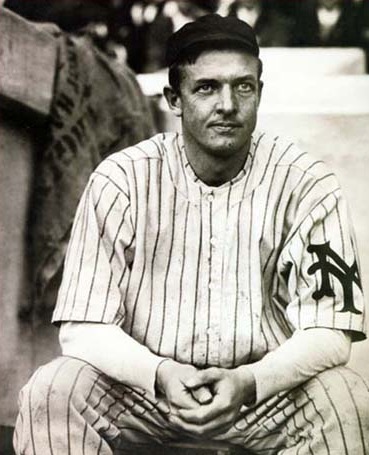


Waddell vs Mathewson

It was something that would be repeated for years.  That dream matchup that could only happen in a World Series.  In 1912 it would be Mathewson vs Smokey Joe Wood. In 1934 it was Dizzy Dean vs Schoolboy Rowe (although it didn't quite happen that way).  In 1936 it was Carl Hubbell vs Red Ruffing.  In 1945 it was Hank Borowy vs Hal Newhouser.  In 1948 it was Spahn and Sain of the Braves against Feller and Lemon of the Indians.  1949 was Newcombe vs Reynolds.  1950 was Robin Roberts vs Reynolds.  In 1957 it was Spahn vs Whitey Ford.  In 1963 it was Koufax vs Ford.  In 1964 it was Gibson vs Ford.  In 1968 it was Gibson vs McLain.  In 1986 it was Gooden vs Clemens.  In 1992 it was Morris and Cone vs Smoltz and Glavine.  These were matchups that could only happen in the most pressure packed, intense, season deciding situations.  It could only happen in the World Series.  But these were the days before interleague play and this was the original.

Waddell vs Mathewson.

This was all still new.  The Pittsburgh Pirates and the Boston Americans (still a few years from being called the Red Sox) had faced off in the first ever World Series in 1903.  The Americans had repeated as AL champs in 1904 but the Pirates were dethroned by the Giants. Although detrhoned doesn't quite give you the right idea.  The Giants destroyed the National League.  They won 106 games and beat an improving, second place Cubs team by 13 games.  John McGraw hated the American League and when McGraw hated something there was nothing that would change his mind.  Not even money.  McGraw had joined the American League when it was formed and ran the Baltimore Orioles.  He clashed repeatedly with Ban Johnson. Johnson didn't like McGraw's foul language.  Johnson didn't like McGraw's questioning the umpires.  Johnson didn't like McGraw's aggressive (read dirty) style of play.  McGraw didn't like Johnson or his rules or his suspensions or his fines.  So McGraw quit.  Though he not only quit, he took most of his team with him and he signed with the National League Giants.  The Orioles franchise was devastated.

Fortunately for McGraw, the owner of the Giants hated Ban Johnson as much as McGraw did.  Andrew Freedman had once owned the Cincnnati Reds.  During his time there, a young sports writer in Cincinnati named Ban Johnson had the audacity to actually criticize the team.  Sure, there was the freedom of the press and all that but it meant nothing to Freedman.  He refused to allow Ban Johnson on team grounds making it impossible for Johnson to cover a team he was assigned to cover.  Johnson eventually teamed with Charles Comiskey, Connie Mack, Clark Griffith and John McGraw to start the rival American League.  When McGraw destroyed the Baltimore franchise and jumped to New York to join Freedman, Johnson struck back.  He basically laid the shattered remains of the Orioles on McGraw's doorstep and moved the franchise to New York.  The war between the American and National Leagues heated up.  It was clear to everyone that the American League was winning.  The war quieted after the peace conference of 1903, although there was one owner who threatened to blow the whole process.

Andrew Freedman would be damned if he would quietly recognize Ban Johnson's league.  Fortunately for both leagues, McGraw's Giants had little to say about it in 1903.  But 1904 was different.  An 18 game winning streak from June to July gave the Giants a 10 1/2 game lead over the competition.  They would stretch that lead to 19 games at one point.  It never got closer than 7 games after July 4th.  The Giants were clearly the best team in the National League and when it came time to set the dates for what would be the second World Series McGraw and Freedman got their revenge.  They refused to play.

According to McGraw and Freedman they had just beaten the best teams in the sport with ease so they were World Champions.  Why would they sully and degrade that title by playing an inferior team from some minor league?  The Giants players were furious.  Several of them, including Joe McGinnity and Mathewson, begged McGraw to let them play.  After all, the players didn't make much and the money from the extra games could surely help them through the winter months.  McGraw would not back down.  He also would not back down on the view that the Giants were World Champs.  When the Giants walked onto the field for Opening Day of 1905, their brand new Navy Blue uniforms had giant white letters across the front declaring "World's Champions".  After destroying the competition again, McGraw finally agreed.  He would face the AL Champs.

Waddell vs Mathewson.

Christy Mathewson was in his prime.  He was the oddity in baseball.  A college boy.  A nice, polite boy.  Good looking.  Well mannered.  Quiet.  Not a drinker or carouser.  He didn't swear.  He didn't fight.  He didn't argue with the umpires.  He was known as the "Christian Gentleman".  He is considered by some as the first baseball player to be viewed as something other than an uncouth thug and reached heights of fame that none had reached, or even imagined, before.

In 1905 Mathewson was the clear leader of the Giants.  He went 31-9.  His ERA was 1.28.  In today's game 200 inning pitched in a season is a strain on the arm.  Mathewson threw 338 2/3 innings.  He allowed 85 runs for the season.  Only 48 of those were earned.  That stat alone is amazing.  Nearly half of the runs allowed were through the poor defense behind him.  After Yogi Berra faced Sandy Koufax in the 1963 World Series he asked "how the hell did he lose five games?"  The question for Mathewson would be, how the hell did he ever lose?

Waddell vs Mathewson.

Rube Waddell was...odd.  That would be the nicest way to put it.  He was impulsive.  Unreliable.  He was fascinated with fires.  In his early days in baseball his teammates dreaded the sound of a fire engine.  Even if Waddell were in the middle of a pitch he would stop and chase the fire engine.  He once damaged his fingers on his pitching hand when he ran into a fire to save...wait for it...a young boy's little red wagon.  The metal wagon burned Waddell's fingers causing him to miss time.
Waddell would routinely leave the team to go fishing for days at a time.  Not telling anyone where he went.  He would just leave and reappear on his own schedule.

He started with the Louisville Colonels but the free spirited Waddell did not mix well with the rigid, strict Fred Clarke.  After repeated run ins Waddell  left the Colonels and ended up in a minor league.  He was happy there.  He could care less about minors vs majors.  He eventually was sent back to the Colonels.  Clarke needed pitching and he could not deny that the odd ball could pitch.  Waddell, along with most of the Colonels stars, were traded to the Pirates before the 1900 season but his antics continued to infuriate Clarke.  He was sent to the minor league Milwaukee Brewers, where he was managed by Connie Mack.  From there he was sent to the Chicago Orphans (later the Cubs).  They didn't like his antics either.  He decided he wanted to play on the west coast so he jumped the Chicago team and landed in the Los Angeles franchise in the Pacific Coast League.  That was in 1901 but half way through the season he had worn out his welcome even in the minor league town of Los Angeles and he was signed by the Athletics.

His antics continued in Philadelphia but Connie Mack was a smart man.  He used the zaniness to his advantage.  He played the antics up.  Come and see the wierdo.  Sure he's crazy but he can pitch like no one else.  He arrived in Philadelphia in June of 1902 but still managed to pitch in 33 games.  He went 24-7.  The antics continued in 1903 as he went 21-19.  1904 was an improvement in his record to 25-19.  His ERA dropped from 2.44 to 1.62.  He had 4 shutouts and struck out an unbeleiveable  (for the time)304 batters.  It was clear there was no better pitcher in the American League.

In 1905 he was at his best.  On September 7 his record stood at 27-10.  His ERA was 1.48.  He had thrown 8 shutouts, struck out 287 and walked only 90 in 328 2/3.  He was clearly the top pticher in the American League and with the Athletics at 4 1/2 games up the talk started.

Waddell vs Mathewson.

September 7.  That's when everything changed.  There was a rule.  It was a fashion rule and no one ever really accused baseball players of being fashionable, though apparently it was one that Rube, who was never much for rules, chose to take seriously.  It was never mentioned if alcohol was involved, although with Rube there was a better than 50/50 chance there was.  The rule was:  don't wear a straw hat (a summer item) after Labor Day.  The other unwritten part of that rule is that if someone catches you wearing one they can take the hat and punch a hole through it.  Hey, it's a rule.


Athletics Pitcher Andrew Coakley arrived at the train station to join the team for their next road trip.  Sitting on his head was a brand new straw hat.  Rube decided it was time for him to inform Coakley of his faux pas.  He approached Coakley.  Coakley was not quite sure what the hell was going on.  Rube was erratic after all and who knew what his intentions were.

According to one biographer Coakley had his spikes hung around his shoulder and when he moved to avoid the lunging Waddell the shoes swung out and hit Waddell in the face.  Waddell, thinking Coakley had punched him, went from jovial to angry and instead of going after Coakley's hat he went after Coakley.  As others jumped in to separate the two, some pushing and shoving started.  With all those suit cases around it was probably inevitable.  Someone tripped.  They went down.  Possibly grabbing onto someone, trying to keep their balance in the chaos, they may have pulled someone else down with them.  In no time a dog pile formed with Waddell and his left arm at the bottom of the pile.

The next day Waddell felt  "a click" in his shoulder as he was shaving.  His arm went dead.  The report was originally that he would take a week off.  He pitched in relief a week later but he had no velocity and no control.  Another week off and the White Sox were hanging around.  By September 21 the lead had dropped from 4 1/2 to 2 1/2.  Rube was still out.  One more week off.  The teams were tied.  If only Rube could pitch.  Already at 27 wins for the year, how many could he have won if he finished the year?  It was over for Rube.  The Athletics struggled through.  They held on to win the American League.


Waddell vs Mathewson.

It would never happen.  Waddell's arm injury kept him out of the World Series.  There have been rumors, stories, as there always were in the days before the Black Sox, that Waddell's arm was not really injured.  The persistent suspicion is that the gamblers had gotten to Rube.  There were rumors that Chicago gamblers got to Rube to allow the White Sox to win the pennant.  There were stories that New York gamblers had gotten to Rube to keep him out of the World Series.  Nothing has ever been proven.

Meanwhile. Mathewson took the mound on October 9th for Game 1.  Instead of Mathewson vs Waddell it was Gettysburg Eddie Plank.  Mathewson was his normal spectacular self.  9 shutout innings.  3 hits.  (Of course 1 Giants error) New York led the series.


The Athletics tied the series in Game 2 with a 3-0 win behind Chief Bender.  Mathewson took the mound again in Game 3.  Instead of Mathewson vs Waddell it was Mathewson vs Coakley.  If only Coakley had followed the damn rules and not worn that straw hat.  Oh, what could have been!  Mathewson lived up to the hype.  Another 9 shutout innings (that was now 18 for the series), only 4 Philadelphia hits, of course another Giants error.  Giants led the series 2 games to 1.

Game 4 was a tense affair with Joe McGinnity facing Eddie Plank.  Both pitchers were on their game but the Giants were able to sneak a 4th inning run across the plate for a 1-0 win and a 3 games to 1 lead in the Series.

With just one more win needed to prove to the world that the American League was so damn inferior that they could only score one, measley, pathetic, stupid run against his Giants, McGraw sent Mathewson out to the mound.  Mathewson pitched 9 more shutout innings (that made it 27 for the series) allowed 5 hits to the Atheletics, of course there were 2 Giants errors. Mathewson won giving the Giants their first World Series victory.

Waddell vs Mathewson.

Mathewson's stats for the 1905 World Series:  3 games started.  27 innings pitched.  13 hits, 0 runs, one walk, 18 strikeouts, 3 wins. 3 shutouts.  Immortality.

Waddell's stats for the 1905 World Series: 0 games, 0 innings.  0  wins.  Generations of speculation.


TRIVIA QUESTION:
One can imagine that sharing a room on the road with the eccentric Rube would cause some clashes.  Fortunately for Connie Mack Catcher Ossie Schreckengrost loved to room with the Rube (or maybe unfortunately since the two got along so well they raiesed all kinds of hell).  Rube did have one habit that drove Ossie nuts and although the Catcher loved rooming with Rube, he had one demand come contract time.  What clause did Schreckengrost insist be put in Rube's contract  if he were to continue sharing a room with the eccentric pitcher?

Answer to Last Week's Question:
The Colorado Rockies are more famous for their lack off pitching than for their pitching success.  Still, Ubaldo Jimenez had quite a bit of success in his days in Colorado.  Jimenez even threw the only no-hitter in the franchise's history.

As with many stars who come through Colorado, Jimenez was traded for minor league prospects, the most prominent of which was Drew Pomeranz.  After the 2011 trade, Jimenez finished the year at 4-4 in Cleveland.  His 2012 was not good.  He led the league in losses  (9-17) and had a 5.40 ERA.  Jimenez turned things around in 2013 with a 13-9, 3.30 season.  In 2014 he signed a big contract with the Orioles but finished the year at 6-9, 4.81 and did not appear in the Orioles' post season run.

Saturday, June 7, 2014

Players I Love More Than I Should: Third Base: Frank "Home Run" Baker

IF you are just joining the blog, don't miss the other players in the "Players I Love More Than I Should series: Yogi Berra, Hank Greenberg, Joe Morgan and Cal Ripken.

More than 18,000 players have appeared in Major League Baseball games since the start of the league.  Some players have short careers that last one at bat or one appearance in the field.  Others have 20+ year careers.  As I read more and more about baseball history there are certain players I find myself enjoying reading about more than others.  It is obviously illogical since many of them retired, or in some cases passed away, long before I was even born.  I have no first hand experience in watching some of them play but for whatever reason their personalities and perseverance strikes me above and beyond the other players I read about.  Over the next few weeks I will be giving you short biographical histories*of some of these players.  Some of them will be Hall of Fame players.  Some of them will be players only casual fans may know.  Regardless, I chose one player from each position for this series to explore.  This week we will explore the Third Baseman  I chose for the series:Frank "Home Run" Baker.

The uniqueness of Frank Baker in this series of player profiles is that he is one of only two players from the dead ball era in the series (check back in a few weeks for the other in the pitching category).  For some, the dead ball era is considered pre-historic, almost inconsequential to today's game.  In truth, some of the best traditions and best legends of the game came from this time period.

By the sixth inning of a dead ball era game the ball was in horrible condition.  It was likely the same ball that was used for the first pitch (and every subsequent pitch).  If the ball had gone into the crowd it was expected that it would come back on the field to be put into play.  Of course if there was no other option, say the ball left the park in an uncommon home run, the umpire would introduce a new ball but otherwise the same ball was kept in use.  By the sixth inning the ball was lobsided, scratched, scuffed, blackened and generally unrecognizable as a baseball.  The idea of hitting the thing for distance was unheard of in the game.

The second game of the 1911 World Series was tied entering the 6th.  The Giants had taken Game 1 and if they could wrap up Game 2 they would be (as Red Barber used to say) in the catbird seat.  Rube Marquard was nearly unhittable for the first part of the game and he started the bottom of the 6th by retiring Bris Lord and Rube Oldring on fly balls.  Pesky little Eddie Collins doubled with two outs and as the batter walked to the plate the Giants bench may have relaxed.  It was Frank Baker and Marquard had owned him to this point in the game. The first pitch came in, a curveball, for a strike.  The second was the same.  Baker was in the hole 0-2.  Behind the plate Chief Meyers knew exactly what the plan was.  Baker could not catch up with Rube's fastball so Chief dropped one finger.  Marquard nodded in agreement.  As he set for the pitch Marquard changed his mind. He had already gotten Baker out on fastballs so there was no way Frank would be expecting a curve.  The ball came in and started to break.  As Baker would later say "I saw it starting to break and I busted it".  The ball launched to left field and landed beyond the wall for a two run Home Run.  The Giants bench deflated.   The Home Run lifted the A's.  Baker was just getting started.

Growing Up on the Farm (Literally)
On March 13, 1886, on a farm in Trappe, MD Frank Baker was born.  Baker's father was a farmer, plain and simple,  married to a distant cousin of Robert E. Lee.  Living in Maryland, one of the border states, Baker's father fought for either side in the Civil War but I am not aware of any information to indicate which side he would have joined, although being married to a relative of Lee might indicate he was likely to have been a Confederate.  Regardless, John Franklin Baker was born to the two in 1886.  At a young age he showed great signs of athleticism and joined the High School baseball team as an Outfielder.  He showed enough promise to get $5.00 a week as a semi pro player.


Fast Moving Rise
The stories of Baker's skills started to spread around the Maryland area and he was eventually signed by Jack Dunn of the legendary Orioles in 1907.  He was given five games to prove he could make it.  Dunn, widely respected for finding talent, saw Baker go 2-15 with two singles in five games and rendered his verdict that Baker was not a professional quality hitter. There was no way he would make it in the big leagues.

Baker was not far from the Maryland-Pennsylvania border and word had gotten around that there were other options available so, some how, Baker signed on for the 1908 season to play for the Reading Pretzels in Reading, PA.  Baker played in 119 games that year, collecting 135 hits, including 11 doubles, 13 triples and six home runs.  One more hit would have made a big difference as he hit .299 for the season.  10 other players from that team would go on to play in the majors.  Only Baker would truly have success.  He finished third on the team in batting, third in hits, first in triples and had three times more Home Runs than anyone else on the team.  No records are available about stolen bases but the numbers (especially the triples) would suggest that Baker had very good speed.  I do not have any information to tell us how many Home Runs were of the inside the park variety, however, given this was during the dead ball era it is likely that many of these were.

For those of you not from the area, Reading, PA is not far from Philadelphia and Connie Mack had scouts all over the Southern Pennsylvania area.  The A's, in 1908, were using future Hall of Famer Jimmy Collins at third base but it was clear Collins was done.  Collins hit only .217 and although he had been great, Mack needed a viable option for 1909.  The A's finished sixth in 1908, 22 games behind the Tigers who were in the middle of a three year domination at the top of the league.  Mack was getting reports that Baker was ready for the big time so at the end of the 1908 the outfielder, rejected by one legend, was given a chance by the legendary Connie Mack at third base.  Mack had several young players called up at the end of the wasted season including  Socks Seybold, Amos Strunk, Jack Barry and Shoeless Joe Jackson.  Baker got into nine games.  He got 9 hits, batted .290, scored 5, drove in 2 and had 2 doubles.  It was too small a sample size but with Collins quitting it was clear Mack needed a third baseman and Baker had potential.


The 1909 A's gave the Tigers a run for their money.  Still featuring the great first baseman Harry Davis and one of the greatest second baseman of all time in Eddie Collins, the A's were clearly a potentially strong team.  Baker had a great year.  He hit 19 Home Runs, stole 20 bases and hit .305, while scoring 73 and driving in 85.  If the offense of Baker and Collins was not strong enough, Joe Jackson had the potential to be great (if he could get his head on straight) and the starting rotation of Bender, Plank, Morgan and Coombs looked to give the A's a bright future.

1910 was the start of something special, something Philadelphia would not see the likes of for another 100 years.  Although Joe Jackson would not be part of it the way it was hoped the rest of the team rounded into form.  With a win on 6/21 the A's took over first place by half a game.  By 7/2 they were five games ahead.  By 9/2 they were twelve and a half up and they rolled to the American League Pennant.  The view of this match up now is completely different from how it would have been viewed entering the series.  It is now viewed as the final hurrah of the Cubs dynasty and the rise of the A's dynasty.  The view at the time would have been the Cubs steamroller continuing to pick up speed but the poor, young, inexperienced A's being little less than a pebble in the way.  The Cubs lost Johnny Evers at the end of the regular season but Heinie Zimmerman was a good replacement so the Cubs were the clear favorites.  Eddie Collins got the A's offense started in the bottom of the first with a lead off single but when he tried to steal Johnny Kling proved he was the best Catcher in the business by gunning him down to end the inning.  The Cubs were not able to get to Chief Bender in the top of the second so Frank Baker got his first World series at bat.  Baker ripped a ground rule double to left field.  Harry Davis sacrificed Baker to third and when Danny Murphy  singled, Baker scored the first run of the game.  In the third, with a 2-0 lead already and Bris Lord on second, Baker singled to earn his first RBI in World Series play.  He wasn't done yet.  With two out and two on in the 8th Baker doubled again scoring Eddie Collins.  The A's won Game 2 as well.  Baker went 1-4 with a walk and a run but Collins was the star of the game, going 3-4 with two doubles, two stolen bases, two runs and an RBI.  Game 3 was crucial.  The underdog A's could take control of the Series  or they could allow the Cubs to gain some footing and fight their way back into the series.  Strunk worked a walk to lead off the game.  A sacrifice bunt moved him to second but he had to hold on a fly ball by Collins.  Baker stepped in against Orval Overall.  Baker lined a single to center scoring Strunk and the A's were on the board.  The Cubs tied the game at 1 in the bottom of the inning and the A's took the lead again in the top of the second with two runs.  The Cubs came right back with two to tie and the fight was on.  Bris Lord started the third with an out.  Collins singled and Baker stepped up again.  He shot a triple to right field scoring Collins.  Harry Davis was hit by a pitch and a Danny Murphy three run Home Run put the game out of hand.  The A's took control of the series with a 12-3 win and the Baker-Collins offensive punch was clearly the reason. The team had a chance for a sweep and they took  a 3-1 lead when Baker doubled and came around to score on Danny Murphy's two run double. By the end of the game Baker was hitting .529 for the series.  The Cubs tied the game in the bottom of the 9th on an RBI triple by Frank Chance and won Game 4 in the 10th to avoid a sweep.  In the 5th and deciding game Baker went 0-5 and his average dropped to .409 for the series, although Eddie Collins stole the show with 2 doubles, 2 RBI and 2 Stolen Bases and the A's won their first World Series.


$100,000 and Creating the Legend

The A's First baseman for 1910 had been a long time great Harry Davis.  He had been playing since 1895 and had hit below .150 the previous season.  The A's were happy with the World Series win but an upgrade was clearly needed.  Davis was moved to a back up role and his starting spot was given to Stuffy McInnis.  The A's struggled badly out of the gate and lost 6 of their first 7.  By mid May they were 12 games behind the front running Tigers who appeared to be running away with the pennant.  The team went on a tear to catch up, and even take over first by half a game, by mid July.  But they stumbled again and fell back.  By July 20 they were five and a half out.  They turned it around again and by August 7 they were in the lead to stay, eventually winning the pennant by 13 games.  The team was led by the pitching and the infield stars of McInnis, Collins, Barry and Baker.  You could forgive the experts if they chose McGraw and the Giants as favorites  over the streaky A's.  Baker's 1911 performance was spectacular again.  He had already led the league in Home Runs in 1909 (he hit 4) and in 1911 his power exploded with 11 Home Runs.  His numbers were far from Ruthian but for the time they were spectacular.  His other stats were not bad either as he hit .334 with 42 doubles.


The 1911 World Series was where Baker truly gained the name of "Home Run Baker".  The Baker-Marquard face off was clearly an important part of that legend but it was only step one.  Step 2 came the next day.  With the series tied the Giants took a 1-0 lead into the top of the ninth.  With Christy Mathewson it looked like the Giants would take the series lead.  Eddie Collins grounded out to start the ninth and Baker stepped in to face the master.  Two quick curves for strikes again put Baker 0-2.  Matthewson knew that Marquard had failed with a breaking ball the game before so he decided to sneak a fast ball past him.  Baker figured Matty wouldn't throw three straight breaking balls so he sat on a fast ball and sent a rocket over the  fence in right field to tie the game.  In the 11th Baker singled to move Collins to 3d and scored the winning run on a Danny Murphy single.  Baker would hit .375 for the series with 2 doubles and the 2 amazingly well timed Home Runs.  The two big hits (combined with his 11 regular season Home Runs) gave Frank a new nickname, the name that would almost become his first name.  He was no longer Frank Baker. He was now "Home Run" Baker.

The 1912 A's season was a disaster.  The team was never truly in the race as the Red Sox stormed to the AL pennant and won one of the closest, most viciously fought World Series.  The A's, meanwhile, seemed to suffer from too much carousing.  Chief Bender and Rube Oldring were both suspended in early September for rumored violations of team rules. Despite the fall from the top for the A's Baker continued to improve.  He reached the 200 hit mark for the first time, led the league in Home Runs (10), and RBI(131). He also had career highs in average (.347), Stolen Bases (40)  and runs (116).   Despite all this there was no catching the Red Sox.


The A's were again led by their infield of McInnis, Collins, Barry and Baker.  They were so successful that Mack decided to reward the four of them.  Each player got raises.  When the salaries were added together they exceeded $100,000 dollars.  For a team to spend that much on payroll was questionable. To spend that much on just four players was unheard of.  Mack didn't care.  He had the best team money could buy and he knew the fans came to watch them.

The A's came back strong in 1913.  The Red Sox, who had ridden the arm of Smokey Joe Wood in 1912, suffered when Wood's arm could not hold up. (He had broken his thumb in the final game of the Series and was never quite the same).  Eddie Plank, Boardwalk Brown,  Bob Shawkey and Chief Bender led the pitching staff and Baker and Collins led the offense as usual.  Baker led the league in Home Runs yet again (12), hit .337, drove in 117 and hit 34 doubles.  The A's ran away with the AL and faced McGraw, Matthewson, Marquard and the Giants in the Series for the second time in three years.

Marquard started Game 1 for the Giants and Baker had a chance to strike first.  With two on and two out in the first Baker faced his old nemesis.  Baker swung and connected and as Marquard whipped his head to track the ball into left field he must have breathed a sigh of relief as he watched George Burns settle under the high fly ball to record the out.  The Giants scored first in the bottom of the third but Collins led off the fourth with a triple and scored on Baker's single.  Baker then scored on a triple by Wally Schang giving the A's a 3-1 lead.  In the 5th Baker lived up to his name again.  With two out Collins walked.  As Collins broke for second on the first pitch, Baker took strike one and Collins was in scoring position.  Baker stepped back in and stared down Marquard.  Marquard went into his motion, unleashed a breaking ball and Baker connected sending the ball into the right field bleachers giving the A's a 5-1 lead.  The A's would win the game 6-4 and Baker would have 3 hits, including the two run Home Run.  Matthewson dominated Game 2 and shut out the A's 3-0.  Baker had 2 of the eight hits allowed by Matthewson but no A's player had an extra base hit and the series was tied.  Baker went 2-4 in the game and drove in 2 as the A's took a 2-1 lead in the series.  Baker was hitting .538 for the series to this point.  Baker's 0-5 in Game 4 did not hurt the A's thanks to the even hotter bat of Eddie Collins.  In Game five Baker went 2-3 with a run scoring sacrifice fly and drove in a total of two runs as the A's once again claimed the World Series title.  

The other side of a Miracle
Baker's numbers were down slightly in 1914.  His Home Runs were down to 9 but he still led the league.  His average dropped a bit but it was still above .300.  The A's struggled over the first month or so but once they took over first place they continued to charge straight into the post season for the fourth time in five years.  Their opponents were a shock.  The Boston Braves, led by Johnny Evers, had started off the season poorly.  By the time 13 games of the season were gone the Braves were 10 games out of first.  By June 8 they were 13 and a half games out of first.  On July 5 they were 15 games out and then the turn around began.  While the Braves caught fire, the Phillies and Giants swooned and the Miracle Braves took the National League by ten and a half games.  Taking the National League was one thing but taking out the $100,000 infield was another.  The A's had a chance to take an early lead in the Bottom of the First but with two on and one out Baker grounded into a double play.  It would be the last chance the A's truly had as they lost 7-1.  Baker went 0-3 in game 2.  The game was scoreless into the 9th when the Braves scored the only run of the game to take a 2 games to 0 lead for the series.  The miracle run seemed to be continuing.  In Game 3 the game was deadlocked in the top of the 10th and it looked like Baker had come through again with a two run single with the bases loaded giving the A's the lead.  Hank Gowdy led off the Braves 10th with a solo Home Run.  The Braves would use a walk, a single and a sac fly to tie the game up and keep it moving forward. In the bottom of the 12th the Braves used a Ground Rule Double, an intentional walk and an error by Bullet Joe Bush to win the game and take a commanding three games to none lead.  Johnny Evers finally got his revenge for having missed the 1909 series when his Cubs had faced off against this same group of A's and his two run single gave the Braves a 3-2 lead in Game 4 and a World Series Miracle win.


Immediately after the loss the rumors started to circulate.  Several players from the A's jumped to the Federal League for bigger contracts.  Stories said some of the players even had the contracts in hand during the Series and looked to make some money on the side by betting on the Series before they joined the new league.  The theory goes that the bets were not all placed on themselves.  It was a precursor to the Black Sox scandal but there was no follow up, no investigation, no outrage.  It was ignored and of course never proven.  It is important to note that these are all just rumors.  No proof has been given to show that anyone on the A's performed less than at their best and the Braves certainly had some talent on their team.

The Split
Connie Mack certainly had some issues with the performance of the team in the World Series.  The team was dismantled. Gettysburg Eddie Plank officially jumped to the Federal League in December of 1914.  Three days later Chief Bender followed.  Three days after that Eddie Collins was sold to the White Sox who were building their own powerful team.  In January Jack Coombs was cut loose.  In June, in mid season, Herb Pennock and Bob Shawkey were discarded.  Of course some players remained but the players used to replace the stars were not up to snuff.

By the time the season started none of it mattered to Baker.  Entering the off season he had asked for a raise.  After all, he had played his best in the series, had remained loyal and rejected offers from the Federal League and with the other high priced players leaving, certainly Mack had some money in the budget to pay his stars.  According to Mack, Baker was already signed and had agreed to a salary.  Baker held out.  Mack refused to budge.  "I'll come back if Connie asks me to."  Mack didn't and told the world that he could get along just fine without Baker.  Mack felt that Baker was breaking his contract by holding out and said "a man who breaks his word once is likely to do it again.  I don't want Baker in my club."

Baker sat out the 1915 season.  He was unsure if his career was over.  There was no free agency at this point.  As long as Mack held the rights to Baker's contract he could not sign a contract with another team.  The Federal League collapsed after the 1915 season so that was no option.  Eventually the Yankees decided they would pay whatever Mack wanted for the contract.

Home Run Baker put on the pinstripes after a year of sitting home (and playing sometimes semi-pro ball) and tried to pick up where he left off.  He hit ten Home Runs, finishing second behind team mate Wally Pipp's 12, but his RBI total and average dropped significantly.  The Yankees were certainly an improving bunch but they were still a bit of a joke around the league.  Baker was a legitimate star for the Yankees, one of the first for the franchise, but it was still a long way from the success that was around the corner for the organization.  Baker had a few strong seasons in 1917 and 1918, even pushing his average above .300 in 1918, but not having Collins, Murphy, Barry and McInnis around him in the lineup meant that pitchers did not necessarily have to throw him pitches to hit.  1919 saw him hit 10 Home Runs and he appeared to be on the verge of regaining his status of the Home Run king.


Tragedy
The winter of 1919 was bad for baseball.  Rumors of the World Series swirled. Chicago was rife with suspicion and it was a bad winter all around.  Baker's wife contracted Scarlett Fever that winter and passed away.  Baker was devastated.  He decided to stay home and focus on his children for the year instead of playing ball.  The Yankees could have used him.  With Babe Ruth leading the way, the Yankees had their first legitimate chance at a pennant.  While the Yankees, led by Ruth, Pipp and Ping Bodie,  fought the Indians and White Sox and dealt with the Carl Mays-Ray Chapman saga, Baker was sitting home trying to reclaim his life.

Comeback
Baker decided he was set to play for 1921.  The problem was Commissioner Landis was not so sure that he could. During his year off Baker had played a few games with some semi-pro teams (he certainly needed the money).  One of the teams his group was scheduled to play against featured Heinie Zimmerman, a player banned by Commissioner Landis.  Landis had declared that any player who played with or against the players banned by the league could no longer play in the majors.  An investigation was launched and Baker finally had some luck.  An appeal from Yankees manager Miller Huggins pointed out that the game set to be played against Zimmerman was actually rained out so techincially Baker never faced off against the banned player.  Landis reviewed it and finally  agreed that Baker could play.  It had taken Baker a while to decide if he wanted to come back after his daughter fell ill but her recovery and his need to earn a living, made up his mind for him.  Baker was cleared to play a week into the season but with Aaron Ward performing well Baker rode the bench at first.  When he did get into the games he struggled.  Before the month ended  Baker was on the bench with a leg injury just as he had brought his average up to .300.  He was back in the lineup by June 3 but on August 20 (the one year anniversary of Ray Chapman's death) he was taken out of the lineup with another leg injury.  It would essentially end his year.  He would return on September 3, but would only play in ten more games, even leaving the team for a little bit with the passing of his  mother.  The Yankees succeeded with Aaron Ward at third base.  Despite the difficulty Baker finished the year with a .294 average and 9 Home Runs.

The Yankees reached their first World Series in 1921.  They faced off against the rival Giants and took the first two games easily.  Baker sat by and watched.  Game 3 was not nearly as fun for the Yankees.  It was a 13-5 beating and although Baker got into the game in the 9th as a pinch hitter he flew out to left in a lost cause.  The Yankees took a three games to 2 lead (the series was a best of nine) but in Game 6 the Giants tied the series back up.  Baker was again used as a pinch hitter in a losing cause and again failed in his only at bat.  For Game 7 he started on the bench but when Mike McNally tore ligaments in his shoulder sliding into second Baker took over at third.  He went 2-3 in the game but the Giants took the lead in the Series with a 2-1 win.  Baker got a start in the final game of the series as McNally was out but unfortunately so was Ruth.  He had an abscess on his arm so dangerously infected that amputation was not out of the question.  Baker went 0-3 and the Giants scored an unearned run on an error by Roger Peckinpaugh.  The Giants won the game and the World Series with a 1-0 victory.

1922 was Baker's final year. He played in only  69 games as the Yankees picked up Joe Dugan for the hot corner.  Injuries, age and the constant tragedy of his life had slowly taken their toll on the once vibrant young man.  The Yankees reached the World Series again but were swept (with one tie) by the Giants.  Baker played in one game as a pinch hitter but went hitless.  It was his final at bat.

John Franklin "Home Run"Baker retired with a .307 lifetime average, 96 Home Runs, 315 doubles, 103 triples and two World Series titles.

Retirement.
Baker walked away from the game but his impact was not done.  Baker still worked as a scout for the Yankees.  He found players here and there and he found one who he knew could not miss.  He approached the Yankees and told them this guy could not miss.  The Yankees passed.  They already had Bob Meusel, Lou Gehrig, and Babe Ruth.  Why the hell would they need another bat?  Rejected, Baker approached Connie Mack.  Mack made the investment and got the best deal of all time. Mack forever thanked Baker for bringing Jimmie Foxx to the A's organization, theoretically making up for the contract dispute of 1915.

Baker's name first appeared on a Hall of Fame ballot in 1936.  He received 0.6% of the vote.  Of course that was the first ever vote so he fell behind names like Ruth, Cobb, Alexander, Speaker, Young and many others.  He picked up some votes in his second year reaching 6.5% but still with names like Nap LaJoie,George Sisler and Ed Delahanty it was a tough field to try to get ahead of.  His voting results yo-yo'd from year to year.  They went to 12.2 to 10.9 back up to 16.7 then down to 10.5 up again to13.7, 19.3 and as high as 30.4 before dropping again to 3.3, 2.4 and finally 3.5.  In 1955 the Veteran's Committee finally made the choice that should have been made years before.  Joining Joe DiMaggio, Ted Lyons, Dazzy Vance and Gabby Hartnett, the Veteran's Committee elected Ray Schalk and Frank "Home Run" Baker.


*This is not intended as a full biography and due to space I have done my best to summarize the life of the players in this series.  For further information on Frank "Home Run" Baker please check out:

Videos:
Ken Burns Baseball


Websites:
http://www.baseball-reference.com/
http://www.baseball-almanac.com/
http://sabr.org/

Books:
Cobb:A Biography by Al Stump
The Ultimate Philadelphia Athletics Reference Book 1901-1954 by Ted Taylor
My Life in Baseball: The True Record by Ty Cobb, Al Stump and Charles C Alexander
Mack, McGraw and the 1913 Baseball Season by Richard Adler
Tinker Evers and Chance: A Triple Biography by Gil Bogen
The First Fall Classic:  The Red Sox, The Giants and the Cast of Players, Pugs and  Politicos Who Reinvented the World Series in 1912 by Mike Vacarro
1921: The Yankees, the Giants and the Battle for Baseball Supremacy in New York  by Lyle Spatz, Steven Steinberg and Charles C. Alexander
The National Baseball Hall of Fame Almanac (2013 edition) by Baseball America


TRIVIA QUESTION:
The $100,000 Infield was made up originally of Harry Davis, Eddie Collins, Jack Barry and Frank Baker.  Davis was replaced by Stuffy McInnis at First Base.  The group won the World Series in 1910, 1911 and 1913.  After the 1914 loss to the Miracle Braves Connie Mack broke up the championship team.  How many World Series titles did the group win after leaving the Athletics?

Answer to Last Week's Question:
Cal and Billy Ripken combined for 451 Home Runs.  The three DiMaggio brothers totaled 573 (Dom had 87, Joe had 361 and Vince had 125).  The Alomar brothers (Roberto 210 and Sandy Jr 112) had 322 total.  The Cansecos (Jose at 462 and Ozzie at 0) totaled 462.  There are three current Molina brothers in the majors (Jose currently has 213, Bengie is currently at 144 and Yadier is currently at 92 for a current total of 449).  The record, however, is held by the Aaron brothers.  Hank hit 755 career Home Runs and his brother Tommie hit a total of 13 giving the family a total of 768. 

Sunday, July 21, 2013

80 Years of All Star Memories

There had been unofficial games of the sport's greatest players before but not like this.  22 years before this there was a collection of stars who played a game to gather proceeds for the widow of poor Addie Joss.  Joss was one of the best pitchers the game had seen in the brief history.  Joss was one of the first pitchers in the modern era to throw a perfect game.  Only 31, he had not been feeling well for quite some time.  Before an exhibition game, in the middle of a conversation, Joss collapsed.  The meningitis he never knew he had would take his life before he ever awoke again.  To provide money to his family, a collection of stars decided to play against Joss's Cleveland team mates and donate any money they made to Joss's widow. 


The Indians had some stars of their own including Jack Graney, Nap Lajoie, and Terry Turner.  Opposing them was a collection of talent never before assembled on one team.  Gabby Street (C, Washington), Hal Chase (1B, Washington), Eddie Collins (2B, Philadelphia), Bobby Wallace (SS, ), Frank "Home Run" Baker (3B, Philadelphia), Tris Speaker (CF, Boston), Ty Cobb (RF, Detroit), Sam Crawford (LF, Detroit), Smokey Joe Wood (P, Boston) and Walter Johnson (P, Washington).  Most of them would be Hall of Fame members.  Others were absolutely dominant  and at the top of their games. 

Fans became obsessed with the idea of seeing great players from opposing teams playing together.  Barnstorming became a huge success.  Post season tours of non-major league cities were big sources of extra cash for the game's big stars.  That was until the owners became terrified that their big name stars would get hurt and their drawing power would be hurt badly.  The league outlawed the barnstorming tours but they filed a mental note about the money they could make.

Enter the 1933 World's Fair in Chicago.  That would be 80 years ago this year.  It was not only the World's Fair, it was Chicago's Centennial Celebration.  Whatever they had planned it had to be big.  The fair included a few exhibitions that would be obscenely offensive today.   Black face performers.  A Midget City.  A series of incubator demonstrations with real babies.  There were also the normal exhibitions by car manufacturers, star performers and an appearance by the Graf Zeppelin.


The fair needed one more thing and with the Cubs having a great team, they had won the NL the year before, the city was baseball mad.  Why not find a way to showcase their great players?  Arch Ward, the Chicago Tribune sports editor suggested that they could get even more people to show up if they used more than just the local stars.  Why not use all of the league's stars?  And even better, why not let the baseball fans see who they want?  It was perfect.  The Tribune distributed ballots in each daily paper, this was a Chicago exhibit after all so the Chicago fans got to choose.  They would be the ones paying for the ticket and playing who they vocally wanted to see ensured high ticket sales.

The 47,595 fans certainly got their money's worth.  It was the last time Connie Mack and John McGraw, rivals since the American League began 30 years before, faced off as managers.  They had gone head to head in the World Series in 1905, 1911 and 1913 and were chosen to lead each squad today.  In future years the manager of the All Star Teams would be the managers of the previous seasons World Series representatives.

McGraw had retired the year before but it was a reunion of sorts for Mugsy.  On his team were Carl Hubbell, Hal Schumacher and Bill Terry, his former players.  Terry, who despised McGraw (and the feeling was probably mutual) had taken over the reigns of the Giants when McGraw retired.  The bigger reunion for McGraw was managing Frankie Frisch.  McGraw, at one point, was like a father to the Fordham Flash but McGraw's tirades and finger pointing grated on Frisch.  After a disagreement (to put it very mildly) in 1926, McGraw shipped Frisch to the Cardinals.  Now, here Frisch was playing for the old man again.  Just like old times, Frisch was the star for McGraw, hitting the first National League Home Run in All Star history.

Old rivalries were renewed as well.  McGraw hated the new style into which the game had evolved.  He was the scientific type.  The Ty Cobb type.  He won with sacrifice hits, good defense and great pitching.  This Home Run game was bull shit in his opinion.  He despised Ruth and the way he had ruined the game with all these long balls.  This was McGraw's first time facing off against Ruth since they had gone head to head in the World Series three years in a row from 1921-1923.

This may have been billed as an exhibition game but it was really a grudge match.  There was a lot of pride at stake and the wounds were still not healed from the war that was ended thirty years ago.  This may have been a showcase for the fans but these players still had to explain themselves to the rest of the league if they messed up.

The first run in All Star game history came in the bottom of the second.  Jimmy Dykes of the Athletics walked with one out.  Joe Cronin of the Senators walked right behind him.  After a fly out for the second out, Lefty Gomez, the Yankees starting pitcher stepped in to hit.  Gomez hit a single to center field bringing Dykes around to score.  That's right.  A pitcher got the first RBI in All Star Game history.


After an easy top of the third the fans got to see what they really wanted to see.  Charlie Gehringer, the Tigers' second baseman, walked and the big guy came up.  Chicago fans hated Ruth.  In the last World Series he had called his shot against the Cubs and had engaged in an ugly feud with them.  Now he stepped in with a runner on first.  He drove a pitch deep to right field and did what everyone would expect the Home Run king to do.  He hit the first home run in All Star Game history and the AL led 3-0.


The NL would cut the lead to 3-2 but that was as close as they got.  The final was 4-2 and the American League had won the first All Star Game.  The NL wanted a rematch and they would get it every year (with the exception of 1945) all the way to the present day. In fact for four years (1959, 1960, 1961 and 1962) they played two All Star Games in a season.  Currently the National League leads the series with a 43-39 record with 2 ties.

The rosters for the first All Star Game (as they do today) included a representative from each team.  Here were the rosters (starters are bolded, future Hall of Fame members are italicized):
American League:
Rick Ferrell C, Red Sox, 
7 time All Star. 
0-3 in the first All Star Game

Al Simmons CF/LF, White Sox, 
3 time All Star. Leading vote getter. 
1-4 with a single and grounded into a double play
Earl Averill CF, Indians,
6 time All Star,
1-1 as  Pinch Hitter with an RBI in the first All Star Game
Wes Ferrell, P, Indians,
2 time All Star. 
Did not play in the first All Star Game)
Orel Hildebrand P, Indians,
only All Star Game. 
Did not play in the first All Star Game)

Charlie Gehringer 2B, Tigers, 
6 time All Star.
0-3 with 2 walks, a Stolen Base and a run scored in the first All Star Game

Ben Chapman LF/RF, Yankees, 
4 time All Star,
1-5 with a strikeout in the first All Star Game
Bill Dickey C, Yankees,
11 time All Star,
Did not play in first All Star Game)
Lou Gehrig 1B, Yankees 
7 time All Star. 
0-2 with 2 walks and a strikeout.  He also committed an error in the first All Star Game.
Lefty Gomez P,Yankees
7 time All Star. 
3 innings pitched.  Allowed 2 hits, 0 runs, 0 walks and 1 strikeout.  At the plate he was 1-1 with an RBI.  He earned the first Win in All Star Game history and his RBI single drove in the first run in All Star Game history.
Tony Lazzeri 2B, Yankees
Only All Star Game.
Did not play in first All Star Game
Babe Ruth RF, Yankees 
2 time All Star. 
2-4, 2 strikeouts, 1 run, 2 RBI, Home Run in first All Star Games

Jimmy Dykes 3B, Athletics,
2 time All Star,
2-3 with a walk and a run scored, helped turn a double play.
Jimmie Foxx 1B, Athletics,
9 time All Star.
Was the reigning AL MVP but did not appear in the first All Star Game.  He would also win his second consecutive MVP award in 1933
Lefty Grove P,Athletics,
6 time All Star.
3 innings pitched, allowed 3 hits, 0 runs, 0 walks, 3 strikeouts and earned the first Save in All Star Game History.  He was 0-1 at the plate.

Sammy West CF, Browns,
4 time All Star,
Entered as a late inning defensive replacement.  Had no plate appearances

Joe Cronin, SS, Senators, 
7 time All Star,
1-3 with a run scored and a walk in the first All Star Game
General Crowder P, Senators,
3 innings pitched, allowed 3 hits, 2 runs, walked none, struck out none and had an ERA of 6.00 for the day.  He was 0-1 at the plate. 
This was his only All Star appearance

National League:
Wally Berger ,CF, Braves,
4 time All Star. 
0-4 and grounded into a double play in the first All Star Game

Tony Cuccinello, 2B, Dodgers. 
2 time All Star. 0-1 with a strikeout as a pinch hitter in first All Star Game

Woody English, 3B, Cubs.
Only All Star Game.
0-1 as pinch hitter and played SS in first All Star Game
Gabby Hartnett C, Cubs
6 time All Star. 
0-1 with a strikeout in first All Star Game
Lon Warneke P, Cubs. 
5 time All Star.
4 innings pitched.  Allowed 1 run, 6 hits, no walks, 2 strikeouts and had a 2.25 ERA.  Was also 1-1 with a triple and run scored in the first All Star Game

Chick Hafey LF, Reds. 
Only All Star Game. 
1-4 in first All Star Game

Carl Hubbell P, Giants.
9 time All Star.
Would win NL MVP in 1933. 2 innings pitched.  Allowed 0 runs, 1 hit, 1 walk and 1 strikeout.  He did not have a plate appearance in first All Star Game.
Lefty O'Doul OF, Giants. 
Only All Star Game.
0-1 as Pinch Hitter in first All Star Game
Hal Schumacher P, Giants. 
2 time All Star.
Did not play in first All Star Game
Bill Terry 1B, Giants. 
3 time All Star.  2-4 in first All Star Game
Dick Bartell SS, Phillies,
2 time All Star. 
0-2 with a strikeout.  Helped turn a double play in first All Star Game
Chuck Klein RF, Phillies. 
2 time All Star.
Reigning NL MVP.  Would finish 2nd in NL MVP in 1933. 1-4 in the first All Star Game

Pie Traynor 3B, Pirates. 
2 time All Star.
1-1 with a double as a pinch hitter in first All Star Game
Paul Waner OF, Pirates. 
4 time All Star. 
Was a late inning defensive replacement.  Did not have a plate appearance in first All Star Game.

Frankie Frisch 2B, Cardinals,
3 time All Star.
2-4 with a run, RBI and Home Run.  Helped turn a double play in first All Star Game
Pepper Martin 3B, Cardinals.
4 time All Star.
0-4 with an RBI and a strikeout in first All Star Game
Bill Hallahan P, Cardinals. 
Only All Star Game. 
2 innings pitched.  Allowed 3 runs, 2 hits, 5 walks, 1 strikeout and had a 13.50 ERA.  Was also 0-1 at the plate.  Took the first loss in All Star Game history.
Jimmie Wilson C, Cardinals. 
2 time All Star Game.
0-1 in the first All Star Game.


TRIVIA QUESTION:
Lefty Gomez started the first All Star Game for the American League and Bill Hallahan for the National League. Three pitchers are tied for the record for starting the All Star Game five different times as a Starting Pitcher. Who are they?
Hint:  All three are in the Hall of Fame

Congratulations to Hope at Disneyland for getting last week's trivia question correct.
Answer to Last Week's Question:
The Cubs moved into Wrigley Field in 1916.  The stadium was built for Chicago's entry into the Federal League, the Chicago Whales.  It was originally called Weeghman Park, named after the owner of the Whales.  When the Federal League folded the Cubs took over the stadium and have played there ever since.  Next year will be the 100th anniversary of the park.

Monday, November 12, 2012

Top 10 Managers of All Time

The job of a major league manager is hard enough on a daily basis.  Put yourself in the shoes of Jim Leyland, the Tigers manager, during Game 1 of this year's World Series.  A week ago you were celebrating sweeping the Yankees to advance to the World Series.  You had this series set up perfectly with the best pitcher in baseball, well rested, starting Game 1.

In the top of the fifth you're already behind 3-0.  Verlander hasn't pitched horribly.  He gave up a home run in the first with two outs and two strikes.  In the third he had two outs and two strikes when the ball hits the third base bag allowing a runner to reach second on what is normally a ground ball out.  The next batter has two strikes and fights off every good pitch Verlander makes, then loops a hit to score two runs.  Verlander has thrown 98 pitches and is due up this inning. 

As you pace the dugout, hands in your pockets to fight off the chill in the San Francisco air,  you need to make a decision.  Do you accept that this is not Verlander's night, pinch hit for him in the hope of jump starting your offense and trusting a bullpen that has been shaky for the last month?  Or do you trust that Verlander can hold the Giants long enough for Jackson, Young, Cabrera and Fielder to get you right back into this?  Regardless of what you choose, one outcome is certain:  you'll have to explain this to the world in a few minutes and many of them won't accept your explanation.

As the manager you have to make the decision to sit your overpaid superstar, who is 0 for the last 24, for the good of the team.  Every move you make is torn apart and critiqued within moments.  Every move you decide not to make is pointed to as the one move everyone is certain would have won the game. 

If having to explain every minor decision isn't hard enough, imagine you have to defend decisions that aren't yours.  Players try to steal without permission and get caught.  Batters decide they can sneak in a bunt in for a base hit and ruin a scoring chance.  This all falls on the manager and no manager who wants the respect of his players would ever blame the player publicly for this.  The manager silently takes the blame.

It is a lonely job.  A job that you accept knowing that you have a shelf life.  Earl Weaver managed the Baltimore Orioles from 1968 to 1982.  Since he left the team after the 1982 season the Orioles have had only one manager last more than two years.  That would be their current manager Buck Showalter who has been there for 2 1/3 years.

What makes a manager great?  A manager has to be able to make the tough decision to sit a star player who is slumping or to tell a legend that someone younger can do the job better and be able to back up the decision with confidence.  A manager has to deal with a fan base that rebels when the ownership refuses to pay the star players big money and leaves them with a shallow talent pool  but Olympic sized expectations.  A manager has to deal with his own success and the perception that because you have made the playoffs five years in a row you have to make it a sixth year in a row or the year is a failure and you are the reason.

A manager has pressure from five sides:  the players, the owners, the press, the fans and themselves.

Despite all of these pressures some thrive in the job.  Here are the ten I consider the best of all time*:
10.  Earl Weaver:


Teams Managed:  Baltimore Orioles 1968-1982
Years in Playoffs:  1969, 1970, 1971, 1973, 1974, 1979
World Series Appearances:  1969, 1970, 1971, 1979
World Series Victories:  1970
Manager of the Year: 0 (Manager of the year was not awarded until 1983)
Earl Weaver was best known for arguing with umpires and being a cranky old man.  What he is also known for is winning.  Weaver developed "the Oriole Way", an organization wide philosophy that taught fundamentals from rookie ball all the way through to the big league team.  He also was a great judge of talent and use of the entire roster through player platoons.  During his time in Baltimore he managed hall of fame players such as Brooks Robinson, Frank Robinson, Eddie Murray, Jim Palmer and Cal Ripken.  His run of success nearly ended on a high note.  In 1982, his Orioles made a late season run to catch the Brewers in the AL East race.  The season came down to a four game series head to head in Baltimore.  The Orioles had to take all four to win.  They came up just short.  Weaver was also known for using foul language.  During a particularly tough stretch for the Orioles batters, Weaver went on a dugout tirade.  One player approached Earl and said "Earl, I'd like to see you walk with the lord." Weaver froze, stared down the player and said: "I'd f---ing like to f---ing see you walk with the f---ing bases loaded."


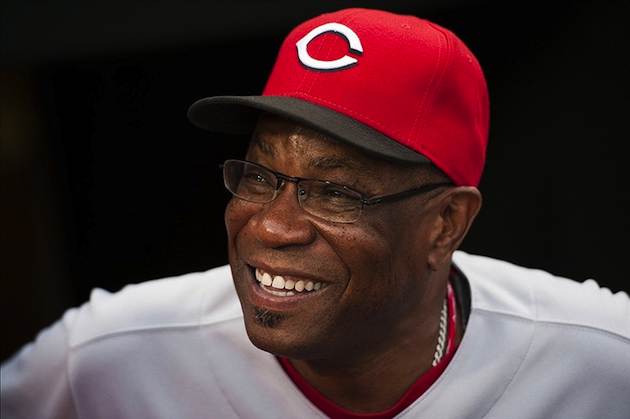
9.   Dusty Baker


Teams Managed:San Francisco Giants (1993-2002), Chicago Cubs (2003-2006), Cincinnati Reds (2008-Present)
Years in Playoffs: 1997, 2000, 2002, 2003, 2010, 2012
World Series Appearances: 2002
World Series Victories: 0
Manager of the Year:  1993, 1997, 2000
It seems blasphemous to think that one of the great Dodger players of the 1970's and early 1980's started his managing career as a Giant.  Although it has been a short managerial career compared to some other managers on this list, Baker has turned around three of the traditionally strong organizations in the history of the game.  Between 1958 when the Giants moved to San Francisco and 1993 when Baker took over, there were few bright years in the bay area.  Baker turned the rarely playoff bound Giants into a consistent force in the NL West pushing them one game short of a World Series ring.  After leaving the Giants he led the Cubs to their first playoff series victory (and if not for a fateful inning to their first World Series) since 1945.  Since leaving the Cubs he has turned the Reds into a two time playoff team in the NL Central (and they appear set to dominate the division for quite some time).  For some reason he doesn't seem to have the support of the Reds fan base but they will surely recognize his importance when he is gone.

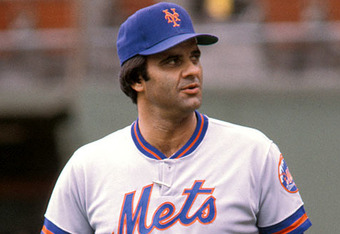
8.   Joe Torre


Teams Managed: New York Mets (1977-1981), Atlanta Braves (1982-1984), St. Louis Cardinals (1990-1995), New York Yankees (1996-2007), Los Angeles Dodgers (2008-2010)
Years in Playoffs: 1982, 1996, 1997, 1998, 1999, 2000, 2001, 2002, 2003, 2004, 2005, 2006, 2007, 2008 and 2009
World Series Appearances: 1996, 1998, 1999, 2000,  2001, 2003
World Series Victories: 1996, 1998, 1999, 2000
Manager of the Year: 1996, 1998
It may be hard to believe that Torre is not higher on the list.  The criticism of Torre was always that he had an unlimited budget to work with and anyone could win with the talent he was given.  That may be true but he certainly did more with less in 1982 in Atlanta and 2008 and 2009 with the Dodgers.  Torre's critics claim that he sat back and watched the Yankees win but Torre was constantly working his magic.  It takes a special manager to juggle the egos of David Wells, Gary Sheffield, Alex Rodriguez, Roger Clemens and any other random overpaid, under performing player Steinbrenner decided to drop on him.  Many of his coaches have gone on to become successful managers including Willie Randolph, Lee Mazzilli and Don Mattingly.

7.   Bobby Cox

Teams Managed: Atlanta Braves (1978-1981), Toronto Blue Jays (1982-1985), Atlanta Braves (1990-2010)
Years in Playoffs: 1985, 1991, 1992, 1993, 1995, 1996, 1997, 1998, 1999, 2000, 2001, 2002, 2003, 2004, 2005 and 2010.
World Series Appearances: 1991, 1992, 1995, 1996 and 1999.
World Series Victories: 1995
Manager of the Year:  1985, 1991, 2004 and 2005.
Sometimes a manager has a good group of players who are used to being told they can't win.  It's up to the manager to change the culture of the organization.  When Cox took over in Toronto they were in a division with the Yankees, Red Sox, Orioles, Tigers, Brewers and Indians.  At the start of every season they would be predicted to finish 6th if they were lucky (it was a dismal time for the Indians as well).  Cox changed all that and took Toronto to the playoffs for the first time in the history of the poor organization.  The Jays were one win away from reaching the Series when the 1985 Royals did what they do best and rallied (see the previous article Greatest World Series Moments: The Most Controversial).  1985 was the first year the LCS round was a best of seven as it had always been best of five.  The joke has always been that the Blue Jays didn't realize the series kept going after they reached three wins.  When Bobby Cox took over for Russ Nixon as manager of the Braves midway through the 1990 season, few thought the last place team had enough talent to get out of the cellar within the next ten years.  (See the previous article Greatest World Series Moments: Greatest Game Ever 2) Over the next 20 years Cox would continually develop players and recognize talent to fit into the Braves system.  Growing talent like David Justice, Ron Gant, Steve Avery, Tom Glavine, John Smoltz, Javy Lopez, Kevin Millwood and Chipper Jones he was also adept at finding small time players like Rafael Belliard, Mark Lemke, Jeff Blauser, Ryan Klesko and Alejandro Pena to fill roles.  Along with this he had the ability to find talent that had been discarded by other teams and resurrect their careers.  Among the long list are Terry Pendleton, Lonnie Smith, Sid Bream, Charlie Leibrandt, Mike Deveraux and Walt Weiss.

6.   Al Lopez

Teams Managed: Cleveland Indians (1951-1956), Chicago White Sox (1957-1965 and 1967-1969)
Years in Playoffs: N/A. (Yearly playoffs did not begin until 1969.  Until then the league winners would advance straight to the World Series)
World Series Appearances: 1954 and 1959
World Series Victories: 0
Manager of the Year: 0 (Manager of the year was not awarded  until 1983)
Probably one of the most forgotten great managers of all time.  Lopez was forced into an awkward position in taking over the Indians.  He replaced a fan favorite in Lou Boudreau and was dropped into a brewing feud between the Indians' GM Hank Greenberg and the Cleveland press.  Lopez rewarded Greenberg in 1954 by leading what many consider one of the top 10 teams of all time, the 1954 Indians.  Cleveland set the mark for most wins in a season but were swept out of the World Series by Willie Mays and the Giants in one of the greatest upsets of all time.  Lopez moved on to the White Sox and led them to their first World Series appearance since the 1919 Black Sox scandal.  Lopez was the first major league star to come out of the Tampa, FL area leading the way for players like Tony LaRussa, Lou Piniella, Tino Martinez and Luis Gonzales.  Why is he this high on the list when he only reached two World Series?  Compare the years he reached the World Series with the manager at number 4 on the list.  Lopez may not have the career wins of some of the people left off the list but he truly was the perfect example of getting more out of less.

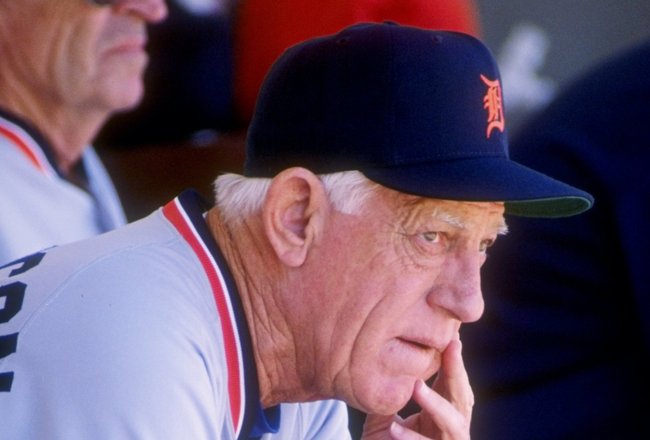
5.   Sparky Anderson

Teams Managed: Cincinnati Reds (1970-1978), Detroit Tigers (1979-1995)
Years in Playoffs: 1970, 1972, 1973, 1975, 1976, 1984
World Series Appearances: 1970, 1972, 1975, 1976, 1984
World Series Victories: 1975, 1976, 1984
Manager of the Year: 1984
Sparky may not have been an all star player but he was one of the brilliant strategists in the history of the game.  Anderson managed a short list of hall of famers (Bench, Morgan, Perez) and a long list of people who should be in the hall of fame (Griffey Sr, Concepcion, Trammell and Morris).  He also became the first manager to win a World Series in both the American and National League.  Sparky also managed three of the greatest teams in the history of the game:  1975 and 1976 Reds (see previous article Greatest World Series Moments: The Greatest Game Part 1) and 1984 Tigers.  His biggest contribution to the game was his use  of the bullpen.  Known as Captain Hook because of his habit of quickly pulling a pitcher, he was the first manager to truly use every pitcher available in every game.  Anderson is well known for his entertaining sound clips.  After the 1976 World Series he told the press that Thurman Munson was a great catcher "but don't never do no one the disservice of comparing 'em to Johnny Bench." (It's amazing that someone who can use that many double negatives in one sentence can pronounce disservice). In the 1984 World Series he told Kirk Gibson that Goose Gossage wasn't afraid of him.  "He don't wanna walk you."  Then, when Gibson hit a three run home run Anderson was yelling like a little kid: "No, don't walk 'im!  Don't walk 'im!"

4.  Casey Stengel


Teams Managed: Brooklyn Dodgers (1934-1936), Boston Braves (1938-1943), New York Yankees (1949-1960) and New York Mets (1962-1965)
Years in Playoffs: N/A  (Yearly playoffs did not begin until 1969. Until then the League winners advanced directly to the World Series)
World Series Appearances: 1949, 1950, 1951, 1952, 1953, 1955, 1956, 1957, 1958, 1960
World Series Victories: 1949, 1950, 1951, 1952, 1953, 1956, 1958
Manager of the Year: N/A (Manager of the year was not awarded until 1983)
The "Old Perfesser" was a jumbled up mess to the outside world but somehow managed to get the most out of his players.  It was like watching an episode of Mr. Magoo.  No one could explain it but somehow he succeeded. He was the first manager to successfully use a platoon system by switching right handed hitters vs left handed pitchers and left handed hitters vs. righties.  He was also unbelievably good at playing hunches.  He once decided to switch the rightie vs lefty system and played a Hank Bauer vs a right hand pitcher.  Bauer usually only played when lefties were pitching but he got a hit in each of his first three at bats.  When the other team brought in a lefty Stengel sent up Gene Woodling, who usually only hit agains righties. Woodling was furious at having sat the whole game and now only hitting against a lefty.  Bauer was furious at not getting a shot to get a fourth hit.  Stengel's explanation to Woodling:  "You'll play your position and do whatever the hell I tell you."  Stengel's explanation to Bauer:  "You ain't no 1.000 hitter.  And you're not a .500 hitter.  In fact, Mr. Bauer, you ain't even a .333 hitter.  So you had your 3 hits for the day and that's all it was gonna be.  That was your quota."  Stengel was fired after the Yankees lost the 1960 World Series in seven games.  Stengel was fired because he was seventy years old.  He told a reporter "I'll never make that mistake again."  He then took over the comical 1962 Mets.  When preparing for the expansion draft a reporter asked where you need to start building a team.  Casey's answer was a catcher, "otherwise you'll have to chase the ball the way to the backstop."  Before he passed away Casey would routinely attend old timers games where he once said "it's wonderful to meet so many friends I never used to like."

3.  Connie Mack

Teams Managed:  Pittsburgh Pirates (1894-1896), Philadelphia Athletics (1901-1950)
Years in Playoffs: N/A (Yearly playoffs did not begin until 1969. Until then the League winners advanced directly to the World Series)
World Series Appearances: 1905, 1910, 1911, 1913, 1914, 1929, 1930, 1931
World Series Victories: 1910, 1911, 1913, 1929, 1930
Manager of the Year: N/A (Manager of the year was not awarded until 1983)
It is definitely not a typo.  Connie Mack managed the A's for 50 years.  Many experts would probably place Mack at either number 1 or 2 on the list.  The reason I did not place him higher was due to the long stretches of truly terrible years between the World Series appearances.  Mack's golden years came in two separate eras.  The first was the era of the "$100,000 Infield" of Stuffy McInnis, Eddie Collins, Jack Barry and "Home Run" Baker as well as the great pitching of Eddie Plank, Eddie Rommel and Jack Coombs.  The second era in the late 1920's to early 1930's included the great teams of Al Simmons, Jimmie Foxx, Mickey Cochrane and Lefty Grove.  (See previous article Greatest Player Never to Win a World Series) Unfortunately, after he disbanded his 1914 World Series team (there are varying explanations why) he struggled to make enough money to rebuild.  He often signed great talent but had to sell them to other teams (usually Boston or New York) to offset another year in the red.  He finally rebuilt the team in the late 1920's but the Great Depression forced him again to sell off his stars.  From 1932 until the A's jumped to Kansas City there were few highlights.  Mack was the first manager to shift the position of his players in the field on a pitch by pitch basis.  He would stand on the top step of the dugout and waive his scorecard to direct his players into position.

2.  Tony LaRussa


Teams Managed: Chicago White Sox (1979-1986), Oakland Athletics (1986-1995), St.Louis Cardinals (1996-2011)
Years in Playoffs: 1983, 1988, 1989, 1990, 1992, 1996, 2000, 2001, 2002, 2004, 2005, 2006, 2009, 2011
World Series Appearances: 1988, 1989, 1990, 2004, 2006, 2011
World Series Victories:  1989, 2006, 2011
Manager of the Year: 1983, 1988, 1992, 2002
LaRussa went out on top but he started at the bottom.  He took over a White Sox team in 1979 that had not made the postseason since Al Lopez (see number 6) led the "Go-Go White Sox" to the World Series in 1959.  The organization was in a tail spin but LaRussa got them back on track and by 1983 had them in the playoffs.  His White Sox team had Carlton Fisk and a young Harold Baines but few other stars, yet LaRussa guided them to a division title.  He was so highly regarded for his work in Chicago that the A's immediately fired their own manager and hired LaRussa when LaRussa left the White Sox in mid season 1986.  While in Oakland, LaRussa built a team that became one of the greatest of all time.  It combined aging greats like Don Baylor, Dave Parker and Willie McGee with young future greats like Canseco, McGwire and Terry Steinbach.  He also had a habit of claiming players that others had given up on and turning them into stars like Carney Lansford, Dave Stewart, Mike Moore, Bob Welch and Dennis Eckersley.  After taking Oakland to the playoffs in 4 out of 5 seasons (including 3 Series appearances and one Series win) LaRussa moved on to St.Louis where he replaced Joe Torre (see number 8)  as the Cardinals manager.  He had an immediate impact and took St.Louis  to a 3-1 NLCS lead over the Braves.  The Braves, led by Bobby Cox (see number 7) came back and won that NLCS.  He continued his ability to identify young talent like Albert Pujols and Rick Ankiel and resurrect players that others had given up on like Jim Edmonds, Larry Walker and David Eckstein.  During his 16 years in St.Louis they reached the playoffs 9 times, reached the World Series 3 times and won it twice.

1.  John McGraw

Teams Managed: Baltimore Orioles (1899, 1901-1902), New York Giants (1902-1932)
Years in Playoffs: 1908 (there was a one game "replay" at the end of the season because the Cubs and Giants were tied.  In one of he most famous moments in the history of the game, a regular season game was declared a tie game because of a protest by the Cubs). 
World Series Appearances:  1905, 1911, 1912, 1913, 1917, 1921, 1922, 1923, 1924.
World Series Victories:  1905, 1921, 1922
Manager of the Year: N/A (Manager of the Year was not awarded until 1923)
Few people in baseball history were as polarizing as John McGraw.  The list of players and managers who had long running feuds with "Mugsy" is like a  hall of fame roster.  Tinker, Evers, Chance, Ty Cobb, Babe Ruth, Frankie Frisch, Rogers Hornsby and Bill Terry all despised the man (some of them even played for him). His supporters are equally as impressive.  Christy Mathewson, Fred Lindstrom, Fred Merkle, Ross Youngs, Mike Donlin, Fred Snodgrass and a million others. The man himself was a paradox.  When he died his wife found a list of African American players he secretly wished he could have signed to play for the Giants, yet at the same time he carried a piece of string that had been used in a lynching as a good luck charm.  He was easy to hate.  There are rumors galore that he was involved in attempts to bribe other teams into throwing a few late season "meaningless games" the Giants' way.  He owned several pool halls with his business partner, Arnold Rothstein, the big money behind the Black Sox scandal.  Regardless of his personal life he was by far the most consistently successful manager in the game.  Connie Mack may have had two distinct eras of success but McGraw was constantly at the top of the league.  His list of World Series appearances could have at least three more years.  In 1904 his Giants won the National League but McGraw chose not to enter the World Series because he didn't feel he had to jeopardize his championship by playing "an inferior" American League.  In 1908 his team had one more regular season win than the Cubs but the Cubs protested a technicality and the game was ruled a tie.  When the season ended the teams were tied and played the first ever one game playoff, won by the Cubs.  In 1919, the year that would end in the Black Sox scandal, McGraw's Giants had a late season collapse.  Oddly, when the punishment from the gambling investigations came out McGraw lost his thirdbaseman and firstbaseman to life time bans.  No one who knew McGraw would ever accuse him of throwing games.  Anyone near him after a loss would tell you it wasn't pretty.  He also could have had two more World Series wins.  In 1912 one game was called a tie because of darkness (there was no night baseball at the time).  Game 8 was played in Fenway parking giving the Red Sox an extra home game, which they won.  McGraw argued that should have been played at the Polo Grounds.  In 1924, if it weren't for some supernatural assistance (see previous article Greatest World Series Moments: The Most Supernatural) he would have won another title.  Regardless of all the controversy McGraw was flat out the best manager of all time.

*Author's Note:  In choosing this list I not only took into consideration the amount of wins by the manager but the consistency of winning, the amount of teams that were led to the playoffs as well as the state of the organization when the manager took over.  I also took into consideration any major long lasting impact on the game. It was only the top 10 so I did leave off many great managers like Lou Piniella, Frank Chance, Bucky Harris, Tommy Lasorda, Walter Alston, Hughie Jennings, Wilbert Robinson and quite a few others.  This is my list.  I am certain your list would look different.  I'm anxious to hear who you would put on yours.  Email me yours at baseballeras (at) gmail (dot) com or leave me a comment in the box below.