Showing posts with label Dave Henderson. Show all posts

Saturday, November 1, 2014

Almost a Dynasty 1980's Athletics

What actually makes a sports dynasty?  Obviously a teem needs to be successful for a continuous amount of time.  Every sport has that one iconic dynasty that fits the Dynasty category.  The NBA had the Boston Celtics who won nine out of ten championships.  The Montreal Canadiens won 7 of nine Stanley Cups (including six straight).  The NFL had several dynasties including the 49'ers, the Steelers, the Cowboys and, most recently, the Patriots.  Baseball itself has had the Yankees dynasties in several incarnations including the 1930's, 1950's and 2000's.

So what actually makes a team a dynasty?  There can of course be several definitions since there are varying levels of success.  A team can dominate their division for a decade but be bounced out in the first round of the playoffs year after year.  We could of course consider that to be a divisional dynasty but you wouldn't call it an overall baseball dynasty.  So let us set the parameters for this series of articles.  A dynasty, for our purposes here, is a team that wins multiple World Series championships (above two as back to back is nice but not a dynasty) within a 5-10 year period.  That being defined, this series will explore those teams that may have been a divisional or league dynasty but for whatever reason could not get over the hump to that World Series dynasty.

This series will show an array of near dynasties.  Some are teams that made the World Series year after year but fell short.  Others will be teams that competed right down to the end of the regular season year after year just to be beaten out.  It will be a series of near misses and what could have beens.

Don't miss the other almost dynasty articles: The Detroit Tigers of the 1900's, The Chicago White Sox of the 1910's and the Pittsburgh Pirates of the 1920's, the Boston Red Sox of the 1940s and the Brooklyn Dodgers of the 1950s, the Milwaukee Braves of the 1950s and the Los Angeles Dodgers of the 1970's.  Now let's get started with this weeks "almost dynasty": The Oakland A's of the 1980's

Bashing in the Bay:
Billy Martin was born and raised in Berkeley California, just five miles or so outside of Oakland.  He was a Yankee at heart but when the Yankees fired him he came home and managed an A's team with few stars.  Led by Tony Armas and Rickey Henderson, Martin was able to fire up the A's enough to get them into the 1981 ALDS against the Kansas City Royals.  They swept the Royals but were then swept by the Yankees (who would in turn be humiliated by the Dodgers). Martin's success was short lived.  In 1982 the team added Davey Lopes but it wasn't enough.  They lost more than 90 games and fell to 5th in the division.  By 1983 Martin was gone but the A's did not improve.  They were an afterthought in the races and they started to realize they needed to completely rebuild.  The team in charge of the rebuilding process were General Manager Sandy Alderson and Farm Director Walt Jockety.  Oakland had a smaller budget than most and they felt they needed to be more aggressive in scouting and find gems with talent that others had missed.  Alderson and Jockety started to pick players off the scrap heap.  If someone else thought a player was finished the A's would look at their talent.  They drafted well.  Their scouts found payers that would fit their team concept.  While the other dynasties had a a few key players the A's had a ton:

Terry Steinbach:  The Catcher in the almost dynasty.  he shared duties behind the plate with Ron Hassey who was Bob Welch's personal Catcher but Steinbach was the force behind the plate.  He was a three time All Star and would stay with the team long after most of the rest of the "almost dynasty" was gone.  He made his debut in 1986 but 1987 was his first full year.

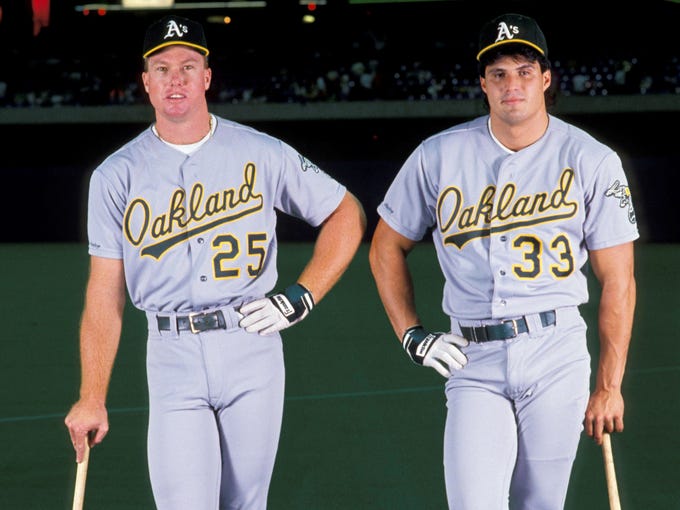
Mark McGwire:  Like Steinbach, "Big Mac" made his debut in 1986 but 1987 was his first full season.  He would hit 49 Home Runs (setting a rookie record) and win the Rookie of the Year.  Big Mac would be a 12 time All Star, set the single season Home Run record and become one of the game's biggest stars.  When the "almost dynasty" started he was considered second  to Canseco.  By the end of the almost dynasty he was second to none.

Walt Weiss:  Weiss played 17 games during the 1987 season.  In 1988 he was the full time Shortstop. During the 1988 season he would captain the defense and would win Rookie of the Year.  Injuries would slow him down.

Carney Lansford:  Carney Lansford had talent.  No one could possibly deny it.  The Angels had known it when he came in third in the Rookie of the Year voting.  The Red Sox had known it when he won a batting title with them in  1981.  For whatever reason (likely because the Red Sox had Wade Boggs at third) teams passed on him.  Sandy Alderson and Walt Jockety would not.  Lansford would be a versatile hitter and spark plug for the team.  He was able to hit anywhere in the lineup and quietly led by example by his willingness to adapt to the team's needs.

Jose Canseco:  Jose was the headline grabber  The big name in the lineup.  In 1986 he was an All Star and Rookie of the Year.  Considered one of the great young talents in the game he would reach the height of baseball fame in 1988 and would fall quickly from it one year later.


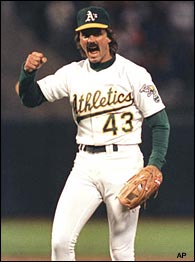
Dave Henderson:  Unfortunately,  when the A's almost dynasty is discussed Dave Henderson is often overlooked.  Like Lansford there was no denying Henderson's talent.  Every team seemed to want him but none kept him.  The Mariners had sent him to Boston where he put the Red Sox on the brink of a World Series.  At the trading deadline the next year he was sent to the Giants where he arrived early enough to help them win the division but too late to be included on the post-season roster.  He signed with the A's following the 1987 season.

Rickey Henderson:  Rickey came a bit late to the party, or alternately you could say there was no party before Rickey arrived.  Rickey had played for Oakland through 1985 when he left for the Yankees.  Unfortunately playing for the Yankees in the 1980's was not the experience it would become 10 years later.  In mid season 1989 Rickey was sent back to Oakland in a blockbuster deal that gave the A's the final ingredient.

Dave Stewart:  Known to his teammates as "Smoke" because of his blazing fastball Dave Stewart defined this "almost dynasty". An intimidating presence on the mound.  He had the talent and power of Roger Clemens with the class of Bob Gibson.  Stewart had been released by the Dodgers, the Rangers and the Phillies.  The Phillies of 1985 had an abundance of young arms in Kevin Gross, Shane Rawley. Bruce Ruffin and Charles Hudson.  Without room for all of them they chose Stewart as the expendable one.  Like the Phillies of that era often did they chose wrong.  He was released by the Phillies and signed by the A's.  It would be one of the best signings the organization ever made.  Without Smoke there would have been no almost dynasty.  His importance to the success of this era cannot be over estimated.

Bob Welch:  Welch had been a big part of that 1970's-80s almost dynasty in Los Angeles.  He went 15-7 in 1987 and during the off season he was part of a gigantic three team trade with the Dodgers, A's and Mets that would play a big part in the NLCS and World Series.  He and Stewart would form the top 1-2 punch in the 1980's.

Dennis Eckersley:  "Eck" redefined the role of the relief pitcher.  He was the closer and when he hit the mound the other team knew they were fighting an uphill battle.

Rise of the Bash Brothers:
The A's 1986 team may not have looked like the start of a dynasty but the signs were there. Lansford was at third base.  Stewart was learning to become the ace he would be.  Canseco was on his way to rookie of the year.  Yet by June they were in last place.  They replaced their manager, Jackie Moore at about the same time that the White Sox were making a managerial change.  When the White Sox manager became available Sandy Alderson jumped at the chance to sign him.  Tony LaRussa turned the year around.  They may not have caught the division leading Angels but they improved to third place.

The following year saw individuals improve and the team started to come together.  As late as August 28 the team was tied for first.  They were led by the arm of Smoke, who was experiencing his first 20 win season, and powerful bats of McGwire and Canseco.  McGwire, on his way to Rookie of the Year hit 49 Home Runs.  They certainly  competed but finished third in the division.  It was clear that things  still weren't quite where LaRussa wanted them.  Stewart undoubtedly  was the ace but he needed help.  So during the off season the A's made some moves.  Given their penchant for finding talent where others missed they made a trade that worked out for them greatly but would also come back to haunt them greatly.  Jose Rijo was a great pitching talent but his results did not reflect his talent.  On December 8 the team gave up on Rijo and sent him to the Reds.  In return they received Dave Parker.  The next day they signed Catcher Ron Hassey to help Steinbach behind the plate.  December 11 was the big day.  With Walt Weiss set to take over at short Alfredo Griffin became expendable, as did reliever Jay Howell  with Eckersley in town.  So the Mets, Dodgers and A's (three of the four eventual playoff teams) got together on a trade.  The Dodgers got Alfredo Griffin, Jay Howell and Jesse Orosco.  The Mets got Kevin Tapani, Wally Whitehurst and Jack Savage.  The A's got  Matt Young and Bob Welch.  December 21 they signed Dave Henderson.  On January 11 they signed free agent Glenn Hubbard to play second base.  All of a sudden the team appeared complete.

Some predicted success for the A's in 1988.  Few foresaw the assault that would be launched against the league out of Oakland.  They won four of the first five games to jump out to first place.  A short three game losing streak to the White Sox led to a stop in fourth place (although still only 1/2 game out of first) but following that it was off to the races.  Smoke (21-12), Welch (17-9) and Storm Davis (16-7) would lead the A's pitching staff.  Eckersley's success (4-2, 45 saves) would send the rest of the league scrambling to find a closer.  Walt Weiss would won Rookie of the Year and Big Mac established himself as a legitimate star.


The 1988 season, however, belonged to one man.  Jose Canseco.  An almost unbelievable combination of power and speed.  Canseco didn't just dominate the league, he owned it.  Canseco had an offensive season for the ages.  120 runs scored, 124 driven in, .307 average, 34 doubles, 78 walks.  But the thing that caught every one's attention was something that was considered impossible.  Canseco hit 42 Home Runs and stole 40 bases.  Never in history had someone reached a 40/40 mark and the world noticed. Canseco instantly became the best player in the league.  An instant lock for the Hall of Fame.  He was only in his third season but he was clearly head and shoulders above the rest of the world. The A's won their division by 13 games and swept a very good Boston Red Sox team in the ALCS.

Entering the World Series of 1988 they were considered unstoppable.  Most of the first game did nothing to change that view.  While the A's had cruised through the season and LCS the Dodgers had to fight and scrap.  They were tired, beat up and missing some key players.  Oakland had their full compliment of power on the field.  Los Angeles did not. Their key man, MVP Kirk Gibson was not available and with their ace Orel Hershiser pushing himself to the limit to win the NLCS  the Dodgers started Tim Belcher against Smoke.

The A's looked to do damage in the first.  After a Lansford strikeout Hendu lined a single and moved to second when Canseco was hit by a pitch. Which caused an argument.  Lasorda argued the ball had hit the bat not Canseco but it was clearly a hit by pitch.  Hitting the A's star was not unnoticed.  Dave Parker flew out but Big Mac walked to load the bases. With Steinbach coming up Dodgers fans got restless and Oakland fans smiled in anticipation.  The Dodgers survived as Steinbach popped up to end the inning.  Smoke was not happy that Belcher had hit Canseco and he wasted no time getting even.  On the first pitch of the game he came up and in against Steve Sax hitting him on the shoulder.  The Dodgers scored two on a Mickey Hatcher Home Run in the bottom of the first.  Hatcher's Home Run matched his regular season total.  Hatcher sprinted around the bases smiling and jumping like the kid who just got the ultimate Christmas present.  Smoke was not happy about it.  No worries.  These were the A's of the Bash Brothers.  If there were going to be fireworks the A's would supply them.  Glenn Hubbard singled.  Weiss struck out looking but Smoke drew a walk.  Lansford walked and the bases were loaded with the big boys coming up.  Dave Henderson is not someone you want walking to the plate when a big hit is needed but Belcher was able to get Henderson swinging.  In stepped the biggest man.  Canseco.  He took ball one.  On the second pitch he connected.  There was no doubt about where this was headed.  Dead center field.  He could have crawled around the bases, and he basically did.  He stood at the plate admiring the shot.  And why not?  It was impressive.  It landed in Center field on top of an ABC camera leaving a dent. The Dodgers cut the lead to 4-3 in the sixth but Stewart was brilliant and with Eckersley set to come in for the 9th there was a feeling of finality to this game before the 9th started.  Scioscia popped out to Weiss to start out.  Jeff Hamilton struck out looking and with the bottom of the order up Eckersley appeared to be in the clear.  He faced Mike Davis who had played in Oakland the year before.  Davis walked.  When the crowd saw who was limping to the plate as the pinch hitter for the pitcher's spot Dodger Stadium was rocking. It would soon rock so hard it would seem to be rolling down the 101.  Kirk Gibson, barely able to stand, was able to swing well enough to connect and send the Dodgers home with a Game 1 win.


Gibson did well in his only plate appearance in the series but it cost the Dodgers his services for the rest of the series.  The A's had Storm Davis on the mound for Game 2.  He was not quite on the level of Smoke or Welch but Davis was a very good starting pitcher.  His opponent in Game 2 was Orel Hershiser.  Orel, known as the bulldog, was in the middle of a season that was to pitching what Canseco's season was to offense.  He had continued it into the postseason. Hershiser allowed a single to Dave Parker in the 2nd but that was erased when Big Mac grounded into a Double Play.  Parker singled again in the 6th and was erased again when Big Mac hit into his second Double Play of the day.  Parker had a third hit in the 7th but the A's were unable to score. They were the only three hits Hershiser gave up. The final was a 6-0 Dodger win for a 2 games to 0 lead in the series.  The Dodgers provided the fireworks thanks to Mike Marshall's three run Home Run.  Unfortunately for the Dodgers Marshall had injured his back in the process. The Dodgers lineup was now short the two big power suppliers.

The A's had a powerful offense that had been quiet to this point.  That's the reason that Alderson, Jockety and LaRussa focused so heavily on pitching. Of course when your hitting is slumping good pitching can pull you through.  The A's offense finally scored their first run since Canseco's Grand Slam when Glenn Hubbard singled, stole second and took third on a Scioscia throwing error.  Ron Hassey, playing since Welch was on the mound, singled to score Hubbard and the A's led 1-0.  The Dodgers tied it at 1-1 with a single run on an RBI double by Franklin Stubbs.  It remained that way until the bottom of the 9th.  Dodgers relief pitcher Jay Howell was on the mound with the Bash Brothers coming up.  Howell got Canseco to pop out to second but McGwire sent the fans home happy with a bottom of the 9th Home Run to end the game.  It seemed like all was right with the world.  The A's were bashing the ball and beating the under matched opponent.  It was assumed that this would turn the tide.

The A's had 9 hits in Game 4, four of them by Hendu, and scored three runs.  With Smoke on the mound that should have been more than enough. It wasn't.  The Dodgers scored four runs, only two earned, and lost another starter when Scioscia was injured. Still, the Dodgers won the game and took a 3 games to 1 lead.  Dave Henderson continued his hot hitting going 4-5 but the rest of the team was quiet.  Hershiser pitched Game 5 and was even more dominant than Game 2.  The Dodgers beat the team that just a week before was considered unbeatable and they did it in convincing fashion.

A Force So Powerful It Shook the Earth:
The A's signed free agent Pitcher Mike Moore from Seattle in the off season.  With Stewart, Welch and Storm Davis it now gave the A's four strong starters. The anticipation of Canseco's follow up to his 40/40 was tremendous but it was clear that there were off field distractions.  There were the several speeding tickets that started the problem.  Then there was the issue at an airport when a traveling companion was found to be carrying a bag of pills.  The friend swore they were his. although there was a close link to Canseco.  The pills turned out to be steroids which woke up the question that had been shouted down just months before when Tom Boswell of the Washington Post had asked it.  Then came the wrist injury.  Canseco at first thought it was just strained but it got worse and he missed a great part of the season.  He had a few more speeding tickets and when he went to a doctor's appointment at the University of California, Berkeley, he was arrested for carrying a concealed, loaded, handgun.  Canseco's season seemed to be full of nothing but trouble.

Oakland struggled to get ahead of the Royals and Angels who surprised most people with their success.  The A's starters were doing what was expected of them.  In fact they had a chance to become the first team since the 1970 Orioles with four 20 game winners.  The offense still had problems thanks to injuries to McGwire, Lansford and Weiss and the question of what to do with the Outfield.  The final outfield puzzle piece came to town with a June 21 trade.  The A's sent Greg Cadaret, Eric Plunk and Luis Polonia to the Yankees and in return they received Rickey Henderson.  Henderson jump started the team and drove the offense.  The race in the AL West was close heading into September but the A's pulled away and won the division by 7 games.

The ALCS against the Blue Jays was contentious and several times came close to erupting into all out warfare.  The tension had begun in the regular season with two separate bench clearing brawls and when Rickey hit a Home Run and admired the feat he had angered the Jays. Toronto managed to win one game but LaRussa had this team focused.  He was not about to allow this team to suffer the same fate the 1988 group had.

Their opponent in the 1989 World Series was their neighbor in San Francisco.  Game 1 saw Stewart face off against Scott Garrelts.  The A's offense was strong.  They knocked 11 hits and scored five runs.  Dave Parker and Weiss hit Home Runs.  Stewart shut down the Giants on five hits.  Mike Moore started Game 2 and faced off against Rick Reuschel.  The A's had a four run inning in the 4th that included an RBI double by Parker and a three run Home Run by Steinbach.
Moore was strong in 7 innings allowing only 1 run.  The A's were up 2 games to 0.

Everything changed as the teams prepared for Game 3.  The scene shifted to San Francisco and as the teams prepared for the game, the A's were set to have Storm Davis start.  The pregame ceremonies were interrupted by Mother Nature.  An earthquake measuring 6.9 hit the San Francisco Bay area collapsing bridges, flattening homes and buildings, setting off fires and killing 63.  Baseball was unimportant as the area tried to rebuild their lives.  There was talk of cancelling the series completely but it was decided to wait.  After waiting two weeks the Series was resumed.  During the time off the A's flew to their spring training home in Arizona.  The Giants stayed in the area and had a few informal practices but few full team practices.  The A's won  Game 3, 13-7, behind Stewart and Game 4, 9-6, behind Moore.  They had won the World Series but few had noticed.

Rijo the Red Gets Revenge:
Storm Davis had been set to start the third game of the 1989 World Series when the earthquake interrupted.  When the series resumed LaRussa sent Dave Stewart to the mound instead of Davis and for Game 4 Davis was passed over in favor of Mike Moore.  Davis, a free agent, felt under aprecciated and decided it was time to move on so he signed with Kansas City.  Also gone on the free agent market were Dave Parker to Milwaukee and Tony Phillips to Detroit.  With Phillips gone a hole developed at Second Base so the Dodgers sent reserve outfielder Stan Javier to Los Angeles and in return received Second Baseman Willie Randolph.  By resigning Rickey Henderson the team remained strong at every position but they had lost some of their depth without Parker, Davis and Javier.

Still, when the regular season began the A's dominated.  They spent only two days (April 11 and 12) out of first place and even that was only 1/2 game out. Unlike the 1989 champions who struggled to gain traction against the Royals and Angels, the 1990 version seemingly won at will. They outpaced the Western Division by 9 games. Bob Welch won 27 games, Stewart won 22 and Scott Sanderson, the replacement for Storm Davis, went  17-11. The team that was already ahead of everyone even found a way to improve at the trading deadline.  They acquired Harold Baines from the Rangers and Outfielder Willie McGee from the Cardinals.  It certainly appeared this team was now perfect. In the ALCS they had little problems with the Red Sox taking Game 1, 9-1, and sweeping the rest of the way.


Their opponents in the World Series were the surprising Cincinnati Reds.  Smoke started Game 1 and faced off against Jose Rijo.  Rijo, whose father-in-law was Hall of Famer Juan Marichal, had originally started with the Yankees and was sent to Oakland as part of the deal that had sent Rickey Henderson to the Yankees. He spent three years as a starter for the Reds in their rotation but just as the team looked to turn the corner and begin the "almost dynasty" Rijo was sent to the Reds for Dave Parker.  Now he had his chance to show the powerful Oakland bats what they had missed out on. In Game 1 Rijo allowed 7 hits in 7 innings and walked only 2.  The best number he put up on the day was 0 as in 0 runs.  The Reds, on the other hand, pou ded Stewart and reliever Todd Burns for 7 runs to take Game 1.  The A's had a much better showing in Game 2 with Bob Welch on the mound but were tied at 4 when Welch left.  The Reds won in the bottom of the 10th for a 2-0 Series lead.

Few could believe that the A's could lose this series, let alone lose three straight but with Tom Browning on the mound for Cincinnati the A's certainly had their work cut out for them.  They didn't help themselves in any way.  The third inning was a 7 run disaster that included a McGwire error, a wild pitch,a pitching change and the Reds batting around.  The team was playing horribly. Everything had gone wrong for Oakland and everything had gone right for the Reds. The biggest disappointment for Oakland was Canseco himself.  After three games he was 1-12 for a .083 average.  In addition his defense had been causing problems when he was caught out of position on a few plays.  Given the poor results in the first three games LaRussa decided to  shake things up for Game 4 and made several line up changes.  Willie McGee started in Right Field in place of Canseco and Jamie Quirk started at Catcher in place of Steinbach.  The A's started Stewart against Rijo again.  Stewart pitched well.  He threw a complete game and allowed only 2 runs on 7 hits.  Rijo, however, allowed only 1 run on 2 hits.  The Reds won.  The team that looked unbeatable was not only beaten but embarrassed.

The downfall was quick and painful for the decade's most powerful team.  Stewart fell to just 11-11 in 1991 and Welch fell to 12-13.  Carney Lansford  and Weiss saw little playing time due to injuries and McGwire's numbers were suffering due to a painful back injury.  Not one player in the regular starting lineup hit .300 for the season and the A's dropped to 4th.  They would rebound for 1992 and reach the ALCS but by that time it was a greatly different team.

What had looked like one of the most dominant teams in history turned out to be a one time World Series Champion.

TRIVIA QUESTION:
The 1988 Dodgers had  several injuries during the World Series leading to a greatly different lineup than the one they had expected to play with entering the playoffs.  Among others Fernando Valenzuela, Kirk Gibson, Mike Marshall and Mike Sioscia missed some or all of the series.  Who was the Catcher that replaced Scioscia and caught the final out of the World Series?

Answer to Last Week's Question:
In 1976 Tommy Lasorda replaced Dodgers legend Walter Alston as manager of the team. Lasorda managed the team through the start of the 1996 season.  When Lasorda started having health issues he handed the reins over to Bill Russell, the former short stop in the "almost dynasty" of the Dodgers.  Russell would manage the team through the end of 1996, all of 1997 and part of 1998.

Monday, June 24, 2013

Forgiving Baseball's Scapegoats: Donnie Moore

Don't forget to check out the other articles in the "Forgiving Baseball's Scapegoats" Series: Fred Merkle, Hack Wilson, Johnny Pesky, Ralph Branca and Leon Durham.


The term closer didn't really become a regular term until a few years later when Dennis Eckersley started his nightly appearances and Bobby Thigpen saved 57 games in 1989.  From the 1990's on every team had to have a closer but before that you just called it a reliable relief pitcher.  Donnie Moore was more than just a reliable relief pitcher for the California Angels, he was dominant.

Moore's career had started in 1975 with sporadic appearances for the Cubs.  He was traded to the Cardinals in 1981 for Mike Tyson (not that Mike Tyson).  His contract was then sold to the Milwaukee Brewers,who returned the contract back to the Cardinals a short while later and was then traded to Atlanta.  He played a few years in Atlanta and had slight success.  In 1985 Moore was signed by the Angels and it was a tremendous move for the Angels and Moore.


He finally put everything together as the Angels challenged the eventual World Champion Kansas City Royals down to the last few days of the season finishing just one game behind the Royals.  Moore was spectacular that season saving 31 with only 8 blown saves.  He also won 8, lost 8, made the All Star team, finished 7th in the Cy Young and 6th in the MVP voting.  Not bad for a relief pitcher. 

The 1986 season was not as strong but the Angels didn't need him to be that year as they won the American League West and moved on to the ALCS for the first time since 1982 and only the third time in their history.  The series started well for them as they got out to a quick 3 games to 1 lead and it looked like this may actually be the year for the "singing cowboy" to get his title. 

Game 5 looked like the moment of ascension for the halos.  Boston jumped out to a quick 2-0 lead in the second but the Angels fought back and when Bobby Grich hit a two run Home Run in the 6th to give California the lead, Angels Stadium sang a halo chorus.  It got louder an inning later when the Angels scored two more to go ahead 5-2 and there was no way this team could lose with Mike Witt on the mound. 


The 9th inning was nothing but tension.  It was dueling curses.  The Red Sox curse of the Bambino vs the Angels curse of unknown origins that had plagued them through the decades.  Now they just needed 3 outs without allowing 3 runs and they would be in the World Series.  Their young ace Mike Witt was tired but he came out for the 9th inning.  It started badly with a single by Bill Buckner but when Jim Rice struck out looking the Angels fans gave a sigh of relief.  Rice was the bat that scared everyone.  They should be fine now.  Just 2 outs left.  Don Baylor, the former Angel MVP and fan favorite, stepped in for the Red Sox and did what he had done for years in this stadium, what the fans had always loved to see.  He drove a pitch into the left field stands for a two run Home Run.  The fans didn't like it so much when he was wearing another uniform.

Still holding a one run lead and one out the Angels allowed Mike Witt to face Dwight Evans and Dewey popped out to third base.  Two out and the bases were empty.  Witt needed just one more out with the bases empty and he was on his way to Angels immortality.  Standing in his way was Rich Gedman who was 4-4 on the day with a Home Run, a double, two singles, two runs and two RBI but with the bases empty and an 0 for 1 Dave Henderson following Gedman to the plate, Witt felt he would get the chance to finish this thing off.  He felt he had earned at least that.  So when he turned around and saw Bob Boone pop up and head towards the mound he was a bit surprised.

"I thought I had a pretty good game plan going in for Gedman, but it wasn't working too successfully."  Witt said after the game.  Manager Gene Mauch was much more direct:  "The bottom line is that Rich Gedman could hit Mike Witt at midnight with the lights out."  So Mauch made the decision to go to the pen.  He brought in Gary Lucas who had great success against Gedman and despite the extra tension, the Red Sox figured this was it.  Game over.  Then Gary Lucas did what he had not done in the last 400 innings he had pitched.    He hit Rich Gedman.  On the very first and last pitch he threw that day Gary Lucas hit Rich Gedman with the pitch.

So the drama continued and Mauch trudged his way back out to the mound to call on another pitcher.  And here is where Donnie Moore enters the picture.  Bottom of the 9th.  Two outs.  One run lead.  Runner on first and stepping to the plate is Dave Henderson.  A player with power  and on the rise but not yet at the peak of his career.  Give it a few pitches and the peak of his career will begin (and won't end for another seven years).

The drama started with ball one, followed by a called strike one.  Henderson swung through the third pitch and now Moore had the advantage.  One more strike and it was all over.  Ball two evened the count.  Henderson couldn't afford to be picky now.  Anything close he had to get the bat on the ball to stay alive at the plate and in the season.  That is not the way a batter likes to approach an at bat.  Moore came back with a breaking ball and Henderson fouled it off.  Then another breaking ball and another foul ball.  It was a long at bat for a situation this tense.  Now it was time for Moore to decide.  He'd thrown two straight breaking balls and Henderson fouled off both of them.  Should they give him one more breaking ball and hope he hasn't got the timing or should they throw the split finger fastball and hope he swings through it?

The problem was that Moore's arm was hurting and the pressure the split finger put on the arm made the pain multiply.  Moore looked in at Boone who signaled for a forkball but Moore shook him off.  He thought Henderson has just missed the last two curves.  They needed an out not another foul ball.  Boone dropped a single digit, indicating the fastball and Moore nodded in agreement.  Moore lifted his leg to start the pitching motion and put everything he had on the pitch. 

The pitch was where he wanted it, on the outside part of the plate.  Watching the video Henderson looks like he starts his swing with a little question of what he's seeing.  His first shift in weight is the movement you normally see on an awkward swing.  The scouts call it hitting with your ass leaning towards the dugout.  The ball headed down, again, right where Moore wanted it.  Down and away with Henderson leaning back should be a strikeout and the Angels should be in the World Series.


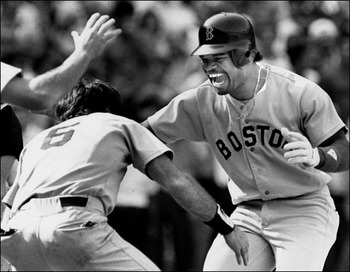
Except that Henderson adjusted quickly and recovered.  He shifted his weight, dove into the swing and caught hold of it.  You could search for years and not find a more opposite emotional reaction to one single swing.  Moore immediately swings around to see where the ball goes while Henderson takes 3 steps down the line and leaps with a giant grin on his face.  The ball is still in the air and it could still be caught.  This was not one of those upper deck, no doubt Home Runs. Moore stands, motionless on the mound and watches.  Hoping, praying silently that Henderson had just missed it.  Henderson lands after his first leap and takes 5 more steps toward first.  He doesn't sprint to first.  It doesn't matter.  This is either going to be a Home Run or an out.  There are few other options.  Then it landed.  Three rows into the stands and Henderson literally jumps for joy then trots around the bases, smiling the whole time.  It would be his only hit of the Series. It takes a minute, literally, for the Red Sox celebration and greeting committee to escort Henderson back to the dugout.  Meanwhile, Moore stands there and watches.  Waiting for the game to resume. 


Moore got the last batter, Ed Romero, on a five pitch at bat.  Growing up my understanding was that this was it and from there the Red Sox went onto the World Series but as I get older and research the game more the importance of the Henderson home run becomes minimal (not in the sense of impact on the series because clearly it changed the series but in the sense of pinning the blame for the loss on Moore).  Sadly, unlike many of our previous forgiven scapegoats this does not end with a long successful career and happy life despite the lasting memory.  Moore struggled with injuries in 1987 and the Angels fans booed him relentlessly while the front office questioned his toughness.  He demanded a trade but no teams were in the market for a pitcher with an injured arm so he faded out of baseball, last pitching for the Angels on August 8, 1988.  The pain of being Donnie Moore finally became too much and on July 18, 1989 Donnie Moore shot his wife and himself in front of their children.  Thankfully his wife survived, however, it is truly a tragic ending for someone who just a few years before had been considered a fun loving, likable guy.


There are probably a million reasons you cannot blame Donnie Moore for losing this Series but here are just a few:
1.  Instead of blaming Donnie Moore we should be praising Dave Henderson for a hell of an at bat.  With the season on the line the Red Sox allowed a batter, who was hitless in the series to that point, face a pitcher at the top of his game.  Down to their last strike Henderson fought off two very good pitches and made a great adjustment on a good pitch by Moore.  Instead of looking at this as a bad pitch we should look at this as a great piece of hitting.

2.  This wasn't the end of the series, or even the game.  Historically we have seen the Angels as walking away and folding once Henderson hit the Home Run but that is certainly not the case.  Henderson hit the Home Run in the top of the 9th.  In the bottom of the 9th the Angels tied the game up.  With just one out and the bases loaded the Angels had Doug DeCinces and Bobby Grich (their 5th and 6th place hitter) at the plate and needed only one run to win it and end the Series.  DeCinces was 2-4 with two doubles on the day.  DeCinces flew out to Right field, not deep enough to score the run.  Grich followed.  He was 1-5 on the day with a two run Home Run.  He lined back to the pitcher and the Angels left the bases loaded.

3.  Moore pitched a scoreless 10th inning against the heart of the Red Sox order.  He also pitched in the 11th and after loading the bases with nobody out gave up a run when Dave Henderson (again) hit a sacrifice fly to right field to score the winning run.  Moore then got the second out of the inning before being relieved and the Red Sox won by one run.

4.  This was only Game 5 of the Series and the Angels had two more chances to win one game.  Their Game 6 starter, Kirk McCaskill lasted only 2 1/3 innings before finally being removed.  John Candaleria, their Game 7 starter lasted only 3 2/3.  With starting pitching like that it seems odd to pin the loss of a series on a tired relief pitcher.

5.  The Angels (not Moore) blew another lead in Game 6.  If the momentum had shifted as dramatically as we have been led to believe after Henderson's Home Run, the Angels don't seem to have noticed.  Not only did they fight back to tie Game 5 immediately after Henderson gave Boston the lead, they left the bases loaded and started off Game 6 in convincing fashion.  In the top of the first in Game 6 the Angels sent eight men to the plate and with a walk and back to back doubles by Reggie Jackson and Doug DeCinces, the Angels were out to a 2-0 lead.  The Angels gave the lead right back to Boston in the bottom of the first.  The Red Sox scored two runs on 0 hits in the inning with two walks, a passed ball, and two well placed ground balls to advance the runners.  Had the Angels avoided the wildness of that first inning the momentum could have swung right back to them.  While Oil Can Boyd would settle down and pitch six more strong innings for Boston, McCaskill would give up a total of 7 runs in less than three innings.

6.  The Mauch/Witt/Lucas trio have avoided blame almost entirely.  I am certainly not suggesting that we should start a campaign to turn these three (or anyone ever) into scapegoats but realistically these three led to the situation that Moore faced.  With a 5-2 lead going into the bottom of the 9th the Angels needed only three outs before giving up three runs.  Of the four runs scored in the inning, 2 belonged to Witt and one belonged to Lucas.  Only one belonged to Moore.  With Witt pitching well and a one run lead everyone believed Witt would get a chance to finish what he started.  Moore himself said "I thought it was Mike's game to win or lose.  I thought I wasn't going to pitch again until the World Series." 

7.  The Angels were missing a major part of their offense after Game 3.  Southern California hadn't gone this crazy over a rookie since Fernandomania.  With Disneyland just blocks away, Wally World was open for business at Angels Stadium.  Wally Joyner finished just 4 first place votes behind Jose Canseco in the Rookie of the Year voting and was hitting .455 in the first three games of the series.  He had 5 hits, 3 runs, 2 RBI, 2 doubles and a Home Run in games 1-3.  The Angels won 2 of those games.  Something happened, no one quite knows what, that caused Joyner to develop an infection.  He was in the hospital fighting off a fever when Donnie Moore faced off against Dave Henderson.  Although Gene and Jackie Autry told the press Joyner would be back for the final two games, the doctors had other ideas and Joyner listened to the doctors.  I am not questioning Joyner's decision not to play because he was very very seriously ill, but with the groove that Joyner was in through the first three games, Mike Witt may have had a lot more run support during Game 5 or McCaskill may have had a bigger lead in the first inning of Game 6.

Monday, December 3, 2012

15 Players You May Not Know from the 1980's but Should

Baseball in the 1980's was not without controversy.  Similar to the steroids scandal today, baseball faced a drug abuse scandal in the 1980's.  It was not steroids that were the drug of choice but amphetamines.  In the winter of 1980-1981, just a few months after winning their first ever World Series, news broke that several high profile Phillies players were receiving "prescription" amphetamines.  The prescriptions were coming from a doctor in Reading, PA and worst of all were being delivered to the players at Veteran's Stadium (the story sounds very similar to Paul LoDuca receiving his steroid shipments at Dodger Stadium).  Amphetamines were not the only drug of choice as Steve Rogers, Tim Raines, Darryl Strawberry, Keith Hernandez, Dwight Gooden and Steve Howe all were caught using cocaine.  Howe was not necessarily the worst offender but he certainly was the one who got caught the most.  Howe was suspended seven times during his career for alcohol and drug abuse. 

Another scandal involved corked bats.  Filling the bat with cork made the bat lighter, allowing for quicker bat speed and also gave some extra spring to the ball off the bat.  There have been recent experiments that said the cork actually absorbs the force of the pitch as opposed to bouncing it as previously assumed.  Either way it is still illegal to use a corked bat.  Billy Hatcher of the Astros got caught red handed.  When the barrel of his bat broke in a 1987 game, cork exploded all over the field.  Hatcher was immediately ejected from the game and suspended for 10 games.  Hatcher didn't hesitate in shifting the blame.  He pointed to a teammate and said he had borrowed the bat.  According to Hatcher he had no idea it was corked.  Hatcher was the only player to get suspended in the 1980's but he was definitely not the only one using this practice.  Every time a guy who was "not a home run hitter" knocked one out of the park the crowd would yell to check his bat.

Bats were not the only thing escalating home runs in the 1980's.  1987 was known as the year of the Rabbit Ball because the ball was jumping out of the park at an alarming rate.  The leagues swore that there had been no change in the manufacturing process and the balls were the same.  There had only once before been an offensive power swing this drastic.  In the early 1920's when the league outlawed spitballs, trick deliveries or any use of foreign substance on the ball.and at the same time demanded that umpires put a new ball in play any time a ball was slightly scuffed, marked or dirtied.  This ended what was known as the dead ball era.

There were heartbreaking stories:  Donnie Moore, the Angels pitcher who gave up a big playoff home run to Dave Henderson, was unable to recover from the loss.  He was devastated at having cost the Angels their chance at the World Series.  He eventually committed suicide. 


Pete Rose was caught betting against his team and was banned for life, forever locking one of the best all around players in history out of the Hall of Fame.  As the manager Rose had plenty of ways to influence the outcome of a game and his teams finished in second place every year, less than ten games out of first.  The scandal was eventually exposed by A. Bartlett Giamatti, the new commissioner.  Giamatti did not revel in the decision and almost seemed to suffer more over the ruling than Rose initially.  The strain was too much for Giamatti.  After almost exactly one year as commissioner, Giamatti died of a heart attack.


There was a true disaster:  The 1989 World Series was interrupted when an earthquake shook the bay area collapsing parts of the Bay Bridge and delaying the A's inevitable win.  The delay and concern over the state of the bay area overshadowed the initial excitement of the A's-Giants match up.  It was a match up that brought back great memories in World Series history.  The A's-Giants had met previously in 1905, 1911 and 1913 and the fourth installment looked like it would be a great series.  It wasn't, although it did have some great moments.  The A's won 4 straight.

There was a bizarre year in 1981 where the season was interrupted by a player strike.  The teams in first place at the time of the strike in mid June were declared first half winners and the teams in first place at the end of the second half, which started in August, were declared winners of the second half.  For the first time in history, there was more than one round in league playoffs. The Dodgers eventually beat the Yankees in the World Series.  Unfortunately, the Reds, who had the best overall record in baseball (combined first and second half) didn't lead the division in either half and missed the playoffs.


Of course, just like today, the media loved to focus on the negative and ignore the positives.

The 1980's was a great time to be a fan of almost any team.  In the AL East, every team except the Indians won the division at least once during the decade and in the AL West every team but the Rangers and Mariners won the division at least once.  In 1980 (Phillies), 1985 (Royals) and 1987 (Twins) organizations won their first ever World Series.  The Padres, Astros, Blue Jays, Brewers and Expos reached the playoffs for the first time in their history.  Only the Dodgers (1981 and 1988) won more than one World Series in the decade.  Not only did no one win back to back World Series, but after the 1970's where the World Series seemed to always be between the same few teams, no team represented their league twice in a row until the A's made the 1988 and 1989 World Series.

Several organizations experienced the highest of highs and the lowest of lows.  The Blue Jays reached the playoffs for the first time in 1985 and jumped out to a 3 games to 1 lead over the Royals.  They then collapsed and lost the series.  They looked strong in 1987 and led the division by 3.5 games with only seven left to play.  They lost their final seven games (including four to the eventual division champion Tigers) and were passed by Detroit.  The Angels made the playoffs in 1982 and 1986.  Both times they were one game away from advancing to the World Series but couldn't quite get there.  The 1986 Red Sox came back and beat the Angels, they then came up short in one of the classic World Series of all time.

The Orioles won the World Series in 1983 then saw a steady decline, bottoming out with the 1988 team which lost their first 21 games.  They rallied in 1989 to lead the AL East nearly all year before collapsing and losing to Toronto on the last day of the year.

The Fall Classics that were played between 1980 and 1989 were often true classics.  1982, 1985, 1986 and 1987 all went the full 7 games.  1980 and 1981 went six games.  The Dodgers-Yankees renewed their rivalry in 1981 and St.Louis ignited a new rivalry with the Dodgers with a classic 1985 NLCS.  The World Series also saw some of the most memorable World Series moments with Kirk Gibson making himself a legend and Bill Buckner making himself the biggest scapegoat in history.


There was also the heartwarming story of Jim Abbott.  Jim Abbott was a left handed pitcher.  He could throw hard and throw accurately but he was missing something that every other pitcher in the league had.  He was missing a right hand.  He never allowed it to slow him down and was able to develop a unique pitching motion that allowed him to throw, put his glove on his pitching hand, field a ball with the glove, switch it to his throwing hand and throw out a runner before you even knew what had happened.  The best part of Abbott's story is that he was truly a great pitcher.  He even pitched a no-hitter.


Directly in the middle of the decade is one of the greatest teams that you probably didn't know was great.  The 1984 Tigers.  Led  by Alan Trammell, Lou Whitaker, Chet Lemon, Lance Parrish, Kirk Gibson, Jack Morris  and Frank Tanana the Tigers jumped out to a 35-5 start, easily the best first 40 games of all time.  The Tigers never slowed down.  They raced through the regular season, eased past the Royals in the ALCS and destroyed the Padres in the World Series.  You'll hear more about them a little farther down.


Although the names of Mike Schmidt, Dwight Gooden, George Brett, Jose Canseco, Pete Rose, Don Mattingly, Dave Winfield and Jim Rice will be the names that are remembered thirty, forty, fifty years from now (or more), every decade has tremendously talented, successful players who make wonderful contributions to the success of their teams, organizations and the league as a whole. Unfortunately many of the players who fall into this category will be forgotten, overlooked and generally ignored. Here are 15 players* from the decade you may not remember but you definitely should:


Catcher:
Mike Scioscia


Career Teams: Los Angeles Dodgers (1980-1992)
All Star Appearances: 1989 and 1990
MVP Voting:  1985 (18th)
Current fans of the Angels recognize Mike Scioscia as the most successful manager in the team's history.  Current fans of the Dodgers recognize Mike Scioscia as the team's Catcher who should have been their manager if the ownership had been smart enough to hire him.  Few remember the talent that Scioscia displayed behind the plate.  He never won an MVP award or Gold Glove.  He only made two All Star teams but should have made more.  Scioscia handled the pitching staff of the Dodgers (Hershiser, Valenzuela, Don Sutton, Jerry Reuss and many more) the same way he has handled the Angels pitching staff for the past decade.  Scioscia sees the game and can anticipate the game better than most people understand.  Scioscia played a huge part in the Dodgers 1988 World Series run.  Not always known as a home run hitter, Scioscia hit a huge game tying home run in the NLCS against the Mets.  He only played in three games in the World Series due to injury but made several outstanding defensive plays to help the Dodgers stun the heavily favored A's.  Scioscia will not reach the Hall of Fame as a player but if he stays on his current path he may reach it as a manager.

Firstbase:
Will Clark


Career Teams:  San Francisco Giants (1986-1993), Texas Rangers (1994-1998), Baltimore Orioles (1999-2000) and St. Louis Cardinals (2000)
All Star Appearances:  1988, 1989, 1990, 1991, 1992 and 1994
MVP Voting:  1987 (5th), 1988 (5th), 1989 (2nd), 1991 (4th) and 1994 (15th)
If the early 2000's seemed to be the golden age of firstbasemen, the 1980's was a close second.  With Mark Grace, Don Mattingly, Mark McGwire, Fred McGriff and Keith Hernandez in their prime and Willie Stargell, Pete Rose and Tony Perez ending their careers, it was easy for Will Clark to get lost in the shuffle.  Clark was often known as "the Thrill" (his home answering machine played B.B.King's "The Thrill Is Gone") but he was also known as the "Natural".  It was well known by pitchers that he rarely swung at pitches outside the zone but pitchers didn't seem to get any breaks against him.  His signature moment came in the 1989 NLCS against Greg Maddux.  Ever wonder why everyone covers their mouths with their gloves when they visit at the mound ?  It wasn't always that way.  In the top of the fourth inning of Game One the bases were loaded with two outs and the Cubs had shaved the Giants big lead to a slim one run.  As Clark stepped into the plate Rick Wrona, the Cubs catcher, went out to talk over how to pitch to Clark.  They couldn't try to get him to chase a pitch outside the zone.  He wouldn't swing.  He would just take the pitches and walk.  While these conferences take place many batters take a few practice swings, look down at the thirdbase coach, look in the dugout, joke with the umpire.  Clark stared out at the mound and glowered at Maddux as he met with Wrona.  He couldn't hear anything above the cheers but he saw Maddux's lips communicate one thing: fastball.  The first pitch came in, a fastball, and Clark sent it out just as fast.  A grand slam to right field.  The Cubs never recovered from the blow and the Giants moved onto their first World Series since 1962.  The result of this play:  never let the batter see what you're saying.

Secondbase:
Harold Reynolds

Career Teams: Seattle Mariners (1983-1992), Baltimore Orioles (1993) and California Angels (1994)
All Star Appearances: 1987 and 1988
MVP Voting: None
Over the last few weeks you have heard me refer to "baseball graveyards".  No better example exists than Seattle in the 1980's.  Talents like Jim Presley, Alvin Davis and Mark Langston toiled in vain in the pre-Ken Griffey, Jr. years of Seattle baseball.  No one toiled longer or better than Harold Reynolds.  The Mariners rarely got out of last place and were not ever competitive.  Reynolds was a top of the lineup, "motor" guy who made the Mariners go, although the destination was never a pretty place.  During the 1980's Rickey Henderson dominated the league in stolen bases.  In 1987, with Rickey suffering from injuries, Reynolds led the league with 60 stolen bases.  A few days after the season ended Reynolds was excited to receive a call from Rickey, assuming Rickey wanted to congratulate him for leading the league in steals.  Instead Rickey told him he should be embarrassed about leading the league with only 60 steals.  Rickey could have done that in half a season.  Reynolds was also a great fielder.  He won three straight Gold Glove awards.  Fans of the game can still see him on MLB Network's nightly coverage of the league.  He regularly gives tremendously insightful analysis, fundamental breakdowns and his own philosophy of the game.  It would be amazing to think what an impact his baseball mind could have made on a team that made the playoffs.

Jim Gantner

Career Teams:  Milwaukee Brewers (1976-1992)
All Star Appearances:  None.
MVP Voting:  None.
If there was ever a player who starred in obscurity and quietly did his job as the stars took credit, Jim Gantner was that player.  In 17 years in Milwaukee Gantner never made an All Star team, never received an MVP vote, never won a Gold Glove, yet he was a key part of the glory days of the Milwaukee franchise.  Although Paul Molitor, Robin Yount, Ted Simmons, Gorman Thomas and Teddy Higuera, and later Gary Sheffield and Greg Vaughn, got the headlines, Jim Gantner just kept plugging away.  He was a good, versatile fielder, playing every infield position at some point and never making more than 13 errors in a season.  Gantner played a big role in Milwaukee's only World Series appearance getting 8 hits including 4 doubles and a triple. In Ganter's final year, as Baltimore collapsed after the All Star break and Toronto thought they were in the clear, Milwaukee took a shot at the Blue Jays.  With three games to play Milwaukee trailed Toronto by only two games.  Gantner did not have his greatest season in 1992 but he certainly led the team in the clubhouse.  Although outside of Milwaukee he is rarely remembered, Brewers fans will never forget his 17 years of service.

Shortstop:
Alan Trammell


Career Teams:  Detroit Tigers (1977-1996)
All Star Appearances:  1980, 1984, 1985, 1987, 1988 and 1990.
MVP Voting:  1980 (20th), 1981 (21st), 1983 (15th), 1984 (9th), 1987 (2nd), 1988 (7th) and 1990 (19th)
Every World Series winning team of the 1980's (and all but one of the runners up) have at least one player in the Hall of Fame except for the 1984 Tigers.  The '84 Tigers are one of the great teams in the history of the sport. They started the season 35-5 and never looked back.  He may not have been voted regular season MVP (the team had no shortage of candidates) but he was the World Series MVP.  In the ALCS against Kansas City, Trammell hit .364 with a triple, a home run and three RBI.  Those are big numbers but his World Series performance made those numbers look weak.  He hit .450 with a double, two home runs and 6 RBI and scored 5 runs.  He was clearly the World Series MVP as the Tigers destroyed the Padres to win their first World Series since 1968.  Trammell was often overshadowed by Shortstops like Ripken, Ozzie Smith, Ozzie Guillen and Tony Fernandez but Ripken always evaluated his own performances based on what Trammell did.  If Cal Ripken thinks he needs to be better than you to justify his own value it should be an easy decision that you should be in the Hall of Fame.

Thirdbase:
Carney Lansford

Career Teams:  California Angels (1978-1980), Boston Red Sox (1981-1982) and Oakland Athletics (1983-1992)
All Star Appearances:  1988
MVP Voting: 1981 (6th), 1982 (32nd) and 1989 (17th)
The Oakland Athletics of the late 1980's and early 1990's had a lineup filled with All Stars, MVP's, Rookies of the Year and future Hall of Fame legends:  Walt Weiss, Don Baylor, Rickey Henderson, Mark McGwire, Dave Parker, Tony Phillips, Willie McGee, Harold Baines, Terry Steinbach, Dave Stewart, Dennis Eckersley, Bob Welch and Jose Canseco.  Carney Lansford was almost always forgotten in this group.  Lansford started his career in California and was a part of the Angels' first playoff team in 1979.  The Angels lost to Baltimore in 4 games but Lansford hit .294 and drove in three runs.  After a few years in Boston Lansford moved on to Oakland.  The A's of the mid 1980's were in transition.  A few years after the signing of Lansford, Oakland started a renaissance with three straight Rookies of the Year (Canseco, McGwire and Weiss) and the developing of a great pitching staff.  Lansford played a big role in the A's rise to prominence but did not get the recognition he deserved.  Players like Lansford are usually called gritty.  Lansford's uniform was always dirty, he was constantly picking himself up off the dirt after making a diving stop, throwing from his knees.  As the A's won their first World Series since 1974, Lansford played some of the best ball of his career.  He hit .455 in the 1989 ALCS against Toronto and followed that up with a .438 World Series as the A's swept Will Clark and the Giants. 

Tim Wallach


Career Teams:  Montreal Expos (1980-1992), Los Angeles Dodgers (1992-1995), California Angels (1996) and Los Angeles Dodgers (1996)
All Star Appearances:  1984, 1985, 1987 and 1990
MVP Voting: 1987 (4th), 1990 (10th) and 1994 (18th)
Playing thirdbase in the NL during the decade of the 1980's was difficult. You were competing with Mike Schmidt, one of the three greatest thirdbasemen of all time, Graig Nettles, a Yankees legend who moved to San Diego as well as Howard Johnson and Chris Sabo, two rising talents.  Playing baseball in Montreal in the 1980's after 1981 was a dead end.  As the Expos lost or traded their stars like Andre Dawson and Gary Carter, the middle years of the decade were dark years.  Tim Wallach was the quiet star of the organization.  Wallach was the one mainstay between the Andre Dawson/Gary Carter years and the development of the younger talent like Marquis Grissom, Delino DeShields and Larry Walker.  Wallach made 5 all star games, won three gold gloves and was one of the few players giving the Expos respectability.  Wallach exited Montreal in 1993 for the Dodgers and was rejuvenated, helping the Dodgers make the playoffs in 1995 for the first time since 1988.  Wallach rarely got the recognition he deserved but would have garnered much more attention had he played somewhere other than Montreal.

Outfield:
Dale Murphy


Career Teams:  Atlanta Braves (1976-1990), Philadelphia Phillies (1990-1992) and Colorado Rockies (1993)
All Star Appearances:  1980, 1982, 1983, 1984, 1985, 1986, 1987 and 1988
MVP Voting:  1980 (12th), 1982 (1st), 1983 (1st), 1984 (9th), 1985 (7th), 1986 (21st) and 1987 (11th)
It is hard to believe that Dale Murphy doesn't have more people pushing for his inclusion in the Hall of Fame.  In fact as I was preparing this article, the ballots for this year's Hall of Fame were released.  Mike Ferrin on MLB Network Radio said that he too was surprised that more people do not support Murphy.  Ferrin's exact words were "if you would have told me in 1986 that Dale Murphy wasn't in the Hall of Fame I would have said you were nuts."  In the ten years between 1980-1989 Murphy received MVP votes in seven seasons, four of those years he was in the top 10 and twice won the award.  Most fans who remember the Braves' long stretch of playoff appearances in the 1990's and early 2000's remember hearing how horrible the Braves were before that time.  What few people remember is that the Braves were a playoff team in 1982.  They were swept out of the playoffs by the eventual World Champion St. Louis Cardinals but Murphy was the man who carried the Braves to a division title by one game over the Dodgers.  Murphy won a second MVP award in 1983 as the Braves finished only 3 games behind the Dodgers.  On top of his leadership and consistent bat in the Braves lineup, Murphy was a tremendous fielder.  He won five consecutive Gold Gloves as an outfielder.  As the Braves started to move towards their youth and looked to make room for young players like David Justice, Ron Gant and Deion Sanders, Murphy was traded to the Phillies during 1990.  Although Phillies fans were excited to get such a big name, Murphy's best days were over. Injuries and the Phillies own youth movement limited Murphy's playing time and effectiveness.  Murphy was known as a very religious, conservative guy who did not drink, smoke or carouse and did not approve of other players who did.  As the Phillies started gathering players such as Lenny Dykstra, Darren Daulton, Pete Incaviglia, John Kruk and Mitch Williams, Murphy's personality didn't really fit in.  He was moved to the Rockies before the Phillies' magical 1993 season but played sparingly for the expansion Rockies.  The only other 2 time MVP of Murphy's stature not in the Hall of Fame is Roger Maris.

Robin Yount


Career Teams:  Milwaukee Brewers (1974-1993)
All Star Appearances: 1980, 1982 and 1983
MVP Voting:  1980 (17th), 1981(17th), 1982 (1st), 1983 (18th), 1987 (11th), 1988 and 1989 (1st)
Robin Yount was elected into the Hall of Fame in 1999, so why is he on a list of forgotten players?  Because although he reached the hall of fame, if you were not a Brewers fans in the 1980's you may have missed just how good this guy was.  The Brewers have had very few eras they could hang their hat on but the Yount/Gantner/Molitor era is the big one, even more so than the Fielder/Braun era that just ended.  In the strike shortened season of 1981 the Brewers reached the playoffs for the first time and although Yount had a great season, it would be nothing compared to his 1982 MVP season.  As a shortstop (not yet a position associated with offensive prowess), Yount hit .331, led the league in doubles (46), hits (210) and total bases (367).  He also hit 29 home runs and stole 14 bases, made the All Star Team and won a Gold Glove.  Still, his best moments of the season were yet to come.  In the Brewers only World Series appearance Robin Yount hit .414, drove in 6, and had 5 extra base hits (4 doubles and a home run).  Few players have ever had a better series on a losing team.  Few shortstops on winning teams have had a series that good.  A few years later Yount started to develop severe shoulder problems, a major issue for someone who has to make strong throws from Shortstop.  So the Brewers moved Yount to the outfield.  Yount did just fine in centerfield and in 1989, on a fourth place team, Yount won his second MVP award at a second position (only the second player in history and the first since Hank Greenberg in 1935 and 1940 at Firstbase and Outfield) to win an MVP at two different positions. 

Dave Henderson


Career Teams:  Seattle Mariners (1981-1986), Boston Red Sox (1986-1987), San Francisco Giants (1987), Oakland Athletics (1988-1993) and Kansas City Royals (1994)
All Star Appearances:  1991
MVP Voting:  1988 (13th) and 1991 (21st)
Dave Henderson seemed to be everywhere during the playoffs of the late 1980's but always seemed to be the forgotten player.  In 1986 the Angels pitchers focused on Boggs, Evans, Rice and Buckner in the ALCS.  Yet it was "Hendu" who hit the big home run to steal the series from California and put Boston in position to reach the World Series, it was his only hit in the series.  Everyone, casual fan or student of the game, has seen Bill Buckner misplay the ground ball that allowed the Mets to win Game 6 of the 1986 World Series.  Few realize that Henderson was the man who put the Red Sox on top in the top of the 10th with another huge home run.  Henderson played the beginning of 1987 with the Red Sox but as the year started to unravel Boston tried to quickly rebuild and Henderson was traded to the Giants on September 1 for a player to be named later.  He did not make the postseason roster, something the Giants likely regretted in retrospect as they lost to the Cardinals in the NLCS.  As a free agent at the end of the season Henderson signed with an Oakland A's team that was looked at as a strong playoff contender with rising superstars Jose Canseco, Mark McGwire, Walt Weiss, Dave Stewart and Terry Steinbach and veteran leaders Dave Parker, Don Baylor, Bob Welch and Dennis Eckersley.  It was a crowded team but Henderson quietly made a big impact.  He hit .304 and pounded 24 home runs in a gigantic Oakland stadium, scored 100 runs and drove in 94.  Just like his stay in Boston, Henderson was best in big situations.  During the three years of the Oakland powerhouse of the late 1980's, Henderson hit 4 postseason home runs, 9 postseason doubles, scored 15 runs and knocked in 11 in just 24 postseason games with Oakland.  As the team evolved through the playoff drives, players like Harold Baines, Willie Wilson and Rickey Henderson cycled through the clubhouse and continued to get the attention, yet Henderson and Carney Lansford were the two forgotten consistent performers.  With his constant energy and unforgettable smile, it was impossible to watch Hendu play and not want to pick up a bat or put on a glove.  If anyone ever showed you it was OK to have fun playing ball, this was the guy.

George Bell


Career Teams:  Toronto Blue Jays (1981-1990), Chicago Cubs (1991) and Chicago White Sox (1992-1993)
All Star Appearances:  1987, 1990 and 1991
MVP Voting:  1984 (19th), 1985 (8th), 1986 (4th), 1987 (1st), 1989 (4th) and 1992 (20th).
The early years of the Blue Jays were not good.  There were very few early stars and even fewer successful seasons.  George Bell was the organization's first star and he used his gigantic muscles to carry the entire organization on his back.  1980's baseball in Canada was a race to see which Canadian team could win a World Series first.  The Expos struck playoff gold first, reaching the NLCS in 1981.  The Blue Jays took a little longer to counterstrike but in 1985, led by Bell, the Blue Jays advanced to within one game of the World Series.  As the Jays jumped out to a 3 games to 1 lead over Kansas City, Bell hit .321, scored 4 times and hit 3 doubles.  Toronto  fell back in the standings in 1986 but Bell continued to carry the team.  As the 1987 season developed it appeared that Toronto was a strong World Series contender and led the AL East.  Bell was the MVP of the season hitting .309 and driving in 134 runs with 47 Home Runs.  Although it may seem silly to current fans, in the 1970's and 1980's hitting this close to 50 home runs was a major achievement.  Few players had gotten this close to it since Roger Maris set the record.  1988 was an off year for Bell (.269 and 24 HR).  1989 saw a resurgence as the Blue Jays won a great race with the Red Sox to reach the ALCS.  Bell struggled in the playoffs, hitting only .200, although he did hit a home run in the final game of the series.  The 1990 season saw another close Red Sox-Blue Jays battle but Bell seemed to play his way out of town as rumors swirled about his poor clubhouse attitude.  These rumors, poor relations with the Toronto media and lack of fan support led to Bell signing a big Free Agent contract with the Cubs.  Chicago fans were excited to get Bell's talent but the love affair ended quickly.  Bell did not fit in well in the Cubs clubhouse and the Cubs faithful were getting tired of waiting for a World Series.  Bell was traded to the crosstown rival White Sox before the 1992 season started.  The Cubs got a pitcher named Ken Patterson and a young outfielder named Sammy Sosa.  It originally appeared that the White Sox got the better of the deal as  Bell hit 25 HR and drove in 115 in his first year.  It is hard to tell why but Bell never could seem to regain the form that made him one of the best players of the decade.  Bell also falls into another dubious category for Phillies fans.  He is one of the long list of "could have been" players the Phillies let get away in the early 1980's as their playoff teams aged.   Bell was originally drafted by the Phillies in 1978 but was claimed by Toronto as a Rule 5 draft pick in 1980.

Starting Pitcher:
Mike Scott


Career Teams:  New York Mets (1979-1982) and Houston Astros (1983-1991)
All Star Appearances:  1986, 1987 and 1989
MVP Voting:  1987 (10th) and 1989 (15th)
Cy Young Voting:  1986 (1st), 1987 (7th) and 1989 (2nd)
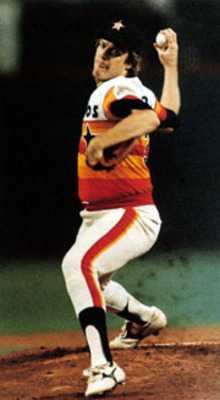
Mike Scott had an amazing 1986 season.  He was nearly unbeatable going 18-10 with 306 strikeouts and a 2.22 ERA.  He finally mastered the split finger fastball, although if you ask the 1986 Mets he was scuffing the ball.  Scott dominated the Mets in the NLCS, winning both games he pitched in and allowing only 1 run in 18 innings but Davey Johnson was positive Scott was doctoring the ball, causing it to make odd dips and twists.  The Mets gathered a hand full of balls that Scott allegedly scuffed during the playoffs and sent them to the National League office.  Nothing ever came of it. Scott fell off in 1987 and 1988 as the Astros started to break apart.  Scott had one last great season in 1989 going 20-10 and a 3.10 ERA.  Somehow, the 20 wins were not enough to win his second Cy Young Award as Mark Davis, a relief pitcher for the Padres, beat him out easily.

Tom Browning


Career Teams:  Cincinnati Reds (1984-1994) and Kansas City Royals (1995)
All Star Appearances:  1991
MVP Voting:  None.
Cy Young Voting: 1985 (6th)
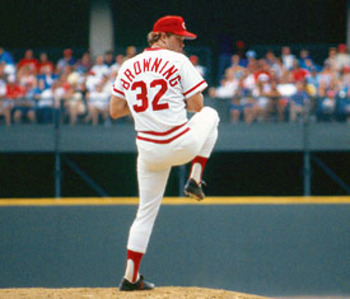
As a rookie Tom Browning won 20 games yet came in second in the Rookie of the Year to Vince Coleman and sixth in the Cy Young voting.  Browning had moments of being unhittable, routinely.  In June of 1988 he came within one out of a perfect game, Tony Gwynn broke it up with a single.  It was a heartbreaking moment.  Browning kept pitching at a high level and in September of 1988 he pitched one of the greatest games in history: a perfect game where he used only 100 pitches (72 strikes) and not one batter got even 3 balls into an at bat. Just short of a year later Browning was almost unhittable again.  He took another perfect game into the 9th inning against the Phillies when Dickie Thon led off the ninth with a single. Amazingly, Browning got 0 Cy Young votes that year.  If Pete Rose wasn't betting against his team, Browning may have had more postseason experience during his prime.  In the first full year after the Pete Rose scandal the Reds won the World Series.  Browning gave up three HR in the postseason but won two of his three games.  Browning started 1991 on a 10-2 stretch and made his only All Star team but things went down hill from there and bottomed out in 1994.  During a 1994 start Browning's arm snapped, literally, in mid pitch.  In baseball's version of the Joe Theisman injury, Browning's shoulder let out a loud pop and his arm separated from the shoulder socket.  Lucky to have mobility in his joint at all, Browning tried a come back with the Royals in 1995 but his career was over.  One of the best pitchers in the decade had the poor luck of playing for a crooked manager and suffering a gruesome injury.

Closer:
Dave Righetti

Career Teams: New York Yankees (1979, 1981-1990), San Francisco Giants (1991-1993), Oakland Athletics (1994), Toronto Blue Jays (1994) and Chicago White Sox (1995)
All Star Appearances:  1986 and 1987
MVP Voting: 1986 (10th)
Cy Young Voting:  1986 (4th)
Fans of the San Francisco Giants will recognize Dave Righetti as the guy who goes out to the mound when Barry Zito or Tim Lincecum is having a bad night.  Yankees fans will recognize Righetti as their best closer until Mariano Rivera came along.  Righetti entered the league in 1981 as a starting pitcher and won Rookie of the Year with an 8-4 record and 2.02 ERA.  In the bizarre 1981 season the Yankees reached the World Series but lost to the Dodgers. Steinbrenner came out and ridiculed his team for losing the World Series but it would be hard to blame Righetti.  He won three games in the playoffs and although he only lasted 2 innings in his only World Series appearance, he got a no decision.  After three years as a starter, including a 1983 no-hitter against the Red Sox, "Rags" got moved to the closer position.  As good as he was in a starting role, he was even better as a closer.  His best year was 1986 when he set a major league record by saving 46 games, went 8-8, walked only 35 and struck out 83 with a 2.45 ERA.  As Steinbrenner tired of the large payroll and small results, the stars were shipped off, along with many prospects,and the Yankees went into a full rebuilding phase.  Righetti signed with the Giants after the 1990 season.  Righetti's first season with San Francisco was spectacular, saving 24 games, yet as the years went on his appearances diminished. Righetti is not a Hall of Fame pitcher but he has certainly mentored several potential hall of famers in San Francisco.

Designated Hitter:
Don Baylor

Career Teams:  Baltimore Orioles (1970-1975), Oakland Athletics (1976), California Angels (1977-1982), New York Yankees (1983-1985), Boston Red Sox (1986-1987), Minnesota Twins (1987), Oakland Athletics (1988)
All Star Appearances: 1979
MVP Voting: 1975 (20th), 1978 (7th), 1979 (1st), 1982 (23rd) and 1986 (13th)
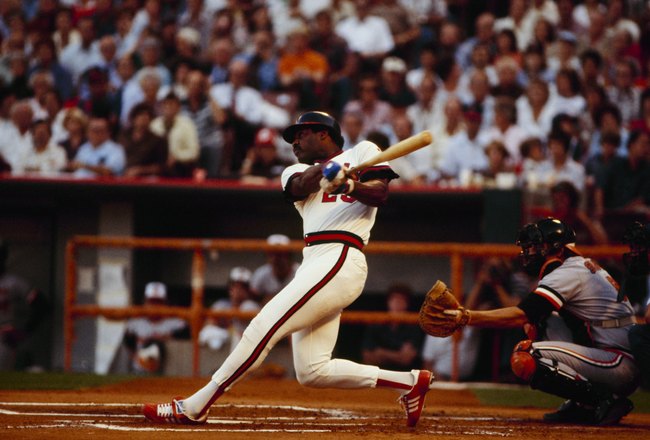
Don Baylor's career began before the Designated Hitter existed.  When the position was instituted it would have been a good idea for his teams to utilize Baylor in this position more often.  That is not to say Baylor was a poor fielder, playing mostly outfield and some firstbase he never made more than 9 errors in a season, Baylor was a steady, strong fielder who rarely made mental mistakes.  When his teams finally figured out what a DH should be, Baylor was the ideal man.  Similar to Mariano Duncan in the 1990's, Baylor's teams seemed to always be in the playoffs and Baylor always seemed to be the unknown, unsung hero. Baylor made the playoffs during his stops in Baltimore, California, Boston, Minnesota and Oakland.  1979 was his best season as he led California to the playoffs for the first time in their history. Baylor hit .296 and hit 36 HR that year while leading the league in RBI (139) and runs scored (120), and striking out only 51 times.  Baylor was also a big reason the Angels reached the playoffs again in 1982.  Baylor helped the Angels jump out to a big 2 games to 0  (in a best of 5 series) against Milwaukee led in the best of 5 ALCS.  In the first 2 games Baylor went 3-6 (including a triple),scored 3 times and drove in 5.  As the Brewers caught fire Baylor did everything he could to get the Angels to the promised land.  In the final three losses Baylor was only 3-11 but his three hits included a double and a Grand Slam that drove in 4 of the Angels 5 runs in a 9-5 Game 4 loss.  As I mentioned, Baylor's teams were almost always in the playoffs.  Baylor played on the infamous 1986 Red Sox team and played a big part in defeating his old team the Angels including a 2 run HR in the top of the ninth that brought the Red Sox to within one run and knocked Mike Witt out of the game eventually bringing in Donnie Moore.  The 1986 Red Sox did not win the World Series and Baylor was sent to Minnesota in a trade deadline deal that helped form one of the great moments in Twins history as the Twins won their first World Series.  Baylor was a free agent after the World Series and signed with a young Oakland team that many felt had one of the best collections of talent in history.  With young talent like McGwire, Canseco, Terry Steinbach and Walt Weiss, Baylor was the steadying influence in the clubhouse, although the 1988 A's were stunned by Mike Scioscia and the Dodgers in Baylor's last season.  Baylor became the first ever manager of the Colorado Rockies and won Manager of the Year as he led the expansion team to the playoffs in only their third year in 1995.  Baylor also managed the Cubs from 2000-2002 but for some reason has not been given another chance to manage.

* Author's Note:  Just as in the last few week, and as may be seen in the next few weeks as we move through this series of articles, I did my best to keep this to one player per position, however, the farther we move from these eras, the easier it is to forget these types of players (and even some hall of fame players).  It is important to remember as we follow the sport that the superstars are not the only ones making contributions to the success of a team.  This is not a comprehensive list of players who fall into this category from this era, it is simply my choice of players who best represented their position and have become forgotten.  Your list is probably different.  Email me yours or leave a comment.