Showing posts with label Mark McGwire. Show all posts

Saturday, November 1, 2014

Almost a Dynasty 1980's Athletics

What actually makes a sports dynasty?  Obviously a teem needs to be successful for a continuous amount of time.  Every sport has that one iconic dynasty that fits the Dynasty category.  The NBA had the Boston Celtics who won nine out of ten championships.  The Montreal Canadiens won 7 of nine Stanley Cups (including six straight).  The NFL had several dynasties including the 49'ers, the Steelers, the Cowboys and, most recently, the Patriots.  Baseball itself has had the Yankees dynasties in several incarnations including the 1930's, 1950's and 2000's.

So what actually makes a team a dynasty?  There can of course be several definitions since there are varying levels of success.  A team can dominate their division for a decade but be bounced out in the first round of the playoffs year after year.  We could of course consider that to be a divisional dynasty but you wouldn't call it an overall baseball dynasty.  So let us set the parameters for this series of articles.  A dynasty, for our purposes here, is a team that wins multiple World Series championships (above two as back to back is nice but not a dynasty) within a 5-10 year period.  That being defined, this series will explore those teams that may have been a divisional or league dynasty but for whatever reason could not get over the hump to that World Series dynasty.

This series will show an array of near dynasties.  Some are teams that made the World Series year after year but fell short.  Others will be teams that competed right down to the end of the regular season year after year just to be beaten out.  It will be a series of near misses and what could have beens.

Don't miss the other almost dynasty articles: The Detroit Tigers of the 1900's, The Chicago White Sox of the 1910's and the Pittsburgh Pirates of the 1920's, the Boston Red Sox of the 1940s and the Brooklyn Dodgers of the 1950s, the Milwaukee Braves of the 1950s and the Los Angeles Dodgers of the 1970's.  Now let's get started with this weeks "almost dynasty": The Oakland A's of the 1980's

Bashing in the Bay:
Billy Martin was born and raised in Berkeley California, just five miles or so outside of Oakland.  He was a Yankee at heart but when the Yankees fired him he came home and managed an A's team with few stars.  Led by Tony Armas and Rickey Henderson, Martin was able to fire up the A's enough to get them into the 1981 ALDS against the Kansas City Royals.  They swept the Royals but were then swept by the Yankees (who would in turn be humiliated by the Dodgers). Martin's success was short lived.  In 1982 the team added Davey Lopes but it wasn't enough.  They lost more than 90 games and fell to 5th in the division.  By 1983 Martin was gone but the A's did not improve.  They were an afterthought in the races and they started to realize they needed to completely rebuild.  The team in charge of the rebuilding process were General Manager Sandy Alderson and Farm Director Walt Jockety.  Oakland had a smaller budget than most and they felt they needed to be more aggressive in scouting and find gems with talent that others had missed.  Alderson and Jockety started to pick players off the scrap heap.  If someone else thought a player was finished the A's would look at their talent.  They drafted well.  Their scouts found payers that would fit their team concept.  While the other dynasties had a a few key players the A's had a ton:

Terry Steinbach:  The Catcher in the almost dynasty.  he shared duties behind the plate with Ron Hassey who was Bob Welch's personal Catcher but Steinbach was the force behind the plate.  He was a three time All Star and would stay with the team long after most of the rest of the "almost dynasty" was gone.  He made his debut in 1986 but 1987 was his first full year.

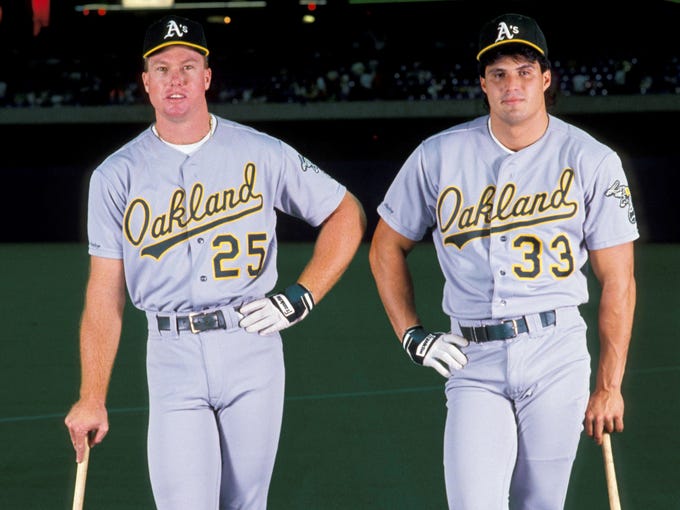
Mark McGwire:  Like Steinbach, "Big Mac" made his debut in 1986 but 1987 was his first full season.  He would hit 49 Home Runs (setting a rookie record) and win the Rookie of the Year.  Big Mac would be a 12 time All Star, set the single season Home Run record and become one of the game's biggest stars.  When the "almost dynasty" started he was considered second  to Canseco.  By the end of the almost dynasty he was second to none.

Walt Weiss:  Weiss played 17 games during the 1987 season.  In 1988 he was the full time Shortstop. During the 1988 season he would captain the defense and would win Rookie of the Year.  Injuries would slow him down.

Carney Lansford:  Carney Lansford had talent.  No one could possibly deny it.  The Angels had known it when he came in third in the Rookie of the Year voting.  The Red Sox had known it when he won a batting title with them in  1981.  For whatever reason (likely because the Red Sox had Wade Boggs at third) teams passed on him.  Sandy Alderson and Walt Jockety would not.  Lansford would be a versatile hitter and spark plug for the team.  He was able to hit anywhere in the lineup and quietly led by example by his willingness to adapt to the team's needs.

Jose Canseco:  Jose was the headline grabber  The big name in the lineup.  In 1986 he was an All Star and Rookie of the Year.  Considered one of the great young talents in the game he would reach the height of baseball fame in 1988 and would fall quickly from it one year later.


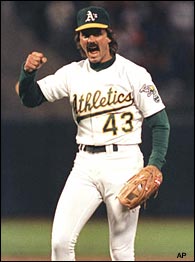
Dave Henderson:  Unfortunately,  when the A's almost dynasty is discussed Dave Henderson is often overlooked.  Like Lansford there was no denying Henderson's talent.  Every team seemed to want him but none kept him.  The Mariners had sent him to Boston where he put the Red Sox on the brink of a World Series.  At the trading deadline the next year he was sent to the Giants where he arrived early enough to help them win the division but too late to be included on the post-season roster.  He signed with the A's following the 1987 season.

Rickey Henderson:  Rickey came a bit late to the party, or alternately you could say there was no party before Rickey arrived.  Rickey had played for Oakland through 1985 when he left for the Yankees.  Unfortunately playing for the Yankees in the 1980's was not the experience it would become 10 years later.  In mid season 1989 Rickey was sent back to Oakland in a blockbuster deal that gave the A's the final ingredient.

Dave Stewart:  Known to his teammates as "Smoke" because of his blazing fastball Dave Stewart defined this "almost dynasty". An intimidating presence on the mound.  He had the talent and power of Roger Clemens with the class of Bob Gibson.  Stewart had been released by the Dodgers, the Rangers and the Phillies.  The Phillies of 1985 had an abundance of young arms in Kevin Gross, Shane Rawley. Bruce Ruffin and Charles Hudson.  Without room for all of them they chose Stewart as the expendable one.  Like the Phillies of that era often did they chose wrong.  He was released by the Phillies and signed by the A's.  It would be one of the best signings the organization ever made.  Without Smoke there would have been no almost dynasty.  His importance to the success of this era cannot be over estimated.

Bob Welch:  Welch had been a big part of that 1970's-80s almost dynasty in Los Angeles.  He went 15-7 in 1987 and during the off season he was part of a gigantic three team trade with the Dodgers, A's and Mets that would play a big part in the NLCS and World Series.  He and Stewart would form the top 1-2 punch in the 1980's.

Dennis Eckersley:  "Eck" redefined the role of the relief pitcher.  He was the closer and when he hit the mound the other team knew they were fighting an uphill battle.

Rise of the Bash Brothers:
The A's 1986 team may not have looked like the start of a dynasty but the signs were there. Lansford was at third base.  Stewart was learning to become the ace he would be.  Canseco was on his way to rookie of the year.  Yet by June they were in last place.  They replaced their manager, Jackie Moore at about the same time that the White Sox were making a managerial change.  When the White Sox manager became available Sandy Alderson jumped at the chance to sign him.  Tony LaRussa turned the year around.  They may not have caught the division leading Angels but they improved to third place.

The following year saw individuals improve and the team started to come together.  As late as August 28 the team was tied for first.  They were led by the arm of Smoke, who was experiencing his first 20 win season, and powerful bats of McGwire and Canseco.  McGwire, on his way to Rookie of the Year hit 49 Home Runs.  They certainly  competed but finished third in the division.  It was clear that things  still weren't quite where LaRussa wanted them.  Stewart undoubtedly  was the ace but he needed help.  So during the off season the A's made some moves.  Given their penchant for finding talent where others missed they made a trade that worked out for them greatly but would also come back to haunt them greatly.  Jose Rijo was a great pitching talent but his results did not reflect his talent.  On December 8 the team gave up on Rijo and sent him to the Reds.  In return they received Dave Parker.  The next day they signed Catcher Ron Hassey to help Steinbach behind the plate.  December 11 was the big day.  With Walt Weiss set to take over at short Alfredo Griffin became expendable, as did reliever Jay Howell  with Eckersley in town.  So the Mets, Dodgers and A's (three of the four eventual playoff teams) got together on a trade.  The Dodgers got Alfredo Griffin, Jay Howell and Jesse Orosco.  The Mets got Kevin Tapani, Wally Whitehurst and Jack Savage.  The A's got  Matt Young and Bob Welch.  December 21 they signed Dave Henderson.  On January 11 they signed free agent Glenn Hubbard to play second base.  All of a sudden the team appeared complete.

Some predicted success for the A's in 1988.  Few foresaw the assault that would be launched against the league out of Oakland.  They won four of the first five games to jump out to first place.  A short three game losing streak to the White Sox led to a stop in fourth place (although still only 1/2 game out of first) but following that it was off to the races.  Smoke (21-12), Welch (17-9) and Storm Davis (16-7) would lead the A's pitching staff.  Eckersley's success (4-2, 45 saves) would send the rest of the league scrambling to find a closer.  Walt Weiss would won Rookie of the Year and Big Mac established himself as a legitimate star.


The 1988 season, however, belonged to one man.  Jose Canseco.  An almost unbelievable combination of power and speed.  Canseco didn't just dominate the league, he owned it.  Canseco had an offensive season for the ages.  120 runs scored, 124 driven in, .307 average, 34 doubles, 78 walks.  But the thing that caught every one's attention was something that was considered impossible.  Canseco hit 42 Home Runs and stole 40 bases.  Never in history had someone reached a 40/40 mark and the world noticed. Canseco instantly became the best player in the league.  An instant lock for the Hall of Fame.  He was only in his third season but he was clearly head and shoulders above the rest of the world. The A's won their division by 13 games and swept a very good Boston Red Sox team in the ALCS.

Entering the World Series of 1988 they were considered unstoppable.  Most of the first game did nothing to change that view.  While the A's had cruised through the season and LCS the Dodgers had to fight and scrap.  They were tired, beat up and missing some key players.  Oakland had their full compliment of power on the field.  Los Angeles did not. Their key man, MVP Kirk Gibson was not available and with their ace Orel Hershiser pushing himself to the limit to win the NLCS  the Dodgers started Tim Belcher against Smoke.

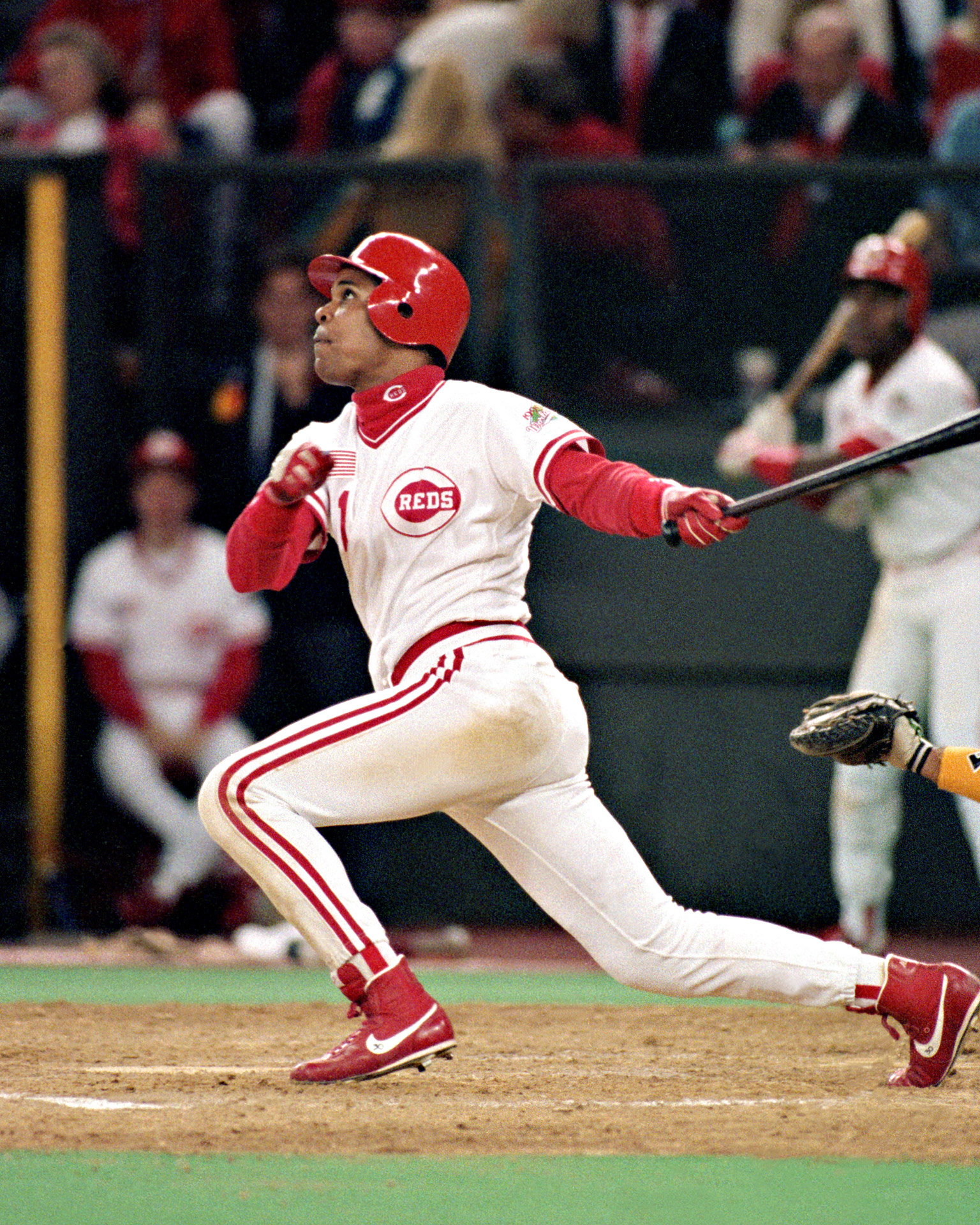
The A's looked to do damage in the first.  After a Lansford strikeout Hendu lined a single and moved to second when Canseco was hit by a pitch. Which caused an argument.  Lasorda argued the ball had hit the bat not Canseco but it was clearly a hit by pitch.  Hitting the A's star was not unnoticed.  Dave Parker flew out but Big Mac walked to load the bases. With Steinbach coming up Dodgers fans got restless and Oakland fans smiled in anticipation.  The Dodgers survived as Steinbach popped up to end the inning.  Smoke was not happy that Belcher had hit Canseco and he wasted no time getting even.  On the first pitch of the game he came up and in against Steve Sax hitting him on the shoulder.  The Dodgers scored two on a Mickey Hatcher Home Run in the bottom of the first.  Hatcher's Home Run matched his regular season total.  Hatcher sprinted around the bases smiling and jumping like the kid who just got the ultimate Christmas present.  Smoke was not happy about it.  No worries.  These were the A's of the Bash Brothers.  If there were going to be fireworks the A's would supply them.  Glenn Hubbard singled.  Weiss struck out looking but Smoke drew a walk.  Lansford walked and the bases were loaded with the big boys coming up.  Dave Henderson is not someone you want walking to the plate when a big hit is needed but Belcher was able to get Henderson swinging.  In stepped the biggest man.  Canseco.  He took ball one.  On the second pitch he connected.  There was no doubt about where this was headed.  Dead center field.  He could have crawled around the bases, and he basically did.  He stood at the plate admiring the shot.  And why not?  It was impressive.  It landed in Center field on top of an ABC camera leaving a dent. The Dodgers cut the lead to 4-3 in the sixth but Stewart was brilliant and with Eckersley set to come in for the 9th there was a feeling of finality to this game before the 9th started.  Scioscia popped out to Weiss to start out.  Jeff Hamilton struck out looking and with the bottom of the order up Eckersley appeared to be in the clear.  He faced Mike Davis who had played in Oakland the year before.  Davis walked.  When the crowd saw who was limping to the plate as the pinch hitter for the pitcher's spot Dodger Stadium was rocking. It would soon rock so hard it would seem to be rolling down the 101.  Kirk Gibson, barely able to stand, was able to swing well enough to connect and send the Dodgers home with a Game 1 win.


Gibson did well in his only plate appearance in the series but it cost the Dodgers his services for the rest of the series.  The A's had Storm Davis on the mound for Game 2.  He was not quite on the level of Smoke or Welch but Davis was a very good starting pitcher.  His opponent in Game 2 was Orel Hershiser.  Orel, known as the bulldog, was in the middle of a season that was to pitching what Canseco's season was to offense.  He had continued it into the postseason. Hershiser allowed a single to Dave Parker in the 2nd but that was erased when Big Mac grounded into a Double Play.  Parker singled again in the 6th and was erased again when Big Mac hit into his second Double Play of the day.  Parker had a third hit in the 7th but the A's were unable to score. They were the only three hits Hershiser gave up. The final was a 6-0 Dodger win for a 2 games to 0 lead in the series.  The Dodgers provided the fireworks thanks to Mike Marshall's three run Home Run.  Unfortunately for the Dodgers Marshall had injured his back in the process. The Dodgers lineup was now short the two big power suppliers.

The A's had a powerful offense that had been quiet to this point.  That's the reason that Alderson, Jockety and LaRussa focused so heavily on pitching. Of course when your hitting is slumping good pitching can pull you through.  The A's offense finally scored their first run since Canseco's Grand Slam when Glenn Hubbard singled, stole second and took third on a Scioscia throwing error.  Ron Hassey, playing since Welch was on the mound, singled to score Hubbard and the A's led 1-0.  The Dodgers tied it at 1-1 with a single run on an RBI double by Franklin Stubbs.  It remained that way until the bottom of the 9th.  Dodgers relief pitcher Jay Howell was on the mound with the Bash Brothers coming up.  Howell got Canseco to pop out to second but McGwire sent the fans home happy with a bottom of the 9th Home Run to end the game.  It seemed like all was right with the world.  The A's were bashing the ball and beating the under matched opponent.  It was assumed that this would turn the tide.

The A's had 9 hits in Game 4, four of them by Hendu, and scored three runs.  With Smoke on the mound that should have been more than enough. It wasn't.  The Dodgers scored four runs, only two earned, and lost another starter when Scioscia was injured. Still, the Dodgers won the game and took a 3 games to 1 lead.  Dave Henderson continued his hot hitting going 4-5 but the rest of the team was quiet.  Hershiser pitched Game 5 and was even more dominant than Game 2.  The Dodgers beat the team that just a week before was considered unbeatable and they did it in convincing fashion.

A Force So Powerful It Shook the Earth:
The A's signed free agent Pitcher Mike Moore from Seattle in the off season.  With Stewart, Welch and Storm Davis it now gave the A's four strong starters. The anticipation of Canseco's follow up to his 40/40 was tremendous but it was clear that there were off field distractions.  There were the several speeding tickets that started the problem.  Then there was the issue at an airport when a traveling companion was found to be carrying a bag of pills.  The friend swore they were his. although there was a close link to Canseco.  The pills turned out to be steroids which woke up the question that had been shouted down just months before when Tom Boswell of the Washington Post had asked it.  Then came the wrist injury.  Canseco at first thought it was just strained but it got worse and he missed a great part of the season.  He had a few more speeding tickets and when he went to a doctor's appointment at the University of California, Berkeley, he was arrested for carrying a concealed, loaded, handgun.  Canseco's season seemed to be full of nothing but trouble.

Oakland struggled to get ahead of the Royals and Angels who surprised most people with their success.  The A's starters were doing what was expected of them.  In fact they had a chance to become the first team since the 1970 Orioles with four 20 game winners.  The offense still had problems thanks to injuries to McGwire, Lansford and Weiss and the question of what to do with the Outfield.  The final outfield puzzle piece came to town with a June 21 trade.  The A's sent Greg Cadaret, Eric Plunk and Luis Polonia to the Yankees and in return they received Rickey Henderson.  Henderson jump started the team and drove the offense.  The race in the AL West was close heading into September but the A's pulled away and won the division by 7 games.

The ALCS against the Blue Jays was contentious and several times came close to erupting into all out warfare.  The tension had begun in the regular season with two separate bench clearing brawls and when Rickey hit a Home Run and admired the feat he had angered the Jays. Toronto managed to win one game but LaRussa had this team focused.  He was not about to allow this team to suffer the same fate the 1988 group had.

Their opponent in the 1989 World Series was their neighbor in San Francisco.  Game 1 saw Stewart face off against Scott Garrelts.  The A's offense was strong.  They knocked 11 hits and scored five runs.  Dave Parker and Weiss hit Home Runs.  Stewart shut down the Giants on five hits.  Mike Moore started Game 2 and faced off against Rick Reuschel.  The A's had a four run inning in the 4th that included an RBI double by Parker and a three run Home Run by Steinbach.
Moore was strong in 7 innings allowing only 1 run.  The A's were up 2 games to 0.

Everything changed as the teams prepared for Game 3.  The scene shifted to San Francisco and as the teams prepared for the game, the A's were set to have Storm Davis start.  The pregame ceremonies were interrupted by Mother Nature.  An earthquake measuring 6.9 hit the San Francisco Bay area collapsing bridges, flattening homes and buildings, setting off fires and killing 63.  Baseball was unimportant as the area tried to rebuild their lives.  There was talk of cancelling the series completely but it was decided to wait.  After waiting two weeks the Series was resumed.  During the time off the A's flew to their spring training home in Arizona.  The Giants stayed in the area and had a few informal practices but few full team practices.  The A's won  Game 3, 13-7, behind Stewart and Game 4, 9-6, behind Moore.  They had won the World Series but few had noticed.

Rijo the Red Gets Revenge:
Storm Davis had been set to start the third game of the 1989 World Series when the earthquake interrupted.  When the series resumed LaRussa sent Dave Stewart to the mound instead of Davis and for Game 4 Davis was passed over in favor of Mike Moore.  Davis, a free agent, felt under aprecciated and decided it was time to move on so he signed with Kansas City.  Also gone on the free agent market were Dave Parker to Milwaukee and Tony Phillips to Detroit.  With Phillips gone a hole developed at Second Base so the Dodgers sent reserve outfielder Stan Javier to Los Angeles and in return received Second Baseman Willie Randolph.  By resigning Rickey Henderson the team remained strong at every position but they had lost some of their depth without Parker, Davis and Javier.

Still, when the regular season began the A's dominated.  They spent only two days (April 11 and 12) out of first place and even that was only 1/2 game out. Unlike the 1989 champions who struggled to gain traction against the Royals and Angels, the 1990 version seemingly won at will. They outpaced the Western Division by 9 games. Bob Welch won 27 games, Stewart won 22 and Scott Sanderson, the replacement for Storm Davis, went  17-11. The team that was already ahead of everyone even found a way to improve at the trading deadline.  They acquired Harold Baines from the Rangers and Outfielder Willie McGee from the Cardinals.  It certainly appeared this team was now perfect. In the ALCS they had little problems with the Red Sox taking Game 1, 9-1, and sweeping the rest of the way.


Their opponents in the World Series were the surprising Cincinnati Reds.  Smoke started Game 1 and faced off against Jose Rijo.  Rijo, whose father-in-law was Hall of Famer Juan Marichal, had originally started with the Yankees and was sent to Oakland as part of the deal that had sent Rickey Henderson to the Yankees. He spent three years as a starter for the Reds in their rotation but just as the team looked to turn the corner and begin the "almost dynasty" Rijo was sent to the Reds for Dave Parker.  Now he had his chance to show the powerful Oakland bats what they had missed out on. In Game 1 Rijo allowed 7 hits in 7 innings and walked only 2.  The best number he put up on the day was 0 as in 0 runs.  The Reds, on the other hand, pou ded Stewart and reliever Todd Burns for 7 runs to take Game 1.  The A's had a much better showing in Game 2 with Bob Welch on the mound but were tied at 4 when Welch left.  The Reds won in the bottom of the 10th for a 2-0 Series lead.

Few could believe that the A's could lose this series, let alone lose three straight but with Tom Browning on the mound for Cincinnati the A's certainly had their work cut out for them.  They didn't help themselves in any way.  The third inning was a 7 run disaster that included a McGwire error, a wild pitch,a pitching change and the Reds batting around.  The team was playing horribly. Everything had gone wrong for Oakland and everything had gone right for the Reds. The biggest disappointment for Oakland was Canseco himself.  After three games he was 1-12 for a .083 average.  In addition his defense had been causing problems when he was caught out of position on a few plays.  Given the poor results in the first three games LaRussa decided to  shake things up for Game 4 and made several line up changes.  Willie McGee started in Right Field in place of Canseco and Jamie Quirk started at Catcher in place of Steinbach.  The A's started Stewart against Rijo again.  Stewart pitched well.  He threw a complete game and allowed only 2 runs on 7 hits.  Rijo, however, allowed only 1 run on 2 hits.  The Reds won.  The team that looked unbeatable was not only beaten but embarrassed.

The downfall was quick and painful for the decade's most powerful team.  Stewart fell to just 11-11 in 1991 and Welch fell to 12-13.  Carney Lansford  and Weiss saw little playing time due to injuries and McGwire's numbers were suffering due to a painful back injury.  Not one player in the regular starting lineup hit .300 for the season and the A's dropped to 4th.  They would rebound for 1992 and reach the ALCS but by that time it was a greatly different team.

What had looked like one of the most dominant teams in history turned out to be a one time World Series Champion.

TRIVIA QUESTION:
The 1988 Dodgers had  several injuries during the World Series leading to a greatly different lineup than the one they had expected to play with entering the playoffs.  Among others Fernando Valenzuela, Kirk Gibson, Mike Marshall and Mike Sioscia missed some or all of the series.  Who was the Catcher that replaced Scioscia and caught the final out of the World Series?

Answer to Last Week's Question:
In 1976 Tommy Lasorda replaced Dodgers legend Walter Alston as manager of the team. Lasorda managed the team through the start of the 1996 season.  When Lasorda started having health issues he handed the reins over to Bill Russell, the former short stop in the "almost dynasty" of the Dodgers.  Russell would manage the team through the end of 1996, all of 1997 and part of 1998.

Saturday, December 21, 2013

The Hall of Fame Controversy Part 1: How Do We View a Potential Hall of Fame Player from the Steroid Era?

For those of you who have been enjoying the rivalries series, I apologize for the interruption of the series.  There are still two more articles coming in that series so please continue to check out.  Since the Hall of Fame voting will be revealed in a few weeks I thought this would be an appropriate time to start a discussion of the Hall of Fame controversy.

Since I started this blog a little over a year ago I have tried to give my honest opinion about things in baseball from the current happenings to historical perspectives and everything in between.  To this point I have avoided broaching some subjects for several reasons.  One of the topics I have avoided is the Hall of Fame and the place of steroid users in history.

First, I wanted to make sure that I thought out what my perspective is in detail so that I can properly give my views and second I needed to make sure I viewed this from as many perspectives as possible.  The biggest focus of the Hall of Fame controversy right now is on what to do with the steroid users but there are a few other issues clouding the nomination process.  So over the next three weeks we'll discuss three main points of the Hall of Fame controversy:

1) Steroids and the Hall of Fame:  How are we setting the parameters of the "steroid era" and what do we define as a Performance Enhancing Drugs?

2) SABRmetrics and the new statistics dominating our analysis.

3) What makes a Hall of Fame Player?:

I am sure that many of you will disagree with my opinions and I would love to hear your views.  The only way we, as baseball fans, will ever get past the controversy is to get as many perspectives as possible and respectfully discuss the issue.  So let's get started with part one.

Steroids and the Hall of Fame:
To start off, the big question is "how do we define the steroid era".  When people reference the steroid era they usually start the discussion with McGwire and Sosa's Home Run duel and end it with the start of drug testing around 2007 when testing became much stricter and better regulated.  There are a lot of problems with this but three main problems exist with the parameters that have been artificially drawn around the era.
  1. We have basically accepted that the "steroid era" is over (meaning that the rampant, unchecked use of the Performance Enhancing Drugs (PED) has stopped), yet in the last few years Bartolo Colon, Nelson Cruz, Alex Rodriguez, Johnny Peralta, Melky Cabrera and several other big stars have been embroiled in a performance enhancing drug ring that was only truly exposed because a disgruntled ex-employee of a South Florida clinic leaked information. How many other clinics similar to the one these players were associated with are out there and have not been discovered yet?  Also, there are many ways that PED users can get around the system.  When I worked retail we had to do whatever we could to stop shoplifters, however, we always knew that shop lifters were developing new ways to take things from under our noses and we were essentially playing catch up to their methods.  Essentially this is the same idea.  The PED users are always one step ahead of the people trying to catch them.  The use of PEDs may never be ended completely.
  2. If the steroid era "lasted" from the late 1990's through the mid 2000's, is it fair to exclude someone from the Hall of Fame because they played in the steroid era as we have defined it and they "looked like they used steroids"?  Last year there were no Hall of Fame members inducted on the normal ballot despite the presence of players like Mike Piazza, Jeff Bagwell and Craig Biggio on the ballot for the first time.  Several voters withheld their votes because they said they were "punishing" the steroid era players (whether or not they used steroids) because the players had known others were using and did nothing about it.  This argument has a few flaws to me, most importantly, how do we know that these players didn't go to the player's union and ask for testing.  Drug testing had been on the table for a very long time before it was finally put in place (it was part of the issues that caused the 1994 strike).  There had to be some players pushing for this testing for the Players' Union to finally agree to it.  In 1988, as Jose Canseco amazed everyone with his 40 Home Runs/40 Stolen Bases, Tom Boswell of the Washington Post wrote an article saying that it was time we started to look into the possibility that steroids were impacting the record books.  The reaction from his media colleagues was that Boswell, a very respected baseball writer and still a very respected historian, was out of line and had no proof.  The support for Canseco by the media made it clear that the media had no intention of pushing the issue and Boswell's reputation was damaged.  It is amazing that these same people are now punishing the players for not informing publicly on their teammates. In addition, the argument against players like Piazza and Bagwell was that there was no proof that they had used steroids but they "looked" like steroid users.  One writer even said he did not vote for Piazza because he had back acne which is sometimes associated with steroid use.  This argument turns the moral stand taken against those who didn't inform on the users into a way for writers to shift the blame from themselves for not pushing on an issue that they clearly were aware of as it happened. 
  3. Performance Enhancing Drugs are not new.  During the 1990's I had a subscription to Sports Illustrated.  One of the issues that I received in the mail had a picture of a gaunt Lyle Alzado, former defensive lineman for the Broncos and Raiders.  The article inside revealed that Alzado had a brain tumor that he linked directly to the use of anabolic steroids he took during his playing days.  He admitted using steroids as far back as 1969.  That's correct.  1969.  In addition to that there were players as far back as the late 1800's who drank "tonics" that were supposed to have properties that could improve your health and energy.  Pud Galvin reportedly drank "monkey testosterone" for better performance.  In the 1930's at least one player was said to have taken injections of an extract from bull testicles.  In the 1960's Mickey Mantle was trying to find a way to play through the knee pain that was destroying his career.  He went to a doctor recommended to him by Mel Allen.  The doctor's injection led to an infection that forced Mickey to miss the end of the 1961 season.  During the 1970's Doc Ellis reportedly pitched a no hitter while high on LSD.  In the 1980's players (including some Hall of Fame superstars) were using amphetamines as "pick me ups".  They would simply drop the "greenies" into their coffee and dissolve them.  We have  arbitrarily defined the steroid era as post 1994 strike or the 1998 Home Run race, when clearly steroids and PED's have been around for decades.  The voters who "punished" players for not demanding testing earlier have already voted for some players and elected players who very easily have done the same thing.  We can certainly continue to incorrectly define the steroid era from post strike to the mid 2000's and the voters can continue to "punish" players of the era who didn't reveal the deep dark secrets of the locker room, but Cal Ripken, Tony Gwynn, Paul Molitor, Kirby Puckett, Wade Boggs, Ryne Sandberg and others also played in that time period and are already in the Hall of Fame (I am not implying, accusing or suggesting any of these players used PED's but they certainly played well into the steroid era and likely played with teammates who were using PED's).  So it was a grand moral statement by the voters to "punish" last year's Hall of Fame candidates who didn't say anything about steroid use publicly, but if the issue truly bothered these individuals, why did they choose last winter to take their stand?
What are we defining as a performance enhancing drug?
We can start with the most rudimentary, first grade essay format and define the words Performance Enhancing Drug.
Performance: the execution of an action
Enhancing:  Heightening or improving, especially enhancing or improving in value, quality desirability or attractiveness.
Drug:  1) a substance that is used as a medicine or 2) an illegal and often harmful substance that people take for pleasure.

So basically what we are saying is that a Performance Enhancing Drug is any substance that improves your ability to perform.  Carl Erskine pitched for the Dodgers in the 1950's.  He often told a story of waking up a day after he had pitched not being able to raise his arm to comb his hair.  His arm was swollen, bent and in pain.  A friend on another team recommended Erskine see that team's trainer, who gave Erskine a shot.  When Erskine's turn came up in the rotation a few days later he was not only healthy, he threw a no-hitter.  If we apply the definition of performance enhancing drug, clearly the substance administered to Erskine enhanced Erskine's ability to recover from his sore arm and perform in his regular rotation spot.  I am not implying that Erskine did not have the ability to throw a no hitter without the shot. Nor am I implicating Erskine as a steroid user, cheater or in any way saying anything negative about Erskine.  In fact, Erskine is one of the most respected and well liked people from those Dodgers teams.  My point is only that without that shot he likely would not have been able to even make the start.  By definition that substance was a PED.  That substance was cortisone.  It is now used regularly by nearly every professional trainer in every major sport. 

The Dodgers trainers used this same treatment to keep Sandy Koufax in performance shape, along with applying hot capsolin (an extreme version of icy hot so severe that it caused blistering on Koufax's arm) that allowed him to get his arm loose enough to throw his breaking ball.  Again, I am in no way questioning the ethics, honesty or character of Sandy Koufax.  The things that Koufax was able to accomplish and the pain that he endured in doing so are amazing and I admire the man greatly but clearly, by our current definition, this would be another Performance Enhancing Drug. 

My point here is not that Erskine or Koufax should be viewed differently.  Erskine had a great career and was a big reason for the success of the Dodgers.  Koufax was a definite Hall of Fame player, one of the best pitchers in the history of the game and also one of the classiest people ever.  So what if they were using an applied treatment from the training staff? 

This is my point:  the arguments against allowing the PED users into the Hall of Fame is that they have an advantage that other players in their eras (and older eras) did not have.  This is another faulty argument.  I think we can all agree that cortisone, when administered by a trained professional, is an acceptable substance that can assist the the body in a quick recovery allowing athletes to perform.  But if we are using the argument that current PED users are cheating because they have an advantage that other players of previous eras did not, should we revise our view of the accomplishments of the 1950's to the present.  For example, Hal Newhouser, Bob Feller, Dizzy Dean, and Carl Hubbell were all great pitchers who dominated the hitters of their eras but how much better could they have been and how much longer could they have pitched if cortisone were available then?  The surgeries that are available now allow pitchers to simply repair a damaged arm that would have been beyond repair decades ago.  Should we punish pitchers like Tommy John and Ron Guidry who had great careers but fell short of Hall of Fame numbers because their arms broke down before the current medical technologies that could have kept them pitching for much longer?  As you can see the issue goes much deeper than a simple someone used steroids and someone else didn't.

Why do players look so much bigger than the old days?:
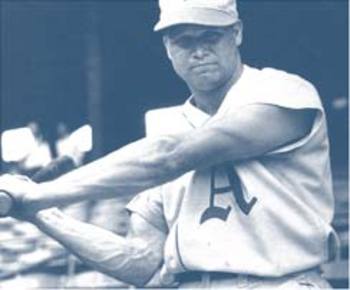
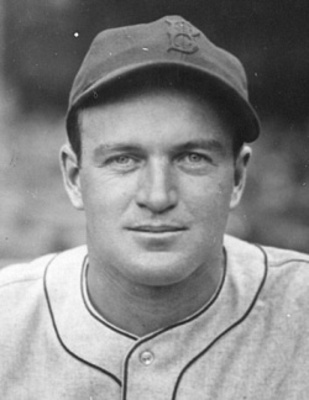
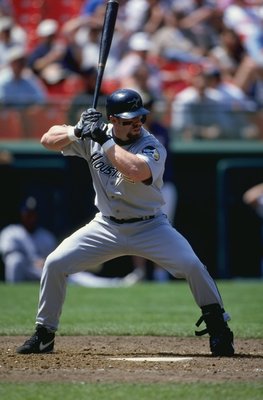
The first part of this answer feeds into the second answer.  Looking at pictures of Mark McGwire, David Ortiz and Prince Fielder it is definitely a logical conclusion that there are more players of larger build today than there were sixty, fifty, or even twenty years ago.  I have not done a percentage based analysis but it is definitely true that the players today are larger than most players of the past.  It is not true in all cases.  Two very specific examples are Jimmie Foxx and Ted Kluszewski.  Foxx was known as "the Beast" because of his gigantic arms.  Kluszewski was alternately known as "Big Klu" or "Killer" and had arms so big he had to cut the sleeves of his shirt to comfortably fit his arms into them.  He routinely asked pitchers not to pitch him low and inside.  It wasn't because he couldn't hit it.  He could.  He could hit it hard, but he couldn't control the fact that the ball always went right back up the middle and he was terrified he would kill a pitcher.

Foxx and Kluszewski are just a few examples.  The truth is there are more players of a larger build today and steroids obviously play a big part in that.  However, there has also been a significant philosophical shift in the training habits of the league in the last twenty to thirty years.  For the first 100 years of organized baseball there was a fear by management and coaches of weightlifting.  There was a fear that the development of muscles (specifically biceps and triceps) would hinder the movement of the arms and would lead to loss of fluidity in the swing.  For pitchers, it was assumed that adding muscle to an individual would hinder their pitching motion and lead to more arm injuries.  With the growth of the fitness industry, health and vitamin supplement improvements and a better study by baseball trainers of the human body, weight lifting is no longer off limits and is often added to off season training regimens under supervision of the team training staff.  The acceptance of weight lifting by the baseball community has had a big impact on the new vision of the baseball player.

Why are we focused on baseball's players using steroids while other leagues ignore or do cursory testing?
When the NFL went on strike a few years ago one of the big issues causing the strike was the Players Union's stance on how far the league could go in testing for illegal substances.  The league wanted to start testing for Human Growth Hormones (HGH) and the union refused.  I actually heard one player make the argument that "no one's using HGH so there is no need to test for it."  That is not an exaggeration, that was an actual argument a current player made.  It would be like applying for a job that required a lie detector test and telling them "I'm not a liar so you don't need to do a lie detector test."  It also sounded eerily like the argument that baseball players were making before the 1994 strike and before the drug testing policy went into place.

The NBA has a first offense penalty of 5 games. Second offense is a 10 game suspension.  A third offense is 25 games and a fourth offense is a two year suspension.  The problem with this system is that players can only be tested four times in a season so once that fourth test is up they are off limits.

The NFL suspends players for 4 games on first offense.  Second offense is eight games and third offense is a full season.
 
The NHL has a stronger policy of 20 games for a first offense, 60 games for a second offense and permanent suspension for a third offense.  The problem with the NHL's policy, similar to the NBA's, is that players can only be tested twice in a season. 

The MLB has the strongest (though clearly not perfect) process for punishing offenders.  The best part of it is the public and permanent shaming of the players.  Manny Ramirez was considered by many one of the greatest hitters in the history of the game.  When he was named as a violator of the MLB policy he went to an overnight pariah.  Raphael Palmeiro was on his way to the Hall of Fame but hasn't been heard from since his positive test in 2005.

In 2006 Shawne Merriman, linebacker for the San Diego Chargers, was suspended four games for violation of the league's policy.  Instead of being treated like a criminal and cheater, the way Palmeiro, Bonds, McGwire, Sosa and Clemens have been, Merriman was voted the league's Defensive Player of the Year...the same season that he had been suspended for four games.  Many of the people who voted for Merriman as the best defensive player that year are the same voters taking a moral stand against PED users in the Hall of Fame.  The Shawne Merriman example is just one of many situations where a player from another sport is given a clean slate when he returns from suspension while Major League Baseball players come back from suspension knowing that they have just thrown away their chance for a Hall of Fame career and the public's trust.

Why is all of this attention paid to MLB and not to the other sports?  Simple.  Baseball is still that national past time.  I will not question that the NFL is the most popular sport in the United States and has been for a long time.  However, baseball has a larger impact on our national psyche.  If you mention specific numbers to sports fans, regardless of what sport they follow, they can likely tell you who the number belongs to.  61 automatically refers to Roger Maris.  714 automatically brings up Babe Ruth. 755 is Hank Aaron.  These are the sacred numbers of baseball history.  These are the number chases that captured the nation's attention.

What is the equivalent to these numbers in other sports?  I recently asked a friend of mine, who is a big football fan, who held the record for all time rushing yards.  He had to look it up and then was surprised at the answer (Emmit Smith).  I asked him who threw the most career touchdown passes and who scored the most career points.  He had no idea.

Ask a sports fan what the number 56 means and more often than not without thinking about it they will just say DiMaggio.  Ask a hockey fan who has the record for most goals in a a season and you'll likely get a blank stare.

Say .401 to a baseball fan and they'll just tell you Teddy Ballgame.  Ask a basketball fan who had the highest Field Goal percentage in a season and most people won't have a clue.

Regardless of the current popularity of football, baseball is still the national past time.


The Cheaters argument:
Every time the topic of steroids and PED's comes up there is a parade of angry callers to sports radio shows who usually say something like "they're cheaters and cheating is wrong so these are bad people."  I am not condoning cheating and I am not condoning the use of PED's, despite what this next argument may say.

We cannot just automatically go with the simple argument that cheaters are bad and these players cheated so they are bad people.

We need to discuss this a little bit more thoroughly.  Yes.  It is absolutely wrong to cheat.  The argument I hear from a lot of people is this:  "I don't want my kids to think it is ok to cheat."  That's a great philosophy, but are the people blaming the players for teaching their children the wrong message teaching the right message themselves?  There are always gray areas to every argument and we seem to apply alternate severity to alternate situations.  Don't forget as a society (sports fans society) we allowed the cheating to flourish despite clear signals there were issues.  Now, after years of  watching this happen we are all of a sudden (in the last ten years) horrified at what is happening.

A few years ago Don Imus, a "shock jock" radio host, was embroiled in a controversy over some horrendous, disgusting remarks he made about the Rutgers Women's basketball team.  The comments he made were offensive and indefensible.  The problem in this discussion is not whether what he said was offensive, the problem is why he thought he could say them.  Imus had been in broadcasting since 1968, meaning by the time the Rutgers issue erupted in 2007 he had been in the field for nearly 40 years.  His entire on-air personality to that point was someone with politically incorrect outspoken and often offensive opinions.  This persona had gotten him high ratings and legions of fans.  Every time he made an off color, offensive statement he received supportive phone calls from fans, higher ratings and higher salary.  All of this not only condoned his outspoken behavior, it encouraged it.  So it is completely illogical for people to get up in arms over the disgusting comments made by Imus in 2007 when they had encouraged him to be offensive for years.  (again I am absolutely, positively not defending Imus or his comments.  I am just making a point that if we were offended by those comments, why were we not in an uproar over comments he had been making for years.)

Steroids are a similar issue. As far back as the 1970's it was widely known that baseball players were using amphetamines for "energy boosts".  There was little outrage or demand for penalties.  In the late 1980's Tony Mandarich played offensive line for Michigan State and it was a poorly kept secret that he used steroids.  Instead of punishing Mandarich the sports society named him "Michelin Man", put him on the cover of Sports Illustrated and chuckled as he was drafted second overall by Green Bay and became a "draft bust".  I had mentioned the article by Tom Boswell earlier in this article.  During the ABC broadcast of Game 1 of the 1988 World Series, moments before Jose Canseco blasted a Grand Slam to give the A's a lead, Joe Garagiola and Vin Scully discussed the article which mentioned the very real possibility that Canseco was using steroids.  Garagiola said that it was unfair for Boswell to question Canseco and Canseco had publicly said that Boswell was a liar.  Bottom line, Canseco was allowed to continue doing what he was doing and society punished Boswell for asking the question that everyone else ignored.  By ignoring it, as a sports society, we condoned Canseco's (and anyone else's) use of PED's.

We still do this.  We can argue all we like that cheaters are bad and cheating is bad and we don't like cheaters but what we say and what we do are completely at odds.  The old argument that actions speak louder than words is still true.  Use this past ALCS as an example.  I sat in my living room watching the Red Sox fans taunt the Tigers Johnny Peralta with stadium wide chants of "Steroids, steroids", clearly demonstrating that as a society we no longer accept this behavior.  Less than an hour later, when David Ortiz blasted a Grand Slam to put the Red Sox back in the game, the Fenway faithful erupted in ecstasy.  Had they forgotten that Ortiz failed a drug test back in 2003?  Likely not because Manny Ramirez who also failed a test in 2003 (and several since) is still persona non grata in Beantown.  Instead of booing the player who had previously failed a drug test, Boston residents actually voted for Ortiz in the recent mayoral election (he came in third by the way).  A similar example is Andy Pettite.  In 2007 Andy Pettite admitted that he had used HGH.  Since then Andy Pettite has been given several contracts, won a World Series and watched as his team mate Alex Rodriguez is treated like the worst human being in history.  Pettite is lauded and promoted while Roger Clemens, his former training partner, is vilified and subject to Federal prosecution.  These are just a few examples of the way every fan base of every team reacts.

Why?  As a society, isn't our position that cheaters are bad people?  So how do we justify turning Barry Bonds into the highest example of cheating while we vote for Ortiz as a public official.  Why have we drawn the distinction between the two?  I have never met any of these people and I am not able to judge them as human beings.  Everything I hear about Pettite and Ortiz is positive.  They are friendly, positive people who do a lot to benefit their communities (and help their teams win).  These are not bad people.  Yet every time someone tests positive for a banned substance, people bring out the same old angry argument that cheating is  bad and cheaters are bad people.

Bonds, on the other hand, was the focus of almost all steroid talk in the early 2000's and was portrayed as evil by the media.  I have never met Barry Bonds and I cannot judge him as a human being.  From everything I hear about Bonds he can be surly, angry, bitter, hard to deal with and down right mean.  I have also heard many times that he does many charitable things and donates large amounts of money that he does not discuss, take credit for or want anyone to know about.  When Bonds was an active player I was far from being a Bonds fan.  My opinion of him was that he was arrogant, selfish and over rated.  Admittedly, my opinion was based solely on the fact that Bonds always played on teams that were direct rivals of teams for whom I am a big fan.  Bonds also falls directly into the question of how we, as a society, react to cheaters.  Whispers of whether or not Bonds was using PED's started in the early 1990's, shortly after he signed with the Giants.  By that time Bonds was already a two time MVP, two time All Star, three time Gold Glove Winner and on his way to the Hall of Fame.  After the whispers and suspicion began (and continued) Bonds was voted as the National League Most Valuable Player five more times and finished second another time.  These votes come from the same people who vote for the Hall of Fame and took a moral stand against steroid users reaching the Hall of Fame last year.  If using steroids is the sin that the media has told us it is why were these same people voting for players they suspected of using steroids and therefore encouraging the cheating behavior.

My argument here is not that we should turn Pettite and Ortiz into villains or that we should view Bonds as a saint. The point is that it is not acceptable to shout from the mountain tops that all cheaters are bad and villains then pick and choose which people we want this to apply to.  We need to discuss this a little more before we just blindly start reacting to these situations.

I am sure that many of you readers disagree with me.  Please send me your views so we can continue to discuss the situation.

Don't forget to check back next week for part two of the Hall of Fame Controversy.

TRIVIA QUESTION:
Mentioned in today's article were Carl Erskine and Sandy Koufax.  How many combined no-hitters/perfect games did these two have in their career?

Answer to Last Week's Trivia Question:
Waiting on deck as Bucky Dent was recovering from the foul ball off his ankle was Mickey Rivers.  Rivers noticed a crack in Dent's bat and had the bat boy bring one of his own.  According to legend, Rivers told Dent "Hey homey, use this bat.  It has a lot of hits in it."  Dent used Rivers's bat to hit his infamous Home Run.  Years later Rivers made statements that implied the bat may have been corked.


Tuesday, August 6, 2013

Who Did It Better?: You Decide

Before there was King Felix's reign in Seattle, King Carl ruled the Polo Grounds in New York.  Carl Hubbell was the dominant pitcher in either league in the 1930's, only Lefty Grove of the A's and Red Sox came close.  Hubbell started the second ever All Star game in his home stadium and faced a great collection of talent.  Of the nine players in the American League starting lineup (Charlie Gehringer (2B, Tigers), Heinie Manush (LF, Senators), Babe Ruth (RF, Yankees), Lou Gehrig (1B, Yankees), Jimmie Foxx (3B, Athletics), Al Simmons (CF, White Sox), Joe Cronin (SS, Senators), Bill Dickey (C, Yankees), Lefty Gomez (P, Yankees) all nine would end up in Cooperstown at the end of their career.  So would Hubbell, of course, but when a Hall of Fame player faces off against a Hall of Fame player someone has to win and someone has to lose. 


The game started off poorly for Hubbell.  It looked like he would be more of a pawn than a king in this game.  Charlie Gehringer led off the game with a single to center and took second when Hubbell's teammate, Wally Berger made an error.  Hubbell then walked Heinie Manush and there were two on with no one out and three of the greatest hitters the game has ever known coming up in a row.  Each one by themself would be enough to give a pitcher a heart attack.  All three of them in a row would be the stuff of nightmares.

First was Babe Ruth.    He had already hit 699 career Home Runs, including 13 so far this year and had hit one in the last game before the break (he also had a double and drove in 4 lifting his season average to .300 to end the first half).  He certainly was not threatening to hit 60 Home Runs this year but there was still lethal power in that bat and with two men on base Ruth was sure he could make an impact on the game.  Suddenly Hubbell's screwball started to work. He almost completely abandoned the fastball and curve. "The thing to do was, you might just show them those pitches but don't get anythng over the plate with the screwball."  Hubbell said. Hubbell threw five screwballs and Ruth struck out swinging.  As he walked back to the bench Lou Gehrig walked to the plate.  The two teammates were not exactly on speaking terms personally but this was professional and Ruth probably muttered something about watching out for that damn screwball catching the front corner of the plate.


Gehrig was at the top of his game and was definitely one of the most feared hitters in baseball.  Gehrig was on fire this year.  He came into the All Star Break with 21 doubles, 24 Home Runs, was hitting .367 and had driven in an almost unheard of 91 RBI just half way through the season.  If Ruth terrified a pitcher Gehrig would make most pitchers want to curl up in a ball and cry.  At least doing that would avoid the pain that was seemingly inevitable because if you don't throw the ball he can't hit it out of the park.  But Hubbell had to make a pitch at some point.  "Gehrig, if I can keep that ball down, keep those breaking balls down I can get him to hit the ball on the ground there's a chance for a double play and I can get out of the inning."  Gehrig ruined his plans.  Hubbell worked Gehrig and gained the advantage.  He had the best hitter of the year off balance and Gehrig went down swinging.  Manush and Gehringer pulled off a double steal moving the runners to second and third.  Hubbell didn't care.  The runners were meaningless right now.  Two outs and still two men on base.  Not just two outs but two straight strikeouts of two straight Hall of Fame players. 


Gehrig shook his head and headed back to the dugoout.  On the way back to the bench he passed the beast.  Jimmie Foxx, the big "Double X".  Gehrig may have told the two time reigning MVP in the absolute prime of one the greatest careers in history, swing away because if you catch hold of one it will go a long way.  In the days before weight training was an accepted part of the training for a baseball player Foxx's arms were gigantic.  They didn't make uniforms big enough for arms the size of sequoias so Foxx cut the sleeves.  He carried his 44 ounce bat up to the plate and was ready to take a few cuts at Hubbell's screwball.  Foxx swung away and tried to send one to the deepest parts of the Polo Grounds.  Instead, he let loose a cut that would have made the mighty Casey proud but hit only the air.  Strike three.  And three first ballot Hall of Fame players went down on strikes.  It was an amazing thing and it was only partly done. 


In the bottom of the first the National League got off to a fast start.  Frankie Frisch, the Fordham Flash and manager of the St.Louis Cardinals, led off the game with a Home Run to right field.  The next three batters went in order and Hubbell took the slow walk back out to the mound with a 1-0 lead. 

This was his park.  This was his crowd.  This was his home.  This was his mound.  He owned this place and he owned these batters.

Al Simmons stepped in, took a few practice cuts and prepared to swing away.  He was swinging a hot bat at .348 for the year with 58 RBI on the year but he had been stuck on 13 Home Runs for a week.  He faced off against Hubbell and followed the example of Ruth, Gehrig and Foxx before him.  He walked back to the dugout after swinging through strike three.


Up next was Joe Cronin.  The "boy wonder" manager of the Washington Senators.  The sporting world thought Senators owner Clark Griffith was  nuts when he decided to give Cronin the manager job at the start of the 1933 season but Cronin and Griffith laughed all the way to an American League pennant.  It would be the last trip to the postseason for Washington baseball until 2012.  Cronin was having a slightly off year so far, he came into the break hitting only .289, but he was still dangerous.  Hubbell took care of him with ease.  His fifth straight strike out of a fifth straight Hall of Fame member. 


The All Star Game was designed to display the best against the best to see who would create the most magical memories.  Hubbell created the first truly special All Star Game moment, one that is still considered among the great achievements in baseball history.  Hubbell's streak of strike outs would be broken when Bill Dickey, the Yankees catcher, hit a single in the at bat folllowing Cronin.  King Carl ended the second inning by striking out Lefty Gomez.

Hubbell pitched a total of three innings and faced 13 batters (all of them future Hall of Fame members) and struck out six of them.  He left the game with a 1-0 lead although Dodgers Pitcher Van Lingle Mungo would blow the save and take the loss in the game.  Leave it to a Dodger to ruin a Giant's big moment.

Nothing like this would happen again in an All Star Game for another 66 years.  The 1999 All Star Game was a celebration of the All Century Team and it took place at historic Fenway Park.  The pregame ceremony was one of the great moments in All Star history.  One by one legends poured onto the field:  Stan Musial, Hank Aaron, Willie Mays, Frank Robinson and Ted Williams mingled with Tony Gwynn, Ken Griffey Jr and Cal Ripken.  The biggest moment of the night came when the game started. Pedro Martinez, like Hubbell in 1934, pitching in front of his home crowd started the game by striking out Barry Larkin (future Hall of Fame member), Larry Walker (fighting for a batting title), and Sammy Sosa (in the middle of another 60 Home Run season). 


His American League teammates scored twice in the first with RBI singles by Jim Thome and Cal Ripken and Pedro walked back out to the mound to face the most feared hitter in the game, Mark McGwire.  Like the last three, McGwire went down on strikes.  Four in a row.  One more and he would tie Hubbell's record. 

At the plate was Matt Williams.  He didn't give Martinez a chance to strike him out.  He grounded the first pitch to Roberto Alomar at second base and when Alomar couldn't handle it Williams was safe on an error.  Jeff Bagwell battled for six pitches and as Bagwell swung through the final pitch Williams was thrown out trying to steal for a double play.


Hubbell had struck out five straight Hall of Fame members in a row.  Martinez had struck out 5 of 6 batters at the prime of their careers.  There is a debate of which was more impressive.  Undoubtedly, Hubbell's was more impressive for several reasons:

1. The 1934 All Star Game was taken very seriously.  In recent years it has evolved into a friendly exhibition but there were still very deep seated hard feelings between the leagues in 1934.  When Hubbell accomplished his feat the batters were not up there swinging for the fences to launch a tape measure Home Run.  These batters were trying to win a game. 

2. A strike out now is accepted and almost expected of a big power hitter, whereas, at the time of Hubbell's accomplishment a strikeout was much less acceptable.  In the entire 1934 season Ruth would strike out 63 times, Gehrig only 31, Foxx 75, Al Simmons 58 and Cronin 28.  By comparison, in the complete 1999 season Larkin would strike out 57 times, Walker 52 times (these two are comparable to Cronin, Gehrig, Ruth and Simmons), Sosa 171 times, McGwire 141 times and Bagwell 127 times. 

3. Bagwell struck out but he swung at a pitch he never would have normally considered swinging at.  With Williams on base the hit and run was put on.  When Williams, not a strong base stealer, took off for second Bagwell had to try to make contact no matter what.  If he didn't Williams would be hung out to dry for sure.  Bagwell swung through a pitch well outside the strike zone that he desperately was trying to foul off.

4. The overall format of the league was different in 1934.  There was still a lot of animosity between the leagues (the baseball wars had only ended about 30 years before and wounds were still fresh.  Because of the animosity between the leagues it was less common (though not unheard of) to have trades between American and National League teams.  This was long before free agency so players were not choosing what team they wanted to sign with every few years and it was before interleague play so the only chance anyone from one league had to face someone from the other league was in the World Series.  Hubbell had never faced most of these batters before (he had faced Cronin the year before in the World Series) so Hubbell had to learn what they liked to hit quickly.  Martinez had been in the National League for several years before moving on to Boston.  He had faced these batters in his National League seasons and also faced some of them in Interleague Play on an almost yearly basis.  Martinez knew these hitters and knew what they liked and where they liked it making Hubbell's feat even more amazing.

Clearly based on these statistics and the over all philosophical approach to the game at the time of Hubbell's accomplishment, his is the better of the two.

TRIVIA QUESTION:
Of the five players struck out by Pedro Martinez in the 1999 All Star Game there was a combined total of four MVP's (Barry Larkin (1995), Larry Walker (1997), Sammy Sosa (1998), Mark McGwire (none) and Jeff Bagwell  (1994) among them.  Of the five players struck out by Carl Hubbell (Lou Gehrig, Babe Ruth, Jimmie Foxx, Al Simmons and Joe Cronin) how many combined MVP's were there in the group?

LAST WEEK'S ANSWER:
The innaugural class of Hall of Fame inductees were elected in 1936 and comprised six members:
Honus Wagner (SS)
Babe Ruth (OF)
Christy Mathewson (P)
Walter Johnson (P)
Ty Cobb (OF)
No player has ever received a 100% vote for the Hall of Fame (shockingly there were apparently some writers who felt these five were not Hall of Fame players).  Ruth and Wagner appeared on identical 95.1% of the ballots.  Christy Mathewson appeared on 90.7, Johnson 83.6 and Cobb 98.2.  There has been a tradition among sports writers that because none of these all time greats received a 100% vote, no player will ever receive 100%.  Because of this tradition players like DiMaggio, Mays, Jackie Robinson, Tony Gwynn (and any other player you can name who would define a Hall of Fame player) did not receive a 100% vote on the Hall of Fame ballot.