Showing posts with label Ty Cobb. Show all posts

Friday, September 12, 2014

Almost a Dynasty: 1900's Detroit Tigers

What actually makes a sports dynasty?  Obviously a team needs to be successful for a continuous amount of time.  Every sport has that one iconic dynasty that fits the Dynasty category.  The NBA had the Boston Celtics who won nine out of ten championships.  The Montreal Canadiens won 7 of nine Stanley Cups (including six straight).  The NFL had several dynasties including the 49'ers, the Steelers, the Cowboys and, most recently, the Patriots.  Baseball itself has had the Yankees dynasties in several incarnations including the 1930's, 1950's and 2000's.

So what actually makes a team a dynasty?  There can, of course, be several definitions since there are varying levels of success.  A team can dominate their division for a decade but be bounced out in the first round of the playoffs year after year.  We could of course consider that to be a divisional dynasty but you wouldn't call it an overall baseball dynasty.  So let us set the parameters for this series of articles.  A dynasty, for our purposes here, is a team that wins multiple World Series championships (above two as back to back is nice but not a dynasty) within a given amount of time.  That being defined, this series will explore those teams that may have been a divisional or league dynasty but for whatever reason could not get over the hump to that World Series dynasty.

This series will show an array of near dynasties.  Some are teams that made the World Series year after year but fell short.  Others will be teams that competed right down to the end of the regular season year after year just to be beaten out.

So let's get started with the first "almost dynasty" the game saw: The Detroit Tigers of the 1900's.

The Detroit Tigers, B.C (Before Cobb) (1901-1905):
Creating a team out of nothing is different today than it was then.  Today there is a talent pool that exists.  Players are designated as unprotected or protected and the unprotected talent is dumped into a player draft for an expansion team.  The formation of the American League was not a civilized agreement between the two leagues to share players so that a competitive balance could be maintained.  It was a cut throat fight for survival.  The American League needed established stars with seat filling power to succeed.  The National League had those players and they were not about to allow them to walk across the street to the rival league and they sure as hell were not going to hand over a list of talent for the new league to pick from.

So what did the American League do?  They stole players.  There was no minor league farm system to feed the big league club.  There was no amateur draft.  There was very little sophistication to the scouting system.  The scouting system was usually that the team heard from someone who heard from someone who might have seen a guy play and thought he was good against non-major league caliber players.

With the birth of the American League the teams needed stars.  The Detroit franchise was no different.  Of course the team had existed as a minor league Western League team but who the hell would want to go see a minor league team calling themselves Major League?  Just because you called yourself a Major League didn't actually make you Major League.

While the Athletics stole Napoleon LaJoie and the Red Sox poached Jimmy Collins and Cy Young, the Detroit franchise got some quality players of lesser fame.  The Tigers grabbed Doc Casey and Joe Yeager from Brooklyn and Kid Gleason (he'll be in next week's article too) from the Giants.

The big signing for Detroit that year was Jimmy Barrett, the star outfielder of the Reds.  Barrett had just finished his first full year with Cincinnati in 1900 and had hit .316 with 5 Home Runs (not bad for the time) and was among the league leaders in Stolen Bases, base hits and runs scored.  It was a big "get" as Barrett seemingly had a tremendous career ahead of him.


The Tigers organization got off to a grrreat start in the premier AL season.  They won their first 5 games and 11 of their first 15.  After 15 games the Tigers were tied for first with Chicago, with Baltimore and Boston not far behind.  As late as May 24 they were still tied for first.  The summer months saw them fall out of the race and beginning with June's 10-14 record, they would not have another month with a winning record until September's 16-10 finish.  The team finished with a winning record (74-61) and finished a respectable third place.  They were 8.5 games behind the league champion Chicago (4.5 behind second place Boston).  There was no World Series so Comiskey and the White Sox were the Champs.  Barrett's numbers were not what they were in Cincinnati but he did have some success.  Although Cy Young and Iron Man McGinnity seemingly led the league in every pitching category, Detroit's pitchers were the core of their success.  Roscoe Miller seemed to be their ace with a 23-11 record but Ed Siever at 18-14 also played a big part in the team's success.

The team did little to improve themselves for the 1902 season.  It showed in the standings.  May 24th seemed to be the important day for the 1902 Tigers, as it had been in 1901, as it was the last day the Tigers were tied for first.  The drop off from there was much more drastic this year.  The Tigers lost 13 of 20 and fell to 5th by mid June.  They would not climb any higher than that and they would actually get much worse.  They would lose 8 straight from July 6- July 15.  That wasn't even their worst.  They would lose another 11 straight (and 18 of 20) in a terrible stretch of August and another 9 of 10 in late September .  They spent a great deal of time in last place and would finish 30.5 games out of first place in 7th place.  The team that finished behind them was the Baltimore Orioles who had lost half of their team to the National League half way through the year.  Barrett again had a decent season but he was far from the player they expected when they stole him from the Reds.Miller (6-12) and Siever (8-11) were ineffective for much of the year and the pitching was terrible as no Tiger hurler had a winning record.  There was some hope as a young pitcher named George Mullin showed some promise.

It was clear something needed to happen to improve this team.  At times you can look back at a move you thought was insignificant but turned out to be the beginning of something special.  The puzzle piece may look like just a gold corner piece but when all the pieces are in place you can see the whole picture of the trophy. The war between the two leagues continued into a third season and as the American League became more successful they had the opportunity to offer more money and more stars were willing to jump leagues. This is how Detroit landed their first bona fide star: Sam Crawford.


Crawford did it all.  He had good speed, hit tremendously, fielded like a gold glove outfielder and had some of the best baseball instincts in the game.  Crawford had played for the Reds since 1899 and had made an immediate impact on the Detroit team.  In addition to adding Crawford for the 1903 season, Pitcher Wild Bill Donovan, who had won 25 games for Brooklyn just two seasons prior, jumped to Detroit.  These two players along with George Mullin were the first three pieces of what would eventually become the Tigers' almost dynasty but you would be hard pressed after the 1903 season to say you saw it coming.  The 1903 cats started at 6-2 before losing 6 straight (and 8 of 9)  By August 30th they were 15 1/2 games behind the league leading Red Sox and would finish the year in 5th place, 25 1/2 behind the team that would win the first ever World Series.

Few major moves were made between the 1903 and 1904 seasons but one trade would pay dividends in the future.  In January 1904 the Tigers traded Billy Lush, an aging and diminishing outfielder, to the Cleveland Naps for "Twilight" Ed Killian.  Another piece of the almost dynasty was now in place.  The 1904 season, however, was a disaster.  The team fell into seventh place during an 8 game losing streak and never climbed higher than sixth the rest of the year.  They finished in 7th place, 32 games behind the leader.  Although pieces were in place to build a winner there was still work to be done. Help was on the way and wherever that help went chaos followed in his wake.

The Peach Ripens (1905-1906)
The Tigers signed a young native of the Springwell section of Detroit to pitch in the 1905 season.  He would pitch in only three games that year, going 1-1, but Eddie Cicotte would have a big impact on next week's "almost dynasty".

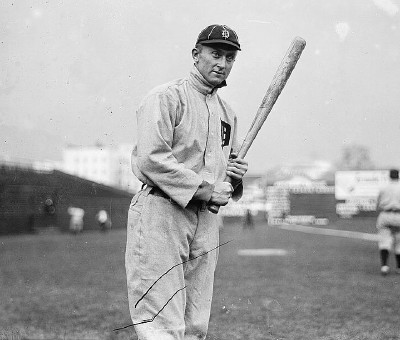
The morning of August 23rd saw the team in 6th place, 15 games out of first.  The next day the team signed a kid from Georgia that would forever change the face of Tigers' history and baseball history.  The young man had been playing for Augusta in the South Atlantic League when he was finally offered a contract  for the big leagues.  He signed on Thursday, August 24th.  He would make his debut a week later. He had to stop home in Georgia for his father's funeral first.  What should have been a triumphant moment for Tyrus Raymond Cobb was a dark and tragic one instead.  The treatment that rookie's receive at the hands of veterans' made his mood only darker. All rookies were taunted, teased, treated like dirt.  They all took it as part of the experience, something everyone went through.  Cobb took it personally.

When Cobb made his debut of August 30th, the Tigers were still in 6th place.  From that point on they would go 26-14 and although they were never really a factor in the pennant race, they finished third.  Cobb would not be the factor in that turn around but his potential was there and his determination was increased.  He promised himself that when the dust had settled, the veterans who had harassed him would be forgotten and Ty Cobb would be on top.  The player that topped that list for Cobb was Matty McIntyre another outfielder.

The pieces were mostly in place now.  Heading into the 1906 season, Outfielder Davvy Jones was added to the roster, as was Catcher Boss Schmidt.  With Jones, Cobb, Crawford and Matty McIntyre it was a crowded outfield.  The man who became expendable was good old Jimmy Barrett.  He had played a total of five years with Detroit, hit .292 and stole 92 bases during those years but he never quite led the Tigers the way it had been envisioned.  On May 9, he was sold back to the Reds.  With Crawford an established star in the league, that left three outfielders to fight for two spots and fighting was something Cobb excelled at.

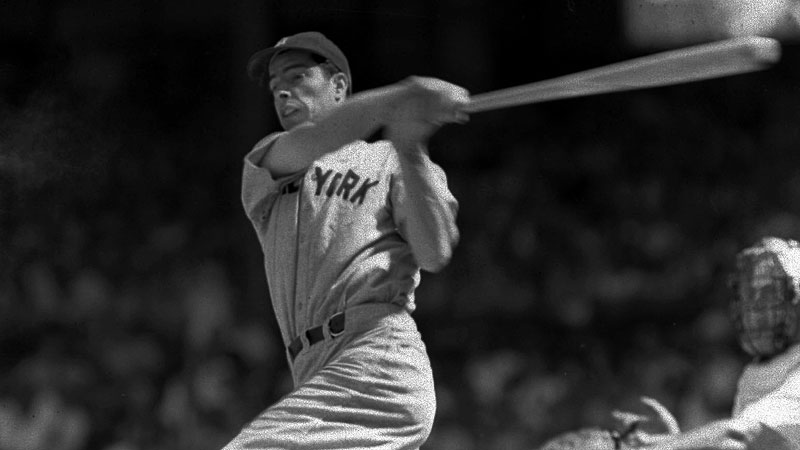
He won the starting assignment and took the league by storm.  He may not have had the impact as a rookie that someone like Joe DiMaggio would have in immediately leading his team to a pennant but Cobb certainly  put the fighting spirit into the Tigers.  Fans in Detroit may not have come out in droves to see the Tigers in 1906, and their 6th place finish certainly would not have excited many for the 1907 season but there was something happening here that many overlooked.  They did so at their own peril.

The Almost Dynasty (1907-1909)
The Tigers made only one move in the off season, picking up Cleveland's First Baseman Claude Rossman.  He was not a player that struck fear in the heart of an opponent.  He didn't need to be.  The 1906 season had been a learning experience for Ty Cobb and for all of the Tigers.  They had learned to play together.  Cobb and Crawford were not the best of friends off the field but on the field they played like one person.  They could work a hit and run better than anyone.  They used silent commands that even their own teammates could not figure out to call for a double steal that almost always worked.

The American League had ignored the Tigers as a contender for years.  The White Sox, Red Sox and Athletics had dominated the league.  Few even looked in the continuously second division Tigers direction when the 1907 season kicked off.  The Tigers ended June and started July with back to back losses.  They sat in fourth place, 6 1/2 games behind the leaders.  At the top of the league were the Athletics, a surprising Cleveland Naps and the White Sox.  The Tigers were about to pounce.  After sweeping a July 4th double header from the lowly Browns, the Tigers started to creep closer to the front. A 19-9 month put them in second place, just two games out of first.  The top four teams were all within 2 1/2 games of each other.  It wasn't first place, but it was the first time most people could remember the cats being in the race this late in the season.  They climbed into first place by 1/2 game on August 5th but bounced back out a few days later.  It appeared that it had been a nice try but when they fell back to third place, 2 games back, by August 17 with a three game losing streak their critics started saying "I told you so".  In years past this team would have kept falling (or not even been here to begin with) but this was Cobb and Crawford's team  and they would be damned if that would happen now.

From August 24- August 31 the team won 8 straight and they entered the last month of the season in first place, 1 1/2 games ahead of Philadelphia, 2 1/2 ahead of Cleveland and 3 1/2 ahead of Chicago.  There was still plenty of time for the Tigers to choke on the bones of their competitors but these kitties now had claws and they fought the competition with everything they had.

They clung to a slim 1/2 game at the end of play on September 26, just marginally ahead of the Philadelphia Athletics.  Up next on the schedule, after having just finished a trip to Boston, was a three game showdown in Philadelphia.  It was do or die for both.  Connie Mack and the A's were fully expected to declaw the Tigers.  It ended a bit differently.  The Tigers won the first game, putting them up a game and a half.  Worst case scenario they left town only 1/2 game behind, which was still better than expected.  When game two was rained out the plan was to play two the next day.  The A's took a lead into the top of the ninth.  The next three outs could change the  pennant.  With a runner on base Ty Cobb stepped in to the  batters box facing A's ace Rube Waddell.  Cobb launched a two run Home Run to tie the game at 8.  According to legend Connie Mack  was so shocked he fell off the bench and knocked over the bat rack.  Although it didn't win the game it has been said that it won the pennant.  The game remained tied into the 14th when controversy erupted.  Harry Davis hit a fly ball toward Crawford.  Crawford tracked the ball near the crowd (the crowd was so large the overflow crowd stood on the outfield grass) and seemed to settle under the ball.  Then the ball dropped to the ground.  Davis was standing on second in scoring position, poised to score the winning run.  Meanwhile Cobb and Crawford surrounded the umpires and argued vehemently.  After a few moments the umpire pointed to Davis and held a fist in the air.  Now it was Davis's turn to erupt.  The call was crowd interference.  Turns out one of the police in the outfield to keep order had scrambled to avoid Crawford, causing him to drop the ball, or so they said, and so the game continued tied.  Into the 15th.  The 16th. The 17th.  In the days before night games and stadium lights, it was too hard to see.  So the umpires ended the game in a tie.  The final game was cancelled and the lead in the standings  remained the same.  The Tigers had only seven games left and they were all against the league doormats.  They won five straight and took the pennant.

Their opponent in their first ever World Series was an angry group of Cubs with something to prove.  The Cubs had won 115 games in 1906 only to lose the series in five to their crosstown rivals.  Now they were back in the World Series and had no interest in taking an opponent lightly.  Game 1 ended in a 3-3 tie after a bizarre bottom of the 9th.  (Even more bizarre there had been questions before the Series on what would happen to the player's shares if one of the games ended in a tie.  Turned out it would go in the player's favor leading to rumors about the bizarre ninth inning being fixed to pad the players' wallets).

The Tigers struck first in Game 2 with a second inning triple by Rossman and a single by Catcher Freddy Payne.  The lead didn't last long.  The Cubs had three straight singles and a walk in the second to tie the game.  The teams traded turns in stranding base runners for two innings. It was constant tension.  Double plays, hit batters, everything but runs scored.  The Cubs opened the 4th with a single. A sacrifice bunt from Jack Pfister advanced the runner.  With a runner on second Jimmy Slagle singled, giving the Cubs the lead.  Slagle then stole second and scored on a double by Jimmy Sheckard.  That quickly the Cubs had a 3-1 victory and a lead in the series.  The Tigers' stars (Cobb and Crawford) were a combined 1-7 with a hit by pitch.

Game 3 quickly got out of hand for the cats  They did not get a base runner until the top of the 4th, an infield single.  The Cubs scored first in the second inning.  They scored three more in the bottom of the 4th for a 4-0 lead.  Two Tiger singles in the 5th were wasted by a double play and the Cubs dominated the Bengals.  It was a 5-1 win and 2-0 series lead.  Crawford drove in the only Tiger run and was hitting .308 in the series. Cobb, however, was 1-4, dropping his average to .167.  Johnny Evers was hitting well over .450 for the Cubs.

The Tigers needed a win badly in Game 4, the first ever World Series home game in Detroit.  The Cubs had two singles and a stolen base in the top of the first but a caught stealing saved the Tigers for the moment.  The home town team had something to cheer in the 4th when Cobb tripled and scored on a Rossman single.  Suddenly the Tigers had life.  Fans started to think positively.  If they win today the Cubs are only up one game.  They could win the next two at home and still have a chance.  It didn't last long.  Evers led off the 6th with a ground ball to short and it looked like they had finally gotten him out, until Shortstop Charley O'Leary made an error on the ground ball.  A walk, a sacrifice and a two run single by the pitcher gave the Cubs the lead.  They added to it in the 7th with three runs on two hits and an error.  The Cubs took control of the series with 6-1 win.
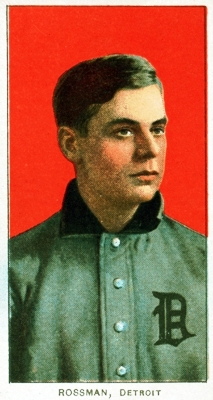


It was basically over at this point, although they had to play one more game.  The Tigers  fought hard.  No team had ever been swept in the World Series and the Tigers didn't want to be the first.  The Cubs scored in the first and second to take a 2-0 lead.  It would holdup.  The Tigers would not.  Claude Rossman would hit .450 for the five games (including the tie game).  No other Tiger hitter would be even close.  Crawford hit .238.  Germany Schaefer .143.  Boss Schmidt .167.  And Cobb?  The man who had energized the team all year hit just .200.  He was the missing man.  Clearly it was more than just Cobb that had caused the poor performance against the Cubs but it was Cobb who took the blame.  The Tigers had missed their first chance to stake a claim to the first dynasty of the World Series era.

Cobb went home and worked hard all winter long in Georgia.  The Tigers, feeling confident after their first World Series appearance, came back nearly unchanged.  No team had repeated as American League World Series representatives and when the Tigers started off at 3-9 and fell to the bottom of the league there was little to indicate that would change.  After a 17-7 May they were at the top of the league.  It was an up and down season.  While the Cubs, Giants and Pirates fought back and forth in what would eventually end up with Merkle's boner, the Tigers, White Sox and Indians battled right down to the end themselves.  Cobb would anger his team mates when he disappeared for five games in mid season to get married.  The problem was he didn't tell any of his team mates or the management his plans and so in the middle of a pennant race the best player in baseball disappeared.

Cobb's relationship with his team mates was like an exposed nerve.  The slightest movement could lead to unspeakable explosions of pain.  He had fought, physically and verbally with nearly every team mate but the key antagonist seems to have been Matty McIntyre.  The worst part of that relationship was that they played side by side.  "Why should I help that no good, son of a bitch?" was McIntyre's response to his managers question of why it was that he never seemed to hustle on balls hit between the two in the outfield.  Cobb felt the same and routinely threatened McIntyre with bodily harm.
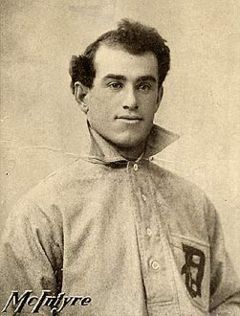


The White Sox' Ed Walsh won 40 games in 1908 but his  loss in his attempt to get 41 in the last series of the year with the Tigers gave Detroit their second trip to the World Series.  It would be years before baseball would see another pair of pennant races this close.

The Tigers scored first in Game 1 of the 1908 World Series, which again opened in Chicago.  The joy of thinking the Cubs would fall in line with Detroit's plans was quickly changed.  The game went back and forth. The Cubs took a 5-1 lead into the 7th but Ed Ruelbach suddenly lost his control.  A three run inning cut the Cubs' lead to 5-4.  The Tigers got two more in the 8th (thanks to two errors) to take a 6-5 lead.  Johnny Evers grounded to first to start the inning and with just two outs left the Tigers breathed a sigh of relief, two outs too soon.  Six straight singles, a double steal and another single later the Cubs led 10-6 and went on to take Game 1. Joe Tinker, Johnny Evers and Frank Chance picked up where they had left off the year before.  In Game 1 the three were a combined 5-13, scored 4 runs, drove in 2 and stole 4 bases.  It was a devastating loss for Detroit.

Game 2 was a great pitcher's duel.  Neither team could get a man on base, let alone score.    Entering the bottom of the 8th Wild Bill Donovan had allowed only one hit.  Things fell apart in the bottom of the 8th.  The big hit was Joe Tinker's two run Home Run but it was not the only hit.  It was a 6 hit, 6 run inning and the Cubs took Game 2.

Game 3 was again crucial for Detroit.  The man the Tigers had counted on to be the man the last two post seasons showed up.  The Tigers scored first on a Cobb RBI single in the first but three Tiger errors in the 4th gave the Cubs a 3-1 lead.  The Tigers faithful had seen this movie before.  They were sure it would be the same until the Tigers scored 5 in the sixth inning.  When the dust settled the Tigers had actually won their first ever World Series game to cut the series lead to 2 games to 1.

Game 3 was the last offensive explosion of the year for the Tigers.  The Cubs would shut them out in the next two games to win their second straight World Series.  The Tigers had now established themselves as the best team in the American League, head and shoulders above any team the league had ever seen, yet their dynasty was non -existent.  They were 0-2 in the World Series.  Cobb had certainly done better this year and it was much more competitive than the year before.  Had a few things gone differently, a few hits in tight situations, a few less errors, and they could have been World Champions, twice.

The Last Best Chance (1909)
The Tigers again made few moves during the off season, although they appear to have considered Claude Rossman at First Base their weak link and they looked to improve at that position.  Where they did add a player was at the opposite end of the infield at Third Base.  They purchased the contract of George Moriarty from the New York Highlanders.

The team got off to a quick start in 1909, winning their first five.  By July 25 they had not fallen out of first place for even a single day and had built a 7 1/2 game lead. They quickly squandered that and within a week the red hot A's had cut the lead to 2.  A week later they were tied with the A's.  By  the last week of August they had fallen from first place.  It was on August 13 that the panic truly set in and the Tigers made a few roster moves.  They sent utility man Red Killefer and Second Baseman Germany Schaefer to the Senators for Second Baseman Jim Delahanty.  Delahanty was one of five brothers (Ed, Joe, Frank, Tom and Jim) who played Major League Baseball.  Ed had been the most successful, but also the most tragic.  He had fallen from a moving train passing over Niagara Falls (stories vary over whether he killed himself or fell accidentally while drunk).  Jim was a solid addition.  On August 20, with Claude Rossman hitting just .260, the Tigers finally made the decision they had struggled with in the off season and traded Rossman to the St.Louis Browns for their first baseman Tom Jones.  What they got out of Jones was similar to what they had gotten out of Rossman, nothing spectacular, but the defense seemed to be the real upgrade.  With Delahanty they got a veteran presence, a defensive improvement over Schaeffer and a man with a knack for key hits.


Detroit caught fire and just as quickly as the recent swoon had started, it ended with a 14 game win streak.  Suddenly the lead was right back up to 5 with just a few weeks away.  Things seemed to be rolling and the team seemed to be clicking.  But this was the Tigers of Cobb and Crawford and it wouldn't  be a season if there wasn't some form of Cobb infused drama and it happened just as the 14 game streak was ending.  As the story goes, Cobb returned to the Cleveland hotel where the team was staying and decided to take the elevator up to his floor. He was told by the elevator operator, an African American gentleman, that the elevator did not operate at that hour.  While any normal human would have just taken the stairs, Cobb's response was to physically attack the man.  He would not be told by an inferior that he could not do something he wanted to do and he began pummeling the man.  A security officer near by jumped in to help the man and things got even worse.  Cobb pulled a knife on the security officer and stabbed him several times.  Two more employees pulled Cobb off the man but he was severely injured.  Criminal charges and civil charges were filed against Cobb as the team left town. Earlier in the year he had been threatened with a lifetime ban after spiking Frank "Home Run" Baker of the A's in an ugly incident at Third Base.  In Al Stump's Biography of Cobb he wrote "in numerous ways, Cobb's 1909 season was the most brilliant yet reprehensible any player ever lived through."Despite the distraction, something his teammates were getting all too familiar with (and tired of) the Tigers went on to win the American League by 3.5 games.

Their opponent this year was the Pirates.  It was a face off of the legendary Ty Cobb vs the legendary Honus Wagner.  Neither had ever won a World Series, although the Pirates' participation in the inaugural World Series seemed ages ago at this point. Authors David Finoli and Bill Ranier did a great job of documenting the public's interest in the match up in their book When Cobb Met Wagner: The Seven-Game World Series of 1909.  It was viewed as good vs evil.  The saintly, beloved Wagner vs the hated demon Cobb.  The perception of the contrasts can be seen in the World Series promotions of the day.  Wagner is drawn as calm, smiling almost relaxed.  Cobb is pictured angry, aggressive and snarling.


On October 8 the Series opened.  Still fearing arrest in Ohio for the previous month's hotel attack, Cobb had to take train routes that would keep him out of the state.  While his Tiger teammates took a train straight into Pittsburgh Cobb traveled by connections and stop overs.  His teammates, mostly Crawford and Matty McIntyre, were furious with Cobb for the distraction.  They had been through this twice before and they wanted nothing more than to come out of this World Series a winner.  They felt the Cobb issue was just the sort of thing that could cause their superstar to lose focus on the enemy Pirates.

The Pirates surprised a lot of people by starting a young Babe Adams in Game 1.  It was the right decision.  4 Tiger errors and 8 Tigers left on base gave the Pirates a 4-1 win.  Two hit batters by Tiger pitching led to some testy feelings and set a tone for the Series.

The Tigers had been through this before.  They did not want to repeat history for a third time but the Pirates made it look easy by scoring two quick first inning runs in Game 2.  The Tigers could have accepted their fate as a three time loser.  Instead they came out swinging.  A two run double by Boss Schmidt in the 2nd inning tied the game.  Two innings later they scored three runs on 2 hits and an error.as well as a steal of home by Cobb gave them the lead and they wouldn't look back.  They tied the series at one game each with a  7-2 win.

The series moved to Detroit for Game 3.  While the Tigers returned directly,  Cobb again had to take his roundabout trip.  The two teams faced off again on October 11.  The series was tied but the Pirates offense wasted no time in changing that.  4 Pirate hits helped by 3 Tiger errors led to a 5-0 lead for the Pirates after just a half inning.  Detroit would continue to boot the ball around and wind up with 5 errors in the game.  Meanwhile,  the Tigers continued to fight against the fear of losing another World Series.  In the 6th the Tigers grouped 5 hits and a Pirates error to plate 4 runs cutting the lead to 6-4.  The Pirates would add two more in the top of the 9th and would be glad they did. The Tigers scored a run in the bottom of the 9th cutting the lead to 8-5.  With Cobb on second, Donnie Bush on third and only one out, Crawford stepped up to the plate.  A base hit would cut the lead to one and would give the Tigers momentum.  Instead, a ground ball out scored one and moved Cobb to third.  The score was now 8-6 and Jim Delahanty was the Tigers' last hope for the day.  They needed to score Cobb from third and extend the inning.  Already with some key hits, Delahanty was someone Tigers fans would have wanted at the plate.  He made solid contact and sent a line drive to left field.  The way fielding had gone in the first three games, nothing was sure.  Cobb was tearing down the line on contact.  Delahanty was running hard out of the box hoping for extra bases.  Instead, Pirates Outfielder Fred Clarke moved over and caught the ball ending the game.  The Pirates now led the series 2 games to 1.

The series had been punctuated to this point by the poor fielding of the Tigers and the poor bat work by Cobb and Crawford.  Although he had some hits, including an RBI double in the Game 3 ninth inning rally, Cobb was  hitting only .273.  Crawford was even worse at .154.  The Tigers offense was coming from lead off man Davvy Jones, Shortstop Donnie Bush and Delahanty.  Unfortunately, Bush and Delahanty were giving away almost as many runs as they were creating with their poor fielding.  The Tigers, in their third World Series, had never led a series.  If  they were to finally win this they would need to string some post season wins together.  There was no better place to start than at home in Game 4.  George Mullin started for the Tigers.  He had suffered through arm injuries all season long but this day he either felt no pain or just ignored it, holding the Pirates to only 5 hits.  The errors that had plagued the Tigers to this point were forgotten.  The fielding woes, however, shifted to Pittsburgh.  The Pirates made 6 errors (they had more errors than hits in the game) and the Tigers scored five runs.  The series was tied again at 2 games each with three games left to play.
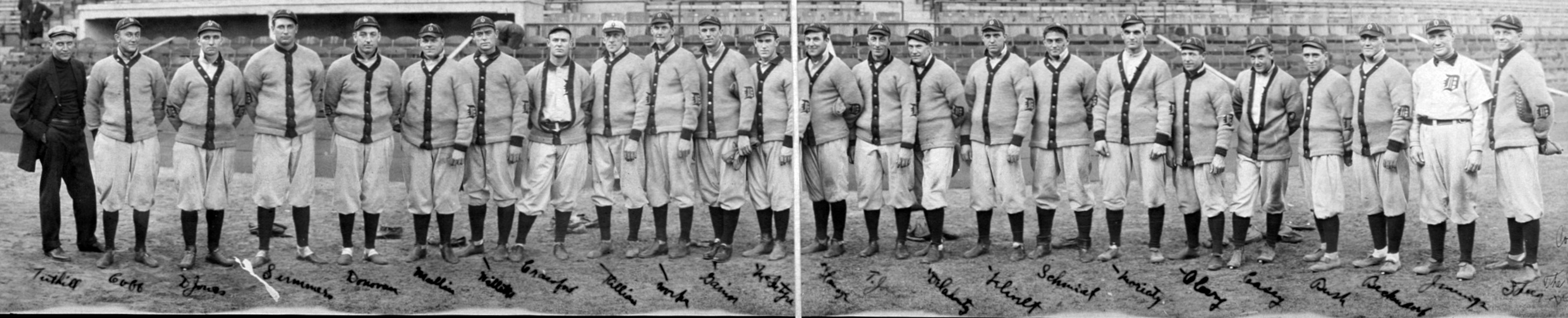


It was back to Pittsburgh for Game 5 and again Cobb took a round about way of getting there.  Some started to see the wear tell on Cobb's face and he seemed to be exhausted.  This series was becoming exhausting for everyone.  The longer the series went, the more tense it got.  Every run could be the one that tilted the series one way or the other.  Every error could be the one that cost a team the glory.  This group of Tigers had the extra pressure of two previous failed seasons.  The papers were filled with stories of the power of Cobb, Crawford and Delahanty.  If the Pirates hadn't learned it yet, the Tigers lead off hitter Davvy Jones was just as dangerous.  He proved it in the top of the 1st inning with a lead off home run to center field.  Despite this being in the dead center of the dead ball era, this series was high scoring.  This game would follow the trend and the Pirates erased the Tigers lead in the bottom of the first.  They would add runs in each of the next two innings but the Tigers would tie it up again with two in the 6th.  Just like the Series, this game was back and forth.  It was in the bottom of the 7th that the game changed.  With one out and two on, the Pirates struck.  Fred Clarke cleared the bases with a three run Home Run.  The Pirates would add one more before the inning ended.  The Tigers tried to fight back and when Crawford hit a Home Run, Tiger fans hoped he was finally coming out of his poor performance.  They would not get any closer and the Pirates would win Game 5 by an 8-4 score, taking a 3 games to 2 lead for the series.

Pittsburgh was now one win away from winning it all.  The Tigers were one loss away from having nothing to show for the last three seasons.  Pirates batters wanted to end this thing now and they got it started the right way with four straight hits, including a two run double from Wagner, giving them a 3 run lead before an out was recorded.  Crawford, showing signs of life, got the Tigers a run in the bottom of the inning with an RBI double.  A two run fourth tied the game again and the Pirates had a fight on their hands.  The Tigers scored two more making it 5-3 heading into the 9th inning.  If they held on they would force the first ever deciding game.  If they gave the game away, the Pirates would be World Series champions.  Tigers fans were confident entering the 9th with a lead.  The confidence was soon shaken.  Two straight singles and an error scored a run for the Pirates.  There were runners on the corners, no one out with the season in the balance.  Things looked bleak for the Tigers.  The Tigers made some defensive adjustments before the next batter, a move that would pay off.  First Baseman Jones had been severely injured on the previous play, knocked out cold to be precise, so Sam Crawford moved to first base, replacing Jones.  Catcher George Gibson stepped in to bat.  He didn't need much to tie up the game and when he made contact Tigers fans held their breath.  The ball was hit on the ground to Sam Crawford at first.  Bill Abstein tore down the line from third.  Crawford had to make a decision and it was one that could change the way this series went.  He could try to turn a double play, allowing the run to score but giving the Tigers two outs with the bases empty.  Or he could gamble and go home, hoping to beat Abstein and keep the lead.  He made a quick decision.  He threw home.  Abstein was out, the lead was in tact but the danger was still on the base paths.  The fate of the season was in the bat of Ed Abbatichio of the Pirates, pinch hitting for the pitcher.  With two strikes Abbatichio swung through a pitch.  For some reason Chief Wilson, the runner on second, broke for third.  It was a useless attempt.  He could have scored just as easily from second on a clean base hit.  Instead, he was out on a steal attempt.  Double play.  Threat over.  Game over.  Tigers' season saved...for now.

No World Series had ever gone to a seventh deciding game before. The build up around the country was tremendous.  As the teams prepared for the big game there were other events going on around the world.  President Taft accepted the resignation of the US Ambassador to China and the President of Mexico was given the key to the city in El Paso, TX.  In Tennessee, Alabama and South Carolina there were reports of entire towns being destroyed by violent storms.  27 were confirmed dead with the death toll "expected to reach 50" and more than $1 Million  worth of damage was done by the storm.  None of that mattered in the cities of Pittsburgh and Detroit. It would end today and no one knew how.

The Pirates threatened in the first but left 2 men on base.  The Tigers got a base runner in the first when Donnie Bush was hit by a pitch but he was caught stealing to end the inning.  Pirates fans worried when lead off hitter Bobby Byrne left the game.  He had been hit by a pitch to start the game.  With a 0-0 tie and everything on the line, it was no time for the backups to get in the game.  The Pirates would strike first in the second inning and it could have been much worse.  They left three men on base but scored twice.  The Tigers tried to mount a response but a walk and a double became useless when the runners were stranded.  Still, it was only 2-0 and the Tigers had fought back all series long.  The teams traded turns stranding runners in the third with the Tigers pinch hitting for their pitcher in their frame.  The Pirates' fourth inning quieted the crowd even more.  Two walks and two singles gave the Pirates 2 more runs and a 4-0 lead.  Two more stranded runners for the Tigers and the crowd groaned as the Pirates inched closer to a World Championship.  What had been billed as a battle between Wagner and Cobb was being decided by the two stars today.  In his first two at bats (taking us up to the 5th inning)  Cobb would fly out and ground back to the Pitcher.  In Wagner's first three at bats (taking us up to the 5th) Wagner had walked twice and flew out.  It was the top of the 6th that would officially decide the battle and the Series.  The frame opened with a quick out.  Tommy Leach then doubled and Fred Clarke walked bringing Wagner to the plate.  The inning could not have been more symbolic.  These three had been the Pirates core three since before the World Series era.  Now they had the chance to win the city's first World Series title.  Wagner did just that.  He sent a triple into the gap.  As Wagner neared third Crawford made a desperate throw to get an out.  It went wild and Wagner scampered home giving the Pirates a 7-0 lead.  Just as would happen in the Tigers' next appearance, 25 years later in 1934, Tigers fans would need to sit and watch as it all came apart.

The missed chances and the end of the era
The decline came quickly.  As the Tigers "almost dynasty" crumbled, Connie Mack and the Athletics climbed over the ruble and built their own real dynasty.

Crawford would play until 1917 and would continue to put up Hall of Fame numbers.  His 309 career triples are still the most all time.

Jim Delahanty, the man who had so many key hits in the 1909 series, played for the Tigers until 1912.  In 1914 and 1915 he played in the Federal League but did not return to MLB when the Federal League closed up shop.  He would forever live in the shadow of his older brother Ed.

Ty Cobb, the most famous Tiger of all, would play into the 1920's.  He would fight charges that he had conspired with Tris Speaker and Smokey Joe Wood to throw games and would forever be a polarizing figure in baseball history.  Known as one of the greatest players of all time, he was also one of the most hated players in baseball history.  Cobb would make a final desperate effort to win a World Series by signing to play for Connie Mack's Athletics.  They would not win with Cobb.  The year after he left they would go on to back to back World Series wins and a third appearance.

The Tigers' "almost dynasty" was one of missed opportunities.  No American League team had repeated as Champions.  No team had ever lost back to back (let alone three in a row) World Series before.  For decades Cubs and Red Sox fans played the "what if" game while waiting for a Championship.  The Tigers' "almost dynasty" is filled with these.  What if Cobb had played better in the first World Series.  What if Crawford and Cobb could have gotten along, how much better could they have been?  What if they had acquired someone like Delahanty a year or two earlier?  What if Cobb wasn't exhausted from traveling nearly 1400 miles in one week to get what took his team mates a fraction of the time?

While the Tigers' three straight AL Championships are nearly forgotten, what is remembered from this time is the dominance of the Cubs, Athletics and Giants.  The "what if" game is not unique to this team.  As you will see next week, the "what if" game is prominent in the decades that followed.

TRIVIA QUESTION:
As mentioned in today's article, the Tigers were the first American League team to win three straight American League pennants.  Who was the first National League team to do the same?

Answer to Last Week's Trivia Question:
The American League was founded by Ban Johnson.  He served as the league president  from the start of the league through 1927.  The National League president when Landis was put into office was John Heydler.  Heydler was a long time part of the NL hierarchy.  He was a personal secretary to long time league president Harvey Pulliam.  When Pulliam committed suicide in 1909 Heydler served as a temporary president.  He took over as a full time president in 1918 and served until  1934.

Sunday, November 17, 2013

Rivalries: Ty Cobb vs Babe Ruth

If you missed it, don't forget to check out the first article in the Rivalries Series:  Christy Mathewson vs. Three Finger Brown

To Ty Cobb, baseball was war.  It was to be taken seriously.  Like religion.  It was a life and death struggle.  It was dirt sprawling, fists flying, spikes slashing battle and anyone who didn't take it seriously would have to face Cobb's wrath. 

To Babe Ruth baseball was a game.  It was to be taken lightly and taken advantage of to the utmost.  It was free swinging, ball launching, slow trotting, clowning and anyone who thought differently didn't matter because Ruth didn't notice anyways. 


Ty Cobb was born into a well respected Georgia family and was brought up in luxury.  His father was a school teacher and landowner.  His relatives had fought in the Civil War, for the south of course, and led Cobb's Legion cavalry in General Lee's army.  The Cobb's legion was legendary in the "Lost Cause" lexicon.  They fought under General McLaw's Division of Longstreet's Corps.  They fought at most of the major battles of the Army of Northern Virginia including Sharpsburg (Antietam), Fredericksburg, Chancellorsville and Gettysburg.  The legion remained famous after the war and was the unit joined by Ashley Wilkes in "Gone With The Wind".  The Cobb family has a county named after it.  Cobb's father tried everything to get him to be a doctor, lawyer, soldier or anything but a ballplayer.  Cobb left home against his father's wishes and promised him he would not drink alcohol, one of the major evils of the world.

Babe Ruth was born to a bar owner in Baltimore.  There was little money for the family.  Ruth skipped school, stole from the family cash register, got into fights.  He did everything wrong and after one too many fights with his father he was declared incorrigible.  Ruth was sent away to a reform school.


Ty Cobb came along at the perfect time for the game.  At the turn of the century the National League was looking for someone to replace the aging stars, those first generation players, while the American League was looking for its identity.  Cobb slashed his way into Detroit from the minor leagues, ready to fight the world, including the entire Tigers team.  He drove his team to three straight World Series appearances in 1907, 1908 and 1909, the first AL team to do so.  In 1909 his Tigers played in the first ever deciding Game 7 and lost.  Cobb would never make it back to the Series.  As great as he was, possibly still the best player in the history of the sport, he would fight forever and never get a World Series title.

Ruth joined the Red Sox at the perfect time for Babe Ruth.  The Red Sox were set for a run of three World Series appearances in the next four years, winning all three.  Ruth moved on to the Yankees and won another five World Series.  His teams appeared in an additional three.  Ruth made the World Series seemingly effortlessly.

Cobb did everything better than anyone ever.  He hit better than anyone for more base hits and a higher average.  He scored runs better than anyone.  He stole home better than anyone.  He could also hate better than anyone.  He hated everyone. He was overflowing with that emotion.  He withheld a certain type of hate for pitchers.  They were the enemy.  He would stare them down as he walked toward the plate. Glare at them.  Scowl.  He would tell himself "this poor son of a bitch has to face the great Ty Cobb."  Then he would do what he wanted.


Ruth entered the league in 1914 as a pitcher, the worst of all people by Cobb's standards, and won two of the four games he appeared in.  He had a near full season in 1915 and won 18 games and a World Series title.  Not bad for a rookie.  He followed that with a 23 win season and a second World Series win, including pitching all 14 innings of a 2-1 win in game 2.  He would give up a first inning run and then throw 13 shutout innings.  He pitched again in the 1918 World Series and threw a 9 inning shutout in Game 1.  He pitched again in Game 4 and held the Cubs scoreless until the 8th.  With one out the Cubs scored a run, ending Ruth's record of consecutive scoreless innings in the post season at  29.  That would stand until the 1960's.

Cobb had no friends.  The people that he called friends were usually more business associates than friends.  They really didn't like him.  He had few reasons to smile and he could care less.

Ruth was every one's friend.  He had so many "friends" that he just stopped learning peoples names.  He would play with Catcher Benny Bengough for 8 years in New York yet still referred to him as "that googles guy."  He would give everyone he met a big "Hiya Kid!"  regardless of age, social standing or how long he had known them.


Cobb was vilified by the press.  Everything he did had some sinister purpose by the view of the press.  When he held out for more money, Tigers owner Frank Navin made him out to be a troublemaker. A greedy, ungrateful ruffian trying to bankrupt an honest business man.  Cobb had to fight to get $5000 a year.

Ruth was adored.  He could seemingly do no wrong.  Cameras and crowds followed him everywhere.  Ruth earned $52,000 a year with the Yankees in the middle of the depression era.  Someone asked him if he felt it was right that he earned more than the President.  Ruth said it was fine with him "I had a better year than he did, didn't I?"  The president was Hoover so no one questioned that Ruth's year was better.


With the two complete opposites it shouldn't be hard to imagine that a rivalry would evolve and yet none of these reasons above sparked the rivalry (although with Cobb's insane drive to be the best, you can see where he would be angry).  The rivalry came from the competing theories of baseball.

Cobb was from the "inside" theory of the game.  Cobb's view of the game was to play for one run.  Fight your way on base anyway you can.  If that means getting hit by a pitch then you took one for the team.  Once you got there nothing would stand in your way.  Cobb would work with Sam Crawford to master the hit and run and the double steal.  They would sacrifice themselves to advance a runner and score the one run then hold the other team.  It was a strategic game to Cobb, won on the base paths by outwitting your opponent.

Ruth was from no real theory of the game.  He walked to the plate, dug in his heels and swung.  Although, we have a picture of the free swinging hitter as missing more than they connect (thanks to the Mighty Casey at the Bat) Ruth was a tremendous hitter, much more than just a Home run hitter.  Ruth would end his career with a .342 average and would even hit .393 one season (and didn't win the batting title.  Harry Heilman of Detroit hit .403).

Ruth's approach revolutionized the game.  It took the attention from the station to station, hard slashing approach of Cobb, Speaker, Hornsby and Frisch and opened the door for the hard swinging, long ball launching bats of Gehrig, Foxx and Greenberg that would translate decades later into Aaron, Bonds, McGwire and Sosa.  In the mind of Cobb, Babe Ruth, arguably the greatest player in the history of the game and probably the player that most revolutionized the game, ruined the national past time.

TRIVIA QUESTION:
Who was Claire Hodgson and what part did she play in the lives of Ty Cobb and Babe Ruth?

Answer to last week's question:
When Mathewson took over as the manager of the Reds, Hal Chase was his first baseman.  Chase was long regarded as the best first baseman in the league and would likely have been considered Hall of Fame caliber, except for one major defect.  Chase was also considered the most crooked baseball player in the league.  Mathewson, long considered the most honest player in the league (his nickname was "the Christian Gentleman"), knew Chase was throwing games. Mathewson filed a complaint with the National League offices (this was several years before the Black Sox scandal).  By the time the league's investigation started, Mathewson was overseas, serving in World War I, and obviously unavailable to provide testimony.  Unable to prove the charges, the Reds released Chase, who was immediately picked up by John McGraw and the Giants.  When Mathewson returned from the war, his managers job with the Reds was already filled so he became a coach for McGraw's Giants.  Just a few months after Mathewson's return Chase was implicated in the investigation that led to the exposure of the Black Sox scandal.  Chase was banned for life along with the eight Chicago players. 


Sunday, November 3, 2013

Book Recommendations to Get You Through the Offseason

We are heading into the off season for baseball and the time in between the end of the post season and the start of free agency for next season.  Until about five years ago I wouldn't have worried about the long winter because I could at least get excited about football.  I'll be honest, the NFL season just doesn't have the same excitement for me it did before the strike a few years ago.

Don't worry, there is still plenty of ways to keep you (and me) focused on the great game of baseball even during the winter months.  I was asked last winter where I get most of my information and a very good friend suggested that I do a post about the books or resources that I use for the blog.  I have honestly read over 100 books and have used close to 100 different DVD, game film and websites to gather my information so the list that follows is not comprehensive, it is just some of my favorite.

To give you some recommendations for reading material, holiday gift ideas or just plain better understanding of the history of the game I have broken them into two categories.  First is the Biographies/Autobiographies.  Please keep in mind that many times "autobiographies" are ghost written so the material may or may not be coming directly from the player/manager, etc.  I have chosen my favorite Biographies/Autobiographies where the personalities of the figures shine through their words, whether written by them or not.

Second, I have chosen a list of Team/Season studies.  As much fun as it is to read about an individual player's memories of a season or event, don't forget this is a team game so it is just as interesting to see how the team works together (or doesn't) and achieves (or falls short of) the ultimate goal. 

Some of these books may be a surprise to you and some may be obvious choices (like the first book on the Autobiography/Biography list).  Regardless, here are some book recommendations to help you through the cold off season winter:

Biographies/Autobiographies
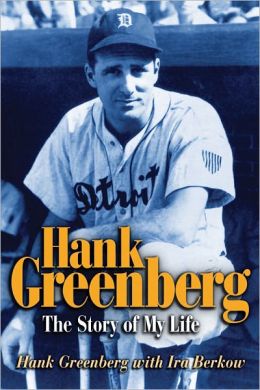
Author: Hank Greenberg and Ira Berkow
Did you really think I'd go more than a few weeks without a Hank Greenberg reference?  Greenberg was working with Ira Berkow on his autobiography when he passed away from cancer.  Berkow had sent Greenberg a list of questions about events, seasons, teams, opponents, etc and had Greenberg tape record his answers.  When Greenberg felt well enough between cancer treatments he would answer the questions and sometimes he would just give information outside of Berkow's requests.  Regardless, it was great information.  Berkow used Greenberg's recorded memoirs to fill out the book and complete the project.  What comes out in the pages is the life story of a humble man who enjoyed his time in baseball as a player and executive and loved his children.

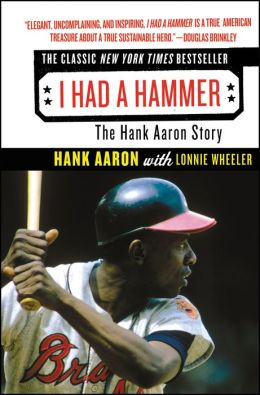
Author: Hank Aaron
Aaron's autobiography touches on the struggles he had coming up through the South Atlantic League in the 1950's, the winning days of the Milwaukee Braves and the trials and pressures of chasing Ruth's record. Aaron is one of the most likable people in baseball history and his personality comes across clearly in his story, making it even more difficult to accept the hatred he dealt with for doing nothing more than being successful.

Ya Gotta Believe: My Rollercoaster Life as a Screwball Pitcher and Part-Time Father and My Hope-Filled Fight Against Brain Cancer
Author: Tug McGraw
During his playing days, Tug McGraw was a household name in the Philadelphia and New York area due to his involvement in magical teams like the 1973 Mets and the 1980 Phillies.  After his playing days he has become known more as the father of Tim McGraw.  In his life story, McGraw discusses his career and personal life including his days with the Mets and the 1973 World Series, his days in Philadelphia, his struggle to form a relationship with his son Tim and his struggle with Brain Cancer.  McGraw is humorous, likable and positive despite his health scare and provides great detail about the Phillies' first ever World Series Championship.

The Only Way I Know
Author: Cal Ripken Jr
Junior has always been open and honest about his influences, his motivation and his love of the game.  This book is no different.  This book discusses growing up with a father managing in the minor leagues, coaching in the majors and the excitement of playing for his father and with his brother in the majors as well as the disappointment of seeing his father fired and his brother leaving the team.  Also discussed are the struggles of his rookie season, the transition from Third base to Shortstop and back, the playoffs and World Series of 1983 as well as the devastating losses of 1996 and 1997.  Cal also discusses the 1994 players strike and the frustration of the cancelled season.  Of course there is plenty of discussion of the streak.  Ripken never claims it himself but in the age of steroids he was the reason to believe in the good of baseball.

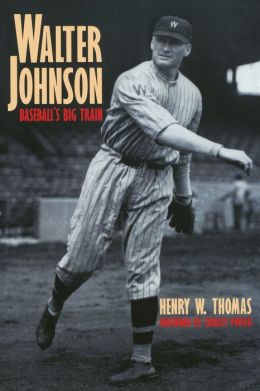
Author: Henry Thomas
Written by his grandson who was too young to know his grandfather when he died, this is the definitive Walter Johnson biography.  It traces the life of Johnson from his childhood in Kansas to the family's move to Santa Ana, CA, Johnson's travels through the minor leagues and his ultimate success as the "King of the Pitchers".  Johnson spent years with the horrible Washington Senators yet still won more games than any pitcher in history, except Cy Young.  Thomas provides great details of Johnson's personal and professional life and the chapters on the two World Series appearances of the Senators are particularly spectacular.  No detail is left out and no detail seems to be "fluff" material.  

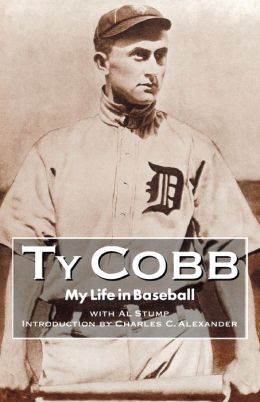
Author: Ty Cobb and Al Stump
Parts of the book are about the strategy of baseball.  Parts are descriptions of Cobb's approach to the game.  Part is bitter.  Part is hopeful.  And part is a defense of his poor reputation.  Cobb is definitely honest for better or worse in his life story.  The book was written mostly by Al Stump who spent several years personally discussing the project with an elderly Cobb.  Anyone who wants to make their own judgement of the legend that is Ty Cobb needs to read this.  Stump wrote the version of the book that Cobb wanted (it was proofed and approved by Cobb himself) so we have no doubt that this is Cobb's mind.  For an alternate perspective you can also check out Stump's biography of Cobb written about his experiences with Cobb during the project.  Stump's biography was later used as the basis for the movie "Cobb".

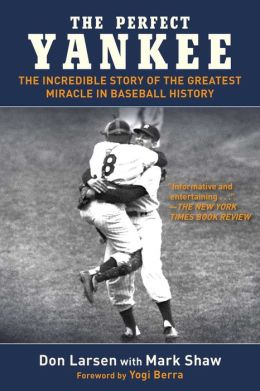
Author: Don Larsen, Mark Shaw and Yogi Berra
For a pitcher known as "googly bird" and someone who was never really considered an ace of any staff, Don Larsen has become famous far beyond the records of his career.  This is the book of his life as well as his experience of pitching the only World Series perfect game.  Larsen discusses his approach to the Dodgers, the joy of pitching and how he became the most imperfect pitcher to pitch a World Series perfect game.  His discussion of technical mechanics of his pitching are intriguing but general enough for casual fans to understand.  For example, he discusses how just one start before the end of the regular season he decided to abandon his wind up and pitch only from the stretch position for better control and how that effected his results, his confidence and led to his perfect game.

Extra Innings
Author: Frank Robinson and Berry Stainbeck
Intended as a response to Al Campanis's appearance on Nightline where Campanis declared that there were no African Americans in the front offices of baseball because no African American wanted a job that high, the book answers Campanis and so much more.  From Robinson's troubles in Cincinnati, success in Baltimore (including the difficulty of being an African American star loved for playing baseball but still not being accepted in general society), Robinson is  honest about his struggles with Angels manager Dick Williams, the benefit of what he learned from Earl Weaver and the difficult job of replacing Cal Ripken Sr and turning around the Orioles organization.  Particularly interesting are his experiences with Jack Clark, whom Robinson managed in San Francisco.   Clark recently accused Albert Pujols of using PED's.  Reading Robinson's view of Clark from 25 years ago may give you a different perspective of Clark's comments on Pujols.

I Never Had It Made: An Autobiography of Jackie Robinson
Author: Jackie Robinson
If you are looking for a book only about baseball this may not be your choice.  If you are looking for a book about the struggles of life, both professional and personal, and the strength that it takes to be successful regardless of continual road blocks, then this is it.  Robinson, of course, discusses breaking the color barrier and his career in baseball but he also discusses the struggle of being a father and husband while being on the road for the better part of the year, attempting to give his family a better life while dealing with the racism of the times and the pain of losing his son just as the son was turning his life around.  There is a reason that Jackie's number is the only one retired across the majors and it goes well beyond the diamond.  If you ever thought that Jackie was over rated as a player you need to read this and it will probably convince you that he is historically under rated.

The Duke of Flatbush
Author: Duke Snider, Carl Erskine and Bill Gilbert
This book may not be in print any longer so you may have trouble finding a copy.  I would suggest checking the library or used book stores.  Duke discusses not only his on the field play but the struggles of paying bills in the days before the million dollar salaries on the salary of a minor league manager.  He also discusses growing up as a fan of Jackie Robinson in Watts, CA,  the struggles of the Dodgers to finally win the World Series, his hatred of the Giants (and Halloween) and the tight friendships that made up the special days in Brooklyn.  Also discussed are Duke's final days in Los Angeles (with excellent details of the 1962 three game playoff between the Dodgers-Giants), his final days with the Mets and the odd feeling of ending his career as a Giant.

Seasons/Teams Studies
Author: Louis P. Mayer
This is a study of the formation of the American League, the war that resulted, the peace conference of 1903 and the first World Series.  Each game of the series has it's own chapter and is explained in detail.  The best of 9 series saw the American League's Boston franchise come back from a 3-1 deficit to win the first ever World Series.  It also includes details of a near player's strike, JFK's grandfather and the greed of the owners that would effect the game for decades.

Author: Cait Murphy
It is hard to pick a favorite book of all the ones I've read but this one is definitely in the top five.  The author does an amazing job of exploring the 1908 baseball season along with the political and social aspects of the US during the time.  The non-baseball sections include the corruption around Chicago and a female mass murderer in Chicago.  The baseball sections focus on the crazy baseball season which had a three team race in the NL that came down to Fred Merkle's "bonehead" mistake and a three team race in the AL which saw Ed Walsh of the White Sox win 40 games.

Author: Mike Vaccaro
A great telling of one of the greatest World Series of all time which ended with Fred Snodgrass's dropped fly ball and a Red Sox victory.  The author describes each game in detail as well as plenty of behind the scenes dealings and fights.  The story of the 1912 Red Sox includes the amazing season of Smokey Joe Wood, the corruption that nearly cost the Red Sox their World Series title and how the ownership's greed nearly alienated their most loyal fans. The Giants' 1912 season includes the stories of Rube Marquard's emergence as one of the best pitchers in the National League and the Giants' support of Snodgrass after the misplayed fly ball.  This was not only one of the most closely contested World Series, it is also one of the most controversial.  Anytime controversy was involved in the first 25 years of the World Series, you can bet John McGraw was involved somehow.

Author: Elliot Asinoff
This study of the 1919 season and the Black Sox scandal was the basis for the movie of the same name.  Asinoff explores the plot, the actual throwing of the games, the revelation of the scandal and the trial in one of the most important seasons in the history of the game.  Anyone who would like to truly understand the complex web of corruption that took place in this scandal should read this.
 
Author: Mike Sowell
This is more than a dual biography of Carl Mays and Ray Chapman, it explores the impact that the death of Chapman had on the Indians' team.  It also discusses the 1920 pennant race between the Yankees, White Sox and Indians.  1920 is one of the most important transitional seasons in the history of the game and this season saw Babe Ruth truly emerge as the new force while the White Sox team was torn apart.

Author: Paul E. Dotrich 
A great study of not just the baseball season of 1926 but many of the national events of the year including the death of Rudolph Valentino.  The author does a great job exploring the pennant race in the NL, including the mutiny and collapse of the defending World Champion Pirates and the first World Series title for the Cardinals.  Baseball fans may know that the 1926 World Series famously saw Grover Cleveland Alexander (alternately rumored to be drunk or hungover) enter the seventh game in relief and work out of a tension filled, bases loaded jam against the rookie sensation Tony Lazzeri.  If you have not heard of that famous at bat (or the bizarre way the series ended) this is a great place to learn more about it.

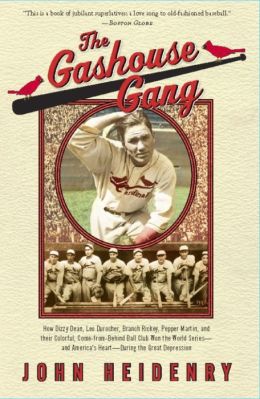
Author: John Heidenry
This book focuses mainly on the history of the St. Louis Cardinals, however, it is an interesting study of the Cardinals evolution from the perennial last place team to the most successful organization in the National League.  The book gives a great perspective on the importance of Branch Rickey before the Jackie Robinson signing and of course there are great Dizzy Dean stories.  The book also gives great description of the 1934 World Series with Joe Medwick's fight with Marv Owen of the Tigers and since this is the 1934 Tigers there is, of course, plenty of good Hank Greenberg information.

Author: Michael Shapiro
Anyone who has blamed Walter O'Malley for being a horrible, greedy, monster for uprooting the beloved Dodgers from the Brooklyn faithful and moving them to the West Coast must read this book.  Besides looking at the struggle of the team to defend their World Series title, Don Larsen's perfect game and the tight core group of the Brooklyn team, this book provides great detail of O'Malley's struggle to build a new stadium in Brooklyn and his desperation to avoid moving the team. 

October 1964
Author: David Halberstam
Anyone who has read a book by David Halberstam knows that you cannot go wrong reading a book by David Halberstam.  I nearly put another of his books (The Summer of '49) on this list as well, however, this one is my favorite of his work.  The 1964 season saw the Cardinals transitioning from the days of Stan Musial to the days of Bob Gibson.  It also saw the mighty Yankees becoming a tired, declining older franchise as Yogi Berra moved into a managerial position and Mantle struggled through knee injuries.  In a classic seven game series the state of baseball changed almost overnight.

Author: Tom Adelman
Similar to Halberstam, you can't go wrong reading a book by Tom Adelman.  Adelman does a great job of tying in the stories outside the game.  This is the story of the Dodgers team, led by Koufax and Drysdale, that appeared to be unbeatable as they faced off against the Baltimore Orioles team which was considered to be a middle of the league team.  Particular focus is paid to the impact of Frank Robinson in Baltimore as he gets traded from the Reds.  Focus is also given to Koufax and his struggle to come to terms with the damage he is doing to his arm and his desire to help his teammates win one last time.

The Long Ball: The Summer of '75- Spaceman, Catfish, Charlie Hustle and the Greatest World Series Ever Played
Author: Tom Adelman
Adelman's title says it all.  This is arguably the greatest World Series ever (although I still think 1991 beats it).  This book has everything.  The Big Red Machine.  The curse of Babe Ruth.  The birth of free agency.  The rebirth of the Yankees featuring Billy Martin, Thurman Munson and George Steinbrenner.  The decline of the Oakland dynasty of the 1970's.  Even cameos by M.C. Hammer and Willie Randolph.  It includes the heart warming story of Luis Tiant seeing his parents for the first time in decades.  It includes details of every edge of your seat game of the series.  And of course, it includes perfect details of the greatest World Series game ever played, the Carlton Fisk Home Run game. Even if you ignore every other piece of advice I give you  (and let's face it all of you will) listen to this one.  You must read this book.


The Bad Guys Won: A Season of Brawling, Boozing, Bimbo Chasing, and Championship Baseball with Straw, Doc, Mookie, Nails, the Kid and the Rest of the 1986 Mets, the Rowdiest Team to Ever Put on a New York Uniform and Maybe the Best
Author:  Jeff Pearlman
This is one of the legendary teams of all time.  The team had so much potential that it is almost unbelievable they only won one World Series as a group.  Reading this will go a long way in telling you why they didn't win more.  The focus is not just on the 1986 team, but in the building of the team.  It includes great biographical information on many of the Mets including Strawberry, Gooden, Kevin Mitchell, Mookie Wilson and Sid Fernandez among others.  The book is entertaining and informative and does a great job of chronicling the legendary team.

The Last Night of the Yankee Dynasty: The Game, the Team and the Cost of Greatness
Author: Buster Olney
Olney is one of the most respected baseball writers of our time and he has done a great job of following the Yankees dynasty of the late 1990's-early 2000's.  Any Yankee fan (or just baseball fan) who wants to know more about the team that rejuvenated the nation's love of the game, this is your book.  In reading this book I gained a whole new perspective on many players including Paul O'Neill, David Cone and Bernie Williams.  I am not a Yankee fan by any stretch of the imagination but this book is one of the best I've ever read.  It discusses the transition form Buck Showalter to Joe Torre, from Don Mattingly to Derek Jeter and the eventual decline of the dynasty.  2001 was certainly one of the best and most emotional World Series ever and this will give you every detail.

TRIVIA QUESTION:
In today's article, I mentioned that the 1926 World Series ended in a bizarre way.  How was the last out recorded?
 
ANSWER TO LAST WEEK'S QUESTION:
Congratulations to Hope and TJD for answering last week's trivia question correctly.

Anyone who routinely listened to Phillies games between 1971 and 2008 can tell you how good Harry Kalas was in the broadcast booth.  He had a subtle humor that was remeniscent of Vin Scully and a professionalism that was remeniscent of Mel Allen.  He had a great exaggerated "Struck him out!" call and "That ball is outta here!" call that have to be heard to be appreciated.  Harry loved the Phillies (or the Fightin's as he often called them).  One of Harry's favorite players was Garry Maddox.  Maddox was often called the Secretary of Defense years before Reggie White became the Minister of Defense in Philadelphia.  Maddox's range in Centerfield was nothing short of amazing.  Maddox had to cover a lot of ground to make up for slower outfield partners like Greg Luzinski, Del Unser and Jay Johnstone.  In fact, Maddox covered so much ground that Kalas said "Two thirds of the earth is covered by water, the rest of it is covered by Garry Maddox."


Sunday, February 10, 2013

Joltin' Joe DiMaggio: The Emergence of the Legend

Joltin' Joe DiMaggio
Written by: Ben Homer and Alan Courtney.
Performed by: Les Brown and his Orchestra
Vocals by: Betty Bonney
Originally Recorded: 1941


The great DiMaggio was not always the great DiMaggio.  Just as Ruth at one point was just a young punk pitcher, Gehrig was just the guy trying to replace Wally Pipp and much later Jeter was just the rookie Shortstop on the Yankees 1996 World Series team, DiMaggio was just a kid when he made it to the majors.  DiMaggio's father was an Italian immigrant who worked as a fisherman.  He moved the family to San Francisco's Fisherman's Wharf area when Joe was one year old.  His father would come home stinking of fish.  It was a hard living and the DiMaggio boys wanted no part of it.  They had one driving ambition.  They wanted to play baseball.  Well, at least Vince did.  Joe used it more of an excuse not to go fishing.  When Joe was 14 he stopped playing baseball and got a paper route to earn some money. It wasn't great but it wasn't fishing.  Vince and Dom never took a break from baseball and Vince was good.  Vince was eventually signed by the San Francisco Seals of the Pacific Coast League.  He encouraged Joe and let him know that he could be very good.  It was clear Joe had talent but Joe would have to get serious to become great.  He did.  He played in playground leagues and Boys Club leagues and with Vince's help he caught the attention of the Seals. In 1932 as the nation was still struggling through the great depression, Charles Lindbergh was handing over a ransom in an attempt to save his baby's life, Connie Mack was selling off the pieces of his great Philadelphia Athletics teams and Babe Ruth was trying to prove he was still the best player the game had ever seen, a young Italian kid in San Francisco debuted with the Seals as a Shortstop.  He played in only 3 games and had only 2 hits (one double and one triple) but he was good enough to get a contract for 1933.  He quickly proved that he had made baseball his life.  He took it very seriously and proved Vince right.  He not only excelled,  he was other worldly.  While playing for the Seals in 1933 DiMaggio hit .340, drove in 169 runs, hit 28 homers and, almost unbelievably, hit in 61 straight games (the team played 187 games that year).  Most would think that was an immediate ticket to the majors but minor league owners of the time could be fickle.  Most of them had no affiliation with Major League teams the way we understand it today.  If they had a guy who could bring that many people into the stadium they needed to get compensation in return for selling the contract.  There was one more problem.  During the off season of that great first year Joe was getting out of a cab late one night when his knee gave out.  The story was that his leg had fallen asleep and when he put the foot on the ground it gave out, causing extensive damage to the knee.  Major League teams disappeared like ghosts.  No one would spend money for a player with a bum knee.  The Seals held on to Joe for three seasons.  After the first year of playing with Vince, the Seals sold the older DiMaggio to the Hollywood Stars and the two never played together again.  Finally, after two more years of proving he wasn't just a flash in the pan, the Yankees took a chance on the kid who could hit minor league pitching but had never faced major league talent.  The Yankees sent Infielder Doc Farrell, Pitchers Floyd Newkirk and Jim Densmore, Outfielder Ted Norbert and $5,000 to the Seals for the rights to negotiate with DiMaggio.  DiMaggio was paid a salary of $8,500 for his first year in the majors.


Betty Bonney: Hello Joe, whatta you know?
DiMaggio: We need a hit so here I go.
Umpire: Ball one
Crowd: Yea!
Umpire: Ball two
Crowd: Yea!
Umpire: Strike one

Crowd: Booo!
Umpire: Strike two

Fan: Kill that umpire!
(snare drum shot.  Slide whistle)
Fan: A case of Wheaties

Occasionally baseball scouts find gold mines of talent in a certain area.  In the 1920's-1930's it was San Francisco.  The Yankees already had two great San Franciscans on the team: their double play combination of Tony Lazzeri (secondbase) and Frankie Crosetti (Shortstop).  As Joe prepared to make the long trek to the opposite part of the country for his first spring training in Florida the Yankees put Joe in contact with the two veterans.  The two Yankee mainstays would carpool with Joe to Florida, each taking a turn to drive.  There was no indication at that point that Joe would one day be "the greatest living ballplayer", he was just a rookie who wanted to make the team, riding with two living Yankee legends.  The deal was that Joe could go along and they would all take turns driving.  Typical of Joe, he said little, and typical of Lazzeri and Crosetti, they said little.  It wasn't until it came to Joe's turn to drive that a conversation broke out.  As it turns out Joe didn't know how to drive.  Crosetti suggested they leave the kid along the side of the road.  He tagged along anyways.  DiMaggio, Crosetti and Lazzeri would be long time friends.  The veterans taught Joe how to be a major league player, and more importantly, how to be a Yankee.  They never said much.  The three were notoriously silent.  Once, as they sat side by side in a hotel lobby there was silence for nearly an hour until DiMaggio cleared his throat.  Out of courtesy Lazzeri asked "what did you say?"  Crosetti finished the conversation with "Shut up.  He didn't say nothing."  They returned to silence.  His rookie season was nothing short of amazing.  He hit .323, 44 doubles, 15 triples, 29 home runs, scored 132 runs and drove in 125.  For a man replacing the great Babe Ruth the pressure didn't seem to effect him.  The Yankees reached the World Series facing the New York Giants.  There were questions of how this Yankees team would perform in the big time.  This was not the Yankees of Herb Pennock, Bob Meusel and Babe Ruth.  This was the new generation.  It could have gone either way. It could have been the Yankees of the 1980's where there was endless talent but no titles.  Or it could have been like the Yankees of the 1990's where there was endless talent and endless titles.  It was like the latter.  The Yankee dynasty of he 1920's was great but the Yankee dynasty that started in 1936 and lasted until 1964 was unbelievable and DiMaggio started it all.  After the tremendous rookie year Joe asked for a raise.  He wanted $17,500.  He got $15,000 but the front office was clear that it was unhappy about this young kid demanding anything.  It was unheard of at the time.  A rookie demanding a raise?  He was worth it.  Actually, the Yankees got him cheap.  Almost unbelievably DiMaggio improved on his rookie season.  He hit .346 with 15 triples, 46 Home Runs, scored 151 and drove in 167.  After another great World Series win Joe wanted another raise.  He wanted $40,000. Didn't Joe know that Gehrig, the true great Yankee who never haggled over salary, didn't even make $40,000? Joe told the Yankees "It's a shame Mr.Gehrig is so underpaid."  The ownership was unhappy.  Joe held out for what he felt he deserved.  Ownership was furious, and bitter and did everything they could to embarrass and break DiMaggio.  They eventually settled on $25,000.  He was vilified by the New York press.  Who did this "damn dago" think he was?  Didn't he know how lucky he was to be a Yankee?  The fans booed him mercilessly.  He was hated.  He won them back.  He led the team to two more pennants and two more World Series titles in 1938 and 1939.  He was becoming a great player steadily and quietly. 


He started baseball's famous streak
That's got us all aglow
He's just a man and not a freak,
Joltin' Joe DiMaggio.

Joe, Joe DiMaggio
We want you on our side
The Yankees missed the World Series in 1940 as the Tigers clawed them off their throne.  Joe started 1941 with an eight game hitting streak, going 19 for 36 (that's a .578 average).  He was 0 for his next 10 but managed to reach base by walks in each of the three games he was hitless.  From April 14 (opening day) through May 14th he hit .306, and although he had games where he failed to get hits, he reached base in all but two of the first 28 games.  Not a bad start for most players but the legend has it that Joe was in a slump heading into the May 15th game in Cleveland.  May 14th certainly was nothing to write home about.  He was 0-3 (with a walk) as Cleveland's Mel Harder shut down the Yankees 4-1 in New York.  When Cal Ripken was in the middle of his consecutive games streak he was often asked why he didn't skip a game.  He often said that he didn't want to miss an at bat.  "If I was hitting well I wanted to keep that going.  If I wasn't hitting well I wanted as many at bats as I could get to try and straighten myself out."  As Joe's "slump" reached 0 for his last 7 at bats the Yankees prepared to take on the White Sox in New York.  It was a game Joe would have loved to forget.  They lost 13-1, although Joe singled and drove in the only run for the Yankees.  He had a double and a triple the next night,  a single and a walk the next night, followed by a 3 for 3 night with  a double, 3 runs, an RBI and a walk.  The slump (0 for 7 can only be called a slump for the greatest hitters in history) was clearly over and what had started as one of the great starts in the history of the game turned into, arguably, the greatest offensive season in the history of the game.  The hits kept coming.  Many times a hitting streak is a grouping of 1 hit games.  DiMaggio's had 34 of them.  It also had thirteen 2 hit games, five 3 hit games and four 4 hit games.  He hit .408 during the streak.  What makes the streak even more amazing was how calm he appeared (although he was suffering from ulcers, chain smoking, drinking endless cups of coffee and couldn't sleep).  Today, when a hitting streak hits the 25 game area you will see guys up there hacking just trying to reach and slap the bat on the ball.  Their strikeout numbers usually skyrocket.  Not for the great DiMaggio.  During the streak he struck out a total of 5 times.


He tied the mark at forty-four
July the 1st you know
Since then he's hit a good twelve more
Joltin' Joe DiMaggio

Joe, Joe DiMaggio
We want you on our side
On June 3rd the world awoke to the news of the death of the beloved Lou Gehrig.  That day the streak reached 20 and Joe went 1-4 with a run, an RBI and a strikeout. On June 6, an off day, the Yankees dedicated a monument to Lou Gehrig in centerfield, the first monument in what would grow to be known as monument park. On June 17 he went 1-4 and scored a run to hit in his 30th straight.  People started taking notice.  Thirty is a nice round number but others had done that.  Tris Speaker had done it in 1912 with the Red Sox.  Charlie Grimm had done it over two seasons in 1922-1923. Sam Rice hit in 30 straight ending the 1929 season carrying over to the 1930 season.  Most recently, Goose Goslin had done it in the Tigers 1934 World  Series season.  Sam Rice had a separate 31 game streak during the Senators 1924 World Series year.  Harry Heilmann between 1922 and 1923 hit in 32 straight during a .400 season. In Joe's 33rd game he went 4-5, scored three runs and drove in a run.  This followed up his 32nd game where he had gone 3-3 with a Home Run, scoring twice and driving in 2.  George Davis hit in 34 straight in 1893. Hal Chase did it in 1907 and Rogers Hornsby had done it in 1922.  Most recently Heinie Manush had done it in the Senators 1933 pennant winning season.  When DiMaggio hit 35 straight on June 22 it was time to take this thing seriously.  Only 9 other players in the history of the game had done better at that time.  George McQuinn of the St. Louis Browns had hit in 34 straight in 1938.  Joe tied him on June 21.  Fred Clarke hit in 35 for the 1895 Louisville Colonels of the National League.  Ty Cobb had hit 35 in 1917.  The great George Sisler had hit in 35 in 1924 and stretching it into the 1925 season.  Gene DeMontreville of the old Washington franchise in the National League hit in 36 straight from 1896-1897.  Joe kept hitting but he got into some trouble around game 38.  He went into his last at bat of the game 0-3.  He calmly pounded a double to extend the streak and kept slugging.  Ty Cobb had hit in 40 straight in 1911.  Joe tied him on June 28 going 2-5 with a double and scoring once.  George Sisler had 41 straight in 1922.  Joe tied Sisler on June 29, although the country, and probably the pitcher, held his breath when Joe was hit by a pitch. He was fine and so was the streak.  Bill Dahlen of the Cubs had hit in 42 for the Cubs in 1894.  Joe tied Dahlen in the second game of a double header on June29.  There was only one person left ahead of him.  Wee Willie Keeler had hit in 45 straight beginning in 1896 and stretching into the 1897 season.  Keeler had a simple hitting philosophy.  "Hit 'em where they ain't."  DiMaggio followed the advice and tied Keeler on July 1.  The Yankees had a double header that day.  In the second game Joe went 1-3 with a run and an RBI to tie Keeler.  From this point on, anything he did made the streak more uniquely his.  He kept hitting.  On June 6, in a Yankee double header, he hit in games 47 and 48 going a combined 6-9, with a double, triple, 2 runs and 4 RBI in the two games. The next day was the All Star Break and everyone wondered if the three day break from the grind of the pennant race would derail the groove Joe was in.  It didn't.  In the All Star Game, July 8, Joe went 1-3 with a double, a walk and a run as the AL won 7-5.  On July 10 it was back to work and Joe was 1-2.  On July 11 he hit in his 50th.  It was a great game as Joe went 4-5 with a run, two RBI and a Home Run.  On July 16 he hit in game 56 and went 3 for 4 with three runs, a double and a walk.  It seemed like this thing would stretch forever. 


From coast to coast that's all you'll hear
Of Joe the one man show
He's glorified the horsehide sphere

Joltin' Joe DiMaggio
Joe, Joe DiMaggio
We want you on our side
The 1941 New York Yankees were anything but a one man show.  You can add the career numbers of the 1941 team and you will find an amazing collection of players:  Six MVP Awards, Six Hall of Fame Players (Bill Dickey, Joe Gordon, Phil Rizzuto, DiMaggio, Red Ruffing and Lefty Gomez) and 80 All Star Appearances.  The team won 101 games while still struggling to recover from the loss of Lou Gehrig.  They got little production from Lou's spot as Johnny Sturm, at first base, hit only .239 in his only year in the majors.  DiMaggio may have been the star of the team but the 1941 Yankees had names that would define this dynasty for the next decade:  Rizzuto, Charlie Keller, Tommy Henrich, Spud Chandler, George Selkirk and Johnny Murphy


He'll live in baseball's Hall of Fame
He got there blow by blow
Our kids will tell their kids his name
Joltin' Joe DiMaggio

We dream of Joey with the light brown plaque
Joe, Joe DiMaggio
We want you on our side
It's funny to hear the uproar over the Hall of Fame voting that took place a few weeks ago.  With numerous steroid era players hitting the ballot this year, people were livid that players like Craig Biggio, Mike Piazza and Jeff Bagwell were not elected on their first opportunity.  One announcer on MLB Network Radio, who clearly favors Piazza, spent a week screaming that it was a travesty these men were not elected on the first ballot.  He invited several voters onto the show then spent significant air time berating and embarrassing them over their votes.  I am certainly not saying these three are not Hall of Fame Players (and in fact many of the people casting votes probably do not put in the research required to truly make a proper choice).Yet, I think we need to put the first ballot selection into perspective a little bit.  DiMaggio first appeared on a ballot in 1945 (although he was still active, he was serving overseas in the military) when one person cast a vote for DiMaggio.  This one vote was 0.4% of the ballots.  His first real appearance on a ballot was 1953.  He fell short of election to the Hall of Fame.  He received only 44.3% of the votes, fewer votes than Dizzy Dean, Al Simmons, Bill Terry, Bill Dickey, Rabbit Maranville, Dazzy Vance and Ted Lyons.  Dean and Simmons were elected that year.  His next year of eligibility, 1954, saw him passed over again.  Rabbit Maranville, Bill Dickey and Bill Terry were elected.  Joe finished with only 69.4% of the votes.  In 1955 he was finally elected along with Ted Lyons, Dazzy Vance and Gabby Hartnett.  He received 88.8% of the votes.  That means that after having five years following his retirement and three years of eligibility there were people who still felt DiMaggio was not a Hall of Fame Player.  The year that he was elected he received votes on 223 of 251 ballots.  Apparently there were actually 28 Baseball Writers who felt that three MVP awards, 13 All Star appearances, 10 World Series appearances (9 World Series victories), 2214 hits (despite losing three seasons in the prime of his career to World War II and several other partial seasons to injuries) and a .325 career batting average while never striking out more than 39 times in a single season, was not Hall of Fame material.  Joe lived on in more than the baseball hall of fame.  He is forever remembered in the major facets of the arts: music, literature and television and always by the best of the best.  Ernest Hemingway's "Old Man" kept himself sane for hours by talking to himself about the great DiMaggio in "Old Man and the Sea".  Simon and Garfunkel used Joe as an example of what our country had lost from the good old days when they sang "Where have you gone Joe DiMaggio?  A nation turns its lonely eyes to you."  in Mrs. Robinson.  And finally, who could forget Cosmo Kramer stalking Joe at Dinky Donuts in an episode of Seinfeld or Fred Mertz's shocked reaction when Little Rickey asked him who Joe DiMaggio was?  Betty Bonney was right when she said "our kids will tell their kids his name."  She probably could have added a few extra generations onto that.


And now they speak in whispers low
Of how they stopped our Joe
One night in Cleveland Oh Oh Oh
Goodbye streak DiMaggio


The Yankees went into the July 17 game against the Indians with a seven game lead in the standings over the second place Indians.  After winning 14 straight the team had lost on July 14 to the White Sox but started another streak.  If he got a hit tonight he would have been given $10,000 from Heinz 57 to endorse their ketchup.  He came up to bat for the first time and smashed a ball towards thirdbase.  Ken Keltner was there.  He made a spectacular back handed stop and threw to firstbase to retire DiMaggio.  0 for 1.  Later in the game DiMaggio came up again.  He smashed another sharp ground ball to third.  Another hard hit ground ball.  Another amazing backhanded stop by Keltner.  Another out.  0 for 2.  In his third plate appearance DiMaggio coaxed a walk.  He would get one more shot.  It could not have been more dramatic.  It was the bottom of the 8th.  The bases were loaded and it was a tight game.  This was DiMaggio's time to shine.  When the game was on the line DiMaggio always found a way to come through.  Jim Bagby, who had replaced Al Smith with one out in the 8th, delivered a pitch.  Joe caught hold of it and hit a screaming line drive towards shortstop.  Lou Boudreau was right there and caught Joe's last chance for 57.  The streak was over.  It had lasted 56 games: 56 singles, 16 doubles, 4 triples, 15 home runs.  The next night Joe started a new streak that lasted 16 games.   In that 16 game stretch he had 29 hits,  a .382 average and 10 multi-hit games.  Although he had lost the streak at 56, he had reached base on a walk in the 0 for 3 night.  When the second streak of 16 finished he had reached base in 74 straight games and had hits in 73 of 74 games.  It was not until August 3, in both games of a double header, that he was kept off base in consecutive games during the 1941 season.  He had reached base in 98 of the first 103 games of the Yankees season.  By the time he was kept off base in consecutive games the Yankees were 11.5 games ahead in the standings well on their way to beating Pete Reiser, Mickey Owen, Pee Wee Reese and the Brooklyn Dodgers in the World Series.