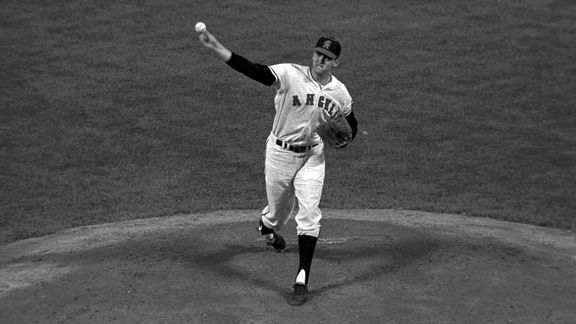
Each team finds a way to honor their legends, usually with the retirement of the player's number. For the fans of that team it is easy to sit in the stadium seats, look out on the display of retired numbers and feel pride in the part that number represents to their history. Unfortunately, fans of the visiting team stopping by to see a game may not know the meaning of those numbers.
So during this series we will explore what the retired numbers for each team mean and why they were retired.
Last week we looked at the San Diego Padres. Continuing this series is the San Francisco Giants. More accurately the New York Gothams/New York Giants/San Francisco Giants.
They are one of the most storied franchises in the history of the sport dating back to 1883. It should be no surprise that the team has honored quite a few of their former players, and will likely honor quite a few of their current heroes in the coming years. So why don't the Giants wear certain numbers anymore? Let's take a look:
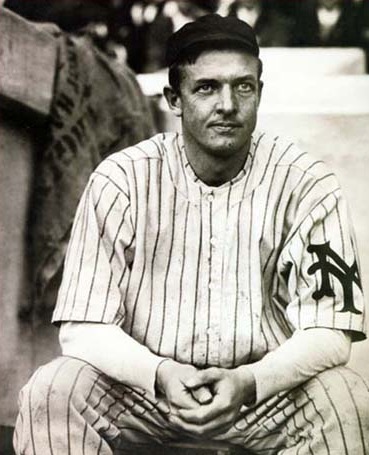
Known as the "Christian Gentleman" or "Big Six" Christy Mathewson was one of the first stars of the game. In fact, Matty changed the public perception of what a baseball player could be. Before Mathewson, baseball players were viewed as borish, uncouth and uneducated drunks. Mothers warned their sons not to become a ball player. Mathewson was a college educated, well spoken gentleman who preached clean living and had once considered priesthood. Mathewson created the "fadeaway" pitch which was essentially the early version of the slider. He won 372 games for the Giants in 17 years and was the identifying field leader of the Giants. In the 1905 World Series Mathewson pitched three complete games (27 innings) and allowed 0 runs. Hard as it is for a pitcher to win three games in any World Series, three shut outs in a World Series has never been approached. Mathewson played long before players used numbers on their uniforms so the Giants "retired" his initials. Despite not having played for nearly 100 years, Mathewson still ranks high in the Giants' record books: WAR for Pitchers (1st), Wins (1st), ERA (1st), W-L % (5th), WHIP (1st), BB/9 IP (3rd), Games Pitched (2nd), Innings Pitched (1st), Strikeouts (1st), Games Started (1st), Complete Games (1st), Shut Outs (1st), Hits (1st), Walks (4th), BB/K (3rd), HR/9 IP (7th), Losses (1st), Earned Runs (3rd), Wild Pitches (4th), Hit By Pitch (7th), Batters Faced (1st)
JM
The Giants history stretches back to the very beginning of the game, long before numbers on the back of the uniforms identified players. Yet the history of the Giants would be nothing without John McGraw. From 1902 through 1932 McGraw led the Giants as their manager. He led the team to the World Series in 1905, 1911, 1912, 1913, 1917, 1921, 1922, 1923 and 1924. They won the World Series in three of those appearances. In several other seasons (1904, 1908 and 1919) he could have guided the Giants to more World Series appearances but came up just short. He ended his Giants managerial career with 2583 wins and is generally considered the greatest manager of all time.
LS
Lon Simmons never played a game in the Major Leagues but he is closely associated with the San Francisco area for good reason. Born in Washnigton state, he played baseball at Burbank High School and Glendale College in Califorrnia before entering World War II. He never made it past the Phillies' minor league system. Simmons started broadcasting professional sports in 1957 and was the voice of the 49'ers from 1957 through 1980. One of his iconic calls being the Jim Marshall wrong way play. From 1958 when the Giants came to town until 1973 he joined with Russ Hodges as the voice of the Giants. He rejoined the Giants doing part time work from 1996 to 2002. Simmons passed away on 4/5/2015.
RH
Russ Hodges started announcing games in New York in the 1940s and was the Giants' equivalent of Vin Scully. Hodges called the Giants World Series appearances in New York in 1951 and 1954 and made the famous call on Bobby Thomson's pennant winning Home Run. Hodges moved to San Franciso and broadcast the team's games through 1970.
3

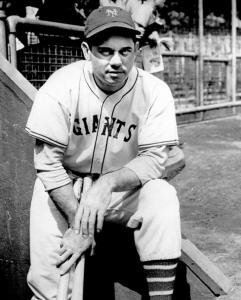
Bill Terry is often forgotten as one of the greats of the game but the big First Baseman was just as important as McGraw or Mays. He did not manage as long as McGraw (10 years) or get as many hits as Mays (2193) but the history of the Giants would have been dramatically different without him. Let's start with the obvious: he is still the last National League batter to hit over .400 in a season (.401 in 1930). He was the NL First Baseman in the first three All Star Games and seven times received votes for MVP. As a manager, Terry took over for McGraw when the older man retired in 1932 and immediately turned the team around. In 1933 he led the team to a World Series win and kept the team competitive in the years that followed. He led them back to the World Series in 1936 and 1937 but they lost to the Gehrig-DiMaggio Yankees both years. There is one specific reason that Giants fans should remember Terry every time they see the Giants play: he designed the orange and black uniforms, switching from the red and blue color scheme of the McGraw years. After all these years Terry still ranks in the top 10 Giants all time in many offensive categories: Batting Average (1st), Games Played (5th), Runs (5th), Hits (3rd), Doubles (4th), Triples (5th). RBI (5th), Singles (3rd) as well as several other categories. Following Bill Terry's retirement in 1936 the number 3 was issued to 17 other players: Mel Ott (1937), Hank Leiber (1937), Wally Berger (1937) ,Jimmy Ripple (1938), Jo-Jo Moore (1939), Harry Danning (1940), Johnny Rucker (1941), Joe Medwick (1943), Jim Mallory (1944-1945), Charlie Read (194), Johnny Mize (1942-1946), Herman Franks (1949), Ozzie Virgil (1969), Mike Sadek (1973-1981), Jeff Ransom(1982) and John Rabb (1982). Bill Terry was elected into the Hall of Fame in 1954.
4
 Mel Ott was the third baseman on the teams led by Bill Terry and he was considered the power in the lineup. Ott played 22 years in the Major Leagues, all with the Giants, made 11 All Star Games and 13 times received MVP votes. He led the league in Home Runs 6 times and walks 5 times. Like Terry, Ott still appears in the top 10 in many categories of the Giants all time leaders: Games Played (2nd), Runs (2nd), Hits (2nd), Total Bases (2nd), Doubles (2nd), Home Runs (3rd), RBI (1st), Walks (2nd), Strikeouts (6th) and singles (2nd). Ott was also one of the most well liked players, league wide, in the history of the game. The first player issued the number 4 for the Giants was Bill Terry in 1932. Only one other player (Hank Leiber in 1937) ever wore the number for the Giants.Mel Ott was elected to the Hall of Fame in 1951
11
 Carl Hubbell was known as "King Carl" for a reason. Carl pitched 16 years for the Giants in New York. He was a 9 time All Star, including the starting pitcher in the first two games, and won two MVP. He dominated the 1930s and had the Cy Young Award existed at the time, he likely would have been the winner in most years of his career. He won 253 games and finished with a 2.98 ERA. Hubbell also is credited with developing the Screwball and his most famous accomplishment was striking out Babe Ruth, Lou Gehrig, Al Simmons, Jimmie Foxx and Joe Cronin consecutively in the 1934 All Star Game. As far as his place among all time Giants pitchers: Wins (2nd), Walks per 9 IP (5th), Innings Pitched (2d), Strikeouts (4th), Games Started (3rd), Complete Games (4th), Shutouts (3rd), Only Freddie Fitzsimmons (1932) was issued the number 11 prior to Hubbell. It was never issued again. Carl Hubbell was inducted into the Hall of Fame in 1947.
20

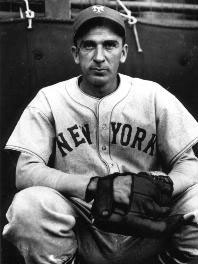
Visiting fans who see the tributes paid to Monte Irvin may look at his numbers and ask why so much attention is given to this man. Simple. He was great. Irvin signed with the Giants before the 1949 season at the age of 30 and was the first African American player on the Giants. He was much more than that though. Irvin was a great defensive outfielder, an All Star, an MVP candidate and a key piece of the 1951 and 1954 Giants World Series teams. Unlike Ott, Hubbell, Terry and Mays he does not appear on every category of the Giants all time list (he is 9th in On Base Percentage) but the 1950s New York Giants would have been much less successful without him. Had he started his career in the Major Leagues at a younger age he may have been much higher on a lot of lists. 21 players were issued the number 20 after Monte Irvin: Darryl Spencer (1956-1959) , Bob Nieman (1960), Dale Long (1962). Bily Hoeft (1963), Frank Johnson (1968-1969), Dick Groat (1967), Bernie Williams (1970-1972), Glenn Redmond (1974) , Bobby Murcer (1975-1976) ,Vic Harris (1977-1978), Joe Strain (1979-1980), Jeffrey Leonard (1985-1986), Eddie Milner (1987), Phil Garner (1988), Tony Torcato (2003), Michael Tucker (2004-2005) , Todd Greene (2006), Fred Lewis (2007), Pat Misch (2008), Steve Holm (2008-2009) and John Bowker (2009-2010). Monte Irvin was elected to the Hall of Fame in 1973 for his career in the Negro Leagues.
24

Willie Mays is the Giant. He is the identity of the team on both coasts. No man is more associated with the team than Mays. Rookie of the Year (1951), 20 All Star Games. 15 times received MVP votes (12 of those in the top 10 and twice a winner). 12 time Gold Glove winner. He is often in the conversation of greatest player of all time. Mays absolutely dominates the Giants record books: WAR (1st), Offensive WAR (1St), Defensive WAR (3rd), Slugging % (2nd), Games Played, (1St), At Bats (1st), Plate Appearances (1St), Runs (1st), Hits (1st), Total Bases (1st), Doubles (1st), Triples (2d), Home Runs (1st), RBI (2nd), Walks (3rd), Strikeouts (1st) Stolen Bases (3rd), Singles (1st), Extra Base Hits (1st), Times on Base (2nd), Sac Flies (1st), and Intentional Walks (3rd). 22 players wore the number 24 for the Giants before Mays: Doc Marshall (1932), Francis Healy (1932), Bernie James (1933), Fresco Thompson (1934), Al Cuccinello (1395), Kiddo Davis (1936-1937), Bill Lohrman (1937), Jumbo Brown (1938), Jimmy Ripple (1939), Buster Maynard (1940), Sid Gordon (1941), Frank Demaree (1941), Gus Mancuso (1942), Bobby Coombs (1943), Charlie Mead (1944), Andy Hansen (1944), Slim Emmerich (1945), Bob Joyce (1946), Woody Abernathy (1946-1947), Joe Lafta (1947-1949) and Mario Picone (1952). No player was issued the number 24 after Mays left the Giants. Mays was elected to the Hall of Fame in 1979.
27

Juan Marichal was a 9 time All Star, 7 time MVP candidate and one time Cy Young candidate. Six times the man known as the Dominican Dandy led the team in wins and was the ace pitcher on the 1962 World Series team. He ranks high among all time Giant pitchers: Wins (3rd), WHIP (4th), Walks/9IP (4th), Games Pitched (6th) , Innings Pitched (5th), Strikeouts (2nd), Games Started (2nd), Complete Games (6th), Shutouts (2nd), Strikeouts/BB (2nd), 16 players wore the number before Marichal: Joe Malay (1933), Hank Leiber (1933-1934), Phil Weintraub (1935), Mickey Haslin (1938), Hy Vandenberg (1937-1939), Tony Cuccinello (1940), Al Glossop (1940), Ace Adams (1941-1946), Goody Rosen (1946), Willard Marshall (1947-1949), Earl Rapp (1951), Spider Jorgensen (1951), Al Corwin (1953), Bill Taylor (1954-1956), Bob Schmidt (1958) and Jim Hegan (1959). No player was issued Marichal's number after he left the Giants. Juan Marichal was elected to the Hall of Fame in 1983.
30
 Orlando Cepeda, known as the Baby Bull, was a key piece of the Giants identity in the transition from New York to San Francisco. In the Giants' first west coast season Cepeda won Rookie of the Year. He went on to All Star appearances in 6 of his 9 years in the Bay and four times received MVP votes. He was a big part of the Giants 1962 World Series team. Cepeda spent only 9 years in SF so his numbers are not quite as high as Terry, Ott and Mays but he still ranks among the top 10 in several categories: Slugging % (5th). Total Bases (9th), Home Runs (6th), RBI (10th). Nine players wore the number 30 before Cepeda: Tip Tobin (1932), Hooks Iott (1947), Bill Voiselle (1947) Ray Poat (1947-1949) Kirby Higbe (1949-1950), Daryl Spencer (1952), Sid Gordon (1955), Dick Littlefield (1956) and Bob Lennon (1956). Twenty players were issued #30 following Cepeda: Billy Hoeft (1966), Jim Johnson (1970), John Carrithers (1970-1973), John Boccabella (1974), Darrel Thomas (1975-1977) , John Camargo (1978-1979), Bob Kearney (197), Chilli Davis (1981-1987) , Rusty Tillman (1988), Donnell Nixon (1988-1989), Mark Thurmond (1990), Chris James (1992), Jim McNamara (1992-1993), Jim DeShaies (1993), Jamie Brewington (1995), Dan Peltier( 1996), Marcus Jensen (1996-1997), Jacob Cruz (1997-1998) and Dante Powell (1998). Orlando Cepeda was selected for the Hall of Fame by the Veteran's Committee in 1999.
36

Gaylord Perry won 314 games over 22 years. 10 of those years were in San Francisco and 134 of those wins were in a Giants uniform. Perry won 15 or more games in 6 straight seasons, was twice an All Star and finished second in the Cy Young voting in 1970, finishing behind Bob Gibson. The following year, his last in San Francisco, he helped lead the Giants to a division title. Perry may not be the biggest name in Giants history but he does appear on the Giants top 10 in several categories including: WAR for Pitchers (7th), Innings Pitched (8th), Strikeouts (6th) ,Games Started (8th), K's/BB (4th). 17 Giants wore the number before Perry: Hugh East (1941), Frank Rosso (1944), Bennie Warren (1946), Monty Kennedy (1946) Mickey McGowan (1948), Alex Konikowski (1948), Clint Hartung (1949-1950), Sam Calderone (1953), Joe Garagiola (1954), Mario Picone (1954), Bob Lennon (1954-1956), Max Surkont (1956-1957), Joe Margoneri (1956-1957), Billy Muffett (1959), Bud Byerly (1959-1960), Sherman Jones (1960) and Frank Linzy (1963). 24 players wore the number following Perry: Sam McDowell (1972), Garry Mathews (1972-1976), Tim Foli (1977) , Skip James (1977-1978), Jim Dwyer (1978), Bill North (1979-1981), Dan Schatzeder (1982), Bill Wellman (1982-1986), Keith Comstock (1987), Dennis Cook (1988), Randy McCament (1989-1990), Rafael Novoa (1990), Gil Heredia (1991-1992), Steve Reed (1992), Erik Johnson (1993), Gino Minutelli (1993), Tim Layana (1993), Tony Mendez (1994), Kenny Greer (1995), Shawn Estes (1995-1996), Jay Canizaro (1996), Wilson Delgado (1997), Joe Nathan (1999-2003) and A.J. Pierzynski (2004). Gaylord Perry was elected into the Hall of Fame in 1991.
44
 Willlie McCovey is probably one of the most under rated players in the history of the game. McCovey debuted in 1959, the Giants' second year in San Francisco, and after only 52 games he won the Rookie of the Year award unanimously and received an MVP vote. He was a 6 time All Star and ten times received MVP votes. He was the MVP of the 1969 season, finishing ahead of Tom Seaver, Hank Aaron and Pete Rose. Of course he ranks high on a number of the team's all time categories: WAR (4th), Offensive WAR (4th), Slugging % (8th), OPS (6th), Games (3rd), At Bats (3rd), Plate Appearances (3rd), Runs (6th), Hits (4th) Total Bases (4th), Doubles (5th) , Home Runs (4th), RBI (4th), Walks (4th), Extra Base Hits (4th), Times on Base (4th), Hit By Pitch (7th), Sac Flies (2nd), Intentional Walks (2d), Only six players wore the number prior to McCovey: Johnny Vergez (1933), Andy Hansen (1947-1950), Al Gettel (1951), Steve Ridzik (1956-1957), Ray Crone (1957-1958) and Don Johnson (1958). No Giant player was issued the number following McCovey's departure. McCovey was elected to the Hall of Fame in 1986.
42
Jackie Robinson's number hanging in the Giants' stadium may seem a bit like taunting to the Giants' faithful, especially since it is in Dodger blue. But Jackie Robinson very nearly did wear the black and orange. Jackie was ready to retire following the 1956 season but kept it quiet. He had signed a deal with LOOK magazine to break the news and give the publication a big exclusive. What he did not know was that the Dodgers were in the process of trading him to the Giants. When the news broke that he was a Giant and that he was retiring instead of going to the Giants all hell broke loose. It strained his relations with the Dodgers front office for years as well as giving voice to claims by the Giants of shady dealings, adding to the legendary rivalry with stories of Jackie retiring to avoid the horrors of a Giants uniform. In total, 16 players wore the number 42 for the Giants: Gene Thompson (1946), Max Lanier (1952), Frank Hiller (1953), Marv Grissom (1953-1958), Joe Shipley (1959-1960), Bobby Bolin (1961-1969), John Morris (1972) Jim Willoughby (1972-1974), Gary Alexander (1977), Milt May (1980), Mike LaCoss (1986), Michael Jackson (1992-1994), John Roper (1995), Shawn Barton (1996), Keith Williams (1996) and Kirk Rueter (1996-1997).
TRIVIA QUESTION:
Surprisingly, despite their tremendous success in the early decades of the New York Giants, only Mathewson and McGraw have been honored by having their initials "retired". There is a Giants pitcher who twirled for the team from 1890-1898. He still ranks highly in the top 10 of many Giants categories: WAR for Pitchers (2nd), Wins (5th), Games Played (7th), Innings Pitched (4th) Strikeouts (3rd), Games Started (5th) Complete Games (3rd), Shutouts (4th), Walks (1st), Hits (4th), Home Runs/9 IP (5th), Losses (2nd), Earned Runs (2nd), Wild Pitches (3d), Hit By Pitch (1st ), Batters Faced (2nd). This Pitcher was elected into the Hall of Fame by the Veterans Committe in 1977. Who is this pitcher?
Answer to Last Week's Question:
Although he was known mostly for his time with The A's and Brewers, Rollie Fingers spent 4 years with the Padres (1977-1980). During that time Fingers had a 34-40 record and saved 108 games.
Similarly, Rich "Goose" Gossage is best remembered as a member of the great Yankee teams of the 1970s. Gossage pitched 4 seasons with the Padres (1984-1987). He went 25-20 with 83 saves.
3
Bill Terry is often forgotten as one of the greats of the game but the big First Baseman was just as important as McGraw or Mays. He did not manage as long as McGraw (10 years) or get as many hits as Mays (2193) but the history of the Giants would have been dramatically different without him. Let's start with the obvious: he is still the last National League batter to hit over .400 in a season (.401 in 1930). He was the NL First Baseman in the first three All Star Games and seven times received votes for MVP. As a manager, Terry took over for McGraw when the older man retired in 1932 and immediately turned the team around. In 1933 he led the team to a World Series win and kept the team competitive in the years that followed. He led them back to the World Series in 1936 and 1937 but they lost to the Gehrig-DiMaggio Yankees both years. There is one specific reason that Giants fans should remember Terry every time they see the Giants play: he designed the orange and black uniforms, switching from the red and blue color scheme of the McGraw years. After all these years Terry still ranks in the top 10 Giants all time in many offensive categories: Batting Average (1st), Games Played (5th), Runs (5th), Hits (3rd), Doubles (4th), Triples (5th). RBI (5th), Singles (3rd) as well as several other categories. Following Bill Terry's retirement in 1936 the number 3 was issued to 17 other players: Mel Ott (1937), Hank Leiber (1937), Wally Berger (1937) ,Jimmy Ripple (1938), Jo-Jo Moore (1939), Harry Danning (1940), Johnny Rucker (1941), Joe Medwick (1943), Jim Mallory (1944-1945), Charlie Read (194), Johnny Mize (1942-1946), Herman Franks (1949), Ozzie Virgil (1969), Mike Sadek (1973-1981), Jeff Ransom(1982) and John Rabb (1982). Bill Terry was elected into the Hall of Fame in 1954.
4

11
20

Visiting fans who see the tributes paid to Monte Irvin may look at his numbers and ask why so much attention is given to this man. Simple. He was great. Irvin signed with the Giants before the 1949 season at the age of 30 and was the first African American player on the Giants. He was much more than that though. Irvin was a great defensive outfielder, an All Star, an MVP candidate and a key piece of the 1951 and 1954 Giants World Series teams. Unlike Ott, Hubbell, Terry and Mays he does not appear on every category of the Giants all time list (he is 9th in On Base Percentage) but the 1950s New York Giants would have been much less successful without him. Had he started his career in the Major Leagues at a younger age he may have been much higher on a lot of lists. 21 players were issued the number 20 after Monte Irvin: Darryl Spencer (1956-1959) , Bob Nieman (1960), Dale Long (1962). Bily Hoeft (1963), Frank Johnson (1968-1969), Dick Groat (1967), Bernie Williams (1970-1972), Glenn Redmond (1974) , Bobby Murcer (1975-1976) ,Vic Harris (1977-1978), Joe Strain (1979-1980), Jeffrey Leonard (1985-1986), Eddie Milner (1987), Phil Garner (1988), Tony Torcato (2003), Michael Tucker (2004-2005) , Todd Greene (2006), Fred Lewis (2007), Pat Misch (2008), Steve Holm (2008-2009) and John Bowker (2009-2010). Monte Irvin was elected to the Hall of Fame in 1973 for his career in the Negro Leagues.
24
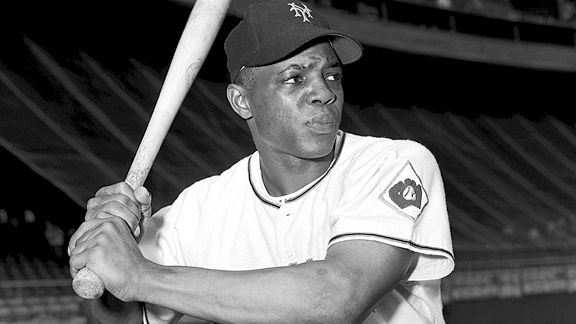
Willie Mays is the Giant. He is the identity of the team on both coasts. No man is more associated with the team than Mays. Rookie of the Year (1951), 20 All Star Games. 15 times received MVP votes (12 of those in the top 10 and twice a winner). 12 time Gold Glove winner. He is often in the conversation of greatest player of all time. Mays absolutely dominates the Giants record books: WAR (1st), Offensive WAR (1St), Defensive WAR (3rd), Slugging % (2nd), Games Played, (1St), At Bats (1st), Plate Appearances (1St), Runs (1st), Hits (1st), Total Bases (1st), Doubles (1st), Triples (2d), Home Runs (1st), RBI (2nd), Walks (3rd), Strikeouts (1st) Stolen Bases (3rd), Singles (1st), Extra Base Hits (1st), Times on Base (2nd), Sac Flies (1st), and Intentional Walks (3rd). 22 players wore the number 24 for the Giants before Mays: Doc Marshall (1932), Francis Healy (1932), Bernie James (1933), Fresco Thompson (1934), Al Cuccinello (1395), Kiddo Davis (1936-1937), Bill Lohrman (1937), Jumbo Brown (1938), Jimmy Ripple (1939), Buster Maynard (1940), Sid Gordon (1941), Frank Demaree (1941), Gus Mancuso (1942), Bobby Coombs (1943), Charlie Mead (1944), Andy Hansen (1944), Slim Emmerich (1945), Bob Joyce (1946), Woody Abernathy (1946-1947), Joe Lafta (1947-1949) and Mario Picone (1952). No player was issued the number 24 after Mays left the Giants. Mays was elected to the Hall of Fame in 1979.
27

Juan Marichal was a 9 time All Star, 7 time MVP candidate and one time Cy Young candidate. Six times the man known as the Dominican Dandy led the team in wins and was the ace pitcher on the 1962 World Series team. He ranks high among all time Giant pitchers: Wins (3rd), WHIP (4th), Walks/9IP (4th), Games Pitched (6th) , Innings Pitched (5th), Strikeouts (2nd), Games Started (2nd), Complete Games (6th), Shutouts (2nd), Strikeouts/BB (2nd), 16 players wore the number before Marichal: Joe Malay (1933), Hank Leiber (1933-1934), Phil Weintraub (1935), Mickey Haslin (1938), Hy Vandenberg (1937-1939), Tony Cuccinello (1940), Al Glossop (1940), Ace Adams (1941-1946), Goody Rosen (1946), Willard Marshall (1947-1949), Earl Rapp (1951), Spider Jorgensen (1951), Al Corwin (1953), Bill Taylor (1954-1956), Bob Schmidt (1958) and Jim Hegan (1959). No player was issued Marichal's number after he left the Giants. Juan Marichal was elected to the Hall of Fame in 1983.
30

36

Gaylord Perry won 314 games over 22 years. 10 of those years were in San Francisco and 134 of those wins were in a Giants uniform. Perry won 15 or more games in 6 straight seasons, was twice an All Star and finished second in the Cy Young voting in 1970, finishing behind Bob Gibson. The following year, his last in San Francisco, he helped lead the Giants to a division title. Perry may not be the biggest name in Giants history but he does appear on the Giants top 10 in several categories including: WAR for Pitchers (7th), Innings Pitched (8th), Strikeouts (6th) ,Games Started (8th), K's/BB (4th). 17 Giants wore the number before Perry: Hugh East (1941), Frank Rosso (1944), Bennie Warren (1946), Monty Kennedy (1946) Mickey McGowan (1948), Alex Konikowski (1948), Clint Hartung (1949-1950), Sam Calderone (1953), Joe Garagiola (1954), Mario Picone (1954), Bob Lennon (1954-1956), Max Surkont (1956-1957), Joe Margoneri (1956-1957), Billy Muffett (1959), Bud Byerly (1959-1960), Sherman Jones (1960) and Frank Linzy (1963). 24 players wore the number following Perry: Sam McDowell (1972), Garry Mathews (1972-1976), Tim Foli (1977) , Skip James (1977-1978), Jim Dwyer (1978), Bill North (1979-1981), Dan Schatzeder (1982), Bill Wellman (1982-1986), Keith Comstock (1987), Dennis Cook (1988), Randy McCament (1989-1990), Rafael Novoa (1990), Gil Heredia (1991-1992), Steve Reed (1992), Erik Johnson (1993), Gino Minutelli (1993), Tim Layana (1993), Tony Mendez (1994), Kenny Greer (1995), Shawn Estes (1995-1996), Jay Canizaro (1996), Wilson Delgado (1997), Joe Nathan (1999-2003) and A.J. Pierzynski (2004). Gaylord Perry was elected into the Hall of Fame in 1991.
44

42
Jackie Robinson's number hanging in the Giants' stadium may seem a bit like taunting to the Giants' faithful, especially since it is in Dodger blue. But Jackie Robinson very nearly did wear the black and orange. Jackie was ready to retire following the 1956 season but kept it quiet. He had signed a deal with LOOK magazine to break the news and give the publication a big exclusive. What he did not know was that the Dodgers were in the process of trading him to the Giants. When the news broke that he was a Giant and that he was retiring instead of going to the Giants all hell broke loose. It strained his relations with the Dodgers front office for years as well as giving voice to claims by the Giants of shady dealings, adding to the legendary rivalry with stories of Jackie retiring to avoid the horrors of a Giants uniform. In total, 16 players wore the number 42 for the Giants: Gene Thompson (1946), Max Lanier (1952), Frank Hiller (1953), Marv Grissom (1953-1958), Joe Shipley (1959-1960), Bobby Bolin (1961-1969), John Morris (1972) Jim Willoughby (1972-1974), Gary Alexander (1977), Milt May (1980), Mike LaCoss (1986), Michael Jackson (1992-1994), John Roper (1995), Shawn Barton (1996), Keith Williams (1996) and Kirk Rueter (1996-1997).
TRIVIA QUESTION:
Surprisingly, despite their tremendous success in the early decades of the New York Giants, only Mathewson and McGraw have been honored by having their initials "retired". There is a Giants pitcher who twirled for the team from 1890-1898. He still ranks highly in the top 10 of many Giants categories: WAR for Pitchers (2nd), Wins (5th), Games Played (7th), Innings Pitched (4th) Strikeouts (3rd), Games Started (5th) Complete Games (3rd), Shutouts (4th), Walks (1st), Hits (4th), Home Runs/9 IP (5th), Losses (2nd), Earned Runs (2nd), Wild Pitches (3d), Hit By Pitch (1st ), Batters Faced (2nd). This Pitcher was elected into the Hall of Fame by the Veterans Committe in 1977. Who is this pitcher?
Answer to Last Week's Question:
Although he was known mostly for his time with The A's and Brewers, Rollie Fingers spent 4 years with the Padres (1977-1980). During that time Fingers had a 34-40 record and saved 108 games.
Similarly, Rich "Goose" Gossage is best remembered as a member of the great Yankee teams of the 1970s. Gossage pitched 4 seasons with the Padres (1984-1987). He went 25-20 with 83 saves.