Showing posts with label Atlanta Braves. Show all posts

Sunday, February 15, 2015

2015 National League East Preview

***The Division Preview that follows is not betting advice in any way shape or form.  Please do not bet any money based in any part on these predictions.***

Don't forget to check back next week for the National League Central Preview. 


Washington Nationals:
Who's New: 
CATCHERS/INFIELDERS
Clint Robinson, 1B (Free Agent from Dodgers)
Ian Stewart, SS (Free Agent from Angels)
Steven LeRud, C (Free Agent from Braves)
Omir Santos, C (Free Agent from Pirates)
Mike Carp, UT  (Free Agent from Rangers)
Dan Butler, C (Trade from Red Sox)
Yunel Escobar, IF (Trade from Athletics)
Dan Uggla, 2B (Free Agent from Giants)
OUTFIELDERS

STARTING PITCHER
Eric Fonataro, SP (Waiver Claim from Cardinals)
Max Scherzer, SP (Free Agent from Tigers)
RELIEF PITCHERS
Bruce Billings, RP (Free Agent from Dodgers)
Heath Bell, RP (Free Agent from Yankees)
Evan Meek, RP (Free Agent from Orioles)
Casey Janssen, RP (Free Agent from Blue Jays)
Who Left: 
CATCHERS/INFIELDERS
Adam LaRoche, 1B (Free Agent to White Sox)
Asdrubel Cabrera, 2B (Free Agent to Rays)
Gregg Dobbs, UT (Unsigned Free Agent)
OUTFIELDERS
Stephen Souza, OF (Trade to Rays)
Nate Schierholtz, OF (Free Agent to Rangers)
Scott Hairston, OF (Unsigned Free Agent)
STARTING PITCHERS
Aaron Laffey, SP (Free Agent to Rockies)
Ross Ohlendorf, SP (Free Agent to Nationals)
RELIEF PITCHERS
Ross Detwiler, RP (Trade to Rangers)
Tyler Clippard, RP (Trade to Athletics)
Ryan Mattheus, RP (Free Agent to Angels)
Rafael Soriano, RP (Unsigned Free Agent)

Winter Headlines:
Scherzer adds to what is now considered the best rotation in baseball.
Loss of LaRoche could mean shift in power.
What to Expect?:
Nationals fans should expect the best.  Defensively they are strong up the middle with Ramos, Desmond, Espinoza and Span.  The pitching rotation of Strasburg, Scherzer,, Zimmerman, Gonzalez and Fister is potentially as good as we have seen in a long time.  With the Braves and Phillies seemingly unloading everyone the Nats should have an easy road to October. What they do when they get there is the question.
Why Should You Root for These Guys?:
Baseball in the nation's capital has not seen a World Series since 1933.  Granted a large part of that time period they didn't have a team.  Still, the Nats have built this group from the ground up and have made (mostly) smart baseball decisions.  It would be nice to see it pay off and see the Fall Classic return to the land of Walter Johnson and Joe Cronin.
Why Might This Season Not Turn Out the Way Nationals Fans Want?:
Getting to the playoffs is one thing, the Nats have done that.  Advancing is another.  With the amount of money spent, the team seems to be putting greater emphasis on the results.  Although the Braves and Phillies are rebuilding for the future, the Marlins and Mets are in a position to surprise a lot of people.  The Nationals need to stay healthy and keep a healthy eye on the rear view mirror.
Don't Expect Too Much From Him:
If we include his minor league stops, Jayson Werth is entering his 18th professional season.  That type of wear and tear can slow a player down over the long run, especially someone like Werth who plays all out all the time. You can expect Werth to be a team leader, near the top of the team roster in many important catgories and a major part of any success that the team has.  Just don't expect an MVP award.
Expect Great Things From:
I say this every year but Stephen Strasburg has the potential to be a truly great pitcher.  Strasburg had a season below his normal standards and was technically the 4th best starter on the team.  With some added protection in Scherzer, expect Strasburg to rise to the competition and have a Cy Young caliber season.
Prediction: 1st Place in NL East


Miami Marlins

Who's New:
CATCHERS/INFIELDERS
Reid Brigniac, SS (Free Agent from Philies
Dee Gordon, SS (Trade from Dodgers)
Miguel Rojas, 1B (Trade from Dodgers)
Martin Prado, IF (Trade from Yankees)
Don Kelly, IF (Free Agent from Tigers)
OUTFIELDERS
Cole Gillespie, OF (Free Agent from Blue Jays)
Michael Morse, OF (Free Agent from Giants)
Scott Sizemore, OF (Free Agent from Yankees)
Tyler Colvin, OF (Free Agent from Giants)
Ichiro Suzuki, OF (Free Agent from Yankees)
David Adams, OF (Free Agent from Orioles)
STARTING PITCHERS
Dan Haren, SP (Trade from Dodgers)
Mat Latos, SP (Trade from Reds)
Andre Rienzo, SP (Trade from White Sox)
David Phelps, SP (Trade from Yankees)
RELIEF PITCHERS
Ryan Reid, RP (Free Agent from Mets)
Aaron Crow, RP (Trade from Royals)
Preston Claiborne, RP (Waiver Claim from Yankees)
Nick Masset, RP (Free Agent from Rockies)
Vin Mazarro, RP (Free Agent from Pirates)
Who Left:
CATCHERS/INFIELDERS
Kyle Skipworth, C (Free Agent to Reds)
Juan Diaz, SS (Free Agent to White Sox)
Enrique Hernandez, IF (Trade to Dodgers)
Garrett Jones, 1B (Trade to Yankees)
Casey McGehee, 3B (Free Agent to Giants)
Rafael Furcal, SS (Unsigned Free Agent)
OUTFIELDERS
Brian Bogusevic, OF (Free Agent to Phillies)
Joe Benson, OF (Free Agent to Braves)
Reed Johnson, OF (Unsigned Free Agent)
STARTING PITCHERS
Brian Flynn, SP (Trade to Royals)
Andrew Heaney, SP (Trade to Angels)
Anthony DeSclafani, SP (Trade to Reds)
Kevin Slowey, SP (Free Agent to Phillies)
Nathan Eovaldi, SP (Trade to Yankees)
Brad Penny, SP (Free Agent to White Sox)
RELIEF PITCHERS
Alex Sanabia, RP (Free Agent to Angels)
Chris Hatcher, RP (Trade to Dodgers)
Dan Jennings, RP (Trade to White Sox)
Arquimedes Caminero, RP (Trade to Pirates)
Kevin Gregg, RP (Free Agent to Reds)

Winter Headlines:
Marlins spear some key players, look to swim up stream.
What to Expect?:
I am a little shocked at myself for thinking this, and I will probably look back at this and laugh at myself, but this could be a competitive team.  At the end of last year the Marlins actually had a playoff chance heading into the last few weeks.  And that was without reigning Rookie of the Year Jose Fernandez.  The Marlins have added some major pieces this off sesaon, key among them Dee Gordon, Martin Prado and Mat Latos.  If things go right the Marlins could play into October.
Why Should You Root for These Guys?:
This could be an exciting time for the Marlins.  This time last year the Marlins were generally considered the bottom of the barrel but these young players have shown that they can surprise some people, despite the perceived lack of support from ownership.
Why Might This Season Not Turn Out the Way Marlins Fans Want?:
There are two big pieces to this team: Stanton and Fernandez.  Unfortunatley both are big questions.  Stanton was injured in a frightening at bat near the end of the year and Fernandez missed most of last season.  Stanton is one of the best players in the game but it is yet to be seen how he will come back and Fernandez is still recovering from last years injury.  The team hopes to have him back by the beginning of June.
Don't Expect Too Much From Him:
Dee Gordon had an All Star season last year and appeared to finally be fulfilling his potential in Los Angeles.  That was with a lineup stacked from top to bottom to help get him in to score.  The Marlins have a good young team but they do not have the same bats that the Dodgers had last year to help.  Expect Gordon to have a high on base percentage and be near the top of the league in steals but he may not be the same Dee Gordon from last year's Dodgers.
Expect Great Things From:
Ichiro Suzuki signed late this offseason with the Marlins after having extensive talks with the Orioles and Mariners.  Suzuki will likely be a bench player and will have to fight for playing time in a crowded young outfield.  Still, Ichiro is one of the best players this game has seen in a very very long time,
Is This His Last Chance?:
Dan Haren has been a good pitcher in the league for a long time and until 2012 he was relatively injury free. But a back injury in 2012 has led to a decline in production for Haren that saw him bounce from Anaheim to Washington to Los Angeles with little consistency.  The Dodgers traded Haren to the Marlins in the offseason and he has made it clear he prefers to pitch on the west coast.  There have been few teams jumping at the opportunity and if he doesn't pitch well in his time in Miami, he may not get a second chance.
Prediction: 2d Place in NL East


New York Mets

Who's New:  
CATCHERS/INFIELDERS
Johnny Monell, C (Free Agent from Dodgers)

OUTFIELDERS
Michael Cuddyer, OF (Free Agent from Rockies)
Alex Castellanos (Free Agent from Padres)
John Mayberry, Jr (Free Agent from Blue Jays)
STARTING PITCHERS

RELIEF PITCHERS
Duane Below, RP (Free Agent from Tigers)
Who Left:  
CATCHERS/INFIELDERS
Josh Satin, 1B (Free Agent to Reds)
Miguel Socolovich, RP (Free Agent to Cardinals)
Taylor Teagarden, C (Free Agent to Cubs)
Omar Quintanilla, SS (Free Agent to Rockies)
OUTFIELDERS
Andrew Brown, OF (Waiver Claim by A's)
Eric Young, Jr, OF (Free Agent to Braves)
Bobby Abreu, OF (Unsigned Free Agent)
STARTING PITCHERS
John Lannan, SP (Free Agent to Marlins)
Daisuke Matsuzaka, SP (Unsigned Free Agent)
RELIEF PITCHERS
Miguel Socolovich, RP (Free Agent to Cardinals)
Ryan Reid, RP (Free Agent to Marlins)
Jose Valverde, RP (Free Agent to Padres)
Germen Gonzalez, RP (Trade to Yankees)
Dana Eveland, RP (Free  Agent to Red Sox)


Winter Headlines: 
Turning the Mess around?  With young group Mets could be moving in the right direction.
What to Expect?:
This team is probably a few pieces and a few years away from competing but they certainly appear to be heading in the right direction.  The key seems to be health.  David Wright, Travis D'Arnaud and Matt Harvey were all hit by the injury bug last year.  They will need to stay healthy to get a real idea of what they are capable of for the future.
Why Should You Root for These Guys?:
The Mets are potentially building something special.  They have a lot of strong young players on the roster and a lot of young talent in the system.  With the Braves and Phillies trading everyone away the Mets may be the new dominant force in the East.
Why Might This Season Not Turn Out the Way Mets Fans Want?:
There are still a lot of missing pieces here.  Shortstop is not settled.  The bullpen is a huge question mark.  The health of Matt Harvey and David Wright are a concern.  This season is an in between season for the Mets.  A playoff run would be nice but is more realistically a year or two in the future.
Don't Expect Too Much From Him:
Fans in Minnesota knew for a long time that Michael Cuddyer had talent and he finally showed it in his last two years in Colorado.  Cuddyer could be a strong influence on the team and help them reach the post season over the next few years but don't expect him to be an MVP.
Expect Great Things From:
The starting rotation is potentially a nice mix of young arms.  Between Jacob deGrom, Dylan Gee, Zach Wheeler and Matt Harvey there is a world of potential on this staff.  Waiting in the wings is Noah Syndergaard who will start the season in Las Vegas.  If the Mets somehow manage to stay in the race (which is not unthinkable) Syndergaard could see action at the big league level.
Is This His Last Chance?:
Bartolo Colon won 15 games last year and threw 200 innings for the Mets.  He also lost 13 and had an ERA over 4.00  Colon is now in his 40's and although he is clearly the veteran leadership on this pitching staff, how long will his aging body hold out?
Prediction: 3rd Place in NL East.


Atlanta Braves
Who's New?: 
CATCHERS/INFIELDERS
Eli Whiteside, C (Free Agent from Cubs)
Pedro Ciraico, IF (Free Agent from Royals)
Alberto Calaspo, 3B (Free Agent from Athletics)
Jace Peterson, IF (Trade from Padres)
A.J. Pierzynski, C(Free Agent from Cardinals)
Emilio Bonifacio, SS (Free Agent from White Sox)
Kelly Johnson, IF (Free Agent from Orioles)
John Buck, C (Free Agent from Angels)
OUTFIELDERS
Zoilo Almonte, OF (Free Agent from Yankees)
Nick Markakis,OF (Free Agent from Orioles)
Joe Benson, OF (Free Agent from Marlins)
Eury Perez, OF (Waiver Claim from Mets)
Jonny Gomes, OF (Free Agent from Athletics)
Eric Young, Jr, OF (Free Agent from Mets)
STARTING PITCHERS
Shelby Miller, SP (Trade from Cardinals)
Chieng Ming Wang, SP (Free Agent from White Sox)
Greg Smith, SP (Free Agent from Phillies)
Wandy Rodriguez, SP (Free Agent from Pirates)
Eric Stults, SP (Free Agent from Padres)
RELIEF PITCHERS
Arodys Vizcaino, RP (Trade from Cubs)
Donnie Veal, RP (Free agent from White Sox)
Jim Johnson, RP (Free agent from Tigers)
Michael Kohn, RP (Free Agent from Rays)
Michael Fotynewicz, RP (Trade from Houston)
Josh Outman, RP (Free Agent from Yankees)
Jason Grilli, RP (Free Agent from Dodgers)
Josh Outman, RP (Free Agen from Yankees)
Ryan Butcher, RP (Free Agent from Dodgers)
David Carpenter, RP (Free Agent from Angels)
Jose Veras, RP (Free Agent from Astros)
Who Left?:  
CATCHERS/INFIELDERS
Tommy LaStella, 2B (Trade to Cubs)
Emilio Bonifacio, IF (Free Agent to White Sox)
Evan Gattis, C (Trade to Astros)
Steven LeRud, C (Free Agent to Nationals)
Ramiro Pena, IF (Free Agent to Padres)
Ryan Doumit, C (Unsigned Free Agent)
Gerald Laird, C (Free Agent to Diamondbacks)
Donnie Murphy, IF (Unsigned Free Agent)
OUTFIELDERS
Justin Upton, OF (Trade to Padres)
Jason Heyward, OF (Trade to Cardinals)
STARTING PITCHERS
Ervin Santana, SP (Free Agent from Twins)
Gavin Floyd, SP (Free Agent to Indians)
Kris Medlen, SP (Free Agent to Royals)
Aaron Harang, SP (Free Agent to Phillies)
Mitch Atkins, SP (Free Agent to Rangers)
David Hale, SP (Trade to Rockies)
Zach Stewart, SP (Free Agent to Angels)
Brandon Beachy, RP (Unsigned Free Agent)
RELIEF PITCHERS
Atahualpo Severino, RP (Free Agent to Angels)
Anthony Varvaro, RP (Trade to Red Sox)
Shreve Chasen, RP (Trade to Yankees)
David Carpenter, RP (Trade to Yankees)
Mitch Atkins, RP (Free Agent to Rangers)
Ryan Butcher, RP (Free Agent to Dodgers)
Pedro Beato, RP (Unsigned Free Agent)
Luis Perez, RP (Free Agent to Blue Jays)
Gus Schlosser, RP (Trade to Rockies)
Winter Headlines: 
Braves unload in offseason, get little back in return,
Outfield experiment is abandoned but is this a better alternative?
What to Expect?:
If you're a Braves fan have low expectations.  The Braves were a competitive team over the last 5 years, even putting some scares in the Phillies, Nationals, Giants and Dodgers.  That run seems to be coming to an end.  The experiment of the Hayward-Upton-Upton outfield has been marked down as a failure and the plethora of young arms have now been abandoned.  What is left is an outfield with one Upton, a lifetime Oriole with health questions and a prospect.  The infield is strong at the corners, average at Shortstop and an aging journeyman at second.  Their closer is one of the best in the game but he may have few opportunities to show it.  Expect the next few years to be a down turn.  But on the positive side:  they're in the same division as the Phillies.
Why Should You Root for These Guys?:
The Braves are almost certainly headed into a rebuilding phase.  Most of the young talent they counted on to spark a rebirth of the 1990s glory days have been shipped away.  The talent that is left could turn out to be in for a long, painful stretch/
Why Might This Season Not Turn Out the Way Braves Fans Want?:
It almost certainly won't turn out in favor of Braves fans.  The team is clearly in rebuilding mode and will have to hope for help from the minor league system.
Don't Expect Too Much From Him:
Nick Markakis was a fan favorite in Baltimore for years and many Orioles fans were saddened by the fact that the team's rise to playoff contender coincided with injury filled years for Nick.  Markakis' best years are behind him (although, as an Orioles fan and fan of Markakis, I hope he proves me wrong).  You can expect Markakis to give 100% effort all the time and to be a positive influence in the clubhouse but don't expect him to lead the Braves into contention or to replace Heyward.
Expect Great Things From:
I probably said the same thing last year but Chris Johnson is a very under rated player at third base.  He has a hard job in replacing Chipper Jones but he quietly is a key piece in this team.  With few big names left expect Johnson to represent the Braves in the All Star Game
Is This His Last Chance?:
A.J. Pierszynski has a reputation for causing clubhouse problems.  It helps to explain why someone with that much talent has moved from the Twins to the Giants to the White Sox to the Rangers to the Red Sox to the Cardinals to the Braves.  To be fair though, he did contribute greatly to the success of the Giants and White Sox in his stays there so the reputation may be a bit exaggerated.  It isn't the first time that a guy's negative clubhouse presence has been overblown in Boston.  Regardless, that reputation has followed A.J. and if he does not correct it in Atlanta there may be little demand left for an aging grumpy Catcher.
Prediction: 4th place in NL East


Philadelphia Phillies

Who's New: 
CATCHERS/INFIELDERS
Chase D'Arnaud, SS (Free agent from Pirates)
Chris Nelson, 3B (Free Agent from Padres)
John Hester, C (Free Agent from Angels)
Cord Phelps, 2B (Free Agent from Orioles)
Chris McGuinness, 1B (Free Agent from Pirates)
Tyler Greene, IF (Free Agent from Padres)
OUTFIELDERS
Xavier Paul, OF (Free Agent from Diamondbacks)
Jeff Francoeur, OF (Free Agent from Padres)
Darren Mastroianni, OF (Free Agent from Blue Jays)
Brian Bogusevic, OF (Free Agent from Marlins)
Jordan Danks, OF (Waiver Claim from White Sox)
STARTING PITCHERS
Kevin Slowey, SP (Free Agent form Marlins)
Jeanmar Gomez, SP (Free Agent from Pirates)
Aaron Harang, SP (Free Agent from Braves)
Chad Billingsley, SP (Free Agent from Dodgers)
Anthony Vasquez, SP (Free Agent from Orioles)
RELIEF PITCHERS
Paul Clemens, RP (Free Agent from Houston)
Who Left: 
CATCHERS/INFIELDERS
Reid Brigniac, SS (Free Agent to Marlins)
Jimmy Rollins, SS (Trade to Dodgers)
Wil Nieves, C (Free Agent to Padres)
OUTFIELDERS
Marlon Byrd, OF (Trade to Reds)
Tony Gwynn, Jr (Unsigned Free Agent)
STARTING PITCHERS
A.J. Burnett, SP (Free Agent to Pirates)
Kyle Kendrick, SP (Free Agent to Rockies)
Greg Smith, SP (Free Agent to Braves)
RELIEF PITCHERS 
Brad Lincoln, RP (Free Agent to Pirates)
Antonio Bastardo, RP (Trade to Pirates)
Jeff Manship, RP (Free Agent to Indians)
B.J. Rosenberg, RP (Free Agent to Dodgers)
Jeremy Horst, RP (Free Agent to Dodgers)
Mike Adams, RP (Unsigned Free Agent)
Shawn Camp, RP (Unsigned Free Agent)
Winter Headlines:  
The end of an era.  Rollins gone. Howard, Papelbon, Hamels and Lee to follow?
What to Expect?:
Expect the worst.  This team still has talent but they are in full rebuilding mode.  It seems that Utley is the only untouchable.  For the last 15 years the Phillies have given their fans some great moments but for the next few years it could be a return to the days of Steve Jeltz, Von Hayes and Shane Rawley.
Why Should You Root for These Guys?:
The Phillies have never had a period of success this sustained before.  There was the nice run from 1976 through 1983 but this is something different.  This was special.  After an era of poor play this gave birth to a whole new generation of Phillies fans.  While I grew up with stories of the exploits of Schmidt, Carlton, Rose, Luzinski and Bowa, today's generation has grown up with the exploits of Rollins, Howard, Hamels, Utley and Ruiz.  Here's hoping that they can give the young generation one last run at something special.
Why Might This Season Not Turn Out the Way Phillies Fans Want?:
To be fair, who's left?  From the championship teams of 2008 and 2009 only Ruiz, Howard, Utley, Hamels and Lee remain.  Of those 5 three have been mentioned in serious trade talks.  Phillies fans can only hope that the trades being made can bring positive results in return.
Don't Expect Too Much From Him:
Chad Billingsley is a tremendously talented pitcher.  When he first arrived in the big leagues, knowing that Kershaw was coming right behind him,the Dodogers thought they had a new Koufax and Drysdale combination.  Unfortunately Billingsley's arm gave out and he has not had a full season since 2011. Billingsley is a classy guy and a good clubhouse presence, something this team could use with the loss of Rollins.  His effectiveness will be defined by the health of his arm.
Expect Great Things From:
Chase Utley is a Hall of Fame player.  Period.  He has shown over the years that he deserves to be mentioned with the greats of this organization like Klein, Ashburn and Schmidt.  Injuries have kept his amazing numbers lower than they could be but when all is said and done he is one of the most entertaining players to watch.
Is This His Last Chance?:
Ruben Amaro, Jr took over the Phillies at the end of the 2008 season and has benefitted from the team that Pat Gillick put together.  That is not to say that Amaro has not done a good job.  He certainly orchestrated the deals that brought Halladay, Polanco, Lee and Ibanez to town.  Each of those deals helped to extend the Phillies' run of success.  However, as the Phillies head into a clear rebuilding mode, will Amaro be able to see the results of his dealings over the last two years.
Prediction:5th place in NL East


*-Please be aware that these predictions are based on the rosters as set in the middle of February.  There are still several key free agents unsigned which could alter these previews.  Also, injuries during spring training could alter my outlook.  Check back next week for the NL Central Preview and continue following to see my final predictions at the start of the season.


TRIVIA QUESTION:
Giancarlo Stanton led the National League in Home Runs last year with 37.  Who was the last player from the NL East to lead the league in Home Runs?

Answer to Last Week's Question:
Ozzie Guillen spent a short time in a Tampa Bay Devil Ray uniform, as did everyone in last week's article.  Of those featured in last week's article only Manny Ramirez played for Ozzie.  Ramirez played in 24 games for the White Sox in 2010.  

Sunday, November 16, 2014

Almost a Dynasty: 1990's Atlanta Braves Part 2

What actually makes a sports dynasty?  Obviously a teem needs to be successful for a continuous amount of time.  Every sport has that one iconic dynasty that fits the Dynasty category.  The NBA had the Boston Celtics who won nine out of ten championships.  The Montreal Canadiens won 7 of nine Stanley Cups (including six straight).  The NFL had several dynasties including the 49'ers, the Steelers, the Cowboys and, most recently, the Patriots.  Baseball itself has had the Yankees dynasties in several incarnations including the 1930's, 1950's and 2000's.

So what actually makes a team a dynasty?  There can of course be several definitions since there are varying levels of success.  A team can dominate their division for a decade but be bounced out in the first round of the playoffs year after year.  We could of course consider that to be a divisional dynasty but you wouldn't call it an overall baseball dynasty.  So let us set the parameters for this series of articles.  A dynasty, for our purposes here, is a team that wins multiple World Series championships (above two as back to back is nice but not a dynasty) within a 5-10 year period.  That being defined, this series will explore those teams that may have been a divisional or league dynasty but for whatever reason could not get over the hump to that World Series dynasty.

This series will show an array of near dynasties.  Some are teams that made the World Series year after year but fell short.  Others will be teams that competed right down to the end of the regular season year after year just to be beaten out.  It will be a series of near misses and what could have beens.

Don't miss the other almost dynasty articles: The Detroit Tigers of the 1900's, The Chicago White Sox of the 1910's, the Pittsburgh Pirates of the 1920's, the Boston Red Sox of the 1940s ,Brooklyn Dodgers of the 1950s the Milwaukee Braves of the 1950s, the Los Angeles Dodgers of the 1970's, the Oakland A's of the 1980's, the Atlanta Braves of the 1990s Part 1.  Now let's get started with this weeks "almost dynasty": The Atlanta Braves of the 1990's Part 2.

Defending Champs:
Little tinkering was done with the World Champion Braves.  Terry Pendleton was still there but Chipper Jones was now playing most of the season at third base.  Mike Deveraux was gone but he was not a key player in the regular season.  They were replaced by youngsters Jermaine Dye and Andruw Jones.  When David Justice battled injuries Ryan Klesko got plenty of playing time in right field.  It almost seemed that the Braves were too powerful.  Steve Avery struggled with arm problems again but with young pitchers Denny Neagle and Jason Schmidt coming up it was clear that the team was building for the future while winning now.

The Braves, led by Smoltz (24-5), Maddux (15-11) and Glavine (15-10) again breezed through the regular season and swept the Dodgers in the ALDS with Smoltz, Maddux and Glavine each winning one game.  Smoltz took on the Cardinals in Game 1 of the NLCS and kept the pattern going.  It ended abruptly with an 8-3 loss for Maddux in Game 2.  Glavine lost Game 3 by a 3-2 count and young Denny Neagle lost Game 4 by a 4-3 count.  Suddenly the Braves' championship pleasure cruise had hit some rough waters.


Smoltz started Game 5 with the season now hanging in the balance.  Whatever it was that snapped the Braves back to life it had an immediate impact.  They scored three runs before St. Louis could record a single out.  They scored 5 runs in the first, another 2 in the second and they never let up. With 22 hits, 5 walks and 14 runs the Braves made a loud statement.  It was loud and clear.  We're still the champs.

Maddux pitched Game 6 and although he did not have the run support that Smoltz had gotten in Game 5, the three runs that he was given were enough.  The Braves won 3-1.  Now they had St.Louis on the ropes.  It was a showdown for the NL pennant in Game 7.  The Cardinals started young Donovan Osborne in Game 7.  He was in his 5th, and best, Major League season but he had never faced pressure like this.  The Braves had Glavine on the mound.  Glavine got the Cardinals 1-2-3 (including a ground out by Ron Gant) in the first. Osborne did not fare quite so well.  He gave up a single and a double.  After a ground ball and an RBI sac fly it looked like he might settle down.  A 1-0 game wouldn't be so bad.  He walked Lopez to load the bases and then the rookies took over.  Jermaine Dye and Andruw Jones hit back to back singles to make it 3-0.  Jeff Blauser was hit by a pitch to reload the bases.  Still, 3-0  was OK.  They could get past that and with Glavine stepping up to the plate there was still a chance for Osborne to do something.   He did.  He gave up a bases clearing triple to Glavine making it 6-0 Braves.  Osborne left the game after 2/3 of an inning having allowed 6 runs on 5 hits.  The Braves won 15-0 and advanced to the World Series for the fourth time in six years and with their bats on fire.

Their World Series opponent would be the New York Yankees. It was a rematch of the 1957 and 1958 World Series.  The Braves had won the 1957 and the Yankees the 1958.  That was back when the Yankees were unbeatable and the Braves were the "almost dynasty".  Now the Braves were the dominant team and the Yankees were the ones with the questions.  While the Braves had the strongest pitching, possibly ever, the Yankees had two strong veterans (David Cone and Jimmy Key), one unproven rookie (Andy Pettite) and one pitcher that some considered the weak link (Kenny Rogers).  The rookie, Pettite, started Game 1 against Smoltz.  Pettite got Marquis Grissom, Mark Lemke and Chipper Jones in order to start the first.  Smoltz put himself in a tough position with two walks but he got Cecil Fielder to fly out to end the inning.  A swinging strikeout by McGriff started the Braves second and people were slightly impressed with the poise of the young pitcher.  Javy Lopez singled and when that was followed by a long fly ball for out number two it seemed to settle any nerves.  Stepping to the plate was Andruw Jones.  He had played in only 31 games in the regular season but with David Justice out of action Jones got  the start in the World Series.  And what did the player who was technically not even a rookie yet do in his first World Series at bat?  In a 6 pitch at bat Andruw Jones gave the Braves a 2-0 lead.  He launched a ball to left field and as Darryl Strawberry went back to catch it he knew before reaching the warning track that it was out.  The Braves 3rd inning was even more fun.  Four singles, a sacrifice, a walk and a stolen base gave the Braves a 5-0 lead and showed Pettite the way out.  They weren't done yet.  Jermaine Dye flew out for the second out and Jones stepped in for his second World Series at bat. It landed in the netting that protected Monument Park in left-center field.  The Braves took Game 1 12-1.


Maddux took the mound in Game 2 against Jimmy Key.  Maddux allowed 6 hits and walked none in 8 innings.  The Yankees offense had now scored only 1 run in 18 innings at home.  The Braves scored 4 runs against Key and looked like the unbeatable champions.  They were on their way home for three games.  The way they had played in the first two games and with Avery and Glavine still to come they were on top of the world.

The Yankees were not about to go quietly.  With David Cone, the veteran ace on the mound, the Yankees were far from defeated.  Glavine pitched well in seven innings allowing only 4 hits, and walking three.  He allowed only two runs, one of them unearned.  The key inning was the 6th with the Braves behind 2-0.  Glavine led off and Grissom followed that with a single, one of his three hits on the day, and Lemke failed to advance the runners when he popped up a bunt.  Chipper Jones walked and loaded the bases for the heart of the lineup.  Fred McGriff, the teeth of the Braves attack, stepped in and Atlanta fans were sure this would be the moment that things worked themselves out.  McGriff popped up the second pitch for the second out.  Next up was Ryan Klesko, the power hitting star of the 1995 World Series, Klesko drew a walk forcing in Glavine with the opening run.  Most managers would have pulled Cone at this point.  Joe Torre decided to win or lose with Cone.  Cone faced Javy Lopez.  A base hit would give Atlanta the lead, the momentum and probably the series.  On an 0-1 pitch Lopez swung and connected. The ball popped up in the air for a final out. The Yankees went on to score three more runs  and save their season, for a day.

The Braves were angry.  They knew they should be ahead three games to none.  They took their anger out on Kenny Rogers.  McGriff led off the second with a solo Home Run.  That inning ended with the Braves leading 4-0 and when they added another run to give them a 5-0 lead Kenny Rogers was told it was time to fold 'em.  In the 5th the Braves added a run to go ahead 6-0 and the Braves were getting fitted for rings.  There was no chance at losing now. The Yankees cut the lead to 6-3 in the 6th but the Braves were still confident.  The Yankees had just six outs left to keep their chances alive.  Charlie Hayes led off with a single and was followed by a Darryl Strawberry single.  Hayes advanced on a Mariano Duncan fielder's choice but there was now 1 out.  In a now legendary, dramatic 6 pitch at bat Jim Leyritz launched a game tying, season saving, three run Home Run.  The game remained tied into the 10th when Wade Boggs, fighting for his first World Series title, gave the Yankees the lead with a bases loaded walk.  The Yankees added a run on an error by Ryan Klesko and suddenly the series that should have been a laugher was tied at 2.

Andy Pettite started for the Yankees in Game 5.  John Smoltz, who had not lost a game in the postseason this year, looked to give the Braves control of the series.  With Maddux and Glavine to follow the Braves still believed they had the advantage. Smoltz was spectacular.  He struck out 10 and walked only three and allowed only 4 hits.  The only glitch came in the 4th.  Charlie Hayes hit a ball to Center Field that Marquis Grissom could not handle and the error left Hayes standing on second.  A Bernie Williams ground ball moved him to third and a Cecil Fielder double scored Hayes giving the Yankees one unearned run.  With an offense as good as Atlanta's and as bad as the rookie Pettite looked in Game 1 it was time for the Braves to go to work.  What happened instead was the first great moment of Andy Pettite's career.  Pettite pitched 8 1/3, allowed 5 hits, walked three but kept the Braves away from home plate.  The Yankees took a 3-2 lead in the series on a 1-0 victory earned on an unearned run.

Suddenly, the Braves, who just a few days before were 5 outs from taking a commanding 3-1 lead in the series were now on the brink of elimination. The Yankees did not make this one quite as dramatic.  They got to Maddux early with a three run 4th.  Paul O'Neill opened the inning with a double and moved to third on a Mariano Duncan ground ball.  Joe Girardi then tripled to score O'Neill (that's right a triple from a slow running catcher).  He then scored on a Derek Jeter single.  Jeter stole second and after a Wade Boggs pop out Jeter scored on a Bernie Williams single.  It was 3-0 Yankees.  The Braves had a chance immediately to cut into that lead.  Chipper Jones opened the 5th with a ground out but McGriff walked Javy Lopez singled and Andruw Jones repeated the feat, loading the bases.  The Braves outfielders had been the surprise stars in the first three games with dramatic Home Runs and tremendous fielding plays.  Dye connected on the first pitch and sent bodies moving in all directions.  It was down the right field line.  Paul O'Neill tore towards the wall.  The runners were tearing around the bases and Dye was sprinting, dreaming of a bases clearing, game tying base hit to turn the tables.  As O'Neill sprinted towards the line he slowed up.  It was nothing more than a foul ball.  Dye managed to draw a walk from starter Jimmy Key and the Braves had their first run.  Manager Joe Torre made a decision to stay with Key, just as he had with Cone in the tight situations.

Walking to the plate was Terry Pendleton.  Braves fans thought back to the 1991 season.  It was Pendleton who had instilled hope. He was the MVP that year.  He was the one who brought the winning attitude from St. Louis.  Pendleton had been their saviour when the Braves organization was at rock bottom.  Now he had a chance to save them again.  Pendleton was a smart veteran.  He was not going to let a pitcher who was clearly struggling off the hook.  Key was looking wild and had just walked in a run.  Now it was time to make him sweat it out.  The count went to 2-1 and Key looked to the Yankee bench almost asking Mel Stottlemeyer what he was doing wrong.  The next pitch was in the exact same spot as the previous two.  Well off the plate outside.  Key was now one pitch away from walking in a second run and with only one out the Braves bench started smiling, clapping.  Stottlemeyer got on the phone and started chewing his gum a little more intensely.  Key delivered a pitch on the lower outside corner.  Pendleton was looking to drive it right back up the middle.  He thought it would score McGriff and with Andruw Jones's speed he might have a chance too.  The runners were off at the crack of the bat.  Jermaine Dye ran well and was off like a shot from first base.  The problem was Pendleton caught the ball on the end of the bat.  It didn't connect well enough to get through.  Dye ran as fast as he could as McGriff crossed the plate.  Derek Jeter fielded the ball just a few steps from the bag.  Dye ran harder, if it's possible, thinking to break up the double play but Jeter was quick.  He stepped on the bag before Dye even had a chance.  Jeter threw on to first base for the inning ending double play.

The Braves had one last chance.  In the top of the 9th Andruw Jones struck out swinging but Klesko and Pendleton hit back to back singles.  Luis Polonia, once the symbol of the Yankees underachieving 1980's to early 1990's teams, pinch hit for Jeff Blauser.  With a chance to prove to Yankees fans that they had let him go too soon, he instead struck out.  The Braves were now one out away from disaster.  Marquis Grissom was determined not to let that happen.  Grissom shot the first pitch into right field scoring Klesko and putting the tying run on third base.  Yankees fans had seen their closer John Wettelend blow saves before, including in the 1995 ALDS against the Mariners.  He had come a long way since then but there was always that worry in the back of their head. "This would be the worst time for him to blow one..."  At the plate was Mark Lemke.  Like Pendleton, Lemke was the symbol of this Braves team.  In 1991 he had been the surprise star  The man who seemed to come up with the big hit whenever they needed it.  Like Pendleton he would not make this easy.  The at bat seemed to take forever. On a 3-2 count Lemke popped the ball along the third base line.  It was right at the dugout.  Charlie Hayes tracked the ball and fell into the dugout trying to catch the final out.  He emerged from the dugout with an empty glove. How many times have you seen it?  A seemingly game or inning ending near out and the batter redeems himself with a base hit.  Not this time.  The baseball gods rewarded Hayes's efforts with a seemingly identical chance, only this time without the necessary dive.  The Yankees were World Champs.  The "team of the decade" the year before were now second.

A Pattern Forms:
The next few years seemed to set a pattern.  The Braves were clearly head and shoulders above their division. In 1997 they won 101 games and although the Marlins were a Wild Card team, the Braves were 9 games better in the regular season.  The Braves were a different team by now.  Terry Pendleton was gone.  David Justice and Marquis Grissom  were traded to Cleveland.  Greg McMichael had been sent to the Mets. Avery was injured.  What had not changed was the pitching, the foundation of this team.  Smoltz, Glavine and Maddux.  The 1997 Braves swept through the Astros in the ALDS with seeming ease and it was thought they would have no trouble making it back to the World Series.  The Marlins had other ideas.  Before they knew what had happened the Marlins had won the NLCS in six games and the Braves were home scratching their heads.

The 1998 Braves were even stronger.  They won 106 games.  The Marlins were no longer a threat after being dismantled.  The Braves had what could be considered the greatest rotation in history with five starters above 15 wins and the realistic possibility at mid season of having five 20 game winners.  Andres Galaraga was now playing first base in place of McGriff and a resurgent Walt Weiss was playing short stop.  Chipper Jones was now widely accepted as one of the best players in the league and the Braves rolled to another division title by 18 games ahead of the Mets.  The Cubs offered little resistance in the NLDS and the Braves quickly won the series 3 games to 1.  They were seemingly toying with the Cubs in Game 2, going 10 innings before taking the game 2-1. Their next opponent was the San Diego Padres.  No one gave the Padres much of a chance except the Padres and their fans.  San Diego shocked the Braves.  They jumped out to a 3 games to 0 lead before the Braves knew what had hit them.  Led by Ken Caminitti, Steve Finley, Greg Vaughn and Mr. Padre Tony Gwynn, the Padres advanced to the World Series for only the second time in their history.  The Braves, again, went home for the winter.

In 1999 they again won the east with 103 wins.  The Mets finished a "close" 6 1/2 games behind them and won the Wild Card.  Again the Braves won the NLDS with seeming ease against Houston, although they did actually lose one game this year,   They looked to break the pattern of the past few years against the Mets in the NLCS.  In a series that would usher in an intense Mets-Braves rivalry, the Braves triumphed.  The Braves jumped out to a 3 games to 0 lead but a 3-2 win in Game 4 kept the Mets alive.  In the pouring rain of Game 5 the teams needed 15 innings to decide the game.  The Braves scored one in the top of the 15th but the Mets won in the bottom of the inning with a walk off grand slam that turned into a walk off single when the team celebration stopped the runners from advancing.  Regardless the Braves advanced the next game when they walked off in their own fashion.  With the bases loaded in the bottom of the 11th, Kenny Rogers walked Andruw Jones to score the NLCS winning run.

Now the almost dynasty had a direct challenge.  The Yankees had beaten them in the 1996 World Series in what should have been the second crown (or third or fourth or fifth) in the dynasty.  Since then the Yankees had won the 1998 World Series and now faced the Braves again.  On the line was the title of team of the decade.  The Braves were now in their 5th World Series in a 9 year period.  They had only won once.  The Yankees had not even reached the playoffs in the decade until the Braves were already being handed the title of team of the decade.  Since then the Yankees had won two World Series and were going for their third.  Except for a 10 inning loss the Braves never really had a chance.  They were swept out with relative ease ending the decade in the heart breaking fashion that had become their trademark.


The Continuing Saga:
As the years went on the pattern remained.  2000 was 95 wins, a close division win over the Mets by 1 game.  They were swept out of the first round by the Cardinals.

2001 saw the Braves in a hot pennant chase with the Phillies.  They put the Phillies away on the last weekend of the season.  They swept the Astros in the first round but were knocked out by the Diamondbacks in the NLCS.

In 2002 they won 101 games, best in the NL and 19 games ahead of second place Montreal.  They lost in the first round to the San Francisco Giants.

In 2003 they were 10 games better than the wild card Marlins.  The Cubs knocked them out in the NLDS.


In 2004 they were 10 games better than the improving Phillies.  They lost to the Astros in the NLDS.

In 2005 the Phillies again pushed the Braves to the limit and finished only 2 games back.  The Astros knocked them out in the first round.

Year after year the Braves dominated the regular season.  No one could question that this was a great team.  Star after star played for the team.  Gary Sheffield.  Brian Jordan.  Andres Galaraga.  Bret Boone.  Rafael Furcal.  J.D. Drew, Vinny Castilla.  Julio Franco.  B.J. Surhoff.  Reggie Sanders. Ozzie Guillen.  Maddux moved on.  Glavine moved on.  Smoltz became a closer and then a starter again.

In 2006 it ended.  The Mets overtook the Braves and it would be a totally different Braves team that  reached the playoffs in 2010.  The almost dynasty that won 13 division titles and 5 National League titles won only one World Series.

TRIVIA QUESTION:
Bobby Cox was in his second stint as manager of the Braves during the "almost dynasty" of the 1990's/  Originally hired in 1978 as the Braves manager he left after the 1981 season.  From 1982 through 1985 Cox led the Blue Jays, taking them just one game short of the World Series in 1985.  Cox returned to manage the Braves part way through the 1990 season and remained until 2010.  When Cox left following 1981, who replaced him as the Braves manager?

Answer to Last Week's Question:
Many people remember Deion Sanders as a Hall of Fame Defensive Back for the Falcons, 49ers, Cowboys (and near the endof his career the Redskins and Ravens).  It would be hard to decide who was the better two sport athlete between Deion and Bo Jackson.  Jackson's injury deprived us of the opportunity to see what the man could really do.  Sanders played with the Braves and Falcons during the almost dynasty and made 8 Pro Bowls during that time.  The Braves had another two sport star who made an impact on both the Atlanta Football and Baseball franchises.  Although his career in football was much shorter (1989-1991) Brian Jordan was a big part of a strong Atlanta secondary.  Jordan played for the Falcons and even had a playoff interception against the eventual Super Bowl Champion Washington Redskins.  Jordan played 15 years in the majors for the Cardinals, Braves, Dodgers and Rangers.


Saturday, November 8, 2014

Almost a Dynasty: 1990's Braves Part 1

What actually makes a sports dynasty?  Obviously a teem needs to be successful for a continuous amount of time.  Every sport has that one iconic dynasty that fits the Dynasty category.  The NBA had the Boston Celtics who won nine out of ten championships.  The Montreal Canadiens won 7 of nine Stanley Cups (including six straight).  The NFL had several dynasties including the 49'ers, the Steelers, the Cowboys and, most recently, the Patriots.  Baseball itself has had the Yankees dynasties in several incarnations including the 1930's, 1950's and 2000's.

So what actually makes a team a dynasty?  There can of course be several definitions since there are varying levels of success.  A team can dominate their division for a decade but be bounced out in the first round of the playoffs year after year.  We could of course consider that to be a divisional dynasty but you wouldn't call it an overall baseball dynasty.  So let us set the parameters for this series of articles.  A dynasty, for our purposes here, is a team that wins multiple World Series championships (above two as back to back is nice but not a dynasty) within a 5-10 year period.  That being defined, this series will explore those teams that may have been a divisional or league dynasty but for whatever reason could not get over the hump to that World Series dynasty.

This series will show an array of near dynasties.  Some are teams that made the World Series year after year but fell short.  Others will be teams that competed right down to the end of the regular season year after year just to be beaten out.  It will be a series of near misses and what could have beens.

Don't miss the other almost dynasty articles: The Detroit Tigers of the 1900's, The Chicago White Sox of the 1910's , the Pittsburgh Pirates of the 1920's, the Boston Red Sox of the 1940s, the Brooklyn Dodgers of the 1950s, the Milwaukee Braves of the 1950s, the Los Angeles Dodgers of the 1970's and the Oakland A's of the 1980's.  Now let's get started with this weeks "almost dynasty": The Atlanta Braves of the 1990's

America's Team?:
The television station TBS was built around the Atlanta Braves.  When it began broadcasting nationally the showtimes always started five minutes after the start of the hour to match the start times of the Braves games.  The only problem was people could see the reruns of Gilligan's Island and the Brady Bunch on any station and the Braves were terrible.  They had superstar Dale Murphy  but that was really it.  In 1990 the team finished dead last but the rumor was they had some good talent in the pipeline.  So hopefully, in a few years, they might just compete.

They were building a strong group of players who would take them right up to the strike year of 1994.  There was no lack of talent on the team that few realized was there but there were, of course, some key players:

Greg Olson:  Olson had played one season with the Twins on a one year contract in 1989. He signed with the Braves for 1990 and impressed everyone in his rookie year, even making the All Star team.  Injuries would slow his career greatly.

Terry Pendleton: A free agent signing from the Cardinals, Pendleton would be the veteran leader of the young Braves.  Pendleton was a key part of the Cardinals World Series teams in 1985 and 1987.  He would bring the winning attitude to Atlanta.

David Justice:  Justice was one of the talented young players in the Braves' system.  He had played just a few games in 1989 but won the rookie of the year in 1990.

Ron Gant: Gant was probably the most talented of all the Braves young players.  He had speed and power and could play great defense.  There were some who believed he could even chase the 40-40 mark.

Lonnie Smith: Known as "Skates" because he ran the bases like he was on roller skates, he had already won World Series titles with the Phillies, Cardinals and Royals.  He signed with the Braves just before the 1988 season and suffered through the poor years with the Braves of the late 1980's.

Tom Glavine:  A second round draft pick of the Braves in 1984, Glavine showed flashes of greatness in his rookie year of 1987.  With the change of leadership to Bobby Cox and the introduction of Leo Mazone as pitching coach, Glavine would put everything together.

Steve Avery:  The #3 overall draft pick in 1988, Avery was considered the future of the franchise. It was believed that he would be the ace of the staff for years to come.

John Smoltz:  A native of Detroit, he wanted nothing more than to pitch with his idol Jack Morris. That dream looked like it would come true when he was drafted by the Tigers but ended when he was traded to the Braves for Doyle Alexander at the 1987 trade deadline.

Chopping Down the Competition:
The rebuilding process began before the 1990 season but took a loud step forward when the Braves traded fan favorite and two time MVP Dale Murphy and Pitching prospect Tommy Greene to the Phillies in exchange for Pitcher Jeff Parrett and Catcher Jim Vatcher.  Fans were not happy that Murphy was gone and the players that were received in return did little to help.  The trade made it clear that a youth movement was in process.  December of 1990 took another big step forward when they signed Pendleton to play Third Base and Sid Bream from the AL East Champion Pirates to play First Base.  On April 1 they added the man that would get the offense started for the Braves when Otis Nixon was acquired from Montreal for Jimmy Kremers.


Heading into the 1991 season no one gave the Braves much of a chance. The critics favorite was the defending champion Reds.  The dark horse team was the San Diego Padres who had made a blockbuster trade in sending Joe Carter and Roberto Almoar to the Blue Jays in exchange for Fred McGriff and Tony Fernandez.

The 1991 Braves started about as expected, or maybe slightly better, with an 8-10 record.  The Reds, Padres and Dodgers were ahead of them.  A strong May put the team five games above .500 and only 1/2 game behind the first place Dodgers.  Still, no one gave them much of a chance.  After all, it was a long way to October and the team had finished last the previous season.  They seemed to settle back into their expected role in June, falling to third and 7 1/2 behind the pace.  Then a funny thing happened.  They didn't play tremendously above everyone else.  They didn't run off huge winning streaks but they won more than they lost and by the end of July the lead had been cut in half.  They continued gaining ground by playing steady ball.  The would win three or four in a row but avoid long losing streaks and before you knew it, on August 28, they took over first place.  The critics couldn't wait for them to collapse.  They could not possibly be for real.  They waited for the Braves to fade.  With the slimmest of leads on September 20 the team lost 4 of their next 5  to fall 2 games behind the Dodgers.  With less than two weeks left the critics started to say I told you so.  But something was happening in Atlanta.  The stadium was packed.  The fans were excited and the "Tomahawk Chop" was gaining attention nationwide.  The Dodgers played .500 the last two weeks going 4-4.  The Braves were nearly unbeatbale.  They went 7-1 down the stretch.

The teams entered play on Saturday, October 5 with Atlanta ahead by one game.  The Braves were at home against Houston.  The Dodgers were playing the hated Giants in San Francisco.  With a 13-13 John Smoltz on the mound the Braves led 4-0 after 3 innings and would win 5-2 with relative ease.  Then it was time to sit and wait.  If the Giants could beat the Dodgers the Braves would clinch the division.  The Giants sent a young Trevor Wilson (12-11) to the mound.  The Giants finally broke the scoreless tie in the 3rd with a single run.  The Dodgers, however, could not seem to get anything going against Wilson.  He held them to 2 hits and 2 walks.  There was never any real threat and the Dodgers lost 4-0.  The Braves had gone from last place in 1990 to the top of the division in 1991.  Now to face the defending NL East Champion Pirates in the NLCS.


The Pirates were a stacked team with All Stars at nearly every position.  Their Outfield trio of Bonillia-Bonds-Van Slyke was considered the best outfield in baseball.  Their middle infielders Jay Bell and Chico Lind were the top double play combination and their starting pitching of Doug Drabek, John Smiley and Neal Heaton were frightening on the mound.  The Braves were given little chance and when Van Slyke homered in the opening frame of the opening game, little changed in the minds of the experts. Two innings later the Pirates added 2 more runs and eventually won 5-1.  This Braves season had been fun, but time to step aside and let the big boys take over.  With Steve Avery on the mound for Game 2 the Braves faced off against former Brave Zane Smith.  Both pitchers seemed to constantly be working out of trouble.  Avery would allow 6 hits and walked 2.  Smith would allow 8 hits and walk 2.  The difference came down to the Braves' 6th inning.  David Justice singled to start the inning.  Two quick outs that followed gave the impression that this inning was like the others.  Then Mark Lemke, only playing in this series because Jeff Blauser had broken his leg, doubled.  He had hit only .234 all year but he now had the biggest hit of his career, so far.  It gave the Braves a 1-0 lead, enough to tie the series at one game each.

The Braves crushed the Pirates 10-3 in Game 3 and when the Braves jumped out to a 2-0 first inning lead in Game 4 it looked like they were going to take control of the series.  The Pirates cut the lead to 2-1 in the second and tied it in the 5th.  The score would remain that way into the 10th inning.  With everything on the line the Pirates mounted an attack. Van Slyke walked on four pitches.  Bonilla popped out and Bonds flew out to left.  Van Slyke stole second and Steve Buechelle walked.  A single by Mike "Spanky" LaValiere brought in Van Slyke but the inning ended when Buechele tried to score and Lemke made a perfect relay throw to the plate.  The Braves could not answer in the bottom of the inning and the series was tied.

What followed in Games 5 and 6 were tight, tense, hard fought, well pitched games.  Zane Smith faced off against Glavine in Game 5.  Glavine pitched 8 innings, allowed only 6 hits, walked three and allowed only 1 run.  Zane Smith pitched 7 2/3 allowing 7 hits, walking only 1 and allowing 0 runs.  The Pirates took the lead in the series 3 games to 2.  Steve Avery faced off against Doug Drabek in Game 6.  Drabek was clearly the Pirates ace and pitched like it.  He allowed only 7 hits and walked three in a complete game effort allowing only a single run, an RBI double by Greg Olson in the Top of the 9th.  Avery pitched 8 innings and allowed only 3 hits and 2 walks but no runs.  The series was tied 3-3.

Game 7 had John Smiley, the Pirates young star pitcher, face off against John Smoltz.  Of the Braves starters Smoltz was considered the weakest one.  At only 13-12 on the season Smoltz did not have the pedigree that Glavine and Avery had and was not the experienced veteran that Charlie Leibrandt was.  True to form, the Braves got their offense from an unexpected source.  A sacrifice fly scored Lonnie Smith but with two out it was Brian Hunter, playing first base for the Braves, who hit a 2 run Home Run to give Atlanta a three run lead.  When that was followed by a Greg Olson single John Smiley was gone.  Smoltz would stick around and shut out the Pirates on 6 hits and 1 walk.  It was almost unbelievable but the Braves were going to the World Series.

Never before in the history of the game had a team that finished in last place the season before reached first place the following year.  The Braves accomplished that in 1991 but what was more amazing was that their opponent, the Minnesota Twins, had done the same thing.  The World Series of 1991 was one of the greatest World Series of all time.  There were non-stop thrills. Close games.  Pitching duels.  Plays at the plate.  Spectacular defensive plays.  Every time fans thought it couldn't get any better it did.

Game 1 went to the Twins by a score of 5-2 with the Twins' Jack Morris beating Charlie Leibrandt.  Leibrandt had pitched in a World Series before with the 1985 Royals.  His legacy in that post season was the hard luck loser.  His fortunes would not change this season.  The Twins took Game 2 in Minnesota as well by a score of 3-2.  Glavine had pitched 8 strong innings and allowed only 4 hits while walking 3.  Unfortunately two of the four hits were Home Runs.  The second of the two Home Runs was a lead off Home Run by Scott Leius in the bottom of the 8th to break a 2-2 tie.  The shocking part of the first two games for the Braves was the lack of power.  The Twins hit four Home Runs in the first two games. The Braves had none.


With Steve Avery on the mound and pitching like an ace the Braves jumped out to a 4-1 lead in Game 3 but Braves errors and Home Runs by Kirby Puckett and Chilli Davis allowed the Twins to tie the game at 4 in the 8th.  Both teams threatened in the 9th, 10th, 11th and 12th. Gant led off the 12th with a fly ball to left field.  Justice followed with a single.  Brian Hunter popped out to second. Justice then stole second to put himself in scoring position and Olson walked putting two on and two out.  Up to the plate stepped Mark Lemke.  He had the big hit in the NLCS and made the great defensive play that helped upset the Pirates now he was asked to win a World Series game.  Lemke shot the ball into shallow left field.  With two outs Justice was moving at the crack of the bat.  He was a few steps around third by the time the ball was fielded but it was barely past the infield dirt.  Justice ran slightly wide on the base paths.  The throw came to the left of home plate, in line with where Justice was running.  Justice adjusted and slid to the first base side of the plate. Justice went into his slide as Brian Harper caught the ball at the plate and dove toward Justice.  It was one of those plays that needs to be watched several times in slow motion to see what the right call was but the call that was made was right.  Safe.  The Braves had barely avoided falling to a 3-0 hole and had now tightened the series to 2-1.

Game 3 was a brief preview of something that was to come but no one knew the gem that was on the horizon and this gave only hints of what was possible.  It was Smoltz vs Morris.  Morris pitched 6 strong innings and allowed only 6 hits and 1 run.  Morris was replaced for a pinch hitter in the top of the 7th with a 2-1 lead. A Lonnie Smith Home Run in the bottom of the inning tied it.  Smoltz  had been replaced by a pinch hitter in the 7th so neither starter got a decision.  They entered the bottom of the 9th tied at 2.  With 1 out Lemke again got the big hit with a triple.  Jeff Blauser was walked intentionally bringing up the pitcher's spot and the chess game began. The Braves sent up Francisco Cabrera to pinch hit.  The Twins removed Mark Guthrie and brought in relief pitcher Steve Bedrosian.  The Braves pinch hit Jerry Willard, a back up catcher, for Cabrera.  All this when all the Braves needed was a fly ball.  Willard delivered.  As the ball left the bat Jack Buck, announcing for CBS yelled out "That's gonna be a winner for Atlanta!"  But wait Jack.  There's more.  Lemke tagged at third as Shane Mack camped under the ball that seemed like it would never come down.  Lemke waited.  Mack waited.  One of those odd moments of inaction in baseball that last the blink of an eye but seem to take forever.  One of those moments of inaction that last a second where it seems that time has stopped.  And as soon as that moment ends the field erupts in motion.  The ball smacked Mack's glove and Lemke tore for home.

Mack's body becomes a living catapult, launching the ball towards home. The pitcher, backing up the play at the plate, sprints behind the catcher.  The third base coach, swinging his arm like a windmill, running down the line with the runner, almost as though he can score the run himself.  The Braves bench jumping up and down in anticipation.  The Twins bench leaning, bending, twisting, hands white knuckling the railing, praying for a good throw.  Mack threw a perfect one hop peg to the plate.  Harper, poised just in front of the plate, caught the ball and made contact with Lemke, who brushed against Harper as he went into his slide.  "and he is.."Jack Buck screamed "ou...safe!  They called him safe!"  And he was. Harper had made contact with Lemke but the ball was in Harper's right hand and never tagged Lemke.  The series was now tied.

Fans couldn't take these late inning wins.  The needed a game to go a little more easily and give their hearts a break.  They got it in Game 5.  The power that had been missing from Games 1 and 2 suddenly appeared in Game 5 as Hunter, Justice and Lonnie Smith hit Home Runs and the Braves scored 14 runs on 17 hits putting them just one win from the World Series title. The Twins jumped out to a 2-0 lead in the first but this Series had a pattern and the Braves tied it in the 5th.  The Twins untied it in the bottom of the 5th.  The Braves tied it again in the 7th and extra innings were needed.  Several double plays by both teams erased any chances the teams had of scoring.  The Twins entered the bottom of the 11th with the heart of the order to come up.  Mr. Twin, Kirby Puckett, sent Twins fans home happy with a Home Run to Centerfield.  Puckett, who had already made a game saving catch against the wall now became the Twins' offensive hero.

Game 7 was nothing short of spectacular.  Morris vs Smoltz in arguably the greatest World Series game in history.  Unfortunately for the almost dynasty, the Twins came out on top.

Flash in the Pan or Real Contender?
There were questions for the Braves as they entered the 1992 season, mostly people wanted to know if this team was for real or were they just a one time contender.  The 1992 Braves started only 11-11 and were in last place near the end of April.  By May 30 they had fallen below .500 but had climbed one standings spot to 5th.  In June (19-6) and July (16-9) they made their move on the NL West.  By the All Star Break they had climbed to second and cut the lead to 1 game.  By August 1 they were just 1/2 game out.  By August 31 they had a 6 1/2 game lead.  The lead reached as high as 10 1/2 but ended at 8.  There was now little question that this was a very strong team.

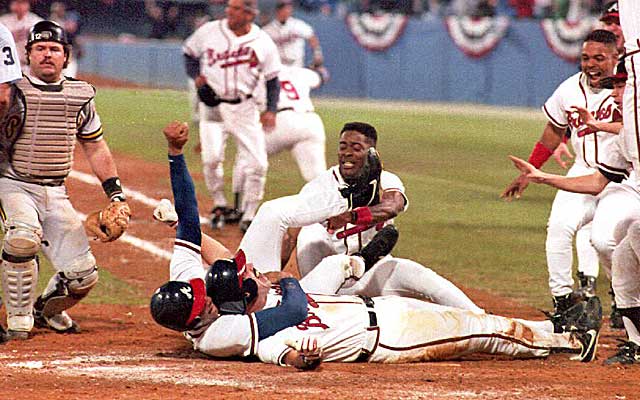
Their opponent in the NLCS, as it was in 1991, was the Pirates. Pittsburgh had lost Bobby Bonillia as a free agent to the Mets but no one thought the Pirates were a push over.  The Braves jumped out to a three games to 1 lead in the Series and looked like they would waltz into the World Series.  Avery was knocked out in the first inning of Game 5 and Glavine fared little better in Game 6.  Smoltz pitched well in Game 7 but just as had happened in the 1991 series he had no support.  He left in the 7th trailing.  The Braves entered the 9th trailing 2-0.  Pendleton led off with a double and when an error allowed Justice to reach first safely Pendleton moved to third.  Sid Bream then walked to load the bases with no out.  As Ron Gant stepped in Braves fans had dreams of a grand slam.  They settled for an RBI sac fly.  Damon Berryhill, playing for an injured Greg Olson, walked to load the bases.  Brian Hunter popped out for the second out and Atlanta was one out away from blowing a once secure 3 games to 1 lead.  With the Pitcher's spot due up Francisco Cabrera pinch hit.  On the fourth pitch of the at bat Cabrera lined a ball into left field.  Justice scored easily and as he reached the plate he turned and saw Sid Bream, one of the slowest runners in baseball (thanks to repeated knee injuries) lumbering around third.  He could see the throw coming to the plate and wildly gestured to Bream that he would need to slide.  Bream did and the throw came in late.  Lying on the ground a wave of Braves flowed on top of Bream celebrating the Braves's second straight National League title.  Now on to Toronto to face the Blue Jays and...oh shit.  Jack Morris.


Morris started Game 1 for Toronto and faced off against Glavine.  Glavine pitched a complete game and allowed only four hits and walking none. One of the four hits was a solo Home Run  by Joe Carter.  The Braves trailed because of that hit as they entered the 6th.  With one out Justice drew a walk.  He moved to second when  Sid Bream singled and moved to third when Gant grounded to short stop.  Gant's speed allowed him to avoid the double play and on the 1-1 pitch he stole second.  At the plate was Damon Berryhill, a former Cubs Catcher who had signed with the Braves to back up Olson.  When Olson was injured he was moved into the starting position.  It worked out fine for the Braves when he launched a three run Home Run to give the Braves a 3-1 lead that would give them Game 1.

The Braves led 4-2 entering the 8th inning of Game 2 with a chance to take control of the series.  An RBI single by Dave Winfield cut the lead to 4-3.  The Braves went in order in the bottom of the 8th.  To start the top of the 9th Braves closer Jeff Reardon got Pat Borders to fly out but he walked Derek Bell.  With All Stars like Winfield, Carter, Alomar, John Olerud and Devon White, it was easy to overlook the strong play by other Blue Jays.  Ed Sprague, an under rated utility man, pinch hit for the pitcher and gave the Jays the lead with a two run Home Run.  The Braves fought in the 9th.  Lemke was unable to reach base but Lonnie Smith took one for the team and reached first by getting hit by a pitch.  He was replaced by Gant as a pinch runner.  Otis Nixon lined out to Center Field for the second out and sensing the urgency of the situation Gant stole second to put himself in scoring position.  Stepping to the plate was the polarizing figure of Deion Sanders.  The loved/hated Sanders drew a walk to bring up the team leader Pendleton.  Swinging at the first pitch Pendleton popped out to third base ending the threat and the game.

Steve Avery pitched 8 strong innings in Game 3 allowing only 5 hits.  Toronto's starter Juan Guzman pitched 8 innings and allowed 8 hits and walked 1.  The game was tied at 1 entering the 8th.  The Braves scored an unearned run when Otis Nixon reached on an error, stole second and scored on a Lonnie Smith single but any chance at a bigger inning ended when Justice was thrown out trying to take third.  The lead lasted all of 8 pitches.  Kelly Gruber made up for his own error that had led to Nixon's run when he launched a game tying Home Run to start the 8th.  The Braves did nothing in the 9th and when Avery gave up a lead off single to Alomar he was removed.  Alomar stole second and Joe Carter was walked intentionally putting two on with no one out.  Both runners advanced on Winfield's sac bunt (that's right a sacrifice bunt successfully put in play by a man who hit 500 Home Runs.  Can Ryan Howard or Many Ramirez do that?)  and the bases were loaded when Ed Sprague was walked intentionally.  This set up a bases loaded 1 out situation where a ground ball might lead to a game saving double play.  Instead Candy Maldonado hit a ball over the heads of the drawn in outfielders to win the give Toronto the lead in the series

Glavine pitched again in Game 4 and again was brilliant.  8 strong innings allowing only 6 hits (though he did walk 4).  He allowed a solo Home Run to Pat Borders in the Third and an RBI single to Devon White in the 7th. Unfortunately, Toronto held the Braves to only one run and suddenly the Braves were down 3 games to 1 in the series.

This Braves team had fought too hard to get back to this point after last year's devastating loss.  They had proven they were for real while the Twins had failed to even make the ALCS.  They had dominated their division, fought off a charge from the Pirates and now they were on the brink of blowing the whole thing.  In their way was Jack Morris.  His opponent was John Smoltz.  The two had faced off the year before in one of the greatest games ever played.  Could they do it again?  The teams traded runs through four and were tied at 2.  Two quick 5th inning outs made it appear that the tie would continue when Otis Nixon singled.  He stole second and scored on a Deion Sanders single.  Pendleton doubled but fan interference held Sanders at third.  David Justice was walked to load the bases with two outs.  The batter was Lonnie Smith.  He had been the goat the year before when his base running mistake was perceived to have lost the Braves Game 7.  Now he kept the Braves' season alive with a Grand Slam giving the Braves a 7-2 lead that would give them the game.


The Braves were confident that if any team could come back from a 3-1 series deficit they were that team.  Trailing 2-1 entering the 9th and with their season on the line, they fought to force a Game 7.  Blauser opened with a single and moved to second on Berryhill's sacrifice bunt.  Smith walked but when Francisco Cabrera lined out they were down to their final out of the season. Otis Nixon singled scoring Blauser and sending Smith to third.  Up to the plate stepped Ron Gant.  A base hit would win it and send the series to one final game.  Instead Gant flew out to end the inning.  But this game was tied and the Braves were still alive.  Neither team scored in the 10th.  With 2 out in the 11th and runners on first and second Dave Winfield stepped in.  He had not had a great post season to this point, which had added credence to Steinbrenner's nickname of "Mr. May".  Winfield reclaimed his reputation with a double that scored both runners giving the Jays a 2 run lead.  It wasn't over yet.  The Braves had life left in them.  As the stadium rang with the tomahawk chop Blauser singled.  Berryhill followed with a ground ball to the short stop but an error allowed Berryhill to reach first and Blauser to advance to third.  Berryhill was not a fast runner so John Smoltz pinch ran and advanced to second on a sac bunt.  Brian Hunter grounded to first base allowing Blauser to score but giving the Blue Jays just one more out to record before ending the series.  Otis Nixon was easily the fastest Brave.  He tried to extend the inning by catching the Jays off guard with a bunt.  He dragged the ball down the first base line.  If he could beat it out the game would be tied.  Pitcher Mike Timlin reacted but would it be quick enough?  Nixon tore past just as Timlin fielded the ball. Timlin flipped to first, just a few steps before Nixon hit the bag.  The Blue Jays were world champions.  For the second year in a row the Braves were so close yet unsuccessful.

The Greatest Rotation:
Avery, Smoltz and Glavine were the great trifecta entering their third year together.  Charlie Leibrandt had been the veteran presence in the rotation but he was not of the same caliber of the three young arms.  Pete Smith, their 5th starter, was dangerous but he was not on their level.  It would be hard to say the Braves were desperate for more pitching but when Cubs Pitcher Greg Maddux is available you can always find room for him.  The Braves signed  Maddux for the 1993 season making an already dangerous team now appear unbeatable.

Still, although they appeared unbeatable the Braves trailed the Giants by 5 games in the standings at the start of June.  By mid July they were 10 games back.  They made a trade for Fred McGriff on July 17 and although McGriff helped the Braves tremendously, it was now the Giants who appeared unbeatable.  They started cutting into the lead but as late as August 11 they were still 9 games back.  A 9 game winning streak cut the lead to 6 1/2.  Another 5 game win streak cut it to 4 1/2.  Winning 16 of the next 20 put them ahead of a collapsing Giants team with a 4 game lead and just two weeks left.  The Giants fought back and on the last day of the season they entered play tied.  The Braves were playing the first year Colorado Rockies.  The Giants faced their hated rivals the Dodgers, looking to return the favor done to the Braves in 1991.  The Braves won 5-3 behind Glavine, giving him his 22nd win of the year.  The Giants lost 12-1 thanks to 4 Home Runs (2 by young Catcher Mike Piazza).  The Braves had advanced to the NLCS for the third straight year.  This time they would face a gritty Philadelphia Phillies team.

The Braves had four pitchers that any other team would call an ace.  Maddux's first year in Atlanta (20-10, 2.36) was spectacular.  Glavine (22-6, 3.20) and Avery (18-6 2.94) were spectacular.  Smoltz was "the weak link" in the group (15-11, 3.62) if you consider 15 wins a weak link.  Their opponents had nothing remotely comparable.  The Phillies pitchers Curt Schilling (16-7, 4.02) and Tommy Greene (16-4 3.42) were their top pitchers while Terry Mulholland (12-9, 3.25) and Danny Jackson (12-11, 3.77) added a veteran presence.  With the Braves experience and power there appeared to be no chance for the Phillies.  What happened next shocked everyone.  The Braves won games by the scores of 14-3 and 9-6 showing their offensive power.  The Phillies won games by the scores of 4-3 (in ten innings), 2-1, 4-3 (again in 10 innings) and 6-3 out lasting the Braves starters in dramatic fashion. Terry Pendleton had a good series hitting .367 and driving in 5 and McGriff did well hitting .435 and driving in 4 runs. Gant (.185) and Justice (.143) had horrible series adding to the Braves' struggles.  For the third straight year the Braves had lost to a team that, on paper, should have been easily beaten.  A pattern was starting to form.  A pattern of heartbreak and disappointment.

The disappointment would continue into the 1994 season.  The league used 1994 to debut the newly formatted divisional and wild card play.  The Braves waved goodbye to their historic rivalries with the Dodgers, Giants, Padres, Reds and Astros.  In the new format they would form new, bitter rivalries, with the Mets, Marlins, Expos and Phillies.  Baseball added an extra playoff round, giving the Braves (and all playoff teams) one more obstacle to reach the pinnacle.  As expected the Braves jumped out to a division lead but the surprising Expos took over first place by six games on August 11.  They would not get any closer and would not fall any farther back.  No one would.  The strike ended the season and the Braves would have to wait another year.

Team of the Decade:
The Braves were slightly changed as they entered the 1995 season but were still the favorites to win their division.  No longer with the team were some key players like Pendleton, Gant and Olson.  Replacing them were Javy Lopez,  Chipper Jones and Marquis Grissom.  The bedrock of the team was still, as always, pitching.  Maddux (19-2, 1.63) was basically unhittable but Avery suffered arm problems and would struggle through the year. There was no competition in the season and the Braves ran away with their new division by 22 games.

There was some fear that the upstart Colorado Rockies might do what the surprise Phillies had done in 1993 but the Braves quickly did away with Colorado.  Grissom, Chipper Jones (2 home runs in his first playoff game), and Javvy Lopez led the offense as the Braves easily advanced 3 games to 1.

Their next opponent was the up and coming  Cincinnati Reds in their first playoff appearance since 1990.  Now playing for the Reds, Ron Gant would have loved nothing more than to show the Braves that they had let him go too soon but his .188 average with only one run scored and one driven in did nothing to change their mind.  In fact the difference in the series came from a surprise source.  The trade deadline is often watched for big time deals.  David Cone going to Toronto in 1992.  Randy Johnson going to Houston in 1998.  Cliff Lee going to Texas in 2010.  Yet often the trades that get ignored give the highest results.  Dave Roberts to the Red Sox in 2004 for example or Mike Deveraux to the Braves in 1995.  The Braves acquired Devo from the White Sox for a minor league player on August 25, 1995.  He played in 29 games and hit only .255 for the Braves but made the post season roster.  What did he do in the NLCS?  He won the series MVP is all.  He hit .308, drove in 5 runs and hit a spirit crushing three run Home Run in the deciding game of the Braves' sweep of the Reds.

That old fear crept back in as the Braves faced the Cleveleand Indians in the 1995 World Series.  The Braves had the experience of playing together but the Indians had a different type of experience.  It was a collection of players who had won other places and they were names that echoed through post season history.  Eddie Murray.  Orel Hershiser.  Dennis Martinez.  Tony Pena.  They were joined by young talent.  Albert Belle,  Jim Thome.  Kenny Lofton.  Manny Ramirez.  This was the type of team that could shock you.

Tied at 1 in the 7th inning of Game 1 the Braves scored two to take the lead.  Cleveland scored one run in the 9th to cut the lead to 3-2 but Greg Maddux was spectacular in a complete game win.  He went the full 9 innings and allowed only 2 hits while walking no one.

The Braves took a 2 games to none lead in Game 2 when Glavine out pitched Dennis Martinez with some help from a two run Home Run from Javvy Lopez.

The Indians were not going down that easy.  Smoltz had a rough night in Game 3, lasting only 2 1/3 innings.  He left while the Braves trailed 4-1.  He would not take the loss.  The Braves fought back thanks to Home Runs by McGriff and Ryan Klesko.  They even managed to take a 6-5 lead on a Mike Deveraux RBI single.  The lead did not last long. The Indians quickly tied it and went on to win the game in the 11th inning.

The fear started to creep up again in Game 4.  The teams were tied at 1 going into the 7th inning.  Ken Hill was on the mound for Cleveland and he was pitching strong but in the 7th things fell apart.  With one out Marquis Girssom walked.  He scored on a Luis Polonia double.  Hill was removed.  Chipper Jones was intentionally walked and both he and Polonia advanced on a Passed Ball.  McGriff struck out and that fear started to gnaw at the Braves again.  Would they lose their chance at a big inning?  David Justice stepped in to face Paul Assenmacher.  Braves fans loved Justice.  He had been a key piece of this playoff run since 1991. He was their star.  They also hated seeing him in this situation.  It seemed to Braves fans that he never came through when they needed him.  His performance in 1993 in particular was fresh in their mind.  He took strike one and looked out at the mound.  You could see him thinking.  Assenmacher's pitch had been on the outside corner.  A perfect pitch.  He blew on his hands still thinking through Assenmacher's repertoire of pitches.  He stepped back in.  Assenmacher looped a perfect off speed pitch over the heart of the plate.  Justice watched strike 2.  He stepped out again blew on his hands.  He took ball 1 on the inside part of the plate.  He was one pitch away from another playoff failure and the bat hadn't left his shoulder.  The fourth pitch of the at bat was on the lower outside part of the plate  It was the same pitch that McGriff had struck out on.  There was one difference.  Justice connected.  It shot straight back up the middle.  Polonia and Jones scored and the Braves took the lead.  They would win 5-2 to take a 3 games to 1 lead.  It put them just one win away from a World Series title.  The same place they had been in 1991.

Maddux pitched well in the next game but not nearly as well as he had in his first start and not nearly as well as Orel Hershiser.  He allowed 7 hits in seven innings and four runs and nearly started a bench clearing brawl when he threw up and in to Eddie Murray.  Maddux said he felt he had pitched well but "everything they got, I thought they earned."  The bottom line was that the Indians forced Game 6.  The great footnote to this Game was Ryan Klesko's 9th inning Home Run.  It did not effect the outcome of the game but it did make history.  It was the third straight game in the series (all in Cleveland) that Klesko had homered in making him the first player in baseball history to hit Home Runs in three straight road games.


Braves fans had seen this story before.  So close bu not there yet.  One of their aces, Glavine, was on the mound for Game 6 and it was so close they could taste the champagne.  Still they had to win and the Indians seemed to be getting stronger and more confident as the series went on.
Glavine was spectacular.  Through the first 5 innings Glavine had allowed only two walks (both to Albert Belle) and was untouchable by the other Indians.  The Braves had every opportunity to take control of the game. In the first Lemke singled but was erased when he tried to steal second.  Chipper singled but was stranded there.  In the second Dennis Martinez walked the first two batters but a double play and a pop fly cancelled the threat.  In the bottom of the 4th Braves fans nearly collapsed from the strain.  After two outs on three pitches to start the inning Justice doubled.  the red hot Klesko was walked intentionally and Javy Lopez was walked to load the bases. That brought up Rafael Belliard.  Another of the players still in Atlanta from that original World Series team in 1991.  The NBC broadcast booth of Bob Uecker, Joe Morgan and Bob Costas discussed the possibilities of pinch hitting for Belliard to get some runs.  The consensus was it was too soon to remove the defensively strong Shortstop who was not terrible at the bat.  Belliard half offered at the first pitch but the home plate umpire said he offered enough.  Strike 1.  Braves fans nationwide had the same sinking feeling when they saw Belliard swing at the next pitch of the at bat and fly harmlessly to Kenny Lofton.  It was happening again.

The Braves stranded two more runners in the 5th.  Glavine allowed his first hit of the game in the 6th but was able to avoid any trouble.  The bottom of the 6th started with David Justice leading off and the love-hate relationship with the fans continued.  His previous at bat had given him his first extra base hit of the postseason.  They prayed it was the start of a string of extra base hits.

Justice took strike one from new Cleveland pitcher Jim Poole.  He grimaced a little showing his displeasure with the call.  He took ball one.  It was not even close.  The third pitch came in and Justice put a signature swing on the ball.  He launched it and there was no doubt this one was gone.  Braves led 1-0.  Now could they hold it.

Glavine was better than ever. He woud leave the game after 8 innings.  He allowed only one hit and three walks.  He struck out 8.  The Braves continued to threaten but could not score and so with three outs left the Braves sent closer Mark Wohlers to the mound.  Wohlers got Kenny Lofton to pop up a 2-1 pitch. Two outs left.  Wohlers got pinch hitter Paul Sorrento to fly out.  One out left.  The stadium was literally rocking.  The anticipation that this was it was unavoidable.

The great thing about baseball is that you can never tell which pitch will change the game.  You will remember a specific pitch forever but before it is thrown you don't know that is the pitch you will remember.  When Kirk Gibson shocked the world his at bat had been long and drawn out.  When Dennis Eckersley released the now famous pitch it was just a pitch.  It didn't become a the pitch until it landed in the bleachers.  Braves fans expected a fight from Carlos Baerga.  With his bat being the only thing keeping the Indians from heading home for the winter there was no way he would swing at anything less than a perfect pitch.  Baerga swung at the first pitch and drove it on an arc towards left-center field.  Marquis Grissom ranged over on the run and easily corraled the ball.

In the NBC broadcast booth Bob Costas proclaimed "The team of the '90's has their championship".  When we see part two of the Braves almost dynasty it will be clear that Costas may have jumped the gun a bit.

TRIVIA QUESTION:
The Braves dynasty of the 1990s through the early 2000s had two key players who were two sport stars in both Baseball and Football.  Both of these players were members of the Falcons and Braves teams.  Who were they?

Answer to Last Week's Question:
Rick Dempsey is best known as the catcher for the Orioles.  He played on the 1979 and 1983 playoff teams for Baltimore and won the World Series MVP in 1983.  When the Orioles sent an unhappy Storm Davis to the Padres and received Catcher Terry Kennedy in return, Dempsey became expendable and was released in November of 1986.  After a season with the Indians Dempsey was released and signed with the Dodgers as a backup for Scioscia.  Rick played in 77 games for the 1988 Dodgers and when Scioscia injured his leg in the series he was replaced by Dempsey.  Dempsey caught the final strike from Hershiser.