So what actually makes a team a dynasty? There can of course be several definitions since there are varying levels of success. A team can dominate their division for a decade but be bounced out in the first round of the playoffs year after year. We could of course consider that to be a divisional dynasty but you wouldn't call it an overall baseball dynasty. So let us set the parameters for this series of articles. A dynasty, for our purposes here, is a team that wins multiple World Series championships (above two as back to back is nice but not a dynasty) within a 5-10 year period. That being defined, this series will explore those teams that may have been a divisional or league dynasty but for whatever reason could not get over the hump to that World Series dynasty.
This series will show an array of near dynasties. Some are teams that made the World Series year after year but fell short. Others will be teams that competed right down to the end of the regular season year after year just to be beaten out. It will be a series of near misses and what could have beens.
Don't miss the other almost dynasty articles: The Detroit Tigers of the 1900's, The Chicago White Sox of the 1910's , the Pittsburgh Pirates of the 1920's, the Boston Red Sox of the 1940s, the Brooklyn Dodgers of the 1950s, the Milwaukee Braves of the 1950s, the Los Angeles Dodgers of the 1970's and the Oakland A's of the 1980's. Now let's get started with this weeks "almost dynasty": The Atlanta Braves of the 1990's
America's Team?:
The television station TBS was built around the Atlanta Braves. When it began broadcasting nationally the showtimes always started five minutes after the start of the hour to match the start times of the Braves games. The only problem was people could see the reruns of Gilligan's Island and the Brady Bunch on any station and the Braves were terrible. They had superstar Dale Murphy but that was really it. In 1990 the team finished dead last but the rumor was they had some good talent in the pipeline. So hopefully, in a few years, they might just compete.
They were building a strong group of players who would take them right up to the strike year of 1994. There was no lack of talent on the team that few realized was there but there were, of course, some key players:
Greg Olson: Olson had played one season with the Twins on a one year contract in 1989. He signed with the Braves for 1990 and impressed everyone in his rookie year, even making the All Star team. Injuries would slow his career greatly.
Terry Pendleton: A free agent signing from the Cardinals, Pendleton would be the veteran leader of the young Braves. Pendleton was a key part of the Cardinals World Series teams in 1985 and 1987. He would bring the winning attitude to Atlanta.
David Justice: Justice was one of the talented young players in the Braves' system. He had played just a few games in 1989 but won the rookie of the year in 1990.
Ron Gant: Gant was probably the most talented of all the Braves young players. He had speed and power and could play great defense. There were some who believed he could even chase the 40-40 mark.
Lonnie Smith: Known as "Skates" because he ran the bases like he was on roller skates, he had already won World Series titles with the Phillies, Cardinals and Royals. He signed with the Braves just before the 1988 season and suffered through the poor years with the Braves of the late 1980's.
Tom Glavine: A second round draft pick of the Braves in 1984, Glavine showed flashes of greatness in his rookie year of 1987. With the change of leadership to Bobby Cox and the introduction of Leo Mazone as pitching coach, Glavine would put everything together.
Steve Avery: The #3 overall draft pick in 1988, Avery was considered the future of the franchise. It was believed that he would be the ace of the staff for years to come.
John Smoltz: A native of Detroit, he wanted nothing more than to pitch with his idol Jack Morris. That dream looked like it would come true when he was drafted by the Tigers but ended when he was traded to the Braves for Doyle Alexander at the 1987 trade deadline.
Chopping Down the Competition:
The rebuilding process began before the 1990 season but took a loud step forward when the Braves traded fan favorite and two time MVP Dale Murphy and Pitching prospect Tommy Greene to the Phillies in exchange for Pitcher Jeff Parrett and Catcher Jim Vatcher. Fans were not happy that Murphy was gone and the players that were received in return did little to help. The trade made it clear that a youth movement was in process. December of 1990 took another big step forward when they signed Pendleton to play Third Base and Sid Bream from the AL East Champion Pirates to play First Base. On April 1 they added the man that would get the offense started for the Braves when Otis Nixon was acquired from Montreal for Jimmy Kremers.

Heading into the 1991 season no one gave the Braves much of a chance. The critics favorite was the defending champion Reds. The dark horse team was the San Diego Padres who had made a blockbuster trade in sending Joe Carter and Roberto Almoar to the Blue Jays in exchange for Fred McGriff and Tony Fernandez.
The 1991 Braves started about as expected, or maybe slightly better, with an 8-10 record. The Reds, Padres and Dodgers were ahead of them. A strong May put the team five games above .500 and only 1/2 game behind the first place Dodgers. Still, no one gave them much of a chance. After all, it was a long way to October and the team had finished last the previous season. They seemed to settle back into their expected role in June, falling to third and 7 1/2 behind the pace. Then a funny thing happened. They didn't play tremendously above everyone else. They didn't run off huge winning streaks but they won more than they lost and by the end of July the lead had been cut in half. They continued gaining ground by playing steady ball. The would win three or four in a row but avoid long losing streaks and before you knew it, on August 28, they took over first place. The critics couldn't wait for them to collapse. They could not possibly be for real. They waited for the Braves to fade. With the slimmest of leads on September 20 the team lost 4 of their next 5 to fall 2 games behind the Dodgers. With less than two weeks left the critics started to say I told you so. But something was happening in Atlanta. The stadium was packed. The fans were excited and the "Tomahawk Chop" was gaining attention nationwide. The Dodgers played .500 the last two weeks going 4-4. The Braves were nearly unbeatbale. They went 7-1 down the stretch.
The teams entered play on Saturday, October 5 with Atlanta ahead by one game. The Braves were at home against Houston. The Dodgers were playing the hated Giants in San Francisco. With a 13-13 John Smoltz on the mound the Braves led 4-0 after 3 innings and would win 5-2 with relative ease. Then it was time to sit and wait. If the Giants could beat the Dodgers the Braves would clinch the division. The Giants sent a young Trevor Wilson (12-11) to the mound. The Giants finally broke the scoreless tie in the 3rd with a single run. The Dodgers, however, could not seem to get anything going against Wilson. He held them to 2 hits and 2 walks. There was never any real threat and the Dodgers lost 4-0. The Braves had gone from last place in 1990 to the top of the division in 1991. Now to face the defending NL East Champion Pirates in the NLCS.

The Pirates were a stacked team with All Stars at nearly every position. Their Outfield trio of Bonillia-Bonds-Van Slyke was considered the best outfield in baseball. Their middle infielders Jay Bell and Chico Lind were the top double play combination and their starting pitching of Doug Drabek, John Smiley and Neal Heaton were frightening on the mound. The Braves were given little chance and when Van Slyke homered in the opening frame of the opening game, little changed in the minds of the experts. Two innings later the Pirates added 2 more runs and eventually won 5-1. This Braves season had been fun, but time to step aside and let the big boys take over. With Steve Avery on the mound for Game 2 the Braves faced off against former Brave Zane Smith. Both pitchers seemed to constantly be working out of trouble. Avery would allow 6 hits and walked 2. Smith would allow 8 hits and walk 2. The difference came down to the Braves' 6th inning. David Justice singled to start the inning. Two quick outs that followed gave the impression that this inning was like the others. Then Mark Lemke, only playing in this series because Jeff Blauser had broken his leg, doubled. He had hit only .234 all year but he now had the biggest hit of his career, so far. It gave the Braves a 1-0 lead, enough to tie the series at one game each.
The Braves crushed the Pirates 10-3 in Game 3 and when the Braves jumped out to a 2-0 first inning lead in Game 4 it looked like they were going to take control of the series. The Pirates cut the lead to 2-1 in the second and tied it in the 5th. The score would remain that way into the 10th inning. With everything on the line the Pirates mounted an attack. Van Slyke walked on four pitches. Bonilla popped out and Bonds flew out to left. Van Slyke stole second and Steve Buechelle walked. A single by Mike "Spanky" LaValiere brought in Van Slyke but the inning ended when Buechele tried to score and Lemke made a perfect relay throw to the plate. The Braves could not answer in the bottom of the inning and the series was tied.
What followed in Games 5 and 6 were tight, tense, hard fought, well pitched games. Zane Smith faced off against Glavine in Game 5. Glavine pitched 8 innings, allowed only 6 hits, walked three and allowed only 1 run. Zane Smith pitched 7 2/3 allowing 7 hits, walking only 1 and allowing 0 runs. The Pirates took the lead in the series 3 games to 2. Steve Avery faced off against Doug Drabek in Game 6. Drabek was clearly the Pirates ace and pitched like it. He allowed only 7 hits and walked three in a complete game effort allowing only a single run, an RBI double by Greg Olson in the Top of the 9th. Avery pitched 8 innings and allowed only 3 hits and 2 walks but no runs. The series was tied 3-3.
Game 7 had John Smiley, the Pirates young star pitcher, face off against John Smoltz. Of the Braves starters Smoltz was considered the weakest one. At only 13-12 on the season Smoltz did not have the pedigree that Glavine and Avery had and was not the experienced veteran that Charlie Leibrandt was. True to form, the Braves got their offense from an unexpected source. A sacrifice fly scored Lonnie Smith but with two out it was Brian Hunter, playing first base for the Braves, who hit a 2 run Home Run to give Atlanta a three run lead. When that was followed by a Greg Olson single John Smiley was gone. Smoltz would stick around and shut out the Pirates on 6 hits and 1 walk. It was almost unbelievable but the Braves were going to the World Series.
Never before in the history of the game had a team that finished in last place the season before reached first place the following year. The Braves accomplished that in 1991 but what was more amazing was that their opponent, the Minnesota Twins, had done the same thing. The World Series of 1991 was one of the greatest World Series of all time. There were non-stop thrills. Close games. Pitching duels. Plays at the plate. Spectacular defensive plays. Every time fans thought it couldn't get any better it did.
Game 1 went to the Twins by a score of 5-2 with the Twins' Jack Morris beating Charlie Leibrandt. Leibrandt had pitched in a World Series before with the 1985 Royals. His legacy in that post season was the hard luck loser. His fortunes would not change this season. The Twins took Game 2 in Minnesota as well by a score of 3-2. Glavine had pitched 8 strong innings and allowed only 4 hits while walking 3. Unfortunately two of the four hits were Home Runs. The second of the two Home Runs was a lead off Home Run by Scott Leius in the bottom of the 8th to break a 2-2 tie. The shocking part of the first two games for the Braves was the lack of power. The Twins hit four Home Runs in the first two games. The Braves had none.

With Steve Avery on the mound and pitching like an ace the Braves jumped out to a 4-1 lead in Game 3 but Braves errors and Home Runs by Kirby Puckett and Chilli Davis allowed the Twins to tie the game at 4 in the 8th. Both teams threatened in the 9th, 10th, 11th and 12th. Gant led off the 12th with a fly ball to left field. Justice followed with a single. Brian Hunter popped out to second. Justice then stole second to put himself in scoring position and Olson walked putting two on and two out. Up to the plate stepped Mark Lemke. He had the big hit in the NLCS and made the great defensive play that helped upset the Pirates now he was asked to win a World Series game. Lemke shot the ball into shallow left field. With two outs Justice was moving at the crack of the bat. He was a few steps around third by the time the ball was fielded but it was barely past the infield dirt. Justice ran slightly wide on the base paths. The throw came to the left of home plate, in line with where Justice was running. Justice adjusted and slid to the first base side of the plate. Justice went into his slide as Brian Harper caught the ball at the plate and dove toward Justice. It was one of those plays that needs to be watched several times in slow motion to see what the right call was but the call that was made was right. Safe. The Braves had barely avoided falling to a 3-0 hole and had now tightened the series to 2-1.
Game 3 was a brief preview of something that was to come but no one knew the gem that was on the horizon and this gave only hints of what was possible. It was Smoltz vs Morris. Morris pitched 6 strong innings and allowed only 6 hits and 1 run. Morris was replaced for a pinch hitter in the top of the 7th with a 2-1 lead. A Lonnie Smith Home Run in the bottom of the inning tied it. Smoltz had been replaced by a pinch hitter in the 7th so neither starter got a decision. They entered the bottom of the 9th tied at 2. With 1 out Lemke again got the big hit with a triple. Jeff Blauser was walked intentionally bringing up the pitcher's spot and the chess game began. The Braves sent up Francisco Cabrera to pinch hit. The Twins removed Mark Guthrie and brought in relief pitcher Steve Bedrosian. The Braves pinch hit Jerry Willard, a back up catcher, for Cabrera. All this when all the Braves needed was a fly ball. Willard delivered. As the ball left the bat Jack Buck, announcing for CBS yelled out "That's gonna be a winner for Atlanta!" But wait Jack. There's more. Lemke tagged at third as Shane Mack camped under the ball that seemed like it would never come down. Lemke waited. Mack waited. One of those odd moments of inaction in baseball that last the blink of an eye but seem to take forever. One of those moments of inaction that last a second where it seems that time has stopped. And as soon as that moment ends the field erupts in motion. The ball smacked Mack's glove and Lemke tore for home.
Mack's body becomes a living catapult, launching the ball towards home. The pitcher, backing up the play at the plate, sprints behind the catcher. The third base coach, swinging his arm like a windmill, running down the line with the runner, almost as though he can score the run himself. The Braves bench jumping up and down in anticipation. The Twins bench leaning, bending, twisting, hands white knuckling the railing, praying for a good throw. Mack threw a perfect one hop peg to the plate. Harper, poised just in front of the plate, caught the ball and made contact with Lemke, who brushed against Harper as he went into his slide. "and he is.."Jack Buck screamed "ou...safe! They called him safe!" And he was. Harper had made contact with Lemke but the ball was in Harper's right hand and never tagged Lemke. The series was now tied.
Fans couldn't take these late inning wins. The needed a game to go a little more easily and give their hearts a break. They got it in Game 5. The power that had been missing from Games 1 and 2 suddenly appeared in Game 5 as Hunter, Justice and Lonnie Smith hit Home Runs and the Braves scored 14 runs on 17 hits putting them just one win from the World Series title. The Twins jumped out to a 2-0 lead in the first but this Series had a pattern and the Braves tied it in the 5th. The Twins untied it in the bottom of the 5th. The Braves tied it again in the 7th and extra innings were needed. Several double plays by both teams erased any chances the teams had of scoring. The Twins entered the bottom of the 11th with the heart of the order to come up. Mr. Twin, Kirby Puckett, sent Twins fans home happy with a Home Run to Centerfield. Puckett, who had already made a game saving catch against the wall now became the Twins' offensive hero.
Game 7 was nothing short of spectacular. Morris vs Smoltz in arguably the greatest World Series game in history. Unfortunately for the almost dynasty, the Twins came out on top.
Flash in the Pan or Real Contender?
There were questions for the Braves as they entered the 1992 season, mostly people wanted to know if this team was for real or were they just a one time contender. The 1992 Braves started only 11-11 and were in last place near the end of April. By May 30 they had fallen below .500 but had climbed one standings spot to 5th. In June (19-6) and July (16-9) they made their move on the NL West. By the All Star Break they had climbed to second and cut the lead to 1 game. By August 1 they were just 1/2 game out. By August 31 they had a 6 1/2 game lead. The lead reached as high as 10 1/2 but ended at 8. There was now little question that this was a very strong team.
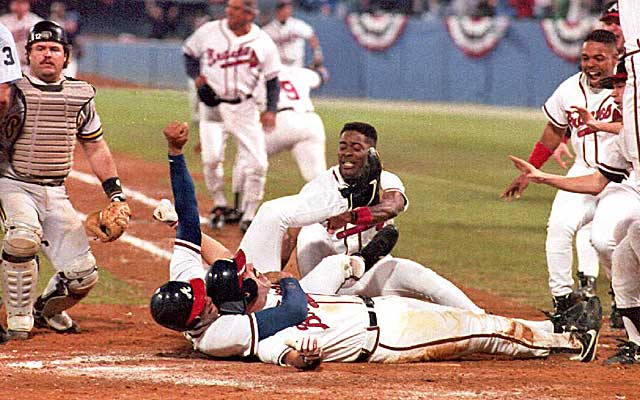
Their opponent in the NLCS, as it was in 1991, was the Pirates. Pittsburgh had lost Bobby Bonillia as a free agent to the Mets but no one thought the Pirates were a push over. The Braves jumped out to a three games to 1 lead in the Series and looked like they would waltz into the World Series. Avery was knocked out in the first inning of Game 5 and Glavine fared little better in Game 6. Smoltz pitched well in Game 7 but just as had happened in the 1991 series he had no support. He left in the 7th trailing. The Braves entered the 9th trailing 2-0. Pendleton led off with a double and when an error allowed Justice to reach first safely Pendleton moved to third. Sid Bream then walked to load the bases with no out. As Ron Gant stepped in Braves fans had dreams of a grand slam. They settled for an RBI sac fly. Damon Berryhill, playing for an injured Greg Olson, walked to load the bases. Brian Hunter popped out for the second out and Atlanta was one out away from blowing a once secure 3 games to 1 lead. With the Pitcher's spot due up Francisco Cabrera pinch hit. On the fourth pitch of the at bat Cabrera lined a ball into left field. Justice scored easily and as he reached the plate he turned and saw Sid Bream, one of the slowest runners in baseball (thanks to repeated knee injuries) lumbering around third. He could see the throw coming to the plate and wildly gestured to Bream that he would need to slide. Bream did and the throw came in late. Lying on the ground a wave of Braves flowed on top of Bream celebrating the Braves's second straight National League title. Now on to Toronto to face the Blue Jays and...oh shit. Jack Morris.
Morris started Game 1 for Toronto and faced off against Glavine. Glavine pitched a complete game and allowed only four hits and walking none. One of the four hits was a solo Home Run by Joe Carter. The Braves trailed because of that hit as they entered the 6th. With one out Justice drew a walk. He moved to second when Sid Bream singled and moved to third when Gant grounded to short stop. Gant's speed allowed him to avoid the double play and on the 1-1 pitch he stole second. At the plate was Damon Berryhill, a former Cubs Catcher who had signed with the Braves to back up Olson. When Olson was injured he was moved into the starting position. It worked out fine for the Braves when he launched a three run Home Run to give the Braves a 3-1 lead that would give them Game 1.
The Braves led 4-2 entering the 8th inning of Game 2 with a chance to take control of the series. An RBI single by Dave Winfield cut the lead to 4-3. The Braves went in order in the bottom of the 8th. To start the top of the 9th Braves closer Jeff Reardon got Pat Borders to fly out but he walked Derek Bell. With All Stars like Winfield, Carter, Alomar, John Olerud and Devon White, it was easy to overlook the strong play by other Blue Jays. Ed Sprague, an under rated utility man, pinch hit for the pitcher and gave the Jays the lead with a two run Home Run. The Braves fought in the 9th. Lemke was unable to reach base but Lonnie Smith took one for the team and reached first by getting hit by a pitch. He was replaced by Gant as a pinch runner. Otis Nixon lined out to Center Field for the second out and sensing the urgency of the situation Gant stole second to put himself in scoring position. Stepping to the plate was the polarizing figure of Deion Sanders. The loved/hated Sanders drew a walk to bring up the team leader Pendleton. Swinging at the first pitch Pendleton popped out to third base ending the threat and the game.
Steve Avery pitched 8 strong innings in Game 3 allowing only 5 hits. Toronto's starter Juan Guzman pitched 8 innings and allowed 8 hits and walked 1. The game was tied at 1 entering the 8th. The Braves scored an unearned run when Otis Nixon reached on an error, stole second and scored on a Lonnie Smith single but any chance at a bigger inning ended when Justice was thrown out trying to take third. The lead lasted all of 8 pitches. Kelly Gruber made up for his own error that had led to Nixon's run when he launched a game tying Home Run to start the 8th. The Braves did nothing in the 9th and when Avery gave up a lead off single to Alomar he was removed. Alomar stole second and Joe Carter was walked intentionally putting two on with no one out. Both runners advanced on Winfield's sac bunt (that's right a sacrifice bunt successfully put in play by a man who hit 500 Home Runs. Can Ryan Howard or Many Ramirez do that?) and the bases were loaded when Ed Sprague was walked intentionally. This set up a bases loaded 1 out situation where a ground ball might lead to a game saving double play. Instead Candy Maldonado hit a ball over the heads of the drawn in outfielders to win the give Toronto the lead in the series
Glavine pitched again in Game 4 and again was brilliant. 8 strong innings allowing only 6 hits (though he did walk 4). He allowed a solo Home Run to Pat Borders in the Third and an RBI single to Devon White in the 7th. Unfortunately, Toronto held the Braves to only one run and suddenly the Braves were down 3 games to 1 in the series.
This Braves team had fought too hard to get back to this point after last year's devastating loss. They had proven they were for real while the Twins had failed to even make the ALCS. They had dominated their division, fought off a charge from the Pirates and now they were on the brink of blowing the whole thing. In their way was Jack Morris. His opponent was John Smoltz. The two had faced off the year before in one of the greatest games ever played. Could they do it again? The teams traded runs through four and were tied at 2. Two quick 5th inning outs made it appear that the tie would continue when Otis Nixon singled. He stole second and scored on a Deion Sanders single. Pendleton doubled but fan interference held Sanders at third. David Justice was walked to load the bases with two outs. The batter was Lonnie Smith. He had been the goat the year before when his base running mistake was perceived to have lost the Braves Game 7. Now he kept the Braves' season alive with a Grand Slam giving the Braves a 7-2 lead that would give them the game.

The Braves were confident that if any team could come back from a 3-1 series deficit they were that team. Trailing 2-1 entering the 9th and with their season on the line, they fought to force a Game 7. Blauser opened with a single and moved to second on Berryhill's sacrifice bunt. Smith walked but when Francisco Cabrera lined out they were down to their final out of the season. Otis Nixon singled scoring Blauser and sending Smith to third. Up to the plate stepped Ron Gant. A base hit would win it and send the series to one final game. Instead Gant flew out to end the inning. But this game was tied and the Braves were still alive. Neither team scored in the 10th. With 2 out in the 11th and runners on first and second Dave Winfield stepped in. He had not had a great post season to this point, which had added credence to Steinbrenner's nickname of "Mr. May". Winfield reclaimed his reputation with a double that scored both runners giving the Jays a 2 run lead. It wasn't over yet. The Braves had life left in them. As the stadium rang with the tomahawk chop Blauser singled. Berryhill followed with a ground ball to the short stop but an error allowed Berryhill to reach first and Blauser to advance to third. Berryhill was not a fast runner so John Smoltz pinch ran and advanced to second on a sac bunt. Brian Hunter grounded to first base allowing Blauser to score but giving the Blue Jays just one more out to record before ending the series. Otis Nixon was easily the fastest Brave. He tried to extend the inning by catching the Jays off guard with a bunt. He dragged the ball down the first base line. If he could beat it out the game would be tied. Pitcher Mike Timlin reacted but would it be quick enough? Nixon tore past just as Timlin fielded the ball. Timlin flipped to first, just a few steps before Nixon hit the bag. The Blue Jays were world champions. For the second year in a row the Braves were so close yet unsuccessful.
The Greatest Rotation:
Avery, Smoltz and Glavine were the great trifecta entering their third year together. Charlie Leibrandt had been the veteran presence in the rotation but he was not of the same caliber of the three young arms. Pete Smith, their 5th starter, was dangerous but he was not on their level. It would be hard to say the Braves were desperate for more pitching but when Cubs Pitcher Greg Maddux is available you can always find room for him. The Braves signed Maddux for the 1993 season making an already dangerous team now appear unbeatable.
Still, although they appeared unbeatable the Braves trailed the Giants by 5 games in the standings at the start of June. By mid July they were 10 games back. They made a trade for Fred McGriff on July 17 and although McGriff helped the Braves tremendously, it was now the Giants who appeared unbeatable. They started cutting into the lead but as late as August 11 they were still 9 games back. A 9 game winning streak cut the lead to 6 1/2. Another 5 game win streak cut it to 4 1/2. Winning 16 of the next 20 put them ahead of a collapsing Giants team with a 4 game lead and just two weeks left. The Giants fought back and on the last day of the season they entered play tied. The Braves were playing the first year Colorado Rockies. The Giants faced their hated rivals the Dodgers, looking to return the favor done to the Braves in 1991. The Braves won 5-3 behind Glavine, giving him his 22nd win of the year. The Giants lost 12-1 thanks to 4 Home Runs (2 by young Catcher Mike Piazza). The Braves had advanced to the NLCS for the third straight year. This time they would face a gritty Philadelphia Phillies team.
The Braves had four pitchers that any other team would call an ace. Maddux's first year in Atlanta (20-10, 2.36) was spectacular. Glavine (22-6, 3.20) and Avery (18-6 2.94) were spectacular. Smoltz was "the weak link" in the group (15-11, 3.62) if you consider 15 wins a weak link. Their opponents had nothing remotely comparable. The Phillies pitchers Curt Schilling (16-7, 4.02) and Tommy Greene (16-4 3.42) were their top pitchers while Terry Mulholland (12-9, 3.25) and Danny Jackson (12-11, 3.77) added a veteran presence. With the Braves experience and power there appeared to be no chance for the Phillies. What happened next shocked everyone. The Braves won games by the scores of 14-3 and 9-6 showing their offensive power. The Phillies won games by the scores of 4-3 (in ten innings), 2-1, 4-3 (again in 10 innings) and 6-3 out lasting the Braves starters in dramatic fashion. Terry Pendleton had a good series hitting .367 and driving in 5 and McGriff did well hitting .435 and driving in 4 runs. Gant (.185) and Justice (.143) had horrible series adding to the Braves' struggles. For the third straight year the Braves had lost to a team that, on paper, should have been easily beaten. A pattern was starting to form. A pattern of heartbreak and disappointment.
The disappointment would continue into the 1994 season. The league used 1994 to debut the newly formatted divisional and wild card play. The Braves waved goodbye to their historic rivalries with the Dodgers, Giants, Padres, Reds and Astros. In the new format they would form new, bitter rivalries, with the Mets, Marlins, Expos and Phillies. Baseball added an extra playoff round, giving the Braves (and all playoff teams) one more obstacle to reach the pinnacle. As expected the Braves jumped out to a division lead but the surprising Expos took over first place by six games on August 11. They would not get any closer and would not fall any farther back. No one would. The strike ended the season and the Braves would have to wait another year.
Team of the Decade:
The Braves were slightly changed as they entered the 1995 season but were still the favorites to win their division. No longer with the team were some key players like Pendleton, Gant and Olson. Replacing them were Javy Lopez, Chipper Jones and Marquis Grissom. The bedrock of the team was still, as always, pitching. Maddux (19-2, 1.63) was basically unhittable but Avery suffered arm problems and would struggle through the year. There was no competition in the season and the Braves ran away with their new division by 22 games.
There was some fear that the upstart Colorado Rockies might do what the surprise Phillies had done in 1993 but the Braves quickly did away with Colorado. Grissom, Chipper Jones (2 home runs in his first playoff game), and Javvy Lopez led the offense as the Braves easily advanced 3 games to 1.
Their next opponent was the up and coming Cincinnati Reds in their first playoff appearance since 1990. Now playing for the Reds, Ron Gant would have loved nothing more than to show the Braves that they had let him go too soon but his .188 average with only one run scored and one driven in did nothing to change their mind. In fact the difference in the series came from a surprise source. The trade deadline is often watched for big time deals. David Cone going to Toronto in 1992. Randy Johnson going to Houston in 1998. Cliff Lee going to Texas in 2010. Yet often the trades that get ignored give the highest results. Dave Roberts to the Red Sox in 2004 for example or Mike Deveraux to the Braves in 1995. The Braves acquired Devo from the White Sox for a minor league player on August 25, 1995. He played in 29 games and hit only .255 for the Braves but made the post season roster. What did he do in the NLCS? He won the series MVP is all. He hit .308, drove in 5 runs and hit a spirit crushing three run Home Run in the deciding game of the Braves' sweep of the Reds.
That old fear crept back in as the Braves faced the Cleveleand Indians in the 1995 World Series. The Braves had the experience of playing together but the Indians had a different type of experience. It was a collection of players who had won other places and they were names that echoed through post season history. Eddie Murray. Orel Hershiser. Dennis Martinez. Tony Pena. They were joined by young talent. Albert Belle, Jim Thome. Kenny Lofton. Manny Ramirez. This was the type of team that could shock you.
Tied at 1 in the 7th inning of Game 1 the Braves scored two to take the lead. Cleveland scored one run in the 9th to cut the lead to 3-2 but Greg Maddux was spectacular in a complete game win. He went the full 9 innings and allowed only 2 hits while walking no one.
The Braves took a 2 games to none lead in Game 2 when Glavine out pitched Dennis Martinez with some help from a two run Home Run from Javvy Lopez.
The Indians were not going down that easy. Smoltz had a rough night in Game 3, lasting only 2 1/3 innings. He left while the Braves trailed 4-1. He would not take the loss. The Braves fought back thanks to Home Runs by McGriff and Ryan Klesko. They even managed to take a 6-5 lead on a Mike Deveraux RBI single. The lead did not last long. The Indians quickly tied it and went on to win the game in the 11th inning.
The fear started to creep up again in Game 4. The teams were tied at 1 going into the 7th inning. Ken Hill was on the mound for Cleveland and he was pitching strong but in the 7th things fell apart. With one out Marquis Girssom walked. He scored on a Luis Polonia double. Hill was removed. Chipper Jones was intentionally walked and both he and Polonia advanced on a Passed Ball. McGriff struck out and that fear started to gnaw at the Braves again. Would they lose their chance at a big inning? David Justice stepped in to face Paul Assenmacher. Braves fans loved Justice. He had been a key piece of this playoff run since 1991. He was their star. They also hated seeing him in this situation. It seemed to Braves fans that he never came through when they needed him. His performance in 1993 in particular was fresh in their mind. He took strike one and looked out at the mound. You could see him thinking. Assenmacher's pitch had been on the outside corner. A perfect pitch. He blew on his hands still thinking through Assenmacher's repertoire of pitches. He stepped back in. Assenmacher looped a perfect off speed pitch over the heart of the plate. Justice watched strike 2. He stepped out again blew on his hands. He took ball 1 on the inside part of the plate. He was one pitch away from another playoff failure and the bat hadn't left his shoulder. The fourth pitch of the at bat was on the lower outside part of the plate It was the same pitch that McGriff had struck out on. There was one difference. Justice connected. It shot straight back up the middle. Polonia and Jones scored and the Braves took the lead. They would win 5-2 to take a 3 games to 1 lead. It put them just one win away from a World Series title. The same place they had been in 1991.
Maddux pitched well in the next game but not nearly as well as he had in his first start and not nearly as well as Orel Hershiser. He allowed 7 hits in seven innings and four runs and nearly started a bench clearing brawl when he threw up and in to Eddie Murray. Maddux said he felt he had pitched well but "everything they got, I thought they earned." The bottom line was that the Indians forced Game 6. The great footnote to this Game was Ryan Klesko's 9th inning Home Run. It did not effect the outcome of the game but it did make history. It was the third straight game in the series (all in Cleveland) that Klesko had homered in making him the first player in baseball history to hit Home Runs in three straight road games.
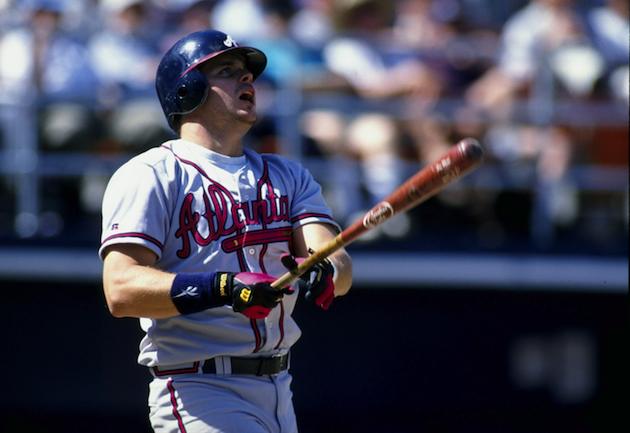
Braves fans had seen this story before. So close bu not there yet. One of their aces, Glavine, was on the mound for Game 6 and it was so close they could taste the champagne. Still they had to win and the Indians seemed to be getting stronger and more confident as the series went on.
Glavine was spectacular. Through the first 5 innings Glavine had allowed only two walks (both to Albert Belle) and was untouchable by the other Indians. The Braves had every opportunity to take control of the game. In the first Lemke singled but was erased when he tried to steal second. Chipper singled but was stranded there. In the second Dennis Martinez walked the first two batters but a double play and a pop fly cancelled the threat. In the bottom of the 4th Braves fans nearly collapsed from the strain. After two outs on three pitches to start the inning Justice doubled. the red hot Klesko was walked intentionally and Javy Lopez was walked to load the bases. That brought up Rafael Belliard. Another of the players still in Atlanta from that original World Series team in 1991. The NBC broadcast booth of Bob Uecker, Joe Morgan and Bob Costas discussed the possibilities of pinch hitting for Belliard to get some runs. The consensus was it was too soon to remove the defensively strong Shortstop who was not terrible at the bat. Belliard half offered at the first pitch but the home plate umpire said he offered enough. Strike 1. Braves fans nationwide had the same sinking feeling when they saw Belliard swing at the next pitch of the at bat and fly harmlessly to Kenny Lofton. It was happening again.
The Braves stranded two more runners in the 5th. Glavine allowed his first hit of the game in the 6th but was able to avoid any trouble. The bottom of the 6th started with David Justice leading off and the love-hate relationship with the fans continued. His previous at bat had given him his first extra base hit of the postseason. They prayed it was the start of a string of extra base hits.
Justice took strike one from new Cleveland pitcher Jim Poole. He grimaced a little showing his displeasure with the call. He took ball one. It was not even close. The third pitch came in and Justice put a signature swing on the ball. He launched it and there was no doubt this one was gone. Braves led 1-0. Now could they hold it.
Glavine was better than ever. He woud leave the game after 8 innings. He allowed only one hit and three walks. He struck out 8. The Braves continued to threaten but could not score and so with three outs left the Braves sent closer Mark Wohlers to the mound. Wohlers got Kenny Lofton to pop up a 2-1 pitch. Two outs left. Wohlers got pinch hitter Paul Sorrento to fly out. One out left. The stadium was literally rocking. The anticipation that this was it was unavoidable.
The great thing about baseball is that you can never tell which pitch will change the game. You will remember a specific pitch forever but before it is thrown you don't know that is the pitch you will remember. When Kirk Gibson shocked the world his at bat had been long and drawn out. When Dennis Eckersley released the now famous pitch it was just a pitch. It didn't become a the pitch until it landed in the bleachers. Braves fans expected a fight from Carlos Baerga. With his bat being the only thing keeping the Indians from heading home for the winter there was no way he would swing at anything less than a perfect pitch. Baerga swung at the first pitch and drove it on an arc towards left-center field. Marquis Grissom ranged over on the run and easily corraled the ball.
In the NBC broadcast booth Bob Costas proclaimed "The team of the '90's has their championship". When we see part two of the Braves almost dynasty it will be clear that Costas may have jumped the gun a bit.
TRIVIA QUESTION:
The Braves dynasty of the 1990s through the early 2000s had two key players who were two sport stars in both Baseball and Football. Both of these players were members of the Falcons and Braves teams. Who were they?
Answer to Last Week's Question:
Rick Dempsey is best known as the catcher for the Orioles. He played on the 1979 and 1983 playoff teams for Baltimore and won the World Series MVP in 1983. When the Orioles sent an unhappy Storm Davis to the Padres and received Catcher Terry Kennedy in return, Dempsey became expendable and was released in November of 1986. After a season with the Indians Dempsey was released and signed with the Dodgers as a backup for Scioscia. Rick played in 77 games for the 1988 Dodgers and when Scioscia injured his leg in the series he was replaced by Dempsey. Dempsey caught the final strike from Hershiser.


