The decade started with the end of one of the great dynasties ever and launched another of the greatest and ended with the darkest World Series in history. The World Series was fully established as a premier sporting event by the time the Cubs and Athletics squared off in 1910. It was not clear how it would fare in the new decade. It got off to a grand start and never looked back.
The 1910 World Series had everything. It had the greatest dynasty the league had ever seen in the Chicago Cubs against a young up and coming team in the Philadelphia Athletics. The Cubs great teams would be making their final push for glory (but they would do it without their great secondbaseman Johnny Evers who broke his ankle a few days before the end of the regular season). They would face a young Atheltics team withgreat pitching and great offense. The Athletics would win the series leading to Connie Mack's first great stretch of winning.
The Giants were the dominant team in the National League, reaching the World Series in 1911, 1912, 1913 and 1917. They nearly made it in 1919 but collapsed to the eventual World Champion Reds. (Later it would be found that two of their players were less than honest and may have helped the Giants collapse for their own reasons.) Although the Giants dominated the NL the AL dominated the World Series. The Pirates won in 1910 but the AL won in 1911, 1912, 1913, 1915, 1916, 1917 and 1918.
The Athletics dominated the American League in the early part of the decade with their $100,000 Infield.
Connie Mack paid an unheard of (for the time) $25,000 each to Harry Davis (later Stuffy McInnis) at Firstbase, Eddie Collins at Secondbase, Jack Barry at Shortstop and Frank "Home Run" Baker at Thirdbase. Mack was judged crazy (it wouldn't be the last time) but it worked. The A's won the World Series in 1911 and 1913 and reached the World Series in 1914.

They were a heavy favorite in the 1914 World Series but a team that would make the "Miracle Mets" of 1969 look like a heavy favorite knocked the Athletics off their throne. The Boston Braves, who had finished 4th exactly once since 1900, shocked the world. The Braves lost both games of a doubleheader on July 4th, the traditional mid-point of the season. That put them 15 games behind the leader, in dead last. Two wins in a doubleheader on July 6th seemed little consolation but they won two more after that. They won 9 more in a row at the end of July and beginning of August. After a loss to Pittsburgh they won another 7 straight. From the end of August to the end of September they went 40-8. They were called the "Miracle Braves" and they astounded the world. They were huge underdogs against the powerhouse Athletics. It would be reminiscent of the 1960 Pirates, 1969 Mets, the 2011 Cardinals. No one saw this coming. The Braves not only beat the heavily favored, reigning World Champion Athletics, they swept them.
The other dominant team in the AL for the decade was the Red Sox. This was the glory days for Beantown. They won the World Series in 1912, 1915, 1916 and 1918. The first Red Sox Championship in the decade was one of the greatest World Series of all time. What was scheduled as a 7 game series turned into an 8 game series when one game was called for darkness. There were fights between players and management, players and umpires, management and management, players and players, management and the league and, ultimately, players and the league. The 1912 World Series came down to the final 8th game. It came down to the final 9th inning...and then some. It would not be until 1991 that a deciding game would reach this excitement. The Red Sox won in dramatic fashion.
Major League Baseball experienced the highs of the dramatic World Series but were not immune to competition. Although it can be hard to imagine this far withdrawn from the time period, a third Major League started play in 1914 and 1915. The owners raided the American and National Leagues for high profile players and were successful by paying higher salaries and removing the reserve clause. Although they took several players from the dominant Philadelphia Athletics, they were not successful in stealing Ty Cobb or Walter Johnson. To get better traction the Federal League sued the Major Leagues, claiming MLB was a monopoly. The case was held up in legal procedures but was scheduled to be heard by Judge Kennesaw Mountain Landis. The delays took too long and the Federal League ran out of money. They folded. The eight teams released the players and most were brought back, at lower salaries, to their previous clubs. The Chicago franchise sold everything they had to the Cubs franchise, including their stadium, Weeghman Park. The Cubs renamed it Wrigley Field.
World War I had a major impact on the league. As the 1918 season started it was unclear whether the league would be able to play at all or be forced to shut down as their players went to war. They found out half way through the season as the War Department issued a "Work or Fight" order demanding that all able bodied men of draft age enter military service or a profession beneficial to the war effort. Baseball appealed the ruling on grounds that the entertainment value of the game made it essential to the war effort. The appeal was denied but the league was given permission to bring the season to a close by September 1. On September 1 the Cubs were declared the National League Champions and the Red Sox were declared the American League Champions. While the rest of the league's players enlisted or found work to benefit the cause the Cubs and Red Sox were given an extra week to play the World Series. The Red Sox would win their fourth World Series of the decade and their last one for over 80 years.
The end of the decade began the Major Leagues' long nightmare. When the Reds overcame a collapsing Giants team and then stunned the White Sox rumors swirled that something just wasn't right. Betting odds had shifted just before the start of the series and there were several plays that looked funny. A poor throw to second on a double play ball, a runner not running hard between second and third, a poor decision to cut off a ball that would have been a play at the plate, a late jump on the ball. They were not necessarily crooked but they looked funny when you put them all together. When these were put together with rumors that parts (or all) of the 1912, 1914, 1915 and 1918 were also played in less than honest fashion, baseball had a problem it couldn't ignore. It still tried to ignore it but it would all come out less than a year later leading baseball to the darkest time in the long and proud history of the league.
Although the names of Tris Speaker, Shoeless Joe Jackson, Eddie Collins and Grover Cleveland Alexander will be the names that are remembered thirty, forty or fifty years from now (or more), every decade has tremendously talented, successful players who make wonderful contributions to the success of their teams, organizations and the league as a whole. Unfortunately many of the players who fall into this category will be forgotten, overlooked and generally ignored. Here are 11 players* from the decade you may not remember but you definitely should:
Catcher
Pickles Dillhoefer
Career Teams: Chicago Cubs (1917), Philadelphia Phillies (1918) and St. Louis Cardinals (1919-1921)
MVP Voting: None.
It is usually difficult to evaluate a trade. Your team may give up a prospect that turns out to be a great player, but in the process they get a player that helps you make a playoff run and gains immediate success but is not quite as good in the long run. Other times you give up a star player to get a strong young talent that never reaches his expectations. Then there is the trade the Phillies made in the off season between 1917-1918. Pickles Dillhoefer had played a total of 42 games in his career and had hit .126. Maybe he was a defensive specialist, you ask? Nope. In 38 games at Catcher he allowed 8 passed balls and caught 26 base runners while 25 stole safely. So why is this guy someone you should remember? Because he is part of the worst trade, no question, in baseball history. The Phillies traded their franchise pitcher Grover Cleveland Alexander, who had taken them to their only World Series appearance in 1915, along with Bill Killefer, their Catcher, to the Cubs for Pickles Dillhoefer, Pitcher Mike Prendergast and $55,000. Prendergast lasted all of a season and 38 games with Philly going 13-15 over the season and a half. Dillhoefer played a total of 8 games in Philadelphia going 1-11 (.091) with no extra base hits, 1 walk and 2 stolen bases. What did Alexander, the man who had already won 190 games for the Phillies, do after leaving Philadelphia? He spent nine years in Chicago where he won another 128 games and four years in St.Louis where he won 55 more. Those don't count the 2 games he won in the 1926 World Series for the Cardinals. He ended his career with 373 wins. And Killefer? He helped the Cubs to a 1918 World Series appearance and later had a decent managerial career. So how did this trade get made? Were the Phillies really that stupid to allow these great players go for nothing? Years later, after the death of Harry Grabiner, the Chicago White Sox long time team secretary, Grabiner's diary became public. In it there was a note that one of his investigators revealed that "Alexander and Kilefer were traded because they were crooked."
Firstbaseman
Fred Merkle
Career Teams: New York Giants (1907-1916), Brooklyn Dodgers (1916-1917), Chicago Cubs (1917-1920) and New York Yankees (1925-1926)
MVP Voting: 1911 (7th) and 1912 (18th)
Few people have been portrayed as evil the way
Carl Mays has throughout history. No one has ever been portrayed more as a bumbling imbecile than Fred Merkle. His first mistake came in 1908 as a young rookie. In running from first to second as the winning run scored he failed to touch second base. (The details of the story are too many to encapsulate here. Keep checking back for a future blog on this incident in detail). He was called out and blamed by the world. Because of this incident the world gained the word "bonehead".
John McGraw, never known for taking a loss well, never blamed Merkle for the mistake and kept him around because he saw the talent this guy had. If only that were the end of the "bumbling" for Merkle. The Giants were one out away from a victory over the Red Sox in the 1912 World Series. It was one of the best World Series of all time. It had a near mid-Series players strike, arguments and near fights between the teams, arguments and near fights between the owners and the league offices, a tie game and actual fights between several players on the Red Sox. Game 8 was over for all intents and purposes as Tris Speaker popped a ball towards firstbase just into foul territory. As Merkle came down the line, Christy Mathewson came over from the mound and Chief Myers, the catcher, came up the line. Merkle settled underneath it ready to catch it. Looking straight up he had no concept of where everyone else was so when he heard Mathewson yell out "Chief, you take it." Merkle backed away and the ball fell at his feet. The Red Sox rallied to win the game and the World Series. Merkle, of course, was blamed again. Yet for someone so prone to constant "bonehead" mistakes he stuck around in the league for a long time and was very productive. In his 16 years in the big leagues he collected over 1500 hits and hit 60 home runs in an era when the Home Run was not a major offensive weapon. Not just a power threat, Merkle also had 81 triples and 272 career stolen bases. The positive numbers will forever be ignored and he will be remembered forever for "Merkle's boner" in 1908.
Arnold "Chick" Gandil
Career Teams: Chicago White Sox (1910), Washington Senators (1912-1915), Cleveland Indians (1916) and Chicago White Sox (1917-1919)
MVP Voting: 1912 (11th) and 1913 (6th)
Chick Gandil grew up in poor conditions and ran away from home at a young age. He hit the road and took jobs where he could find them, including a stint as a semi-pro boxer. When he learned he could make money playing baseball, and that he was better than most players in the Major Leagues, he started playing professionally. He was a good firstbaseman, one of the best in the league. He didn't have power numbers (no one in this era had today's power numbers) but for a bigger guy he had some speed. He stole as many as 30 bases in a season. His fielding numbers were great too. For a firstbaseman, involved in almost every play, he had an impressive .992 fielding percentage. Gandil had one weakness: money. He also had a big problem: he played for the cheapest owner in the league, Charles Comiskey. As the 1919 World Series approached Gandil set out to do something about it. He contacted Sport Sullivan, a Boston gambler and long time friend of Gandil's, and threw out an idea. What if I could get you a few other guys to throw the World Series? Would you be in? The wheels started rolling and pretty soon he had seven other guys in the plot with him. The problem was the gambling community seemed to all know about it too. It quickly got around and the big money switched from the White Sox to the Reds. The other problem? The players weren't getting paid as planned (or depending on the version you read, the money was making it to the players but only Gandil and Swede Risberg got what they were promised and then some). Gandil hit only .231 in the World Series but he did have 5 RBI and a triple. In the off season after the World Series Gandil bought a new car and some jewelry for his wife, argued over his salary for the upcoming season with Comiskey and then decided to go into retirement. When the scandal eventually hit the news Gandil was tried with the other Black Sox and banned from baseball. It meant little to Gandil, he had already retired.
Secondbaseman
Morrie Rath
Career Teams: Philadelphia Athletics (1909-1910), Cleveland Indians (1910), Chicago White Sox (1912-1913) and Cincinnati Reds (1919-1920)
MVP Voting: None
Looking back at the box score on October 2 most White Sox fans saw it as nothing more than a Hit By Pitch. Looking back at the box score over 90 years later, it is the second most disgusting Hit By Pitch in league history (the most disgusting will be coming up later in this article.) Leading up to the 1919 season Morrie Rath had only one season where he played over 100 games and it was not a great season. He hit only.272. The next year his playing time dropped to 92 games and his average dropped to .200. He didn't last long but he didn't quit. The Upper Darby, PA resident bounced to Kansas City to Toronto back to Kansas City and then Salt Lake City before getting another shot with the Reds. It wasn't a long stay but he made the most of it. He likely had to pinch himself as he stepped in to lead off the Cincinnati half of the first inning. Just a year ago he was a minor leaguer begging to get a job in the majors and here he was, the lead off hitter for a World Series team. The first pitch from Eddie Cicotte came in for a called strike one. The second pitch was inside, too far inside, and as Rath tied to avoid the pitch it hit him square in the back. It was a signal. The night before the game as Cicotte retired to his hotel room he found the promised money under his pillow. Now it was his turn to earn the dirty money. He was told to send a signal to the gamblers to let them know the fix was on: hit the first batter of the game. Rath took a trip to first base but didn't stay there long. Throughout the Series he seemed to always be on base and always be moving around. Rath had 7 hits, walked 4 times (was hit by a pitch once) and scored 5 runs. His career was short lived. He was out of the majors after the 1920 season but he achieved what some who play five times as long as he did never do: he won a World Series.
Shortstop
Ray Chapman
Career Teams: Cleveland Indians (1912-1920)
MVP Voting: None.
Ray Chapman was one of those guys that everyone loves. Friendly, outgoing, funny, talented, every one's friend. He was a positive team leader in the clubhouse. When the team was slumping he would often break into song in an operatic voice (apparently it was a very good operatic voice and he received offers to sing publicly) that would get the team laughing and relaxed. A good batter with a good eye and good speed (he stole 52 bases in 1917) he was probably the best fielding Shortstop of the decade. He was also one of the most unselfish ballplayers, constantly at the top of the league in sacrifices, even leading the league with 67 sacs in 1917. Playing in Cleveland in the 1910's was frustrating. The team always seemed to be close to overtaking the Athletics, Red Sox, White Sox or Tigers but they always seemed to fade at the end of the year. Chapman was frustrated with the losing and was starting to think about life beyond baseball. His father in law was a high ranking politician in Cleveland and talked about getting him a good job. Recently married, with his first child on the way and a home being built for the family, he was ready to retire at the end of the 1920 season, just as soon as the Indians won the World Series. Chappie didn't dislike anyone, except Carl Mays, who he often told friends and family aimed at batters heads. The Indians, Yankees and White Sox had a tough three team battle going for first when the Indians came to New York. In the fifth inning of the August 16th game Chapman stepped in to lead off the inning against Mays. The first pitch came in high and tight. Chapman froze. There was an audible crack and the ball rebounded back to Mays on the mound. Mays fielded it. Threw to
Wally Pipp at first and retired Chapman, or so he thought. As he turned back to the mound to get back to work he heard an audible hush come over the stadium and saw Pipp staring, frozen, at home plate, not comprehending what was happening. The crack that Mays had heard, which he assumed had come from the bat, was actually Chapman's temple. He hadn't moved from the batters box. He stood still for a moment, fell to his knees then collapsed. There were two doctors at the stadium that day, both of which immediately raced to home plate to offer assistance. Chapman regained consciousness and assured everyone he was ok. He was taken out of the game and as he walked toward the clubhouse (the exit was in centerfield) he reached second base and collapsed again. He was carried to the clubhouse and taken immediately to the hospital. He was in and out of consciousness, but not coherent, for a few hours. X-rays revealed that the ball had shattered the skull and a large part of bone was pressing itself on the brain. An operation was performed but was unsuccessful. Chapman passed away before his wife could arrive by train from Cleveland. He is still the only Major League player killed as a result of an on the field injury.
Thirdbase
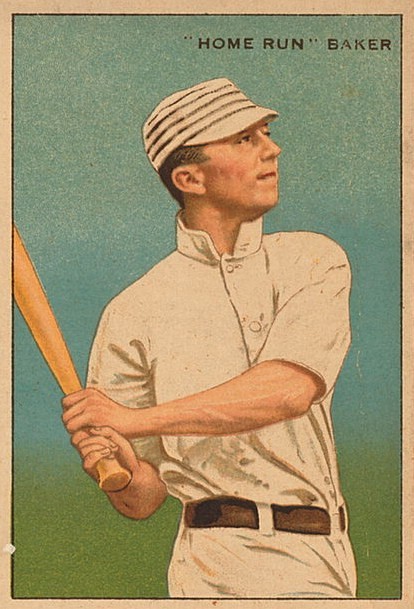
John Franklin "Home Run" Baker
Career Teams: Philadelphia Athletics (1908-1914), New York Yankees (1916-1922)
MVP Voting: 1911 (11th) ,1912 (7th), 1913 (5th) and 1914 (3rd)
For a man nicknamed "Home Run", Baker has a definite deficiency in the power department. Purchased from the minor league Reading, PA franchise in 1908, his season high for round trippers was an anemic (by today's standards) 12 in 1913. That led the league, as did his 11 in 1911 and 10 in 1912. This was the dead ball era and Home Runs were hard to come by. Baker held down the hot corner as part of Connie Macks' $100,000 infield. The other owners of the league were not real happy about the precedent that set for paying only four players $100,000 a season, but Mack didn't care. It worked. The A's won the AL in 1910, 1911, 1913 and 1914 and won the World Series in three of those four years. In fact, the 1914 loss has often been pointed to as another World Series that may have been fixed. Baker was known as Home Run Baker less for the number of Home Runs he hit and more for when he hit them. In Game 2 of the 1911 World Series Baker faced off against Rube Marquard with Eddie Collins on base and no score. It didn't stay that way for long. Baker launched one over the left field wall. The next day, with the Giants leading the game in the ninth inning, Baker faced off against Christy Mathewson. He launched another Home Run to tie the game. The A's won it in 11 innings and went on to win the series. As the Giants returned to the World Series after the devastating 1912 loss to the Red Sox, they had to face Mack's $100,000 infield again with Rube Marquard starting Game 1. With the A's already ahead 3-1 in the 5th and with Eddie Collins (again) on second base Baker launched Marquard's second pitch for a Home Run (again). Baker didn't only hit Home Runs in the World Series. It seemed like he hit everything. In the 1910 series he hit .458. In 1911 he hit .375 and in 1913 he hit .450. He was unstoppable in big games...until 1914 when the "miracle Braves" took out the dominant Athletics. Baker hit only .250 in the series, got into a salary dispute with Mack in the winter and sat out the 1915 season. He was sent to the New York Highlanders for $37,500 for the 1916 season and helped to turn the fortunes of the bad franchise around. Injuries and personal tragedies limited Bakers production and he missed the entire 1920 season. (Imagine how that season may have changed with a healthy Baker hitting with Bodie, Meusel, Pipp and Ruth). Baker returned to play the 1921 and 1922 seasons but his abilities had diminished and the competitive fires had started to fade after several personal problems. He appeared in the 1921 World Series against the Giants but McGraw finally got the best of him. He hit only .250 with no extra base hits, no runs and no RBI. He made one final brief appearance in the 1922 World Series as a pinch hitter but went 0-1. Baker was an easy choice for the Hall of Fame after retirement.
Larry Gardner
Career Teams: Boston Red Sox (1908-1917), Philadelphia Athletics (1918) and Cleveland Indians (1919-1924)
MVP Voting: 1912 (14th)
Until ten years ago it would have sounded insane to say that the Red Sox were the feared, dominant team in the game. They were dominant and they were almost unstoppable. After winning the first ever World Series in 1903, the Boston franchise reached the World Series again in 1912, 1915, 1916 and 1918. Gardner was one of the big reasons why. Similar to Baker, Gardner had a knack for coming through when it was needed. After Merkle dropped Tris Speaker's foul pop in the 1912 World Series Speaker drove the next pitch for a game tying base hit. When the leftfielder overthrew the cutoff man Speaker took second bringing up Duffy Lewis with runners on second and third. The Giants walked Lewis intentionally. No batter wants to have the guy in front of him walked intentionally, even when it makes good baseball sense, and Gardner was no exception. Even if he had gotten out he knew the game was tied and they could win the game in extra innings. He didn't wait around. He got a game winning base hit to give the World Series to the Red Sox. Gardner also contributed greatly to the 1915 and 1916 World Series champion Red Sox teams and the 1920 Indians World Series Champions. Gardner was a great fielder and was the only Thirdbaseman Ty Cobb was afraid to bunt against. "Gardner would be in there pouncing on that ball before I was ten strides down the line." Years after they were retired Cobb asked Gardner how he did it. "You clenched your jaw and clamped your lips together when you were going to bunt. The minute I saw that I came running."
Outfield
George Whiteman
Career Teams: Boston Red Sox (1907), New York Highlanders (1913) and Boston Red Sox (1918)
MVP Voting: None.
George "Lucky" Whiteman. A veteran of 86 career Major League games. He played in three separate seasons with breaks of six and five years in between. When the United States entered World War I and players started getting drafted, teams started taking what they could get. Whiteman had not played in the Major Leagues since 1913. Since the he'd made stops in Houston, Montreal, Louisville, Toronto and back to Louiseville. With the war ramping up and the "Work or Fight" law taking effect Whiteman got one last chance. He had a tough season in 1918 playing in 71 games and hitting only .262 but he was more of a caretaker in rightfield. This was the first season that Ruth was playing on a regular basis (more than just when his turn came up in the pitching rotation) and Whiteman played in the outfield when Ruth did not. Going into the 1918 World Series it was assumed that Ruth would be starting in every game, either in the field or as a pitcher, but Manager Ed Barrow surprised everyone by starting Whiteman in every game and it paid off. Whiteman's numbers alone don't stand out. 5 hits, 1 triple, 2 runs, 1 RBI and a .250 average. Not jaw dropping numbers, yet it seemed like he was everywhere, always on base when they needed it, putting pressure on the Cubs. For a player who was in the lineup as a fill in he was the final reason they won their last World Series until 2004. The Red Sox had gone ahead in the 3rd inning. With runners on first and third Whiteman hit a fly ball to right field, an easy out. Max Flack came in to get it, put his hands up and missed it. He just missed it. While Red Sox fans could point to Bill Buckner as the reason they had not won a World Series since 1918, Cubs fans can point to Max Flack as a big reason they have not won a World series since 1908. Flack's error on the Whiteman fly ball scored two runs. The only two Boston would need but Whiteman's heroics weren't done yet. In the 8th inning with the baseball game turning into a chess match Turner Barber pinch hit for the Cubs thirdbaseman Charlie Deal. Barber hit a sinking line drive into leftfield where Whiteman was playing. Whiteman came charging in and had to make a decision. A decision that could change the game. Change the series. He could let the ball fall and Barber would be on base with no one out. He could dive for it and take a chance that the ball would get past him and Barber could get extra bases, possibly even an inside the park home run to tie the game. Hold up or dive? No time to think. He dove. It's a decision you may see anytime you watch a game. It can happen t anytime and every time it does you will have the same reaction. You might gasp. You'll hold your breath and wonder for what seems like forever but is really less than a second, did he make the right choice. Whiteman's body was aimed straight towards home. The ball smacked in his glove as he hit the ground. His momentum carried him into a roll and he came up in a somersault holding the ball for out number one. He rolled his neck a few times, hands on knees loosening the neck he injured in the dive. One play later he left the game, replaced by Babe Ruth. George Whiteman saved the last Red Sox World Series victory until 2004.
Benny Kauff
Career Teams: New York Highlanders (1912), Indianapolis Hoosiers (Federal League) (1914), Brooklyn Tip-Tops (1915) and New York Giants (1916-1920)
MVP Voting: None
Benny Kauff played 5 games with a very poor 1912 Yankees team. He had a total of 3 hits in 11 at bats and was sent down to the Yankees minor league affiliate in Hartford. His 1913 season in Hartford was decent but it was against minor league pitching. His chances of getting back to the majors were slim. Then the Federal League came calling. They were looking for players. Any players. He signed with the Indianapolis Hoosiers of the Federal League. It wasn't quite the majors but it was close. He was facing a number of pitchers who had jumped to the new league. He not only did well. He dominated. in the first year of the Federal League he led the league in Runs (120), Hits (211), Doubles (44), Stolen Bases (75), Average (.370) and On Base % (.445). He was a clear MVP of the league. He was still the star of the second year of the Federal League but his numbers dropped a bit. As the Federal League went under the contracts of the players were sold for whatever the teams could get. McGraw saw talent in the young man and bought the contract for $35,000. There was a lot expected for the star of the Federal League. As McGraw rebuilt with a young core of players to head into the new decade Kauff was intended to be the lynch-pin. He didn't live up to it. His average dropped to .265 and his strikeouts rose to 65. Kauff played five years with the Giants. In 1919, as the game dealt with the rumors of the crooked World Series, Kauff and his brother were arrested. They were accused of being involved in a car theft ring that spanned several states. The trial lasted into 1921 and the innocent decision came down during the reign of Commissioner Landis. Landis was a previous Federal Judge and in reviewing the facts of the case made his own ruling. Landis called the innocent ruling a "miscarriage of justice." As he cleaned the crooked players out of the game Kauff was banished too. On May 13, 1921 he was officially banned for life from playing in Major League Baseball or any minor league affiliate.
Eddie Grant
Career Teams: Cleveland Naps (1905), Philadelphia Phillies (1907-1910), Cincinnati Reds (1911-1913) and New York Giants (1913-1915).
MVP Voting: None.
Some people just have bad luck. Call it what you want. Cursed. Snake bit. Star crossed. Whatever it is it always seems to strike at the best time in their life. Eddie Grant would seem to be someone who had it all. Brains. Physical talent. Looks. Charm. He was a great athlete. Excelled at all levels until he hit the Major Leagues where his talents proved that he was good but not a superstar. He was a bit of a genius. He loved the opera. He read books not comic strips like other players of his time. He was not the type to start fights or go out all night like the typical player of the era. His playing abilities were never tremendous but he was a positive influence wherever he went and was a smart player. He got married in 1911 and was deeply in love. He and his new wife were on vacation less than a year after the wedding. His wife woke up one morning, complaining of chest pains. An hour later she had passed away of a heart attack in his arms. He was devastated but recovered. His baseball exploits were never grand and drew little attention. He made contributions to poor Phillies teams and bad Reds teams. He helped the Giants in a part time role to reach the World Series in 1913. He retired after 1915 and was starting to make headway in his private law practice. It was starting to take off. Then World War I broke out. There was no "Work or Fight" rule in 1917. It was strictly a volunteer army at that point and Grant volunteered. His unit saw heavy action. Real action. His brains helped him in his military career and he soon became a captain. In early October 1918, just a month after George Whiteman saved the Red Sox World Series, Eddie Grant's unit was given an impossible task. There was a "lost battalion" in the Argonne Forest, surrounded completely by German troops. Grant's unit's job was to fight their way through the Germans and open a path for the lost battalion to make it through. It couldn't be done. Grant's commander was wounded mortally shortly after the assault began. Grant knelt by him to get instructions. As he moved in action, calling for more stretchers, German (or possibly friendly) artillery came crashing through the trees. Two shells had Grant's name on them. He was hit directly with the shells, dying instantly.. He was the only Major League player killed in action during the war. There was a famous headline in the papers. "Eddie Grant sleeps in the Argonne Forrest".
Pitcher
Smokey Joe Wood
Career Teams: Boston Red Sox (1908-1915) and Cleveland Indians (1917 and 1919-1920)
MVP Voting: 1912 (5th)
It felt like a firecracker had gone off in his hand. He had delivered a beautiful pitch. Fastball with some movement right down the middle. Chief Myers, the Giants Catcher, swung and drove it right back up the middle. Wood reacted instantly, instinctively. It's a play that happens a hundred times a year. The pitcher delivers the ball, sees a hit coming back at him and sticks up his hand. The fans immediately hold their breath and pray the ball makes it past. This one didn't. It smacked Wood on the thumb and dropped at his feet. He picked up the ball and threw it to firstbase retiring Myers. It was the third out in the top of the 10th inning of Game 8 of the 1912 World Series. The Red Sox were down 2-1 but Wood's reflexes had stopped another run from scoring. Had the ball gotten through it would have scored Fred Merkle. Wood's thumb was broken but stopping the run from scoring allowed the Red Sox to win the World Series. Wood's career started slowly. There were slight improvements for Smokey Joe from 1908-1911. His wins increased slowly from 1 to 11 to 12 to 23. In 1912 everything clicked.
EVERYTHING clicked. There have been few better pitching seasons in the history of baseball in any league at any level. He was nearly unbeatable. He won 34 games and lost only five. He had 10 shutouts, a 1.91 ERA and at one time he even won 12 straight decisions without a loss, still a league record. In several appearances in the 1912 World Series, Wood was unhittable against a scary Giant lineup who knew how to win and knew how to wait out a pitcher. He won three games in the World series and had the world ahead of him before that line drive smashed his thumb. It healed in the off season but in spring training he fell on wet grass during drills and hurt the thumb and his throwing arm. He never fully recovered. He won only 11 games in 1913, 10 in 1914 and 15 in 1915. He was finished by 1916. Out of baseball. The Red Sox had given up on him. Tris Speaker had not. Speaker had been traded to the Indians and he needed an outfielder with a strong throwing arm and a good bat. Wood got his feet wet in 1917 with 10 games but by 1918 he was playing full time. Wood continued to play the outfield until 1922. There were rumors at the end of the career. He was already retired but he was implicated with Cobb and Speaker by Dutch Leonard of throwing a game. He denied it and Leonard's accusations went nowhere. Wood didn't live up to his promise on the diamond but he lived a long life. He passed away just a few months short of his 96th birthday.
Author's Note: Just as in the last few weeks, and as may be seen in the next few weeks as we move through this series of articles, I did my best to keep this to one player per position, however, the farther we move from these eras, the easier it is to forget these types of players (and even some hall of fame players). It is important to remember as we follow the sport that the superstars are not the only ones making contributions to the success of a team. This is not a comprehensive list of players who fall into this category from this era, it is simply my choice of players who best represented their position and have become forgotten. Your list is probably different. Email me yours or leave a comment.