Showing posts with label New York Giants. Show all posts

Saturday, November 30, 2013

Rivalries: Jackie vs. Leo

Don't forget to check out the other articles in our rivalry series:  Christy Mathewson vs Three Finger BrownTy Cobb vs Babe Ruth, and Joe DiMaggio vs Ted Williams.

"Listen up!"  The words were angry, vicious and worst of all at this time of the morning, loud.

It was late.  Half of those present were pulled out of bed.  Some of them may have just snuck into bed.  None of them had experienced anything like this spring training.  First of all, it was in Havana.  What the hell were a bunch of white guys, many of them southerners, doing in Cuba? Then of course there was Jackie Robinson.  What the hell was an African American from California  doing in Cuba with all these white southerners?

"Listen up!"  He said it again but the first one was probably enough.  When the Lip told you to listen you listened.  "I hear some of you guys got a problem with Robinson."  Leo knew exactly who the players were who had the problem.  "I don't care if the guy is yellow, or black or has stripes like a f***ing zebra.  I'm the manager of this team and I say he plays."


The problem became this: when the 1947 season opened and Jackie Robinson jogged out to first base for the Brooklyn Dodgers, Leo Durocher was sitting at home, suspended by the commissioner for his involvement with less than savory characters and his association with a married woman.  So in the end, he had no say over who played for 1947. 

While Leo sat out for the season, Burt Shotton and Jackie Robinson took the Dodgers to their first pennant since 1941, Durocher's third year as manager.  He had been through a lot since then.  The Dodgers had fought with the Cardinals for first place.  The Cardinals were Leo's former team, Branch Rickey's former team and Pete Reiser's former team.  Durocher had seen Pete Reiser, the natural, the leader, the one man that had more talent (it was whispered) than even DiMaggio.  Reiser ran himself into a wall, literally, and fractured his skull.  The doctors told him to stay out or risk his life.  Durocher needed him in uniform for moral support but promised not to use him.  He couldn't keep the promise and Reiser's health was forever ruined.  Durocher saw many of his stars, Reiser, Reese and more, shipped off to war and miss the prime of their careers.
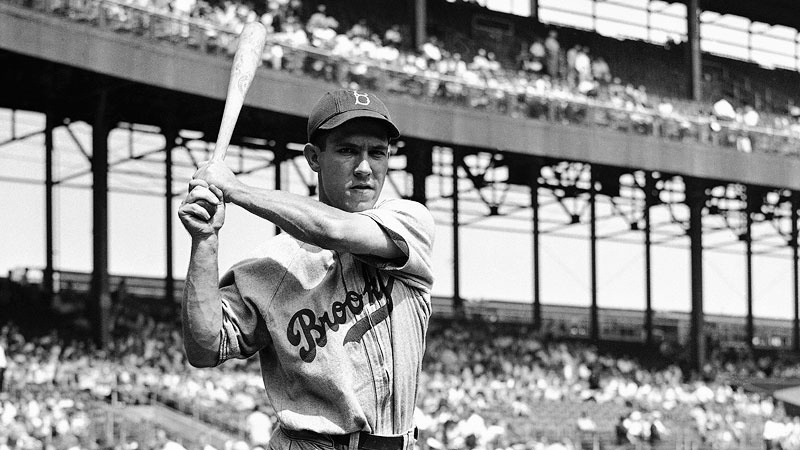


Durocher saw the same talent, or more, in Jack.  He couldn't wait to see what he could do.  He saw what Jackie could do, lead the team like few had done before, but Jack did it for Shotton and the Dodgers reached the World Series.  Durocher would need to wait for 1948 to get the advantages out of Jack's talent.  But if the Dodgers front office thought Jack's success the year before would mean immediate acceptance they were wrong.

The Dodgers bus pulled up to a Florida stadium in Spring Training 1948, overflowing with a record crowd to see the Dodgers.  Dodger Pitcher Rex Barney told the story of a big security officer stopping Jack at the entrance and questioning Jack's intelligence and literacy.  Durocher immediately spoke up.  "He can't go in there?  He can't go in that entrance?  Then we are not going in there.  Do you know what that means?"  In Barney's story the security guard relented knowing the overflow crowd would likely riot.  It was a rare moment of camaraderie between Jackie and Leo.


Like most award winning players, especially one as spectacular as Robinson, everyone wanted a piece of him.  Four off season months and lots of rubber chicken dinner speaking engagements later, Jack appeared at Spring Training twenty pounds above his 1947 playing weight.  Durocher was appalled.  Robinson wasn't the only over weight star.  Pete Reiser and Jack were forced to run for hours in rubber sweat suits to work off the excess fat.  While they were running laps in tropical heat Durocher was yelling at them "C'mon fatso!  Get moving."  It was humiliating for the players and Jackie resented it.

The difference between Shotton and Durocher was night and day.  Shotton had told the Dodgers that he would stay out of their way and that they could win despite him.  Durocher drove them relentlessly and let them know who was boss.  The pressure on Shotton was non existent.  If he had lost it would have been what everyone expected.  For Durocher the pressure was ever-present.  He was terrified that if the Dodgers struggled he would be blamed and fired.  The season was a disaster.  The team struggled.  Robinson struggled.  As the pressure mounted Durocher took it personally.

On Sunday, June 11, the Dodgers lost 3-2 to the Giants and fell to 35-37.  It was Durocher's last game as a Dodger manager.  On July 15, the Giants split a double header, bringing their record to 37-38.  Their manager, Giant legend Mel Ott, was fired and replaced with none other than Leo.  If the Dodger's Giants rivalry had been dormant for a few years it was about to erupt.
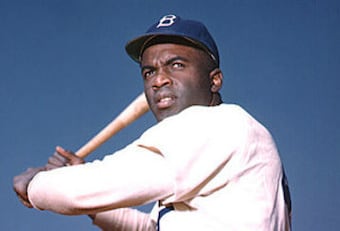

Durocher's style of managing caused quite a bit of resentment to the remaining Dodgers.  Two players in particular, Jackie and Carl Furillo, hated Leo.  Leo was from the old school.  The school that thought if you can distract your opponent they won't focus on the job.  Durocher would stand in the coaching box and mimic a person with a swollen head and point to Jack. 

After a tight pitch from Sal the barber, Jackie bunted the next pitch foul down the first base line and ran straight through Maglie.  Durocher yelled to Jackie.  "That's bush league Robinson."  Jack yelled back "You should know.  You taught me to do it."

Durocher was a master taunter but Jackie could give it right back.  Russ Meyer, a former Giant who was traded to the Dodgers said "He (Jackie) hated Durocher with a goddamn passion.  He used to taunt him." According to Meyer Robinson yelled taunts like "Hey Leo, who you gonna marry next?  Is Laraine taking good care of you?"

The funny thing about rivalries is that once the years go by the anger usually fades.  At the end of their careers both had won World Series.  Both ended in the Hall of Fame and both were remembered as successful.

Jackie himself reflected on the rivalry with clarity.  He remembered the spring training from hell in his auto biography.  "To get me in shape, Leo put me through some furious physical paces.  They were humiliating because rookies, reporters and teammates were all onlookers.  Leo also kept after me verbally, and as the world knows, he is a magnificent tongue lasher.  At the time I thought he was being too excessive, but later I realized he was only doing what was necessary, and even though his comments hurt, I could not forget that Durocher had done all he could the previous year to help ease my way into the majors...I think that Leo felt I had not given him my best effort and was working harder for Shotton.  That wasn't true but on the playing field Leo and I got into a number of hassles that were picked up by the press.  Leo and I were alike in so many ways, and that could have been part of our problem.  But no matter how many verbal insults were exchanged, I believe we never lost the respect we had for each other's abilities."

TRIVIA QUESTION:
Current Dodger Manager Don Mattingly has asked for a three year contract as a reward for his success.  It has been a long time Dodger organization policy to only give Dodgers' managers a one year contract (this dates back to long before the move from Brooklyn).  In fact, legendary Dodger manager Tommy Lasorda never had a contract longer than one year.  Mattingly's demand for a three year contract is eerily similar to the demand of Brooklyn manager Charlie Dressen back in 1953.  Dressen had led the Dodgers to a three game playoff against the Giants in 1951, followed by back to back National League Championships in 1952 and 1953.  Dressen wrote a letter to Walter O'Malley demanding a three year contract.  O'Malley did not deal well with demands from others so he replaced Dressen.  Who replaced Dressen as Dodgers manager?


Answer to Last Week's Trivia Question:
In games 1 & 2 of the 1951 World Series the Yankees started a young outfielder in his first full year in the Major Leagues.  The right fielder went 0-3, with 2 walks in Game 1.  In Game 2 the young player went 1-2 with a run and strikeout.  He only played part of the second game.  In the top of the 5th inning, Willie Mays led off the Giants' 5th inning with a fly ball to right-center field.  Joe DiMaggio moved over to track down the fly ball, invading the right field territory.  The young right fielder had started to track the ball himself but when he saw DiMaggio tracking it he attempted to move into a back up position.  When he changed his course Mickey Mantle caught his spike on an exposed drain pipe and severely damaged his knee causing pain for the rest of his life.

Friday, May 10, 2013

Forgiving Baseball's Scapegoats: Fred Merkle

Dear sir,
In the game today at New York between New York and the Chgo Club, in the last half of the 9th inning, the score was a tie, 1 to 1.  New York was at the Bat, with two men out, McCormick of N. York on 3rd base.  Bridwell was at the Bat and hit a clean single Base-hit to Center Field...
That was the last moment of the craziest season ever that made any sense. 

___________________________________________________________________________________
The young rookie takes a modest lead off of first.  Not too large.  He knows that with two outs in a tie game and a runner on third he is not the important person.  He just wants a big enough lead to get the pitcher's attention.  He takes a step off the bag.  Two steps.  Now three, four, five and gets ready to run on contact.  The pitcher steps off the bag and fakes a throw.  The runner dives back.

The pitcher this day is Jack Pfister, known throughout the league as "Jack the Giant Killer".  Even in a terrible season when he struggles with arm problems and he can't seem to beat anyone he can beat the hated rivals.  His arm is killing him.  He struggles all day and his curve ball, at least the three that he attempts to throw, are excruciating.  He has little left to give but he keeps going anyway.  He fakes the throw to first but never truly intends to throw over.  It just takes too much out of him.  It won't matter.  The message is clear.  Pfister is telling the runner without saying a word:  "I know you're there."  The runner's dive back to the bag tells Pfister, with no sound, "I know your moves."

This is the crucial moment of the crucial inning of the crucial series of the 1908 season.  The Giants had sported a four and a half game lead just a few days ago.  Then two losses to the Pirates and two losses to the Cubs heading into this game and the league was all tied up again.  The seemingly lifeless Cubs came out of hibernation at the right time and fought their way back into contention.  And who is the biggest beneficiary of all this Cubs/Giants battle?  The Pirates, who were five games behind after losing a double header to the Giants on September 18th.  That was the day the writers crowned the Giants.  The Pirates reacted by winning their next five games and cut the lead behind the Cubs and Giants to one game.  As the Cubs and Giants, the ugliest rivalry in the sports at that time, fight and claw at each other, the Pirates keep winning. 

The runner takes another modest lead, maybe even a step further this time, confident that the pitcher will not throw over.  The runner is a 19 year old kid from Toledo, OH.  Going from small town to Giant city is a big change for a young man like him but he adjusted well in his limited playing time.  He normally doesn't play but Fred Tenney, the regular first baseman, sat out this game with back problems.  Tenney had not missed any games before today and he won't miss another after this one all year but this kid has done well today.  He got the single that moved the winning run just 30 steps from home plate and now he is standing off first smiling, knowing he has made the difference.

To this point in his brief career Fred Merkle has been described as using his intelligence "in everything he does" and showing  "good judgment on the base paths".  The Chicago Tribune, just a few days earlier, told readers that if Tenney went down the Giants would be fine because Merkle is ready to step in to the First base role.  He stands a few steps off first now.  Watching Pfister.  Waiting for the pitch.


Pfister swings his arm back and delivers the first pitch to Al Bridwell.  Bridwell swings the bat and drives the ball to center field.  With two outs Moose McCormick, the runner on third, ambles home.  This is the last moment of the craziest season ever that made any sense.  The game is over.  Except it isn't.

It takes an estimated 30 steps to run the 90 feet between bases.  If Fred Merkle, the base runner on first, has a slight lead of five or six steps and has taken even a slow trot towards second on contact, he is probably  another eight or ten steps toward second.  He is at least half way or more towards the base and this is where all hell breaks loose. 

As McCormick pounds his foot emphatically on the plate to score the winning run the ecstatic fans pour onto the field like a wave. Their Giants have beaten the hated Cubs and climbed back into first place.  They were going to celebrate, and maybe taunt a few Cubs in the process. Merkle has never experienced anything like this before and it is intimidating as hell to a young 19 year old kid.  Many of them head straight for him to congratulate him on the hit that put McCormick on third.  All he knows is that half crazed fans are all over the place and it is a long way to that Polo Grounds clubhouse entrance in center field.  Since McCormick has already scored the winning run why take the extra 15 or so steps when those 15 steps get you closer to the safety of the clubhouse.  And besides, the game is over.  Except it isn't.

Johnny Evers, the Cubs second baseman, is the best in the league.  In fact, other than Nap LaJoie, no one could remember someone playing second base better.  One other thing about Evers.  He is by far, without equal, the most fiery, competitive person the game has ever seen.  Not even Cobb can equal the fighting spirit of Evers, known by some as the "Human Crab",  in his prime.  Baseball is this man's life and he knows every detail, every quirk, every loophole in the rule book and he'll be damned if anyone, especially a 19 year old rookie,  steals a win from Johnny Evers.  Every night, after the bars close of course, Evers comes home with a candy bar, the Sporting News and the baseball rule book and studies the game before bed.  A few weeks before this, the Cubs were playing the Pirates when the same thing happened. Evers knows the rule. Even if the winning run scores the runner on first has to advance to second to erase the chance of a force out.  Simple.  If the runner doesn't touch second the play is still alive.  In the Pirates game Evers had gotten the ball, stepped on second and told the umpire the runner was out.  The umpire hadn't seen the play so the run in that game counted.  But luck today is with the Cubs.  The umpire from that game who had not been on the lookout for the runner touching second is behind the plate umpire.  He knows that Evers knows the rules and he sees what Evers is up to.


The noise is unbelievable.  How anyone hears anything clearly is amazing but Evers has a clear idea of what needs to be done.  He is screaming, shrieking to Solly Hoffman. "Gimme the ball, damnit!  Come on Solly!"  People swarm everywhere. Fans, sportswriters and members of both teams running for the clubhouse.  Police men, the few that are on hand, try to keep order but there are just not enough to really do anything about it.  They basically try to make sure no one was getting trampled.

Hoffman tosses the ball to Evers but Joe McGinnity, one of the Giants' great pitchers, intercepts the throw.  Evers, Joe Tinker and McGinnity wrestle for the ball while Pfister and Frank Chance try to get the umpire's attention.  McGinnity gets free from the Cubs long enough to throw the ball somewhere into the crowd. If this were a cartoon (and it wasn't too far off) McGinnity would be dusting off his hands and walking proudly off.  There is no way the Cubs will find the ball in that swirling mass of humanity and confusion.  The Giants have won.  The game is over.  Except it still isn't.

Merkle is blissfully unaware at this point that anything other than a drunken bacchanal for the fans is taking place on the field.  That is until Christy Mathewson, the "Christian Gentleman" comes desperately looking for Merkle to get him back to second base.  As Merkle returns to the field, trying to rebuckle his pants as he runs, possibly just in socks, a Cubs relief pitcher (which in 1908 means a spectator in uniform) is fighting with a fan.  Rube Kroh sees McGinnity throw the ball into the crowd and somehow sees who picks up the ball.  Kroh sprints after the fan and wrestles with him.  Undoubtedly, the drunken fans have no idea what the hell is happening and see only a hated rival attacking their brethren so this becomes a hell of a struggle.  Kroh pounds the fan over the head, crushing his bowler hat, and steals the ball back.  This is getting closer and closer to a cartoon every moment and you can almost envision stars and birds swirling around the fan's head while a bump slowly grows out of his head.

Kroh throws to Evers who holds the ball straight in the air for the umpire to see and jumps up and down on the bag.  The Cubs have turned the never before or after seen Center field to opposing pitcher to fan to relief pitcher to second base force out play.  The umpire at second base hasn't seen Merkle run for the clubhouse before reaching second but the home plate umpire has.  "Merkle never reached second base.  The runner is out.  The run doesn't count.  The inning is over."

New York's finest, the few on hand, already overwhelmed by the crazed fans, realize this is a bad situation that is about to get much much worse.  As word circulates through the crowd jubilation turns to anger.  The police encircle the umps, the rival Cubs can fend for themselves, and use their nightsticks forging a way through the crowd to safety. 

The umpires immediately send off a letter to the league President.  "Dear sir, in the game today at New York...  Merkle did not run the Ball out; he started toward 2nd base but on getting half way there, he turned and ran down the Field toward the Club House. The Ball was fielded in to 2nd base for a Chgo Man to make the play."

Even if the umpires can clear the fans from the field there is not enough light and certainly not enough security, to resume the game.  Game over.  1-1 tie.  The Giants protest the decision.  The Cubs counter protest.  And still, they play the regularly scheduled game the next day without incident.  The Giants win 5-4 to regain first place. 

The headlines the next day are murderous towards the Cubs.  The Cubs fire back.  As the season churns on and the race remains tight all the way, Fred Merkle becomes the focus of everyone's hatred.  The Giants fans start to despise him.  Why the hell couldn't he have taken 15 more steps to finish the play?  The terms "numbskull" and "bonehead" are introduced into the American vernacular to describe him.  The Cubs' owner claims it was not the Cubs' fault the Giants were stupid.  "We can't supply brains to New York's dumb players."

The Giants, Cubs and Pirates continue to fight for the pennant and at the end of the regular season the Cubs and Giants are tied, with the Pirates just a half game behind them both.  The difference is that tied, disputed game from September 23rd that the Giants should have won if only Merkle had run a few more feet.  The protests have gone back and forth and the league's investigation has sworn affidavit's from both sides swearing that "it happened this way" which is exactly the opposite of the way the other team swore it had happened.  The final result is that the teams would "replay" the disputed tied game. Technically it is the first playoff in Major League history but it is only called  a replay game.  The Cubs win the replay game and go on to beat the Tigers in the World Series.

Merkle's reputation as a player is ruined.  He will forever be known as the idiot who made the bonehead play of failing to touch second on a routine base hit and cost the Giants the 1908 pennant. The play is forever known as "Merkle's boner" and from this point to the end of his career every error he makes will immediately lead to a boo or the rude comment  "It's that damn Merkle again!" or "What do you expect? It's Merkle."

Merkle's career is much more than 15 steps he didn't take on an apparent game winning base hit.  As the Giants went on to reach the World Series in 1911, 1912 and 1913, Merkle makes major contributions  to the Giants winning teams.  He lands in the top ten in RBI four times, Home Runs three times and extra base hits five times.  Merkle ends his career with 1580 hits and also helps the 1916 Brooklyn Dodgers reach the World Series, their first appearance ever, and helps the 1918 Cubs reach the World Series.  He was not a hall of fame player but he was definitely not a bumbling idiot.


The Merkle mistake took place over 100 years ago, in fact the same year as the Cubs' last World Series victory, yet Merkle is still blamed for losing the 1908 pennant for the Giants.  115 years after the fact it is time for Merkle to shed the label of bonehead.  There are plenty of reasons the lost pennant was not his fault.  Here are just a few:

1.  The Giants had a four and a half game lead with only a few weeks left in the season.  Merkle's early turn towards the clubhouse may have cost the Giants one game head to head with the Cubs, but the Giants had already blown their lead by the September 23rd Merkle game.  They were tied going into that game.

2.  The Giants as a group had lost focus.  On taking the four and a half game lead, the team started discussing who they would be playing in the Worlds Series and who would pitch the first game.  They immediately lost the next two games to the Pirates, another big contender in the pennant race that year, and the first two games of the Cubs series.

3. The Giants won 5-4 the next day, putting them back into first place by one game.  Regardless of the outcome of the Merkle game they had a chance to overcome the chaos and move forward.  They had the advantage since the Cubs were chasing them.

4. The fact that the newspapers and Sporting News made a point of discussing the Pittsburgh-Chicago game of a few weeks earlier, where Evers attempted to get the same ruling, seems to show that batters failing to run all the way to second in this situation was fairly common.  Merkle did what most players of the era did. 

5.  The Giants' closest competition in 1908 were the Pirates and Chicago.  The Giants went 11-11 against Pittsburgh and 11-11 against Chicago (including two straight losses to the Pirates and two straight to the Cubs after reaching the four and a half game lead).

6.  The Giants went just 11-10 in May and started June 7-8 leading to a six and a half game deficit.  Their competition during the beginning of June included Boston, St.Louis (the 6th and 7th place teams at that time.  St.Louis would finish dead last, winning only 49 games that year) Chicago and Pittsburgh (their competition). These records were long before Merkle started seeing playing time.

7.  The Giants should have won the replay game.  Christy Mathewson started the replay game for the Giants in New York with the intimidating support of an overflow crowd behind him.  The Cubs had received death threats and several of them were nervous.  Mathewson was the most dominant pitcher in the history of the game at that time. On the other hand, the Giants knocked Jack Pfister out of the game in the first inning after scoring a run and having two runners on base.  The Giants not only blew a four and a half game lead in late September, they blew a lead with Mathewson on the mound in the replay game.

8.  The Giants went on to reach the World Series in 1911, 1912, 1913, 1921, 1922, 1923 and 1924
 under McGraw's leadership and in 1933, 1936 and 1937 under the leadership of Bill Terry.  They won the Series in 1921, 1922 and 1933.  Although they didn't win the 1908 pennant they had plenty of success in the years that followed while the Cubs have not won since.

9.  The Giants never blamed Merkle so why should you?  John McGraw said "It is criminal to say that Merkle is stupid and to blame the loss of the pennant on him.  We were robbed of it and you can't say Merkle did that."  Al Bridwell later said "I wish I'd never gotten that hit.  I wish I'd struck out instead.  If I'd done that it would have spared Fred a lot of humiliation."

10. Merkle nearly won the Giants the 1912 World Series with a tenth inning RBI double in the eighth game giving the Giants the lead.  That World Series loss is blamed on next week's member of the scapegoat club.

Saturday, October 20, 2012

Greatest World Series Moments: Most Supernatural

Washington: First in war, first in peace and last in the American League.

It was a stale old joke that started in 1901with the start of the American League and the Washington Senators were sick of it.  In the first ten years of the league they had finished above 7th (out of 8 teams) twice, and both of those seasons they only reached 6th.  They weren't a baseball organization, they were  a punchline.

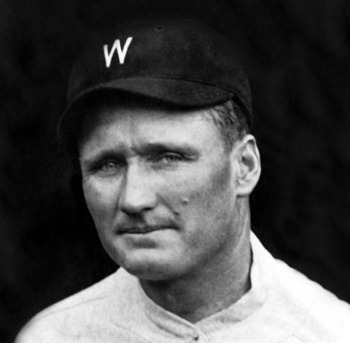
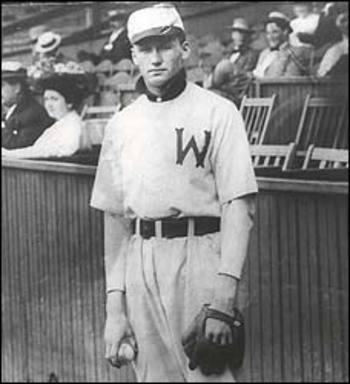
Fans of the Senators had one silver lining: they had the greatest pitcher in the history of the game pitching for one of the worst teams of all time.  The next time you hear someone say the Padres need to trade Chase Headley, the Pirates need to trade Andrew McCutcheon or the Rockies need to trade Carlos Gonzalez because no player with that much talent should have to play in a baseball grave yard you can reply with one simple answer:  Walter Johnson. 

(Walter Johnson won 417 games in his career, second only to Cy Young's 511.  He is regarded by many as the greatest pitcher of all time.  If anyone wants to read a great baseball book I recommend reading the biography Walter Johnson: Baseball's Big Train  by Henry W. Thomas.)
 

He ended his career with 417 wins, winning 20 games or more 12 times including 33 games one year and 36 another.  What makes his career even more amazing is the fact that he achieved these numbers on a terrible team.  He won more games by one run than anyone in history but the best stat of all is that he lost more games by 1-0 than anyone else.  26 times in his career he held the opponent to one run and lost the game because the pathetic Senators offense couldn't push across a single run.  Imagine the number of wins he could have had with just slight run support.  In an era where celebrity was new and baseball ruled the sports world, Johnson was adored.  Ruth and Cobb got headlines for  the wrong reasons.  Johnson got headlines for being polite, humble, ethical, an example to the youth.

As the years went on and Johnson plugged along, there were small signs of improvement in the nation's capital and fans tried to be excited.  They reached second place three times, a distant second, but they quickly slipped back into the lower division.


(Walter Johnson spent his entire career with the lowly Washington Senators.  Between 1908 and 1923 the Senators finished in the top three only four times.  Even in those years they finished 6.5, 14 and 29.5 games behind first place.  Little was expected of the Senators as they entered the 1924 season.)
 

Leading up to the 1924 season Bucky Harris, a young secondbaseman in only his fifth year in the league, was named player-manager.  The predictions were dismal and little was expected.  Their team was made up of young players who had shown little promise and older veterans seemingly on their way out.  Their shortstop, Roger Peckinpaugh, was best known for making an error in the final game of the 1921 World Series, allowing the only run of the game to score.

1924 was different somehow.  The Senators went 20-4 from mid June to early July and took over first place.  You could almost hear the nation chuckle.  The Senators in first place.  It's like when Jerry stands next to an electrical socket and picks up Tom's tail, then winks at the audience.  You know what the joke is but you watch it anyways and you laugh when it happens.

The longer they stayed in the race, the bigger the comedic payoff  was expected to be when the Yankees would catch them by the tail.  Funny thing was, the Yankees grabbed the tail a few times and tied for first place for a day or so but they could never quite get the punch line to stick.  Washington took over first place for good on September 19 and Walter Johnson was named MVP of the season with a 23-7 record.  Suddenly this wasn't a  joke.  This was real.

(Bucky Harris took over as manager before the start of the 1924 season.  He was a young, inexperienced manager.  He had the support and respect of his teammates and lead the team to their first ever American League pennant.)


Certainly the punch line was just being delayed.  The Giants would drop the banana peel for sure.  The Giants were the opposite of the Senators.  A power house full of cocky, experienced future hall of famers (no less than seven), the Giants had been in the World Series eight times out of the first 19 (it easily could have been an even ten).  This was their ninth visit overall and their fourth straight appearance.

 In 1921 and 1922 they beat the Yankees and lost to the Yankees in 1923.  John McGraw, arguably the best manager of all time, was furious about that loss.  He hated Ruth for ruining the game with all these home runs, hated the Yankees for cutting into his New York profits and hated the American League for too many reasons to go into in this article.  His Giants had been beaten last year by those AL punk Yankees.  The entire 1924 season was about proving that the Giants were still kings and they certainly wouldn't lose to this lousy team.  It was almost insulting to lower the great Giant name by beating a second rate organization like the Senators.

(John McGraw managed the Giants from 1902-1932.  During that time his teams reached the World Series nine times and won three.  He is considered by many the greatest manager of all time.  Entering the 1924 season he was still angry at the team's World Series loss to the Yankees in 1923.)


The Senators were not only the underdog fan favorite, Walter Johnson was the nation's favorite.  The nation wanted to see Walter succeed.  The pressure was on Walter to make his supporters happy.  In game 1 he took the loss, though it would be hard to say he deserved to lose it.  He pitched 12 innings and lost 4-3.  Another 1 run loss.  Johnson's second appearance in game 5 was less heroic.  He gave up six runs in eight innings and lost again.  He was dejected, feeling he had let down his supporters, his team mates and Clark Griffith, the Senators' owner.  Almost inconsolable, Johnson felt he had lost his one opportunity at a world title.

As the series moved to game 7, no one wanted to see the punch line land anymore.  It wouldn't be funny.  It would just be cruel, tragic.

Game 7.  Bottom 8th.  2 outs.  Runners on 2nd and 3d.  Washington 2 runs down.

The basic fundamentals of baseball tell the runners in this situation that they run like hell as soon as they hear the crack of the bat.  When you have played the game as often as Nemo Leibold and Muddy Ruel you can often tell from the sound of the bat whether it will be worth the effort.

Bucky Harris made contact and the runners were in motion.  The sound was not encouraging.  A routine ground ball to thirdbaseman Fred Lindstrom, a great fielding thirdbaseman and a future hall of famer early in his career.  Leibold moved the ninety feet and touched home plate, a seemingly useless routine.  Ruel also moved on contact and ran as fast as he could, which unfortunately was not that fast.  Ruel was generally considered one of the slowest runners in either league.  As he neared third base he expected to see the Giants walking toward the dugout as the routine play was executed to end the inning.  What he saw instead was the third base coach with his arm spinning fast enough to tear the shoulder out of the socket and screaming at the top of his lungs to get his ass moving.  It was too loud for him to hear what was being yelled.  Ruel ran faster, or tried to, and rounded third.

(Harry Leibold was nicknamed "Nemo" after his resemblance to the comic strip character "Little Nemo".  Nemo had played for the 1919 White Sox and was one of the "Clean Sox" who did not participate in the conspiracy with the "Black Sox".  He scored ahead of Muddy Ruel in Game 7 of the 1924 World Series.)

Lindstrom had seen the ball off the bat and readied to field the ball.  Hands chest high, knees soft, eyes on the ball.  One more hop and he would have it.  Then the second most bizarre, unexpected, unpredictable thing in the history of the World Series happened.   The ball hit a pebble or hard clump of dirt, or something, and took the biggest bounce you've ever seen, ten feet in the air.  Lindstrom jumped as high as he could but the ball went over his head. 

Call it what you want.  A bad bounce, intervention from the baseball gods, luck.  Whatever you call it this game 7 was tied.


(Fred Lindstrom is one of the unluckiest players in history.  A strong fielder and future hall of famer, Lindstrom had no chance to field the ball when it took a big bounce over his head in the 8th.  His day would get worse.
 

As the top of the 9th started Walter Johnson took the mound.  How much cruelty was this man supposed to take?  The nation stopped waiting to laugh and started waiting to cry.  This time, when Jerry smacked Tom in the face with the frying pan it wouldn't be a punchline it would be a sucker  punch.  Tension mounted as the game moved through the 9th, the 10th, the 11th and the 12th inning.  Walter was courageous as he continued to set down the experienced Giants lineup but he was constantly in danger.  Fans sat on the edge of their seats.  Praying, wringing their hands, rocking in their seats, exhaling with each strike, gasping at each ball.  It was constant tension.

The Giants had runners on 2nd and 3d in the 9th but Walter got a ground ball to work out of trouble.  He walked the lead off hitter in the 10th but got a double play ball to escape danger.  There were two runners on in the 11th when he got a strike out to keep the game tied.  The 12th was the easiest as he gave up a lead off single but nothing else.

The suspense was maddening.  If the game took place today, graphics would start appearing on your screen to compare this game to other extra inning World Series games and announcers would be telling you that the longest game in World Series history was in 1916 when a young pitcher named Babe Ruth won 2-1 for the Red Sox, pitching all 14 innings.  We would see shots of fans praying, hands over their eyes, waiting for something bad to happen.

If the eighth inning divine intervention wasn't enough to make some people believe the Senators were a team of destiny, the bottom of the 12th made it undeniable.  Ralph Miller led off for Washington with an easy ground ball.  1 out.  Muddy Ruel had only one hit in 19 at bats to this point in the series. As he stepped in to bat, and Johnson set to bat next, Senators fans wondered how long Johnson would be able to hold out.  Ruel swung and popped a ball straight up behind home plate.  Hank Gowdy, the Giants Catcher, tore off his mask and tracked the ball.  He threw the mask down.  The ball had gone straight up, then drifted back toward the plate, drifted some more, it just kept drifting.  Gowdy kept tracking it as it came down and was finally ready to pull it in and as he took his last step he planted his foot directly in the discarded catchers mask.  It clung to his foot.  He shook the foot to get it off.  Planted the foot again but the damn mask was still there. He fell to the ground and the ball fell next to him.  


(Hank Gowdy was the hero of the 1914 World Series for the "Miracle" Boston Braves.  He was also the first active Major League player to volunteer for military service during World War I.  The Giants poor luck continued when a drifting foul pop caused Gowdy to trip over his discarded catcher's mask.)
 

"That mask up and bit Gowdy!"  Clark Griffith yelled from his owner's boxed seats.  No one could believe what they were seeing.

Ruel made them pay with a double to left.  Maybe there was some magic left.  Johnson stepped in to bat and hit a ball right at Travis Jackson, the shortstop, another hall of famer, who couldn't handle the ground ball and his error allowed Johnson to reach safely. 

1st and 2nd.  1 out.  Earl McNeely at the plate.  A base hit would win it.  The Giants moved to double play depth hoping to prolong the game. 

On the second pitch McNeely swung and the ball was grounded toward Lindstrom at third.  McNeely had average speed and Lindstrom might have to hurry but this was a perfect double play opportunity.  Ruel, on second ran like hell, well, as close as someone with his speed could, hoping to decoy Lindstrom into a tag.  Lindstrom ignored him and Ruel saw Lindstrom ready to field the ball.

Then the absolutely most bizarre, supernatural, unbelievable thing  in the history of the World Series happened.  Ruel saw, out of the corner of his eye, a sudden, drastic, desperate motion.  It was Lindstrom.  Leaping.  Reaching desperately to grab the ball that had hit the exact same pebble, or hard spot or whatever it was, and bounced ten feet in the air, over his head.  It was eerily similar.  He saw the thirdbase coach swinging his arm like a propeller ready for take off.

Ruel didn't have time to look around and see what had happened and the ball didn't get that far into the outfield.  As Ruel turned third Irish Meusel ran in from leftfield and fielded the ball.  This would be close.  Meusel dropped his glove hand, fielded, turned, cocked his arm to fire the ball home and... never made a throw.  Ruel came in to score.

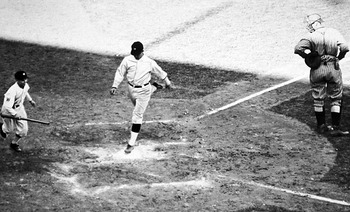
(Muddy Ruel scores the winning run without a throw from Irish Meusel.  John McGraw would berate Meusel on the train ride home demanding to know why he hadn't thrown home to make a play on Ruel.)

The crowd had been on the edge of their seat since the 8th inning frenzy.  All the emotions let loose.  The tension, the anguish, the hoping, the decades of disappointment, everything flooded out in a drowning wave of noise.  This play turned the baseball world on end.  Tom had finally caught Jerry.  The Senators were finally World Series Champions.

First in war, first in peace and first time World Champions!