It was a stale old joke that started in 1901with the start of the American League and the Washington Senators were sick of it. In the first ten years of the league they had finished above 7th (out of 8 teams) twice, and both of those seasons they only reached 6th. They weren't a baseball organization, they were a punchline.
Fans of the Senators had one silver lining: they had the greatest pitcher in the history of the game pitching for one of the worst teams of all time. The next time you hear someone say the Padres need to trade Chase Headley, the Pirates need to trade Andrew McCutcheon or the Rockies need to trade Carlos Gonzalez because no player with that much talent should have to play in a baseball grave yard you can reply with one simple answer: Walter Johnson.
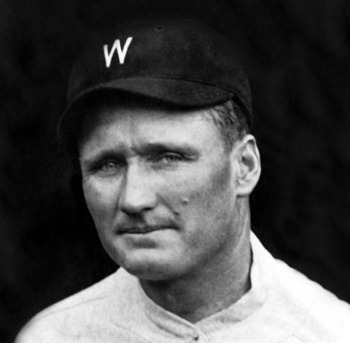
(Walter Johnson won 417 games in his career, second only to Cy Young's 511. He is regarded by many as the greatest pitcher of all time. If anyone wants to read a great baseball book I recommend reading the biography Walter Johnson: Baseball's Big Train by Henry W. Thomas.)
He ended his career with 417 wins, winning 20 games or more 12 times including 33 games one year and 36 another. What makes his career even more amazing is the fact that he achieved these numbers on a terrible team. He won more games by one run than anyone in history but the best stat of all is that he lost more games by 1-0 than anyone else. 26 times in his career he held the opponent to one run and lost the game because the pathetic Senators offense couldn't push across a single run. Imagine the number of wins he could have had with just slight run support. In an era where celebrity was new and baseball ruled the sports world, Johnson was adored. Ruth and Cobb got headlines for the wrong reasons. Johnson got headlines for being polite, humble, ethical, an example to the youth.As the years went on and Johnson plugged along, there were small signs of improvement in the nation's capital and fans tried to be excited. They reached second place three times, a distant second, but they quickly slipped back into the lower division.
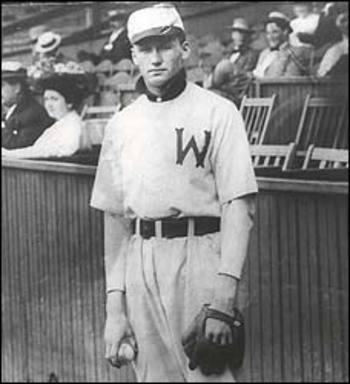
(Walter Johnson spent his entire career with the lowly Washington Senators. Between 1908 and 1923 the Senators finished in the top three only four times. Even in those years they finished 6.5, 14 and 29.5 games behind first place. Little was expected of the Senators as they entered the 1924 season.)
Leading up to the 1924 season Bucky Harris, a young secondbaseman in only his fifth year in the league, was named player-manager. The predictions were dismal and little was expected. Their team was made up of young players who had shown little promise and older veterans seemingly on their way out. Their shortstop, Roger Peckinpaugh, was best known for making an error in the final game of the 1921 World Series, allowing the only run of the game to score.1924 was different somehow. The Senators went 20-4 from mid June to early July and took over first place. You could almost hear the nation chuckle. The Senators in first place. It's like when Jerry stands next to an electrical socket and picks up Tom's tail, then winks at the audience. You know what the joke is but you watch it anyways and you laugh when it happens.
The longer they stayed in the race, the bigger the comedic payoff was expected to be when the Yankees would catch them by the tail. Funny thing was, the Yankees grabbed the tail a few times and tied for first place for a day or so but they could never quite get the punch line to stick. Washington took over first place for good on September 19 and Walter Johnson was named MVP of the season with a 23-7 record. Suddenly this wasn't a joke. This was real.

(Bucky Harris took over as manager before the start of the 1924 season. He was a young, inexperienced manager. He had the support and respect of his teammates and lead the team to their first ever American League pennant.)
Certainly the punch line was just being delayed. The Giants would drop the banana peel for sure. The Giants were the opposite of the Senators. A power house full of cocky, experienced future hall of famers (no less than seven), the Giants had been in the World Series eight times out of the first 19 (it easily could have been an even ten). This was their ninth visit overall and their fourth straight appearance.
In 1921 and 1922 they beat the Yankees and lost to the Yankees in 1923. John McGraw, arguably the best manager of all time, was furious about that loss. He hated Ruth for ruining the game with all these home runs, hated the Yankees for cutting into his New York profits and hated the American League for too many reasons to go into in this article. His Giants had been beaten last year by those AL punk Yankees. The entire 1924 season was about proving that the Giants were still kings and they certainly wouldn't lose to this lousy team. It was almost insulting to lower the great Giant name by beating a second rate organization like the Senators.

(John McGraw managed the Giants from 1902-1932. During that time his teams reached the World Series nine times and won three. He is considered by many the greatest manager of all time. Entering the 1924 season he was still angry at the team's World Series loss to the Yankees in 1923.)
The Senators were not only the underdog fan favorite, Walter Johnson was the nation's favorite. The nation wanted to see Walter succeed. The pressure was on Walter to make his supporters happy. In game 1 he took the loss, though it would be hard to say he deserved to lose it. He pitched 12 innings and lost 4-3. Another 1 run loss. Johnson's second appearance in game 5 was less heroic. He gave up six runs in eight innings and lost again. He was dejected, feeling he had let down his supporters, his team mates and Clark Griffith, the Senators' owner. Almost inconsolable, Johnson felt he had lost his one opportunity at a world title.
As the series moved to game 7, no one wanted to see the punch line land anymore. It wouldn't be funny. It would just be cruel, tragic.
Game 7. Bottom 8th. 2 outs. Runners on 2nd and 3d. Washington 2 runs down.
The basic fundamentals of baseball tell the runners in this situation that they run like hell as soon as they hear the crack of the bat. When you have played the game as often as Nemo Leibold and Muddy Ruel you can often tell from the sound of the bat whether it will be worth the effort.
Bucky Harris made contact and the runners were in motion. The sound was not encouraging. A routine ground ball to thirdbaseman Fred Lindstrom, a great fielding thirdbaseman and a future hall of famer early in his career. Leibold moved the ninety feet and touched home plate, a seemingly useless routine. Ruel also moved on contact and ran as fast as he could, which unfortunately was not that fast. Ruel was generally considered one of the slowest runners in either league. As he neared third base he expected to see the Giants walking toward the dugout as the routine play was executed to end the inning. What he saw instead was the third base coach with his arm spinning fast enough to tear the shoulder out of the socket and screaming at the top of his lungs to get his ass moving. It was too loud for him to hear what was being yelled. Ruel ran faster, or tried to, and rounded third.

(Harry Leibold was nicknamed "Nemo" after his resemblance to the comic strip character "Little Nemo". Nemo had played for the 1919 White Sox and was one of the "Clean Sox" who did not participate in the conspiracy with the "Black Sox". He scored ahead of Muddy Ruel in Game 7 of the 1924 World Series.)
Lindstrom had seen the ball off the bat and readied to field the ball. Hands chest high, knees soft, eyes on the ball. One more hop and he would have it. Then the second most bizarre, unexpected, unpredictable thing in the history of the World Series happened. The ball hit a pebble or hard clump of dirt, or something, and took the biggest bounce you've ever seen, ten feet in the air. Lindstrom jumped as high as he could but the ball went over his head.
Call it what you want. A bad bounce, intervention from the baseball gods, luck. Whatever you call it this game 7 was tied.

(Fred Lindstrom is one of the unluckiest players in history. A strong fielder and future hall of famer, Lindstrom had no chance to field the ball when it took a big bounce over his head in the 8th. His day would get worse.
As the top of the 9th started Walter Johnson took the mound. How much cruelty was this man supposed to take? The nation stopped waiting to laugh and started waiting to cry. This time, when Jerry smacked Tom in the face with the frying pan it wouldn't be a punchline it would be a sucker punch. Tension mounted as the game moved through the 9th, the 10th, the 11th and the 12th inning. Walter was courageous as he continued to set down the experienced Giants lineup but he was constantly in danger. Fans sat on the edge of their seats. Praying, wringing their hands, rocking in their seats, exhaling with each strike, gasping at each ball. It was constant tension.The Giants had runners on 2nd and 3d in the 9th but Walter got a ground ball to work out of trouble. He walked the lead off hitter in the 10th but got a double play ball to escape danger. There were two runners on in the 11th when he got a strike out to keep the game tied. The 12th was the easiest as he gave up a lead off single but nothing else.
The suspense was maddening. If the game took place today, graphics would start appearing on your screen to compare this game to other extra inning World Series games and announcers would be telling you that the longest game in World Series history was in 1916 when a young pitcher named Babe Ruth won 2-1 for the Red Sox, pitching all 14 innings. We would see shots of fans praying, hands over their eyes, waiting for something bad to happen.
If the eighth inning divine intervention wasn't enough to make some people believe the Senators were a team of destiny, the bottom of the 12th made it undeniable. Ralph Miller led off for Washington with an easy ground ball. 1 out. Muddy Ruel had only one hit in 19 at bats to this point in the series. As he stepped in to bat, and Johnson set to bat next, Senators fans wondered how long Johnson would be able to hold out. Ruel swung and popped a ball straight up behind home plate. Hank Gowdy, the Giants Catcher, tore off his mask and tracked the ball. He threw the mask down. The ball had gone straight up, then drifted back toward the plate, drifted some more, it just kept drifting. Gowdy kept tracking it as it came down and was finally ready to pull it in and as he took his last step he planted his foot directly in the discarded catchers mask. It clung to his foot. He shook the foot to get it off. Planted the foot again but the damn mask was still there. He fell to the ground and the ball fell next to him.

(Hank Gowdy was the hero of the 1914 World Series for the "Miracle" Boston Braves. He was also the first active Major League player to volunteer for military service during World War I. The Giants poor luck continued when a drifting foul pop caused Gowdy to trip over his discarded catcher's mask.)
"That mask up and bit Gowdy!" Clark Griffith yelled from his owner's boxed seats. No one could believe what they were seeing.Ruel made them pay with a double to left. Maybe there was some magic left. Johnson stepped in to bat and hit a ball right at Travis Jackson, the shortstop, another hall of famer, who couldn't handle the ground ball and his error allowed Johnson to reach safely.
1st and 2nd. 1 out. Earl McNeely at the plate. A base hit would win it. The Giants moved to double play depth hoping to prolong the game.
On the second pitch McNeely swung and the ball was grounded toward Lindstrom at third. McNeely had average speed and Lindstrom might have to hurry but this was a perfect double play opportunity. Ruel, on second ran like hell, well, as close as someone with his speed could, hoping to decoy Lindstrom into a tag. Lindstrom ignored him and Ruel saw Lindstrom ready to field the ball.
Then the absolutely most bizarre, supernatural, unbelievable thing in the history of the World Series happened. Ruel saw, out of the corner of his eye, a sudden, drastic, desperate motion. It was Lindstrom. Leaping. Reaching desperately to grab the ball that had hit the exact same pebble, or hard spot or whatever it was, and bounced ten feet in the air, over his head. It was eerily similar. He saw the thirdbase coach swinging his arm like a propeller ready for take off.
Ruel didn't have time to look around and see what had happened and the ball didn't get that far into the outfield. As Ruel turned third Irish Meusel ran in from leftfield and fielded the ball. This would be close. Meusel dropped his glove hand, fielded, turned, cocked his arm to fire the ball home and... never made a throw. Ruel came in to score.
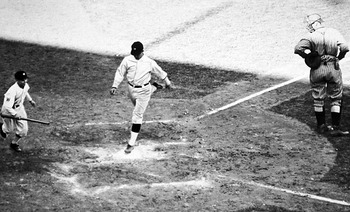
(Muddy Ruel scores the winning run without a throw from Irish Meusel. John McGraw would berate Meusel on the train ride home demanding to know why he hadn't thrown home to make a play on Ruel.)
The crowd had been on the edge of their seat since the 8th inning frenzy. All the emotions let loose. The tension, the anguish, the hoping, the decades of disappointment, everything flooded out in a drowning wave of noise. This play turned the baseball world on end. Tom had finally caught Jerry. The Senators were finally World Series Champions.
First in war, first in peace and first time World Champions!
