Abbott: Well Costello, I'm going to New York with you. You know Bucky Harris, the Yankee's manager, gave me a job as coach for as long as you're on the team.
Costello: Look Abbott, if you're the coach, you must know all the players.
Abbott: I certainly do.
Costello: Well you know I've never met the guys. So you'll have to tell me their names, and then I'll know who's playing on the team.
Abbott: Oh, I'll tell you their names, but you know it seems to me they give these ball players now-a-days very peculiar names.
Costello: You mean funny names?
Abbott: Strange names, pet names...like Dizzy Dean...
Costello: His brother Daffy.
Abbott: Daffy Dean...
Costello: And their French cousin.
Abbott: French?
Costello: Goofè.
Baseball players have always had nicknames. Some are more common than others. The nickname "Red" has been applied to many players including Red Rolfe, the third baseman on the Yankees great 1930's teams and manager of the Detroit Tigers for several years, as well as Red Dooin, Catcher for the Phillies and Red Schoendienst, the Hall of Fame Second Baseman of the Cardinals and Braves. "Lefty" of course applies to a left hand pitcher. "Lefty" Carlton, "Lefty" Grove and "Lefty" Gomez being the most common. There are some truly great nicknames that have been applied throughout the years. Hugh Mulcahy, a pitcher for the Phillies, who lost 20 games in a season twice became forever known as "Losing Pitcher" Mulcahy because Philadelphia Sports Writers said the only time they saw his name in the paper it was always preceded by the words Losing Pitcher. The Waner brothers (Paul and Lloyd) were called "big poison" and "little poison" because when they hit back to back you had to pitch to one of them so you could pick your poison. Padres Catcher Doug Gwosdz was known as eye chart (think about it) and Cardinals Pitcher Mark Rzepczynski is known as scrabble. Al Simmons of the A's was famously known as "Bucket Foot" because he would routinely "step in the bucket" when he swung. Ron Cey, the Dodgers great third baseman, was known as "the Penguin" because of the funny way he ran. My personal favorite of all time is Freddy "Boom-Boom" Beck. "Boom-Boom" pitched for the Phillies and it was said there were two booms on almost every pitch. The first boom was the ball hitting the bat, the second boom was the ball hitting the wall at Baker Bowl.
Baseball players have always had nicknames. Some are more common than others. The nickname "Red" has been applied to many players including Red Rolfe, the third baseman on the Yankees great 1930's teams and manager of the Detroit Tigers for several years, as well as Red Dooin, Catcher for the Phillies and Red Schoendienst, the Hall of Fame Second Baseman of the Cardinals and Braves. "Lefty" of course applies to a left hand pitcher. "Lefty" Carlton, "Lefty" Grove and "Lefty" Gomez being the most common. There are some truly great nicknames that have been applied throughout the years. Hugh Mulcahy, a pitcher for the Phillies, who lost 20 games in a season twice became forever known as "Losing Pitcher" Mulcahy because Philadelphia Sports Writers said the only time they saw his name in the paper it was always preceded by the words Losing Pitcher. The Waner brothers (Paul and Lloyd) were called "big poison" and "little poison" because when they hit back to back you had to pitch to one of them so you could pick your poison. Padres Catcher Doug Gwosdz was known as eye chart (think about it) and Cardinals Pitcher Mark Rzepczynski is known as scrabble. Al Simmons of the A's was famously known as "Bucket Foot" because he would routinely "step in the bucket" when he swung. Ron Cey, the Dodgers great third baseman, was known as "the Penguin" because of the funny way he ran. My personal favorite of all time is Freddy "Boom-Boom" Beck. "Boom-Boom" pitched for the Phillies and it was said there were two booms on almost every pitch. The first boom was the ball hitting the bat, the second boom was the ball hitting the wall at Baker Bowl.
Abbott: Goofè Dean. Well, let's see, we have on the bags, Who's on first, What's on second, I Don't Know is on third...
Costello: That's what I want to find out.
Abbott: I say Who's on first, What's on second, I Don't Know's on third.
Costello: Are you the manager?
Abbott: Yes.
Costello: You gonna be the coach too?
Abbott: Yes.
Costello: And you don't know the fellows' names?
Abbott: Well I should.
Costello: Well then who's on first?
Abbott: Yes.
Costello: I mean the fellow's name.
Abbott: Who.
Costello: The guy on first.
Abbott: Who.
Costello: The first baseman.
Abbott: Who.
Costello: The guy playing...
Abbott: Who is on first!
Costello: I'm asking YOU who's on first.
Abbott: That's the man's name.
Costello: That's who's name?
Abbott: Yes.
Costello: Well go ahead and tell me.
Abbott: That's it.
Costello: That's who?
Abbott: Yes.
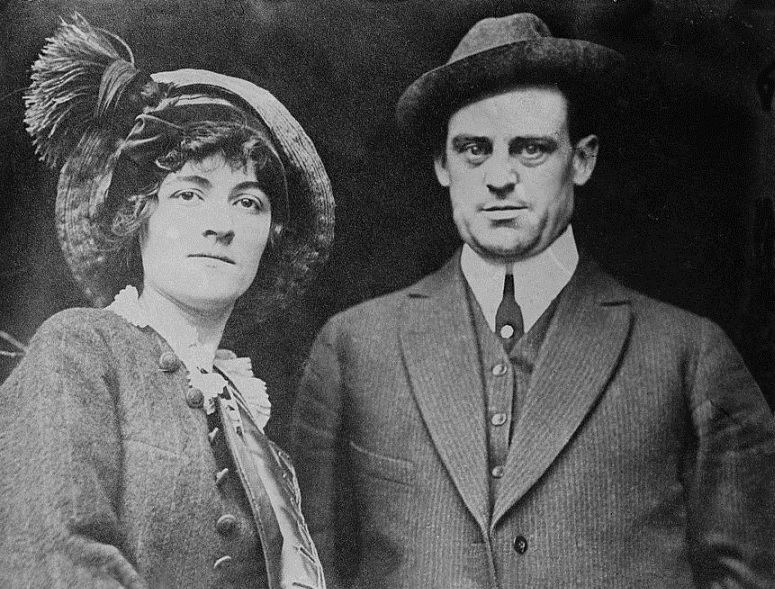
The Vaudeville stage and baseball had a strong connection. Back at the turn of the century baseball stars took to the stage in the winter to make some extra cash. John McGraw, Ty Cobb, Christy Mathewson and Rube Marquard all had strong connections to the stage. Marquard even married a star of the stage in a story out of a soap opera. Marquard and his future wife were having an affair. Her husband accused her of infidelity. She counter claimed abuse. The husband tried to catch the two of them together which led to Marquard scrambling down a hotel fire escape to avoid being caught. You can only imagine what McGraw felt about that kind of distraction.
Joe Tinker, of the famous Tinker to Evers to Chance combination, was a big enough hit to consider quitting the game. "Turkey" Mike Donlin of the Giants actually left the game for a few years over a contract dispute and took to the stage. Donlin was a good enough actor that after his retirement he appeared in several silent films including some Buster Keaton comedies.
The connection went two ways. Don't forget it was a vaudeville man who wrote the baseball anthem. At the turn of the century baseball sketches were all over the vaudeville map. Bud Abbott would have been familiar with many of these. His family was heavily involved in show business as part of the circus. At the age of 16 Bud was working in the box office for a burlesque theater. He went on to promote burlesque tours and by 1924 Bud was himself performing on stage with some of the most famous comedians.
Costello: Look, you gotta first baseman?
Abbott: Certainly.
Costello: Who's playing first?
Abbott: That's right.
Costello: When you pay off the first baseman every month, who gets the money?
Abbott: Every dollar of it.
Costello: All I'm trying to find out is the fellow's name on first base.
Abbott: Who.
Costello: The guy that gets...
Abbott: That's it.
Costello: Who gets the money...
Abbott: He does, every dollar. Sometimes his wife comes down and collects it.
Costello: Who's wife?
Abbott: Yes.
PAUSE
Abbott: What's wrong with that?
Costello: Look, all I wanna know is when you sign up the first baseman, how does he sign his name?
Abbott: Who.
Costello: The guy.
Abbott: Who.
Costello: How does he sign...
Abbott: That's how he signs it.
Costello: Who?
Abbott: Yes.
Lou Costello, the younger of the famous team, was surprisingly athletic and an excellent basketball player. Born in New Jersey, Lou moved to Hollywood to try his luck in the movies. Not possessing the good looks of Valentino, Costello was usually the one doing stunts or building the sets for the movies he would have preferred to star in. By the 1930's few people could handle the strains of the depression and being a sometimes actor was not the best career path so Costello decided to head back home. Half way there he ran out of money. Stuck in Missouri, he took to the vaudeville stage to make some money and started to make a name for himself as a comedian.


Costello: All I'm trying to find out is what's the guy's name on first base.
Abbott: No. What is on second base.
Costello: I'm not asking you who's on second.
Abbott: Who's on first.
Costello: One base at a time!
Abbott: Well, don't change the players around.
Costello: I'm not changing nobody!
Abbott: Take it easy, buddy.
Costello: I'm only asking you, who's the guy on first base?
Abbott: That's right.
Costello: Ok.
Abbott: All right.
The show business gods have a way of forcing people to meet. If Pete Best hadn't had to miss a night playing with the Beatles in Hamburg, they may have never been forced to use the drummer from Rory Storm and the Hurricanes and Ringo Starr may never have been considered to replace Pete Best. As Jimmy Page and John Paul Jones tried to convince John Bonham to join the New Yardbirds, Bonham insisted he would only join if they also hired the lead singer of his band. Imagine what Led Zeppelin would have sounded like if Robert Plant was not the lead singer. As NBC was preparing an American band to rival the Beatles two kid musicians decided to try out just for the hell of it. Peter Tork was chosen to join the Monkees. Steven Stills, his friend, was rejected. Could you imagine Crosby Tork and Nash?
In 1930 as Lou Costello was gaining a reputation as an up and coming comedian. He was all set to go on stage one night but his straight man fell ill. Just his luck, the fates were literally waiting in the wings. Bud Abbott stood in for Costello's wing man and the team worked together for the first time. The two officially became a team in 1936 and by 1938 they were appearing together on the Kate Smith radio show. In March 1938 they first performed the famous sketch. It was an immediate hit. In 1940 they appeared in a movie called One Night in the Tropics where they performed a short version of "Who's on First?".


Costello: What's the guy's name on first base?
Abbott: No. What is on second.
Costello: I'm not asking you who's on second.
Abbott: Who's on first.
Costello: I don't know.
Abbott: He's on third, we're not talking about him.
Costello: Now how did I get on third base?
Abbott: Why you mentioned his name.
Costello: If I mentioned the third baseman's name, who did I say is playing third?
Abbott: No. Who's playing first.
Costello: What's on first?
Abbott: What's on second.
Costello: I don't know.
Abbott: He's on third.
Costello: There I go, back on third again!
PAUSE
Costello: Would you just stay on third base and don't go off it.
Abbott: All right, what do you want to know?
Costello: Now who's playing third base?
Abbott: Why do you insist on putting Who on third base?
Costello: What am I putting on third.
Abbott: No. What is on second.
Costello: You don't want who on second?
Abbott: Who is on first.
Costello: I don't know.
Abbott & Costello Together:Third base!
When the team were given their own radio program they performed the sketch several times. The most famous version was recorded during either 1947 or 1948 as it references Bucky Harris as the Yankees manager. Harris manged the pinstripes for two years, defeating Jackie Robinson and the Dodgers in the 1947 World Series.
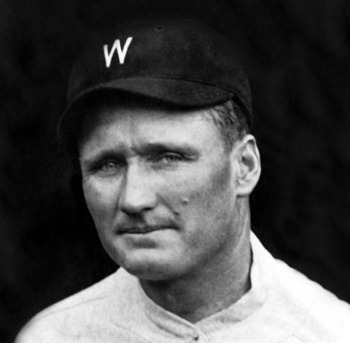
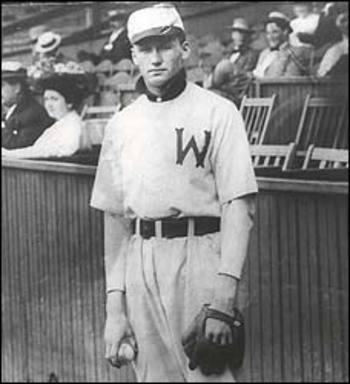
Harris started playing with the Washington Senators in 1919 and by 1924 was managing the Senators. Known as Clark Griffith's "boy wonder" manager, Harris led the Senators to the World Series in both 1924 and 1925, winning the 1924 World Series. He managed the Senators until 1928. He then managed the Tigers from 1929-1933, never finishing higher than 5th. He led the Red Sox in 1934 and finished 4th. He returned to the Senators as manager from 1935-1942, managed the Phillies for 1943. Then came his chance to manage the Yankees for two years (1947 and 1948). The Yankees manager until 1946 had been Joe McCarthy. Hired after Harris was the legendary Casey Stengel. After leaving the Yankees in 1948 Harris returned for a third tour in Washington from 1950-1954 and finally managed in Detroit (second tour) for 1955 and 1956. Harris was inducted into the Hall of Fame in 1975.
Harris started playing with the Washington Senators in 1919 and by 1924 was managing the Senators. Known as Clark Griffith's "boy wonder" manager, Harris led the Senators to the World Series in both 1924 and 1925, winning the 1924 World Series. He managed the Senators until 1928. He then managed the Tigers from 1929-1933, never finishing higher than 5th. He led the Red Sox in 1934 and finished 4th. He returned to the Senators as manager from 1935-1942, managed the Phillies for 1943. Then came his chance to manage the Yankees for two years (1947 and 1948). The Yankees manager until 1946 had been Joe McCarthy. Hired after Harris was the legendary Casey Stengel. After leaving the Yankees in 1948 Harris returned for a third tour in Washington from 1950-1954 and finally managed in Detroit (second tour) for 1955 and 1956. Harris was inducted into the Hall of Fame in 1975.
Costello: Look, you gotta outfield?
Abbott: Sure.
Costello: The left fielder's name?
Abbott: Why.
Costello: I just thought I'd ask you.
Abbott: Well, I just thought I'd tell ya.
Costello: Then tell me who's playing left field.
Abbott: Who's playing first.
Costello: I'm not... stay out of the infield! I want to know what's the guy's name in left field?
Abbott: No, What is on second.
Costello: I'm not asking you who's on second.
Abbott: Who's on first!
Costello: I don't know.
Abbott & Costello Together: Third base!
PAUSE
Costello: The left fielder's name?
Abbott: Why.
Costello: Because!
Abbott: Oh, he's centerfield.
Although the two had become synonymous with the sketch they were not the authors. There is a question as to who wrote the sketch and numerous people claimed it was them. Regardless of who wrote the lines, Abbott and Costello's timing perfected it.
Costello: Look, You gotta pitcher on this team?
Abbott: Sure.
Costello: The pitcher's name?
Abbott: Tomorrow.
Costello: You don't want to tell me today?
Abbott: I'm telling you now.
Costello: Then go ahead.
Abbott: Tomorrow!
Costello: What time?
Abbott: What time what?
Costello: What time tomorrow are you gonna tell me who's pitching?
Abbott: Now listen. Who is not pitching.
Costello: I'll break your arm, you say who's on first! I want to know what's the pitcher's name?
Abbott: What's on second.
Costello: I don't know.
Abbott & Costello Together: Third base!

There is a danger in working closely with a partner. There are cautionary tales everywhere of two partners who work together and have a public face of perfect harmony but have a strained relationship in real life. Lennon and McCartney. Crosby and Hope. Astaire and Rogers. Martin and Lewis. The Sherman Brothers. Steven Tyler and Joe Perry. Even Tinker and Evers had a period where they wouldn't speak to each other under any circumstances, though they still turned a double play better than anyone. Abbott and Costello had a period of not speaking as well. For about two to three years the two would not speak unless they were performing. Legend has it that Costello fired a domestic servant who was immediately hired by Abbott. Costello took it personally and refused to speak to the other. After a few years the frost thawed and the relationship appeared to repair itself.
Costello: Got a catcher?
Abbott: Certainly.
Costello: The catcher's name?
Abbott: Today.
Costello: Today, and tomorrow's pitching.
Abbott: Now you've got it.
Costello: All we got is a couple of days on the team.
PAUSE
Costello: You know I'm a catcher too.
Abbott: So they tell me.
Costello: I get behind the plate to do some fancy catching, Tomorrow's pitching on my team and a heavy hitter gets up. Now the heavy hitter bunts the ball. When he bunts the ball, me, being a good catcher, I'm gonna throw the guy out at first base. So I pick up the ball and throw it to who?
Abbott: Now that's the first thing you've said right.
Costello: I don't even know what I'm talking about!
PAUSE
Abbott: That's all you have to do.
Costello: Is to throw the ball to first base.
Abbott: Yes!
Costello: Now who's got it?
Abbott: Naturally.
Just as with any successful formula, there were plenty of copy cat sketches. The most common variation was the use of rock band names. Instead of Who, What and I Don't Know the most common bands used in the sketch were The Who, The Guess Who, The Band and Yes. This sketch was done on SCTV with Eugene Levy and Tony Rosato and a similar sketch was seen on the animated tv series Animaniacs in the 1990's with Slappy the Squirrel and her nephew Skippy. Another variation was seen on The Kids in the Hall when Dave Foley played the worst vaudeville comedian ever. As Kevin McDonald's character is preparing to be exasperated by his partner Foley stops and explains to McDonald that the names, which sound like questions are really regular names. Foley even goes so far as to explain that the third baseman is "Iduno, Phil Iduno. I-D-U-N-O. But I can see how if you say it fast it could sound like 'Gee, I don't know.' but it's not. It's Phil Iduno."
Costello: Look, if I throw the ball to first base, somebody's gotta get it. Now who has it?
Costello: Look, if I throw the ball to first base, somebody's gotta get it. Now who has it?
Abbott: Naturally.
Costello: Who?
Abbott: Naturally.
Costello: Naturally?
Abbott: Naturally.
Costello: So I pick up the ball and I throw it to Naturally.
Abbott: No you don't, you throw the ball to Who.
Costello: Naturally.
Abbott: That's different.
Costello: That's what I said.
Abbott: You're not saying it...
Costello: I throw the ball to Naturally.
Abbott: You throw it to Who.
Costello: Naturally.
Abbott: That's it.
Costello: That's what I said!
Abbott: You ask me.
Costello: I throw the ball to who?
Abbott: Naturally.
Costello: Now you ask me.
Abbott: You throw the ball to Who?
Costello: Naturally.
Abbott: That's it.
Costello: Same as you! Same as YOU! I throw the ball to who. Whoever it is drops the ball and the guy runs to second. Who picks up the ball and throws it to What. What throws it to I Don't Know. I Don't Know throws it back to Tomorrow, Triple play. Another guy gets up and hits a long fly ball to Because. Why? I don't know! He's on third and I don't give a darn!
Abbott: What?
Costello: I said I don't give a darn!
Abbott: Oh, that's our shortstop.
TRIVIA QUESTION:
Jimmy Fallon's late night show did a sketch featuring the character's of Who and I Don't Know. What two legendary comedians played the two famous characters?
ANSWER TO LAST WEEK'S TRIVIA QUESTION:
The expansion draft for The Angels and replacement Senators team was a disaster. The two teams were given a list of players to choose from. By the rules, no team could lose more than seven players total and neither of the new teams could choose more than four players from any one team. At the end of the final round it was revealed that the Tigers had lost more than seven players, the Angels had selected more than the four player limit from several teams and the Senators had done the same. At that point the two teams had to back track and choose again, return players and trade some players to even everything out. At the end of the draft it was again determined that the Senators had taken too many players from one team. Instead of backtracking again the Senators decided to trade one of the players to the Angels. The Angels had a choice of three players and reportedly their representative said "I don't know who to take. We'll take a chance on Chance." They were referring to Dean Chance who went on to become one of the first stars of the organization finishing third in the 1962 Rookie of the Year voting and winning the Cy Young awared in 1964.
ANSWER TO LAST WEEK'S TRIVIA QUESTION:
The expansion draft for The Angels and replacement Senators team was a disaster. The two teams were given a list of players to choose from. By the rules, no team could lose more than seven players total and neither of the new teams could choose more than four players from any one team. At the end of the final round it was revealed that the Tigers had lost more than seven players, the Angels had selected more than the four player limit from several teams and the Senators had done the same. At that point the two teams had to back track and choose again, return players and trade some players to even everything out. At the end of the draft it was again determined that the Senators had taken too many players from one team. Instead of backtracking again the Senators decided to trade one of the players to the Angels. The Angels had a choice of three players and reportedly their representative said "I don't know who to take. We'll take a chance on Chance." They were referring to Dean Chance who went on to become one of the first stars of the organization finishing third in the 1962 Rookie of the Year voting and winning the Cy Young awared in 1964.