Showing posts with label Pee Wee Reese. Show all posts

Saturday, May 9, 2015

Why Don't the Los Angeles Dodgers Wear That Number Anymore?

Every team in the league has its own legends.  Some legends tower over the history of the game.  Some tower over a certain portion of the history.  Some define an organization and are the first thought anyone has when the team is mentioned.

Each team finds a way to honor their legends, usually with the retirement of the player's number.  For the fans of that team it is easy to sit in the stadium seats, look out on the display of retired numbers and feel pride in the part that number represents to their team's history.  Unfortunately, fans of the visiting team stopping  by to see a game may not know the meaning of those numbers.

So during this series we will explore what the retired numbers for each team mean and why they were retired.

We have already looked at the San Diego Padres and San Francisco Giants in this series.  This week we will look at the Brooklyn Dodgers/Los Angeles Dodgers:


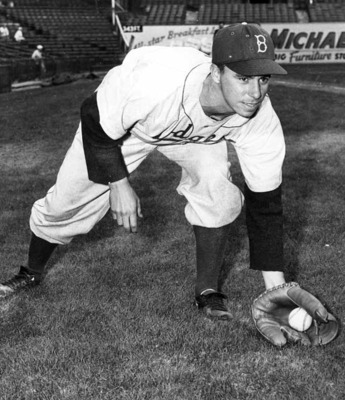
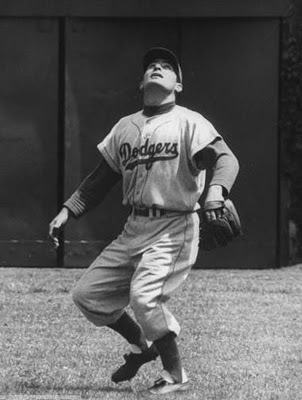
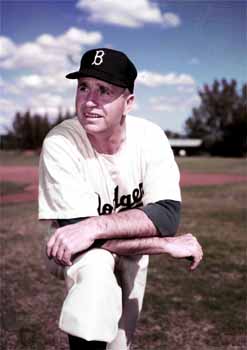
The Dodgers in Brooklyn got a reputation of winners in their final two decades.  It wasn't always that way.  The key man, the leader, in establishing that trend was Pee Wee Reese.  He was the captain, the field leader.  He well earned the #1.  He was more than numbers, he was the guiding force of the Brooklyn Dodgers.  The 10 time All Star also received MVP votes in 12 different seasons.  Pee Wee ranks among the top Dodgers in many categories: WAR (1st), Offensive WAR (2nd) , Defensive WAR (1st), Games Played (3rd), At Bats (2nd), Plate Appearances (2nd), Hits (2nd), Runs (1st), Total Bases (5th), Doubles (4th), Triples (8th), RBI (7th), Walks (1st), Stolen Bases (10th) Singles (2nd), Extra Base Hits (8th). Times on Base (2nd) and Sac Hits (3rd),  Before Pee Wee came along seven players wore the number 1: Johnny Frederick (1932-1934), Buzz Boyle (1935), Freddie Lindstrom (1936), Woody English (1937-1938), Packy Rogers (1938), Gene Moore (1939) and Charlie Gilbert (1940).  While Pee Wee Reese was serving in World War II, the number 1 was issued to Paul Waner (1943 and 1944) and Mike Sandlock (1945).  Following Reese's retirement in 1958 four players wore the number 1 for the Dodgers:  Billy Grabarkewitz (1969-1972), Rick Auerbach (1974-1976), Derrel Thomas (1979) and Gary Weiss (1980-1981).  Reese was inducted into the Hall of Fame in 1984 by the Veteran's Committee.

2

Tom Lasorda pitched two years  for the Dodgers in Brooklyn and lost his spot on the roster to Sandy Koufax.  If you ask Lasorda, he should have been kept instead of Koufax.  His work in those two years (8 games, 0-0, 7.62 ERA) are not why his number is retired.  Lasorda's number is retired because he managed the team for 22 years, won 1599 games as manager and constantly had the Dodgers contending for first place.  Under Lasorda's leadership the Dodgers won 8 division titles, 4 National League Pennants and two World Series.  Before Lasorda took over the team 14 players wore the number 2:  Neal Finn (1932), Joe Judge (1933), Jim Bucher (1934-1937), Leo Durocher (1938-1945), Bobby Morgan (1950-1953), Randy Jackson (1956-1958), Don Demeter (1959-1960), Bart Shirley (1966), Dick Schofield (1966-1967), Zoilo Versalles (1968), Bobby Valentine (1969-1972), Paul Powell (1973), Orlando Alvarez (1973-1975) and Ellie Rodriguez (1976).The number 2 was never issued following Lasorda's retirement.  Lasorda was elected to the Hall of Fame in 1997.

4

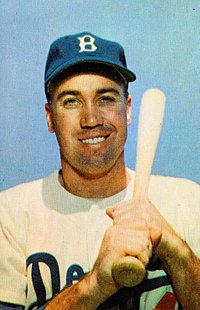
If Pee Wee Reese was the leader of the Brooklyn teams, Duke Snider was the power.  Snider hit 407 career Home Runs and likely would have hit quite a few more if not for the first few years in Los Angeles when the Dodgers played in the oddly shaped Coliseum.  Snider played on six of the Dodgers World Series teams, the first in 1949, and hit 11 World Series Home Runs.  Snider is in the top 10 Dodgers in many categories WAR (2nd), Offensive WAR( 1st), Slugging % (4th), OPS (5th), Runs (3rd), Hits (4th), Total Bases (2nd) , Doubles (2nd), Triples (6th), Home Runs (1st), RBI (1st), Walks (4th),Singles (9th), Extra Base Hits (1st) Times on Base (4th) and Intentional Walks (3rd).  Snider was a long time presence for the Dodgers long after he retired and he loved to mentor young players.  10 players were issued the number 4 before Duke (some of them quite famous in their own right):  Hack Wilson (1932-1934), Frenchy Bordgaray (1935-1936), Tony Malinosky (1937), Bert Haas (1937), Dolph Camili (1938-1943), Gil Hodges (1943), Joe Orengo (1943), Gil English (1944), Babe Herman (1945) and Mike Sandlock (1946).  Three players wore the number 4 following Snider: Tom Hutton (1966-1969), Kevin Pasley (1974-1977) and Bill North (1978).  Snider was elected into the Hall of Fame in 1980.
19

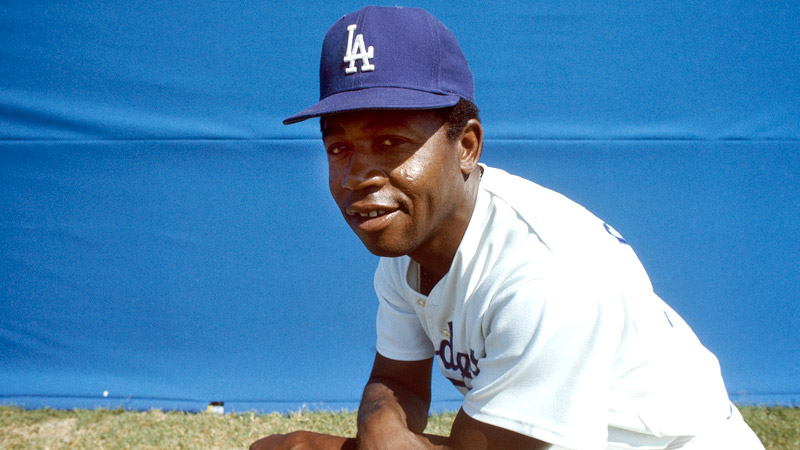
There has been a general rule with the Dodgers management that only players inducted into the National Baseball Hall of Fame in Cooperstown will have their number retired.  That will explain why you don't see Maury Wills, Fernando Valenzuela, Steve Garvey, Orel Hershiser or Kirk Gibson's numbers up there.  There is one exception to this rule: Jim Gilliam.  Gilliam does appear on a number of the Dodgers lists of top ten all time: WAR (8th), Offensive WAR (8th), Games Played (5th), At Bats (5th), Plate Appearances (3rd), Runs (4th), Hits (8th), Total Bases (9th), Doubles (7th), Walks (2nd) Singles (6th), Times on Base (3rd), Gilliam was quite a bit more than that.  He was one of the longest hold overs from the Brooklyn days, spent 14 years as a player for the Dodgers and remained as a coach until his death in 1978, just before his 38th birthday.  During the post season of 1978 the Dodgers wore a patch with the number 19 on their uniform sleeve in honor of Gilliam. Before Gilliam came along 17 players wore the number for the Dodgers: Ray Phelps (1932), Chink Outen (1933), Babe Phelps (1935-1936), Jim Lindsey (1937), Ralph Birkofer (1937), Ira Hutchinson (1939), Herman Franks (1940-1941), Cliff Dapper (1942), Frenchy Bordagaray (1943), Ed Head (1944), Charlie Fuchs (1944), Tom Sunkel (1944), Morrie Aderholt (1944-1945), Cy Buker (1945), Joe Hatten (1946-1951), Johnny Schmitz (1951-1952) and Joe Landrum (1952).    No player was issued the number 19 after Gilliam's death.
20

Don Sutton debuted for the Dodgers in 1966 and joined a defending World Champion.  He finished at 12-12 that year and would not appear in the Dodgers' World Series loss to the Orioles.  Sutton would go on to pitch for the Dodgers for a total of 16 years and win 233 regular season games and another five post season games for the Dodgers.  Sutton was the link in the chain of great Dodgers pitchers between Koufax and Drysdale to Valenzuela and Hershiser.  Sutton was a four time All Star and four times received votes for the Cy Young (all of them top 5 finishes).  Of course Sutton ranks in the top 10 all time Dodgers in many categories: WAR for Pitchers (4th), Wins (1st), WHIP (6th), Games Pitched (1st), Innings Pitched (1st), Strikeouts (1st), Games started (1st), Complete Games ( 8th), Shutouts (1st).  24 players wore the number before Sutton came along:  Sloppy Thurston (1932-1933), Glenn Chapman (1934), Zack Taylor (1935), Harry Eisenstat (1935), George Cisar (1937), Tom Baker (1937), Ernie Koy (1938-1940), Wes Flowers (1940), Kemp Wicker (1941), Larry French (1941-1942), Al Glossop (1943), Tommy Warren(1944), Charlie Osgood (1944), Ralph Branca (1946-1947), Elmer Sexauer (1948), Hank Behrman (1948), Phil Haugstad (1947-1951), Carmen Mauro (1953), Rip Repulski (1959-1960), Turk Farrell (1961), Daryl Spencer (1962-1963), Dick Scott (1963), Larry Miller (1964 and AL Ferrara (1963-1965). 11 players wore the number 20 following Sutton's departure: Candy Maldonado (1982-1985) , Ed Amelung (1986) , Larry See (1986), Phil Garner (1987), Don Sutton (in his return in 1988), Willie Randolph (1989), Mike Davis (1989), Brian Traxler (1990), Darren Holmes (1990), Mitch Webster (1991-1995), Mike Blowers (1996) and Darren Lewis (1997).  Sutton was elected to the Hall of Fame in 1998.

24

For a team as consistently competitive as the Dodgers were in their last two decades in Brooklyn it seems odd that they had so many managers.  There was Leo Durocher, Clyde Sukeforth, Burt Shotton, Durocher again, Ray Blades, Shotton again, Charlie Dressen and finally Walter Alston,  Wearing number 24 Alston led the team to seven first place finishes, seven National League pennants and four World Series wins (the first four in franchise history).  Alston spent 24 years as Dodgers manager and won 2040 regular season games.  In addition to the 7 first place finishes, he led the team to 8 second place finishes.  18 players wore the number 24 before Alston came along: Ed Pipgras (1932), Cy Moore (1932), Jimmy Jordan (1933), Watty Clark (1934), Bobby Reis (1935), Randy Moore (1936), Jim Peterson (1937), Jake Daniel (1937), Buck Marrow (1937-1938), Lee Rogers (1938), Al Hollingsworth (1939) Bill Crouch (1939), Joe Gallagher (1940), Tommy Tatum (1941), Paul Waner (1941) Augie Galan (1941-1946), Bobby Bragan (1947-1948) and Hank Edwards (1951).  No player was issued Alston's number 24 following his departure.  Alston was inducted into the Hall of Fame in 1983.
32

Along with Jackie Robinson, Sandy Koufax could be the most iconic Dodger of all time.  Koufax started with the Dodgers in Brooklyn but did not become a great pitcher until the team moved to Los Angeles.  Koufax was absolutely dominant through 1966 and is considered one of the greatest pitchers the sport has ever seen.  Koufax was a six time All Star, three time Cy Young winner and an MVP.  He ranks high on many Dodgers' categories and would have ranked much higher had his elbow not broken down.  For All Time Dodgers lists he ranks: WAR (3rd), ERA (10th). Wins (5th), Win Loss % (7th), WHIP (4th), Hits/9 IP (2nd), K/9IP (3rd), Games Pitched (7th), K's (3rd), Shutouts (3rd), K/Walk (6th),  18 players wore the number 32 before Koufax: Goody Rosen (1937), Art Parks (1939), Boots offenberger (1939), Jimmy Ripple (1939), Lee Grissom (1940-1941), Bob Chipman (1941), Johnny Rizzo (1942), Rube Melton (1943), Bill Lohrman (1943), Fats Dantonio (1944), Ray Hayworth (1944-1945), Babe Herman (1945), Les Webber (1945-1946) Joe Tepsic (1946), Willie Ramsdell (1947-1948), Cal Abrams (1949-1952), Rocky Nelson (1952) and Bill Antonello (1953),
No player was issued number 32 following Koufax's retirement.  He was elected into the Hall of Fame 1972 on the first year of eligibility.

39

Roy Campanella was one of the most well respected Dodgers of the Brooklyn era and had he not been paralyzed in a car accident likely would have played well into the Los Angeles era.  He was so well respected by the O'Malley's that he was often spoken of as a future manager, twenty years before Frank Robinson became the first African American manager.  An All Star in 8 of his 10 years he was also a 3 time MVP.  He ranks high in many Dodgers categories;  Offensive WAR (10th). Slugging % (10th), Home Runs (4th) and RBI (8th), If he had not been injured he would certainly be higher on many lists.  Only three players wore the number before Campy:  Ray Lucas (1933), John Corridon (1946) and Ed Chandler (1947).  Three players were issued Campy's number 39 following his retirement : Ken Rowe (1963), Howie Reed (1964-1966) and Bob Lee (1967).  Campanella was inducted into the Hall of Fame in 1969.

42

Little explanation is needed for Jackie Robinson.  He is the face of the Dodgers history and much of Baseball's history. Along with Reese and Snider, Jackie dominates the Dodger record books: WAR (3rd), Offensive WAR (3rd), Defensive WAR (7th), OBP (4th), OPS (9th), Runs (7th), Walks (6th), Extra Base Hits (10th), Hit By Pitch (2nd),  What is most amazing about Jackie's numbers is that baseball was considered his 4th best sport.  He was best known for football at UCLA and was an Olmypic athlete in Track.  He also lettered in Basketball while at UCLA.  If he had been allowed to play baseball directly out of college there is no telling what his numbers could have been.  Only 1 player, George Jeffcoat (1939) wore the number 42 before Jackie and only Ray Lamb (1969) ever wore the number 42 following Jackie's retirement. Robinson was inducted into the Hall of Fame in 1962.
Don Drysdale was the counterpart to Sandy Koufax and in some ways a better pitcher.  Drysdale won 209 games in 14 years with the Dodgers.  He represented the team in 8 All Star Games, was a Cy Young Award Winner and four times received MVP votes (twice finishing in the top 5).  Drysdale and Koufax defined the first winning era of the Los Angeles chapter.  He leads even Koufax in many of the Dodgers pitching categories: WAR for Pitchers (2n), Wins (2nd), Games Pitched (2nd), Innings Pitched (2nd), Strikeouts (2nd), Complete Games (6th), Shutouts (2nd), Prior to Drysdale no player ever wore the number 53 for the Dodgers.  Following Drysdale only Tom Paciorek (1970) ever wore the number.  Drysdale entered the Hall of Fame in 1984.

TRIVIA QUESTION:
As mentioned in today's article, with the exception of Jim Gilliam, the Dodgers' team policy has generally been to not retire a player's number unless they are elected to the Hall of Fame.  This leaves quite a few players with major impacts on the team history without thatt honor.  One player spent 14 years of a 19 year career with the Dodgers, won an MVP, received MVP votes 8 times as a Dodger (including a second place finish), made eight All Star Teams and won 4 Gold Gloves.  He also is among Dodgers top 10 lists in a number of categories: WAR (9th), Games Played (9th), At Bats (8th), Plate Appearances (8th), Hits (5th), Total Bases (6th), Doubles (3rd), Home Runs (6th), RBI (5th),Strikeouts (9th), Singles (7th)Extra Base Hits (6th), Times on Base (9th), Sac Flies (3rd), Intentional Walks (4th).  In addition to all  that, this player was the leader on 4 Dodger Playoff Teams (all of which made the World Series and one of them won) and won an NLCS MVP with the Dodgers.  After leaving the Dodgers he played in another NLCS and won an NLCS MVP with that team.  The man also holds the National League record for consecutive games played.  Who is this?

Answer to Last Week's Trivia Question:
Amos Wilson Rusie, known as the Hoosier Thunderbolt, played 10 years in the Major Leagues.  He started in 1889 with his hometown Indianapolis Hoosiers going 12-10 with a 5.32 ERA.  When the Indianapolis franchise closed shop because of financial issues, Rusie was sent to the Giants.  Rusie would pitch for the Giants from 1890-1898, although he would miss all of 1896 as a hold out.  In his 8 seasons with the Giants, Rusie never won less than 20 games (his lowest total was 20).  His win totals were amazing: 29, 33, 32, 33, 36, 23, 28 and 20.  Rusie won the 1894 Pitching Triple Crown, twice had the league's top ERA, led the league in strikeouts 5 times and four times led the league in shutouts.  Rusie was inducted in the Hall of Fame by the Veterans Committee in 1977.

Saturday, October 11, 2014

Almost a Dynasty: 1950's Dodgers

What actually makes a sports dynasty?  Obviously a teem needs to be successful for a continuous amount of time.  Every sport has that one iconic dynasty that fits the Dynasty category.  The NBA had the Boston Celtics who won nine out of ten championships.  The Montreal Canadiens won 7 of nine Stanley Cups (including six straight).  The NFL had several dynasties including the 49'ers, the Steelers, the Cowboys and, most recently, the Patriots.  Baseball itself has had the Yankees dynasties in several incarnations including the 1930's, 1950's and 2000's.

So what actually makes a team a dynasty?  There can of course be several definitions since there are varying levels of success.  A team can dominate their division for a decade but be bounced out in the first round of the playoffs year after year.  We could of course consider that to be a divisional dynasty but you wouldn't call it an overall baseball dynasty.  So let us set the parameters for this series of articles.  A dynasty, for our purposes here, is a team that wins multiple World Series championships (above two as back to back is nice but not a dynasty) within a 5-10 year period.  That being defined, this series will explore those teams that may have been a divisional or league dynasty but for whatever reason could not get over the hump to that World Series dynasty.

This series will show an array of near dynasties.  Some are teams that made the World Series year after year but fell short.  Others will be teams that competed right down to the end of the regular season year after year just to be beaten out.  It will be a series of near misses and what could have beens.

Don't miss the other almost dynasty articles: The Detroit Tigers of the 1900's, The Chicago White Sox of the 1910's, the Pittsburgh Pirates of the 1920's and the Boston Red Sox of the 1940's.  Now let's get started with this weeks "almost dynasty": The Brooklyn Dodgers of the 1950's.

Sowing the Seeds of Sorrow:
The "almost dynasty" of the Brooklyn Dodgers in the 1950's started long before the 1950's.  The Dodgers in Brooklyn were the city itself.  It was part of the largest city in the United States struggling to retain a small town feel.  Of course they were known for the Brooklyn Bridge but they took pride in their Dodgers, even during the bad times.  The Dodgers of the 1930's were known more for their goofy antics than they were for their success.  The team earned the nickname "the Daffiness Boys" for their seeming constant errors.  The most famous being a play where three Brooklyn base runners ended up on the same base.  The team had to fight hard to overcome that image.

They did so in 1941.  The image that replaced it was the image of heartbreak.  The Dodgers in 1941 surprised many people by not only reaching the World Series but putting up a fight against the dominant Yankees.  They entered the ninth inning of Game 4 with a lead that would tie the series at 2 games.  This is where the "almost dynasty" takes root.  On the final strike of the game, theoretically ending the game, the ball got past Catcher Mickey Owens allowing Tommy Henrich to reach base.  The Yankees took advantage of the miscue and won that game, then rolled through the team to the World Series title.  1946 was no picnic either.  The team could have won the National League again and faced off against  Ted Williams, Johnny Pesky and the Red Sox.  Instead, they were tied with St.Louis on the final day and lost the first ever National League Playoff to the Cardinals.  (The game played between the Giants and Cubs after the 1908 season was technically not a playoff.  It was called a "replay" of the disputed Merkle game.)  The 1947 Dodgers overcame the hate they faced as a result of breaking baseball's color lines and the last minute suspension of their manager and won the National League but were dominated by the Yankees in the World Series.  1949 again saw them win a close National League race only to fall short, again to the Yankees.

The 1940's could have been the Dodger's near dynasty, if only the 1950's were not so much more heartbreaking.

The Core Eight:
While the Yankee dynasty of the 1990's-2000's had what was considered the "Core Four" of Jeter, Posada, Pettite and Rivera (although Tino Martinez, Paul O'Neill and Bernie Williams should also get more recognition for their participation in that group) the Dodgers had what some might call a core eight.

The 1940's Dodgers had a strong group of players including Dixie Walker, Mickey Owen, Eddie Stanky, Kirby Higbe, Hugh Casey and Pete Reiser.  By the time the 1949 season rolled around it was an almost brand new team.  Reese remained from the 1941 team but even between 1947 and 1949 the team was greatly changed.  So who are the core 8?:

Pee Wee Reese:  One of a million missed opportunities for the Red Sox, Manager Joe Cronin felt his body could sustain a few more years as player-manager in Boston.  That made short stops in the Boston system expendable so in 1939 the Red Sox traded Pee Wee Reese to Brooklyn for $35,000 and three players.  Reese played only half of the 1940 season but was the team leader on the 1941 World Series team.  He would miss three seasons serving in World War II.  He would become the face of the franchise.  The quiet leader.  The captain.

Carl Furillo:  AKA the Reading Rifle.  Signed with the Dodgers before the 1941 season but did not see any action until he returned from World War II.  He was known for his defense but also won a batting title.  He was a ferocious competitor and under rated part of the Dodgers almost dynasty.

Gil Hodges: Hodges, like Furillo, signed before World War II, although Hodges actually appeared in one game before shipping off to the Marines.  Hodges was originally signed as a Catcher and spent most of the time on the bench watching the other Catchers.  When First Baseman Preston Ward hit a slump Durocher threw Hodges onto first and he stuck.

Jackie Robinson: Jackie joined the Dodgers in 1947 and immediately became a spark on the team.  He was the man who made the Dodgers go.  Few players in history could change the game like Jackie did.  He was once referred to as "Ty Cobb in Technicolor".

Roy Campanella:  Campy signed with the Brooklyn organization shortly after Jackie Robinson but did not make his debut with the big league Dodgers until 1948.  Campy would be one of the biggest contributors offensively and defensively.  He would make eight All Star Teams in ten seasons and would win three MVP awards.

Don Newcombe:  Big Newk was signed shortly after Campy and Jackie.  He made the big league team in 1949 and had an immediate impact.  He lost two seasons to the Korean War and unfairly gained a reputation for being unable to win the big game.  Big Newk was the undisputed ace of the team and the "almost dynasty" wouldn't have existed without him.  In fact had it not been for the two years in Korea, it likely would have been a real dynasty.

Duke Snider:  The Duke of Flatbush signed with the Dodgers before the 1943 season but did not appear until after the war.  While many of those above contributed to the 1947 World Series team, Duke would come late to the party.  He would be the big hitter in the Dodgers' "almost dynasty" and would have a love/hate relationship with the fans.

Carl Erskine: Known to the fans as "Oisk" because of the way the Brooklyn accent played with his name.  Carl would pitch two no-hitters in his career and if not for arm problems that sometimes made it impossible for him to lift his throwing arm high enough to comb his hair, Oisk might have made the Hall of Fame.

These were not the only key players of the almost dynasty but these eight were the group that did most of the heavy lifting.  As you'll see, starting with 1950, the other contributors also made legendary contributions.  Some good and some bad.

The Wide Turn and the Whiz Kids:  
Thirty years later Richie Ashburn sat in a broadcast booth in the Astrodome with Harry Kalas.  It was October of 1980 but the topic, as a young Marty Bystrom warmed up to face the Astros in the deciding game of the NLCS, was pressure.

"Rich, what was the most pressure packed game in which you were ever involved as a player?"  Kalas asked casually.
"Well the last game of that '50 season obviously.  It was either win or go into a playoff."

The "almost dynasty" of the Dodgers started immediately in the 1950's.  The Phillies' young group of 1950 were known as the Whiz Kids.  They had surprised the league to lead most of the year but as the season wound down their lead was down to two games with two games to play.  Those last two games were against the Dodgers, the team charging hard at the end of the season.  If the Dodgers won both games they would tie for first and play a three game playoff against the Phils.  Lose one and they were done.

Ebbets Field was tense in the Saturday opener of the two game set.  In the bottom of the 5th the game was scoreless.  Each scoreless inning increased the pressure.  Campy struck out to start the 5th but Third Baseman Billy Cox singled and went to second on Pitcher Erv Palica's ground ball.  Dodgers fans started to cautiously stir.  There was still another batter before Pee Wee and Duke made their appearance and they had already seen their team leave three runners on base this game.  The hitter was Cal Abrams, today's Left Fielder.  Abrams broke the scoreless tie with a single.  Pee Wee followed with a triple and when the Phillies brought in their MVP Jim Konstanty, the Duke rudely greeted him with a 2 run Home Run giving the Dodgers a 4 run lead.  The Whiz Kids would cut the lead to 4-3 but Campy would take away any doubt in the bottom of the 8th with a Three Run Home Run.  The Dodgers were now one game back with one game to play.

On the mound for the Dodgers in the season finale was Big Newk.  He was facing off against the Phillies ace Robin Roberts.  If Saturday was tense Sunday's game had people being fit for straight jackets.  For the first five innings neither team scored.  It was now half way through the game and stomachs churned a little louder as the game inched on.  Every called strike got a little groan, every ball was a little victory.  The Phillies came to bat in the 6th.  Eddie Waitkus and Richie Ashburn went down for two quick outs and it looked like the Dodgers would have another easy inning.  Dick Sisler singled to Center Field causing some anxiousness in the crowd.  Del Ennis followed with a single and the crowd grew restless.  Stepping in was Willie (better known as "Puddin' Head") Jones.  Puddin' Head hit a ground ball up the middle that scored Sisler but Snider got to it quickly enough to hold Ennis.  Dodgers fans were sure this was the negative sign they had dreaded.  Beaten by Puddin' Head.  Then the unthinkable happened in the bottom of the inning.  The Dodgers tied it on a Home Run.  It wasn't Hodges, Snider or Campy.  It wasn't even Jackie.  It was Pee Wee!  The little guy who had hit only ten Home Runs all year hit one out (barely, it got stuck in the screen for a ground rule Home Run).  But hell, a tie game is a tie game and a Home Run from Pee Wee was a sign that the Dodgers were going to win it all.

The Dodgers were energized entering the bottom of the 9th still tied.  Cal Abrams walked to lead off the inning and now they were sure.  Reese singled sending Abrams to second and there were two on and no out with Duke, Jackie, Furillo and Gil to follow.  There was no way they didn't win this.  Snider lined a single to center and Ebbets Field was louder than ever.  It was over.  But what was it that Yogi said?

Abrams took off for third.  Ashburn, the Phillies Center Fielder, had a notoriously week throwing arm.  The scouting report was he was no threat to throw someone out.  Abrams hit the bag at third with Third Base coach Milt Stock screaming "Go! Go! Go!"

Abrams turned the bag (history has blamed him for turning too widely and costing him precious steps) as Ashburn fielded the ball.

Abrams sprinted for home.

Ashburn picked it up on one hop.

Abrams kept running.

Ashburn turned and fired a perfect strike to Stan Lopata at the plate.

Abrams stopped running.  Out at the plate.  With Robinson, Furillo, Hodges and Campanella due up next and only one out the Dodgers should have still won it but the out at the plate deflated the crowd.  For decades Cal Abrams was public enemy number one.  Public enemy number two may have been the Phillies' Dick Sisler, who hit a three run Home Run in the top of the 10th sending the Whiz Kids to the World Series and the Dodgers home disappointed for another long winter.

Say Hey!:
Any lasting effects from the last day loss in 1950 seemed to have disappeared.  Although they wouldn't pay immediate dividends, the Dodgers made some tremendous signings in the off season.  Signings that would feed the "almost dynasty" long into the future:  Joe Black, Jim Gilliam, Johnny Podres and Maury Wills.  The Dodgers took over first in mid May and by mid August they had built a 13 game lead.  They were starting to count their chickens (or playoff bonuses) with a month and a half left.  The closest team was the Giants.  There was no way they would catch the Dodgers.  It was over.

What was it that Yogi said?

The Dodgers went 27-24 the rest of the way.  Normally that record does well enough to maintain a 13 game lead.  Not when the Giants, led by Durocher and Willie Mays go 39-8.  The lead shrank and the Dodgers needed a 9-8, 14 inning win on the last day of the season just to remain tied and force a playoff against the Giants.

The Dodgers lost the first game of the series at home 3-1.  Game 2 was in the Polo Grounds and the Dodgers played like a team angry that Durocher was trying to take their pennant.  Jackie started it in the first with a Two Run Home Run.  Jackie would go 3-5 with 3 RBI on the day.  Rube Walker (playing for an injured Campy), Hodges and Andy Pafko would also hit Home Runs and the Dodgers won 10-0, tying the series.

The final game was played at the Polo Grounds but after the 10-0 demolishing the Dodgers were confident.  Say Hey! kids.  It was nice seeing you but it will be nicer seeing you go, especially you Leo.  You all head home.  We'll take on the Yankees.

The Dodgers confidence skyrocketed in the Top of the 8th.  Tied at 1, the Dodgers got to Sal "the Barber" Maglie.  The situation may have been too tense for Jackie to make his normal Maglie joke before the game. "Don't bother shaving. Maglie will pitch you close enough to do it for you."  To start the 8th Furillo shot a ball straight back at Maglie but Maglie caught it for out number one.  The two tough men may have glared at each other.  Furillo silently saying "I wish it would have hit ya, ya bastard."  Maglie silently saying "Sit down ya Dodger son of a bitch."  Reese and Snider singled. A Maglie wild pitch scored Reese.  Jackie was walked intentionally.  Pafko singled scoring Snider.  After a Hodges pop out, Billy Cox singled scoring Jackie and it was 4-1 Dodgers.

Big Newk pitched a perfect 8th and the Dodgers just needed three more outs. He gave up back to back singles before getting Monte Irvin to foul out.  When Whitey Lockman doubled Newk's day was over.  And then came Ralph Branca to face Bobby Thompson.  Cue Russ Hodges.

One Step Closer:
1950 saw the Dodgers come within a wide turn of forcing a three game playoff.  1951 saw the Dodgers lose a three game playoff.  In 1952 these guys were not messing around.  They won the NL by 4 1/2 games (though it wasn't necessarily that close) and faced the Yankees, who were playing in their fourth straight World Series.

Although it had only been a few years since the 1949 World Series this Yankees team was different.  DiMaggio, Keller, Henrich were gone.  Rizzuto, Reynolds, Raschi and Berra were still there but new were Martin, Mantle and Joe Collins.

This year was different.  In 1941 the Dodgers had shot themselves in the foot with the Owens passed ball.  In 1947 and 1949 they were just overpowered by a great Yankee team led by The Great DiMaggio.  In 1952 they actually struck first, they won Game 1 behind rookie pitcher Joe Black's complete game.  They lost Game 2 7-1 but came back and won Game 3 behind Preacher Roe.  Not only did they win it, they won it in Yankee Stadium with two runs in the 9th to beat the Yankees at home.  Joe Black pitched again in Game 4 and held the Yankees to only 2 runs.  Unfortunately Allie Reynolds was better holding the Dodgers to 0 runs to tie the series at 2.  The Dodgers had missed an opportunity, behind Black's well pitched game, to take a commanding 3-1 lead.

If Game 4 was a missed opportunity, Game 5 was a statement.  With a chance to take the lead again, Carl Erskine took the mound.  The Bums scored one run in the 2nd but left the bases loaded.  When they scored three more in the 5th (thanks to a Pee Wee sac fly and a two run blast from Duke) it looked like the men left on base was an after thought.  Hank Bauer started the bottom of the fifth with a single.  Billy Martin duplicated it.  Irv Noren pinch hit for the pitcher and followed Bauer and Martin's example, scoring Bauer.  Gil McDougald grounded to Reese who forced Noren but Martin scored.  It was 5-2.  Still a safe lead.  Rizzuto singled McDougald to third but when Mantle popped out for the second out Dodgers fans breathed a sigh of relief.  The collective released breath from Brooklyn may have created a tail wind because the next batter, Johnny Mize, launched a three run Home Run to tie the game.  In other years this team would have quit but not after last year.  This team fought back.  Snider had an RBI single in the 7th to tie it up.  In the top of the 11th Duke would untie it with an RBI double and the Dodgers were one game away from their first ever World Series win.  I wonder if Yogi said anything to the Dodgers after the game.

With elimination looming the Yankees started one of their Aces, Vic Raschi.  The Dodgers started... well let's see.  Erskine?  No he started Game 5.  Joe Black?  Nope. Newcombe?  Nope, he was in the military. (oh, how different it could have been if Big Newk were available).  Branca or Preacher Roe?  Nope.  The choice to start a potentially clinching game was... Billy Loes.  His name may not immediately jump out like Branca, Erskine or Newk but Billy Loes was 13-8 in 1952 and he had a 2.69 ERA.  So although it wasn't the flashy pick it was a good choice.  Through 6 innings he had allowed only 2 hits and 2 walks but no runs.  Raschi was just as good through 6 allowing only four hits and no runs.  It was another gut squeezing game.  In the bottom of the 6th the faithful at Ebbets Field thought they had it made.  Duke (they loved him again) led off with a Solo Home Run to give the Dodgers a 1-0 lead.  It didn't last long.  Maybe Yogi didn't say it out loud but his bat said it for him.  He led off the Top of the 7th with a game tying Home Run.  Then, missed opportunity number 2 for the Dodgers.  Gene Woodling walked.  Unnerved, Loes balked  Woodling to 2nd.  In true Dodgers fashion he didn't just balk.  He came set,  Thought about what he wanted to throw and then.,, he dropped the ball.  It just fell to the ground and Woodling advanced to second. Irv Noren struck out and Billy Martin popped up.  Two out.  All Loes had to do was get the pitcher and they were out of the inning.  Raschi hit a weak ground ball back to the mound.  Loes didn't react.  It hit off his leg, rolled into right field and Woodling scored from second on the error from Loes.  So what happened?  Loes lost the grounder, he said, in the sun.  What?  How can you lose a ground ball in the sun?  Erskine backed him up.  "In October the sun is right between the decks for probably no more than a couple mintues' time.  And that's exactly when that happened, and when Loes said he lost it in the sun everyone laughed, and the fact is, if you ever pitched in Ebbets Field you know that's possible in October with a ball that's hit with a little bounce on it."  In the top of the 8th Mantle made his presence known with a solo Home Run to give the Yankees a 3-1 lead.  Snider hit his second Home Run of the game but no one was on base so the Yankees lived on for one more day.

Joe Black started Game 7 and the Dodgers were confident they had this one already.  Neither Black nor Reynolds was dominant.  The Yankees struck first in the fourth.  The Dodgers answered right back in the bottom of the third.  The Yankees took the lead again in the 5th on a Gene Woodling Solo Home Run.  The Dodgers answered in the bottom 5th.  The Yankees scored again on a solo Home Run from Mantle in the 6th.  The Dodgers were silent in the 6th.  The Dodgers scored in the 7th.  The Dodgers were silent in the 7th.  Well not exactly silent.

Here was missed opportunity number three.  Furillo walked to start the inning.  For Carl it was nothing more than a walk.  There was no hand clapping on the way down to first.  At this point it was nothing but a base runner.  Rocky Nelson pinch hit for Preacher Roe.  With a 1-1 count (Nelson and the crowd thought it should be 2-0) Raschi threw well outside and the Dodgers dugout came to life.  Cookie Lavagetto, Dodgers coach and fan favorite, was loud in rooting Nelson on.  Nelson popped a ball up to short.  Rizzuto fought the sun but caught the ball.  Billy Cox stepped in. The count went to 3-2.  Benches started to get uneasy.  Sitting positions were shifted.  Hats, the same ones that had sat in the same position for innings, now felt tight or tilted.  The hats came off as nervous hands ran through hair.  Cox lined a single sending Furillo to third and Pee Wee came to the plate with Duke on deck. As the count went to 3-1 Stengel got nervous. Yelling from the dugout he eventually took a walk to the mound.  The next pitch came in and Pee Wee started to walk to first but was called back.  It didn't take long for him to get to first.  He walked on the next pitch and Snider strode to the plate to face a new pitcher.

Bases loaded.  1 out.  All they needed was a base hit.  On an 1-1 count Duke checked his swing on an outside fastball and fouled it off.  He was furious with himself.  He shouldn't have even offered at it.  The count went full and the tension got bigger.  Snider swung and connected on the next pitch. It was on the outside part of the plate and if he could have made perfect contact with it he could have driven it for at least a double.  Instead it was popped up. The infield fly rule was called and there were two out.  That brought up Jackie Robinson.  Two out.  Bases loaded.  If there was any one person you would want at the plate in this situation it was Jackie.  He swung through strike one.  The Yankees stirred.  Ball one.  The Dodgers bench stirred.  On the mound Bob Kuzava fidgeted between pitches, played with the rosin bag.  Ball two and Yogi didn't like this one.  He started growling at the ump.  Lavagetto was still pacing, clapping, yelling from the dug out as Robinson fouled off another pitch.  It was on the inside part of the plate, the kind of pitch Jackie would love to pull.  He just pulled it too far.  The next pitch was identical and Jack tried to pull it inside the bag.  Foul ball.

With the bases loaded and a two run lead the Yankees were playing the middle infielders back and the corner fielders were guarding the line.  The next pitch was out over the plate.  Jackie swung.  Connected.  It went straight up in the air.  With two out Furillo was moving and crossed the plate.  Behind the plate Berra waited for Kuzava to take charge.  Cox hit third and turned the corner.  On the mound Kuzava looked straight up.  Watching.  Reese started jogging to second.  At short stop Rizzuto started to amble towards the mound.  Cox noticed the lack of urgency on the Yankees part and he headed home.  At second base Billy Martin knew this was not his ball.  It was Kuzava's or maybe Collins' at first.  Reese rounded second and headed for third as the ball started coming down and the Yankee fielders stood motionless.  Martin sprinted towards the infield.  Robinson was at second by now.  Dodgers fans saw the ball falling.  Jackie and Reese saw the same.  Cox crossed the plate.  Martin kept sprinting.  If the ball fell to the ground Furillo and Cox would have scored and Reese had a good chance.  Martin kept running.  Kuzava watched.  Rizzuto had lost it in the sun.  The ball was falling.  Martin sprinting.  Falling.  Sprinting.  Falling. Martin reached the field grass in front of the mound.  He stuck his glove out and just below his knees the ball dropped in his glove.  Three outs.  Threat over.  For all intents and purposes, Series over.  Better luck next year.

Again:
1953 was similar to 1952 in the fact that the regular season was an almost foregone conclusion by June.  Brooklyn ran away with the pennant by 13 games.  They finished with a 105-49 record.  Their World Series opponent again was the Yankees.  The Dodgers lost the first two games. won the second two and it looked like seven games again.  The Yankees took a 3-1 lead into the 9th inning of Game 6.  The Dodgers tied it when Carl Furillo launched a two run Home Run.  Dodgers fans, who moments before had given up, raised their eyes for a moment.  Maybe there would be a Game 7.  It didn't last long.  A Billy Martin single in the bottom of the 9th scored Hank Bauer giving the Yankees their fifth straight World Series win.  The Dodgers almost dynasty now had a clear pattern and the Dodgers were becoming the lovable losers.

Where the hell did they come from?
The Dodgers' 1954 season was not bad.  They won 92 games.  The problem was Leo Durocher and the Giants were better.  The Giants took over first on June 9 and although the Dodgers would continue chipping away at the lead they could never quite overtake the Giants.  While the Giants faced off against the heavily favored Indians the Dodgers brooded over another missed opportunity to win it all.

The off season brought Jim Gilliam to the team and there was a question of where he would play.  Gilliam was a second baseman, Jackie Robinson's position.  What about Billy Cox?  He was traded to Baltimore with Preacher Roe leaving Third Base open.  Jackie did not want to move to third but in the end he did.

Finally?:
There was drama in the 1955 season and it mostly centered around the fact that the Dodgers were now aging.  Robinson, Reese, Campy and Furillo were all now slowing down.  Snider and Erskine were middle aged.  Injuries were starting to take their toll.  There was a question of how long the window would remain open.

The National League picture had slowly been changing.  The Giants won in 1954 and the Braves were coming soon.  The Dodgers were building their youth for the future.  Roger Craig, Jim Gilliam, Johnny Podres, Sandy Koufax, Don Drysdale and Don Zimmer looked like they would keep the train rolling for longer but could they accomplish what the core eight had done.  One other player intended to be part of the new core was stolen away by the Pirates and their new club President, Branch Rickey.  Rickey had an eye for talent so when they had a chance to steal Roberto Clemente from the Dodgers, they jumped at the chance.

The 1955 Dodgers ran away with the league...again.  Their opponent for the 1955 World Series was the Yankees...again.  Big Newk lost Game 1 to Whitey Ford 6-5.  Billy Loes lost Game 2 to Tommy Byrne 4-2 and suddenly the Dodgers were down 2 games to 0.  The series shifted to Ebbets Field and the Dodgers fans expected this to be quick but painful.  Instead, the Dodgers scored runs in bunches, winning Game 3 8-3.

The Yankees jumped out to 3-1 lead in Game 4 which gave the impression that the series would have the same score by the end of the day.  In the bottom of the 4th Campy hit a solo shot to cut the lead to 3-2.  Furillo immediately followed with a single.  Up stepped Gil Hodges.  The big, intimidating ex-marine and future manager of the Miracle Mets.  Hodges, who had long overcome the pain of his horrible 1952 season, gave the Dodgers the lead with a two run Home Run.  One inning later, with Reese and Gilliam on base, Duke Snider hit a three run Home Run.  It gave the Dodgers a secure lead in the game and a tie in the Series.  Game 5 went to the Dodgers behind 6 strong innings from Roger Craig.  The Dodgers were (again) only one game from winning a World Series.

With the season on the line the Yankees wasted little time in putting up their fight.  Dodgers Starter Karl Spooner finished the game with 1/3 inning pitch.  He gave up 2 walks, three singles and a three run Home Run.  That made the game 5-0.  It would not get any better for the Dodgers that day.  To this point in the series the home team had won every game.  If the Yankees won Game 7 it would be the first time a home team had won every game of a 7 game series.  If they lost it meant it was the first time a Dodgers team had won the World Series.

The Yankees started Tommy Byrne.  The Dodgers started... Johnny Podres.    Podres?  Had Dodgers fans  not learned from the disaster of Billy Loes a few years before? Podres was brilliant.  Campanella scored the first run of the game on an RBI single from Hodges.  A sac fly from Hodges in the 6th gave the Dodgers a 2-0 lead.  Now Dodgers' fans just had to sit and wait for the disaster to strike.

It didn't take long.  Don Zimmer had started the game at second.  The Dodgers had pinch hit George Shuba for Zimmer the inning before hoping to get an extra run.  It hadn't worked so as the bottom of the inning started some movement occurred in the Brooklyn defense.  Jim Gilliam moved to his natural position at second base.  That left an opening in Left Field.  The solution was a seldom used outfielder named Sandy Amoros.  Billy Martin opened the inning with a walk.  McDougald followed by trying to sacrifice Martin to second.  Instead he ended up with a single and two runners on base with no out.  Up to the plate stepped Yogi.  As Yogi always said about it being over...

The Dodgers outfielders were shifted towards the right.  Way to the right.  Berra never could drive a ball to left field.  Shocking everyone, Berra connected on a pitch that headed towards the left field corner.  Dodgers fans were sure this was it.  Amoros started running towards the ball.  Martin and McDougald were sure they would both score.  Berra had thoughts of a triple.  Amoros ran like hell.  He just ran until he was almost out of room and stuck out his glove.  The ball smacked in his glove.  The umpire's fist shot up in the air.  The runners, Martin and McDougald, stopped dead and reversed direction.  It was chaos.  As we have always said on the baseball eras blog, it does not matter what causes the chaos.  What matters is how you react to the chaos.  Amoros, with the ball secure, tried to stop but with his speed and momentum he couldn't stop dead.  He slammed into the wall, using the fence to stop his momentum.  He quickly recovered, turned and threw to Reese.  Reese, reacting quickly to the chaos, turned and threw to first.  McDougald slid back in but Hodges had already caught the ball.  Double play.  Threat over.  Where Billy Loes had failed a few years earlier, Johnny Podres had succeeded.

The Dodgers had their first World Series title.  Now, how about 2?

The Defending Champs:
As expected the Dodgers won the National League again.  As expected the Yankees were the opponent.  What was not expected was the difficulty the Dodgers faced in getting back to the series.  You can read more about that next week in the next "almost dynasty".  The Dodgers struggled greatly during the season.  The battles on the field were matched day by day by the battles between Dodgers' owner Walter O'Malley and the city of Brooklyn.  As the Dodgers fought for the pennant, the ownership fought for a new stadium.  Rumors swirled.  Not about whether the Dodgers would play in Ebbets Field or a new Brooklyn stadium.   Rumors swirled about whether they would play in Brooklyn at all.  During parts of the 1956 season they didn't.  For a few series they used a minor league stadium in Jersey City, NJ as their home stadium.  Despite the challenge from the Braves the Dodgers held on to, or stole away, the pennant.

The series started the same as the 1955 series, except the Dodgers won the first two this time, crushing Don Larsen 13-8 in Game 2. The Yankees won Games 3 and 4.  Game 5 was the classic.  The legendary game.  The perfect game.  So it came down to Game 6.  It was win or go home.

Game 6 was another classic.  Scoreless into extra innings, Jackie Robinson singled home the only run for a 1-0 win forcing Game 7.

With so many tight, hard fought games over the years between these two teams the anticipation for Game 7 was huge.  Everyone assumed it would be a classic and given the result of the 1955 Game 7 there was no way to tell who would win.  The Dodgers seemed to have the advantage with Big Newk starting for the Dodgers against Johnny Kucks for the Yanks.  The Yankees scored first in the first inning with a  two run Home Run from Yogi.  The Dodgers couldn't answer.  In the third inning the Yankees struck again with another two run homer from Yogi.  The Dodgers again couldn't answer.  A solo Home Run by Elston Howard in the 5th and a Grand Slam by Moose Skowron in the 7th would be all the scoring for the day.  Johnny Kucks pitched nine innings allowing only three hits and no runs for a 9-0 World Series clinching victory.  The "almost dynasty" of the Dodgers had missed the opportunity to win back to back championships.

The Decline and Fall:
The "almost dynasty" in Brooklyn fell quickly and was replaced by (in some parts running simultaneously with) the almost dynasty in next week's article.  The Dodgers hung in the race until mid season but by the end of July the team was in third place and they would never climb higher.  Injuries depleted their power and the talent expected to replace the aging players did not progress as quickly as anticipated.  Drysdale showed signs of success but Koufax was wild and unreliable.  Add to that rumors, which turned into reality, that the Dodgers would be moving to Los Angeles led to smaller crowds and a lack of interest in the team for the first time in team history.

The core eight were starting to slow down.

After the 1956 season  the Dodgers did the unthinkable.  They traded Jackie Robinson to the rival Giants.  Too bad they didn't know he had already planned to retire.

Following the 1957 season Campanella was in a car accident leaving him paralyzed his entire life.

At 37, Pee Wee's playing time diminished and he was playing games at third base instead of Short Stop.  He made the move to Los Angeles for the first season but retired after that first year.

Furillo also made the trip to Los Angeles for a few years but injuries and the sudden appearance of younger talent shrunk his playing time.

Big Newk suffered on the mound following the Game 7 loss in 1956.  He went just 11-13 in 1957.  He started out 0-6 in the first Los Angeles season before being traded to the Reds.

Gil Hodges played with the Dodgers until being drafted by the Mets in the 1962 expansion draft.  He would eventually manage the team to their first ever World Series title.

Carl Erskine always had Hall of Fame talent.  His arm was the only thing holding him back.  His injuries slowly took their toll.  He went just 5-3 in 1957, 4-4 in 1958 and 0-3 with a 7.71 ERA in 1959 before retiring.

Duke Snider was the last man standing.  As Pee Wee, Campy and Furillo aged and saw less playing time, Duke became the team leader.  He stayed with the team through 1962, even making huge contributions to the Dodgers first World Series win in LA.

The Brooklyn teams of the late 1940's and early 1950's could have been a full fledged dynasty.  With six pennants between 1947 and 1956, as well as two other years (1950 and 1951) that were missed opportunities, the team had chance after chance to stake their claim as an actual baseball dynasty.  Instead, what they ended up with was one World Series title and second place in history to the Yankees dynasties of the 1940's through early 1960's.

TRIVIA QUESTION:
The Dodgers signed Sandy Koufax as a "bonus baby" meaning that the size of his contract required him to remain on the major league roster.  In order to make room for Koufax on the roster the Dodgers had to send a player to the minor leagues.  What player was sent to the minors to make room for Koufax?

Answer to Last Week's Question:
Congratulations to TJD for answering last week's question correctly!
Between 1941 and 1964 the Yankees, Indians and Red Sox dominated the top of the American League.  The Yankees won the American League in 1941, 1942, 1943, 1947, 1949, 1950, 1951, 1952, 1953, 1955, 1956, 1957, 1958, 1960, 1961, 1962, 1963 and 1964.  The Indians won the AL in 1948, and 1950.  Although the Red Sox came close in 1948 and 1949 they only manged to win the AL in 1946.  Only three other teams managed to sneak into the World Series from the AL.  The Senators and A's were not able to sneak in at all during that time.  The 1944 St. Louis Browns were able to win the American League and challenge the National Leauge's powerful St. Louis Cardinals in a cross town World Series.  The following year the 1945 Detroit Tigers rode the emotion of Hank Greenberg's return to beat the Cubs.  The 1959 White Sox led by Al Lopez reached the Fall Classic before losing to the Dodgers in their first ever West Coast World Series win. 

Saturday, October 12, 2013

The Life of Andy Pafko: February 25, 1921-October 8, 2013


Phil Cavarretta.  Stan Hack.  Ralph BrancaJackie Robinson.  Pee Wee Reese.  Gil Hodges.  Roy Campanella.  Duke Snider.  Carl FurilloSal Maglie.  Henry Aaron.  Eddie Mathews.  Joe AdcockWarren Spahn.  Lew Burdette. Bobby ThomsonRed Schoendienst.

What do all these names have in common?

1947 All Star Game.  1948 All Star Game.  1949 All Star Game.  1950 All Star Game.

1945 Cubs.  1951 Dodgers.  1952 Dodgers.  1957 Braves.  1958 Braves.

What does all this have to do with anything?

I try to constantly find new information through reading and research, to improve my general understanding of the history of the game and, through that, improve the blog for accuracy and content.  This past Tuesday I finished reading a book that I had purchased way back in January about the 1957 Milwaukee Braves.  It was a great book about some of the legends of the game.  Anytime a book includes information about Henry Aaron you can't go wrong but one thing shocked me as I started reading it. 

One name came up and I had an immediate reaction.  "I didn't know Andy Pafko was on that team!"

Remember at the top of this article when I asked you what all those super stars of the game, the names that echo through history, have in common?  They were all teammates of Andy Pafko.  Those four straight All Star Games?  They were the four straight years that Andy Pafko was honored in the mid summer classic.  Those legendary National League teams I listed?  Those were the teams that Pafko contributed to as they reached the World Series (or came one pitch short). 

When I realized that Pafko was on that Braves team it started me thinking  of all the legendary players who took the field with Pafko.  All the legends he faced off against in his four World Series.  All the accomplishments he had and yet his name is not one that resonates in history.

If you go to Wrigley Field you will see honors given to Banks, Dawson, Santo, Sandberg.  If you go to Dodgers Stadium you will see the numbers of Robinson, Reese, Snider and Campanella.  If you go to Turner Field you will find Aaron's 44.  Nowhere will you find a reference to Andy Pafko.

Pafko was not a Hall of Fame player.  He played 17 seasons with the Cubs, Dodgers and Braves.  He hit a career high 36 Home Runs (of his career total 213) in 1950 for the Cubs.  In his career he had a lifetime batting average of .285.  He didn't have 3000 career hits (1796), or 1000 RBI (976) or 1000 runs (844).  Andy Pafko didn't get Gold Gloves (they didn't exist back then).  Andy Pafko just did what his teammates needed him to do to get them into the World Series.

Pafko was quiet and humble.  He didn't beg for headlines or scream and yell at umpires.  He quietly went about his job.  He jogged out to the position that his manager told him to play and he hit in the batting order where his manager told him to hit. 

I have a morning routine when I get to work.  I am usually a few minutes early so I have time to check the paper before punching in for the never ending work day.  On Wednesday I was flipping through the sports section trying to catch up on the scores and find some funny details about Wednesday's game when I got to the last section of the last page of the sports section.  You know that section.  It's the one that tries to hide all the boring  or bad news of the sports world.  It usually has something about someone getting arrested, or the results of a cricket match that took six days to play in India or that two fighters no one has heard of faced off in a press conference yesterday and pretended they hated each other.  Normal stuff.

On Wednesday I was flipping that page closed and I caught two things that made me open that page and scan it again.  The words I saw were Pafko, 92.

Andy Pafko died on Tuesday, October 8, in a nursing home from complications of Alzheimer's Disease.  He was not a Hall of Fame player.  The casual fan won't see his name and number hanging in their stadium or realize the great numbers he accumulated over his career or realize the humility and workman like attitude that he displayed next to some of the greatest players that ever lived.  But students of the game will find it impossible to avoid the name Andy Pafko.

Thursday, April 11, 2013

Your Guide to 42: Watching the Movie Made Easy

The movie 42 is being released on April 12 and to be honest it has been a long time since I have been this excited for a movie.  Living in the LA area and loving the history of the game as I do, obviously I have read and researched Jackie Robinson quite a bit so I am going into this movie with what I feel is a pretty good understanding of how the people listed in the cast will be portrayed as well as what the key points of the film will be.  Recently, I was discussing the film with a friend and realized that not everyone will recognize the characters or know why they are important.  My intent with this article is to give anyone who plans to see the movie a better understanding of what you will be seeing and filling in the back story to allow you to focus on the movie with a clearer understanding of who everyone is.


KEY PLOT POINTS
Based only on what I have seen in the trailers and the cast list (found on imdb) it appears that there will be a few key focuses of the movie.
  1. Jackie's life leading up to his signing with the Dodgers organization, his relationship with his wife Rachel, his relationship with Clyde Sukeforth (the scout who brought Jackie to Brooklyn) and his relationship with Branch Rickey (the Dodgers owner who decided to break the color barrier).
  2. His 1946 season with the Dodgers farm team in Montreal, his relationship with his first manager, Clay Hopper, his acceptance by the Canadian fans and his fight to deal with the resistance of the white players and fans in the minor league.
  3. A petition circulated by many of the Southern players (and some non southerners) on the Dodgers 1947 team asking Branch Rickey not to bring Jackie to the majors.  The petition, started by Outfielder Dixie Walker and signed by most of the southern players, as well as a few northerners, has become a controversy in the study of Jackie Robinson.  The petition has never been seen and some of the players accused of signing it say it never existed and several who claim it did exist say they never signed it.  In this storyline look for Pee Wee Reese and Pete Reiser, the two Dodgers stars, to refuse to sign it.
  4. The Dodgers first game of the 1947 season against the Boston Braves.
  5. The Dodgers first and second series against the St. Louis Cardinals where Enos Slaughter spiked Jackie, Joe Garagiola argued with Jackie and Stan Musial calmed Jackie down.
  6. The Dodgers first series in Philadelphia where the Phillies, led by manager Ben Chapman, brutally taunted Jackie.  This was one of the first times that the team rallied in his support.  The reaction of the Dodgers and several others nearly cost Chapman his job.
  7. The Dodgers series against the Pirates where Fritz Ostermuller threw at Jackie's head, Hank Greenberg showed strong support for Jackie and Kirby Higbe threw at Pee Wee Reese's head.
  8. The eventual acceptance and support of Jackie's teammates and Jackie's success in the league.
It does not appear, based on the list of characters, that the movie will go past the 1947 season (there is no mention of Roy Campanella, Duke Snider, Gil Hodges or Carl Erskine), however, as mentioned above this is all speculation based solely on the previews and list of characters on the IMDB page.

CHARACTERS
Following is a list of characters you will see in the move broken into five categories:  1. Jackie and his family, 2.  Dodgers Management and Personnel, 3.  Dodgers Players, 4. Other league players and personnel and 5.  Individuals not listed but likely to appear in the film:

JACKIE AND HIS FAMILY
Jackie Robinson:

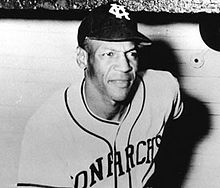
Obviously Jackie Robinson is the focal point of the movie and one of the most recognizable players in the history of the game.  There will be many posts of Jackie to come (and some that have already mentioned him) but there are a few key life points that will obviously be important to know. Jackie was born January 31, 1919 in Cairo, GA.  His mother moved the family when Jackie was very young to live with her brother and his family in Pasadena, CA.  Jackie originally attended Pasadena Community College then went on to become a lettered athlete in baseball, basketball, track and All-American football star at UCLA and was the first student at the school to letter in four sports in the same year.  Jack left UCLA just before graduation and was hoping to work towards being an Athletic Director.  He went on to play professional football (not in the NFL) and ended up playing in Hawaii.  As he was returning from Hawaii after the season the Japanese bombed Pearl Harbor.  Jack enlisted in the army and was in an officer training program.  While in the service he got into an argument with a white officer and was court martialed on exaggerated charges.  He was discharged, returned to the states and was offered a job playing in the negro leagues.  He was the Shortstop for the 1945 Kansas City Monarchs when he was approached by Clyde Sukeforth.

Rachel (Isum) Robinson:
Rachel Isum met Jackie Robinson when they were both students at UCLA.  Rachel was studying nursing and later went on to get a PhD in nursing becoming very successful and celebrated in the field.  Rachel and Jackie married and had a very successful marriage full of mutual love and support.  They had three children and without Rachel's support Jackie never would have succeeded in 1947.  The two were truly a team.  This is a perfect example of the saying that "behind every successful man is a successful woman".  Since Jackie's death in October 1972 Rachel has done a great job of preserving the legacy of Jackie Robinson and is often seen at events honoring his memory.

Mallie Robinson:
Mallie McGriff Robinson was one of 14 children born to Wash and Edna McGriff, slaves in the Cairo, GA area.  She married Jerry Robinson and had five children, Jackie being the youngest, and they worked as sharecroppers in Georgia.  Eventually Jerry left the family and Mallie could not afford to pay the rent on the land.  She packed up her five children and moved to live with her brother's family in Pasadena, CA.  She worked hard to support the five children and as they got older they helped support Mallie.  Her son Mack was an Olympic Athlete who finished second to Jesse Owens in the 1936 Berlin Olympics.

DODGERS MANAGEMENT/PERSONNEL
Branch Rickey:

Branch Rickey was one of the most successful executives in baseball when he signed Jackie to a professional contract.  A deeply religious man he refused to work on Sunday, even when he was a Catcher for the Yankees and later manager of the Cardinals.  Rickey often told a story of his time as the coach at Ohio Wesleyan University.  When the team tried to check into a hotel before a road game at Notre Dame, Rickey was told the team would not be accepted if they planned to check in with Charles Thomas, their African American Catcher.  Rickey was able to convince the hotel to allow them to stay as long as Thomas did not sign the register and Thomas was only given a cot in Rickey's room, not an actual bed.  When Rickey got to his room Thomas was sitting on the edge of the cot, crying and scratching at his hands.  Rickey stopped and watched not knowing what to do.  Thomas just said "It's my skin.  If I could just tear it off I would be like everyone else."  Rickey went on to become an executive with the St. Louis Browns and St.Louis Cardinals, introducing the famous Cardinals logo of two birds perched on a baseball bat.  He revolutionized the sport by developing the first farm system of teams but he kept the terrible memory of Charles Thomas in his mind the rest of his life.  After Happy Chandler,  the new commissioner, made a statement known as the "four freedoms"statement, the door was open for Rickey to break the color barrier.

Clyde Sukeforth:
Clyde Sukeforth was sent by Branch Rickey to scout Jackie and was told he was scouting players for the Brooklyn Dodgers negro league team.  Sukeforth reported back to Rickey, brought Jackie in for the first ever meeting and was a longtime supporter of Jackie.  Frequent readers of the blog will remember that Clyde was featured in the series of articles focusing on players you may not know but should.

Clay Hopper:
Clay Hopper was a Southerner managing the Brooklyn Dodgers' farm team, the Montreal Royals, when Branch Rickey assigned Jackie to play for the Royals.  Hopper was appalled that he would be the first white manager to manage an African American player and begged Rickey to assign Jackie to another team because he was terrified of what his neighbors would do.  While watching Jackie in practice before the season Rickey turned to Hopper and said "Can you believe the play that man just made?"  The response summed up Hopper's beliefs.  He asked Rickey "Mr. Rickey, do you really think a n*****'s a human being?"  Hopper did his best to adapt to the situation ( if he didn't he would be out of a job) and to adapt to the changing world.  As the Dodgers continued to sign players to follow Jackie's success Hopper continued to manage Montreal.  Joe Black, Roy Campanella and Don Newcombe all played under Hopper and although his racial views may or may not have changed, Campanella said he never had any negative experiences with Hopper.

Larraine Day:

Larraine Day was a famous actress best known for staring in the Dr. Kildare movie series along with Lew Ayres (husband of Ginger Rogers).  Day herself was married to actor Ray Hendricks, although she was carrying on an affair with Leo Durocher, the Dodgers manager.  Day and Hendricks sued each other for divorce on the grounds of infidelity and the scandal led to long time Dodger supporters, such as the Catholic Youth Organization, boycotting the team.  Already in hot water for his other issues, the Dodgers ordered Durocher and Day to end the relationship.  They refused, remained together and even married.  When Durocher moved to the Giants, Day was given a pregame radio program called "Day with the Giants".

Leo Durocher:

Durocher is famous for many things but the most famous was the statement he probably never made: "Nice guys finish last."  He was originally signed by the Yankees but was released when Babe Ruth accused him of trying to steal his watch.  Durocher was part of Rickey's "Gashouse Gang" 1934 Cardinals and was a fierce competitor who was always ready for a fight.  Before the 7th game of the 1934 World Series the legendary Frankie Frisch asked Durocher to play a little closer to second because Frisch was concerned he was too exhausted to play with his normal range.  He told Frisch, who was also his manager, "Go get yourself a wheelchair if you can't cover your territory.  I'm not making myself look bad to make you look good."  Durocher's controversy didn't begin or end with the Larraine Day scandal.  His battles with Lee MacPhail were legendary.  Durocher was also known to associate with George Raft, a Hollywood actor and close friend of mobster Bugsy Siegel.  Happy Chandler demanded that Durocher cut ties with the mobsters (and Raft) or he would be disciplined.  When Durocher taunted MacPhail for having gamblers in his owner's box during a spring training game, MacPhail complained to Chandler and an investigation began.  While the investigation went on Jackie was in Spring Training fighting to be promoted from Montreal.  When Durocher found out about the petition signed by the southern players he called a team meeting.  He made it clear that the players better fall in line or deal with him. He yelled at the team "I don't care if he's yellow or black or has stripes like a god damn zebra.  I'm the manager of this team and I say he plays."  The day before Opening Day 1947 Durocher was suspended for his gambling connections.  He was replaced by Burt Shotton for the 1947 season but was back on the bench for 1948.  Durocher and Robinson did not get along.  When Jackie struggled at the start of the new year Durocher seemed to take it personally.  Durocher treated Jackie like he did his other players (with a lot of yelling) but Jackie did not respond well and the relationship soured.  Durocher was fired half way through the 1948 season and was immediately signed by the rival Giants igniting one of the most vicious periods of the rivalry.


Burt Shotton:

Burt Shotton was forced into a tough situation.  The Dodgers had tied for first place in 1946 and were expected to challenge for the pennant in 1947.  The season started with the player revolt and the Durocher suspension followed very quickly after.  Rickey originally wanted Joe McCarthy, former Yankees manager, to take over but McCarthy refused.  Clyde Sukeforth was given a temporary job but convinced Rickey that Burt Shotton was the man for the job.  Shotton was known for wearing regular clothes in the dugout and not the usual full uniform.  When Durocher was let go half way through the 1948 season Shotton was brought back and managed through the end of the 1950 season.  When Cal Abrams was thrown out at the plate by Richie Ashburn to clinch a Phillies win over the Dodgers on the last day of the 1950 season Shotton was let go.

Harold Parrott
Harold Parrott was the Dodgers traveling secretary given the impossible task of coordinating the Dodgers travel plans for the 1947 season.  Parrott played a big part in keeping the balance on the team.  When the players signed the petition to ask Rickey not to bring Jackie to the Dodgers, Parrott was the one who learned of the player revolt and brought it to Rickey's attention.  Rickey told Parrott that he had confidence that everything would work out.  Rickey predicted there would be some kind of incident that would rally the team behind Jackie.

Red Barber

Red Barber, a southerner, was the Dodgers long time broadcaster who voiced his concerns to Branch Rickey about breaking the color barrier.  He may not have agreed with the signing at first, however, he quickly came to admire Robinson and was a great supporter of Jackie.  Barber worked with a young Vin Scully in Brooklyn to broadcast the Dodgers games and taught Scully everything he knew.  Shortly after Rickey sold his shares of the team to Walter O'Malley, Barber moved to the Yankees broadcast booth rather than working for O'Malley.

Jake Pitler
Jake Pitler was a first base coach for the Dodgers.  His Jewish background was used as a way to connect the team with the Jewsh community in Brooklyn.  Pitler was very supportive of Jackie.  During that first spring training Pitler told the press "It would be a crime not to let this boy come up because of his color."  Throughout the season Pitler routinely pointed out that Jackie was the motor that made the Dodgers go.


Dodgers Players:
Pee Wee Reese (Uniform #: 1):
One of many southern born players on the Dodgers, Reese was overseas in the military service when the news came out that Jackie had signed a contract with Brooklyn. Jackie had played Shortstop for the negro leagues, Reese's position.  When he was asked how he felt about Jackie possibly competing for Pee Wee's job, Reese said "if he can outplay me he deserves to play."  During Jackie's rookie season as the Dodgers were playing in Cincinnati Jackie was being heckled horribly.  During an in between inning warm up Pee Wee walked over to Jackie who was being called terrible names from the crowd.  He put his arm around Jackie's shoulder and just stood next to him looking at the crowd.  They didn't yell anything back to the crowd but it was a clear signal that the Dodgers players were standing by their teammate.  Reese and Robinson were very close friends.  They rarely hung out outside of the clubhouse but the two had an eternal respect for each other and loved to clown around before and after games.

Carl Furillo (Uniform # 6):

Furillo was one of the best players during the glory days of the Brooklyn Dodgers and one of the most misunderstood. An intense competitor, he was quiet, moody and with a quick temper. Furillo's part in the arrival of Jackie Robinson is full of controversy. When the Southern players drafted their petition they asked Furillo to sign it. What happened next depends on who you decide to believe. Furillo claims he flat out refused to sign it. Branch Rickey and later Buzzie Bavasi claimed Furillo had signed the petition. Some claimed Furillo signed it to keep Jackie out, while Bavasi claimed it was out of peer pressure and not out of any malicious intent. When the movie "Jackie Robinson Story" was released there was an Italian-American ballplayer who signed the petition but was not mentioned by name. Furillo was convinced that the player represented him and was furious he was being portrayed as a racist. It is not clear how he will be portrayed in the movie although based on the list of Dodgers players it appears he will be included in the group signing the petition. Jackie and Furillo were never close. Once asked what he would do if Jackie tried to take his job Furillo replied "I'd cut his legs off." Realizing how it would appear in print Furillo immediately went to Jackie and explained that although he said the words it was not intended as a racial comment but only in terms of a player fighting for his job. He had thought of the question only in terms of a baseball player trying to take his job and not as a racial question. Furillo did not socialize with Jackie outside the clubhouse (Furillo socialised with very few players) but on the field they supported each other.

Dixie Walker (Uniform #11):

Dixie Walker was born and raised in Georgia, as his name would suggest, and he was proud of his southern heritage.  Walker started his career in New York with the Yankees and is the only player to have played on the same team with Babe Ruth and Jackie Robinson.  While playing for the Yankees he was roomed with Ben Chapman, manager of the Phillies when Jackie broke into the league.  Walker was a fan favorite and important part of the improving Dodger organization.  The year before Jackie arrived Walker finished second in MVP voting as the Dodgers ended the regular season tied for first place with the Cardinals.  When Dixie found out that Rickey planned to bring Robinson to the Dodgers he gathered the southern players of the team together and started a petition asking Rickey not to force them to play with an African American.  From most sources Walker seems to be the main instigator of the petition idea (though the other players seemed to need little prodding).  Walker may not have liked Robinson but he learned to be professional around him and even helped Jackie in practices, something he would not do for other players.  When Duke Snider asked Walker for help on a play Walker told him "figure it out for yourself kid".

Eddie Stanky (Uniform #12)
Eddie Stanky had a good reason to fear having Jackie Robinson on the team. Stanky finished 7th in the MVP voting in 1946 for the Dodgers team that forced the first ever National League playoff. With Robinson playing a middle infield position and Pee Wee Reese, the team captain, at shortstop, it was clear where Jackie was destined to play. Stanky refused to sign the petition started by Dixie Walker, not necessarily because of Jackie, but out of loyalty to Branch Rickey. Stanky walked up to Jackie when he was officially given a spot on the Dodgers roster and said "I don't like you but we'll play together and get along because you're my teammate." As Ben Chapman and the Phillies launched an assault on Robinson, his teammates stood quietly by and let it happen. There was nothing they could (or would) do. Finally, during the third game in the Phillies series Stanky had had enough. "Hey you cowards, why don't you yell at someone who can answer back?" The Phillies did. Stanky was traded to the Boston Braves after the 1947 season and helped the Braves to their final National League Championship in Boston.

Ralph Branca (Uniform #20)


Ralph Branca is remembered for one pitch.  In the 1951 playoff against the hated Giants, Branca threw the pitch that Bobby Thompson turned into "the shot heard around the world" which started Russ Hodges screaming "the Giants won the pennant!" for seemingly hours.  In 1947 he was still a young pitcher for the Dodgers and was several years away from infamy.  He was throwing a no hitter against the Cardinals when Enos Slaughter spiked Jackie at first.  According to Branca he told Jackie he would bean the next Cardinals batter in retaliation but Jackie told him not to worry about it and just worry about getting the outs.  Branca did not finish the no hitter but he did do a lot to support Robinson in his time with the Dodgers.  Branca had several uniform numbers through his years with the Dodgers.  In 1947 he wore number 20, however, you may also see him in a #12 or #13 uniform.  He wore unlucky #13 at the time of Thompson's legendary home run.  Branca was also the father in law of Bobby Valentine.

Spider Jorgensen (Uniform # 21)
Spider Jorgensen was a team mate of Robinson's in Montreal and came up to the Dodgers in 1947 along with Jackie.  Jorgensen was in the spring training camp when Jackie first joined the organization and said he didn't think too much either way of having Jackie on the team. Jorgensen had played with African Americans in Junior College and in the California summer leagues and he had no concerns with having Jackie on the team.  (Only 10 months younger than Jackie, and being from California, it is likely that Jorgensen would have heard of Jackie's success at UCLA).  Like Hermanski, Jorgensen was a good player, but not a great player and as a rookie he probably felt it better to keep quiet and focus on playing in the 1947 season.

Gene Hermanski (Uniform # 22)
Gene Hermanski was a good outfielder for the Dodgers but not a great player. He first came to the majors in 1943 and hit .300 in only 18 games. He served in the military in 1944 and 1945 but was back for 64 games in 1946, hitting only .200. Hermanski is usually absent from Robinson literature and seems to have kept relatively quiet. This is just speculation but it may be that as a native of Massachusetts, and as a relatively marginal player at the time he may have had little social contact with the Southern players. He probably also felt it was best to keep quiet, keep his head down and focus on playing. He played a big part in the Dodgers success in 1947 and 1949 and their success in the early parts of the 1951 season. He was traded to the Cubs in June of 1951 and played through the 1953 season ending his career with the Pirates.

Bobby Bragan (Uniform #24)
Bobby Bragan was a utility player, mostly playing at Catcher, born and raised in Birmingham, AL. He did not play in 1946 but was back on the roster in 1947 for Jackie's rookie season. When he learned that Robinson would join the big league Dodgers, he signed the petition started by Dixie Walker. He also had salary issues with management and demanded to be traded. Bragan played in only 34 more games for the Dodgers over the next two seasons before retiring. He deeply regretted the petition he signed and went on to manage in the majors. Bragan's uniform number may also appear as#15. He wore #15 during the years 1943 and 1944. When he returned to the roster in 1947 he was given uniform #24.

Hugh Casey (Uniform #25)
Hugh Casey was one of the southern players who almost immediately sided with Dixie Walker when the idea of a petition was put forth. He and Jackie were never friends and Casey often made racial jokes in front of Jackie. Although they were not friends, Casey often worked with Jackie in practice and often defended him against other teams.

Rex Barney (Uniform #26)
Rex Barney was on the mound warming up in Cincinnati when the crowd started to verbally attack Jackie and Reese famously put his arm around Jackie's shoulder.  Barney would later say that Jackie was "the most exciting player I have ever seen- not the best but the most exciting."  Barney was a pitcher with a lot of potential but was often wild.  Going into the 1947 season he had pitched in 27 games and had a 4-7 record in parts of two seasons. He would go on to a 5-2 record in 1947.  His best season was 1948 when he went 15-13 with a 3.10 ERA.  His wildness continued to get worse as his career progressed and his career never got back on track.  After his playing days Barney worked for years as the stadium announcer in Baltimore.  He was known to say "Give that fan a contract!" anytime a fan made a nice catch on a foul ball and the end of announcements would often be completed with an exaggerated "Thank You!" extending the word you.  Following the Orioles last game played in Memorial Stadium the Orioles had a ceremony to celebrate the legends of the franchise.  The last sound that came over the PA of Memorial Stadium was Rex Barney's "Thank Youuuuuuu!"

Pete Reiser (Uniform #27)

Fans of the blog will remember the stories of Pete Reiser from the recent series of articles about players you may not know but should. Despite his many injuries and deteriorated state, the US Army called Reiser into duty and stationed him at Fort Reilly. The fort had a baseball team and obviously they wanted Reiser,a great star in the league at the time, on the team. As they were practicing they saw an African American Sergeant walk up to the field and just stand there watching not sure how to go about getting onto the team. The coach turned to him and told him he would "have to go play for the black team" which everyone knew didn't exist. Reiser did not clarify if he laughed along with the coach at the joke or kept silent but he did say that it was the first time he had seen Jackie Robinson and he would forever remember Jackie quietly walking away. Reiser was no pioneer in civil rights but he saw no reason Jackie shouldn't play. When Dixie Walker asked Reiser to sign the petition, Reiser told a story about his daughter being desperately ill while on vacation. The Reiser's looked up the closest doctor and went immediately. The doctor, who happened to be African American, treated Pete's daughter who immediately recovered. After telling the story he asked Walker what he would have done if he had been in that situation. Walker said he would have turned around and walked out of the doctor's office. Reiser told him he was a fool and flat out refused to sign Walker's petition.

OTHER LEAGUE PLAYERS/PERSONNEL:
Happy Chandler
Chandler was the second commissioner of baseball.  Judge Kennesaw Mountain Landis (the first) died  in 1944 Chandler replaced him (after a brief interim commissioner) and immediately showed that he intended to run things differently.  Landis had repeatedly said publicly that there was no ban on African-Americans playing in the Major Leagues but behind the scenes made it clear that he would not allow it.  Chandler was different.  Chandler was asked by two African American reporters whether he would continue Landis's policy.  He responded "I'm for the four freedoms and if a black man can make it at Okinawa and go to Guadalcanal, he can make it in baseball." Chandler, born and raised in Kentucky, was widely criticised by southern fans.

Johnny Sain (Uniform #33 for Braves)
There was a clear game plan for the Braves in the 1940's and 1950's. The pitching staff was "Spahn then Sain, then pray for rain". Sain won 20 games in 1946 and would win another 21 in 1947. On April 15, 1947 Sain started the opening day game against the Dodgers and was the first pitcher to face Jackie Robinson in a regulation Major League game. Sain had a great amount of success against Jackie and throughout the years Jackie struggled to hit Sain's curve ball. Sain would win 24 games in 1948 as the Braves reached the World Series and would later go on to be a long time pitching coach for the Yankees.

Ben Chapman (Phillies Manager):


Chapman will likely be the villain in the movie.  He played for the Yankees in the early 1930's and was often the center of controversy in his playing days.  He was known around the league as a borderline dirty player and during the 1933 pennant race with the Senators he repeatedly spiked the Senators Second baseman Buddy Myers and had several altercations with the Senators team.  Chapman also got into trouble in New York when he made several off color jokes about Jewish fans.  When DiMaggio joined the Yankees Chapman became expendable and was traded.  He eventually wound up in Philadelphia and was player-manager beginning in 1945.  Chapman was born and raised in Alabama and was not shy about letting the world know he was against the integration of any institution, not just baseball.  When the Dodgers visited Philadelphia for the first time, Chapman began a barrage of abuse against Jackie and ordered his players and coaches to do the same.  Several Phillies players held their bats like machine guns, aimed them at Jackie and made gun noises.  The intensity of the abuse was well beyond what the Dodgers had suffered in any other city.  Chapman was criticised by the Dodgers, the press and the Phillies management.  Chapman was quick to say that he was only doing what had been done to all players, trying to get an advantage by "bench jockeying" and refused to admit he had targeted Jackie more intensely than he would have done to any other rookie.  The Phillies management was ready to fire Chapman immediately.  Chapman offered to apologize to Jackie and had Harold Parrott ask Jackie to help him out by taking some pictures together for the press.  To his credit Jackie agreed and photos of the two of them with uncomfortable smiles appeared in the papers the next day.  The only thing that Jackie insisted on for the apology was that Chapman come over to the Dodgers dugout to apologize.  The incident did nothing to change Chapman's outlook on life.

Herb Pennock:
Herb Pennock was a legend in Philadelphia. Known as "the Squire of Kennett Square" where he grew up, Pennock was signed by Connie Mack in 1912 and pitched for Mack's 1914 AL Champion Athletics. When Mack dumped payroll after the World Series loss, Pennock went on to pitch for the Red Sox until that team shifted most of their best players to the Yankees and he moved to New York in 1923. He was the star pitcher in the Yankees first World Series win. At the time Jackie came into the league Pennock was the General Manager for the Phillies and was ready to fire Ben Chapman after the ugly incident. Only Chapman's "apology" to Jackie saved his job.

Eddie Dyer
As a rookie manager in 1946 Eddie Dyer led the Cardinal to a first place tie with Brooklyn, a victory over the Dodgers in the first ever National League playoff series and a seven game World Series win over the Red Sox. Leading into opening day 1947 , Dyer had to deal with his players, led by a southern contingent, threatening to go on strike if they were forced to play in the same league as Jackie Robinson. Fortunately for Dyer, NL President Ford Frick ended all of the strike talk quickly by saying that anyone who chose to go on strike in protest of Robinson could stay home because they would not be welcomed back...ever. Following the first series with the Cardinals, Jackie mentioned Eddie Dyer as one of the "swell bunch of guys" who had treated him well.

Stan Musial (Uniform #6 for Cardinals)
Frequent readers who saw the post that was completed at the time of Musial's passing will know that he is generally considered one of the nicest and classiest men to have ever played the game. He was named along with Garagiola and Eddie Dyer as two players treating Jackie well during the Dodgers' first visit to St. Louis. When the Cardinals played the Dodgers in the second series, when Slaughter spiked Jackie and Garagiola had his confrontation with Robinson, Jackie was on first base and was angry. Jackie reportedly said (either to Stan or to the first base coach) "I don't care what happens but when I get down to second base I'm going to kill someone." Musial's response was "I don't blame you. You have every right to do it." Musial's calm, classy response calmed Jackie down.

Joe Garagiola (Cardinals Uniform #17):

Joe Garagiola was stationed at Fort Reilly with Pete Reiser when Jackie was told he would "have to go play for the black team".  There is no documentation that I have found to detail Joe's reaction. Garagiola's portrayal in the movie could go one of two ways.  Following the Dodgers' first visit to St.Louis in 1947 Jackie singled out several players as having treated him very well and being "swell guys".  Garagiola was one he singled out as being in that group.  The second time the Dodgers faced the Cardinals, during the playoff race, things did not go quite so well.  In the same game that Enos Slaughter spiked Jackie, Garagiola spiked Jackie as he tried to beat out a double play ground ball.  When Jackie came to bat Garagiola, a catcher,  and Robinson had a heated conversation, leading to Garagiola taking off his mask and the two exchanging words face to face. Garagiola forever denied that the spike was intentional and it is possible that Jackie overreacted to an accidental spiking, having been viciously spiked earlier in the game by Slaughter, not knowing that Garagiola was just running out a ground ball.  Garagiola was a childhood friend of Yogi Berra, both growing up in the St. Louis area.  Joe is best known for his humor and his career as an announcer after his playing days.  Garagiola had a thick, identifying accent and was the voice of the baseball and the World Series on NBC for nearly twenty years.  His last World Series broadcast was in 1988.  Garagiola was a television figure for decades hosting several game shows, appearing on the Today Show as a regular host and a fill in host for Johnny Carson.  During one 1968 hosting stint, filling in for Carson, Garagiola welcomed John Lennon and Paul McCartney to The Tonight Show.  It was the only appearance of any Beatles (as Beatles or later as solo artists) on The Tonight Show.  Garagiola continued broadcasting after leaving NBC and spent time on broadcast teams for the Angels and Diamondbacks.  Just over a month ago, February 22, Garagiola officially retired.

Billy Herman (Uniform #11 for Pirates)
Billy Herman was a great second baseman for the Cubs. A seven time All Star in Chicago and team leader for the Cubs' 1932, 1935 and 1938 World Series teams, the Dodgers made a trade for Herman early in 1941 and the double play combination of Herman and Reese helped lead the Dodgers to their first World Series since 1920. Herman hated Branch Rickey and was traded to the Braves midway through the 1946 season (the final straw that sent Herman packing is debated). In 1947 Herman was in his last year of his career and was playing for the Pirates. He is mentioned very little in connection with Robinson that I am aware so it is unclear if he will be one of the Pirates vocally against Jackie or one who showed concern when he was hit by Ostermuller.

Fritz Ostermuller (Uniform # 21 for Pirates)
When the Dodgers first faced the Pirates in 1947, the Pirates were a divided team among themselves, which likely explains why they ended so low in the standings that year (62-92, last place, 32 games behind the Dodgers).  Ostermuller was not happy that Jackie was in the league and took the opportunity to show Jackie what he thought. The first pitch was up and in, aimed right at Jackie's head.  Jack was able to get his arm up to deflect the ball but fell to the ground and was in severe pain.  His Dodgers teammates came to his defense and challenged Ostermuller, several Pirates players also showed some concern.  Later in the season, when Jackie stole home for the first time in his career, it was against Ostermuller. In that same series in Brooklyn Jackie homered off Ostermuller.

Kirby Higbe (Uniform #13 for Pirates)
Kirby Higbe was a southern born pitcher known to his teammates as Kirby "F'ing" Higbe because as soon as he checked into a hotel on the road he would call room service and announce "This is Kirby F***ing Higbe in room 205.  Send up...".  He would then charge the laundry list of items to the team.  When Dixie Walker asked players to sign a petition to keep Jackie off the team Higbe reluctantly signed.  A few days later he was having a few beers with Harold Parrott and his guilt got the best of him.  He let Parrott know of the planned revolt leading Rickey and Durocher to react.  His involvement led Rickey to trade Higbe to the Pirates, along with several players including future long time manager Gene Mauch (not in any way involved in the petition but just a very interesting side note), in exchange for Al Gionfrido.  Gionfrido would be one of Jackie's biggest supporters in the clubhouse and would make one of the greatest catches in World Series history in the 1947 World Series.  Higbe's part was not over.  The day before Ostermuller threw at Jackie, Higbe started against the Dodgers.  Pee Wee Reese led off the game and the first pitch was identical to the one Ostermuller sent at Jackie the day before, although Reese was not hit by the pitch.  Most believed it was because Pee Wee had refused to sign the petition but there could have been deeper bad feelings between the two as they were long time teammates.  Reese stepped back into the box and sent the second pitch of the game out of the park for a home run.

"Young" Ed Charles:
Ed Charles is listed on the IMDB cast page as "young Ed Charles" in the movie.  Charles would have been a week away from turning 14, growing up in Daytona Beach, FL, when the Dodgers opened the 1947 season.  Charles went on to be a pretty good player on some very bad teams.  He was drafted by the Braves in 1952 but would be moved to the Athletics organization before the Braves became consistent National League contenders.  He would play for the Athletics during the bad Kansas City years and then would be moved to the comical Mets.  Charles was still with the team when the  "Miracle Mets" won the 1969 World Series.  Ed Charles is still active in the baseball community and is very well respected.  He will likely be utilized to portray the doors that were opened to the youth of the country because of the success of Branch Rickey's plan and Jackie's hard work.

CHARACTERS NOT LISTED BUT LIKELY APPEARING OR BEING REFERENCED:
Hank Greenburg (Uniform #5 for Pirates)

Hank Greenberg was one of the greatest players the American League had ever seen and ranks along with Ty Cobb as the best player in Tigers history.  He won two American League MVP's and was a war hero.  After the 1946 season the Tigers traded the great First baseman to the Pirates.  He had no intention of going to the NL and planned to retire.  He was convinced by Bing Crosby, owner of the Pirates, to play for one season.  During the Pirates series with Brooklyn, when Jackie was on first base, Greenberg gave Jackie plenty of encouragement.  Having suffered years of abuse for his Jewish background Greenberg empathized with what Jackie was experiencing.  Greenberg offered to take Jackie out to dinner after the game but Jackie declined saying he was afraid it would put Hank in a bad position.

Bob Feller (Indians Pitcher) 

Bob Feller was one of the best pitchers in the history of the game  When he was asked how he felt about Robinson he said that he did not think he would make it in the majors because "he's all tied up in the shoulders" referring to Jackie's awkward almost lunging swings at times.  He was not the only one who felt Jackie's mechanics at the plate would make him an easy out.  Feller said that he doubted Jackie would have even been given a chance to play if he had been a white man.  A few months later he would be teammates with Larry Doby.

Dan Bankhead (Uniform # 23 for Dodgers)
Midway through the season when it was clear that Jackie was a success Rickey wanted to expand the experiment to cement the idea that this was for real and not just a stunt or gimmick.  On August 26th Rickey signed Dan Bankhead of the Negro League's Memphis Red Sox.  Bankhead made his debut on August 26th and was the second African American player to play in the National League.  He was not nearly as successful as Jackie.  He pitched in 18 innings with no record but an ERA of 7.20.  He finished his career in 1951 with a career 9-5 record and a 6.52 ERA.

Larry Doby (Uniform #14 for Indians):

It would be an interesting study to try and figure out what makes one person successful and another less successful under the same adverse conditions.  Larry Doby became the first African American to play in the American League on July 5, 1947, just a few months after Jackie Robinson debuted for the Dodgers.  Doby did not have the support (of management or teammates) or the personality of Robinson.  While Robinson and Rickey understood that always keeping quiet and not fighting back his first year in the league would help him in the long run, Doby was often angry, morose and distant.  Doby did not get the following or the attention that Robinson did and was often portrayed in books and newspaper articles as bitter.

Bill Veeck:
Bill Veeck owned several teams over the years and was always looking for ways to bring fans into the seats.  When he owned the Browns he hired a midget, Eddie Gaedel, to pinch hit for one game.  Later, when he owned the White Sox, he came up with Disco Demolition night and the players wearing shorts instead of the traditional pants.  Before Branch Rickey came up with the idea of breaking the color barrier, Veeck had planned to buy the Phillies and fill the starting lineup with African American players.  When Commissioner Landis learned of Veeck's plan he made sure the Phillies were sold to someone else.  As the owner of the Indians, Veeck was able to break the color barrier in the American League by signing Larry Doby. 

Buck O'Neil:

Of all the people who deserve to be in the Hall of Fame but are not, Buck O'Neil tops the list.  He never played in the major leagues, never managed in the major leagues but he was one of the greatest ambassadors the game has ever had.  Buck was Jackie's manager when he played for the Kansas City Monarchs of the Negro Leagues.