Showing posts with label Brooklyn Dodgers. Show all posts

Saturday, October 11, 2014

Almost a Dynasty: 1950's Dodgers

What actually makes a sports dynasty?  Obviously a teem needs to be successful for a continuous amount of time.  Every sport has that one iconic dynasty that fits the Dynasty category.  The NBA had the Boston Celtics who won nine out of ten championships.  The Montreal Canadiens won 7 of nine Stanley Cups (including six straight).  The NFL had several dynasties including the 49'ers, the Steelers, the Cowboys and, most recently, the Patriots.  Baseball itself has had the Yankees dynasties in several incarnations including the 1930's, 1950's and 2000's.

So what actually makes a team a dynasty?  There can of course be several definitions since there are varying levels of success.  A team can dominate their division for a decade but be bounced out in the first round of the playoffs year after year.  We could of course consider that to be a divisional dynasty but you wouldn't call it an overall baseball dynasty.  So let us set the parameters for this series of articles.  A dynasty, for our purposes here, is a team that wins multiple World Series championships (above two as back to back is nice but not a dynasty) within a 5-10 year period.  That being defined, this series will explore those teams that may have been a divisional or league dynasty but for whatever reason could not get over the hump to that World Series dynasty.

This series will show an array of near dynasties.  Some are teams that made the World Series year after year but fell short.  Others will be teams that competed right down to the end of the regular season year after year just to be beaten out.  It will be a series of near misses and what could have beens.

Don't miss the other almost dynasty articles: The Detroit Tigers of the 1900's, The Chicago White Sox of the 1910's, the Pittsburgh Pirates of the 1920's and the Boston Red Sox of the 1940's.  Now let's get started with this weeks "almost dynasty": The Brooklyn Dodgers of the 1950's.

Sowing the Seeds of Sorrow:
The "almost dynasty" of the Brooklyn Dodgers in the 1950's started long before the 1950's.  The Dodgers in Brooklyn were the city itself.  It was part of the largest city in the United States struggling to retain a small town feel.  Of course they were known for the Brooklyn Bridge but they took pride in their Dodgers, even during the bad times.  The Dodgers of the 1930's were known more for their goofy antics than they were for their success.  The team earned the nickname "the Daffiness Boys" for their seeming constant errors.  The most famous being a play where three Brooklyn base runners ended up on the same base.  The team had to fight hard to overcome that image.

They did so in 1941.  The image that replaced it was the image of heartbreak.  The Dodgers in 1941 surprised many people by not only reaching the World Series but putting up a fight against the dominant Yankees.  They entered the ninth inning of Game 4 with a lead that would tie the series at 2 games.  This is where the "almost dynasty" takes root.  On the final strike of the game, theoretically ending the game, the ball got past Catcher Mickey Owens allowing Tommy Henrich to reach base.  The Yankees took advantage of the miscue and won that game, then rolled through the team to the World Series title.  1946 was no picnic either.  The team could have won the National League again and faced off against  Ted Williams, Johnny Pesky and the Red Sox.  Instead, they were tied with St.Louis on the final day and lost the first ever National League Playoff to the Cardinals.  (The game played between the Giants and Cubs after the 1908 season was technically not a playoff.  It was called a "replay" of the disputed Merkle game.)  The 1947 Dodgers overcame the hate they faced as a result of breaking baseball's color lines and the last minute suspension of their manager and won the National League but were dominated by the Yankees in the World Series.  1949 again saw them win a close National League race only to fall short, again to the Yankees.

The 1940's could have been the Dodger's near dynasty, if only the 1950's were not so much more heartbreaking.

The Core Eight:
While the Yankee dynasty of the 1990's-2000's had what was considered the "Core Four" of Jeter, Posada, Pettite and Rivera (although Tino Martinez, Paul O'Neill and Bernie Williams should also get more recognition for their participation in that group) the Dodgers had what some might call a core eight.

The 1940's Dodgers had a strong group of players including Dixie Walker, Mickey Owen, Eddie Stanky, Kirby Higbe, Hugh Casey and Pete Reiser.  By the time the 1949 season rolled around it was an almost brand new team.  Reese remained from the 1941 team but even between 1947 and 1949 the team was greatly changed.  So who are the core 8?:

Pee Wee Reese:  One of a million missed opportunities for the Red Sox, Manager Joe Cronin felt his body could sustain a few more years as player-manager in Boston.  That made short stops in the Boston system expendable so in 1939 the Red Sox traded Pee Wee Reese to Brooklyn for $35,000 and three players.  Reese played only half of the 1940 season but was the team leader on the 1941 World Series team.  He would miss three seasons serving in World War II.  He would become the face of the franchise.  The quiet leader.  The captain.

Carl Furillo:  AKA the Reading Rifle.  Signed with the Dodgers before the 1941 season but did not see any action until he returned from World War II.  He was known for his defense but also won a batting title.  He was a ferocious competitor and under rated part of the Dodgers almost dynasty.

Gil Hodges: Hodges, like Furillo, signed before World War II, although Hodges actually appeared in one game before shipping off to the Marines.  Hodges was originally signed as a Catcher and spent most of the time on the bench watching the other Catchers.  When First Baseman Preston Ward hit a slump Durocher threw Hodges onto first and he stuck.

Jackie Robinson: Jackie joined the Dodgers in 1947 and immediately became a spark on the team.  He was the man who made the Dodgers go.  Few players in history could change the game like Jackie did.  He was once referred to as "Ty Cobb in Technicolor".

Roy Campanella:  Campy signed with the Brooklyn organization shortly after Jackie Robinson but did not make his debut with the big league Dodgers until 1948.  Campy would be one of the biggest contributors offensively and defensively.  He would make eight All Star Teams in ten seasons and would win three MVP awards.

Don Newcombe:  Big Newk was signed shortly after Campy and Jackie.  He made the big league team in 1949 and had an immediate impact.  He lost two seasons to the Korean War and unfairly gained a reputation for being unable to win the big game.  Big Newk was the undisputed ace of the team and the "almost dynasty" wouldn't have existed without him.  In fact had it not been for the two years in Korea, it likely would have been a real dynasty.

Duke Snider:  The Duke of Flatbush signed with the Dodgers before the 1943 season but did not appear until after the war.  While many of those above contributed to the 1947 World Series team, Duke would come late to the party.  He would be the big hitter in the Dodgers' "almost dynasty" and would have a love/hate relationship with the fans.

Carl Erskine: Known to the fans as "Oisk" because of the way the Brooklyn accent played with his name.  Carl would pitch two no-hitters in his career and if not for arm problems that sometimes made it impossible for him to lift his throwing arm high enough to comb his hair, Oisk might have made the Hall of Fame.

These were not the only key players of the almost dynasty but these eight were the group that did most of the heavy lifting.  As you'll see, starting with 1950, the other contributors also made legendary contributions.  Some good and some bad.

The Wide Turn and the Whiz Kids:  
Thirty years later Richie Ashburn sat in a broadcast booth in the Astrodome with Harry Kalas.  It was October of 1980 but the topic, as a young Marty Bystrom warmed up to face the Astros in the deciding game of the NLCS, was pressure.

"Rich, what was the most pressure packed game in which you were ever involved as a player?"  Kalas asked casually.
"Well the last game of that '50 season obviously.  It was either win or go into a playoff."

The "almost dynasty" of the Dodgers started immediately in the 1950's.  The Phillies' young group of 1950 were known as the Whiz Kids.  They had surprised the league to lead most of the year but as the season wound down their lead was down to two games with two games to play.  Those last two games were against the Dodgers, the team charging hard at the end of the season.  If the Dodgers won both games they would tie for first and play a three game playoff against the Phils.  Lose one and they were done.

Ebbets Field was tense in the Saturday opener of the two game set.  In the bottom of the 5th the game was scoreless.  Each scoreless inning increased the pressure.  Campy struck out to start the 5th but Third Baseman Billy Cox singled and went to second on Pitcher Erv Palica's ground ball.  Dodgers fans started to cautiously stir.  There was still another batter before Pee Wee and Duke made their appearance and they had already seen their team leave three runners on base this game.  The hitter was Cal Abrams, today's Left Fielder.  Abrams broke the scoreless tie with a single.  Pee Wee followed with a triple and when the Phillies brought in their MVP Jim Konstanty, the Duke rudely greeted him with a 2 run Home Run giving the Dodgers a 4 run lead.  The Whiz Kids would cut the lead to 4-3 but Campy would take away any doubt in the bottom of the 8th with a Three Run Home Run.  The Dodgers were now one game back with one game to play.

On the mound for the Dodgers in the season finale was Big Newk.  He was facing off against the Phillies ace Robin Roberts.  If Saturday was tense Sunday's game had people being fit for straight jackets.  For the first five innings neither team scored.  It was now half way through the game and stomachs churned a little louder as the game inched on.  Every called strike got a little groan, every ball was a little victory.  The Phillies came to bat in the 6th.  Eddie Waitkus and Richie Ashburn went down for two quick outs and it looked like the Dodgers would have another easy inning.  Dick Sisler singled to Center Field causing some anxiousness in the crowd.  Del Ennis followed with a single and the crowd grew restless.  Stepping in was Willie (better known as "Puddin' Head") Jones.  Puddin' Head hit a ground ball up the middle that scored Sisler but Snider got to it quickly enough to hold Ennis.  Dodgers fans were sure this was the negative sign they had dreaded.  Beaten by Puddin' Head.  Then the unthinkable happened in the bottom of the inning.  The Dodgers tied it on a Home Run.  It wasn't Hodges, Snider or Campy.  It wasn't even Jackie.  It was Pee Wee!  The little guy who had hit only ten Home Runs all year hit one out (barely, it got stuck in the screen for a ground rule Home Run).  But hell, a tie game is a tie game and a Home Run from Pee Wee was a sign that the Dodgers were going to win it all.

The Dodgers were energized entering the bottom of the 9th still tied.  Cal Abrams walked to lead off the inning and now they were sure.  Reese singled sending Abrams to second and there were two on and no out with Duke, Jackie, Furillo and Gil to follow.  There was no way they didn't win this.  Snider lined a single to center and Ebbets Field was louder than ever.  It was over.  But what was it that Yogi said?

Abrams took off for third.  Ashburn, the Phillies Center Fielder, had a notoriously week throwing arm.  The scouting report was he was no threat to throw someone out.  Abrams hit the bag at third with Third Base coach Milt Stock screaming "Go! Go! Go!"

Abrams turned the bag (history has blamed him for turning too widely and costing him precious steps) as Ashburn fielded the ball.

Abrams sprinted for home.

Ashburn picked it up on one hop.

Abrams kept running.

Ashburn turned and fired a perfect strike to Stan Lopata at the plate.

Abrams stopped running.  Out at the plate.  With Robinson, Furillo, Hodges and Campanella due up next and only one out the Dodgers should have still won it but the out at the plate deflated the crowd.  For decades Cal Abrams was public enemy number one.  Public enemy number two may have been the Phillies' Dick Sisler, who hit a three run Home Run in the top of the 10th sending the Whiz Kids to the World Series and the Dodgers home disappointed for another long winter.

Say Hey!:
Any lasting effects from the last day loss in 1950 seemed to have disappeared.  Although they wouldn't pay immediate dividends, the Dodgers made some tremendous signings in the off season.  Signings that would feed the "almost dynasty" long into the future:  Joe Black, Jim Gilliam, Johnny Podres and Maury Wills.  The Dodgers took over first in mid May and by mid August they had built a 13 game lead.  They were starting to count their chickens (or playoff bonuses) with a month and a half left.  The closest team was the Giants.  There was no way they would catch the Dodgers.  It was over.

What was it that Yogi said?

The Dodgers went 27-24 the rest of the way.  Normally that record does well enough to maintain a 13 game lead.  Not when the Giants, led by Durocher and Willie Mays go 39-8.  The lead shrank and the Dodgers needed a 9-8, 14 inning win on the last day of the season just to remain tied and force a playoff against the Giants.

The Dodgers lost the first game of the series at home 3-1.  Game 2 was in the Polo Grounds and the Dodgers played like a team angry that Durocher was trying to take their pennant.  Jackie started it in the first with a Two Run Home Run.  Jackie would go 3-5 with 3 RBI on the day.  Rube Walker (playing for an injured Campy), Hodges and Andy Pafko would also hit Home Runs and the Dodgers won 10-0, tying the series.

The final game was played at the Polo Grounds but after the 10-0 demolishing the Dodgers were confident.  Say Hey! kids.  It was nice seeing you but it will be nicer seeing you go, especially you Leo.  You all head home.  We'll take on the Yankees.

The Dodgers confidence skyrocketed in the Top of the 8th.  Tied at 1, the Dodgers got to Sal "the Barber" Maglie.  The situation may have been too tense for Jackie to make his normal Maglie joke before the game. "Don't bother shaving. Maglie will pitch you close enough to do it for you."  To start the 8th Furillo shot a ball straight back at Maglie but Maglie caught it for out number one.  The two tough men may have glared at each other.  Furillo silently saying "I wish it would have hit ya, ya bastard."  Maglie silently saying "Sit down ya Dodger son of a bitch."  Reese and Snider singled. A Maglie wild pitch scored Reese.  Jackie was walked intentionally.  Pafko singled scoring Snider.  After a Hodges pop out, Billy Cox singled scoring Jackie and it was 4-1 Dodgers.

Big Newk pitched a perfect 8th and the Dodgers just needed three more outs. He gave up back to back singles before getting Monte Irvin to foul out.  When Whitey Lockman doubled Newk's day was over.  And then came Ralph Branca to face Bobby Thompson.  Cue Russ Hodges.

One Step Closer:
1950 saw the Dodgers come within a wide turn of forcing a three game playoff.  1951 saw the Dodgers lose a three game playoff.  In 1952 these guys were not messing around.  They won the NL by 4 1/2 games (though it wasn't necessarily that close) and faced the Yankees, who were playing in their fourth straight World Series.

Although it had only been a few years since the 1949 World Series this Yankees team was different.  DiMaggio, Keller, Henrich were gone.  Rizzuto, Reynolds, Raschi and Berra were still there but new were Martin, Mantle and Joe Collins.

This year was different.  In 1941 the Dodgers had shot themselves in the foot with the Owens passed ball.  In 1947 and 1949 they were just overpowered by a great Yankee team led by The Great DiMaggio.  In 1952 they actually struck first, they won Game 1 behind rookie pitcher Joe Black's complete game.  They lost Game 2 7-1 but came back and won Game 3 behind Preacher Roe.  Not only did they win it, they won it in Yankee Stadium with two runs in the 9th to beat the Yankees at home.  Joe Black pitched again in Game 4 and held the Yankees to only 2 runs.  Unfortunately Allie Reynolds was better holding the Dodgers to 0 runs to tie the series at 2.  The Dodgers had missed an opportunity, behind Black's well pitched game, to take a commanding 3-1 lead.

If Game 4 was a missed opportunity, Game 5 was a statement.  With a chance to take the lead again, Carl Erskine took the mound.  The Bums scored one run in the 2nd but left the bases loaded.  When they scored three more in the 5th (thanks to a Pee Wee sac fly and a two run blast from Duke) it looked like the men left on base was an after thought.  Hank Bauer started the bottom of the fifth with a single.  Billy Martin duplicated it.  Irv Noren pinch hit for the pitcher and followed Bauer and Martin's example, scoring Bauer.  Gil McDougald grounded to Reese who forced Noren but Martin scored.  It was 5-2.  Still a safe lead.  Rizzuto singled McDougald to third but when Mantle popped out for the second out Dodgers fans breathed a sigh of relief.  The collective released breath from Brooklyn may have created a tail wind because the next batter, Johnny Mize, launched a three run Home Run to tie the game.  In other years this team would have quit but not after last year.  This team fought back.  Snider had an RBI single in the 7th to tie it up.  In the top of the 11th Duke would untie it with an RBI double and the Dodgers were one game away from their first ever World Series win.  I wonder if Yogi said anything to the Dodgers after the game.

With elimination looming the Yankees started one of their Aces, Vic Raschi.  The Dodgers started... well let's see.  Erskine?  No he started Game 5.  Joe Black?  Nope. Newcombe?  Nope, he was in the military. (oh, how different it could have been if Big Newk were available).  Branca or Preacher Roe?  Nope.  The choice to start a potentially clinching game was... Billy Loes.  His name may not immediately jump out like Branca, Erskine or Newk but Billy Loes was 13-8 in 1952 and he had a 2.69 ERA.  So although it wasn't the flashy pick it was a good choice.  Through 6 innings he had allowed only 2 hits and 2 walks but no runs.  Raschi was just as good through 6 allowing only four hits and no runs.  It was another gut squeezing game.  In the bottom of the 6th the faithful at Ebbets Field thought they had it made.  Duke (they loved him again) led off with a Solo Home Run to give the Dodgers a 1-0 lead.  It didn't last long.  Maybe Yogi didn't say it out loud but his bat said it for him.  He led off the Top of the 7th with a game tying Home Run.  Then, missed opportunity number 2 for the Dodgers.  Gene Woodling walked.  Unnerved, Loes balked  Woodling to 2nd.  In true Dodgers fashion he didn't just balk.  He came set,  Thought about what he wanted to throw and then.,, he dropped the ball.  It just fell to the ground and Woodling advanced to second. Irv Noren struck out and Billy Martin popped up.  Two out.  All Loes had to do was get the pitcher and they were out of the inning.  Raschi hit a weak ground ball back to the mound.  Loes didn't react.  It hit off his leg, rolled into right field and Woodling scored from second on the error from Loes.  So what happened?  Loes lost the grounder, he said, in the sun.  What?  How can you lose a ground ball in the sun?  Erskine backed him up.  "In October the sun is right between the decks for probably no more than a couple mintues' time.  And that's exactly when that happened, and when Loes said he lost it in the sun everyone laughed, and the fact is, if you ever pitched in Ebbets Field you know that's possible in October with a ball that's hit with a little bounce on it."  In the top of the 8th Mantle made his presence known with a solo Home Run to give the Yankees a 3-1 lead.  Snider hit his second Home Run of the game but no one was on base so the Yankees lived on for one more day.

Joe Black started Game 7 and the Dodgers were confident they had this one already.  Neither Black nor Reynolds was dominant.  The Yankees struck first in the fourth.  The Dodgers answered right back in the bottom of the third.  The Yankees took the lead again in the 5th on a Gene Woodling Solo Home Run.  The Dodgers answered in the bottom 5th.  The Yankees scored again on a solo Home Run from Mantle in the 6th.  The Dodgers were silent in the 6th.  The Dodgers scored in the 7th.  The Dodgers were silent in the 7th.  Well not exactly silent.

Here was missed opportunity number three.  Furillo walked to start the inning.  For Carl it was nothing more than a walk.  There was no hand clapping on the way down to first.  At this point it was nothing but a base runner.  Rocky Nelson pinch hit for Preacher Roe.  With a 1-1 count (Nelson and the crowd thought it should be 2-0) Raschi threw well outside and the Dodgers dugout came to life.  Cookie Lavagetto, Dodgers coach and fan favorite, was loud in rooting Nelson on.  Nelson popped a ball up to short.  Rizzuto fought the sun but caught the ball.  Billy Cox stepped in. The count went to 3-2.  Benches started to get uneasy.  Sitting positions were shifted.  Hats, the same ones that had sat in the same position for innings, now felt tight or tilted.  The hats came off as nervous hands ran through hair.  Cox lined a single sending Furillo to third and Pee Wee came to the plate with Duke on deck. As the count went to 3-1 Stengel got nervous. Yelling from the dugout he eventually took a walk to the mound.  The next pitch came in and Pee Wee started to walk to first but was called back.  It didn't take long for him to get to first.  He walked on the next pitch and Snider strode to the plate to face a new pitcher.

Bases loaded.  1 out.  All they needed was a base hit.  On an 1-1 count Duke checked his swing on an outside fastball and fouled it off.  He was furious with himself.  He shouldn't have even offered at it.  The count went full and the tension got bigger.  Snider swung and connected on the next pitch. It was on the outside part of the plate and if he could have made perfect contact with it he could have driven it for at least a double.  Instead it was popped up. The infield fly rule was called and there were two out.  That brought up Jackie Robinson.  Two out.  Bases loaded.  If there was any one person you would want at the plate in this situation it was Jackie.  He swung through strike one.  The Yankees stirred.  Ball one.  The Dodgers bench stirred.  On the mound Bob Kuzava fidgeted between pitches, played with the rosin bag.  Ball two and Yogi didn't like this one.  He started growling at the ump.  Lavagetto was still pacing, clapping, yelling from the dug out as Robinson fouled off another pitch.  It was on the inside part of the plate, the kind of pitch Jackie would love to pull.  He just pulled it too far.  The next pitch was identical and Jack tried to pull it inside the bag.  Foul ball.

With the bases loaded and a two run lead the Yankees were playing the middle infielders back and the corner fielders were guarding the line.  The next pitch was out over the plate.  Jackie swung.  Connected.  It went straight up in the air.  With two out Furillo was moving and crossed the plate.  Behind the plate Berra waited for Kuzava to take charge.  Cox hit third and turned the corner.  On the mound Kuzava looked straight up.  Watching.  Reese started jogging to second.  At short stop Rizzuto started to amble towards the mound.  Cox noticed the lack of urgency on the Yankees part and he headed home.  At second base Billy Martin knew this was not his ball.  It was Kuzava's or maybe Collins' at first.  Reese rounded second and headed for third as the ball started coming down and the Yankee fielders stood motionless.  Martin sprinted towards the infield.  Robinson was at second by now.  Dodgers fans saw the ball falling.  Jackie and Reese saw the same.  Cox crossed the plate.  Martin kept sprinting.  If the ball fell to the ground Furillo and Cox would have scored and Reese had a good chance.  Martin kept running.  Kuzava watched.  Rizzuto had lost it in the sun.  The ball was falling.  Martin sprinting.  Falling.  Sprinting.  Falling. Martin reached the field grass in front of the mound.  He stuck his glove out and just below his knees the ball dropped in his glove.  Three outs.  Threat over.  For all intents and purposes, Series over.  Better luck next year.

Again:
1953 was similar to 1952 in the fact that the regular season was an almost foregone conclusion by June.  Brooklyn ran away with the pennant by 13 games.  They finished with a 105-49 record.  Their World Series opponent again was the Yankees.  The Dodgers lost the first two games. won the second two and it looked like seven games again.  The Yankees took a 3-1 lead into the 9th inning of Game 6.  The Dodgers tied it when Carl Furillo launched a two run Home Run.  Dodgers fans, who moments before had given up, raised their eyes for a moment.  Maybe there would be a Game 7.  It didn't last long.  A Billy Martin single in the bottom of the 9th scored Hank Bauer giving the Yankees their fifth straight World Series win.  The Dodgers almost dynasty now had a clear pattern and the Dodgers were becoming the lovable losers.

Where the hell did they come from?
The Dodgers' 1954 season was not bad.  They won 92 games.  The problem was Leo Durocher and the Giants were better.  The Giants took over first on June 9 and although the Dodgers would continue chipping away at the lead they could never quite overtake the Giants.  While the Giants faced off against the heavily favored Indians the Dodgers brooded over another missed opportunity to win it all.

The off season brought Jim Gilliam to the team and there was a question of where he would play.  Gilliam was a second baseman, Jackie Robinson's position.  What about Billy Cox?  He was traded to Baltimore with Preacher Roe leaving Third Base open.  Jackie did not want to move to third but in the end he did.

Finally?:
There was drama in the 1955 season and it mostly centered around the fact that the Dodgers were now aging.  Robinson, Reese, Campy and Furillo were all now slowing down.  Snider and Erskine were middle aged.  Injuries were starting to take their toll.  There was a question of how long the window would remain open.

The National League picture had slowly been changing.  The Giants won in 1954 and the Braves were coming soon.  The Dodgers were building their youth for the future.  Roger Craig, Jim Gilliam, Johnny Podres, Sandy Koufax, Don Drysdale and Don Zimmer looked like they would keep the train rolling for longer but could they accomplish what the core eight had done.  One other player intended to be part of the new core was stolen away by the Pirates and their new club President, Branch Rickey.  Rickey had an eye for talent so when they had a chance to steal Roberto Clemente from the Dodgers, they jumped at the chance.

The 1955 Dodgers ran away with the league...again.  Their opponent for the 1955 World Series was the Yankees...again.  Big Newk lost Game 1 to Whitey Ford 6-5.  Billy Loes lost Game 2 to Tommy Byrne 4-2 and suddenly the Dodgers were down 2 games to 0.  The series shifted to Ebbets Field and the Dodgers fans expected this to be quick but painful.  Instead, the Dodgers scored runs in bunches, winning Game 3 8-3.

The Yankees jumped out to 3-1 lead in Game 4 which gave the impression that the series would have the same score by the end of the day.  In the bottom of the 4th Campy hit a solo shot to cut the lead to 3-2.  Furillo immediately followed with a single.  Up stepped Gil Hodges.  The big, intimidating ex-marine and future manager of the Miracle Mets.  Hodges, who had long overcome the pain of his horrible 1952 season, gave the Dodgers the lead with a two run Home Run.  One inning later, with Reese and Gilliam on base, Duke Snider hit a three run Home Run.  It gave the Dodgers a secure lead in the game and a tie in the Series.  Game 5 went to the Dodgers behind 6 strong innings from Roger Craig.  The Dodgers were (again) only one game from winning a World Series.

With the season on the line the Yankees wasted little time in putting up their fight.  Dodgers Starter Karl Spooner finished the game with 1/3 inning pitch.  He gave up 2 walks, three singles and a three run Home Run.  That made the game 5-0.  It would not get any better for the Dodgers that day.  To this point in the series the home team had won every game.  If the Yankees won Game 7 it would be the first time a home team had won every game of a 7 game series.  If they lost it meant it was the first time a Dodgers team had won the World Series.

The Yankees started Tommy Byrne.  The Dodgers started... Johnny Podres.    Podres?  Had Dodgers fans  not learned from the disaster of Billy Loes a few years before? Podres was brilliant.  Campanella scored the first run of the game on an RBI single from Hodges.  A sac fly from Hodges in the 6th gave the Dodgers a 2-0 lead.  Now Dodgers' fans just had to sit and wait for the disaster to strike.

It didn't take long.  Don Zimmer had started the game at second.  The Dodgers had pinch hit George Shuba for Zimmer the inning before hoping to get an extra run.  It hadn't worked so as the bottom of the inning started some movement occurred in the Brooklyn defense.  Jim Gilliam moved to his natural position at second base.  That left an opening in Left Field.  The solution was a seldom used outfielder named Sandy Amoros.  Billy Martin opened the inning with a walk.  McDougald followed by trying to sacrifice Martin to second.  Instead he ended up with a single and two runners on base with no out.  Up to the plate stepped Yogi.  As Yogi always said about it being over...

The Dodgers outfielders were shifted towards the right.  Way to the right.  Berra never could drive a ball to left field.  Shocking everyone, Berra connected on a pitch that headed towards the left field corner.  Dodgers fans were sure this was it.  Amoros started running towards the ball.  Martin and McDougald were sure they would both score.  Berra had thoughts of a triple.  Amoros ran like hell.  He just ran until he was almost out of room and stuck out his glove.  The ball smacked in his glove.  The umpire's fist shot up in the air.  The runners, Martin and McDougald, stopped dead and reversed direction.  It was chaos.  As we have always said on the baseball eras blog, it does not matter what causes the chaos.  What matters is how you react to the chaos.  Amoros, with the ball secure, tried to stop but with his speed and momentum he couldn't stop dead.  He slammed into the wall, using the fence to stop his momentum.  He quickly recovered, turned and threw to Reese.  Reese, reacting quickly to the chaos, turned and threw to first.  McDougald slid back in but Hodges had already caught the ball.  Double play.  Threat over.  Where Billy Loes had failed a few years earlier, Johnny Podres had succeeded.

The Dodgers had their first World Series title.  Now, how about 2?

The Defending Champs:
As expected the Dodgers won the National League again.  As expected the Yankees were the opponent.  What was not expected was the difficulty the Dodgers faced in getting back to the series.  You can read more about that next week in the next "almost dynasty".  The Dodgers struggled greatly during the season.  The battles on the field were matched day by day by the battles between Dodgers' owner Walter O'Malley and the city of Brooklyn.  As the Dodgers fought for the pennant, the ownership fought for a new stadium.  Rumors swirled.  Not about whether the Dodgers would play in Ebbets Field or a new Brooklyn stadium.   Rumors swirled about whether they would play in Brooklyn at all.  During parts of the 1956 season they didn't.  For a few series they used a minor league stadium in Jersey City, NJ as their home stadium.  Despite the challenge from the Braves the Dodgers held on to, or stole away, the pennant.

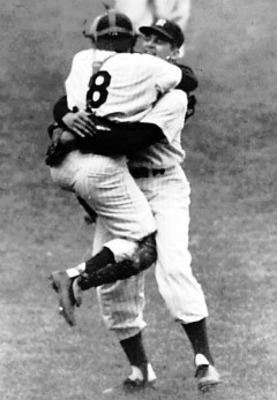
The series started the same as the 1955 series, except the Dodgers won the first two this time, crushing Don Larsen 13-8 in Game 2. The Yankees won Games 3 and 4.  Game 5 was the classic.  The legendary game.  The perfect game.  So it came down to Game 6.  It was win or go home.

Game 6 was another classic.  Scoreless into extra innings, Jackie Robinson singled home the only run for a 1-0 win forcing Game 7.

With so many tight, hard fought games over the years between these two teams the anticipation for Game 7 was huge.  Everyone assumed it would be a classic and given the result of the 1955 Game 7 there was no way to tell who would win.  The Dodgers seemed to have the advantage with Big Newk starting for the Dodgers against Johnny Kucks for the Yanks.  The Yankees scored first in the first inning with a  two run Home Run from Yogi.  The Dodgers couldn't answer.  In the third inning the Yankees struck again with another two run homer from Yogi.  The Dodgers again couldn't answer.  A solo Home Run by Elston Howard in the 5th and a Grand Slam by Moose Skowron in the 7th would be all the scoring for the day.  Johnny Kucks pitched nine innings allowing only three hits and no runs for a 9-0 World Series clinching victory.  The "almost dynasty" of the Dodgers had missed the opportunity to win back to back championships.

The Decline and Fall:
The "almost dynasty" in Brooklyn fell quickly and was replaced by (in some parts running simultaneously with) the almost dynasty in next week's article.  The Dodgers hung in the race until mid season but by the end of July the team was in third place and they would never climb higher.  Injuries depleted their power and the talent expected to replace the aging players did not progress as quickly as anticipated.  Drysdale showed signs of success but Koufax was wild and unreliable.  Add to that rumors, which turned into reality, that the Dodgers would be moving to Los Angeles led to smaller crowds and a lack of interest in the team for the first time in team history.

The core eight were starting to slow down.

After the 1956 season  the Dodgers did the unthinkable.  They traded Jackie Robinson to the rival Giants.  Too bad they didn't know he had already planned to retire.

Following the 1957 season Campanella was in a car accident leaving him paralyzed his entire life.

At 37, Pee Wee's playing time diminished and he was playing games at third base instead of Short Stop.  He made the move to Los Angeles for the first season but retired after that first year.

Furillo also made the trip to Los Angeles for a few years but injuries and the sudden appearance of younger talent shrunk his playing time.

Big Newk suffered on the mound following the Game 7 loss in 1956.  He went just 11-13 in 1957.  He started out 0-6 in the first Los Angeles season before being traded to the Reds.

Gil Hodges played with the Dodgers until being drafted by the Mets in the 1962 expansion draft.  He would eventually manage the team to their first ever World Series title.

Carl Erskine always had Hall of Fame talent.  His arm was the only thing holding him back.  His injuries slowly took their toll.  He went just 5-3 in 1957, 4-4 in 1958 and 0-3 with a 7.71 ERA in 1959 before retiring.

Duke Snider was the last man standing.  As Pee Wee, Campy and Furillo aged and saw less playing time, Duke became the team leader.  He stayed with the team through 1962, even making huge contributions to the Dodgers first World Series win in LA.

The Brooklyn teams of the late 1940's and early 1950's could have been a full fledged dynasty.  With six pennants between 1947 and 1956, as well as two other years (1950 and 1951) that were missed opportunities, the team had chance after chance to stake their claim as an actual baseball dynasty.  Instead, what they ended up with was one World Series title and second place in history to the Yankees dynasties of the 1940's through early 1960's.

TRIVIA QUESTION:
The Dodgers signed Sandy Koufax as a "bonus baby" meaning that the size of his contract required him to remain on the major league roster.  In order to make room for Koufax on the roster the Dodgers had to send a player to the minor leagues.  What player was sent to the minors to make room for Koufax?

Answer to Last Week's Question:
Congratulations to TJD for answering last week's question correctly!
Between 1941 and 1964 the Yankees, Indians and Red Sox dominated the top of the American League.  The Yankees won the American League in 1941, 1942, 1943, 1947, 1949, 1950, 1951, 1952, 1953, 1955, 1956, 1957, 1958, 1960, 1961, 1962, 1963 and 1964.  The Indians won the AL in 1948, and 1950.  Although the Red Sox came close in 1948 and 1949 they only manged to win the AL in 1946.  Only three other teams managed to sneak into the World Series from the AL.  The Senators and A's were not able to sneak in at all during that time.  The 1944 St. Louis Browns were able to win the American League and challenge the National Leauge's powerful St. Louis Cardinals in a cross town World Series.  The following year the 1945 Detroit Tigers rode the emotion of Hank Greenberg's return to beat the Cubs.  The 1959 White Sox led by Al Lopez reached the Fall Classic before losing to the Dodgers in their first ever West Coast World Series win. 

Sunday, July 6, 2014

Players I Love More Than I Should: Outfield: Carl Furillo

More than 18,000 players have appeared in Major League Baseball games since the start of the league.  Some players have short careers that last one at bat or one appearance in the field.  Others have 20+ year careers.  As I read more and more about baseball history there are certain players I find myself enjoying reading about more than others.  It is obviously illogical since many of them retired, or in some cases passed away, long before I was even born.  I have no first hand experience in watching some of them play but for whatever reason their personalities and perseverance strikes me above and beyond the other players I read about.  Over the next few weeks I will be giving you short biographical histories*of some of these players.  Some of them will be Hall of Fame players.  Some of them will be players only casual fans may know.  Regardless, I chose one player from each position for this series to explore.  This week we will explore one of the outfielders I chose for the series: Carl Furillo.

If you are just joining the blog don't miss the other players in the Players I Love More Than I Should series: Yogi BerraHank GreenbergJoe MorganCal Ripken, Frank "Home Run" Baker,  Frank Robinson and Larry Herndon.

Humble Beginnings:
The 1920's in the Reading, Pennsylvania area were not tremendous.  Although most of the country was running high on the "Roaring 20's" attitude of anything goes, the hub of the railroad was struggling.  With the creation of the automobile, the need for railroad transportation decreased.  As the automobile increased in popularity, the uses for the vehicle increased.  The railroad started to slowly suffer.  As the country went into prohibition, the city was kept from running dry by racketeer Tony Moran.  Moran kept the underground going with gambling, black market whiskey and women.  According to the Berks County Historical Society's website, Moran kept gambling dens and speakeasies at 529 Cherry Street as well as 529 Penn Street.  He must have had deep pockets because the Historical Society tells us that many speak easies were shut down but Moran never had a raid, despite being known city wide.

Five miles east of the city, in the suburb of Stony Creek Mills on March 8, 1922 Carl Furillo was born.  Baseball in the Reading area was a big deal.  The first minor league team started in Reading in 1919 as the Reading Coal Barons in the International League and finished 8th with a 51-93 record.  The team remained in the International League but continuously changed names.  They were called the Marines (1919), Aces (1921-1922), Keystones (1923-1932), Red Sox (1932-1935) and then minor league baseball disappeared from Reading for a few years.  Furillo's older brother Nick played on the Stony Creek baseball team while Carl, the adoring younger brother, was the bat boy.  By 1940 Furillo had shown that he was clearly the best player in the city and he was able to hook on with the Pocomoke City Chicks in Maryland.  Furillo hit .319 and played with future Dodgers team mate Gene Hermanski.

He also played for the Reading Chicks that year where he played all of 6 games and hit .320 (8-25 with no extra base hits).  The Dodgers bought into the rights of the Reading organization and in 1941 renamed the team the Reading Brooks.  The legend says that they only bought the team because of the air conditioned bus and Carl Furillo.  Furillo's team mate on the 1941 team would loom large in the history, although not as a player.  Al Campanis played 108 games for the team.  He would go on to spend decades in baseball front offices, including the Dodgers.   Furillo continued to impress as he hit .313 with 23 doubles, 16 triples and 10 Home Runs.  It was enough to get him promoted to the Dodgers' Montreal Royals team.  The Royals team would be filled with players moving up to the majors though only Stan Rojek and Alex Kampouris would have more than a cup of coffee.

Furillo planned to move up to the majors for the next year but instead he moved out to Europe. He was enlisted in the army, saw significant combat, was injured in combat but refused to accept the purple heart.  After three years with the military Furillo returned a much matured young man, ready to finish what he was so close to starting before he had left.

Breaking In:
Furillo went to spring training in 1946 and picked up where he left off.  Although he immediately took a dislike to his manager.  After an argument over salary and Durocher's misperception of Furillo's drinking habits the two got off on the wrong foot and never got back on track.  Furillo would play 117 games and hit only .286 for the year.  It was his defense that caught every one's attention.  Furillo played all three outfield positions and got attention for the strength of  his arm.  He fired the ball like a bullet from a rifle earning him the nickname "the Reading Rifle".  He even received a vote for MVP.  The team finished the regular season tied for first with the St. Louis Cardinals and had a two game playoff.  Furillo started the first game in Centerfield.  Furillo went 0-4 (though he did reach on an error in the second) as Joe Garagiola, Stan Musial and fellow Reading, PA native Whitey Kurowski took game 1 4-2.Game 2 went little better.  In the bottom of the 9th, trailing 8-1, the Dodgers made a late push to extend the season.  Furillo singled with a runner on 3rd and came around to score.  It was too little too late as the Dodgers lost 8-4.

The team would be drastically different the following year.  1947 would be the year of Jackie Robinson and would start with great turmoil.  A number of players signed a petition, led by Dixie Walker and Kirby Higbe, asking the team not to bring Jackie to the Brooklyn team.  Higbe swore to the day he died that Furillo was one of the signers.  Just as adamant was Furillo who swore he never signed it. "We went to Havana for spring training, and one day when I was at the ball field, and I don't remember who it was anymore, whether it was Bragan or Dixie Howell, he said to me 'Furillo, what would you do if he came after your job?' And I wasn't thinking.  I just said 'I'd cut his legs off."  And the remark got in the papers, and before you know it, I was the guy in the middle."...I had made it and it was too late.  You couldn't retract it.  But I got along good with Jackie.  And I told Jackie about it. I said 'I'm sorry but I didn't mean it the way they put it."   Even more infuriating for Carl was the way he was portrayed in the Jackie Robinson Story film released. Although his name was not used, he felt that the Italian outfielder who protested against Jackie playing with the Dodgers was representative of him. The incident led to a new attitude from Furillo.  He became a loner in the Dodgers locker room.  He rarely associated with the other players.  "I didn't associate with any of them.  I lived in Flushing, and the rest of them lived in Brooklyn.  When the game was over, they went their way, and I went mine."  The Dodgers reached the World Series and Furillo had a great series.  He hit .353 with 2 doubles and 3 RBI.  It wasn't enough.  The Dodgers fell to the Yankees 4 games to 2.

The Dodgers fell off in 1948 but Furillo continued to improve. What did not improve was his relationship with Durocher.  His playing time diminished and when Durocher moved on to the Giants no one was happier than Furillo.

Bums:
The Dodgers were building something special.  They already had players like Furillo, Reese and Robinson. They added to this Campanella, Hodges, and Duke Snider to build a National League powerhouse.  Year in and year out the Dodgers were on the top of the league and year in and year out they were losing to the Yankees in the World Series.  Furillo was a big part of that success.  He worked perfectly with Snider in Centerfield to patrol the outfield.  Local merchant Abe Stark had an advertisement in right field for years.  It was a target for opposing hitters.  The ad said "Hit sign, win suit".  Eventually Abe Stark gave Furillo a suit because his defense in the outfield had prevented Stark from ever having to give a hitter a suit.  He was a quiet, often sullen personality in the club house.  He got along fine with his team mates when he was in the locker room and on the field but he rarely socialized with them after the games.  He became known as "Skoonj" around the locker room because his favorite food was Scungili.


Campanella, Robinson, Snider and Reese would all make the Hall of Fame.  Hodges would become remembered forever for battling a terrible slump in the 1952 World Series and being the manager who led the Mets to respectability.  Branca would be remembered for giving up the Home Run to Bobby Thompson.  Even Cal Abrams, Sandy Amoros, Cookie Lavagetto and Al Gionfriddo would gain more notoriety.  With all of this Furillo somehow became the forgotten Dodger.  Every year he would hit near or above .300.  He won the 1953 batting title at .344.Every year he would work like a machine to keep the legendary Brooklyn teams in the pennant race.  Every year they would lose to the Yankees.  The Yankees-Dodgers October match up became an annual tradition

1947, 1949, 1952, 1953.   Every season the Yankees would win.  Furillo performed well most post seasons.   In 1947 the Dodgers lost in six games.  Furillo hit .353, scored 2, drove in 3 and walked three times.  1949 and 1952 were down series for him.  He  hit .125 and .174.  1953 was a six game battle and Furillo did everything he could to get past the now Mantle led Yankees.  Furillo had 8 hits (including 2 doubles and a Home Run), scored four runs, drove in four and had a .333 average for the series.

It seemed it would never change.  The 1955 series started as expected.  The Yankees won the first two games of the series.  The Dodgers came back and won the next three.  Furillo's offense and defense helped the Dodgers take a lead in the series.  The Yankees tied it up with a win in Game 6 and everyone expected 1955 to end the same way the other years did.  Furillo did not have a hit in the final game but his ground ball in the 4th moved Campanella to third where he scored easily on Gil Hodges's single.  In the 6th with Reese on second and Snider on first the Yankees chose to intentionally walk Furillo to load the bases.  By Furillo getting on base and moving Reese to third, the Dodgers were able to score the second and final run of the game giving them a 2-0 win and the first World Series Championship in the team's history.

If the Yankees-Dodgers match ups were tradition, the  Giants-Dodgers matchups were vicious.  "We hated them.  We just hated the uniforms." Furillo said.  "I hated Halloween.  There was too much orange and black." Duke Snider would say.  The hatred that many of the players had for Durocher (Jackie and Furillo mainly among them) and the bitterness Durocher had towards the Dodgers led to many an ugly scene.  Not the least of witch was the ugly brawl on the Game of the Week.  Furillo approached the plate and heard Durocher's voice from the Giants bench.  "Stick it in his ear."  The next pitch hit Carl on the wrist.  As he trotted down to first he looked into the Giants dugout.  By at least one account Durocher flipped off Furillo.  Others said Durocher motioned for Furillo to come and get him.  Whatever it was Furillo tore into the enemy dugout with fists flying.  In the chaos that followed Furillo had Durocher in a headlock and was apparently ready to kill.  It was said that Leo was turning purple.  As the story goes, Furillo's hand was stepped on in the skirmish and he broke his finger.  Furillo tells it differently.  According to Carl no one stepped on his finger.  Leo personally bent it backwards until it broke.

In 1958, after decades of fighting for the same city, the Dodgers and Giants decided to move west and fight over the same coastline.  Many of the Dodgers moved with the team including Snider, Reese, Hodges and Furillo.  The first year, playing in the bizarre dimensions of the Los Angeles Coliseum, Furillo performed admirably but the adjustment was difficult.  Koufax and Drysdale were still learning and Erskine and Newcombe were struggling with health issues.  The odd shape of the outfield led to greatly diminished power numbers for everyone (Snider hit only 15) but Furillo hit 18 Home Runs and led the team with 83 RBI.  It was not a successful season for the Dodgers but Furillo's performance earned him one MVP vote.  Jim Gilliam (4 votes) was the only other Dodger to receive votes.

The Downfall
The 1959 season was the first successful season for the Dodgers in Los Angeles.  It was a disaster for Furillo.  He had seen limited action when he entered the game on June 29.  He had only 58 at bats, 19 hits, 2 doubles and no Home Runs.  On June 29th Carl entered the game as a pinch hitter in the bottom of the ninth.  The Dodgers trailed by a run and had runners on 2nd and 3rd.  Furillo hit a sacrifice fly to score the tying run, sending the game into extra innings.  In the bottom of the 11th Carl came to the plate with a runner on first.  He singled to right field and as he ran down the line he felt a pain in the back of his leg.  He had torn a calf muscle.  Furillo missed a month of the season but returned in time for the Dodgers to help the Dodgers in the final push for a pennant.  As the season ended the Dodgers tied with the Braves and had a best of three playoff to advance to the World Series.  The Dodgers won Game 1 but Furillo stayed on the bench.  With the Braves' star Lew Burdette on the mound for Game 2, runners on first and third with no out, and the Dodgers down a run, Furillo hit a sac fly to tie the game and send it into the 10th.  In the bottom of the 11th Furillo singled with a runner on first but was stranded there.  The Braves went in order in the top of the 12th riveting up the pressure exponentially.  Wally Moon and Stan Williams went down quickly in the Dodgers half of the 12th and it looked like the Braves might possibly stay alive for one more chance at bat.  If they could do so they would have Eddie Matthews and Hank Aaron coming up.  Instead, Gil Hodges walked and Joe Pignatano singled.  Furillo stepped in hoping to send the Dodgers to the World Series.  The Braves hoped the 38 year old would end the inning and extend their year.  He took the first pitch for a called strike.  He watched the second pitch for a ball.  On pitch three he fouled the ball off.  On the fourth pitch Furillo grounded the ball to shortstop and Braves fans breathed a sigh of relief, until the throw went wild and Hodges scored to send the Dodgers to the World Series.

The Dodgers faced the Go Go White Sox in the 1959 World Series.  The Sox ran away with the first game of the series with an 11-0 win.  The Dodgers tied it up in Game 2, although Carl had little to do with either game.    Game 3 went into the bottom of the 7th scoreless.  With two out and the bases loaded in the 7th Furillo pinch hit for Don Demeter.  His two run single gave the Dodgers the lead in the game and eventually the series as they won 3-1.  It was his only hit in 4 at bats in the series and it tipped the scale to the Dodgers as they won their first West Coast World Series.  It was not the best performance of the series as Chuck Essegian pinch hit two Home Runs and Larry Sherry won 2 games and saved 2 more.  It was the performance of the professional who knew his role in the team's success and did what was needed to win.

As the 1950's ended and the 1960's began the Dodgers had to find a way to transition the aging players to the younger products of the strong farm system.  Norm Larker replaced Gil Hodges at first base.  Maury Wills starred where Pee Wee Rees had formerly led.  In the outfield Ron Fairly, Willie Davis, Tommy Davis and Wally Moon started to push Furillo and Snider to the sidelines.  Although Snider still got significant playing time, the outfield was too crowded.  Furillo played in 8 games but by May 7 he was out of the rotation.  On May 17th he was released.

According to the Dodgers they offered  Furillo a chance to play in the minors or a few options to coach.  According Furillo he was never offered a job, only a minor league option.  Furillo asked to be allowed to find another team that was willing to take a chance.  This was refused.  Nearly a decade before Curt Flood, Furillo decided to fight the reserve clause.  He wrote a letter to Senator Estes Kefauver, known as a politician who fought for fair business practices and against monopolies.  Ultimately the appeal to Kefauver went nowhere.  Not until the end of the 1960's would another serious challenge be made to the reserve clause.  Furillo's claim for the rest of his life was that he had been blacklisted because of his attempt to challenge the reserve clause.

Furillo retired with 1910 hits, 324 doubles, 56 triples, 192 Home Runs, 895 Runs and 1085 RBI. His final career  average was .299.  His numbers are not amazingly eye popping.  They don't bring immediate comparisons to Ruth, Aaron, DiMaggio and Frank Robinson.  They do, however, compare nicely with some other Hall of Fame Players.  He should certainly have received more consideration for the Hall of Fame than he has.  Along with Furillo, Gil Hodges has been locked out of the Hall of Fame, though Hodges's reputation through the years has been much more protected.  Few teams have ever had the run of success that the 1940's-1950's Dodgers teams had.  The teams are heavily represented in the Hall of Fame with Snider, Campanella, Robinson and Reese.  The legend around the contributions of Branca, Erskine, Podres, Abrams, Gionfriddo and Amoros has grown over he years.  The one who has been lost in the shuffle is Carl Furillo.

*This is not intended as a full biography and due to space I have done my best to summarize the life of the players in this series.  For further information on Carl Furillo please check out

Videos:
Ken Burns Baseball
42
Dodger Blue: The Championship Years
The Official World Series Film Collection


Websites:
http://www.baseball-reference.com/
http://www.baseball-almanac.com/
http://sabr.org/

Books:
The Boys of Summer by Roger Khan
Jackie Robinson: A Biography by Ronald Rampersad
The Last Good Season: Brooklyn, the Dodgers and Their Final Pennant Race Together by Michael Shapiro
Summer of '49 by David Halberstam
Bums: An Oral History of the Brooklyn Dodgers by Peter Golenbock
I Never Had It Made by Jackie Robinson
Perfect: Don Laren's Miraculous World Series Game and the Men Who Made It Happen by Lew Paper
Forever Blue: The Story of Walter O'Malley, Baseball's Most Controversial Owner, and the Dodgers of Brooklyn and Los Angeles by Michael D'Antonio
Carl Furillo: The Forgotten Dodger by Bill Ninfo
A Tale of Three Cities: The 1962 Baseball Season in New York, Los Angeles and San Francisco by Steven Travers
Duke of Flatbush by Duke Snider
Baseball in Reading by Charles J. Adams III
Brooklyn Dodgers: The Last Great Pennant Drive,1957 by John R. Nordell, Jr
Bums No More: The Championshio Season of 1955 by Stewart Wolpin
The Perfect Yankee: The Incredible Story of the Greatest Miracle in Baseball History by Don Larsen with Mark Shaw


TRIVIA QUESTION:
Carl Furillo earned the nickname "Reading Rifle" based on his home town of Reading, PA and his strong, accurate throwing arm.  How many career Outfield assists did Furillo have?

Answer to Last Week's Question:
Larry Herndon played in three Post Season Series, a total of 10 games, and won two of them.  Herndon played in 2 games of the 1984 ALCS against the Royals and went 1-5 with a Home Run.  He played in all five games of the 1984 World Series against the Padres and went 5-15.  Herndon also played in three of the five games in the 1987 ALCS against the Twins and went 3-9.  This brings his total hits/at bats in the post season to 9-29 for a .333 career post season average.

Saturday, November 30, 2013

Rivalries: Jackie vs. Leo

Don't forget to check out the other articles in our rivalry series:  Christy Mathewson vs Three Finger BrownTy Cobb vs Babe Ruth, and Joe DiMaggio vs Ted Williams.

"Listen up!"  The words were angry, vicious and worst of all at this time of the morning, loud.

It was late.  Half of those present were pulled out of bed.  Some of them may have just snuck into bed.  None of them had experienced anything like this spring training.  First of all, it was in Havana.  What the hell were a bunch of white guys, many of them southerners, doing in Cuba? Then of course there was Jackie Robinson.  What the hell was an African American from California  doing in Cuba with all these white southerners?

"Listen up!"  He said it again but the first one was probably enough.  When the Lip told you to listen you listened.  "I hear some of you guys got a problem with Robinson."  Leo knew exactly who the players were who had the problem.  "I don't care if the guy is yellow, or black or has stripes like a f***ing zebra.  I'm the manager of this team and I say he plays."


The problem became this: when the 1947 season opened and Jackie Robinson jogged out to first base for the Brooklyn Dodgers, Leo Durocher was sitting at home, suspended by the commissioner for his involvement with less than savory characters and his association with a married woman.  So in the end, he had no say over who played for 1947. 

While Leo sat out for the season, Burt Shotton and Jackie Robinson took the Dodgers to their first pennant since 1941, Durocher's third year as manager.  He had been through a lot since then.  The Dodgers had fought with the Cardinals for first place.  The Cardinals were Leo's former team, Branch Rickey's former team and Pete Reiser's former team.  Durocher had seen Pete Reiser, the natural, the leader, the one man that had more talent (it was whispered) than even DiMaggio.  Reiser ran himself into a wall, literally, and fractured his skull.  The doctors told him to stay out or risk his life.  Durocher needed him in uniform for moral support but promised not to use him.  He couldn't keep the promise and Reiser's health was forever ruined.  Durocher saw many of his stars, Reiser, Reese and more, shipped off to war and miss the prime of their careers.


Durocher saw the same talent, or more, in Jack.  He couldn't wait to see what he could do.  He saw what Jackie could do, lead the team like few had done before, but Jack did it for Shotton and the Dodgers reached the World Series.  Durocher would need to wait for 1948 to get the advantages out of Jack's talent.  But if the Dodgers front office thought Jack's success the year before would mean immediate acceptance they were wrong.

The Dodgers bus pulled up to a Florida stadium in Spring Training 1948, overflowing with a record crowd to see the Dodgers.  Dodger Pitcher Rex Barney told the story of a big security officer stopping Jack at the entrance and questioning Jack's intelligence and literacy.  Durocher immediately spoke up.  "He can't go in there?  He can't go in that entrance?  Then we are not going in there.  Do you know what that means?"  In Barney's story the security guard relented knowing the overflow crowd would likely riot.  It was a rare moment of camaraderie between Jackie and Leo.


Like most award winning players, especially one as spectacular as Robinson, everyone wanted a piece of him.  Four off season months and lots of rubber chicken dinner speaking engagements later, Jack appeared at Spring Training twenty pounds above his 1947 playing weight.  Durocher was appalled.  Robinson wasn't the only over weight star.  Pete Reiser and Jack were forced to run for hours in rubber sweat suits to work off the excess fat.  While they were running laps in tropical heat Durocher was yelling at them "C'mon fatso!  Get moving."  It was humiliating for the players and Jackie resented it.

The difference between Shotton and Durocher was night and day.  Shotton had told the Dodgers that he would stay out of their way and that they could win despite him.  Durocher drove them relentlessly and let them know who was boss.  The pressure on Shotton was non existent.  If he had lost it would have been what everyone expected.  For Durocher the pressure was ever-present.  He was terrified that if the Dodgers struggled he would be blamed and fired.  The season was a disaster.  The team struggled.  Robinson struggled.  As the pressure mounted Durocher took it personally.

On Sunday, June 11, the Dodgers lost 3-2 to the Giants and fell to 35-37.  It was Durocher's last game as a Dodger manager.  On July 15, the Giants split a double header, bringing their record to 37-38.  Their manager, Giant legend Mel Ott, was fired and replaced with none other than Leo.  If the Dodger's Giants rivalry had been dormant for a few years it was about to erupt.


Durocher's style of managing caused quite a bit of resentment to the remaining Dodgers.  Two players in particular, Jackie and Carl Furillo, hated Leo.  Leo was from the old school.  The school that thought if you can distract your opponent they won't focus on the job.  Durocher would stand in the coaching box and mimic a person with a swollen head and point to Jack. 

After a tight pitch from Sal the barber, Jackie bunted the next pitch foul down the first base line and ran straight through Maglie.  Durocher yelled to Jackie.  "That's bush league Robinson."  Jack yelled back "You should know.  You taught me to do it."

Durocher was a master taunter but Jackie could give it right back.  Russ Meyer, a former Giant who was traded to the Dodgers said "He (Jackie) hated Durocher with a goddamn passion.  He used to taunt him." According to Meyer Robinson yelled taunts like "Hey Leo, who you gonna marry next?  Is Laraine taking good care of you?"

The funny thing about rivalries is that once the years go by the anger usually fades.  At the end of their careers both had won World Series.  Both ended in the Hall of Fame and both were remembered as successful.

Jackie himself reflected on the rivalry with clarity.  He remembered the spring training from hell in his auto biography.  "To get me in shape, Leo put me through some furious physical paces.  They were humiliating because rookies, reporters and teammates were all onlookers.  Leo also kept after me verbally, and as the world knows, he is a magnificent tongue lasher.  At the time I thought he was being too excessive, but later I realized he was only doing what was necessary, and even though his comments hurt, I could not forget that Durocher had done all he could the previous year to help ease my way into the majors...I think that Leo felt I had not given him my best effort and was working harder for Shotton.  That wasn't true but on the playing field Leo and I got into a number of hassles that were picked up by the press.  Leo and I were alike in so many ways, and that could have been part of our problem.  But no matter how many verbal insults were exchanged, I believe we never lost the respect we had for each other's abilities."

TRIVIA QUESTION:
Current Dodger Manager Don Mattingly has asked for a three year contract as a reward for his success.  It has been a long time Dodger organization policy to only give Dodgers' managers a one year contract (this dates back to long before the move from Brooklyn).  In fact, legendary Dodger manager Tommy Lasorda never had a contract longer than one year.  Mattingly's demand for a three year contract is eerily similar to the demand of Brooklyn manager Charlie Dressen back in 1953.  Dressen had led the Dodgers to a three game playoff against the Giants in 1951, followed by back to back National League Championships in 1952 and 1953.  Dressen wrote a letter to Walter O'Malley demanding a three year contract.  O'Malley did not deal well with demands from others so he replaced Dressen.  Who replaced Dressen as Dodgers manager?


Answer to Last Week's Trivia Question:
In games 1 & 2 of the 1951 World Series the Yankees started a young outfielder in his first full year in the Major Leagues.  The right fielder went 0-3, with 2 walks in Game 1.  In Game 2 the young player went 1-2 with a run and strikeout.  He only played part of the second game.  In the top of the 5th inning, Willie Mays led off the Giants' 5th inning with a fly ball to right-center field.  Joe DiMaggio moved over to track down the fly ball, invading the right field territory.  The young right fielder had started to track the ball himself but when he saw DiMaggio tracking it he attempted to move into a back up position.  When he changed his course Mickey Mantle caught his spike on an exposed drain pipe and severely damaged his knee causing pain for the rest of his life.

Friday, November 9, 2012

The Life of Lee MacPhail

Leland Stanford MacPhail, Jr.
October 25, 1917-November 8, 2012


Larry MacPhail's relationship with Leo Durocher is legendary.  Someone once said of Larry: "With no drinks he was brilliant.  With one he was a genius, with two he was insane.  He rarely stopped at two."

As the baseball legends go, MacPhail would routinely call Durocher after a few drinks, argue over who was pitching or not playing or not hitting, the conversation would get heated and one of two things would happen:  Durocher would quit or Durocher would get fired.  The next morning MacPhail would call Durocher to find out what pitcher he was planning to start that day or when he was stopping by the office to discuss player personnel.  It was a routine

Like most baseball legends these stories are quite likely exaggerated.  It's unlikely that a man like MacPhail could be that erratic and still be as successful as he was. 

In 1941 Larry made one of his best hiring decisions.  He chose Leland Stanford MacPhail, Jr to run the Brooklyn farm team in Reading, PA.  The Dodgers organization bought the Reading franchise, as the story goes, for two reasons:  Carl Furillo and the air conditioned bus.  The Reading Brooks were in the Dodgers organization for one year, long enough for Lee MacPhail to get Furillo ready for the majors and to acquisition the bus.

It would be hard to imagine that the one year in Reading taught Lee everything he needed to know but he certainly learned quickly.  When he got out of the Navy after World War II he went to work for Larry MacPhail, now owner of the Yankees.  He was again asked to toil in the minor leagues and find talent to feed the Yankees dynasty with young talent.  During his time with this responsibility the Yankees won seven World Series.  Among the long list of talent discovered by Lee were Mickey Mantle and Whitey Ford.

After creating one of the greatest dynasties in the history of sports, Lee moved out on his own and started to shape the Baltimore Orioles franchise.  The O's had moved from St.Louis just a few years before where they had struggled for over 50 years as the American League's doormats.  The St.Louis Brown's made the World Series one time before moving to Baltimore in 1954.  The first five years in Baltimore did not seem to really bring any hope for the future.  Lee MacPhail changed that.  Lee used his tremendous organizational skills to build Baltimore into the best baseball organization of the late 1960's to 1970's.  He left before the Orioles won their first World Series in 1966 but the team was developed out of his talents.

For many years afterwards Lee worked in the game.  He returned to the Yankees during the dark CBS years and eventually became the American League president.  His most memorable moment as the AL President came from the infamous George Brett pine tar incident.  When Brett was called out for using too much pine tar on his bat the Royals filed a protest.  As President of the American League the protest came to MacPhail's desk and he sided with Kansas City.  It was one of the few times that a League President overturned an umpire's decision.

On Thursday, November 8, 2012 at the age of 95, Lee MacPhail passed away.  When legends pass on the conversation usually turns to their "legacy".  Lee MacPhail's legacy, including the connection of his father dating back to the 1930's spans nearly every era of baseball but it also expands into the present day and lives on.  Lee's son Andy MacPhail, Larry's grandson, was also a baseball executive and helped build the Twins world Series teams in 1987 and 1991, the strong Cubs teams of the late 1990's and helped lay the ground work of the current Orioles teams. 

Lee MacPhail passed away but the impact he left on the game of baseball is well marked in the past and will continue to reach well into the future.

Sunday, September 23, 2012

"...if you were the last batter in a perfect game or no hitter?"

He threw the last pitch of the 8th inning. He let it go, followed through and felt the sweat fly off his hand as the ball twisted towards the plate.  Watching Joe Collins, the big Yankee first baseman, swing through the pitch he heard the "tick" of the foul tip and the "smack" of the ball hitting Campanella's glove. Sal Maglie walked off the mound toward the visitors dugout.  He had done his job and it was a hell of a job.  8 innings pitched, 5 hits allowed, only 2 runs allowed, 2 walks, 5 strikeouts.  Giving up only 2 runs to the powerful Yankees with the reigning World Champs backing him should have been enough to win, now he trusted they would do their job.

Maglie may have reflected on the oddity of being in this position. It had been an odd season, truly surreal. It started in Spring Training when he was told he wasn't good enough to be a starter for the Cleveland Indians. He did his best to convince them he was good but try being sharp when you only  pitch once a month.  He begged Hank Greenberg, the General Manager, to play him, trade him release him, anything.  Just give him a chance.  So he got his chance.  An exhibition  game against a minor league team.  Fortunately for Maglie he pitched great and fortunately for Greenberg, the Dodgers saw the performance.  Looking for one last pitcher to help shore up the staff, the Dodgers took a chance and bought Maglie's contract.  There was only one problem:  Maglie hated the Dodgers with a passion and the feeling was mutual.  Maglie pitching for the Dodgers would be today's equivalent of Jeter wearing red socks, a grey jersey and Boston written on the chest or Chipper Jones pulling on a red pin striped Phillies' uniform. 

Photo Courtesy of:  Bleacher Report

Once, while pitching for the Giants, Maglie threw a fastball at Carl "the Reading Rifle" Furillo's head.  The next thing you know Furillo's in the Giant's dugout with Leo Durocher in a headlock.  Durocher's turning purple, Giants players are telling Furillo to stop and the umpire's begging Furillo to kill Durocher.  Total chaos and it all happened on the "Game of the Week" for the world to see. The Dodgers players nicknamed Maglie "the Barber" because he would pitch so close to your chin that he would give you a trim.  The professional "do your job" culture that dominated the Brooklyn Dodgers of that era kept Furillo from killing Maglie when he walked into the Dodgers clubhouse and the 13-5 record he posted after arriving didn't hurt.

He wouldn't have questioned that his day was done as he left the mound.  That's the thing about being a pitcher late in the game.  If your spot in the order is due to bat the announcers refuse to even acknowledge you as an option.  They'll say "the pitcher's spot is due up third" and you know late in the game your manager won't allow a .129 hitter to come to the plate when someone who is actually allowed to take batting practice can take your place.  He had done his job and now his teammates had to do theirs.

This series was a crossroads moment in baseball history.  It put the final stamp of historical interpretation on the era of to franchises.  Since 1941 these two teams had met repeatedly in the World Series. In 1941, 1947, 1949, 1952 and 1953 it was always close, usually went six or seven games and provided some of the greatest World Series memories in history.  This series would stamp the Dodgers as "lucky" to have finally gotten the 1955 win or stamp them as the new dynasty, defeating the aging, beaten, crumbling Yankees.

The top of the 9th started with Furillo, a consistent .300 hitter, flying out to right field.  Campanella grounded to second for the second out and then came "the pitcher's spot".  There was really no thought to the process.  As unpredictable and random as this game can be this was inevitable and well planned out.  There was one choice that made sense.  The Dodgers needed a pinch hitter.  A right handed batter was needed to face Don Larsen, the left handed pitcher.  Preferably someone who had faced the pitcher before and knew his pitch pattern and his motion.

By about the 5th or 6th inning Dale Mitchell likely would have been thinking his name would come up if things kept going the way they were going.  Sitting on the bench leaves a lot of time for thinking and observing and "what if...?" 

The "what if" was here.  Top of the ninth, 2 out the team is down 2-0, Game 5 of the 1956 World Series and, oh yeah, Don Larsen is pitching a perfect game.  Mitchell likely thought "Don Larsen, of all people, is pitching a perfect game.  For God's sake, they call him 'Googly Bird', and somehow not a single Brooklyn Dodger had reached base.  If Pee Wee Reese, Jackie Robinson, Duke Snider, Carl Furillo, Gil Hodges and Roy Campanella can't get a hit off this guy, what do they expect me to do?"

Mitchell was a professional.  He was in his tenth major league season and had told the Indians at the beginning of this year that it would be his last.  It had been a great career:  he had been on the Indians World Series champs team of 1948, had made great contributions to the 1954 juggernaut Indians that were shocked by the Giants, had made two All Star Games and had received MVP votes in 4 different seasons.  Mitchell was a professional, a good one, and he knew what was coming.  Go up there and start a rally.
Photo Courtesy of: Bleacher Report


Dale Mitchell struck out looking...and argued to the day he died that the pitch was high and outside.  Replays are difficult to tell but he was probably right.

This morning my friend asked me "if you were the last batter and the opposing pitcher is pitching a no hitter or perfect game, would you give up and let the guy have a no hitter, would you try to get a hit, or would you lay down a bunt and try to sneak a hit in there?"  Basically, "If you were Dale Mitchell...?"

A no hitter or perfect game is a rare and amazing thing, but only if the pitcher earns it.  Dale Mitchell may have struck out looking to give Don Larsen a perfect game but he didn't "GIVE" it to him.  Mitchell's at bat was a 5 pitch struggle that ended on a questionable strike call.  He didn't think "this guy is going to pitch a perfect game in the World Series" he thought "if I find a way to get on base I have the most powerful lineup in the world behind me and this guy will have forgotten about the 26 guys in a row he retired."  I am also fairly certain that Sal Maglie wasn't thinking "I hope this guy gets it."  He was thinking "if we can just get one guy on base we are still in this thing."

I'm not a pitcher so I can't say for sure but I doubt any pitcher would want to be given the last three outs of a no hitter.  They would want to earn that achievement.  In 1988 Dave Stieb, a pitcher for the Blue Jays took a no hitter into the 9th inning and with 2 strikes on the last batter gave up a hit.  Devastating.  It gets worse.  One start later the same thing happened.  It gets worse.  In 1989 it happened again.  Finally in September of 1990 Stieb got a no hitter.  Imagine how great it must have felt for him to finally get that accomplishment and have earned it as opposed to having someone give it to him.

Photo Courtesy of: Sports Net

As a batter your job is to go from a batter to a base runner and help your team win the game.  If you are lucky you will get four or five chances a game to make that happen and you can't give those chances up.  Pitchers are creatures of habit and rely on a rhythm to be effective.  If a pitcher is getting into a rhythm your best bet is to step out of the box as he is getting set to throw, take as much time as you can in between pitches and bunt.  Make him come off the mound and force him to get out of rhythm.  If you want a chance to win your best bet is to get him out of his rhythm early, by the third or fourth inning.  If you're being no hit early in the game lay down a bunt.  Rafael Furcal of the Cardinals is the best at this right now.

I can't tell you how many times I've watched a game where a pitcher is rolling along through the lineup and hitter after hitter is up there hacking at the first pitch popping up or grounding out.  No one steps out of the box and makes the pitcher think a little.  No one takes a pitch and makes the pitcher work to get you out.  These situations in the 4th, 5th or 6th innings are where the pitchers really earn the no hitter or perfect game.

"If I were the last batter in a no hit game..." I'd fight to get a solid hit but I'd be screwed because my team didn't get the pitcher out of rhythm earlier in the game.