Showing posts with label Pittsburgh Pirates. Show all posts

Sunday, February 22, 2015

2015 National League Central Preview

***The Division Preview that follows is not betting advice in any way shape or form.  Please do not bet any money based in any part on these predictions.***


Don't forget to check out the National League East Preview and check back next week for the National League West Preview

St. Louis Cardinals
Who's New:  
CATCHERS/INFIELDERS
Dean Anna, IF (Free Agent from Pirates)
Mark Reynolds, 1B (Free Agent from Brewers)
OUTFIELDERS
Jason Heyward, OF (Trade from Braves)
STARTING PITCHERS
Carlos Villanueva, P (Free Agent from Cubs)
RELIEF PITCHERS
Miguel Socolovich, RP (Free Agent from Mets)
Matt Belisle, RP (Free Agent from Rockies)
Who Left?: 
CATCHERS/INFIELDERS
Audry Perez, C (Free Agent to Rockies)
Daniel Descalso, 2B (Free Agent to Rockies)
A.J. Pierszynski, C (Free Agent to Braves)
Mark Ellis, 2B (Unsigned Free Agent)
OUTFIELDERS
Shane Robinson, OF (Free Agent to Twins)
Jermaine Curtis, OF (Free Agent to Reds)
STARTING PITCHERS
Jorge Rondon, P (Waiver Claim by Rockies)
Justin Masterson, P (Free Agent to Red Sox)
RELIEF PITCHERS
Eric Fonataro, RP (Free Agent to Nationals)
Pat Neshek, RP (Free Agent to Astros)
Jason Motte, RP (Free Agent to Cubs)
David Aardsma, RP (Free Agent to Dodgers)
Winter Headlines:  
Despite several key losses, Cardinals remain clear favorite in Central.
What to Expect?:
The Cardinals organization seems to have this game figured out.  Their minor league system continues to produce key players and they make smart trades and signings.  They don't always have big names but they know how to build a team that gets the most out of their pieces.
Why Should You Root for These Guys?:
This Cardinals run of success is something special.  This run started in 2000 when the Cardinals finished 1st.  Since then the team has only missed the playoffs three times.  Four times they have reached the NLCS only to come up short. Twice they have reached the World Series and lost and twice they have won it all.  For an organization boasting a history with Frankie Frisch, Rogers Hornsby, Dizzy Dean, Stan Musial, Enos Slaughter, Johnny Mize, Bob Gibson, Lou Brock and Ozzie Smith (among a million others) it is amazing to say that this may be one of the best times of their history.
Why Might This Season Not Turn Out the Way Cardinals Fans Want?:
The Cardinals are clearly the favorite in this division but pitching depth, something they have used to their advantage in other years, may be a bit thin this year.  Wainwright is spectacular every year and Lance Lynn has started his career strong but there is a significant drop off after the top 2.  John Lackey's age should be a cause for concern and the rest of the rotation is unproven.  It would seem they have some questions about the rotation and pitching depth themselves based on the fact that they traded for Lackey and Masterson at the trade deadline last year.
Don't Expect Too Much From Him:
John Lackey has had a very good career but age and injuries have caught up to him.  Although he was 11-7 with Boston when he was traded to St.Louis his ERA was high and he only went 3-3 in St. Louis.  Lackey is still a strong pitcher but his best days are behind him.
Expect Great Things From:
Jason Heyward is one of the most talented and hard working players in the game, although his last few years in Atlanta were not up to his normal production levels.  Part of that can be traced to a horrific at bat in 2013 where he was hit in the face with a pitch that shattered both sides of his jaw but that does not account for all of the problems.  A new start in St.Louis will be just what he needs.  Expect Heyward to regain his All Star form.
Is This His Last Chance?:
Peter Bourjos had huge potential and huge expectations when he came to the majors in Anaheim.  An outfield of Bourjos-Trout-Hunter was supposed to be a winning combination for the Angels but a lack of production led to Bourjos being sent to St.Louis in exchange for David Freese.  Bourjos has now fallen to a bench role.
Prediction: 1st in NL Central


Pittsburgh Pirates:

Who's New: 
CATCHERS/INFIELDERS
Francisco Cervelli, C (Trade from Yankees)
Jake Elmore, SS (Free Agent from Reds)
Steve Lombardozzi, 2B (Trade from Orioles)
OUTFIELDERS
Corey Hart, OF (Free Agent from Mariners)
STARTING PITCHERS
A.J. Burnett, SP (Free Agent from Phillies)
Clayton Richard, SP (Free Agent from Diamondbacks)
Chris Volstad, SP (Free Agent from Angels)
Charlie Leesman, SP (Free Agent from White Sox)
RELIEF PITCHERS
Brad Lincoln, RP (Free Agent from Phillies)
Blake Wood, RP (Free Agent from Royals)
Rob Scahill, RP (Trade from Rockies)
Josh Stinson, RP (Free Agent from Orioles)
Josh Lindbaum, RP (Waiver Claim from Athletics)
Antonio Bastardo, RP (Trade from Phillies)
Radhames Liz, RP (Free Agent from Blue Jays)
Arquimedes Caminaro, RP (Free Agent from Marlins)
Who Left:
CATCHERS/INFIELDERS
Russell Martin, C (Free Agent to Blue Jays)
Chase D'Arnaud, SS (Free Agent to Phillies)
Dean Anna, IF (Free Agent to Cardinals)
Ike Davis, IF (Trade to Athletics)
Clint Barmes, IF (Free Agent to Padres)
Thomas Field, IF (Free Agent to Rangers)
Chris McGuiness, 1B (Free Agent to Phillies)
Omir Santos, C (Free Agent to Nationals)
Michael Martinez, IF (Free Agent to Indians)
Jake Elmore, 1B (Free agent to Rays)
Gaby Sanchez, 1B (Unsigned Free Agent)
OUTFIELDERS
None
STARTING PITCHERS
Edinson Volquez, SP (Free Agent to Royals)
Adam Wilk, SP (Free Agent from Angels)
Wandy Rodriguez, SP (Free Agent to Braves)
RELIEF PITCHERS
Justin Wilson, RP (Trade to Yankees)
Ernesto Frieri, RP (Free Agent to Rays)
Chaz Roe, RP (Free Agent to Orioles)
Preston Guillemet, P (Free Agent to Blue Jays)
Jeanmar Gomez, RP (Free Agent to Phillies)
John Axford, RP (Free Agent to Rockies)
Vin Mazaro, RP (Free Agent to   Marlins)
Rafael Perez, RP (Free Agent to Mariners)
Winter Headlines: 
Who's the ace?
What to Expect?:
Pirates fans have been happy with the team's improvement over the last 5 years, however, the team may take a big step back this season.  There is no clear ace on the team and the loss of Russell Martin to lead the staff could cause a big drop off in a very competitive division.
Why Should You Root for These Guys?:
The Pirates have built this team fom the ground up.  The key pieces of this team have all come through the minor league system.  In an offseason where we have seen Atlanta and Oakland dismantle competitive teams and scatter their pieces all over the league it would be nice to see a team that has grown together, win together.
Why Might This Season Not Turn Out the Way Pirates Fans Want?:
Pitching.  The Pirates starting rotation is a big question for this team.  They somehow got by last year with Edinson Volquez and Gerrit Cole but Volquez is gone and Cole is probably not a true ace, at least not yet.  They resigned Burnett but the magic Burnett carried with him a few years ago seems to be gone.
Don't Expect Too Much From Him:
Francisco Cervelli is a decent Catcher.  He is not an All Star and he is not Russell Martin.  Martin had a way of controlling the game behind the plate and getting the pitchers to follow his lead.  Cervelli does not have that reputation.
Expect Great Things From:
Andrew McCutcheon is one of the best players in this league.  If you are trying to show a non fan why this game is so great show them McCutcheon.  He is a special player and watching him play with passion is a great experience.
Is This His Last Chance?:
A.J. Burnett has come back for a second tour of the Steel City.  In his first trip through the city he was the ace of the staff and led the team to their first playoff appearance since 1992.  At 8-18 with an ERA of 4.59 with the Phillies last year, Burnett will need some magic to help the Pirates back to the post season.
Prediction: 2nd in NL Central

Chicago Cubs
Who's New: 
CATCHERS/INFIELDERS
Tom LaStella, IF (Trade from Braves)
Jonathan Herrera, IF (Free Agent from Red Sox)
Miguel Montero, C (Trade from Diamondbacks)
David Ross, C (Free Agent from Red Sox)
Taylor Teagarden, C (Free Agent from Mets)
OUTFIELDERS
Adron Chambers, OF (Free Agent from Blue Jays)
Chris Denorfia, OF (Free Agent from Mariners)
Mike Baxter, OF (Free Agent from Dodgers)
Dexter Fowler,OF (Trade from Astros)
STARTING PITCHERS
Jason Hammel, SP (Free Agent from Athletics)
John Lester, SP (Free Agent from Athletics)
RELIEF PITCHERS
Donn Roach, RP (Waiver Claim from Padres)
Jason Motte, RP (Free Agent from Cardinals)
Mike Kickham, RP (Waiver Claim from Giants)
Francisley Bueno, RP (Free Agent from Royals)
Jorge DeLeon, RP (Free Agent from Athletics)
German Gonzalez, RP (Waiver Claim from Rangers)
Who Left: 
CATCHERS/INFIELDERS
 Eli Whiteside, C (Free Agent to Braves)
Luis Valbuena, 3B (Trade to Astros)
John Baker, C (Free Agent to Mariners)
Lars Anderson, 1B (Free Agent to Dodgers)
Josh Vitters, IF (Free Agent to Rockies)
OUTFIELDERS
Justin Ruggiano, OF (Trade to Mariners)
Ryan Kalish, OF (Free Agent to Blue Jays)
STARTING PITCHERS
None
RELIEF PITCHERS
Arodys Vizcaino, RP (Traded to Braves)
Kyuji Fujikawa, RP (Free Agent to Rangers)
Wesley Wright, RP (Free Agent to Orioles)
Alberto Cabrera, RP (Free Agent to Tigers)
Dan Straily, RP (Trade to Astros)
Carlos Villanueva, RP (Free Agent to Cardinals)
Marcos Mateo, RP (Free Agent to Padres)
Winter Headlines:
The ripening products of the Farm System.
What to Expect?:
Cubs fans should be excited.  Theo Epstein has this team moving in the right direction and they should be right in the thick of this competitive division.  The Farm System is producing high expectations and the arrival of Joe Maddon from the Rays has led to big excitement in the Windy City.
Why Should You Root for These Guys?:
For the obvious reason.  It has been over 100 years since the team won a World Series.
Why Might This Season Not Turn Out the Way Cubs Fans Want?:
That all depends on your expectations.  If you are expecting an immediate World Series with the arrival of Dexter Fowler, John Lester and Maddon you will be disappointed.  If you are expecting an improved, competitive team laying the ground work for a climb to the post season then you should be satisfied.
Don't Expect Too Much From Him:
John Lester is a very good pitcher and was one of the top free agents in a very good class of free agent pitchers.  You can expect him to be the ace of this staff and to eat a lot of innings but don't expect a Cy Young from him just yet.
Expect Great Things From:
Joe Maddon is a terrific manager and his style is made for a situation like the Cubs.  In Tampa he was able to work with a small budget and develop great talent.  When that talent hit free agency he was able to find great replacements and continue his winning ways.  For a young team like the Cubs it could be a match made in heaven.
Is This His Last Chance?:
This team is too stocked with young talent to be considered anyone's last chance.  The young kids on this team added with Maddon's winning attitude could make this team fun to watch.
Prediction: 3rd place in NL Central


Cincinnati Reds:
Who's New: 
CATCHERS/INFIELDERS
Josh Satin, 1B (Free Agent from Mets)
Ivan de Jesus, IF (Free Agent from Red Sox)
Kyle Skipworth, C (Free Agent from Marlins)
Irving Falu, IF (Free Agent from Brewers)
Eugenio Suarez, SS (Trade from Reds)
OUTFIELDERS
Brennan Boesch, OF (Free Agent from Angels)
Marlon Byrd, OF (Trade from Phillies)
Jermaine Curtis, OF (Free Agent from Cardinals)
Chris Dominguez, OF (Free Agent from Giants)
STARTING PITCHERS
Anthony DeScalfani, SP (Trade from Marlins)
Paul Maholm, SP (Free Agent from Dodgers)
Donovan Hand, SP (Free Agent from Brewers)
RELIEF PITCHERS
Jose Cisneros, RP (Free Agent from Astros)
Nate Adcock, RP (Free Agent fom Rangers)
Wilmer Font, RP (Free Agent from Rangers)
Jose De La Torre, RP (Free Agent from Brewers)
Burke Badenhop, RP (Free Agent from Red Sox)
Kevin Gregg, RP (Free agent from Marlins)

Who Left: 
CATCHERS/INFIELDERS
Jake Elmore, IF (Free Agent to Pirates)
Ramon Santiago, IF (Free Agent to Blue Jays)
Jack Hanahan, IF (Unsigned Free Agent)
OUTFIELDERS
Chris Heisey, OF (Trade to Dodgers)
Ryan Ludwick, OF (Free Agent to Rangers)
STARTING PITCHERS
Brett Marshall (Free Agent to Rockies)
Mat Latos, SP (Trade to Marlins)
Alfredo Simon, SP (Trade to Tigers)
Carlos Marmol, SP (Unsigned Free Agent)
RELIEF PITCHERS
Curtis Partch, RP (Free Agent to Giants)
Logan Ondrusek, RP (Free Agent to Japan)
Ryan Rowland Smith (Unsigned Free Agent)
Trevor Bell, RP (Unsigned Free Agent)
Winter Headlines: 
With age and injuries, questions arise about how long the window will stay open.
What to Expect?:
It is a loaded question and it depends on a few things.  First, how healthy are Phillips, Votto and Cueto?  If they can stay healthy this team can be a serious force in the National League and could challenge for first in a very close division.  If they have the same issues they have suffered through the last two years the team may struggle.  Second, how good is Marlon Byrd?  We know he can be good because we saw it after the trade deadline in Pittsburgh a few years ago.  We also know he can be just average as we saw with the Mets and Phillies.  Finally, how important was Mat Latos?  Not having the 1-2 punch of Cueto-Latos could be a big problem.  Homer Bailey is a very good number 2 starter but he missed the las few weeks of last season and culd miss part of the firs month.  After Cueto-Bailey there is a significant drop off in quality.
Why Should You Root for These Guys?:
In 2012 this team was one game away from advancing to the National League Championship Series.  That year they had overcome some inuries and a late season stroke suffered by Dusty Baker to finish the season with the best record in baseball.  They followed that up with a loss to Pittsburgh in the Wild Card round and replaced Baker.  This group of Cueto-Phillips-Votto-Bruce have worked hard to help give this franchise a rebirth.  It would be nice to see this group hoist a trophy together.
Why Might This Season Not Turn Out the Way Reds Fans Want?:
We already talked about the question of the health and loss of Latos but more than that, the other teams in this division are strong and the Cubs have improved.  With 5 teams about equally matched someone has to finish last and it seems as though the Cubs are determined not to be the doormat anymore.
Don't Expect Too Much From Him:
Joey Votto had his worst season as a professional in 2014.  Injuries cut his playing time to just 62 games and his average dropped to .255.  As the injuries start to catch up to him Votto will need to display his leadership and build his clubhouse presence but his numbers on the field may fall a bit.
Expect Great Things From:
At 20-9 and 2.25 Johnny Cueto had his best year as a pro and if it were not for a historic year from Clayton Kershaw he would have won the Cy Young.  Cueto is the clear ace of this staff and any success the Reds hope for will start with Cueto.
Prediction:4th in NL Central


Milwaukee Brewers
Who's New: 
CATCHERS/INFIELDERS
Adam Lind, 1B (Trade from Blue Jays)
Luis Sardinas, IF (Trade from Rangers)
OUTFIELDERS
Bryan Peterson, OF (Free Agent from Rangers)
STARTING PITCHERS

RELIEF PITCHERS
John Ely, RP (Free Agent from Red Sox)
Neal Cotts, RP (Free Agent from Rangers)
Chris LeRoux, RP (Free Agent from Yankees)
Chris Perez, RP (Free Agent from Dodgers)
Corey Knebel, RP (Trade from Rangers
Josh Roenicke, RP (Free Agent from Rockies)
David Herndon, RP (Free Agent from Phillies)
Who Left:  
CATCHERS/INFIELDERS
Matt Pagnozzi, C (Free Agent to Diamondbacks)
Irving Falu, IF (Free Agent to Reds)
Mark Reynolds, 1B (Free Agent to Cardinals)
Eugenio Velez, IF (Free Agent to Rays)
Jeff Bianchi, IF (Free Agent to Red Sox)
Rickie Weeks, IF (Free Agent to Mariners)
Lyle Overbay, 1B (Unassigned Free Agent)
OUTFIELDERS
Caleb Gindl, OF (Free Agent to Blue Jays)
STARTING PITCHERS
Zach Duke, SP (Free Agent to White Sox)
Marco Estrada, SP (Trade to Blue Jays)
Tom Gorzelanny, SP (Free Agent to Tigers)
Donovan Hand, SP (Free Agent to Reds)
Yovanny Gallardo, SP (Trade to Rangers)
Billy Buckner, SP (Unsigned Free Agent)
RELIEF PITCHERS
Jose De la Torres, RP (Free Agent to Reds)
Francisco Rodriguez, RP (Unsigned Free Agent)
Winter Headlines: 
In the fight or time to rebuild?
What to Expect?:
With this division being as competitive as ever it is hard to say where the Brewers will finish.  Last year they appeared to be on the decline heading into the Spring but amazing years by Segura, Gomez and Lucroy kept them in the race until the end of the year.  With improvement by the Cubs but fall off from the Reds and Pirates the Brewers could still stay in the fight.  In reality though, the lack of pitching depth, especially in the bullpen, will likely lead to a last place finish.
Why Should You Root for These Guys?:
The general perception of the organization (to non-fans and non-students of the game) is that of a losing organization.  In reality this is a proud organization with Hall of Famers, MVP's and a usually competitive history.  For a die-hard fan base it would be nice to see Milwaukee get the respect it deserves.
Why Might This Season Not Turn Out the Way Brewers Fans Want?:
This division is very close from top to bottom and the Cubs are no longer the door mat of the league.  The Brewers still have Garza and Lohse at the top of the rotation but they lost Gallardo and Estrada in the offseason.  The bullpen is shaky and Lucroy suffered a serious injury that will keep him out for some time.
Don't Expect Too Much From Him:
Matt Garza has been a big name in baseball since he emerged with the Rays in their playoff years.  He was a big name in a trade to the Cubs.  That was followed by a big hype over a trade to the Rangers in 2012. He then became a big name free agent in 2014.  The results since he had his big year in 2010 have not been great.  In fact, despite his reputation as a top level ace, Garza is only 75-75 over his career.  That included 4-5 in his stint with the Rangers and 8-8 in his year with the Brewers.  Garza is of course a very good pitcher and will help the Brewers in any chance they have at the post season but he is not an ace.
Expect Great Things From:
Jean Segura came to the Brewers in the Zack Grienke trade with the Angels a few years ago and it was a steal for the Brewers.  Jean Segura is one of the best hitting short stops in the NL and is superb defensively.  Expect an All Star year from him.
Is This His Last Chance?:
Johnathon Broxton was a dominant closer for the Dodgers in their 2008-2009 runs to the playoffs but a series changing double to Jimmy Rollins in 2009 and a complete collapse in 2010 led to his departure from Los Angeles.  He has bounced around the league with varying levels of success.  The Brewers are asking him to regain his 2008 form but it may be too late.
Prediction:5th in NL Central


*-Please be aware that these predictions are based on the rosters as set in the middle of February.  There are still several key free agents unsigned which could alter these previews.  Also, injuries during spring training could alter my outlook.  Check back next week for the NL West Preview and continue following to see my final predictions at the start of the season.


TRIVIA QUESTION:
Adam Wainwright led the National League in wins in both 2013 and 2009.  Before Wainwright, when was the last time a National League Central Pitcher led the league in wins?

Answer to Last Week's Question:
Since the league moved to the three division format, a National league East player has led the league in Home Runs four times (including Stanton in 2014.  The first to do so was Jim Thome (47) with Philadelphia in 2003.  Not until Ryan Howard (58) in 2006 did anyone else from the east lead the league.  Howard did it again in 2008 with 48. Between 2008 and 2014 no one from the East led the league in Home Runs.

Saturday, September 27, 2014

Almost A Dynasty: 1920's Pittsburgh Pirates

What actually makes a sports dynasty?  Obviously a team needs to be successful for a continuous amount of time.  Every sport has that one iconic dynasty that fits the Dynasty category.  The NBA had the Boston Celtics who won nine out of ten championships.  The Montreal Canadiens won 7 of nine Stanley Cups (including six straight).  The NFL had several dynasties including the 49'ers, the Steelers, the Cowboys and, most recently, the Patriots.  Baseball itself has had the Yankees dynasties in several incarnations including the 1930's, 1950's and 2000's.

So what actually makes a team a dynasty?  There can of course be several definitions since there are varying levels of success.  A team can dominate their division for a decade but be bounced out in the first round of the playoffs year after year.  We could of course consider that to be a divisional dynasty but you wouldn't call it an overall baseball dynasty.  So let us set the parameters for this series of articles.  A dynasty, for our purposes here, is a team that wins multiple World Series championships (above two as back to back is nice but not a dynasty) within a 5-10 year period.  That being defined, this series will explore those teams that may have been a divisional or league dynasty but for whatever reason could not get over the hump to that World Series dynasty.

This series will show an array of near dynasties.  Some are teams that made the World Series year after year but fell short.  Others will be teams that competed right down to the end of the regular season year after year just to be beaten out.  It will be a series of near misses and what could have beens.

Don't miss the other almost dynasty articles: The Detroit Tigers of the 1900's and The Chicago White Sox of the 1910's.  Now let's get started with this weeks "almost dynasty": The Pittsburgh Pirates of the 1920's.

The original Pirates
The Pirates organization in the National League are nearly as old as baseball itself.  The team was formed in 1882 and over the span of their existence are truly one of the more successful organizations.  They don't have anywhere near the number of World Series titles of the Yankees, Cardinals, Red Sox or Tigers but they have been a well run, competitive organization for the better part of their history.

Of course every organization (even the Yankees) have their ups and downs.  The Pirates, just before the turn of the century, were on the down trend.  Things changed dramatically.  The team was purchased by a man named Barney Dreyfus.  Dreyfus also owned the National League's Louisville franchise.  Louisville had some great players.  Honus Wagner.  Tommy Leach.  Fred Clarke.  Ginger Beaumont.  Sam Leever.  Ed Doheny.  Louisville was unbeatable.  Dreyfus now wanted the Pirates to be unbeatable so he made a simple business decision.  Instead of a long drawn out scouting and rebuilding process he just simply proposed a trade. The Louisville team would trade their best players to the Pirates.  As the owner of both he quickly approved his own proposal.

When the league discarded four teams at the end of the 1899 season Louisville was one of them.  The Pirates went on to become the dominant team in the league.  The Pirates finished second in 1900 then won the 1901, 1902 and 1903 NL Pennants before losing the first ever World Series in 1903.  Over the next ten years they would finish in the top three all but one year (1904 they finished fourth) and would even win the 1909 World Series over Ty Cobb and the Tigers' "almost dynasty".  Following the 1909 World Series the team declined quickly. Wagner, Clarke and Leach grew old.  Leach was sold off as was Pitcher Vic Willis.  First Baseman Bill Abstein had a horrendous World Series and was sold to the Browns.  Bobby Byrne had broken his ankle in a Game 7 collision at third and did not perform as well afterwards.  Dots Miller and Chief Wilson were eventually traded off.  Catcher George Gibson moved on to the Giants.  The replacement players were good but not great and the franchise declined.  The team bottomed out in 1917 finishing in last place.  1917 was the start of the Giants' run of success as New York won the NL in 1917, 1921, 1922 1923 and 1924 (they should have won the pennant in 1919 as well but there were questions about the honesty of the third baseman and first baseman).

Although the Pirates bottomed out in 1917 the recovery was already in process. They climbed to 4th in 1918,1919 and 1920.  In 1921 they were ready to compete.

Building the new Bucs
Few names would span the end of the Pirates' first dynasty through the beginning of the new one: Babe Adams was the most prominent.  As a rookie in 1909 Adams had won three of the Pirates four World Series victories, bringing the city their first World Series title.  He was a surprise starter in Game 1 ( he had been 12-3, 1.11 ERA that regular season but had only started in 12 games).  Since that rookie year Adams had established himself as the ace of the staff (he won between 15 and 20 games 5 times in his career and rarely had an ERA above 2.50).

Max Carey had also appeared on the 1909 Pirates, although he had little to do with the team.  He appeared in only 2 games that year and was not part of the post season roster.  Carey did develop into one of the better players in the league and often led the league in steals.

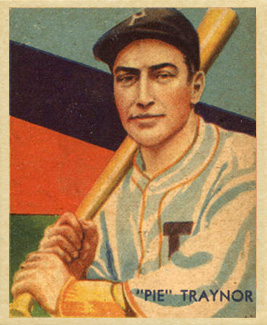
In September of 1920 the Pirates made one of their greatest contract purchases ever when they spent $100,000 for Pie Traynor.  Traynor would go on to a Hall of Fame career and spend 17 years in a Pirates uniform.


At the end of the 1920 season, a year that saw them quite improved, the Pirates sent three players (including future Hall of Famer Billy Southworth) to the Boston Braves and in return they received Rabbitt Maranville.  Maranville was an established star who had helped the 1914 Miracle Braves win a championship, however, his numbers had declined in recent years and his clubhouse presence in Boston had become a bit of a question.  The Pirates were happy to have him because, although he had some team mate problems in Boston, Maranville was a fiery player who could possibly fit well with Traynor and Carey.

Also coming to the Pirates during this time were some strong young players less well known that Traynor.  Clyde Barnhart played only 21 games in 1920 but would be full time in 1921.  Charlie Grimm would go on to fame with the Cubs but he would get his first real big league experience with the Pirates starting for the team in 1921 after being acquired from the Cardinals in 1919.  Carson Bigbee played the outfield starting in 1916 and remained through the mid 1920's.  Pitcher Wilbur Cooper, along with Babe Adams, was one of the best the league saw.

Resurgence
It had been more than a decade since the fans in Pittsburgh had something to cheer about.  The Steelers and Penguins did not exist.  The NBA (or it's ancestor league the BAA) was another 25 years away and even then the Pittsburgh Ironmen would finish in dead last, five games worse than the next best team.  For Pittsburgh sports fans it was the Pirates or nothing.

With a collection of young talent like Traynor and Barnhart along with Maranville and Carey it was not unthinkable that the Pirates were improving to the point of impacting the pennant race.  With the Giants led by McGraw and a defending NL Champ Brooklyn still strong, contention still seemed a long shot for 1921.  The Pirates got off to a hot start.  On April 30, the team sat 1 1/2 ahead of the Robins and 2 1/2 ahead of the Giants.  The team batting was well ahead of anyone's expectations.  Maranville was hitting .397, Carey was at .333.  The surprises were Grimm (.308) and second baseman Cotton Tierney (.453).  An 18-7 May put the team at 29-10.  They had built a lead as high as 4 games but it stood at 3 as the calendar moved to June.  They had distanced themselves from the Robins (9 1/2 back) but the Giants were hanging strong.  A brief losing streak saw them fall a half game out of first for a day on June 3 but they quickly recovered and by July 22 they were 4 1/2 ahead of the Giants.  The lead was at 3 as the Giants came to town for a four game series.  This was the crucial series of the year.  A sweep would put the Pirates seven games up to start August.  The Pirates won game 1 increasing the lead to four.  The next day the Pirates lost a heartbreaker.  They led 4-0 after 6 and 5-1 after 7.  Then the Giants erupted for five in the 8th and 2 in the 9th.  The Giants won in the 10th inning.  The next night the Giants won again with a 4-1 masterful pitching performance by Jesse Barnes.  The lead was down to one with one game left against the Giants.  The Pirates again led, this time 4-2, in the 9th before the Giants stunned them with 4 runs in the 9th.  A 1-0 loss the following night to the Braves made it 5 losses in 6 games and the top of the NL was tied.  The Giants series was a big missed opportunity for the young team.  They quickly recovered and rebuilt their lead.  It was up to 7 1/2 by August 22nd.  They lost 13 of the next 15 games and the lead shrunk again.  This team didn't quite know how to hold a lead.  They went 14-23 from the time they reached the 7 1/2 game lead until the end of the year.  The Giants went 24-9 in the same span and the Giants won the league by 4 games.

Many expected the Pirates to challenge again in 1922.  The Pirates expected it themselves and they made few moves in the offseason.  The season did not go as planned.  65 games into the season they were 10  games out of first and stuck in 5th place.  Manager George Gibson was fired and was replaced with Bill McKechnie.  The team went 53-36 under McKechnie, spending most of September in second but never getting closer than three and a half.  Losing 7 of their last 10 dropped them to third.

The 1923 Pirates started the year 6-7.  It is not a terrible record but the Giants started 10-4.  The Pirates were in 6th place at the end of the first month.  They would bounce back and forth between second and third the rest of the year, even cutting the lead to 2 1/2 at one point but  the Giants were much too strong and ran away with the league.  Some felt that this run of Giant success was the greatest collection of talent the game had ever seen.  Few felt the team could be beaten but Ruth and the Yankees proved it was possible. The Yankees, playing their first year in their own stadium, took out the two time World Champions leaving a bad taste in John McGraw's mouth but the taste of blood in that of the Pirates.

Feeling very close to overtaking the Giants, Pittsburgh decided to give a few young players a shot. Glenn Wright took over at Shortstop while Kiki Cuyler patroled the outfield full time.  This now gave the Pirates four future Hall of Fame players (Maranville, Traynor, Carey and Cuyler) as well as two players considered among the best in their day (Wright and Grimm).  After the Giants' 1923 World Series loss, the Pirates felt they could take on the once unbeatable Giants.  They played mediocre ball (19-20) through the first two months.  June started poorly and it appeared to be another lost season.  The Pirates played well the rest of the season and ended the year with 90 wins.  9 games out of first on August 8 the team won 9 straight cutting the deficit to just three games.  They would finish the season in third place, 3 games out of first.

It was yet another disappointing season.  Pirates fans were growing tired of the disappointment.  Every year they felt they had a chance and every year they stumbled out of the gate.  It seemed as though the end of each year was the same refrain.  "If only they had started stronger."  Angels and Royals fans have felt the same way the last few years.  The Pirates made a big move in the off season, one that was immediately questioned.  They sent Maranville, Grimm and Wilbur Cooper, the team's ace, to the Chicago Cubs.  In return they received George Grantham, Al Niehaus and the man who would replace Cooper, Vic Aldridge.  The trade was very unpopular with fans and Maranville did not make it easy on the team.  In numerous speaking engagements in the Pittsburgh area he denied the rumors that the was a nuisance in the clubhouse or had played any part in the diruptions that had secretly become the downfall of the team.  They also signed a young shortstop named Joe Cronin who would see little playing time.

Another Near Disappointment
Those who questioned the trade of Maranville, Grimm and Aldridge immediately started yelling "I told you so..." when the team again stumbled out of the gate.  At 6-8 the team was in last place.  The Pirates turned to an old leader to help ignite the team.  Fred Clarke, the man who had led the team in the early 1900's, was brought in as a consultant.  The team started to turn around and went 16-9 in May and signed veteran First Baseman Stuffy McInnis of the A's $100,000 infield.  By the end of May they had climbed to third, 5 1/2 games behind the Giants.  They continued winning.  By the end of June they were tied for first.  The month of July was a seesaw battle going back and forth.  Pirates fans feared the worst.  Although they were ahead Pirates fans had seen this trick before and they were skeptical.  Pittsburgh continued to win.  As August turned to September their lead was at 8.  It still could all fall apart.  After all, this was the fifth straight season they were in contention.  Any, or all, of those seasons could have resulted in a World Series appearance. Instead it ended before the World Series began.  On September 10 they won to extend their lead back to 8 games.  They lost the next 4 in a row and Pirates fans started to sweat  How long would it take for the collapse to happen?  It didn't.  They won their next 9 straight and advanced to their first World Series since the days of Wagner, Clarke and Leach.

Their opponents were the defending champion Washington Senators.  While a year before they were viewed as underdogs against McGraw's Giants, this year the Senators were expected to roll over the young Bucs.  The great Walter Johnson started Game 1.  The year before his Game 1 World Series start was a disappointment.  This time he dominated.  He allowed only 5 hits. Pie Traynor had two of them, including a solo Home Run in the 5th.  The Senators won it 4-1 taking a one game lead.

Game 2 was a tense battle.  Joe Judge hit a Home Run in the second putting the Senators up 1-0.  Glenn Wright tied it up in the 4th with a solo shot of his own.  The middle innings were crucial.  Every runner stranded could have meant either a tied series or a two game lead for the Senators.  The 8th inning started with an easy ground ball to Shortstop Roger Peckinpaugh. The AL MVP, playing with a severly injured leg, couldn't field it and there was a runner on first.  Two batters later Kiki Cuyler put the Pirates ahead with a long Home Run.  It was only a two run lead and the Senators would not go quietly.  The 9th opened with a walk, a single and another walk loading the bases with no one out.  Vic Aldridge got Bobby Veach to fly out scoring a run and cutting the lead to one.  Still with two runners on base and no one out Pirates fans were on the edge of their seats.  A strikeout gave the Pirates fans some relief.  The next batter connected on a ground ball.  Second baseman Eddie Moore needed to field it or the Senators would tie up the game.  Moore fielded and threw to McInnis.  The Pirates had held on to tie the series.

Games 3 and 4 did not go the Pirates way.  Game 3 saw the Pirates blow a 3-1 lead.  Emil Yde gave up a three run Home Run to Goose Goslin, immediately followed by a solo Home Run to Joe Judge and that would be all the scoring in Game 4.  The Senators had a 3 games to 1 series lead and needed just one more win to give Washington a second World Series title.  With Walter Johnson, the greatest Pitcher in the history of the game, and Stan Coveleski, former hero of the Cleveland Indians 1920 World Series victory, it seemed impossible that the Senators might not win.
A lead off single and a double gave the Senators a one run lead but a tired Coveleski could not hold the lead.  The Pirates scored twice in the third to take the lead.  Joe Judge hit another Home Run (his 3rd of the Series) tying it at 2.  It was all Pirates from there.  They extended their season with a 6-3 win in Game 5.

Game 6 was just as tense.  The Senators scored one in the first and one in the second to give them a 2-0 lead.  The Pirates appeared to be playing out the string. The Pirates fought back in the third to tie the game with 2 runs.  The next run was crucial.  A Senators run could mean the end of the season.  A Pirates run could mean the extreme pressure of a Game 7..  Lead off hitter Eddie Moore started the 5th inning for the Pirates with a Solo Home Run giving Pittsburgh a one run lead.  The Senators threatened in both the 8th and 9th but couldn't score.  The series was tied at three forcing a final deciding game.

Walter Johnson started for the Senators in Game 7.  It looked like it would be a miserable, disappointing day for Pirates fans.  The conditions were dreart as rains soaked the field.  The conditions were so bad that Johnson's biographer named the chapter discussing the game "The Great Sea Disaster".  The Senators jumped out to a 4-0 lead in the first.  Vic Aldridge had problems from the beginning.  A single, fly ball  out, wild pitch, walk, another wild pitch, another walk, a third walk, and a single.  Aldridge's day was over but the inning wasn't.  A Catcher's interference and an error later and it seemed like it would be a long day.  The Pirates cut the lead to one with a 3 run third but Joe Harris hit a two run double in the top of the fourth to push the score to 6-3. The weather continued to deteriorate.  Pittsburgh got one more run in the 5th and when the game became official Commissioner Landis declared the Senators the World Champions.  But not so fast.  The Senators refused to accept the decision.  They did not want to accept what they feared would be a tainted title so the game continued.   The Pirates tied it in the 7th but the Senators kept them from going ahead when Pie Traynor tried to stretch a triple into an inside the park Home Run but was thrown out at home. The Senators bounced right back out in front  the next inning when Peckinpaugh, playing on a badly injured leg, hit a solo Home Run.  The rain was so bad at this point that the grounds crew had to continuously pour sawdust onto the Pitcher's mound, attempting to cover the puddles.  Walter Johnson was filling his hat with saw dust hoping to keep the rain out of his eyes.  Johnson got two quick outs in the bottom of the 8th making it look like the Senators would be set to win it in the 9th.  Earl Smith doubled.  Carson Bigbee, pinch hitting, doubled scoring Smith.  Eddie Moore walked and Max Carey hit a ground ball to Peckinpaugh.  It looked like the inning was over. Instead Peckinpaugh's damaged leg slipped and the throw went wild.  The bases were loaded with two outs.  Kiki Cuyler untied it with a 2 run Ground Rule Double giving the Pirates a 9-7 lead and after a quick 1-2-3 9th innning, the World Championship.

The Pirates near dynasty, after five years of collapses and stumbles now had a World Championship.  The follow up would fit the pattern of the first few years of the almost dynasty, only in a much more scandalously dramatic fashion.

The ABC Affair
The 1926 defending Champion Pirates were in a tight battle with a surprise contender, the St.Louis Cardinals.  The Cardinals had never really contended for an NL title before.  Pittsburgh again stumbled out of the gate but by July 24 had moved into first place.  Fred Clarke was still serving as a bench coach for the team and making his voice heard, even if the players and manager McKechnie were trying hard to turn it into background noise.  Although his help was credited with leading to the 1925 World Series win, the players and McKechnie had heard enough.  Max Carey was slumping late in the season and McKechnie was ready to bench him.  Clarke, loudly and in the presence of the entire team,  suggested that the bat boy might improve the team over Carey's current performance.  It was the last straw and the players said enough is enough.  Babe Adams (A), Carson Bigbee (B) and Max Carey (C) demanded that Clarke leave the team and not be involved anymore.  Owner Barney Dreyfus, partial to Clarke because of his long previous service, did not take well to demands.  On August 13th the team released A, B and C from the team.  Three of the key players in the World Series team were gone, just like that, with the team fighting for a pennant.  In fact they were in first place by 2 games.  They held first  until August 30th but a Cardinals team led by Rogers Hornsby, Jim Bottomley and an aging Grover Cleveland Alexander overtook them for their first ever NL title.  It was yet another missed opportunity for an almost dynasty.


Pick Your Poison
Before the 1926 season, the Pirates had signed two outfielders with the future in mind.  The future came quicker than expected.  In October of  1925 the Pirates signed Paul Waner away from the San Francisco Seals of the Pacific Coast League.  Paul played in 144 games in 1926 and had there been a rookie of the year award at the time he likely would have won it, even receiving votes for MVP.  A few months later they signed another oufielder, a 21 year old who would not see any playing time in 1926 but would star for the Pirates in 1927.  It was Paul's little brother Lloyd.  The two were so potent a pair that they were said to be poison to the other team.  Paul, the older, was "Big Poison" and the younger Lloyd was "Little Poison".  Opposing pitchers would need to pick their poison but one would likely beat them. If the poisons didn't the rest of the lineup would.  Carey and Bigbee were gone but Traynor, Wright and Cuyler were still there and the team added Joe Harris from the Senators.  Their competition at the top was again a surprise. This time it was the Cubs.  The Pirates fell six games back by August 16 but went 30-13 the rest of the way.  This included winning streaks of 7 and 11.  The Bucs won the  NL by a game and a half.  Just one year after the devastating embarasment of the ABC Affair the Pirates had a chance to add to their almost dynasty.


Their opponents, unfortunately for Pittsburgh, were the 1927 Yankees known as Murderer's Row.  Still known as one of the greatest teams of all time the '27 Yankees included Tony Lazzeri, Mark Koenig, Bob Meusel, Joe Dugan, Earle Combs and of course Ruth and Gehrig.  The story is often told of the Waners watching the Yankees hit ball after ball into the bleachers  in batting practice and basically giving up before the series even started but the story is absurd.  The Waners would certainly not have been discouraged and with Traynor, Wright and Cuyler leading the way the team would not be allowed to keep that attitude for long.  In fact Game 1 was anything but a run away.  The Yankees scored on a triple from Gehrig in the first but the Pirates came right back with a run in the bottom of the 1st.  The Yankees scored three in third to go up 4-1.  The Bucs chipped away with one in the bottom of the third and the teams traded runs back and forth.  Game 1 was a 6-4 victory but the Pirates could have pulled it out.

Games 2 and 3 were less competitive.  The Pirates scored first but the Yankees quickly took at 3-1 lead.  They extended that to 6-1 in the 8th and eventually won 6-2.  The Yankees would take a 2-0 lead against the Pirates in the first inning of Game 3 on a triple by Gehrig, who was thrown out trying to stretch it into an inside the park Home Run.  The Pirates did not manage to get anyone on base until the top of the 8th when Traynor singled and Clyde Barnhardt doubled him home.  This came too late because the inning before saw the Yankees score six (including a three run Home Run from Ruth).  The Yankees took a 3-0 series lead with an 8-1 win,

The Pirates, fighting hard to avoid a sweep, trailed 3-1 in the 7th inning of Game 4 thanks to another Ruth Home Run, when they rallied to tie the game.  There may not have been much hope at this point to beat the Yankees but they sure as hell were going to make them fight for it.  The tie game went into the bottom off the 9th.  Combs led off the Yankees 9th with a single.  Koenig followed with a bunt single. They both moved up on a wild pitch and Ruth was walked intentionally to load the bases.  It seemed like an impossible situation.  When Gehrig and Meusel struck out, the Pirates hoped for extra innings.  Just a few pitches later it was all over.  A wild pitch scored the winning run.  It was another year of what if's that could have led to a dynasty.


The Decline and Fall of the Almost Pirates Dynasty
The Pirates did not just give up after the 1927 season, although they would not reach the World Series again.  They played poorly in April and May of 1928, as seemed to be their pattern, but it was too much to come back from this time.  They finished 4th, 8 1/2 behind the Cardinals.  They played well in 1929, even holding first place as late as July 23.  They played 32-34 ball the rest of the way.  The Cubs, however, went 44-24 in the same span, winning the NL by 10 1/2 games.  1930 was the opposite of the almost dynasty pattern.  The team played well out of the gates, holding the top spot with a 9-3 April.  A poor finish dropped them to 5th for the year, they would finish in the same spot the next year

The team made one final push in 1932.  In late July they had a six game lead but the Cubs again got hot and the Pirates played mediocre ball.  They put up a valiant fight but in the end came up short, 4 1/2 behind the Cubs.  1933 was almost identical finishing 2nd to the Giants, 5 games back.

The players were mostly gone.  Only Traynor and the Waners remained but Traynor was now 34.  The Pirates would take a long time rebuilding.  It would become a bit of a baseball graveyard, the place dying careers and less than touted prospects ended up.  It was not until 1960 that the Pirates would again become a contender.


TRIVIA QUESTION:
Mentioned in today's article was the Louisville franchise of the National League.  At the end of the 1899 season the NL expelled 4 teams, including the Louisville franchise.  What were the other three teams?

ANSWER TO LAST WEEK'S TRIVIA QUESTION:
Congrtulations to Hope for Correctly Answering Last Week's Trivia Question:
The 1959 White Sox came to beknown as the "Go-Go" Sox because of their speed on the base paths.  They reached the World Series for the first time since the Black Sox scandal.  The manager of the Sox was Al Lopez.  The Sox broke a strangle hold by the Yankees at the top of the league.  In fact from 1949 through 1964 the Yankees won the American League every year except two.  One of course was the 1959 Sox led by Al Lopez.  The other was 1954 Indians, also led by Al Lopez.


Saturday, May 17, 2014

Players I Love More Than I Should: First Base Hank Greenberg

Don't forget to check out the first article in this series of player profiles:  Yogi Berra.

More than 18,000 players have appeared in Major League Baseball games since the start of the league.  Some players have short careers that last one at bat or one appearance in the field.  Others have 20+ year careers.  As I read more and more about baseball history there are certain players I find myself enjoying reading about more than others.  It is obviously illogical since many of them retired, or in some cases passed away, long before I was even born.  I have no first hand experience in watching them play but for whatever reason their personalities and perseverance strikes me above and beyond the other players I read about.  Over the next few weeks I will be giving you short biographical histories*of some of these players.  Some of them will be Hall of Fame players.  Some of them will be players only casual fans may know.  Regardless, I chose one player from each position for this series to explore.  This week we will explore the First Baseman  I chose for the series, the one that my regular readers probably knew was coming: Hank Greenberg.


Hank Greenberg suffered through some horrible moments in his career.  Every moment was a struggle.  Even his most noble and lasting action was torn apart by a press that found reasons not to like him. Some have said this is the normal territory heroes tread, however, the general consensus was that Hank suffered quite a bit more because of his Jewish heritage.  After all of that Greenberg remains one of the most under rated players in the history of baseball and one of my favorite baseball figures.

Early Days in New York
The Philadelphia Athletics were still riding high on their World Series Championship on New Year's Eve 1910-1911.  While they were celebrating Sarah Greenberg was ensuring the future of baseball.  Five minutes into the new year Sarah Greenberg gave birth to Henry Benjamin Greenberg.  The Greenbergs were Romanian immigrants who settled in the Greenwich Village section of New York.  The same Greenwich Village that would give birth to the career of Bob Dylan decades later. Similar to the story of Yogi Berra, Hank's father could not comprehend what good could come out of playing ball.  Hank didn't care.  It was all he thought of.  He would spend all day at the ball field.  No matter what time of year.  Regardless of snow, rain, cold.  Hank focused on all aspects of his game.  Fielding, hitting, even sliding.  He built himself a sliding pit to work on sliding like the major leaguers he read about in the papers.  He was a great athlete all around.  Tall for his age, he excelled at basketball.  As a freshman in high school Greenberg made the varsity baseball team.  His biggest problem was also his biggest attribute.  He was a perfectionist.  When he wasn't perfect he would get down on himself.  If he struck out, didn't advance a runner, missed a shot, committed a dumb foul or made any normal everyday mistake he would get angry and frustrated.  Then he would use that frustration to push himself harder.  Like all young boys Hank wanted to be a Major League Baseball player.  He was also aware of how difficult it was.  Hank would spend hours with the neighborhood kids hitting balls until it was too dark to see anymore.  His High School Basketball coach would later say "Hank never played games, he worked at them.  He was not the natural athlete."  Sharing that field with the kids was a local Irish policeman named Pat McDonald, who was also an Olympic Hammer Tosser.  They shared the same field and the local kids were terrified of him.  Often he would wind up to practice a hammer toss and would see one of those damn punks out of the corner of his eye and have to stop his throw.  One day he saw Hank as they were both leaving the park and called him over.  Hank froze.  Terrified.  This was not only a policeman, he was a very very large man.  Hank approached him with caution: "Young man, I just came from watching the Yankees play and, by god, you can hit a ball better than Lou Gehrig."  A compliment telling Hank he hit better than the man he idolized, especially coming from the man he called his mortal enemy, made Hank even more determined to be a big league ballplayer.

Playing for the Home Town Team?
Paul Krichell had been a scout for the Yankees for years.  He had discovered Lou Gehrig, Tony Lazzeri and would later discover Phil Rizzuto and Whitey Ford.  Greenberg's high school teammate Rudy Herzog caught Krichell's attention.  Krichell went to the game to scout Herzog.  Instead he saw something he had least expected.  A tall first baseman.  So tall and gangly it almost didn't make sense that he could have the coordination to swing a bat.  Krichell liked what he saw but didn't say anything.  He couldn't risk tipping anyone off to this amazing find.  When he saw Lou Gehrig he had told the Yankees he had found another Babe Ruth.  He may very well have told them now that he had found another Lou Gehrig.  Krichell started to scout Greenberg.  He and Hank went to see a game together.  Hank asked the obvious question.  If you have Gehrig why do you want a first baseman.  Krichell quietly told Greenberg that Gehrig was washed up.  "In a few years you'll be the Yankees' First Baseman."  Greenberg knew better.  He hoped to play for the Giants but he was getting offers from the Pirates, Nationals and others as well.  Hank wanted to test his skills so he was able to line up some work as a semi-pro player, thanks to the help of Tigers scout Jean Dubuc.  This small bit of help gave the Tigers the inside track and in September 1929 Greenberg  signed with the Tigers for $9000 ($3000 for the season and $6000 signing bonus) with the caveat that Hank be allowed to attend college for four years and join the Tigers after the school year and full time after four years.  A great student, Hank had a scholarship to attend NYU.  Krichell upped his offer to $10,000 but Hank knew he would be stuck behind Lou Gehrig and knew he would never reach the big leagues.  "That was the primary reason I signed with Detroit.  It certainly was not the glamour of playing in Detroit, since I knew nothing about the town, nothing about the ballpark...It was my good fortune to sign with the Tigers because the Detroit ballpark turned out to be perfect for a right handed hitter and Detroit was a great baseball town.

The Long Road to Detroit
Greeneberg's father, although happy with the extra income that the Tiger's contract added to the household, still had doubts about Hank's future.  He was worried that Hank would be done in a year or two and have no fall back.  He insisted that Hank go to college.  Hank agreed.  So did the Tigers.    "My contract with the Tigers had a provision that I wouldn't be farmed out any lower than AAA ball.  But the Tigers permitted me to join them at Spring Training."  Articles in Detroit started to pop up about the prospect at First base but when the season started, instead of heading back north for school, Greenberg was sent to the A Ball affiliate in Newark.  Following in Gehrig's steps, Greenberg tried to fill the shoes that Gehrig had left when he had played in Newark for the Yankees.  Greenberg waived the AAA level clause and got started.  A young Jewish kid, far from home with great pressure and expectations for the first time Hank struggled and was optioned to Level C ball in Raleigh, NC.  The south was not the most welcome place for a Jewish kid at the time and Hank felt more awkward and out of place.  He continued to struggle and was hitting .151 when a pitcher on the team started to point out that he was hitting .155.  The taunt ignited the competitive fire in Greenberg and got him hitting.  Greenberg played 122 games for the 1930 Raleigh team and hit a total of 19 Home Runs with a .314 average.  Not bad for a young kid who was supposed to be in college. His numbers were enough to get him called up at the end of the season and get some big league experience.  "I got in one game as a pinch hitter against the Yankees in a game that was hopelessly lost.  The pitcher was Red Ruffing and I was as good as out before I even reached the plate."  Expecting to get some sort of playing time, Hank sat on the bench for the rest of the year.  Growing more and more frustrated with every inning he was inactive, Hank could not wait for the end of the year.  Finally in the bottom of the eighth inning of the last game of the year, Greenberg was told it was his chance.  Standing up he hit his head on the roof of the dugout.  Frustrated, self-conscious and now embarrassed Hank yelled out "I'm not going to play for this team." and stormed out.  As a 19 year old kid Hank did not look long term.  When he was sent to Spring Training 1931 he was designated a B League player, Hank then tried to invoke the clause requiring him to be at AAA or higher.  Tiger Owner Frank Navin was not someone to be trifled with.  Navin told Hank in a letter:  "You were given a $9000 bonus to sign with the understanding you were to go to college for four years and play baseball in college...Instead you cut the four years entirely....we took you to Detroit so you could get acquainted with Major League surroundings and not play ball, thinking it might help you." The stay in B League with Beaumont lasted only 3 games.  He was dropped lower to the III league and played the year at Evanston, IN hitting .318 with 15 HR.  The next year he played the whole year in Beaumont.  Greenberg often tried to downplay the anti semitism he faced.  In one game he collided on the base paths with Zeke Bonura, an opposing first baseman.  There was a near riot over a Jewish man colliding with a white man.  Extra security was ordered for the next day.  Despite the challenges, Hank hit 81 extra base hits (including 39 Home Runs) and hit .290 in his full year in Beaumont.  With these numbers he would never need to spend another day below AAA.


The Climb to the Near Top
The Tigers organization was not in the best of shape compared to other organizations when Hank joined them in 1933.  Although the days of Cobb, Crawford, Schaeffer and Jennings were not that far in the past, the team had not reached a World Series since 1909.  The team was not terrible but it was usually a 6th place team and out of contention.  1933 was no different, except that the future looked bright.  The team had slowly brought in young players like Gehringer, Owen, Rogell, Jo-Jo White (nicknamed because of his distinct way of telling people he was from Georgia), Auker, Rowe and of course Hank.  The team finished fifth in 1933, behind Joe Cronin and his Washington "Wrecking Crew".  Hank had a solid rookie year.  He hit .301, drove in 87 but hit only 12 Home Runs.  The Tigers saw that the youth would serve them well.  What they needed was some veteran leadership.  They found a way to deal for it (which was closer to stealing it).  On 12/12/1933 they traded Catcher Johnny Pasek and $100,000 to Connie Mack's A's and in return they got one of the greatest Catchers in history in his prime: Mickey Cochrane.  (Cochrane was so popular that a coal miner in Oklahoma, nicknamed Mutt, would name his son Mickey after the Catcher.  Cochrane's namesake would go on to become the legendary Yankee who replaced Joe DiMaggio in center field.  You might have heard the name Mickey Mantle once or twice.)  The Tigers weren't done.  Coming off their World Series appearance the Senators Clark Griffith could not afford to give raises to the players who had earned them.  The result was he traded Goose Goslin to the Tigers for outfielder John Stone.  The Tigers were now solid everywhere.  With Cochrane in the lead and Greenberg in the clean up spot, the Tigers roared in 1934.  The '34 Tigers started fast but by May 10 they had fallen to 6th.  Hank was hitting only .226 but things were about to change  As the Yankees learned what life would be like without Ruth and the Senators struggled to replicate their magical pennant of the previous year, the G-Men (Greenberg, Gehringer and Goslin) started an assault and Schoolboy Rowe, Eldon Auker and Tommy Bridges blew people away from the mound.  The Tigers climbed to the top and clawed their way to the American League pennant.  Greenberg became a beloved player in Detroit based on this year alone.  He hit .339, hit 63 doubles and 26 Home Runs and drove in 139 RBI. The Tigers faced the famous "Gashouse Gang" Cardinals in the World Series and Hank was taunted terribly by the Cardinals, most viciously by Dizzy Dean.  Dean repeatedly yelled to Hank "Hey Mose" referring to his Jewish heritage.  Dean yelled to another Cardinal pitcher "Throw him a pork chop.  He can't touch it."  Hank struggled in the series and was devastated by the disappointment.  Dean even yelled to him  "Hey Mose, come on into our clubhouse and get your meal money. You're the best player we got."  The series went seven games, although the Cardinals routed the Tigers in a feisty game 7.  The Tigers were angry at the loss.


Reaching the Top and Becoming a Hero
During the 1934 pennant race, which was still tight at the time, Hank had to make a serious decision.  The baseball season, designed decades before, did not take into consideration any holidays.  Baseball was non-denominational in theory.  In 1934 the Tigers needed Hank for every game and every at bat.  Hank had to make a choice of his own.  With his team in a pennant race the Jewish Holiday of Rosh Hashanah approached.  Uncertain of how to approach the problem, Hank played on a holiday when all are supposed to rest and reflect.  The controversy erupted.  How could he be a Jewish hero when he defied his religion.  Rabbi's around the country defended him but his parents were furious.  Even worse, the holiest holiday, Yom Kipur, was quickly approaching.  Hank had little to think about.  While he could defend playing on Rosh Hashanah there was no wiggle room on this.  He sat out.  His teammates were worried but they respected his decision.  Hank's decision was heralded and he set the standard for all who followed.

Hank made 1935 his own personal answer to the taunting of Dean from the previous year's World Series.  Greenberg won his first MVP award hitting 46 doubles, 36 Home Runs, driving in an amazing 170 and hitting .339.  In July Hank was on pace to match Babe Ruth's Home Run record but his focus was always Lou Gehrig and the RBI record.  His 170 was well better than anyone in the league.  He put up tremendous numbers.  Even better, the Tigers won the AL pennant again.  Their opponents this year were the Chicago Cubs.  Hank again suffered torment from the NL bench.  "They were all on me with 'Jew this' and 'Jew that'."  It got bad enough that umpire George Moriarty stopped the game and told the Cubs to stop.  Cubs first baseman Phil Cavaretta remembered "the language was pretty rough.  Detroit was on some of our players.  We tried to retaliate."  Cavaretta does not appear to have joined in the yelling though he did say some of the things that were said should never be printed.  Greenberg hit a Home Run in Game 2 and was hit by a pitch his next time up.  While on first base, Charlie Gehringer lined a base hit and Greenberg decided he would score no matter what.  He hit third and turned for home.  Waiting at the plate was Gabby Hartnett with the ball and when the two collided Greenberg broke his wrist.  It swelled up over night and he was done for the series.  He watched from the bench as the Tigers won their first World Series.


The next season was a disaster as well.  In the 12th game of the year, a collision at first base was all it took to break the same wrist and make the year a wash.  Hank trained hard, harder than ever if possible, and came back with a vengeance.  Always a fan of Gehrig, Greenberg held himself  to the Iron Horse's standards.  Greenberg idolized Gehrig and loved the chance to play with him.  Both naturally shy men, Greenberg would always say hello to Gehrig when they traded positions at first base.  Gehrig never responded.  Feeling shunned Greenberg stopped saying hello.  The next inning Gehrig asked him "You didn't say hello to me last inning.  Are you mad at me?"  In 1937, Greenberg did more than say hello to Gehrig's record 184 RBI for a season.  He chased, it clawed at it, fought it and craved it all year.  He ended the year with 183 RBI and 40 Home Runs.  "1937 was, personally, my best year.  I say this because ballplayers appreciate that runs batted in are all that's important to a ball club."  He was just warming up because 1938 would be Hank's big year.

It was clear by now that Hank was head and shoulders (literally) above every other first baseman and maybe every player in general.  With the exception of DiMaggio there were few who could challenge him.  1938 would prove it.  It quickly became clear that Hank was ahead of Babe Ruth's single season Home Run pace and as the summer moved on the press started to believe that someone might actually be capable of catching the Babe.  The pressure Hank felt was comparable to the pressure that Maris would face in 1961 but the attention was possibly even more focused.  In the era when nicknames were a must Hank's Home Runs gained him the nickname of "Hammerin' Hank".  In Detroit at the time two of the biggest personalities were Henry Ford and Father Charles Coughlan.  Ford was allegedly an Anti-Semite and Coughlan was vocally an anti-Semite.  In one of the most ironic twists of fate, the two were Tigers fans meaning they were cheering for the "Hebrew Hammer", another of the many nicknames Greenberg was given.  Hank certainly faced attention for his religion.  "Ben Chapman played for the Yankees.  He was a genuine Jew-baiter.  Whenever he would have a bad day in the outfield the Jews at Yankee Stadium would get after him because he had made remarks about Jews...I knew and still know that men like Ben Chapman, and there were a lot of them, hated my guts and resented my success all the more because I am a Jew."  As the year progressed Hank kept pace with the Babe.  On August 1 he was still ahead of the pace and the attention became more intense.  The reaction was various.  Some were elated.  Some were angry.  Some were skeptical.  Some thought he could do it because he was just too damned good not to.  Some thought he couldn't because the anti-Semitic pitchers in the league wouldn't give him the chance (he would walk a carer high 119 times).  "What if I do break it?  It will be just like the guys who flew the Atlantic after Lindbergh.  The Babe was the first to do it."   At the end of August he had 46.  Still ahead of Ruth.  An early September slump put him slightly behind but not out of it.  He kept hitting and was followed closely by Jimmy Foxx for most of the year.  There has always been a theory that pitchers were avoiding the plate with Hank because he was Jewish.  Hank never felt so.  He felt that the pressure on him was equally on the pitchers.  They didn't want to walk him but the nerves caused them to miss the plate.  He also felt that having young players called up for the end of the season hurt.  He felt some off these pitchers were wild and unused to the focus.  The numbers show that in the last month of the year, as he chased the record, he walked 28 times.  In the earlier months of the season, well before the focus of the race was intense, he walked 20-23 times per month.  Not much more.  In the end the dramatic chase ended with 58 Home Runs, two shy of Ruth.  Despite all that, the Tigers would finish in 4th and Mickey Cochrane would lose his job.

1939 was worse, with a fifth place finish.  The Tigers needed something to change their fortunes.  They approached Hank Greenberg, one of the best players in the game,  with the idea of switching positions.  How would the player feel about moving to Left Field.  Left Field?  The Tigers wanted young first baseman Rudy York to take over there and the Tigers could not afford to lose Hank's production.  So Hank did it.  What Michael Young has been lauded for doing when he helped the Rangers by switching positions to help the team, Greenberg did in the 1940 season.  How did he do?  He led the league with 50 doubles, 41 Home Runs and 150 RBI.  He also scored 129 and hit .340.  He won his second MVP (the first player to win an MVP at two different positions) and led the Tigers to the World Series.  The Tigers lost to the Reds in seven games.  "What a disappointed lot we were coming back from Cincinnati on that train, losing that final game after a long hard season."  With the continent of Europe engulfed in war and fears that the United States might be dragged into it, Greenberg registered for the draft on his way home to New York.  It would be an important part of his legacy.

War Time Hero
In January of 1941 Greenberg's draft number was called.  He was sent for a physical and, amazingly, he failed.  It was not yet war time and the army could still afford to be selective with who served.  The reason he didn't pass:  he had flat feet.  His poor arches were enough to have him disqualified from service.  There was an immediate and angry backlash.  While others were being sent for basic training a professional athlete, capable of winning an MVP, was not fit for wartime duty.  The assumption was that Greenberg had bought his way out of the army.  Greenberg voluntarily submitted himself for a second physical with another doctor and this time he passed.  After 12 games of the 1941 season Greenberg was off to the army.  This was still pre-Pearl Harbor so there was little chance of combat.  Hank put in his time and shortly after he was inducted a law was passed limiting the drafting age at 28.  Hank, at 30, would have been exempt.  On Friday, December 5, 1941 Hank was discharged from the army.  He returned to New York for a restful weekend.  It was a nice one day weekend.  Hank thought of how he would need to get back into playing shape and planned out his exercise routine.  Then Sunday everything changed.  December 7, 1941. Hank knew exactly what he needed to do.  "I'm going back in.  We are in trouble and there is only one thing to do - return to service.  I have not been called back.  I am going back of my own accord."  He was the first player to volunteer for service.  Hank was first stationed in Ft. Worth, TX.  His room mate during his stay there was none other than actor William Holden.


Not satisfied with remaining state side, Greenberg requested a transfer closer to the action.  He served in the air force and was stationed in India.  He saw little combat but was in several moments where he "didn't wonder whether or not I'd be able to return to baseball.  I was quite satisfied just to be alive."  On June 9, 1945 Greenberg was discharged he had now missed all of three seasons and parts of two others in the prime of his career.  Now he was trying to do what no one had done before.  Skip nearly five years and return at a high level of play.

The Hero Returns
Hank returned to the Tigers' lineup on July 1.  The Tigers had won the day before putting them a game and a half in front of the league.  With DiMaggio, Feller and Williams still in the service there was no reason for anyone to believe the Tigers couldn't stay there.  This was any one's year for the taking.  Greenberg took the field in left.  "In my first game back, on July 1, I came out in front of 55,000 people, the largest crowd of the year in Briggs Stadium.  Everybody was cheering like mad.  After four years in the service, the greeting was nice, but it didn't matter all that much to me.  I was just glad to be back alive.  I just went out there to do my job. I went right back out to left field.  We were playing Philadelphia in a double header and I hit a home run in the eighth inning of the first game."
Greenberg was able to play in 78 games that year and hit .311 with 13 Home Runs and 60 RBI.  His most important hit won the pennant.  With the pennant on the line and rain pouring down on the last day of the season Greenberg stepped to the plate and launched a Grand Slam to send the Tigers back to the fall classic.  Even better, the Tigers would face the Cubs.  While Hank had missed the end of the 1935 World Series against the Cubs because of his broken wrist, he was excited to get another chance.  Hank played well but he was blamed for allowing the series to reach the 7th game.  With runners on base Hank went to field a ball hit to left.  In an odd change of events, the type that would normally go against the Cubs, the ball hit a sprinkler head and bounced over Hank's head.  It led to a Cubs win and a Game 7.  What was worse, Hank injured his wrist again and it looked like he would miss the crucial game 7 again.  The Cubs had their MVP Hank Borowy, a new addition from the Yankees, on the mound for Game 7.  Greenberg went to batting practice once but really couldn't even grip the bat.  The Cubs didn't notice.  Maybe they were too entertained by the ruckus in the crowd.  Some crazy Cubs fan had brought a Billy Goat to the game and was arguing with security who were trying to escort him and the goat out.  The fan cursed the team and it seems to have taken effect immediately.  The Tigers started the game with three straight singles and a run.  That brought Hank to the plate with two on, no one out and a one run lead already.  This would be the time for the big man to swing away. The Cubs pulled the infield back hoping for just a fly ball at worst.  Instead Hank laid down a bunt.  Something no one saw coming and the Cubs seemed to unravel.  Four more runs and the Tigers' second World Series title followed and the Cubs have not been back to a World Series since.

Playing for Bing
Hank's 1946 season was a mixture of success.  He was able to play 142 games and hit 44 Home Runs but the team fell badly and Hank had only a .277 average.  With many of the older players like Gehringer, Auker and White gone it was time for the Tigers to rebuild.  They did what was unthinkable just a year and a half after the conquering hero returned.  They sold his contract to Pittsburgh for $75,000.  Hank would not dream of playing in Pittsburgh.  The team was a joke and what the hell did he know about National League pitchers, ball parks or umpires?  He was ready to retire.  The problem was the Pirates needed him.  The team had recently been purchased by, among others, Bing Crosby who owned 25% of the team.  The team had not been to a World Series since 1927 and had very few seasons where they were competitive.  When fans learned that the new ownership was willing to go out and get a player like Greenberg, the team sold $400,000 worth of advanced tickets.  The ownership begged him to play one more year.  Bing wrote him several letters begging him to play and the Pirates GM met with Hank repeatedly to talk him into it.  Fate has a way of putting people where they are needed most.  Hank agreed and it was a good thing he did.  This was Jackie Robinson's first season in the major leagues and when the Dodgers came to Pittsburgh for the first time several Pirates players tried to get to Jackie.  In a close play at first Hank and Jackie collided. It was not a dirty play by either.  It was just part of the game.  A little later as Hank covered first and Jackie was a base runner, Hank casually asked "I didn't get a chance to ask if you were hurt on that play."  Jackie said he was fine and Hank told him not to let the haters get to him.  He told him "keep your head up. You're doing fine."  Hank also invited Jackie to dinner after the game.  Jackie declined thinking it would put Hank in an awkward position but he let several people know how important that interaction was for him.  Hank's kindness came at the right time  Hank's kindness also helped mentor a young Ralph Kiner in the early part of his career.  The young Kiner was struggling and the Pirates were concerned he might not make it.  Greenberg had insisted on a clause in his contract that he not have a room mate on the road.  He waived that clause and took Kiner under his wing.  After one year in Pittsburgh Hank officially retired and had no idea what was next.

Moving on Up
Just as fate put Hank on first base to encourage Jackie, in the World Series that year fate sat him next to the man that would launch Hank on the second career of this life. He took his seat next to Bill Veeck, former owner of the St.Louis Browns and a man looking to take over a new team.  The two hit it off, had similar views on the game and when Veeck bought the Cleveland Indians he brought Hank along with him.  Hank started by running the farm system and moved up to General Manager.  While General Manager Hank shocked the Cleveland Press by firing fan favorite manager Lou Boudreau and hiring Al Lopez as the manager.  All Lopez did was lead the Indians to a World Series in 1954.

Veeck moved on and bought the Chicago White Sox and eventually brought Greenberg with him.  Hank, in turn, brought Lopez with him to Chicago and the team again reached a World Series, though they never won the whole thing.

Possible Owner
Many times at the winter meetings while Hank was the GM, the topic of shifting teams came up.  Hank made the suggestion that the league explore the west coast.  He was laughed at.  Clark Griffith, owner of the Washington Senators, told Hank "It's cold and it's damp out there."  Griffith had pitched in Portland in 1905 and had not been west since.  Griffith decided to move to Minnesota instead.  When the league was forced to expand in 1961 they were originally going to give a team to Washington (to replace the now Twins) and Toronto.  At the last minute Hank brought in some financial power and convinced the league that baseball in Southern California, competing with the NL Dodgers, would work.  The league looked at his plan and agreed.  Then his financial backers backed out and Hank was left without a team.  Instead Walt Disney convinced Gene Autry to buy into the team and the Los Angeles Angels were born.

The Toughest Fight
Hank was not broken up terribly about missing out on the team.  Greenberg had a great life.  He wisely invested his money. He had been elected into the Hall of Fame in 1956 (seriously, it took him nine years to make the Hall of Fame?), he was happily married, had a wonderful relationship with his kids and was happily retired.  Greenberg became known as a Jewish legend, an idol of the religious community, although he never truly identified with the Jewish religion.  He understood the good that came out of this connection but he never played up the fact that he was Jewish.  Because of the legendary status he had attained throughout the years he was approached by Ira Berkow to work on an autobiography that would eventually become "Hank Greenberg: The Story of My Life".  In 1985 Hank started to have some pains in his leg.  At first he ignored it but after a while decided to get it checked.  It was cancer and it was spreading.  Few knew that Hank was suffering.  He was notoriously a private person and he felt that this was something he could fight and beat.  Even Hammerin' Hank could not beat this.  On September 3, 1986 the Tigers finished a series with the Seattle Mariners. They blew a two run lead and lost when Ken Phelps hit a bottom of the ninth Home Run to defeat the Tigers.  Less than twelve hours later, at 8:50 A.M., the Tigers organization had an even bigger loss. Hank passed away on Thursday, September 4, 1986.  At his prayer service Walter Matthau, the great comedic actor, was one of the speakers.  He told his favorite story of Hank.  According to Matthau when Hank was in the army a drunken sailor was looking for a fight and felt he would pick an "easy target".  The sailor yelled out "Anybody here named Goldberg or Ginsburg? I'll kick the livin' daylights out of him."  Hank stood up, all 6'4 of him, and said "My name is Greenberg."  The sailor looked at him and thought about it for a second.  "I didn't say nothin' about Greenberg.  I said Goldberg or Ginsburg."  Hank had already told Matthau this story was false.  Matthau told him "I don't care, I'm going to continue to tell the story anyways."

*This is not intended as a full biography and due to space I have done my best to summarize the life of the players in this series.  For further information on Hank Greenberg please check out:

Videos:
Ken Burns Baseball

Websites:
http://www.baseball-reference.com/
http://www.baseball-almanac.com/
http://sabr.org/

Books:
Hank Greenberg: The Story of My Life By Hank Greenberg and Ira Berkow
Al Lopez: The Life of Baseball's El Senor  By Wes Singletary
Hank Greenberg: The Hero of Heroes by John Rosengren
Hammerin' Hank Greenberg: The Jewish Babe Ruth by Adam Pfeffer
Sleeper Cars and Flannel Uniforms: A Lifetime of Memories from Striking Out Babe Ruth to Teeing It Up With the President. by Elden Auer with Tom Keegan
The Gashouse Gang:  How Dizzy Dean, Leo Durocher, Branch Rickey, Pepper Martin and their Colorful, Come From Behind Ballclub Won the World Serie's and America's Heart During the Great Depression by John Heidenry
TRIVIA QUESTION:
Mentioned in today's article was Bing Crosby's ownership of the Pittsburgh Pirtates.  Bing partnered with future Seattle Mariners owner Danny Kaye in the movie White Christmas but his more famous partner was Bob Hope.  Hope also owned a Major League team.  Who was it and on what classic television show did his ownership play a part in an episode plot?

Answer to Last Week's Trivia Question:
Congratulations to Hope on Answering Last Week's Question Correctly.
The Yankees have retired the number 8 twice.  Catcher Bill Dickey originally wore the number 10 in his rookie 1929 season.  From 1930-1946 he sat behind the plate with a number 8 on his back.  Yogi wore the number 38 for the 1946 season.  He then switched to number 35 for the 1947 season.  Beginning in 1948 Berra switched to to the number 8.