Showing posts with label 1929 Athletics. Show all posts

Saturday, May 25, 2013

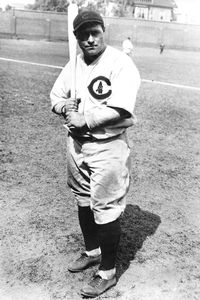
Forgiving Baseball's Scapegoats: Hack Wilson

If you enjoy this article be sure to check out the previous articles in the Forgiving Baseball's Scapegoats: Fred Merkle and Fred Snodgrass

Just the thought of something like this would wake an outfielder up in a cold sweat. It would be a worst nightmare.  Like the dream where you show up to class naked.  Or you're trying to run away from something but your legs don't work.  The difference for Hack Wilson was that this was no dream.  It was actually happening.

Just a few minutes ago there was no doubt about the outcome of this game.  The Cubs had an 8-0  lead in the seventh inning and they were going to tie up the 1929 World Series against the Philadelphia Athletics.  The inning started poorly for the Cubs.  A solo Home Run for Jimmie Foxx.  So what.  8-1.  That was followed by four straight singles and two more runs.  Still no problem.  8-3.  They only needed three outs without giving up 5 runs.  The next hitter popped up to short.  One out.  That was followed quickly by another single.  8-4 and now the lead was cut in half.  The Cubs changed pitchers, hoping this would make the difference.  It looked like it might.  Mule Haas lifted a fly ball to Center field.  The A's were satisfied with that. The runner on third would likely tag up and come home.  The Cubs were satisfied assuming they would trade one more out for a run but the moment Haas made contact Hack Wilson's nightmare began.


It was terrifying.  The  ball left the bat and he had no idea where it was.  He could tell it was in the air and he could tell it was in his general area but he had no idea where.  He needed help.  He looked to the shortstop who pointed, then to the left and right fielders, sprinting, yelling, pointing.  He still didn't see it.  When you see a fly ball and react immediately you can estimate where it will come down.  If you don't know where it is how can you expect to track it down?  He finally saw it but it was well over his head and deep.  He raced after it but there was nothing he could do.  A three run, inside the park Home Run and the game was tied with still only one out. 

The bases were now empty so all the Cubs needed was two more outs to keep the game tied.  The A's weren't quite done.  A walk, a pitching change, a single, another RBI single, another pitching change, a hit batter and  two run double led to a 10- 8 deficit.  Finally, two strikeouts and they were out of the inning.  Instead of the 8-0 lead that they had started with they were down 10-8.  It was the biggest inning in the history of the World Series and the blame was hung on the shoulders of Hack Wilson. 


The Cubs came to bat looking to swing the momentum back to their side.  They had some strong bats coming up.  Charlie Grimm grounded out.  Zach Taylor struck out  and the Cubs used a pinch hitter, future Hall of Famer Gabby Hartnett, who struck out.  The 8th inning was over for the Cubs and they were down to three offensive outs.  The top of the order was up in the 9th.  Norm McMillian struck out.  Woody English struck out looking and Rogers Hornsby, the great "Rajah", one of the greatest hitters of all time, flew out to end the game.

It was the greatest collapse in a single game in World Series history.  An eight run lead turned into a two run loss in a single inning.  The Cubs lost Game 4 and Game5 and the 1929 Philadelphia Athletics fulfilled their destiny as one of the top teams in history.  The entire Cubs team had collapsed but the blame immediately focused on Hack Wilson and his misadventure in Center field.


There are plenty of reasons why Hack Wilson does not deserve the blame for this loss or the loss of the series.  Here are just a few:

1.  Wilson's error allowed three runs to tie up the game in what had been an 8-0 lead.  The other seven runs scored in the inning had nothing to do with Wilson's performance.  Putting the blame on Wilson ignores a complete collapse by the pitching staff.  Prior to the misplayed fly ball the Cubs pitchers had allowed five singles, a Home Run and four runs while recording only one out.  Following the Wilson misplay the pitching staff allowed a walk, a hit by pitch, two singles, a double and three more runs before recording another out.  the collapse was a complete team wide collapse and cannot be pinned on one person.

2. Wilson contributed significantly to the Cubs 8-0 lead.  He went 2-3, including a single with a man on base, and scored a run in the Cubs own five run sixth inning.

3.  The Cubs would not have made the World Series without the season contributions of Hack Wilson.  Wilson drove in 153 and hit .345 while hitting 39 Home Runs.  His following season (1930) may be the greatest offensive season in the history of the game. 

4.  Wilson was the Cubs' greatest offensive weapon in the 1929 World Series.  Hack hit .471 in the five game series (well above the next closest Cubs regular) with 8 hits.  His eight hits included a 3-3 day with 2 walks and a run in the Cubs only win in the Series. 

5.  Hack Wilson was the pin cushion of the league for several years.  John McGraw let Wilson slip away because he felt Wilson's night life habits meant that Wilson couldn't perform.  During his time in Chicago his night life continued unchanged and the papers made continued reference to his partying.  The missed fly ball seemed to be one more way for the papers to pin the tail on Wilson.

Check back next week for the continuation of the Forgiving Baseball's Scapegoats series when we explore Johnny Pesky and his role in the 1946 World Series.

Sunday, September 30, 2012

The Greatest Player Never to Win A World Series

"Whatever you do, don't come home a failure."

This was the advice he received from his father as he set out on his career.  His family was a famous family in the history of Georgia and baseball was definitively not the profession for the son of  a respected, well-to-do college professor.

He certainly had not failed.  He played two years in the minor leagues and 24 in the majors.  Even today he ranks among the highest in the all time stats lists: 4189 hits (2nd all time), 2246 runs (2nd all time), 724 doubles (4th all time), 295 triples (2nd all time), 1938 RBI (8th all time), 897 Stolen Bases (4th all time).366 lifetime batting average (highest of all time).  In the first Hall of Fame ballot he received votes on 222 of 226 ballots.  When he died, just five months short of his 75th birthday, he still swore he could hit .300 against the pitchers at that time.

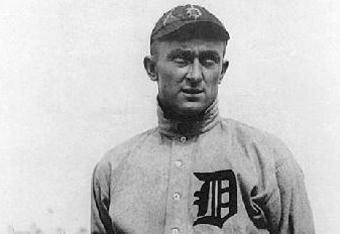
Photo Courtesy of: Philly Sports History

26 years after leaving home to prove to his father that he could make his family proud by playing a child's game for money, Ty Cobb sat at his breakfast table reading the newspaper.  It was Tuesday, October 15, 1929 and he instinctively turned to the sports page to see the results of yesterdays game.  It confirmed what he expected.  The Philadelphia Athletics had beaten the Chicago Cubs in 5 games, including a Game 4, 7th inning rally that saw them score 10 runs and overcome an 8-0 deficit.  This team was unstoppable.  Jimmie Foxx, Al Simmons, Mickey Cochrane, Max Bishop, Mule Haas, Bing Miller, Lefty Grove, George Earnshaw.  This team was built to win...and they did.  They just did it one year too late for Cobb.

The decision to sign a contract with the Athletics was a difficult one.  Even today he is synonymous with the Detroit Tigers and most people forget he ended his career as an Athletic. He was there for the glory days of the Tiger organization.  More accurately, he was the glory days.  Cobb and Sam Crawford terrorized the American League for the first decade of the league's existence.  They reached the World Series three years in a row.


Photo Courtesy: Bleacher Report

In 1907 they lost to the Cubs and he hit .200 as his team became the first ever to be swept in a Series. 1908 saw a second appearance in the World Series and another loss to the Cubs.  This time no one could call him a failure.  He hit .368 in a five game series but still no championship.  The Cubs fell off in 1909 but the American League was still chasing the Tigers.  They became the first American League team to reach the World Series three years in a row and they played the Pirates.  It was Cobb vs. Honus Wagner.  The hated vs. the beloved.  The devil vs. the baseball god.  The fan's dart board vs. the fan's favorite.  Today's equivalent of Barry Bonds vs. Cal Ripken.

1909 was a vicious, hard fought, bloody battle.  Anger and chaos ruled that year.  At one point Cobb was on first base and yelled to Wagner at shortstop "Look out krauthead. I'm coming down on the next pitch."  Cobb took off with the pitch and Wagner was there to cover.  Depending on the version you believe, Cobb spiked Wagner, or Wagner spiked Cobb or Wagner tagged Cobb out by punching him in the face with the ball.  Cobb denied any of this happened.  It was a tense, exciting World Series and for the first time ever it went to a final deciding game 7.  The hype was immense.  The pressure was almost unbearable.  The result was a let down.  Pirates 8, Tigers 0 and the Tigers were the first team to lose three straight World Series.

He had spent 22 years in blue and orange with an old english D on his hat. Then came the accusations, the shame.  He had been no stranger to controversy but this was different.  Dutch Leonard, a marginal pitcher at best, had ruined his reputation over night.  The sport had weathered the storm of the Black Sox scandal and was regaining the passionate fans.  Then Leonard fired a cannonball into the baseball world.  According to Leonard during a late season meaningless game between Cleveland and Detroit in 1925 there was an agreement between Leonard and Cobb from the Tigers and Tris Speaker and Smokey Joe Wood of the Indians to throw a game the Tigers way.  It would help the Tigers jump up to the first division and get a cut of the post season earnings.

Kaboom!  Leonard fired the shot.  Cobb, Speaker and Wood denied it.  Leonard insisted.  Commissioner Landis suspended them all pending an investigation.  Leonard insisted.  Landis demanded proof.  Leonard claimed he had letters from Cobb and Wood.  Cobb was indignant.  Landis demanded Leonard show up and testify and give proof.  Leonard never showed.  Cobb demanded that he be cleared.  The owners asked Speaker and Cobb to quietly walk away.  Nothing more would be said of the incident but they were done.

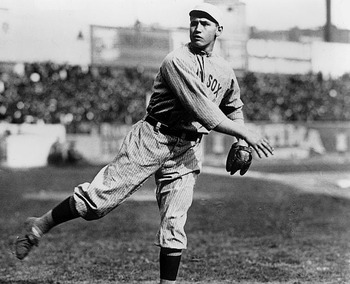
(Smokey Joe Wood seen here in 1912 with Boston, was accused of throwing a game in 1925 along with Tris Speaker and Cobb while Woood was a member of the Indians.)
Photo Courtesy of: Bleacher Report

Cobb didn't do anything quietly and he screamed to the world that he was wronged.  It didn't matter to the Tigers owner Frank Navin.  Cobb was done as a Tiger and he was free to sign a contract with anyone crazy enough to take him. No one thought Philadelphia was an option.  Cobb had what at best could be called a hate-hate relationship with the city but Connie Mack was building a strong young team and wanted some veteran leadership. 

1927 was intended to be the rise of the Athletics dynasty.  The Philadelphia phoenix rising from the ashes of the continuing disaster that was the fire sale of talent from 1914.  Cobb may not have been friendly with anyone on the team but he knew hitting and could teach hitting.  As the manager in Detroit he taught Harry Heilmann to become a consistent .400 hitter.  In Philadelphia he would help Al Simmons become a Hall of Fame hitter.  All of this talent on one team couldn't fail.  Apparently no one told the 1927 Yankees that the A's were supposed to win.  New York put together one of the greatest (and many experts claim the absolute greatest) teams of all time.

Cobb played well.  He hit .357, stole 22 bases and struck out only 12 times but he got frustrated and jumped the team with two weeks left.  He said he was unsure about next year.  He might play. He might not.

He did play but he played less.  Bing Miller and Al Simmons had grown in 1927 and Mack could tell the future of the team was in the youth.  Cobb played only 95 games but hit over .300.  On September 11, 1928 he made his last appearance and retired at the end of the year.  He told the world that he wanted to retire with some hits left in his bat.  The A's were in a pennant race but ultimately lost by four and a half games to the Yankees.  Cobb once said that one of his greatest disappointments was failing to win Connie Mack one more World Series (or reading between the lines, winning one for himself) in that 1928 race.

1929 Philadelphia Athletics
Photo Courtesy: Sports Encyclopedia
 
His retirement may have been a bit premature as the 1929 A's were a rival to the 1927 Yankees as one of the greatest teams of all time and he certainly couldn't have hurt that reputation.  They won the American League by 18 games and crushed the Cubs in the World Series.  As the young A's celebrated the start of the last great Philadelphia A's era (they would win the World Series in 1929 and 1930 and lose a 7th game in 1931), Cobb sat at home.  Wondering.  "What if I had hung on for one more season?"

He held some amazing records.  He was generally considered (along with Ruth and Wagner) as one of the top three players of all time.  He was rich (Cobb smartly invested his money in two small time companies before they hit it big: Coca Cola and Oldsmobile).  He was the first millionaire baseball player and the money came independent of baseball.  He had all of this.  Yet 26 years after he left home, he had failed to gain that one elusive World Series win.