Showing posts with label Bill Dinneen. Show all posts

Sunday, January 11, 2015

I Didn't Know He Played For: Baltimore Orioles

Last week we started a look at a new series called "I didn't know they played for..." with a look at the minor league history of my home town, Reading, PA.  This week we take a look at the major league history of the Baltimore Orioles organization.

The Baltimore Orioles started as the St. Louis Browns.  (Of course you knew that because I'm sure you vividly recall the well written, exhilarating article about the history of team names).  The Browns did not have the greatest history but they did have quite a few recognizable names play for the team including George Sisler, Don Gutteridge and Pete Gray.

The team moved to Baltimore in 1954 (which you of course also knew because you read this blog every week, right?) Since moving to Baltimore the Orioles team has become one of the key identifying features of the city.  The fresh crab cakes from the inner harbor, the historical ships and the great shopping district are just as identifiable for the area.

The Orioles teams have had some of the greatest players of all time represent their team proudly.  Frank and Brooks Robinson, Jim Palmer, Eddie Murray and Cal Ripken are the most identifiable.  Every organization has players that come through town on the way to making their mark some where else.  Sometimes the player is near the end of their career and are trying to make one last playoff run or World Series appearance.  These players are often remembered as a member of another organization but nevertheless appeared as a Brown or Oriole at some point.  Here are some of the players that you may not remember as having played for the Browns or Orioles.

Jiggs Donahue:
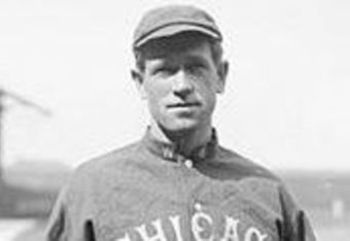
The name Jiggs Donahue may not resonate through the history of the game today but he played a very big part in one of the greatest upsets of all time.  The 1906 Cubs are still considered one of the greatest teams of all time.  They breezed through the National League before they ran into the crosstown rival White Sox, lovingly referred to that year as the "Hitless Wonders".  They were anything but hitless in the World Series.  Donahue was a driving force in that series playing like a man possessed.  A man who had only 25 extra base hits all year long ended up with two doubles and a triple in the upset win and drove in 5 runs.  In all Donahue played six years with the White Sox, his best being 1905.  Before he was a White Sox he was a member of the St.Louis Browns. Or more precisely, the original Milwaukee Brewers of 1901 who moved to St. Louis in 1902.  One of the contract jumpers from the National League at the start of the American League, Donahue signed with Milwaukee for 1901 and hit .316 in 37 games.  He played with the team in St.Louis in their first year there but appeared in only 30 games and hit .237.  In 1903 he was sent to the minors but resurfaced with the White Sox for 1904.

Bill Dinneen:
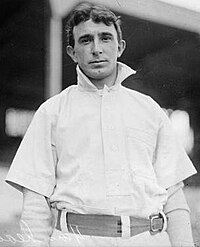
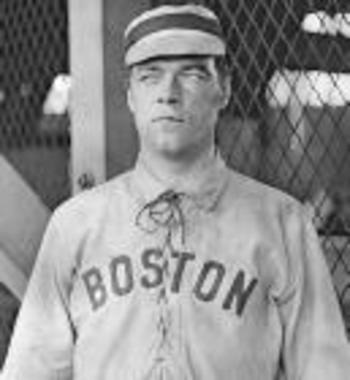
The first World Series in 1903 featured some of the greatest names of all time: Jimmy Collins, Fred Clarke, Tommy Leach, Honus Wagner and Cy Young.  The man who made the difference among all these  legends was Bill Dinneen.  Dinneen won three of the five games needed by the Red Sox to capture their first ever World Series title.  He continued to pitch for the Sox until 1907.  In June 1907, as the Sox were retooling for what would become the 1912-1918 dynasty, they sent their former pitching hero to the Browns for Beany Jacobson and $1500 dollars.  Dinneen would play two and a half years with the Browns before retiring.  He would go 27-24 with a 2.57 ERA in St.Louis.  Not bad considering how terrible most of those Browns teams were. Actually, the 1908 Browns also featured Rube Waddell, the former A's star, and put up a fight in the close American League race. Dinneen would go on to be a successful Major League umpire for many years after his playing days.

Charlie Root:
Despite not having won a World Series title since 1908 and not having reached a World Series since 1945, the Cubs were regularly in contention between 1908 and 1945.  Charlie Root was the ace of the Cubs' pitching staff on 4 World Series teams (1929, 1932, 1935 and 1938).  Despite being known as the man who gave up Babe Ruth's called shot, Root had a very good career, ending with a 201-160 record.  Root started with the Cubs in 1926 but before he was a Cub he was a Brown.  Root appeared in 27 games for the 5th place Browns in 1923, going 0-5 with a 5.70 ERA.  Obviously the Browns needed pitchers who could win so Root was sent back to the minors where he resurfaced three years later.

Jim Bottomley:

As hard as it may be for modern fans to believe, the St.Louis Cardinals were once the doormat of the National League.  As they came out of the darkness and into contention Jim Bottomley and Rogers Hornsby were the keys to the offense.  Bottomley even won an MVP award in 1928 as the Cardinals returned to the World Series.  But as always happens, the years go on, age catches up with the players and younger players come along.  When it was time for Bottomley to give up the first base bag he was not done with his career.  The Cardinals traded Bottomley to the Reds and after a few years finished his career with the lowly Browns.  In 2 years there he hit .285 (not bad but well below his .310 career average) and drove in 107 runs (less than what he used to accomplish in just one year with the Cardinals). Bottomley was inducted into the Hall of Fame in 1974.

Dizzy Dean:
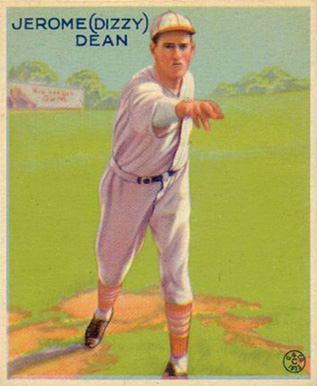
Dizzy Dean is synonymous with the St.Louis Cardinals "Gashouse Gang" of 1934.  Dean was later a legendary broadcaster and was always known for his goofy persona.  What few people know is that the great Dean tried a come back in 1947.  He pitched 1 game for the Browns in 1947.  In 4 innings he allowed three hits and a walk but no runs and did not get a decision.

Eddie Lopat:
The Yankees, who dominated the game in the late 1940s and 1950s are mostly remembered for their offensive names like DiMaggio, Berra, Mantle, Bauer, Gordon and Rizzuto.  Often forgotten are their three aces of Allie Reynolds, Vic Raschi and Eddie Lopat.  In the 8 years that Lopat pitched in the Bronx, the Yankees won 5 World Series.  As the Yankees went for the 1955 AL pennant Lopat's record sat at 4-8.  The Yankees sent Lopat to the Orioles for pitcher Jim McDonald.  Lopat would pitch in only 10 games for the O's and went 3-4.  At the end of the season Lopat was released and retired.

Dizzy Trout:
Dizzy Trout worked with Hal Newhouser to lead the Tigers pitching staff of the 1940s.  Trout pitched in the World Series for the 1940 and 1945 for the Tigers and, although not as successful as Newhouser he was a fan favorite.  What few remember is that Dizzy, father of Steve Trout, ended his career with the birds.  Trout disappeared from the game after the 1952 season but resurfaced in Baltimore at the age of 42 in 1957.  Trout appeared in 2 games for the O's  and retired only one of the five batters he faced.  He allowed 4 hits and 3 runs in 1/3 of an inning for an ERA of 81.00.

Whitey Herzog:
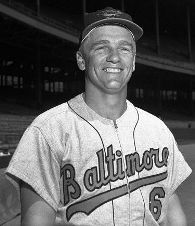
Whitey Herzog was a Hall of Fame manager mostly with the Royals and Cardinals though he also spent time with the Rangers and Angels.  As with almost all managers, they had to be players somewhere before they became managers.  Herzog played for several teams but he played more in Baltimore than for any other team.  Herzog played two seasons (1961 and 1962) with the Orioles and hit .280 in his time there

Harvey Haddix:
Harvey Haddix was an All Star, Gold Glove winner and famously pitched 12 perfect innings before losing the game in the 13th.  He saw a lot of success with the Cardinals and Pirates, even winning a World Series title with the Pirates in 1960.  What few remember is where Haddix ended up.  In 1964 and 1965 Haddix pitched in Birdland.  After the 1963 season as the Pirates were looking for a youth movement Haddix was sent to Baltimore. He went 5-5 in 1964 and 3-4 in 1965.  His contract was sold to the Braves after the 1965 season.  Too bad.  Had he hung on one more year in Baltimore he would have gotten another World Series ring.

Enos Cabell:
Enos Cabell is one of the all time great players in the history of the Astros organization.  As Cabell matured as a player, the Astros matured as a team.  Before Cabell became an Astros legend he helped the Orioles make the playoffs.  He first appeared in the majors for three games in 1972.  His playing time increased to 30 games the next year and 80 games in 1974.  When the O's took on the A's in the 1974 ALCS Cabell saw action in three games although the A's went on to their third straight World Series win.  In December of that year Cabell was traded with Rob Andrews to the Astros in exchange for Lee May and Jay Schlueter.  It worked out for Cabell. The Astros would eventually retire his number.

Rick Burleson:
The name Rick Burleson may not stand out to casual fans, but Red Sox Nation certainly remembers him and the fans of the Angels should remember him too.  He played a big part in the success of both organizations.  The Rooster came up with the Red Sox in 1974 and finished 4th in Rookie of the Year voting (he was behind Mike Hargrove, Bucky Dent and George Brett).  In 1975 the feisty Burleson combined with Denny Doyle as the middle infield in the Red Sox first World Series team since 1967.  After his time in Boston he went on to help the Angels organization for 5 years, even playing a big part in the  classic 1986 ALCS between the Halos and the Red Sox.  Burleson became a free agent after the 1986 season.  The Orioles hadn't quite figured out what direction they were heading and despite having a young Bill Ripken in their minor league system they signed Burleson.  In 1987 Burleson would play 62 games and hit .209.  He would retire after the 1987 season.

Dwight Evans:
Jim Rice, Carl Yastrzemski and Fred Lynn.  It's a hell of an outfield but it didn't leave room for one of the most important pieces of the 1975 Red Sox.  Dewey Evans was too good to sit on the bench so Yaz moved to First Base to make room.  From 1972-1990 Evans patrolled the Fenway outfield and was there for every near victory and painful defeat.  He made one of the most unbelievably spectacular catches in the 1975 World Series.  When the Reds rallied in 1975 Game 7 Dewey watched it.  When Buckner let the ball trickle through Dewey saw it.  And when McGwire, Canseco and the Bash Brothers destroyed the Red Sox Dewey was there.  He played 2505 games in a Red Sox uniform.  After 19 years of service in the Boston organization the Red Sox were ready to move on with Mike Greenwell, Ellis Burks and Tom Brunansky.  After the 1990 season the Red Sox released Evans.  He felt he still had something left to contribute so he went to Baltimore, who experts felt were close to a big rebirth.  Instead 1991 was the tipping point downward for Baltimore.  Prior to the season they had sent three minor leaguers (Pete Harnisch, Steve Finley and Curt Schilling) to Houston for Glenn Davis.  Davis played in only 49 games that year.  Evans managed to play in 100 games and finished with a respectable .270 but his RBI (38) and Home Runs (6) were way below his standards.  Evans retired at the end of the season.


Lonnie Smith: 
Everywhere Lonnie Smith went World Series appearances (usually wins) would follow.  Philadelphia (1980), St. Louis (1982) Kansas City (1985), Atlanta (1991, 1992). Everywhere except Baltimore.  Smith had signed with the Pirates in  1993 after a successful stay in Atlanta.  At the trade deadline, with the Orioles feeling they might still catch the Blue Jays,  the Orioles sent 2 minor leaguers to the Pirates for Smith.  It wasn't a Glenn Davis bad trade (the two minor leaguers never made an impact in the majors) but Smith only played in 9 games for the O's that year.  They did not catch the Jays.  Smith played in 35 games for the O's in the strike shortened 1994 season.  When the game returned in 1995 Smith did not.  He retired.

Sid Fernandez:
Doc Gooden, Ron Darling and David Cone got the headlines as the stars of the pitching staff for the Mets of the 1980s,.  Sid Fernandez quietly succeeded.  Fernandez pitched 10 years for the Mets and won just short of 100 games for the Mets, not including the post season.  When his contract with the Mets ended after the 1993 season, Fernandez signed with Baltimore.  Sid finished at 6-6 with a 5.15 ERA in his first AL year.  He started the next season at 0-4 with a 7.39 ERA and was released on July 10, 1995.

Joe Carter:
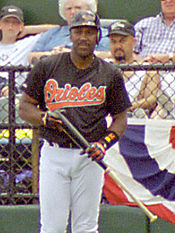
For a short while, a very brief period, there was a nice little rivalry brewing between the O's and Jays in the AL East.  From 1989 to 1993 the Orioles and Jays were fighting for the top perch.  Fans in Baltimore hated their northern neighbors and Joe Carter was the leader, the icon of that group.  After the 1997 season Carter was a free agent and he signed with the Orioles.  His stay was brief, only 85 games, and he hit only .247 but he did hit 11 Home Runs.  At the trade deadline, with the Orioles' inflated payroll and reduced results, Carter was traded to the Giants for a minor league prospect.

Ozzie Guillen:
The Orioles in the mid/late 1990s were so close to winning.  They had come up just short in 1997.  The off season of 1997-1998 was a disaster.  Their manager, an organizational legend as a player who had just won Manager of the Year, left.  With the front office realizing that their team was old and with a small window left to win the Orioles decided to mortgage the future and bring in as many veteran stars (regardless of age) as possible.  Joe Carter and Doug Drabek were signed.  Looking for a Short Stop that would allow Cal Ripken to move to Third Base, the Orioles signed Ozzie Guillen. Ozzie played all  of 12 games for the O's in 1998(mostly as a backup for Mike Bordick) and hit .083 in just 18 plate appearances. Guillen was released by the Orioles on May 1 and signed with the Braves.

Casey Blake:
Casey Blake developed into a strong defensive third baseman and good middle of the lineup hitter for the Indians and Dodgers.  When Cleveland nearly reached the 2007 World Series, Blake was at the hot corner.  When the Dodgers lost back to back NLCS to the Phillies in 2008 and 2009, Blake played a big part.  Blake's road to success was not quite that easy.  Along the way he passed through the Phillies, Tigers, Yankees and Blue Jays systems eventually ending up with the Twins.  After a short stay there Blake was waived by the Twins and on September 21, 2001 the Orioles took a chance.  Blake played in 6 games for the O's  He had 2 hits in 15 At Bats (.133) but one of those two hits was a Home Run.  Blake also stole two bases.  At the end of the year Blake was waived by the Orioles and reclaimed by the Twins ending his tenure with the O's.

TRIVIA QUESTION:
The Glenn Davis trade mentioned today was one of the worst trades in baseball history.  Curt Schilling, Pete Harnisch and Steve Finley were sent to the Houston Astros.  How many All Star Appearances did these three combine for and how many times did they  play on a World Series team?

Answer to Last Week's Question:
It is often said that the Dodgers purchased the Reading team for Carl Furillo and the air conditioned bus.  The team was not overloaded with great talent but the 1941 Reading Brooks did send a few players (other than the obvious Furillo) to the Major Leagues:
Al Campanis: Played 7 games in 1943 for the Dodgers.
Paul Cheverinko: Had already spent his time in the majors by 1941.  He played a combined 42 games in 1937 and 1938 for the Dodgers.
Buck Etchison: Would not play for Brooklyn but spent 1943 and 1944 in Boston with the Braves.  This included 109 games in the war reduced ranks of the Major Leagues.
Heinie Heltzel: Played 29 games for the 1943 Braves and 11 games for the 1944 Phillies.
Lyle Judy: Similar to Cheverinko, Judy had already played in the majors.  He spent all of 8 games with the Cardinals in 1935.
Joe Walsh: Pitcher Joe Walsh had also already spent his time in the Majors by 1941.  He appeared in 8 games for the Boston Braves in 1938.


Saturday, January 26, 2013

9 Players You May Not Know from the 1900's but Should

The National League owners were confident that they were the only game in town.  They had no competition.  They could do anything they wanted.  Charles Comiskey and Ban Johnson were tired of it  and decided to do something about it.  They purchased the Western League, a minor league organization, and started planning.  They set up organizations in Chicago, Boston, Detroit, Baltimore, Philadelphia, Cleveland, Washington and Milwaukee and declared that in 1901 they would start play as the American League a Major League on par with the National League.  As an extra challenge to the National League, they placed teams in several cities where the National League already had a presence. 

In order to compete with the established National League they needed established talent.  Knowing the players in the NL were unhappy with their contract situations Johnson and Comiskey went calling.  They signed Connie Mack to run the Philadelphia organization and John McGraw as the  player/manager of the Baltimore organization,  They grabbed players like Cy Young, Jimmy Collins, Ed Delahanty, Sam Crawford and George Davis.  Some of these players went directly to the cross town competition.  None caused more controversy than Napoleon LaJoie.

Nap played for the Phillies, who were very successful at the turn of the century, mostly because of LaJoie and Delahanty.  The owners could do anything they wanted so they set a ceiling on the amount of money any one player could make.  The Phillies had a secret deal with LaJoie to give him  bit of a bonus and promised him that although he couldn't tell anyone, LaJoie was the highest paid player in the league.  He soon found out that Delahanty had a similar agreement that was $1,000 higher than LaJoie's .  Nap was not happy.  Not only did he jump to the American League, he jumped to the team that would cause the most distress to the Philllies:  the crosstown Athletics. Now it was the Phillies' turn to be unhappy.  They sued LaJoie saying that he was still under contract to them and therefore he couldn't play for another team.  The Phillies won the case and the court declared that he was not permitted to play for any team unless it was the Phillies.  Fortunately for LaJoie the court injunction was only effective in Pennsylvania.  For the good of the league Connie Mack sent Lajoie to the Cleveland franchise.  Any time the Indians played in Philadelphia, Nap would get a free vacation to Atlantic City.

The original 8 franchises of the American League are all still in operation in one form or another, just not all in the same place. Boston is still the Red Sox, Cleveland is still the Indians,Chicago is still the White Sox and Detroit is still the Tigers.  The other four teams are still around just not the same as they were in 1901.  The Philadelphia Athletics eventually moved to Kansas City before moving to Oakland (and possibly to San Jose in the coming years).   The Washington franchise moved to Minnesota to become the Twins.  The Baltimore Orioles moved to New York and became the Highlanders (also called the Hilltoppers and later the Yankees).  The Milwaukee Millers moved to St. Louis and became the Browns until they moved to Baltimore in 1954 to become the current Orioles.

The American League's arrival was successful and led to an all out war with the National League.  It was bitter, it was ugly and it was dirty.  There were attempts to discredit the other league, arguments and flat out fights between the owners and both leagues claiming they were the real major league.  After a few years the National League owners had enough and begged for peace.  The owners met in Cincinnati in the winter of 1903 (the first ever owners' "hot stove winter meetings") and came to an agreement.  Both leagues would be considered Major Leagues.  At the end of each season the winner of the American League would play the winner of the National League in a series to determine the champion of the Major Leagues.  It would be considered a World's Series.

The first decade of the World Series was not always exciting.  Often the pennant races were more exciting than the championship seasons. The first ever World Series in 1903 had the Boston Pilgrims (now the Red Sox) and the Pittsburgh Pirates.  The Red Sox won the best of 9 Series The 1905, 1906, 1907 and 1908 World Series were all decided in 6 games or less. 

The 1909 World Series had everything. It had the best against the best.  Tigers vs. Pirates.  Ty Cobb vs. Honus Wagner.  The best hitter in the AL vs the best hitter in the AL.  It was the first World Series to go the full 7 games and the Pirates won the World Series causing Cobb to lose his last chance at the World Series title.


For Cubs fans, still waiting for a World Series championship, these were the glory days.  The 1906 Cubs have the highest winning percentage in history, higher than the 1927 Yankees, 1929 Athletics, 1998 Yankees or 2001 Seattle Mariners.  The Cubbies reached the World Series in 1906, 1907 and 1908 becoming the first team to reach three consecutive World Series and the first to win back to back World Series.  The day before the replay of the Merkle game, Cubs manager Frank Chance made a statement that would have sent fear into the hearts of the opponents of the time, but would have sent laughter across the world had it been said today:  "Who ever heard of the Cubs losing a game they had to have?"

Although the names of Ty Cobb, Honus Wagner, Ed Walsh, Napoleon LaJoie and Rube Waddell will be the names that are remembered thirty, forty or fifty years from now (or more), every decade has tremendously talented, successful players who make wonderful contributions to the success of their teams, organizations and the league as a whole. Unfortunately many of the players who fall into this category will be forgotten, overlooked and generally ignored. Here are 11 players* from the decade you may not remember but you definitely should:


Catcher
Johnny Kling


Career Teams:  Chicago Orphans/Cubs (1900-1908 and 1910-1911), Boston Rustlers/Braves (1911-1912) and Cincinnati Reds (1913)
MVP Voting: 1911 (27th)
The Cubs were a well oiled machine.  Year after year they kept chugging along, winning National League pennants in 1906, 1907 and 1908.  Two World Series championships. No reason to believe the winning wouldn't continue as the years went on.  Kling had a second job running a pool hall in his home town of Kansas City.  It was an expensive investment and a successful investment and he spent the 1910 season running the business, not behind the plate for the Cubs.  They suffered for it.  The Cubs missed an opportunity to become the first team to reach the World Series four straight years but without Kling to guide the pitching staff and throw out the runners the way only he could, the Pirates played in October instead of the Cubs.  Kling returned for the 1910 season and, no big shock, the Cubs returned to the World Series.  Kling was not a huge offensive threat but he fit into the style of play that Frank Chance loved.  Smart, heads up, alert baseball.  Always keeping the opposition on their toes and always taking advantage of their mistakes.  Kling is certainly not a Hall of Fame player but Chance would not have wanted anyone else behind the plate during those years.


Firstbase
"Prince" Hal Chase


Career Teams:  New York Highlanders (1905-1913), Chicago White Sox (1913-1914), Buffalo Feds (Federal League) (1914-1915), Cincinnati Reds (1916-1918) and New York Giants (1919)
MVP Voting:  None.
Hal Chase has been described as one of the most talented Firstbasemen in the history of the sport.  He was widely known as the best defensive first sacker in the game and immensely talented with the bat as well.  Chase even helped write an instructional manual called "How to Play Firstbase".  He had one major character flaw.  He was crooked as hell.  Frank Chance took over as manager of the New York Highlanders (still a few years from being known as the Yankees) in 1913 with Chase as his firstbaseman.  The team was going nowhere, players were not making the gigantic salaries now and Chase could always do with extra cash.  He learned to  make crooked plays look straight.  He would play a step or two farther off the line or deeper than normal and react a split second too late, letting the ball glance off his glove to allow a runner to reach the bag.  Throw just wide when the pitcher is covering first.  One day after a particularly poor fielding day for the Yankees, Chance visited the press box to find out how the game was being scored.  He was told the fielders were being charged with throwing errors.  Chance was angry.  "Those throws aren't wild." Chance said. "Chase is making them look that way."  Chance knew Chase was throwing games but the Highlander management didn't want a scandal.  Chance was not the only manager to suspect.  Christy Mathewson managed Chase with the Reds.  Mathewson was the personification of fair play, the boyhood idol of the nation.  Christy was triumphed in the press as the most honest person in the league, the man who changed the negative perception of the profession.  He saw, just as Chance did, that Chase was crooked. He was not afraid to cause a stir and complained to the owners of the Reds and the league offices.  Chase was investigated and set to have a hearing.  Luckily for Chase, Mathewson was overseas in World War I at the time of the trial and unable to testify.  Without his testimony Chase was cleared.  The Reds released him but John McGraw was willing to take anyone he believed would help him win. He made a wrong decision.  As the 1919 season unfolded McGraw saw the same things Chance and Mathewson had seen.  Chase would play out of position.  Break to the bag late.  Fail to field easy throws that then looked like they were poorly thrown.  McGraw didn't have to worry long.  As the Black Sox scandal unfolded Chase's name came up often.  The investigation made it clear that he was aware of the fix and had bet heavily on the Reds.  When Commissioner Landis made a ruling on the eight  Chicago players, Chase was also banned from baseball. His talent that could have allowed his name to live forever as a legend of baseball was wasted and used to make his name infamous as the most crooked player in history.

Secondbase
Johnny Evers


Career Teams:  Chicago Orphans/Cubs (1902-1913), Boston Braves (1914-1917), Philadelphia Phillies (1917), Chicago White Sox (1922) and Boston Braves (1929)
MVP Voting:  1912 (20th), 1913 (10th) and 1914 (1st)
There is always a great debate over what makes a Hall of Fame player.  Over the years the voters have developed some "automatic" qualifiers:  3000 hits, 500 Home Runs, .300 batting average.  Johnny Evers doesn't meet any of them.  There are others who feel that to reach the Hall of Fame, the story of your era cannot be told without your inclusion.  Evers certainly meets that criteria.  Still, others feel that your career needs to have one identifiable, era defining moment.  Evers has several of them.  Recently there are those who argued that Joe Tinker, Johnny Evers and Frank Chance are not Hall of Fame caliber players and are only in the Hall of Fame because of a famous poem written about them.  The people who argue this miss the point.  The Hall of Fame is not always about sheer numbers it is about impact and legacy.  The Chicago Cubs teams from 1906-1910 were truly great teams and the Tinker, Evers and Chance combination was without a doubt the reason.  The three men worked together to develop some plays that are used today including the hit and run and an intentional bounce on the throw from shortstop to first to lower the chance of over throwing the ball.  They perfected the station to station, sacrifice bunts, stolen base one run at a time style of the day.  Alternately known as the "Crab" for his sour disposition and the way he approached ground balls and "the Trojan"  for his hometown of Troy, NY, Evers was hands down the best second baseman in the National League in his era.  His contributions were far beyond numbers.  His attitude, determination and fiery spirit were big reasons the Cubs were the best team of the decade.  Evers was not one to shy away from a night out on the town but never when it would interfere with his success on the diamond.  It was said that Evers would curl up in bed every night with a chocolate bar, the Sporting News and the league rule book.  His knowledge of the rules led to his involvement in one of the most infamous moments in baseball history, "Merkle's boner."  As the Cubs prepared for the 1910 World Series Evers broke his ankle in several places at the end of the regular season, depriving the Cubs of one of their greatest weapons  at the worst possible time.  It would be easy to claim that Evers was only effective when he had the help of the strong Cubs team, yet when he moved on to a poor Braves team that had not had any competitive success to speak of he created a miracle.  Evers came on board in Beantown in 1914 and was the driving force behind the Braves' miracle World Series win.  Evers won the MVP award in 1914 leading the Braves to their first ever World Championship.  Evers' numbers may not match up with modern day players but those who argue he does not belong in the Hall of Fame miss the point of what makes a Hall of Fame player.

Shortstop
George Davis


Career Teams:  Cleveland Spiders (1890-1892), New York Giants (1893-1901), Chicago White Sox (1902), New York Giants (1903) and Chicago White Sox (1904-1909)
MVP Voting: None.
It was a helpless feeling. Sitting in the stadium, watching his 1903 Giants teammates practice and not permitted to play.  He could play. Just not with the Giants.  He was one of the best Shortstops of his time.  It was the reason the White Sox wanted him so badly.  They threw money at him in 1901, more than he made from the Giants, and Charles Comiskey didn't ever throw money at anything.  Davis accepted the Chicago offer, jumped to the American League and abandoned his New York Giants contract.  He had a good season, not great, hitting .299 but he was a big help to the new franchise.  Then the winter of 1903 came and with it a visit from John McGraw.  He told Davis that legally, because of the reserve clause, he was still under contract with the Giants and, although they weren't happy about being abandoned, they were willing to forgive and forget and give him an even larger salary than Comiskey.  So Davis accepted and jumped back to the National League with the Giants.  That same winter the leagues decided to settle on peace instead of all this fighting.  As the owners discussed ways to bring about compromise they went through the list of players who had jumped leagues one by one to decide who would be sent back to the National League and whose contract would be accepted as legitimate in the American League.  When they got to George Davis it was agreed.  He would have to go back to the White Sox.  No one consulted Davis but that was that.  He played for the White Sox now.  Under his old contract, under their terms.  He refused.  He wouldn't report.  He was told it was that or nothing.  He held out as long as he could, spurred on in his rebellion by McGraw.  Against all orders McGraw even played Davis in four games.  The National League owners were furious.  All the work to bring about peace between the leagues was about to be undone because McGraw was playing Davis when he was technically a member of the White Sox.  Davis eventually went to the White Sox and they were happy to have him.  As the 1906 "hitless wonders" White Sox overcame the Chicago Cubs grizzly attack in the 1906 World Series Davis hit .308, drove in 6 runs and had 3 doubles.  Davis learned to accept his role with the White Sox, although he never earned the amount of money McGraw would have paid him in New York.

Thirdbase:
George Rohe


Career Teams: Baltimore Orioles (1901) and Chicago White Sox (1905-1907)
MVP Voting:  None.
George Rohe did not have a very long or a very successful career in the major leagues, but like Jimmy Sebring he made a major contribution to early World Series play.  As the White Sox "hitless wonders" prepared to take on the 1906 Chicago Cubs, one of the greatest teams in history, Rohe was not expected to play. The weather in Chicago that fall was bitterly cold and George Davis caught a cold.  The White Sox adapted for the first game moving Les Tannehill, their regular third baseman, to Shortstop and played George Rohe at thirdbase.  Not known as a powerful hitter Rohe tied for the team lead in hitting in the Series at .333. He not only led the team in hitting, he had timely hits.  In Game One with the score tied at 0 in the 5th Rohe tripled down the left field line.  The next batter hit a slow ground ball right back to the pitcher. Rohe didn't hesitate.  He ran on contact.  Three Finger Brown, the Cubs pitcher, fielded the ball as Rohe tore down the line.  The ball beat Rohe to the plate as Rohe slid.  Johnny Kling, the Cubs Catcher, dropped the ball and Rohe scored the first run of the series.  The Cubs would win the game 2-1.  Game 3 was tied at 0 in the 6th with the bases loaded when Rohe stepped up.  There were two outs and with the light hitting Rohe at the plate the Cubs may have relaxed a bit.  It was a poor decision.  Rohe ripped another pitch into the gap.  There were runners flying everywhere as the Cubs tracked the ball down.  The ball was thrown back into the infield and Rohe was held at third base but only after three runs had scored giving the White Sox all the runs they would need.  Of the four wins in the series for the White Sox two of them came courtesy of George Rohe.

Outfield:
Jimmy Sebring


Career Teams:  Pittsburgh Pirates (1902-1904), Cincinnati Reds (1904-1905), Brooklyn Superbas (1909) and Washington Senators (1909)
MVP Voting:  None.
This was all uncharted territory.  No one had experienced this type of series before. It was quite an experience.  There was an overflow crowd, so large that the outfield was partially roped off and fans were given standing room only on the field.  Any ball hit into the roped off area was a ground rule double. For Jimmy Sebring, a rookie on a veteran Pirates team, he had already had a good day having driven in two runs earlier in the game.  In the seventh inning, with the Pirates already ahead by 5 runs, Sebring ripped into a pitch and sent it over the head of Buck Freeman.  Sebring was sprinting immediately, thinking triple.  Buck Freeman was sure it would reach the roped off area and Sebring would be held at second.  The ball rolled to within ten feet of the crowd and stopped.  Sebring kept tearing around the bases  Freeman saw it stop and realized he made a terrible misjudgement.  He sprinted toward the ball to make a desperate play on the ball.  It was too late.  Sebring, running hard the whole way, scored easily.  It was the first ever home run in World Series history, an inside the park home run.  The rest of Sebring's career was not the greatest but he will forever be remembered for the first round tripper in World Series history.

"Turkey" Mike Donlin


Career Teams: 
MVP Voting:  St.Louis Perfectos/Cardinals (1899-1900), Baltimore Orioles (1901), Cincinnati Reds (1902-1904), New York Giants (1904-1906 and 1908 and 1911), Boston Rustlers (1911),  Pittsburgh Pirates (1912) and New York Giants (1914)
"Turkey" Mike was a character, literally.  During this era it was rare that players earned enough as a player to last them the whole year.  A second income was need to get through the winter months.  Donlin reached the heights of fame playing for the Giants and decided to make some money off his fame.  He went to vaudeville and starred on the stage.  The reviews were great and he loved the job.  He not only enjoyed it but met the love of his life, Vaudeville star Mabel Hite.  Falling in love with the stage and Mabel, Donlin left the Major Leagues to manage Mabel's career.  He missed several years (McGraw's World Series losses may have been different if he had played) but when Mabel passed away from cancer Donlin came back.  His heart wasn't in it.   He played a few partial seasons but he didn't have the passion he had for acting.  He moved to Hollywood and became good friends with Lionel Barrymore.  Barrymore helped Donlin get into some movies, none very good, and Donlin loved it.  He appeared in over 60 movies starting in 1914.  Donlin died of a heart attack at the young age of 55 in Hollywood.

Patsy Dougherty

Career Teams:  Boston Pilgrims (1902-1904), New York Highlanders (1904-1906) and Chicago White Sox (1906-1911)
MVP Voting:  None.
He had never been so furious in his life.  One poor swing of the bat, one bad hop, one cloud of dust and one call all within one minute and his rage erupted.  This World Series was tied at 2 games each and the White Sox had a chance at a big inning to put this game away early.  Dougherty knew that every missed opportunity against a Cubs team that had experienced more success than anyone imagined possible, could be fatal. It was the top of the first with two outs.  George Davis stood on third base, George Rohe on second (after a ground rule double) and Jiggs Donahue at first.  This was Dougherty's chance to break it all wide open, just like he had in the 1903 World Series.  Ed Ruelbach delivered the pitch and Patsy swung.  He made contact but it wasn't good contact.  The ball went straight back to Ruelbach's feet, hit the mound and bounced straight up.  Dougherty tore down the first base line.  With two outs he had to reach first or it didn't mean anything.  Davis and Rohe crossed the plate.  At second base, Johnny Evers reacted immediately. As the ball came back to the mound, hit the mound and deflected off of Ruelbach's glove, Evers was right there to field it.  Dougherty heard the first base coach screaming this would be close.  Evers grabbed the ball, off balance, threw with whatever he could on the ball as Dougherty dove head first into the first base bag.  It was hard to hear anything over the crowd.  It seemed that everything hung on this play.  Safe and two runs had scored.  Out and it all disappeared like nothing had happened.  "Out!".  Dougherty jumped up and went right after the ump.  Fielder Jones, the player- manager, joined in.  It was too much for Dougherty.  The White Sox had worked so hard to have it all blown by this call. It didn't matter in the end.  The White Sox won Game 5 by a score of 8-6 and Game 6 by a score of 8-3 for the World Championship.  As Dougherty watched an easy ground ball to Jiggs Donahue for the final out of the 1906 World Series he may have had a sense of deja vu.  He had seen this same thing a few years earlier.  In 1903 as Honus Wagner struck out to end the World series making the Boston Pilgrims (Red Sox) the first ever World Series champions, Dougherty stood in left field.  Dougherty did not have a tremendous 1906 World Series, he hit only .100, yet he achieved something no one had done before but many would do after.  Although he was not a Hall of Fame player he was the first to do what Johnny Evers, Babe Ruth, Frankie Frisch, Pete Rose, Reggie Jackson, Catfish Hunter,  Darryl Strawberry and Pat Burrell would do over the next 100 plus years.  Patsy Dougherty was the first player to win a World Series with two different teams.

Pitcher:
Bill Dinneen


Career Teams:  Washington Senators (1898-1899), Boston Beaneaters (1900-1901), Boston Pilgrims/Americans/Red Sox (1902-1907) and St.Louis Browns (1907-1909)
MVP Voting: None.
The players of the 1903 World Series did not think of the matchup in the way we view it now.  The Pittsburgh Pirates likely viewed it as an annoyance that they had already won the championship and now had to lower themselves to face the "inferior" American League.  The Red Sox saw it as an annoyance because their contracts had already expired so they wouldn't be getting paid for the games.  Regardless, both sides wanted to win.  The honor of the league was at stake.  There was pure, genuine hatred between the leagues.  The Pirates jumped out to a 3-1 lead in the best of 9 series.  Then Bill Dinneen took over.  He won three games in the Series while allowing only 8 runs in four games and striking out 29.  As the Red Sox ran out of extra pitchers, Dinneen and Cy Young alternated pitching in the series and the two of them shut down the powerful Pirates lineup.  Dinneen's career wasn't over when he stopped playing.  Although he only played in one World Series he participated in eight more.  Dinneen was a tremendous umpire for the American League for years after he stopped pitching and was one of the best ever.  It would be interesting to know what his reaction would have been when pitchers questioned his balls and strikes calls.

Author's Note:   It is important to remember as we follow the sport that the superstars are not the only ones making contributions to the success of a team.  This is not a comprehensive list of players who fall into this category from this era, it is simply my choice of players who best represented their position and have become forgotten.  Your list is probably different.  Email me yours or leave a comment.