The 1960's were bookended by two of the greatest upsets in the history of the game. The Pittsburgh Pirates, who had not been to a World Series since 1927, surprised everyone by beating out the Dodgers, Giants and Cardinals to reach the World Series against the powerful Yankees. If ever there was a David and Goliath story this was it. Throughout the World Series the Pirates were outscored 55-27. They won the close games and forced a Game 7. Tied in the bottom of the ninth inning of Game 7 a light hitting second baseman named Bill Mazeroski hit an unexpected home run to end the series and topple the Yankees dynasty. Following the loss
Casey Stengel was fired by the Yankees. He was told it was because he was seventy years old. Casey told a reporter "I'll never make that mistake again."
The Yankees replaced Stengel with Ralph Houk and continued to dominate the American League in 1961 as Mickey Mantle and Roger Maris chased the biggest Yankee legend of them all, Babe Ruth. As Mantle and Maris fought to top Ruth's 60 home runs, Yankees fans cheered for Mantle and booed Maris. Mantle was viewed as a "true Yankee" and Maris was viewed as someone not worthy to carry Mantle's glove. In the end Maris beat Ruth's record by one home run, yet commissioner Ford Frick, a big fan and previous publicist of Ruth's wouldn't let this stand. He declared that Maris's record would go in the books with an * to draw attention to the fact that Maris had more games in the season than Ruth.
The 1960's were a decade of continuous movement in the baseball landscape. 1962 saw the first expansion of the National League. To compensate the National League fans in New York who were devastated over the loss of the Giants and Dodgers, the Mets were created (though based on the way they played for the first few years it seemed like a punishment rather than an appeasement). The 1962 Mets are still the perfect example of a bumbling baseball team. They were the true Major League version of the Bad News Bears. Along with the Mets came the Houston Colt .45's in the National League. The Los Angeles Angels and the Washington Senators (replacing the original Washington Senators who were now the Minnesota Twins) joined the American League in 1961. By the end of the decade four more teams would come into play as the Montreal Expos, San Diego Padres, Kansas City Royals (replacing the Kansas City Athletics who had moved to Oakland) and the Seattle Pilots (who would very shortly become the Milwaukee Brewers).
There were some great surprise teams who had one single year of success and gave us some of the greatest World Series of all time. The 1960, 1962, 1964, 1965, 1967 and 1968 Series all went 7 games. Starting with the Pirates in 1960, nearly every year had a surprise team reach the World Series (1961 Reds, 1962 Giants, 1964 Cardinals, 1965 Twins, 1966 Orioles, 1967 "Impossible Dream" Red Sox, 1968 Tigers and 1969 "Amazin'" Mets). Although the 1964 Cardinals were listed as a surprise team, the Cardinals were truly the great team in the decade. The St. Louis Cardinals had the most dominant pitcher of the decade with Bob Gibson, the most dominant base stealer in Lou Brock, the most dominant fielder in Curt Flood and the greatest team of the decade reaching the World Series in 1964, 1967 and 1968, each one a seven game classic.

With the addition of four teams to each league the Major Leagues created the divisional format for 1969. There were now four divisions: American League East (Yankees, Orioles, Red Sox, Tigers, Indians and Senators), American League West (Athletics, Royals, Twins, Pilots, White Sox and Angels), National League East (Phillies, Cubs, Cardinals, Mets, Expos and Pirates) and National League West (Dodgers, Giants, Braves, Reds, Padres and Colt .45's).
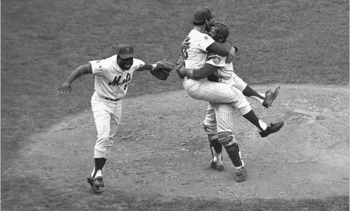
The new format led to the first ever Championship Series rounds, a best of five series to determine the World Series participants. The first NLCS was the Braves and the Mets (both surprises). The first ALCS was the Twins and the Orioles. The Orioles were supposed to destroy the comical underdog Mets. The Orioles stuck to the script in the opening game winning 4-1 and entering the 9th inning of Game 2 tied at 1. Then the miracle happened and the "Amazin's" went off script to win the next four games for their first World Series title. It was the perfect end (unless you're an Orioles fan) to a decade full of unexpected World Series teams and upsets.

Although the names of Sandy Koufax, Don Drysdale, Mickey Mantle, Roger Maris, Tom Seaver, Bob Gibson, Frank Robinson, Brooks Robinson and Henry Aaron will be the names that are remembered thirty, forty or fifty years from now (or more), every decade has tremendously talented, successful players who make wonderful contributions to the success of their teams, organizations and the league as a whole. Unfortunately many of the players who fall into this category will be forgotten, overlooked and generally ignored. Here are 14 players* from the decade you may not remember but you definitely should:
Catcher:
Jerry Grote
Career Teams: Houston Colt .45's (1963-1964), New York Mets (1966-1977), Los Angeles Dodgers (1977-1978), Kansas City Royals (1981) and Los Angeles Dodgers (1981)
All Star Appearances: 1968 and 1974
MVP Voting: None
Certain pitchers have a specific Catcher they insist on having behind the plate when they pitch. Bob Welch of the Oakland A's demanded that Ron Hassey catch for him instead of Terry Steinbach. When Greg Maddux pitched for the Braves he insisted on having Eddie Perez catch instead of Javy Lopez. Tim Wakefield insisted on having Doug Mirabelli catch instead of Jason Varitek because Mirabelli knew how to handle the knuckleball. Tom Seaver, one of the best pitchers of the 1960's and one of the greatest pitchers ever, insisted that Jerry Grote catch when he pitched. It was a matter of comfort and trust. With Jerry Grote as the Mets' Catcher, the Mets manager could relax knowing that Grote could call a game better than any Catcher, possibly ever. Grote would think ahead of the game and envision the entire thing unfold before it happened. If a poor or average hitter would come up in the middle innings of the game with the Mets ahead, Grote would have the pitcher give the batter a pitch to hit. Grote believed that if the batter got a hit in the middle innings he would be satisfied with his one hit for the day and be less likely to fight as hard in the late innings. Grote was also a master of manipulating a game. He would look at the pace of the game and anticipate who was likely to bat in the late innings. If it looked like a team's big hitters were likely to come up in the late innings, Grote would ease up on a few batters to get the part of the batting order he wanted to face up in the ninth. Very few catchers have ever been able to call a game like Grote.
John Roseboro (+)
Career Teams: Brooklyn/Los Angeles Dodgers (1957-1967), Minnesota Twins (1968-1969) and Washington Senators (1970)
All Star Appearances: 1958, 1961, 1962 and 1969
MVP Voting: 1961, 1965 and 1966
Being a Catcher in the Dodgers organization in the early 1950's was not a very promising career path. You were sitting behind Roy Campanella, the three time MVP, definite future Hall of Fame member and undisputed greatest Catcher on the planet. When Campanella was paralyzed in a car accident, Roseboro was forced into action. It wasn't the way you want to get a job but Roseboro made the best of it. When the Dodgers moved to the west coast Roseboro went with them. The rivalry between the Giants and Dodgers moved west with the teams. Dodgers-Giants was always ugly but it was ugliest when they were fighting for first place. It was never uglier than August 22, 1965. Juan Marichal, the Giants' pitcher, had a reputation as a knock down pitcher. He knocked down Maury Wills and Ron Fairly in the first inning. Pitching for the Dodgers was Sandy Koufax, who refused to ever throw at a batter. When Marichal stepped up to bat, Roseboro wouldn't allow Marichal to get back to the bench without receiving a message and if the message didn't come from the mound it would come from behind the plate. As Roseboro returned Koufax's first pitch he made sure it was close enough to Marichal's face to trim his mustache. Marichal let Roseboro know that it better not happen again. It did. Marichal turned around and used the only weapon he had. His bat. He slammed it down on Roseboro's head at least three times and was ready to pound some more but was tackled before he could inflict more pain. It is one of the ugliest scenes in the history of sports. Roseboro recovered after receiving 14 stitches and missing some time. Marichal later apologized to Roseboro and the two became close friends but the image of Roseboro vs. Marichal is the most violent image of the Dodgers-Giants rivalry. Roseboro continued on a strong career and helped the Twins become a consistent playoff team at the end of the decade.
Firstbase:
Norm Cash
Career Teams: Chicago White Sox (1958-1959) and Detroit Tigers (1960-1974).
All Star Appearances: 1961, 1966, 1971 and 1972
MVP Voting: 1961 (4th), 1962 (31st), 1965 (33rd), 1966 (12th), 1968 (23rd) and 1971 (12th).
When you think of American League power hitters Norm Cash is not one that comes to mind. Yet, Cash hit a total of 377 in his career. He never led the league and never hit more than 41 in a season. When he hung up his spikes at the end of the 1974 season Cash was fourth in AL history behind Babe Ruth, Lou Gehrig and Ted Williams. He has since been passed by many players as the home run numbers became inflated but those names are pretty illustrious. Cash's best year was 1961. He led the league in Batting Average, Hits, Intentional Walks (even more than Maris or Mantle) and On Base Percentage and set career marks in Hits, Triples, Home Runs, Stolen Bases, Runs, RBI and Batting Average. Unfortunately that was the year Maris and Mantle battled each other to beat Babe Ruth's single season home run record. Cash was an integral part of Detroit's 1968 World Series win. Game 7 of the 1968 World Series was scoreless heading into the top of the 7th. With 2 outs Cash took a 2-1 pitch for strike 2. He turned to the umpire and said "Come on, it's outside". He shook his head and took ball 3. One strike away from moving to the 8th inning scoreless, Cash drove the next pitch to right field for a single setting off a three run rally. The Tigers won Game 7 by a score of 4-1.
Secondbase:
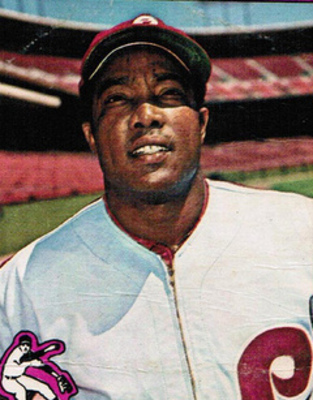
Tony Taylor
Career Teams: Chicago Cubs (1958-1960), Philadelphia Phillies (1960-1971), Detroit Tigers (1971-1974) and Philadelphia Phillies (1974-1976)
All Star Appearances: 1960
MVP Voting: 1963 (16th)
If someone asked you to name the top 10 Phillies of all time Mike Schmidt, Steve Carlton and Jimmy Rollins would probably be the first to come to mind. Very few would think of Tony Taylor, yet he sits in the top ten of several Phillies historical categories. It would be hard to argue that he had the historical impact on the organization of a Pat Burrell or Cole Hamels but Taylor worked in Philadelphia when the only people who went to Phillies games were probably there as some form of punishment. Taylor was part of one of the most infamous Phillies teams in history. The 1964 Phillies led the National League by 6 1/2 games with only twelve games left in the season. For a team that had won 90 games to that point in the season winning another five or six should have been nothing. Don't forget this was the Phillies. After taking the 6 1/2 game lead they immediately lost the next 10 games while the Cardinals caught fire and took over first place.
Shortstop:
Dick Groat
Career Teams: Pittsburgh Pirates (1952-1962), St.Louis Cardinals (1963-1965), Philadelphia Phillies (1966-1967) and San Francisco Giants (1967)
All Star Appearances: 1959, 1960, 1962 1963 and 1964
MVP Voting: 1957 (15th), 1960 (1st), 1962 (16th) and 1963 (2nd).
Few players are fortunate enough to play in a World Series Game 7 and be involved in one of the greatest moments of World Series history. Even fewer players have that chance twice. In the 1950's the Yankees seemed to be involved in the World Series every year. When the Pittsburgh Pirates faced off against the Yankees in 1960 few gave the Pirates a chance. When the Yankees took a big lead heading into the bottom of the 8th of Game 7 everyone assumed the Pirates' magical season had ended. Groat, the NL MVP in 1960, led the charge and drove in the first run of the inning with an RBI single. A few batters later he scored on a big, game tying, 3 run home run by Hal Smith. The Pirates went on to win the game with the most famous series ending home run in history. The Pirates glory days didn't last too long into the 1960's and by 1963 Groat was traded to the Cardinals. It was a great move for the Cardinals, who had fallen on hard times since their last World Series in 1946. With Groat's leadership and steady fielding the Cardinals were able to overcome the collapsing Phillies, fight their way to the World Series and force the heavily favored Yankees into a classic Game 7. Although Groat had only 5 hits in the 1964 World Series he played a big part in helping to topple the great Yankee dynasty...twice.
Thirdbase:
Ken Boyer
Career Teams: St.Louis Cardinals (1955-1965), New York Mets (1966-1967), Chicago White Sox (1967-1968) and Los Angeles Dodgers (1968-1969)
All Star Appearances: 1956, 1959, 1960, 1961, 1962, 1963 and 1964
MVP Voting: 1956 (28th), 1958 (13th), 1959 (10th), 1960 (6th), 1961 (7th), 1962 (18th), 1963 (13th), 1964 (1st).
With seven All Star Appearances, five Gold Glove awards and an MVP award it would be hard to imagine Ken Boyer as a forgotten player. Yet as the Cardinals began to dominate the decade Boyer seemed to always be the man overshadowed. Overshadowed by Stan Musial's constant .300 average, by Lou Brock's stolen bases, by Bob Gibson's million strikeouts and, amazingly, even by Tim McCarver stealing home during a World Series game. During his years in St.Louis Boyer was a consistent .300 hitter, consistently drove in close to 100 runs, scored close to 100 runs and hit between 25 to 30 home runs. As the Musial era ended and the new Cardinals dynasty started Boyer was one of the few links between the eras. In the 1964 World Series the Cardinals were viewed as lucky to have made it that far and as the Yankees threatened to take a 3 games to 1 lead the sports writers were writing their stories saying their early predictions had been dead on. Down 3-0 in the top of the 6th the Cardinals loaded the bases with one out. Boyer stepped in and slammed a pitch to left field. The grand slam gave the Cardinals a 4-3 lead and completely turned the series around. That would have been a great World Series for anyone, yet Boyer wasn't done. In Game 7 the Cardinals were up 6-0 when Mickey Mantle hit a three run home run to cut the lead in half and lead fans to believe some Yankee magic might be in the making. But Boyer put the Cardinals back up by four with a solo home run. The Yankees tried to rally in the 9th led by a solo home run by Clete Boyer, Ken's brother. They became the first brothers to homer in the same World Series game. Although Boyer has somehow been overlooked for the Hall of Fame his number was retired by the St.Louis Cardinals organization.
Gene Freese
Career Teams: Pittsburgh Pirates (1955-1958), St.Louis Cardinals (1958), Philadelphia Phillies (1959), Chicago White Sox (1960), Cincinnati Reds (1961-1963), Pittsburgh Pirates (1964-1965), Chicago White Sox (1965-1966) and Houston Astros (1966)
All Star Appearances: None.
MVP Voting: None.
Gene Freese did not have a tremendously long career and it was not a tremendously amazing career but the Cincinnati Reds had an amazing season in 1961 and Gene Freese was a big part of that team. Going into the 1961 season few gave the Reds a chance. It was assumed the Dodgers, Giants, Braves or Cardinals would be fighting for a World Series spot and the Reds were expected to be somewhere in the bottom half of the league. Freese held down the hot corner while having his best, most complete offensive season. He had career highs in Runs (78), Hits (159), Home Runs (26) and RBI (87). He also had near career highs in Doubles (23), Stolen Bases (8) and Batting Average (.277). Freese did not have a great World Series, only one hit and three walks with four strikeouts, but none of the Reds really had a great Series. The Yankees knocked the Reds out in 5 games and Freese never did quite play the same again. In spring training of 1962 Freese broke his ankle. His career was not over but he would never play another full season.
Outfield:
Curt Flood
Career Teams: Cincinnati Reds (1956-1957), St. Louis Cardinals (1958-1969) and Washington Senators (1971).
All Star Appearances: 1964, 1966 and 1968
MVP Voting: 1963 (24th), 1964 (11th), 1965 (15th), 1966 (20th), 1967 (13th) and 1968 (4th)
For students of the game it may be insane to see Curt Flood on a list of players that are unknown but sadly the casual fan doesn't hear about Curt Flood nearly enough. The Cardinals dominated the 1960's with players like Stan Musial, Bob Gibson, Lou Brock and Tim McCarver. Even with these hall of fame players there were several other big contributors to their decade of dominance. No one did more for St. Louis than Curt Flood. He was one of the best defensive players of the decade. No one patrolled centerfield better than Flood and his seven straight Gold Gloves proved it. Unfortunately Flood is now known for just two things and both detract from the greatness he had achieved. First, in the 1968 World Series, just a few batters after Norm Cash started what turned out to be a game winning rally, Jim Northrup hit a fly ball to Flood. Flood stood just outside the afternoon shadows as the ball left the bat. He saw the ball and reacted immediately. There was little doubt the gold glove winner had reacted right. He took a few steps in, then headed towards left. Flood could fly and he was moving quickly, when suddenly, he turned and started heading back to the wall. He still had a chance to get there but he stumbled. He didn't fall but he lost about two steps. By the time he recovered he had just enough time to throw his glove up but the ball had moved too far even for him to reach it. The ball fell just over his head and rolled to the wall for a two run triple. In just two bad steps Flood went from the best defensive centerfielder in the game to "that guy who couldn't catch a fly ball". Flood played the 1969 season and even won another Gold Glove but after the 1969 season the Cardinals traded Flood and Tim McCarver to the Philadelphia Phillies. Flood told the Cardinals he didn't want to go. He loved St.Louis. He loved the fans, the stadium, the organization, the city. He knew very little about Philadelphia other than the reputation it had for race problems. This was before Catfish Hunter and before Messersmith and McNally fought for free agency. This was the days before players had "no-trade clauses". If a team wanted to trade you, you were gone. Flood refused. He told the league that he was not a piece of property they could sell without his permission. He took his fight to the U.S. Supreme Court asking to have the "reserve clause" overturned. He lost. The Phillies, a bad enough team already, didn't need the extra headache and shipped Flood to the Washington Senators. After one year in Washington Flood retired. He fled the US and became a recluse eventually passing away in 1997.
Johnny Callison
Career Teams: Chicago White Sox (1958-1959), Philadelphia Phillies (1960-1969), Chicago Cubs (1970-1971) and New York Yankees (1972-1973)
All Star Appearances: 1962, 1964 and 1965
MVP Voting: 1962 (18th), 1963 (15th), 1964 (2nd) and 1965 (24th)
When the Mets collapsed at the end of the 2007 season, the Red Sox imploded at the end of the 2011 season and the Braves fell apart at the end of the 2011 season, long time fans of Philadelphia breathed a deep sigh of relief. It meant that they could finally stop hearing that their 1964 season was the biggest failure in baseball history. For nearly the entire 1964 season the Phillies had the rest of the National League decidedly beaten. With just 12 games left in the season the Phillies held a 6 1/2 game lead. The leader of the Phillies was Johnny Callison. As the rest of the team folded under the pressure Callison did everything he could to keep the team afloat. Over the last twelve games Callison hit .250 with 3 home runs (all in one game which the Phillies lost) and a double, driving in 10 and scoring 7. It wasn't enough. The Cardinals passed the Phillies for first place and eventually won the World Series. Callison had his best season of his long career and finished second behind Ken Boyer of the Cardinals for the MVP award.
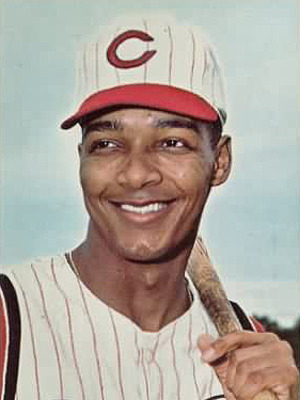
Vada Pinson
Career Teams: Cincinnati Reds (1958-1968), St. Louis Cardinals (1969), Cleveland Indians (1970-1971), California Angels (1972-1973) and Kansas City Royals (1974-1975)
All Star Appearances: 1959 and 1960
MVP Voting: 1959 (15th), 1960 (18th), 1961(3rd), 1963 (10th) and 1964 (18th)
As teams develop talent and make constant adjustments to their rosters they need to make decisions to keep one player and not another. Sometimes they decide correctly and sometimes they don't. In the 1990's the Braves decided to keep Andruw Jones and discard Jermaine Dye. It was the right decision. In the 2000's the Angels chose to keep Bobby Wilson and not Mike Napoli. That may have been a bad decision. The 1960's Reds had to make the same decision. The Reds surprised everyone by making the World Series in 1961 and Vada Pinson was a big reason why. Pinson seemed to be an all around player: strong defensively, good speed and decent power. The Reds had another talented young outfielder named Frank Robinson. To be fair to Pinson, the Reds didn't need to get rid of Robby and they didn't suffer too much with Vada in the outfield. Bill DeWitt, the Reds GM, decided that Frank Robinson needed to go. When people complained DeWitt tried to explain that it would be alright because Robinson may have only been 30 but he was "an old 30". Robinson went on to become one of the greatest players in the history of the game and Pinson became an above average player who made great contributions to the Reds organization and several other teams in his career, but he was not Frank Robinson. Robinson and Pinson will forever be remembered as the two young outfielders who helped the Reds to the 1961 pennant but Frank is the one who gained immortality.
Tony Conigliaro (+)
Career Teams: Boston Red Sox (1964-1970) California Angels (1971) and Boston Red Sox (1975)
All Star Appearances: 1967
MVP Voting: 1965 (33rd) and 1966 (28th)
The 1967 Red Sox were in 4th place, only winning 4 of their last 12 games and their season was starting to fade away as they faced the California Angels on August 18th. The score was 0-0 heading into the Red Sox half of the 4th. The Sox needed this game to save their season. The Sox had the heart of their order coming up. Jack Hamilton threw the pitch to Tony C. up in the zone but got the ball too far in.
Petrocelli knelt in the on deck circle and heard it before he could process what had happened. He ran to Tony Conigliaro as Tony C. laid face down in the dirt. The pitch had shattered Conigliaro's face, severely fracturing the cheek bones and orbital socket. Conigliaro was one of the great up and coming stars of the game and along with Yaz and Rico was expected to lead the Red Sox into the postseason for a decade or more. After Tony C. was carried off the field Petrocelli drilled a triple and scored on an error. The Red Sox won the 1967 pennant and had a chance to win their first World Series since 1918 but without the potent bat of Tony C. in the lineup they lost game 7 to the Cardinals. Conigliaro tried to make several comebacks but he just couldn't see the ball the same way and his numbers slipped. He had one last great season in 1970 where he hit .266 with 36 Home Runs but he was traded to the Angels after the season as Boston started to rebuild their team. Had Conigliaro not been injured the history of the Red Sox, the World Series, including the 1967,
1975 and 1986 World Series and the story of Major League Baseball may have been much different.
Pitcher:
Jim "Kitty" Kaat
Career Teams: Washington Senators (1959-1960), Minnesota Twins (1961-1973), Chicago White Sox (1973-1975), Philadelphia Phillies (1976-1979), New York Yankees (1979-1980) and St.Louis Cardinals (1980-1983)
All Star Appearances: 1962, 1966 and 1975
MVP Voting: 1966 (5th), 1967 (20th) and 1975 (28th)
Cy Young Voting#: 1975 (4th)
The rule is unofficial, but traditionally if you win 300 games as a pitcher you are guaranteed to get into the Hall of Fame. Apparently 283 wins over a 25 year career doesn't quite cut it. Jim Kaat was the best fielding pitcher in his era with no close runner up. Kaat won 16 Gold Gloves as the best fielder at his position. If you don't think fielding the ball from the Pitcher's position is tough, try following through on a pitch going 90+ miles an hour with your momentum taking you toward third base when a batter bunts a ball towards first base. As your body falls away from the ball you have to make an immediate reaction to decide whether you are fielding the ball to throw to first or sprinting to first to cover the bag. Not an easy play. Just ask
Danny Cox. When the 1965 Minnesota Twins surprised everyone by reaching the World Series, Jim Kaat was their ace. He won 18 games with a 2.83 ERA. When the Twins faced the Dodgers in a 7th game Kaat was the obvious choice to start. He didn't pitch terribly. He gave up 2 runs, 5 hits and a walk in 3 innings but when you're playing a seventh game and you're facing Sandy Koufax, the manager gives you a very short leash. The Dodgers went on to win Game 7 2-0 with Koufax only allowing 3 hits. No one could have beaten Koufax that day. Kaat 's 1966 season was even better, though the Twins were not. Kaat won 25 games in 1966 and dropped his ERA to 2.75. Kitty moved from team to team as his career progressed making the playoffs with the Phillies in 1976 and the Cardinals in 1982. Since his retirement Kaat has been a broadcaster. He still broadcasts live games for MLB Network and is one of the most insightful and classy broadcasters ever.
Harvey "Kitten" Haddix
Career Teams: St. Louis Cardinals (1952-1956), Philadelphia Phillies (1956-1957), Cincinnati Reds (1958), Pittsburgh Pirates (1959-1963) and Baltimore Orioles (1964-1965)
All Star Appearances: 1953, 1954 and 1955
MVP Voting: 1953 (17th)
Cy Young Voting#: None
I didn't realize until I started minutely researching Harvey Haddix that his nickname was Kitten and that having both Jim Kaat and Harvey Haddix on this line would make a feline family. There is no intentional theme of cats in this week's article although both Haddix and Kaat were "south paws". Haddix was not a Hall of Fame caliber pitcher but he was better than near perfect one night. On May 26 1959 Haddix faced off against Lew Burdette and a Milwaukee Braves team that featured some great hitters like Henry Aaron, Eddie Matthews and Joe Adcock (haven't heard of Adcock before? Check back next week). When Lew Burdette struck out in the bottom of the 9th it was the 27th straight batter retired, a perfect 9 innings. The only problem was that the game wasn't over. Although the Braves had not put a single person on base, the Pirates had been unable to capitalize on any of their own 8 hits. The game moved through the 10th, 11th, 12th and 13th. The Pirates put runners on base in each inning and the Braves couldn't get anyone on base until the bottom of the 13th. The inning started off with an error by the thirdbaseman ending the perfect game but still leaving the no hitter in tact. Three batters later Joe Adcock drilled a double to right-center field scoring the game's only run. Haddix had been perfect for 12 innings and lost on an unearned run in the 13th inning. Haddix made major contributions to the Pirates' 1960 miracle season. Although he only won 11 regular season games he won 2 in the World Series. The Pittsburgh pitching staff was abused in the 7 game series with a collective ERA of 7.11. They lost games by scores of 16-3, 10-0 and 12-0. Fred Green had a Series ERA of 22.50. Harvey Haddix was the savior of the pitching staff. His 2.45 ERA was easily the best on the team and when Bill Mazeroski drilled a home run to end the World Series Haddix was the winning pitcher, his second win of the series.
Relief Pitcher:
Moe Drabowsky
Career Teams: Chicago Cubs (1956-1960), Milwaukee Braves (1961), Cincinnati Reds (1962), Kansas City Athletics (1962-1965), Baltimore Orioles (1966-1968), Kansas City Royals (1969-1970), Baltimore Orioles (1970), St. Louis Cardinals (1971-1972) and Chicago White Sox (1972)
All Star Appearances: None.
MVP Voting: None.
Cy Young Voting#: None.
Before the 1990's no one ever said "I want to be a relief pitcher when I grow up." When kids ran out on the field to choose positions for a pick up game no kid ever yelled "I got closer." For a long time being a relief pitcher was an insult. It was a useless position that meant you were only good enough to pitch when the other guy proved he was so bad it wasn't worth leaving him in to get knocked around anymore. Being a journeyman relief pitcher was even worse. It meant no team wanted you to start and no team wanted you to even do the mop up duty. Moe Drabowsky was all of these things but he did his job well. He would never be confused for a Hall of Fame player, or even an All Star pitcher but in Game 1 of the 1966 World Series Moe Drabowsky changed the history of baseball in just a few innings. Since moving to Los Angeles in 1958 the Dodgers had reached the World Series four times. Since moving to Baltimore from St.Louis the Orioles had reached their first World Series. No one gave the Orioles a chance. The Dodgers were dominant. The Orioles were...well, no one knew because no one had heard of them. Game 1 was started by Don Drysdale, big double D, the most intimidating man in sports. The O's weren't intimidated and took a 4-0 lead. The Dodgers started to make a rally in the 3rd inning and Moe Drabowsky came in to keep the Orioles in the lead. With the bases loaded he struck out the first batter he faced, then walked in a run and got the final out by forcing John Roseboro to pop out. It was the last trouble he would have on the day. He retired the next 10 batters in a row, allowed a walk and a single, then retired the next 8 batters to end the game, striking out 11 Dodgers in the process. Drabowsky's win set the tone for the Orioles' four game sweep and launched the glory days of Orioles baseball that would stretch into the 1980's. For the Dodgers it was the end of the Drysdale-Koufax era and would lead to a rebuilding that would result in the Garvey/Cey/Lopes/Russell era of the 1970's.
* Author's Note: Just as in the last few weeks, and as may be seen in the next few weeks as we move through this series of articles, I did my best to keep this to one player per position, however, the farther we move from these eras, the easier it is to forget these types of players (and even some hall of fame players). It is important to remember as we follow the sport that the superstars are not the only ones making contributions to the success of a team. This is not a comprehensive list of players who fall into this category from this era, it is simply my choice of players who best represented their position and have become forgotten. Your list is probably different. Email me yours or leave a comment.
+-For readers interested in seeing the vivid pictures of the John Roseboro/Juan Marichal incident or the results of the Tony Conigliaro beaning, they are easily found all over the internet. I felt it was important that I not use these images for my article. Both Tony C. and John Roseboro have become known for these two moments which lasted no more than a few minutes. Unfortunately, Roseboro's great career and the great potential of Conigliaro, have been largely ignored and focus has been placed on the gruesome images of these moments. It is important to remember that both players made tremendous contributions to championship seasons for their teams and their career cannot be defined by just these few moments.
#- The Cy Young award was not awarded until 1956. Between 1956-1966 there was one award for both leagues. It was not until 1967 that the American and National leagues each awarded a Cy Young trophy.



.jpg)