Showing posts with label Dwight Evans. Show all posts

Sunday, June 28, 2015

Oh, How Different Things Might Have Been: Jim Rice and the 1975 Red Sox

History is fixed.  It is unchangeable.  Nothing can change the past.  You can watch Carlton Fisk hop down the line a million times and he will still waive the ball fair.  No matter how many times Todd Worrell touches that bag, Don Denkinger is still going to call Jorge Orta safe.  Bill Buckner is never going to field that little roller behind the bag and Mitch Williams will not look back over his shoulder to see Joe Carter's fly ball being caught.

The winners and losers in the history of the game will always be winners or losers.  But this series will explore some "what if's".  What if a player who missed the World Series hadn't gotten injured?  What if a play that turned a World Series had been completed differently?

We have already looked at  the 1905 Philadelphia Athletics, the 1910 Cubs, the 1962 Dodgers and last week the 1968 Tigers.  This week we look at how the loss of a rookie outfielder might have changed World Series for the 1975 Red Sox:

No one had predicted this.  Anyone who had would have been sent for evaluation.  Imagine it.  The Orioles had won the division every year (except 1973) since the division format had been invented.  Only the Tigers had been able to claw the birds out of the top perch.  Although Baltimore had sent Frank Robinson and Boog Powell to the Indians (suddenly the Indians looked improved) the O’s still had Brooks Robinson and that great pitching.  The Yankees had added Catfish Hunter and Bobby Bonds to a roster that already included Thurman Munson and Graig Nettles.  Even the young Brewers were improving with Robin Yount and Darrell Porter mixing with veterans George Scott and Hank Aaron.

So what did the Red Sox have?  They had arguably the best Catcher in baseball (Freehan, Munson and Bench were certainly in the discussion) but he was out of the lineup for god knows how long.  They had an aging legend in Carl Yastrzemski whose knees were shot and would be moved to First Base to save his body.  They had a pitcher that was rejected by Cleveland and Minnesota with a wind up so ridiculous it almost baffled the mind that the pitches made it to the catcher at all.  They had another pitcher that would have been rejected by Monty Python as a character too unbelievable to be part of their sketches and called himself “Spaceman”.

They also had a ton of young, unproven players.  No one was dumb enough to believe Boston had a shot at this.  Still, at the end of the first month the Sox stood at the top of the division at 7-5.  Any hope of a Boston miracle began to fade as the Sox dropped 4 straight and fell to 4th.  A quick rally in the form of an 8-2 stretch actually put the Red Sox four games up by mid May and the focus was on the excitement of Luis Tiant and the young players.
There were three main youngsters that became the focus of the team: Fred Lynn, Dwight Evans  and Jim Rice. 

The opening day lineup was honestly a bit of a mess. Yaz, the man who had written the textbook on how to play the Green Monster, was at First Base.  In Left Field was Juan Beniquez with Lynn in Center Field and Evans in Right.  Catching was Bob Montgomery in place of an injured Fisk.

Friday April 18th was a big day.  Though few saw it at the time, it would be a great day in the story of the franchise.  Facing off against the favored Orioles, Reggie Cleveland gave up 2 quick first inning runs.  Boston went in order (Beniquez, Rick Burleson, Yaz) in the first.  The O’s got another base runner in the second but Dave Duncan remained at first and the Sox came up for the second inning.
Dwight Evans grounded to Brooks Robinson at third to start the inning and Rico Petrocelli  walked.  Walking to the plate, in his first starting assignment of the year, was Jim Rice.  In the days before baseball players used weights, Jim Rice was a giant.  The theory at the time was that weights and baseball didn’t mix.  It was thought that larger muscles would interfere with the fluidity of the swing.  Rice was a challenge to that theory.  He was a football player on the baseball diamond.  He was so strong that he once broke his bat on a check swing.  Think about the physics of that moment.  His arms were so powerful that when they stopped their momentum a wooden bat continued moving, putting enough pressure to crack a solid object in two.  He demonstrated his power here with a two run game tying Home Run.  The next batter was Fred Lynn who walked.
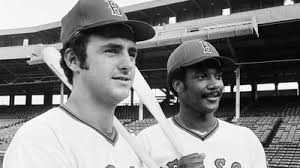


In the third, Dwight Evans doubled giving the Sox the lead.  In the 4th Rice stepped to the plate and hit his second Home Run of the day putting Boston up 4-2.  By the end of the inning Boston led 6-2.  In the 7th Fred Lynn hit a solo Home Run.  The three youngsters (Evans, Rice and Lynn) would be 6-13, scored 3 runs, 5 RBI, a walk, a double and three Home Runs.  It was the first time all three had started together.  But try telling the Red Sox fans it was a great day as they filed out of Fenway.  Lee May, the Orioles First Baseman, had gone 2-3, with 2 runs, 7 RBI, 2 Home Runs (both with two men on).  The Sox lost 9-7, at home to a division rival.

The rookies took over the season.  It seemed that every time you looked up Fred Lynn was sliding face first on the grass or crashing into a wall to make a catch and Rice was trotting around the bases.  They were dubbed the “Gold Dust Twins” and they carried the team to win after win.  By July 28th they were 9 games up.  The lead shrunk to 5 ½ by September 1 but they recovered and continued to win.  Lynn, Rice and Evans were everywhere.  Evans was the least successful of the three somehow.  Rice and Lynn were similar in numbers.  At the end of the year their numbers looked like this:
                                Hits        Runs      RBI         2B/3B/HR            Avg.       BB/K      SB/CS
Jim Rice                  174         92           102         29/4/22                .309        36/122  10/5
Fred Lynn               175         103         105         47/7/21                .331        62/90     10/5

It should be obvious why they were called twins.  It definitely was not because they looked alike.  Things were great.  Fisk was back in the lineup by the end of June, the kids were tearing it up and the combination of Tiant and Lee was consistently winning.  The Sox fans started seeing rings.
It was an unusual feeling.  The Boston Globe asked “What’s Right with the Red Sox”.  But this was still the era of the Curse of the Bambino.  It struck on September 21.  Facing Detroit, the Tigers had taken a 1-0 lead in the first, although with the Gold Dust Twins a one run lead was nothing.  Leading off the second inning was  Jim Rice.  The pitch came in tight on Rice.  It was too far inside and Rice did not react quickly enough.  It hit Rice on the hand, crushing the powerful hand between the ball and the bat, breaking the hand.  Rice would stay in the game and came around to score.  He walked in his next plate appearance and flew out in the 6th.  With the Sox ahead heading into the 7th, Evans replaced Rice in right field.    Rice was sent for x-rays and it was found that a bone was broken.  The Sox clinched their division but they would be without Jim Rice in the playoffs.


Their first opponent would be a difficult challenge.  The A’s were the World Series Champions three times running.  They had lost Catfish Hunter since last year but they still had names like Bert Campaneris, Sal Bando, Joe Rudi, Gene Tennace, Vida Blue, Ken Holtzman, Rollie Fingers and the biggest of all, Reggie Jackson.  It did not appear to be an easy task and without Rice many thought the Red Sox didn’t stand a chance.

The Sox scored twice in the first inning of Game 1 thanks to two Oakland errors.  It remained 2-0 entering the bottom of the 7th.  Boston exploded for five runs, three of those unearned, and cruised to a 7-1 lead.

Game 2 was a bit more tense.  Reggie Jackson put the A’s out to a 2-0 lead with a 2 run Home Run and the A’s young outfielder Claudell Washington added to the lead with an RBI double in the third.  Yaz answered in the bottom of the third with a 2 run Home Run of his own and Rico Petrocelli grounded into a double play that allowed Carlton Fisk to score from third.  Tie game headed into the 4th.  From there it seemed to be all Red Sox.  Fisk drove in Yaz with an RBI single in the 6th.  Petrocelli homered in the 7th and Lynn drove in Juan Beniquez in the 9th for a 6-3 win and a 2-0 lead in the series.

We can only imagine the mood in the A’s locker room after the second straight loss. Often volatile, even when winning, we can at least be confident that it wasn’t quiet.   Without Catfish as an option, the A’s went back to their ace Ken Holtzman to try and save their season.  He had  been victimized by 4 A’s errors in Game 1 and had to work out of trouble n the 1st inning of Game 3 but he seemed to settle down.  The game was scoreless entering the 4th.  After 2 quick outs  Fred Lynn hit a fly ball that looked like it would get the A’s to the plate but Claudell Washington misplayed the ball and Lynn ended up on second base.  Petrocelli made them pay with a single scoring Lynn.  The A’s went in order in the 4th and Holtzman returned to the mound.  Holtzman struck out Cecil Cooper to start the inning but Rick Burleson singled.  Juan Beniquez (Rice’s replacement) flew out for out number 2.  Denny Doyle singled to score Burleson and Yaz followed with a single. Holtzman’s day was done but the Red Sox were not.  Relief Pitcher Jim Todd gave up an RBI single to Fisk, scoring Doyle and was replaced.  Paul Lindblad came in and allowed Yaz to score on a Wild Pitch making it 5-0 Sox.  Down 6-1 in the 8th, the A’s made one last rally when they bunched three singles and an error to score 2 but  Dick Drago came in to relieve Rick Wise and got a double play to end the inning.  The Sox had advanced to the World Series for the first time since 1967 and only the third time (1946 being the other) since 1918.

The Sox were able to win relatively easily without Rice in the ALCS but that was mostly thanks to A’s poor fielding.  Juan Beniquez, Rice’s replacement, had gone 3-12 with only one extra base hit, a double.  They would need more than that if they were going to beat the Reds of Bench, Morgan, Rose and Perez.

The Reds were heavily favored entering the World Series based on their dominant regular season and collection of future Hall of Famers.  The 1975 World Series is one of the greatest of all time with each game seemingly more surprising and exciting than the next.  Game 1 saw Luis Tiant pitch an emotional dominating game.  Tiant had been reunited with his parents for the first time since leaving Cuba.  Fidel Castro had allowed them a temporary visa to see their son pitch in the World Series. 
Boston led Game 2 heading into the 9th inning and were on the verge of taking a 2 games to none lead until the Reds got 2 doubles, a stolen base and two runs to take the lead.  The Sox went in order in the bottom of the 9th.

Game 3 saw a controversial end to a 10 inning game.  After trailing 5-1 the Sox fought back to tie the game only to lose on a non-call of batter/runner interference by Ed Armbrister. 

Game 4  was another win for Tiant, who was not as sharp as he had been in Game 1.  He allowed 4 runs but with a 5 run inning in the 4th the Sox tied the series at 2 games each. 

Game 5 saw Tony Perez break out of his slump with a solo Home Run and a three run Home Run to give the Reds a 3 games to 2 lead in the series.

Game 6 was arguably the greatest game ever played.

Game 7 saw the Red Sox take a 3-0 lead and hold a 3-2 lead heading into the 7th.  But Bill Lee had to leave when a blister formed on a finger on his pitching hand and Joe Morgan drove in Ken Griffey in the top of the 9th to win the World Series.

Of course it is easy to say that Jim Rice would have made the difference but we can’t know that he would have made the difference.  Knowing that the series went 7 games and each game was close, Rice certainly could have made a difference.  It is not fair to say “things would definitely have happened differently if… “  There is never an absolute.  If a fielder doesn’t throw wild, our team will win.  If a runner doesn’t lose his footing turning a bag, our team will win.  It certainly would improve the team's chances of winning but it doesn’t automatically mean they will win.  So simply saying that the Red Sox would have won in 1975 if Jim Rice was in the lineup is not entirely accurate, but he certainly could have helped their chances greatly.

With that being said, let’s look at how Rice could have changed things had he been in the four losses in the World Series.  When the Red Sox were healthy and playing at their best in 1975 their lineup looked like this:
C    Carlton Fisk
1B  Carl Yastrzemski
2B  Denny Doyle
SS  Rick Burleson
3B Rico Petrocelli
RF  Dwight Evans
CF Fred Lynn
LF Jim Rice
DH Juan Beniquez/Cecil Cooper/Rick Miller/Bernie Carbo

The DH was not used in the World Series so two bats were essentially taken out of the lineup: Jim Rice and the DH.

The first loss for the Red Sox, Game 2, saw Yaz playing in place of Rice in Left Field but since Yaz was part of the regular lineup,First Baseman Cecil Cooper would have been considered the Rice replacement.  In Game 2 Cooper would go 1-5 with a double.  In fact he led off the game with the 2 base hit.  He was erased on a double play.So in his other 4 plate appearances could he have effected the game the way Rice could have?  Of course there is always the argument  that a healthy Rice could show his power at any time. so of course Rice could have changed the game in that way.  Cooper led off the third with a ground ball to Joe Morgan.  In the 5th, he was the third out in a 1-2-3 inning.  In the 7th, he was out number 2 in a 1-2-3 inning.  In the 9th Cooper made the final out with a pop out to short, again part of a 1-2-3 inning.  There was no point in this game that Cooper left runners on base or killed a rally.

Game 3 had the same lineup.  Cooper was hitting in the lead off spot (Rice would normally be 4th or 5th in the lineup).  Cooper went 0-5 and twice he came to bat with a runner on base. In the bottom of the 5th with two out and Burleson on first, Cooper grounded out.   The second time could be a situation where we could see Rice making a difference.  The Red Sox trailed entering the top of the 9th.  Fred Lynn struck out to start the inning.  Rico followed with a single and after a pitching change Dwight Evans tied it with a Home Run.  Burleson followed with a single and suddenly the pressure was on.  Pitcher Jim Willoughby sacrificed Burleson to second and up came Cecil Cooper.  Imagine the pressure on the Reds had Jim Rice walked to the plate with a runner in scoring position instead of Cecil Cooper but the intimidation that could have been applied by Rice could have changed the way that game went.  Instead Cooper flew out easily to Center Field and the game remained tied into the 10th.  Of course, you can also do the “what if” game with Ed Armbrister’s bunt in the 10th inning as well, as in what if the umpire called him out.

Game 5 was the next loss and the lineup got juggled a little.  Yaz moved to First Base and batted third.  Taking over in Left Field was Juan Beniquez.  Beniquez would go 0-3 with a walk and a strikeout.  But were any of his plate appearances in situations where Rice could have made a difference?  Beniquez led off the game by grounding to third.  That was followed by a Denny Doyle triple.  So had Rice been in the game he was more likely to get on base, although Rice normally batted in the middle of the lineup so we can give Beniquez a pass on the lead off spot.  In the third, Beniquez was the third out in a 1-2-3 inning.  In the 6th, with the Reds ahead 2-1 Beniquez got a 2 out walk and was stranded there.  By the time he came up to the plate again to lead off the 9th  the Reds were ahead 6-1.  Beniquez struck out looking. 


Finally, Game 7.  Could Rice have changed things? Again the answer is that he could flex his power at any given moment but the real question is: did his replacement miss any opportunities to change the game? Yaz again played First Base but in Left Field to start the game was Bernie Carbo.  Carbo had hit a pinch hit Home Run the night before.  That Home Run tied him with Chuck Essegian of the 1959 Dodgers for most pinch hit Home Runs in a World Series with 2.  Carbo led off the game with a double to left field.  When Denny Doyle followed with a fly ball to right, Carbo failed to advance.  It was a lack of aggressiveness on the base paths that Red Sox fans would point to as a missed opportunity.  Yaz grounded to the right side of the infield, advancing Carbo to third, although he might have scored had he advanced to third on Doyle’s fly ball out.  Burleson flew out to end the inning.  Rice was not a tremendous runner.  He stole 10 bases in  1975 but would never again break double digits in that category.  So it is unclear whether this would have differed with him on the base paths.  With only one out and Yaz coming up, Don Zimmer, coaching 3rd base, might have held Rice at second anyways.  Carbo next came up in the 3rd with the game still scoreless.  He worked a one out walk, moved to third on a Doyle single and scored the game’s first run on a Yaz single.  Carbo came to bat again in the 4th.  Bill Lee singled to start the inning and moved to second on a wild pitch.  Carbo grounded to second to advance Lee to third, so although it wasn’t a base hit, it was a productive out.  Doyle and Yaz left Lee at third.   Carbo’s final at bat of the game came leading off the 6th.  With Boston ahead 3-2 Carbo was the first out of a 1-2-3 inning.  Rick Miller replaced Carbo in left field to start the 7th.  By the time Carbo’s spot came up in the order again the Sox were down 4-3.  Leading off the bottom of the 9th, Juan Beniquez pinch hit for Rick Miller.  He flew out to right for the first out of a 1-2-3 inning.  Certainly the Boston approach to the game might have been different had Rice been in the game.  Rice would not have been replaced defensively by Miller in the 7th and his presence at the plate would have made Sparky Anderson much more nervous than Juan Beniquez.  Following Beniquez’s fly ball out to start the 9th, Boston went to the bench again and sent up Catcher Bob Montgomery to pinch hit for Denny Doyle.  Had Rice been in the game, Darrel Johnson would have had other options for pinch hitters (like Bernie Carbo) in that situation.

But the question still remains, would Rice have made the difference?  Comparing numbers is always helpful.  So as a final review to allow you to make your decision, let’s compare the numbers of Rice’s replacements to Rice’s numbers in the other post seasons he played in his career:
                                                AB/Hits Runs      RBI         2B/3B/HR            BB/K             AVG
Cecil Cooper (1975*)              1-18       0              1              1/0/0                     0/3              .056
Juan Beniquez (1975*)              1-8       0              1              0/0/0                     1/1              .125
Bernie Carbo (1975*)                2-5      2               3              1/0/1                     1/1              .200
Jim Rice (Career Postseason+)18-76   15              8              2/1/2                    9/22             .237
*-numbers used are only in situations where player was considered Rice’s replacement

+- Rice played in the 1978 playoff game to decide the AL East division as well as 1986 ALCS, 1986 World Series and 1988 ALCS.  The 1978 AL East division deciding game is technically not post season but was included as it added weight to viewing Rice’s performance in playoff situations.

TRIVIA QUESTION:
Joe Morgan was named the MVP of the 1975 World Series.  Morgan went 7-27,  including a double, for a  259 average. He also scored 4 runs, drove in 3, including the series winner, walked 5 times and stole 2 bases.

There was another major piece of the Big Red Machine who had great numbers and could have been considered for the Series MVP.  This Red went 10-27 (.370) including a double and a triple, scored 3, drove in 2 and walked 5 times. Although many feel this Red should be in the Naitonal Baseball Hall of Fame he has not been enshrined in Cooperstown yet. Who is he?

Answer to Last Week's Trivia Question:
The Cardinals and Tigers first faced each other in the World Series in 1934.  It was the Gashouse Gang vs. Hank Greenberg, Charlie Gehringer and SchoolboyRowe.  In a great, tightly contested seven game series the Cardinals  came out on top.

The 1934 World Series was Detroit's fourth World Series appearance (they had lost to the Cubs in 1907 and 1908 and the Pirates in 1909).  It was the Cardinals 5th appearance (they had beaten the Yankess in 1926 and lost to the Yankees in 1928.  They had also lost to the Athletics in 1930 but beaten the Athletics in 1931)

By the time the two faced off again in 1968 the Cardinals had won the 1942, 1944, 1946, 1964 and 1967 and had lost the 1943 World Series. The Tigers had won the 1935, 1945 World Series and had lost the 1940 World Series.

After the 1968 season both teams fell off drastically.  The Cardinals would not reach the World Series again until the Whitey Herzog era of the 1980s.  They won the 1982 World Series but lost the 1985 and 1987 World Series.  The Tigers, following the 1968 World Series, would not return to the Fall Classic until 1984.

The 1990s were a terrible era for the Tigers but saw a rebirth for the Caridnals, although no World Series appearances.

The early 2000s started poorly for the Tigers but they surprised everyone with a dramatic 2006 turn around and run through the playoffs to the World Series.  The Cardinals continued their rebirth with a 2004 World Series appearance where they faced the Red Sox.  In 2006 tehy returned to the World Series and faced the Tigers (the third time they faced off) and won their first World Series since 1982.

The Cardinals returned to the World Series in 2011 and 2013 while the Tigers returned in 2012.  Any one of those seasons could have seen a rematch as the oposing team lost in the LCS round of their respective leagues.

Sunday, January 11, 2015

I Didn't Know He Played For: Baltimore Orioles

Last week we started a look at a new series called "I didn't know they played for..." with a look at the minor league history of my home town, Reading, PA.  This week we take a look at the major league history of the Baltimore Orioles organization.

The Baltimore Orioles started as the St. Louis Browns.  (Of course you knew that because I'm sure you vividly recall the well written, exhilarating article about the history of team names).  The Browns did not have the greatest history but they did have quite a few recognizable names play for the team including George Sisler, Don Gutteridge and Pete Gray.

The team moved to Baltimore in 1954 (which you of course also knew because you read this blog every week, right?) Since moving to Baltimore the Orioles team has become one of the key identifying features of the city.  The fresh crab cakes from the inner harbor, the historical ships and the great shopping district are just as identifiable for the area.

The Orioles teams have had some of the greatest players of all time represent their team proudly.  Frank and Brooks Robinson, Jim Palmer, Eddie Murray and Cal Ripken are the most identifiable.  Every organization has players that come through town on the way to making their mark some where else.  Sometimes the player is near the end of their career and are trying to make one last playoff run or World Series appearance.  These players are often remembered as a member of another organization but nevertheless appeared as a Brown or Oriole at some point.  Here are some of the players that you may not remember as having played for the Browns or Orioles.

Jiggs Donahue:
The name Jiggs Donahue may not resonate through the history of the game today but he played a very big part in one of the greatest upsets of all time.  The 1906 Cubs are still considered one of the greatest teams of all time.  They breezed through the National League before they ran into the crosstown rival White Sox, lovingly referred to that year as the "Hitless Wonders".  They were anything but hitless in the World Series.  Donahue was a driving force in that series playing like a man possessed.  A man who had only 25 extra base hits all year long ended up with two doubles and a triple in the upset win and drove in 5 runs.  In all Donahue played six years with the White Sox, his best being 1905.  Before he was a White Sox he was a member of the St.Louis Browns. Or more precisely, the original Milwaukee Brewers of 1901 who moved to St. Louis in 1902.  One of the contract jumpers from the National League at the start of the American League, Donahue signed with Milwaukee for 1901 and hit .316 in 37 games.  He played with the team in St.Louis in their first year there but appeared in only 30 games and hit .237.  In 1903 he was sent to the minors but resurfaced with the White Sox for 1904.

Bill Dinneen:
The first World Series in 1903 featured some of the greatest names of all time: Jimmy Collins, Fred Clarke, Tommy Leach, Honus Wagner and Cy Young.  The man who made the difference among all these  legends was Bill Dinneen.  Dinneen won three of the five games needed by the Red Sox to capture their first ever World Series title.  He continued to pitch for the Sox until 1907.  In June 1907, as the Sox were retooling for what would become the 1912-1918 dynasty, they sent their former pitching hero to the Browns for Beany Jacobson and $1500 dollars.  Dinneen would play two and a half years with the Browns before retiring.  He would go 27-24 with a 2.57 ERA in St.Louis.  Not bad considering how terrible most of those Browns teams were. Actually, the 1908 Browns also featured Rube Waddell, the former A's star, and put up a fight in the close American League race. Dinneen would go on to be a successful Major League umpire for many years after his playing days.

Charlie Root:
Despite not having won a World Series title since 1908 and not having reached a World Series since 1945, the Cubs were regularly in contention between 1908 and 1945.  Charlie Root was the ace of the Cubs' pitching staff on 4 World Series teams (1929, 1932, 1935 and 1938).  Despite being known as the man who gave up Babe Ruth's called shot, Root had a very good career, ending with a 201-160 record.  Root started with the Cubs in 1926 but before he was a Cub he was a Brown.  Root appeared in 27 games for the 5th place Browns in 1923, going 0-5 with a 5.70 ERA.  Obviously the Browns needed pitchers who could win so Root was sent back to the minors where he resurfaced three years later.

Jim Bottomley:

As hard as it may be for modern fans to believe, the St.Louis Cardinals were once the doormat of the National League.  As they came out of the darkness and into contention Jim Bottomley and Rogers Hornsby were the keys to the offense.  Bottomley even won an MVP award in 1928 as the Cardinals returned to the World Series.  But as always happens, the years go on, age catches up with the players and younger players come along.  When it was time for Bottomley to give up the first base bag he was not done with his career.  The Cardinals traded Bottomley to the Reds and after a few years finished his career with the lowly Browns.  In 2 years there he hit .285 (not bad but well below his .310 career average) and drove in 107 runs (less than what he used to accomplish in just one year with the Cardinals). Bottomley was inducted into the Hall of Fame in 1974.

Dizzy Dean:

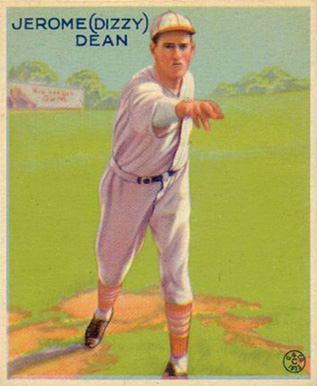
Dizzy Dean is synonymous with the St.Louis Cardinals "Gashouse Gang" of 1934.  Dean was later a legendary broadcaster and was always known for his goofy persona.  What few people know is that the great Dean tried a come back in 1947.  He pitched 1 game for the Browns in 1947.  In 4 innings he allowed three hits and a walk but no runs and did not get a decision.

Eddie Lopat:
The Yankees, who dominated the game in the late 1940s and 1950s are mostly remembered for their offensive names like DiMaggio, Berra, Mantle, Bauer, Gordon and Rizzuto.  Often forgotten are their three aces of Allie Reynolds, Vic Raschi and Eddie Lopat.  In the 8 years that Lopat pitched in the Bronx, the Yankees won 5 World Series.  As the Yankees went for the 1955 AL pennant Lopat's record sat at 4-8.  The Yankees sent Lopat to the Orioles for pitcher Jim McDonald.  Lopat would pitch in only 10 games for the O's and went 3-4.  At the end of the season Lopat was released and retired.

Dizzy Trout:
Dizzy Trout worked with Hal Newhouser to lead the Tigers pitching staff of the 1940s.  Trout pitched in the World Series for the 1940 and 1945 for the Tigers and, although not as successful as Newhouser he was a fan favorite.  What few remember is that Dizzy, father of Steve Trout, ended his career with the birds.  Trout disappeared from the game after the 1952 season but resurfaced in Baltimore at the age of 42 in 1957.  Trout appeared in 2 games for the O's  and retired only one of the five batters he faced.  He allowed 4 hits and 3 runs in 1/3 of an inning for an ERA of 81.00.

Whitey Herzog:

Whitey Herzog was a Hall of Fame manager mostly with the Royals and Cardinals though he also spent time with the Rangers and Angels.  As with almost all managers, they had to be players somewhere before they became managers.  Herzog played for several teams but he played more in Baltimore than for any other team.  Herzog played two seasons (1961 and 1962) with the Orioles and hit .280 in his time there

Harvey Haddix:
Harvey Haddix was an All Star, Gold Glove winner and famously pitched 12 perfect innings before losing the game in the 13th.  He saw a lot of success with the Cardinals and Pirates, even winning a World Series title with the Pirates in 1960.  What few remember is where Haddix ended up.  In 1964 and 1965 Haddix pitched in Birdland.  After the 1963 season as the Pirates were looking for a youth movement Haddix was sent to Baltimore. He went 5-5 in 1964 and 3-4 in 1965.  His contract was sold to the Braves after the 1965 season.  Too bad.  Had he hung on one more year in Baltimore he would have gotten another World Series ring.

Enos Cabell:
Enos Cabell is one of the all time great players in the history of the Astros organization.  As Cabell matured as a player, the Astros matured as a team.  Before Cabell became an Astros legend he helped the Orioles make the playoffs.  He first appeared in the majors for three games in 1972.  His playing time increased to 30 games the next year and 80 games in 1974.  When the O's took on the A's in the 1974 ALCS Cabell saw action in three games although the A's went on to their third straight World Series win.  In December of that year Cabell was traded with Rob Andrews to the Astros in exchange for Lee May and Jay Schlueter.  It worked out for Cabell. The Astros would eventually retire his number.

Rick Burleson:
The name Rick Burleson may not stand out to casual fans, but Red Sox Nation certainly remembers him and the fans of the Angels should remember him too.  He played a big part in the success of both organizations.  The Rooster came up with the Red Sox in 1974 and finished 4th in Rookie of the Year voting (he was behind Mike Hargrove, Bucky Dent and George Brett).  In 1975 the feisty Burleson combined with Denny Doyle as the middle infield in the Red Sox first World Series team since 1967.  After his time in Boston he went on to help the Angels organization for 5 years, even playing a big part in the  classic 1986 ALCS between the Halos and the Red Sox.  Burleson became a free agent after the 1986 season.  The Orioles hadn't quite figured out what direction they were heading and despite having a young Bill Ripken in their minor league system they signed Burleson.  In 1987 Burleson would play 62 games and hit .209.  He would retire after the 1987 season.

Dwight Evans:
Jim Rice, Carl Yastrzemski and Fred Lynn.  It's a hell of an outfield but it didn't leave room for one of the most important pieces of the 1975 Red Sox.  Dewey Evans was too good to sit on the bench so Yaz moved to First Base to make room.  From 1972-1990 Evans patrolled the Fenway outfield and was there for every near victory and painful defeat.  He made one of the most unbelievably spectacular catches in the 1975 World Series.  When the Reds rallied in 1975 Game 7 Dewey watched it.  When Buckner let the ball trickle through Dewey saw it.  And when McGwire, Canseco and the Bash Brothers destroyed the Red Sox Dewey was there.  He played 2505 games in a Red Sox uniform.  After 19 years of service in the Boston organization the Red Sox were ready to move on with Mike Greenwell, Ellis Burks and Tom Brunansky.  After the 1990 season the Red Sox released Evans.  He felt he still had something left to contribute so he went to Baltimore, who experts felt were close to a big rebirth.  Instead 1991 was the tipping point downward for Baltimore.  Prior to the season they had sent three minor leaguers (Pete Harnisch, Steve Finley and Curt Schilling) to Houston for Glenn Davis.  Davis played in only 49 games that year.  Evans managed to play in 100 games and finished with a respectable .270 but his RBI (38) and Home Runs (6) were way below his standards.  Evans retired at the end of the season.


Lonnie Smith: 
Everywhere Lonnie Smith went World Series appearances (usually wins) would follow.  Philadelphia (1980), St. Louis (1982) Kansas City (1985), Atlanta (1991, 1992). Everywhere except Baltimore.  Smith had signed with the Pirates in  1993 after a successful stay in Atlanta.  At the trade deadline, with the Orioles feeling they might still catch the Blue Jays,  the Orioles sent 2 minor leaguers to the Pirates for Smith.  It wasn't a Glenn Davis bad trade (the two minor leaguers never made an impact in the majors) but Smith only played in 9 games for the O's that year.  They did not catch the Jays.  Smith played in 35 games for the O's in the strike shortened 1994 season.  When the game returned in 1995 Smith did not.  He retired.

Sid Fernandez:
Doc Gooden, Ron Darling and David Cone got the headlines as the stars of the pitching staff for the Mets of the 1980s,.  Sid Fernandez quietly succeeded.  Fernandez pitched 10 years for the Mets and won just short of 100 games for the Mets, not including the post season.  When his contract with the Mets ended after the 1993 season, Fernandez signed with Baltimore.  Sid finished at 6-6 with a 5.15 ERA in his first AL year.  He started the next season at 0-4 with a 7.39 ERA and was released on July 10, 1995.

Joe Carter:

For a short while, a very brief period, there was a nice little rivalry brewing between the O's and Jays in the AL East.  From 1989 to 1993 the Orioles and Jays were fighting for the top perch.  Fans in Baltimore hated their northern neighbors and Joe Carter was the leader, the icon of that group.  After the 1997 season Carter was a free agent and he signed with the Orioles.  His stay was brief, only 85 games, and he hit only .247 but he did hit 11 Home Runs.  At the trade deadline, with the Orioles' inflated payroll and reduced results, Carter was traded to the Giants for a minor league prospect.

Ozzie Guillen:
The Orioles in the mid/late 1990s were so close to winning.  They had come up just short in 1997.  The off season of 1997-1998 was a disaster.  Their manager, an organizational legend as a player who had just won Manager of the Year, left.  With the front office realizing that their team was old and with a small window left to win the Orioles decided to mortgage the future and bring in as many veteran stars (regardless of age) as possible.  Joe Carter and Doug Drabek were signed.  Looking for a Short Stop that would allow Cal Ripken to move to Third Base, the Orioles signed Ozzie Guillen. Ozzie played all  of 12 games for the O's in 1998(mostly as a backup for Mike Bordick) and hit .083 in just 18 plate appearances. Guillen was released by the Orioles on May 1 and signed with the Braves.

Casey Blake:
Casey Blake developed into a strong defensive third baseman and good middle of the lineup hitter for the Indians and Dodgers.  When Cleveland nearly reached the 2007 World Series, Blake was at the hot corner.  When the Dodgers lost back to back NLCS to the Phillies in 2008 and 2009, Blake played a big part.  Blake's road to success was not quite that easy.  Along the way he passed through the Phillies, Tigers, Yankees and Blue Jays systems eventually ending up with the Twins.  After a short stay there Blake was waived by the Twins and on September 21, 2001 the Orioles took a chance.  Blake played in 6 games for the O's  He had 2 hits in 15 At Bats (.133) but one of those two hits was a Home Run.  Blake also stole two bases.  At the end of the year Blake was waived by the Orioles and reclaimed by the Twins ending his tenure with the O's.

TRIVIA QUESTION:
The Glenn Davis trade mentioned today was one of the worst trades in baseball history.  Curt Schilling, Pete Harnisch and Steve Finley were sent to the Houston Astros.  How many All Star Appearances did these three combine for and how many times did they  play on a World Series team?

Answer to Last Week's Question:
It is often said that the Dodgers purchased the Reading team for Carl Furillo and the air conditioned bus.  The team was not overloaded with great talent but the 1941 Reading Brooks did send a few players (other than the obvious Furillo) to the Major Leagues:
Al Campanis: Played 7 games in 1943 for the Dodgers.
Paul Cheverinko: Had already spent his time in the majors by 1941.  He played a combined 42 games in 1937 and 1938 for the Dodgers.
Buck Etchison: Would not play for Brooklyn but spent 1943 and 1944 in Boston with the Braves.  This included 109 games in the war reduced ranks of the Major Leagues.
Heinie Heltzel: Played 29 games for the 1943 Braves and 11 games for the 1944 Phillies.
Lyle Judy: Similar to Cheverinko, Judy had already played in the majors.  He spent all of 8 games with the Cardinals in 1935.
Joe Walsh: Pitcher Joe Walsh had also already spent his time in the Majors by 1941.  He appeared in 8 games for the Boston Braves in 1938.


Sunday, October 28, 2012

Greatest World Series Moments: Greatest Game Part 1

The Reds were ahead in the 1975 World Series three games to two.  Fenway Park was oddly quiet.  Even with a three run lead in the top of the fifth and one out the fans in Boston seemed to be waiting for something bad to happen.  At the half way mark there was little about this game that would lead anyone to think this was a classic.   

Ed Armbrister pinch hit for pitcher Jack Billingham, already the Reds third pitcher of the game, and walked.  Pete Rose followed with a single and suddenly, with Ken Griffey, Joe Morgan, Johnny Bench and Tony Perez due up next, the Fens buzzed with anxiety.

Fred Lynn was on the move with the crack of the bat.  He had already put the Red Sox ahead 3-0 with a first inning 3 run home run and now he had a chance to break the Reds' back with another sensational catch.  This was a rookie but you couldn't tell from his performance in the biggest week of the baseball season.  He tracked the ball towards left-center field, that big green wall.  It wasn't headed to the monster, it was that little angle where the odd dimensions of Fenway converge.  Fred Lynn had only played in this park for a year but he had learned to trust his abilities and trust the other outfielders.

(Fred Lynn had an amazing rookie year in 1975.  He became the first player to earn Rookie of the Year and MVP honors in the same year.  Not until Mike Trout, for the 2012 Angels, would another rookie have the impact that Lynn had for the 1975 Red Sox)

Griffey had driven the ball hard but Lynn knew that he had it.  Even if he didn't reach this ball Dwight Evans and Yaz would be there to play the ball off the wall.  He had the ball timed perfectly.  He took two strides onto the warning track and jumped toward the wall.  It was an amazing effort to reach the ball in the first place but this was what Freddie had done since he came up from the minors.  He stuck out his right foot to brace himself against the wall.  It was his first mistake all year.  The metal cleats hit the concrete wall.  No traction.  Moving at full speed the foot slipped straight down and his momentum twisted his body.  Suddenly, the back that had carried the Red Sox to one of the most improbable championship runs smashed against the concrete wall and Fred Lynn crumpled to the warning track motionless.  Fenway went silent, like a funeral. 


(Ed Armbrister was involved in a controversial play in game 3 that led to a Reds win.  He pinch hit in Game 6 and earned a walk, scoring on Ken Griffey's triple)

The ball shot off the wall and Dwight Evans was there to field it and fire it back into the infield but not before Armbrister and Rose had scored and Griffey stood on third with a triple.  New England held their collective breath as Yastrzemski, Evans, manager Darrell Johnson and the team trainer stood over a body.  It was a bad sign when Yaz had to help Lynn straighten out his legs which had staid in that position since he had hit the wall.

Eventually Lynn was helped up.  He rolled his head around a few times, did a few bends and nodded to the trainer that he was OK.  He got a quiet, reserved standing ovation from the Boston fans, but the moment had come.  This was the beginning of the end, Sox fans were sure.  Just like every other disappointing year since 1918. 

The Reds were able to tie the score in that inning but that was it.  The Sox weren't losing, but still, there was a sense of doom hanging over Boston as the city waited for the other shoe to drop.  It came in the top of the 7th.  Luis Tiant was the heartwarming story of the series.  His career had been resurrected in Boston after some tough years in Cleveland and Minnesota.  He now had a chance to become the first pitcher to win three games in one World Series since Denny McLain for the Tigers in 1968 and had a chance to do it in front of his parents.  After leaving Cuba to become a Major League pitcher over ten years ago, he had not seen his parents, who still lived in Cuba.  That was until a deal was made with Castro to allow the senior Tiants to visit the US to see their son perform in the World Series.  He had not disappointed but the tired arm could hold out only so long. 

He had breezed through the first 4 innings.  Gave up three in the fifth after Lynn's crashing attempt but had settled down in the 6th.  The Reds batters didn't like his pace.  It was too quick.  So they started to slow the game down themselves.  Calling time late.  Stepping out of the box late.  Taking time in between pitches.  Making Tiant work.  He gave up two runs in the 7th but got out of further trouble then gave up a lead off home run to Cesar Geronimo to start the 8th.


(Luis Tiant used a deceptive pitching motion to keep batters off balance.  Leading up to the series the Reds argued through the press that Tiant's motion was a balk.  In Game 1 he was called for a balk.  Tiant nearly became the first pitcher since 1968 to win three World Series games.)

Suddenly the Sox were three runs down, their pitching star demoralized and only six outs left to save their season.  The conversation went from Tiant being able to win three games in one world series and turned instead to Rawly Eastwick of the Reds having a chance to win three games in one series.  As the game moved to the bottom of the 8th it seemed like little more than a wake for the World Series hopes of the 1975 home town heroes.

Lynn started the 8th with a single to leftfield and Rico Petrocelli worked a walk.  Runners on 1st and 2nd.  0 out.  Any momentum that was being built was quickly quieted as Evans struck out swinging and Rick Burleson flew out to leftfield.  That brought up the pitchers spot.  Darrell  Johnson went to his bench for a pinch hitter.  Bernie Carbo walked to the plate.  He had hit a pinch hit home run in Game 2 and Johnson hoped he might be able to do it again.

Eastwick's 2-2 pitch was low and inside.  Carbo couldn't decide what to do: take it or swing.  Too close to take and now too late to get a good swing.  The ball was nearly in Bench's glove when Carbo finally decided he better do something, so he awkwardly dropped the bat head in the direction of the pitch and fouled the ball off.  Tom Adelman, in his great book The Long Ball:  The Summer of '75- Spaceman, Catfish, Charlie Hustle and Greatest World Series Ever Played (honestly one of the greatest books I have ever read), would call this the ugliest swing in the history of baseball, and it is hard to argue.    Red Sox fans had essentially thrown in the towel.  The next 2-2 pitch came in and Carbo swung again.

Dick Stockton had called every Red Sox game that year and watched the ball off the bat.  "Deep centerfield!  Way back, way back!  We're tied up!"

Fenway erupted as the wake ended and the crowd awoke.  Carbo clapped his hands as he rounded second, knowing he would be a Red Sox legend for life.

(Bernie Carbo was originally drafted by the Reds.  When Reds manager Sparky Anderson cut him several years later Carbo was bitter.  Carbo hit two pinch hit home runs in the 1975 World Series tying Chuck Essegian (1959 Dodgers) for most pinch hit home runs in one series)
A game six in any playoff series is a bizarre animal.  One team has to be ahead three games to two.  One team has a chance to gain a series win.  One team has to fight with everything they have to avoid having their season end.  This game six had now gone from a good game to a desperate struggle and each team had three outs left to decide if this was the end or if they would play tomorrow for all the glory.

It would be hard to say that the Big Red Machine could ever be desperate with a future hall of fame manager, three future hall of fame players (two or three others that should be in the hall of fame and one more who would be in the hall of fame if not for his own poor life choices).  This team would not give up and the big bats would be coming up.  Morgan, Bench, Perez.  If anyone would scare the Red Sox relievers, these guys would.  If anyone was scared on the Red Sox they didn't show it.  Morgan, Bench and Perez went down quickly raising the pressure on the Red Sox.

(The 1975 Big Red Machine lineup: Catcher Johnny Bench (5), First Baseman Tony Perez (14), Second Baseman Joe Morgan (5), Shortstop Dave Concepcion (13), Third Baseman Pete Rose (14), Outfielder Ken Griffey (30), Outfielder Cesar Geronimo (20) and Outfielder George Foster (15).  The team won the World Series in 1975 and 1976.)
Score one run and the game is over, the series moves to tomorrow.  Fail to score and the momentum switches right back to the Reds.  The bottom of the ninth had a promising start.  Denny Doyle drew a walk.  Yaz, the legend in the flesh, shot a single to right field, sending Doyle to third.  1st and 3rd.  0 out.

Baseball fans immediately recognize the situation.  Bottom 9th.  Tie Game.  Runner on third. Less than 2 outs.  A fly ball wins the game.  The Reds had few choices with Fisk, Lynn and Petrocelli due up next.  Sparky Anderson paced the dugout trying to decide what to do.  He finally held out his hand with four fingers extended and Fisk was walked to load the bases.  Facing Lynn was certainly no less dangerous than facing Fisk but at least it set up a force play at any base that might save the day.

Lynn just needed a fly ball to get the run in from third.  He got it, but as soon as it was hit he could tell it wasn't deep enough.  Foster ran to the foul line and lined up the catch.  Fenway's odd dimensions came into play again.  The foul line along leftfield runs very close to the wall and gives a right handed outfielder throwing home a hard time to get good arm extension on a throw. 

Before the pitch Don Zimmer, coaching third base, had yelled in Doyle's ear:  "Anything in the air you tag up immediately.  Wait for me to tell you if you're going."  Doyle stood on third watching Foster come in to make the catch.  Zimmer knew right away it wasn't deep enough so he was surprised when he turned and saw Doyle heading toward home.

"NO, NO, NO!" Zimmer yelled to Doyle.  Doyle later said he heard Zimmer yelling "Go, Go, Go!"

Foster made the catch at the wall, took one step back and fired a perfect strike to Bench at home.  Doyle's out, double play and the momentum back to the Reds.  Petrocelli grounded out to end the inning and the stadium fell silent again.  This game was getting better as it went along.  Pinch hit home runs, plays at the plate, extra innings.  If the fans there only knew what they were about to see they would have laughed at how excited they were getting over these small things.

(Denny Doyle took off from third on George Foster's catch in the bottom of the ninth.  Bench waited with the tag.)


The game moved to the 10th.  The Reds got a one out single and a steal of second by Dave Concepcion but they stranded him there. Momentum to Red Sox.  Boston sent Evans, Burleson and Carbo to the plate.  They went down in order.  Momentum back to Reds. 

Rose was hit by a pitch to start the 11th.  Or was he?  The pitch was inside and Rose spun  around but there was no clear contact with any part of his body or his uniform.  Never one to argue with a free base, Rose tossed his bat and sprinted down to first.  Who knows what it hit but the umpires gave Rose first. Griffey tried to sacrifice Rose to second.  The bunt was in front of the plate and slightly down the third base line.  Fisk moved quickly, made eye contact with Burleson, grabbed the ball and fired down to second.  Burleson stepped on second and forced Rose.  It wasn't a double play but it was an amazing reaction nonetheless.  With Griffey on first, Joe Morgan stepped up.  Joe Morgan, little Joe as his teammates knew him, was the engine that powered the Big Red Machine. Anytime something happened, he was driving the momentum for the Reds.  Morgan drove a 1-1 pitch to right field.  This was it.  The moment that would turn the game and put the Reds up. 


                                                    Photo Courtesy of Bleacher Report
 (Joe Morgan was the leader of the Big Red Machine. He was a 10 time All Star, 2 time MVP (1975 and 1976) and was inducted into the Hall of Fame in 1990.  After his playing career, Morgan became a highly successful analyst for ESPN)


Griffey moved on contact.  It wasn't what the fundamentals said but it was clear that this was over the head of Dwight Evans.  At worst extra bases and a run scores.  At best a two run home run.  Evans had been playing in and broke back on contact.  He ran back.  Straight back.  Turned his back to the plate and just ran.  Kept running.  He knew it was hopeless.  He just ran.  The ball was over his head, headed to the freakishly short wall, a sure home run.  Evans made a desperate jump as he hit the warning track.  Not only was it over his head when he jumped, the ball was moving behind him.  He just threw his hands up and back.  The ball stuck in the glove. Evans landed, stumbled to the wall and braced himself awkwardly. It was one of the greatest catches ever made in a World Series game but Evans didn't have time to celebrate.  It was only out number 2. 

Griffey was past second by the time he realized the ball was caught.  He slammed on the brakes and came back around second.  Evans steadied himself, turned to the infield and heaved a throw towards first.  After having made one of the best catches in history, he now made one of the worst throws.  It was not only off line, Yaz had to come past the firstbase coach's box to field it.   Over 35,000 people in the stadium held their breath as Griffey came tearing back towards first.  There was no way they would catch him and Johnny Bench would walk to the plate.

Yaz heard someone yelling.  "First base, first base!"  It was Burleson.  The shortstop had sprinted across the diamond, racing Griffey back to the bag.  The Reds firstbase coach was screaming to Griffey to get back.  Griffey didn't know what was happening or where the ball was.  It was hard enough to believe Evans had reached the ball but to believe that the throw back to the bag was so far off line and then to look at first and see the shortstop standing there  It was chaos.  Yaz tossed to Burleson in plenty of time.  Double Play. Inning Over.

(Dwight Evans was one of three rookie outfielders to make a significant impact for the 1975 Red Sox.  Along with Lynn and Jim Rice, the Red Sox appeared to have a trio of Outfielders for decades to come.  Rice did not play in the 1975 Series because of a broken wrist.  Evans, seen here making one of the greatest catches in World Series history, followed the catch with one of the worst throws ever.)
It was one of those moments that make fans think their team is destined to win.  For this unbelievable play to happen Evans had to make an unbelievable catch.  To save the Red Sox from allowing Griffey to get back to the bag, Yastrzemski had to be aware that Fisk had not moved up to back up first base, that the pitcher had backed up third on the play and that he had to get off the bag to save the throw from going wild.  To allow for the double play Burleson, whose job was to cover second (Doyle would be the cut off man) had to realize as soon as the ball left Evans's hand, that the poor throw would leave firstbase uncovered.  Momentum back to the Red Sox. 

If ever momentum would give a team a kick in the rear this had to be it.  Rick Miller pinch hit for Dick Drago to start the bottom of the 11th.  Miller, Doyle and Yaz went down in order.  Momentum back to the Reds.  It was well into Sunday morning by this time.  Late night programming was being delayed but no one in the stadium could have cared less.  Back and forth.  This game seemed like it would never end.  This game had gone from constant runners on base and big hits to a pitchers duel with no warning.  The Reds fighting to not have to play later today and to celebrate tonight, or what was left of tonight.  The Red Sox punching back to get one more chance at the title.

The Reds put two runners on in the top of the 12th but couldn't move anyone along.  Momentum back to the Red Sox but momentum was getting tired.  Everyone was getting tired.  The Red Sox had Fisk, Lynn and Petrocelli due up this inning but at this time of night it didn't seem to matter.  It was late.  It was cold.  It was damp October weather and everyone was exhausted.

Pat Darcy warmed up on the mound and Bench could see his pitches were not sharp.  Fisk and Lynn tried to stay warm in the on deck circle, watching Darcy warm up.  Fisk used the weighted bat, swinging it one armed like a windmill.  Fisk turned again and watched Darcy.  He watched another flat fastball barely pop Bench's mit.  Fisk turned to Lynn, pounded the knob of the bat on the ground to dislodge the weight and said:  "I got a good feeling.  I'm going to drive one off the wall.  You drive me in, OK?"  Pudge wasn't joking.  Pudge never joked about baseball.  This was serious.  Lynn smiled.  Nodded his head.  Didn't say anything.  What can you say to a guy calling his shot?

Fisk stepped into the batters box.  He had a routine.  Used the right hand to lift the jersey off the left shoulder, it got rid of the constriction on the swing.  Arms up to shoulder height.  Jerk them back quickly with a severe motion to loosen the shoulder muscles.  One.  Two.  Hold the bat above the head, bend back, bend to the left bend to the right.  Adjust the jersey on the shoulders again so it doesn't constrict the swing.  Now you're ready.  First pitch was a ball.  Bench was concerned.  If Fisk had told Lynn he had a good feeling Bench would have told someone he did not.  Fisk stepped out and repeated the routine.  He stepped back in to the plate.

The 1-0 pitch came in belt high over the plate and he turned on it.  He drove it towards the wall, that big green monster of a wall in left.  Depending on the angle of where you sat it was fair, it was foul, it was off the wall, it was an out, it was a home run.  Fisk had the perfect view straight down the line.  So did Bench and the umpires.  It was high.  It was far.  Fair or Foul?

Fisk hopped down the line once.  Fair or foul? He waved his arms across his body towards first base, hoping, begging, pleading for the ball to stay fair.  Fair or foul? He hopped again, waved his arms toward first base again.  Desperate for anything that would help that ball get fair.  He hopped again, waved his arms.  Hopped again waved his arms.  Fair or Foul?  The ball bounced off the bright yellow pole above the green monster.  Fair ball!


(Carlton Fisk begs the ball to stay fair as he hops down the first base line.)
(Fisk celebrates as the ball hits the foul pole.  Fisk waving the ball fair is one of the greatest images of all time, sports or otherwise.  It is almost impossible to watch this play and not be excited.)

The stadium exploded.  It was bedlam.  Fisk went crazy.  Hopping each step of the way down to first base.   Fans poured onto the field.  Fisk had to fight his way through the  madness. Pushing people out of the way.  Fans patting him on the back, wanting to shake his hand.  He still had to reach home plate for the run to count.  He almost had to elbow two teens as he ran down the third base line.  The hallelujah chorus played on the stadium organ as Fisk landed on home plate.

Outside the stadium New England was full of crazed fans.  Church bells rang.  Bars emptied. People poured into the streets.  Children were woken up to experience the thrill that would never be experienced again.

This was only Game 6.  What would game 7 have in store?