Much like the All Star Game, baseball gets their Hall of Fame right. Also much like the All Star Game, the fact that so many people are so vocal and passionate about the players enshrined in the Hall of Fame also proves just how deeply embedded the game is in our national psyche.
Unfortunately, this year's inductees make me realize my age. All of these players were coming into the league when I was playing junior high ball and collecting baseball cards. Let's put it this way: I'm old enough to remember Pedro as Ramon's little brother, Randy Johnson as that goofy tall guy on the Expos, Smoltz as the young kid pitching a Game 7 and Biggio as that Catcher on the Astros who looked like he was 12.
Nevertheless, each of these players well deserves their elections and you would be hard pressed to find an argument that any of these players does not belong. So without further ado, ladies and gentlemen, I present your 2015 Hall of Fame class:
Randy Johnson
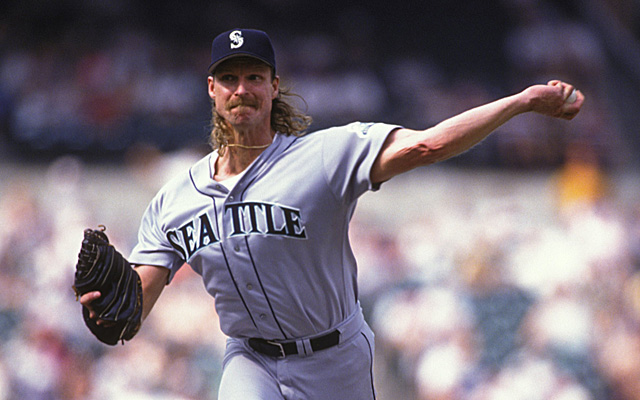
At 6'10'' and 225 pounds it was impossible not to notice Randy Johnson. If you didn't see him you would have heard the hiss of the terrifyingly fast moving fast ball. Johnson was drafted by the Braves in 1982 but failed to sign (imagine if he had: Glavine, Avery, Smoltz, Maddux and Johnson). He was drafted again in 1985 in the second round by the Expos and reached the majors in 1988. As the 1989 season neared the mid point, the Expos felt they had a chance to win now, while the Mariners were perpetually building for the future. In what was seen as a steal for the Expos and a disaster for Seattle, the Mariners sent their only star, Mark Langston to the Expos in exchange for Gene Harris, Brian Holman and Randy Johnson. It took less than a year for the Mariners to find out what they got. On June 20, 1990 Johnson no-hit the Tigers. Johnson would go 14-11 in his first full Mariners season and would establish himself as a star the following year with his first All Star appearance. He would make 9 more in his career. By 1995 Johnson was the most feared pitcher in the game and his dominance led the Mariners to their first ever post season birth. He finished the season at 18-2 and in a one game playoff for the AL West title beat Mark Langston, now pitching for the Angels, whom he had been traded for years earlier. He won his first Cy Young Award that year and finished 6th in MVP voting. He continued to pitch for Seattle but had a rocky relationship with the ownership. At the 1998 trading deadline he was moved to the Astros where he went 10-1 and helped Houston to the playoffs. He signed with the Arizona Diamondbacks in the off season and immediately helped the expansion team become a contender. He would win the next four straight Cy Young awards, three of four ERA titles and the 2001 World Series MVP (shared with co-ace Curt Schilling). The Cy Young run ended after an injury plagued 2003 season when Johnson made just 18 starts and finished 6-8. He returned healthy in 2004 and pitched a perfect game that year. He was traded to the Yankees following that year and although he had a strong year, the team behind him was not the dominant Yankees of years past and the team struggled. Johnson never seemed entirely comfortable in the big city and after the 2006 season he returned to Arizona in pursuit of 300 wins. He had an injury plagued 2007 season but returned to win 11 in 2008. He spent his final year with the Giants in 2009 and retired as one of the greatest pitchers in the history of the game. It is impossible to list all of the achievements he had during his 22 year career. Suffice it to say he was without a doubt, a clear choice for the Hall of Fame.
John Smoltz's life was chosen for him by age 4. He would follow in the path of his mother's and father's and grandfather's chosen calling, an accordion player. Luckily John got up the courage to tell his parents he had different ideas, although not before winning several contests with the instrument. Smoltz grew up in Detroit idolizing Jack Morris. His grandfather worked at Tiger Stadium for decades and would get John into the press box or on the field before batting practice. When the Tigers won the 1984 World Series, John and his brother got a piece of the grass at Tigers Stadium, replanted it and built a shrine around it. So when he was drafted by the Tigers in 1985 it was a dream come true. Yet before he could fulfill his dream of pitching with Jack Morris as a 1-2 dynamo, he was traded to Atlanta for Doyle Alexander. At the time Atlanta was a baseball grave yard and it took John a long while to accept the fact that he would not get to pitch with the Tigers. Smoltz reached the majors in Atlanta in 1988 and went 2-7, not exactly rookie of the year, but his follow up season saw him at 11-6 with a 2.10 ERA by the All Star Break, enough to earn him a trip to Anaheim for the Bo Jackson show. Smoltz took the loss in the game but the remembered moment is the back to back Home Runs Rick Reuschel served up to Bo Jackson and Wade Boggs. Smoltz would make 7 more All Star Games in his career. Following that first All Star appearance, Smoltz would work with a strong Braves rotation that would learn how to win. Glavine, Avery and Pete Smith joined Smoltz and veteran Charlie Leibrandt to take the young Braves from last place in 1990 to the brink of a World Series title in 1991. Starting Game 7 in Minnesota against childhood idol Jack Morris, Smoltz pitched 7 1/3 scoreless innings to give the Braves a chance to win, but Morris came out on top with 10 scoreless innings. The young Braves core would go on to win 13 consecutive division titles, reaching the World Series 5 times and winning the 1995 World Series. During that long run of playoff appearances Smoltz won 15 games. He was also the 1992 NLCS MVP and the 1996 Cy Young winner. Smoltz missed the 2000 season with an injury and was not strong enough to crack the rotation for 2001. He convinced Bobby Cox that he could help the team out of the bullpen and saved 10 games in the 2001 season. He had intended it as only a partial season answer but his performance was strong enough for the Braves to make him the team's closer for a full season. In three years as the closer he would save 154 games, make 2 All Star Appearances and finished 3rd in the Cy Young voting in 2002. As the rest of the rotation mates (Avery, Maddux and Glavine) moved on, the Braves moved him back to the rotation where he would again shine. The Braves post season run had come to an end by this time but Smoltz was still dominant winning as many as 16 games. Early in the 2008 season Smoltz needed shoulder surgery, leading the Braves to give up on him. After being released by the Braves, Smoltz had to decide whether to retire or try a comeback at the age of 42. Not ready to go out on a sour note, Smoltz signed with the Red Sox and had to convince the Red Sox he was worth it. It was a disaster for Smoltz. He started the year in the minor leagues and made his season debut in June against the Nationals. Smoltz would go 2-5 for the Sox with an ERA over 8. He was released in early August and worried that his career was over. Still he worked hard at home and found a mechanical flaw in his delivery. He auditioned for the Cardinals and was able to convince Tony LaRussa that he could help the Cardinals. He asked for just one thing, the opportunity to start two games before being exiled to the bullpen. With a big division lead LaRussa and the Cardinals agreed. Smoltz was impressive in the two starts, impressive enough to be included in the post season rotation plans. With the Dodgers up 2-0 in the NLDS Smoltz appeared in relief in the third game in St.Louis. Smoltz pitched 2 innings, allowed 4 hits and 1 run as the Cardinals were eliminated. Hoping to resign with St.Louis in the off season, he was not in the team's plans and retired. Like Johnson he has too many accomplishments to name here but he was a clear Hall of Fame choice.
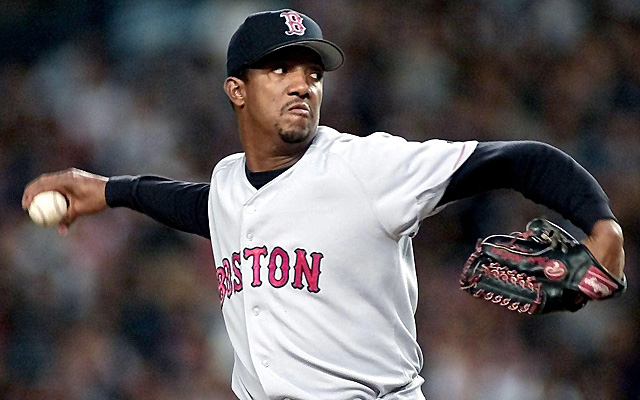
Julia Roberts was once known as Eric Roberts' little sister. Ken Griffey, Jr was once known as Ken Griffey's kid and Pedro Martinez was once known as Ramon's little brother. Pedro came to the majors as a late season call up in 1992. He appeared in 2 games and took a loss in his only decision. After a 10-5 1993 season the Dodgers traded him to Montreal in exchange for Delino DeShields. He immediately helped the Expos become a contender, and had it not been for the season ending strike, Pedro might have led the Expos to a post season berth. He would spend the next three years in Montreal, making his first All Star appearance in 1996. His final year in Montreal, 1997, saw him go 17-8 with a 1.90 ERA (best in the league) and won his first Cy Young award. As always happens when a dominant player lands on a bad team, the press started the campaign of "what a shame he's stuck in that situation" and the Red Sox made the Expos a deal that the Expos had to take. The Red Sox sent Carl Pavano and Tony Armas to the Expos in exchange for Pedro and he made an immediate impact. Pedro went 17-8 with a sub 3.00 ERA and helped lead the Red Sox into the post Roger Clemens era of Post Season baseball. Pedro won the first game but the Red Sox were bounced from the ALDS by the Indians. Pedro's season was good enough to give him a second place finish in the Cy Young race. It would be a better year in 1999 as he went 23-7 with a 2.07 ERA, 313 K's and his second Cy Young. Pedro started the All Star Game in Fenway Park with the legends of the league in attendance. The "All Century Team" was revealed before the game but the legends saw the biggest cheers go to Pedro as he struck out Barry Larkin (Hall of Famer), Larry Walker, Sammy Sosa, Mark McGwire and Jeff Bagwell (with only Matt Williams reaching on an error). He would again beat Cleveland in the first round of the post season and win a game against the hated Yankees as the rivalry between the two started to heat up. The Red Sox would miss the playoffs in 2000, 2001 and 2002, although Pedro would continue to dominate the league. At 18-4 and a 1.74 ERA Pedro won his third Cy Young award in 2000. An injury plagued 2001 (7-3 in 18 starts) led to a big comeback in 2002 with a 20-4, 2.26 ERA and a second place finish in the Cy Young voting. 2003 was a turning point for the Red Sox and their rival Yankees. A hard fought season series with boiling tempers led to an even more heated ALCS and a bean ball war. In a now infamous scene, Pedro threw Don Zimmer to the ground during a bench clearing brawl that continued through a heated series. With a Game 7 deciding game at stake Pedro was the man on the mound and gave the Red Sox a lead into the late innings. As all of America screamed at the television, hoping for Grady Little to get Pedro out of the game the Yankees rallied to tie the game and eventually destroy the dreams of the Red Sox nation. It was, they said, the curse of Babe Ruth. The 2004 Red Sox had a mantra. "Reverse the Curse". Though late into the 4th game of the ALCS it looked like it was the same old story. Just moments away from being swept from the playoffs the Red Sox rallied and won the game. They kept the rally going three more games to reach the World Series where they won another four straight to end the curse once and for all. As the biggest free agent in the wake of the win Pedro signed a big deal to go to New York. Although Sox fans hated Pedro going to the rival city, they could at least be thankful it wasn't to the hated Yankees. Instead, Pedro signed with the Mets. He would be part of a big rebirth in the National League's big apple team. He would go 15-8 and make another All Star appearance but the Mets failed to reach the post season. 2006 would be a post season appearance for the Mets but a below average year for Pedro. At 9-8 and a 4.48 ERA it was his worst personal year to date, although he would be an All Star. Injuries slowed his success and he would miss the post season. The Mets could have used the help as they fell in 7 games to the eventual World Champion Cardinals. 2007 was another injury plagued year as he appeared in only 5 games, going 3-1. He returned in 2008 to appear in 20 games but the Mets were a mess by that point and Pedro ended his New York tenure with a 5-6 record and an ERA of 5.61. With the last two injury plagued and sub-par years Pedro failed to sign a contract in the off season and some thought his career was over. Yet, the defending champion Phillies entered the All Star break looking for pitching help and signed Pedro to a contract for part of the 2009 season. Pedro proved he was not done yet and went 5-1 in 9 starts, helping the Phillies win the NL East again. Pedro started one game in the NLCS for the Phillies and went 7 very strong innings, allowing only 2 hits and 0 runs, leaving without a decision. The Phillies advanced to the World Series for the second year in a row. With Cliff Lee, Cole Hamels and Pedro the Phillies looked to have a strong chance but Pedro took 2 losses and the Phils fell to the Yankees four games to two. It was the last series of his career. Although there was talk of Pedro getting another half season contract, it never developed. He retired as one of the most accomplished and most feared pitchers of his generation.
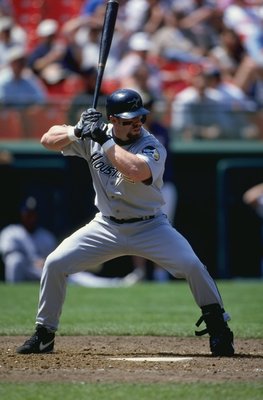
Craig Biggio
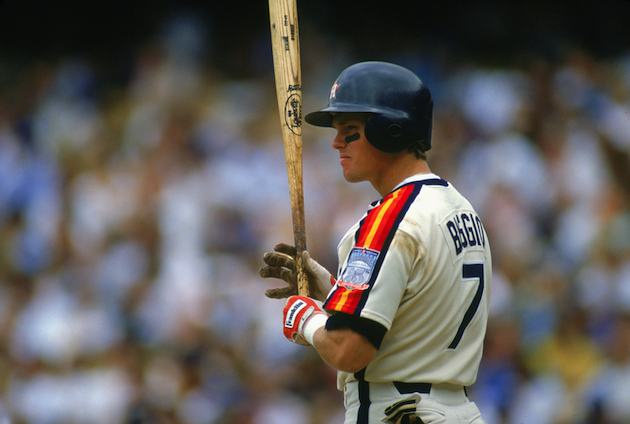
 The Astros in the mid 1980s were a great team. A post season team. A near World Series team. With Nolan Ryan, Mike Scott, Glenn Davis, Billy Hatcher and Kevin Bass they were a powerful team. In 1986 they came within a key hit of advancing to their first World Series. By the time Craig Biggio reached the Astros in 1988 everything had gone down hill. As the Astros rebuilt the team Craig Biggio was their lone remaining star. He came up to the Major Leagues as a Catcher and made his first All Star team in 1991 along with Pete Harnisch, who had come over from Baltimore in the big off season trade. Realizing the punishment that Biggio was taking behind the plate, Houston moved Biggio to Second Base. Viewed with skepticism, it was portrayed as one more poor decision by Houston. Why would they take an All Star player and move him out of position? All he did was make six All Star appearances at his new position and become the face of the Astros. Never flashy, never putting up big power numbers in the increasingly important Home Run numbers, Biggio quietly led the Astros. Five times he won Silver Slugger awards and four times he won Gold Glove awards. By the mid 1990s the Astros organization was reborn around the "Killer B's" of Biggio, Bagwell, Derek Bell and Lance Berkman. By 1997 the Astros were a regular contender. In 2004 the Astros reached the NLCS for the first time since 1986 and in 2005, despite missing Jeff Bagwell, they reached the team's first ever World Series. Although the Astros were swept by the White Sox every game was close. Expecting a continuance of the post season runs, Astros fans were disappointed over the next few years. Although Biggio could not lead the team back to the post season he did give the Astros fans one more big thrill as he reached 3000 hits during his final year, 2007. 4 times Biggio won player of the week. He retired 5th all time in doubles, 6th in triples and 2nd in Hit by Pitch. As much as Tony Gwynn is Mr. Padre, Craig Biggio is Mr. Astro.
TRIVIA QUESTION:
The 2014 Hall of Fame class included Tom Glavine and Greg Maddux, both big time post season pitchers. Smoltz, Johnson and Pedro also proved to be big time post season winners. Which Hall of Fame class had more post season wins?
Answer to Last Week's Question:
The 1985 All Star Game featured 16 future Hall of Famers (as of this writing). On the American League side Henderson, Ripken, Winfield, Murray, Brett and Rice returned. For the NL Gwynn, Sandberg, Carter and Smith returned. That made it a total of 10 returning All Stars.
Although there were six who did not return, Kirby Puckett, Wade Boggs and Mike Schmidt joined the Hall of Fame parade for 1986.
TRIVIA QUESTION:
The 2014 Hall of Fame class included Tom Glavine and Greg Maddux, both big time post season pitchers. Smoltz, Johnson and Pedro also proved to be big time post season winners. Which Hall of Fame class had more post season wins?
Answer to Last Week's Question:
The 1985 All Star Game featured 16 future Hall of Famers (as of this writing). On the American League side Henderson, Ripken, Winfield, Murray, Brett and Rice returned. For the NL Gwynn, Sandberg, Carter and Smith returned. That made it a total of 10 returning All Stars.
Although there were six who did not return, Kirby Puckett, Wade Boggs and Mike Schmidt joined the Hall of Fame parade for 1986.