Saturday, July 13, 2013

Forgiving Baseball's Scapegoats: Steve Bartman

Don't forget to check out the other articles in the "Forgiving Baseball's Scapegoats" Series: Fred Merkle, Hack Wilson, Johnny Pesky, Ralph Branca , Leon Durham, Donnie Moore, Bill Buckner and Mitch Williams

It must be a unique experience to root for the Cubs.  1908.  That was the pinnacle of Cubs fandom.  Of course the Cubs have a very proud tradition.  Tinker, Evers and Chance.  Three Finger Brown. Rogers Hornsby.  Charlie Root.  Ernie Banks. Billy Williams.  Ferguson Jenkins. Ron Santo.  Ryne Sandberg.  Andre Dawson.  Mark Grace.  Harry Carey.  The friendly confines of Wrigley Field.  With all of that, 1908 was still the top moment.  1908: When the Cubs won the second of their back to back World Series, when someone could honestly say "who ever heard of the Cubs losing a game they needed to win" without being laughed out of town, that was 95 years before this.
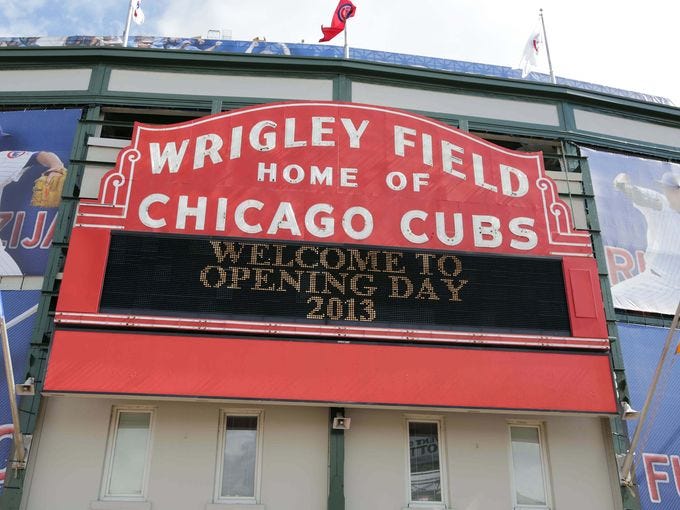

The Cubs had not won a postseason series in 95 years.  When that happened:
  • Mickey Mouse (1928), Bugs Bunny (1938) and the Flinstones (1959) were decades away.
  • The first All Star Game (1933) was 25 years away.
  • Jackie Robinson was 49 years from his debut
  • Babe Ruth (1915) was seven years away from his debut.
  • The Yankees would not win their first World Series for another 15 years (1923)
  • Fenway Park would not exist for another four years and Wrigley Field for another six years (and wouldn't be the Cubs home for another two years after that).
  • The American Professional Football Association (the NFL's ancient ancestor) was 12 years from the first game.
  • The assassination of Archduke Ferdinand was 5 years away.
  • The first use of the Designated Hitter was 65 years away.
They had reached the playoffs and the World Series several times but they just had not won.  This was the year.  All the years of hearing "wait 'til next year" was now over.  They were a great team.  They had beaten the jinx by taking out the Atlanta Braves.  They had beaten great teams to get here and now they just had to beat these new kid Florida Marlins. 

It was fitting that they would advance to the World Series today. October 14. It was 95 years ago to the day that the Cubs of Tinker, Evers and Chance beat Ty Cobb's Tigers for the second straight (and last) Cubs World Series title.  This Cubs team took a 3 games to 1 series lead into game 5 but lost 4-0.  They now were in the 8th inning of Game 6 and they had a 3-0 lead with young Mark Prior on the mound and cruising through the Marlins lineup.  Florida had only 3 hits to this point.

Mike Mordecai flied out to start the inning and Cubs fans could start counting down.  5 more outs.  Then Juan Pierre doubled and Cubs fans were nervous. The Marlins had the big bats coming up with only one out and now everyone knew something would happen.  Something bad.  The city of Chicago was positive it was coming but the pressure of waiting to see what it would be was agonizing.

The next batter, Luis Castillo started an epic, 9 pitch at bat, although for Cubs fans this at bat is still going on.  On a 3-2 pitch Castillo lifted a fly ball down the left field line and left fielder Moises Alou tracked it right up to the stands.  He jumped and had this timed perfectly. 

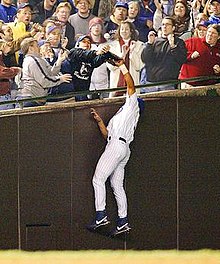
It was just at the wall.  Anywhere between five and ten fans were sure they had a souvenir from the day the Cubs clinched their first trip to the World Series since 1945.  Alou was sure he had out number two. Then the ball bounced off the hands of a fan and Alou landed without the ball.  Alou went berserk.  He was furious.  Regardless of Alou's anger the at bat continued.  Just like the 1985 World Series, it isn't important what causes the chaos, it is how you react to the chaos that is important and the Cubs didn't react well.  Castillo finished the nine pitch at bat with a walk.  Ball four got past the catcher and Juan Pierre advanced to third.


Ivan Rodriguez faced off against Prior.  Prior had the advantage of an 0-2 count but Rodriguez stroked a single to left field scoring Pierre.  The lead was down to 2 and a young Miguel Cabrera, future Triple Crown winner, stepped in to face Prior. Cabrera hit an easy bouncing ball to Shortstop and this would get them out of trouble.  An easy 6-4-3 double play and the inning is over.  The ball bounced.  Shortstop Alex Gonzalez turned to backhand the grounder. It hit in his glove and then dropped straight to the ground.  Everyone was safe.  Bases loaded.  Instead of being out of the inning it was the start of dark times.

Derek Lee, future Cubs' legend, stepped in and doubled to left and the game was tied. Prior was gone but they could still salvage this thing.  It wasn't the end of the world.  Mike Lowell was walked intentionally to load the bases and a sacrifice fly from Mr. Marlin, Jeff Conine, gave Florida the lead and gave the Cubs their second out.  Todd Hollandsworth was walked intentionally to load up the bases and Mike Mordecai, the first out of the inning stepped in with the bases loaded.

Steve Lyons, the Fox broadcaster, told everyone as the 2-1 pitch was being delivered that Mordecai was a great fastball hitter.  Mordecai was lucky because that was exactly what he was getting and it was exactly where he wanted it.  Right down the middle.  Mordecai rifled the pitch to left-center field and it was a shot right at the very symbol of the Cubs.  It smacked up against the Wrigley Field ivy clearing the bases and scoring three runs.  An RBI single by Juan Pierre followed giving Florida an 8-3 lead.  Luis Castillo mercifully ended the inning with a pop out to second base but the curse had struck.  Despite the wild pitch, botched double play ball and conga line of batters to the plate Cubs fans knew exactly who to blame.  It was the guy who tried to catch the ball.

The guy's name is known to everyone:  Steve Bartman.  His life was ruined.  He received death threats.  He had beer poured on him.  He had to be escorted out of the stadium by security.  His entire life changed for the negative because of one foul ball.  There are a trillion reasons (other than the regular common sense reasons) that you cannot blame Steve Bartman.  Here are just a few:

1.  Steve Bartman did exactly what you would have done.  Deny it all you want but if you are at a regular season game (let alone a potentially series clinching game) and a foul ball comes your way your first thought is going to be "I've been coming to games for years and I am finally getting a foul ball."  Watching the replay at least five other fans are going for the ball.  A fan two seats in front of Bartman comes within an eye lash of touching the ball before Bartman does.

2.  The Cubs themselves did not blame Bartman.  The team issued a statement after the game saying "games are won on the playing field-not in the stands.  It is unfair and inaccurate to suggest that an individual fan is responsible for the events that transpired in Game 6.  He did what every fan who comes to the ballpark tries to do-catch a foul ball in the stands.  That's one of the things that makes baseball the special sport that it is."

3.  The Cubs self destructed.  A wild pitch and a botched double play ball are only part of the story. All of the Marlins hits were clean base hits that were nowhere near being outs.  Mark Prior,the Cubs young ace, said after the game "We had chances to get out of that situation.  I hung an 0-2 curveball  to Rodriguez that he hit for a single.  Alex Gonzales, who's a sure thing almost at Shortstop, the ball came up on him...Everybody in the clubhouse and management knows that play is not the reason we lost the game."

4.  The Cubs had a 3 games to 1 series lead.  The Cubs jumped out to a quick 4-0 lead in Game 1 but ended up losing 9-8 in 11 innings.  That could be seen as their first missed opportunity. Game 2 was a blow out 12-3 in favor of the Cubs.  Game 3 was a tight 11 inning game won on a top of the 11th RBI triple by Doug Glanville.  The emotion and momentum of that win translated into a Game 4 8-3 win which was actually not even as close as it sounds.  Game 5 was the Cubs opportunity to ride their scorching hot bats into the World Series but Josh Beckett dominated them with a 4-0 two hit shutout.  The Cubs also had a chance to win Game 7.  They gave up three runs in the first to Florida but in the second and third they roared back and took a 5-3 lead.  Two innings later the Cubs gave the lead back and kept giving until Florida led 9-5.  From the time the Cubs took their 5-3 to the end of the game they had exactly 0 base runners and one hit.  A two out solo, pinch hit Home Run by Troy O'Leary in the 7th.

5.  This Marlins team was good.  We didn't know it then but we can see it now.  The Marlins had won the World Series in 1997 with an amazing collection of talent including Bobby Bonillia, Moises Alou, Gary Sheffield, Al Leiter, Kevin Brown and quite a few others.  That team was immediately torn apart and the Marlins went into a rebuilding mode.  Entering the 2003 season they were a joke with little proven talent, other than Ivan Rodriguez.  When their season record hit 16-22, last place in the N.L.East, nine games out of first and losers of 12 of their last 16 games,  the management changed managers.  Jeff Torborg was out, 72 year old Jack McKeon was in and the laughter got louder.  These poor Marlins.  Not only did they have the worst team in the league, now their manager might be late for games because he was taking advantage of an early bird special somewhere.  The Marlins went 75-49 under McKeon and won a Wild Card berth.  At the time we looked at the team as an inexperienced group of kids with no proven talent.  What we know now is that this team was full of All Stars and some possible Hall of Famers.  Ivan Rodriguez was a former MVP and Todd Hollandsworth was a former Rookie of the Year and All Star.  Other than these two there were very few recognizable names.  That would change.  It has been ten years since this series and few fans won't recognize the names that were on this roster:  Derrek Lee, Mike Lowell, Juan Pierre, Juan Encarnacion, Miguel Cabrera, Brad Penny, Dontrelle Willis, Josh Beckett and A.J. Burnett.  Every one of those players became (or still is) a major contributor to playoff teams in other cities.  The Marlins of 2003, mostly because of the perception they had coming into the season, are one of the most underrated World Series teams in history.

TRIVIA QUESTION
The Chicago Cubs moved into Wrigley Field in 1916 although the stadium was opened in 1914.  What team originally occupied the Stadium?  (for imaginary bonus points, what was the original name of the stadium?)

Answer to last week's question: 
Congratulations to TJD who got the answer to last week's question correct.
 
Garry Maddox made his debut in Centerfield for the Giants on April 25, 1972.  Starting for the Giants that night was future Hall of Fame Pitcher Juan Marichal.  Facing off against Marichal was future Hall of Fame pitcher Steve Carlton.  Maddox went 0-3 with 2 strikeouts against Carlton (the Giants only got one hit in the game) as Carlton won his third game.  Maddox would be traded to the Phillies on May 4, 1975.  Carlton and Maddox would play together for a number of years during the Phillies most successful period, each being major contributors to the Phillies first sustained period of success.

Sunday, July 7, 2013

Forgiving Baseball's Scapegoats: Mitch Williams

***NEW FEATURE THIS WEEK:
STARTING THIS WEEK READ TO THE END OF THE ARTICLE FOR A TRIVIA QUESTION. CHECK BACK NEXT WEEK FOR THE ANSWER AND A NEW QUESTION***

Don't forget to check out the other articles in the "Forgiving Baseball's Scapegoats" Series: Fred Merkle, Hack Wilson, Johnny Pesky, Ralph Branca , Leon Durham, Donnie Moore and Bill Buckner

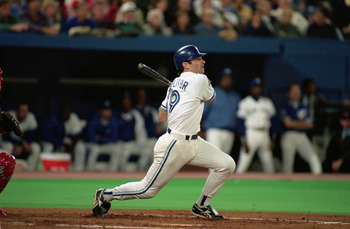
The magical season was over. The Phillies' bench was quiet. It was an odd thing for this group who never seemed to shut up. Rounding the bases for the Blue Jays was Paul Molitor. He had played in the league since 1977. He had been a rookie of the year. By the end of his career he would be a seven time All Star playing nearly every infield position and, along with Robin Yount and Jim Gantner, was the beginning middle and end of the history of the Milwaukee franchise. The previous winter he had made the almost impossible decision to leave Milwaukee for the chance to win a World Series. He had shown the world what everyone in Milwaukee had known for years. He was one of the best hitters the game has ever seen. In the bottom of the 5th inning of Game 6 of the 1993 World Series he drove a 1-1 pitch from Terry Mulholland deep into the left field seats and that, everyone was sure, was the nail in the Phillies' coffin.


When the Phillies' big hitters, Daulton, Eisenreich and Thompson, went down in order in the top of the 6th the requiem bells were drowning out the Liberty Bell in the city of brotherly love. As the Top of the 7th started with the bottom of the order coming to the plate and the Phillies down by four runs it was just a matter of formality. Then, as it had all year long, the magic returned. Kevin Stocker opened the inning with a ten pitch at bat, fouling off four pitches and working a walk out of Dave Stewart. Mickey Morandini singled and Stocker, ever the spark plug, took the extra base. Suddenly something was brewing.

Walking up to the plate was the heart of the Phillies. If anyone represented the toughness and passion of this team it was the man they called "Nails" (as in tough as). If Molitor's Home Run was supposed to drive the nails in the coffin, Nails drove them right back out with a three run Home Run to right field. Tie game. Dykstra would not allow this thing to end. Not if he had anything left to say about it. Seven batters later and the Phillies had amazingly batted around and scored five runs in the inning.


Now not only were they still alive, they were only 9 outs away from forcing Game 7. Rickey Henderson, Devon White and Molitor went in order in the 7th and it was just six outs left. Toronto loaded the bases in the 8th but Larry Andersen, yes the Larry Andersen Phillies fans hear every game, got out of the inning without allowing a run and it was only three outs to go for Game 7.

Dave Hollins, Darren Daulton and Jim Eisenreich went down in order in the top of the 9th and now it was time for Phillies fans to follow whatever routine they had followed all year long. Whatever it was, it had gotten them this far. Some crossed their fingers. Some held their breath. Some covered their eyes or paced the floor or sat and prayed and some just couldn't take the stress and left the room altogether getting updates from the braver fans who watched what actually unfolded.


Rickey Henderson stepped in to hit and "Wild Thing " was sure this was the hitter that would win the game. He would need to get ahead of Rickey. It was life and death to fall behind this guy so the first pitch had to be perfect. BALL ONE. It was a small thing but now he was worried. BALL TWO. Now he was sweating. BALL THREE. Now he was screwed. BALL FOUR and Rickey was on board. No one out. The best lineup in a long time all waiting to get a shot. Devon White. Molitor. Carter. Olerud. Alomar. It was a modern day Murderer's Row but all Williams could think of was "Rickey is going to steal".

Williams focused on Devon White but was clearly distracted by Rickey. Four times in White's nine pitch at bat Williams threw over to first. Each time Rickey got back easily. White flew out to deep left-center field. Molitor stepped in. No one could remember anyone hitting this well in a postseason series. He already had 11 hits (2 doubles, 2 triples, 2 Home Runs), 10 runs, 8 RBI , 2 walks and zero strike out. Despite all that, if he failed here this would be the at bat everyone remembered.

Williams was still distracted by Rickey. He threw over to first and Rickey was back easily again. It was fun for Rickey. This was what he loved. He would inch off the base. Get into a low squat. Then wait, motionless, waiting until the pitcher's eyes were on him. Then he would lean slightly. The legs twitched. No one in the stadium knew if he was going or not. Maybe it was getting a better foothold. Maybe it was a lean towards second. Maybe he wanted to see the pitcher's move to get the timing. Only Rickey knew. Williams stared him down then went to the plate. Ball one. Williams was frustrated. Almost as if Rickey could turn a stolen base into a three run Home Run. The pattern repeated. He delivered home again and Molitor fouled it off and the dance started all over again. This time Molitor delivered and drove a single to Center field. Dykstra reached the ball quickly and Henderson held at second.

Now even the Phillies fans with nerves of steel cringed. Joe Carter approached the plate and if the Jays wanted anyone at the plate it was Carter. Big Joe was the heart and soul of this team. He was the leader. The veteran. The clutch hitter. Carter took ball one, then ball two. This was a hitter's count anyone would want. He took strike one then swung through strike two.


The 2-2 pitch,the fifth of the at bat, came in. Williams released. Put everything into the pitch. His glove hand landed on the mound giving him balance. His back leg swung around and he was almost laying on the mound. By the time that foot hit the ground the ball was headed in the opposite direction. It was high. It was moving fast and it was going very very far. Williams didn't wait. He walked off the mound. Head down. He gave one last quick glance over his shoulder just to make sure he wasn't wrong. He was right and as his head dropped again Joe Carter went into orbit. Fireworks burst everywhere in all colors. Carter jumped like a ten year old kid and flew around the bases to be lifted onto the shoulders of his teammates at home plate. It was a shocking, amazing, exciting end to a great series.


Before the ball landed in the Skydome seats Philadelphia was sure that if it were not for Mitch Williams the team would have won the World Series. There are plenty of reasons you can't blame Mitch Williams and here are just a few:

1. Mitch Williams was called the Wild Thing for a reason, really for many reasons. When he followed through on a pitch his body flew one way, his arm went another, his hair flew in a completely other direction and every swing from the opposing batters made the entire city of Philadelphia gasp. At least that is how history has told us we all acted when Wild Thing appeared in a game. The way we understand that season now Williams didn't know where the ball was going when he threw it and every appearance was an adventure. The reality is Williams had a total of 6 blown saves in 49 attempts. He also saved 43 games. That was good enough for 7th in the league.

2. Most of the Phillies didn't hit. While Molitor (.500), Alomar (.480), Tony Fernandez (.333) Pat Borders and Devon White (.292) seemed to be smacking the ball everywhere for the Blue Jays, the Phillies hitters struggled. Of the Phillies regulars only Dykstra (.348), Kruk (.348), Duncan (.345) and Milt Thompson (.294) had regular success against Toronto pitching. The key role players of the Phillies, the ones who got them there (along with Darren Daulton) failed to hit the way they had against the Braves to get Philadelphia to the World Series. Daulton (.217), Eisenreich (.231), Hollins (.261), Rickey Jordan (.200), Incaviglia (.143), Morandini (.200) and Stocker (.211) all failed to hit in the clutch the way they had in the NLCS. The Blue Jays were also much more efficient. The Phillies worked 34 walks out of the Blue Jays but struck out 50 times. The Blue Jays worked 25 walks and struck out only 30 times. The Phillies left 54 runners on base while the Blue Jays left only 39.

3. The entire Phillies pitching staff failed. There is no way to deny Williams had a very poor series but to pin the entire seres loss on one arm is ridiculous. Williams made three appearances, blew two save opportunities, lost two games and saved one. He allowed six earned runs in 2 2/3 innings pitched for a 20.25 ERA. That wasn't the worst of it all. Larry Andersen (12.25 ERA), Tommy Greene (27.00), Danny Jackson (7.20), Terry Mulholland (6.75), Ben Rivera (27.00) and David West (27.00) all had tremendously high ERA's.

4. The Blue Jays had the better team. The 1993 Phillies team is legendary in Philadelphia and provided Phillies fans the first positive baseball memories in ten years. Those memories would need to last for another 10 years as the organization struggled to regain the magic of '93. There is no denying that the Phillies team put it all together to stun everyone. The Blue Jays were built to be the Yankees of the 1990's before the Yankees of the 1990's. Their starting line up was full of All-Stars, MVP's, Cy Young winners, legends and future Hall of Fame members. John Olerud, Roberto Alomar, Tony Fernandez, Joe Carter, Rickey Henderson, Devon White and Paul Molitor were all clicking on all cylinders while Juan Guzman, Dave Stewart, a young Pat Hentgen and Al Leiter were pitching at the top of their game. If the 1994 strike had not interrupted the season there is no telling how long their run would have lasted.

TRIVIA QUESTION:
Legendary Phillies outfielder Garry Maddox made his Major League debut for the San Francisco Giants on Tuesday, April 25, 1972. What future Hall of Fame pitcher did he face off against?
Email me your answer or leave your guess in the comments section.

Monday, July 1, 2013

Forgiving Baseball's Scapegoats: Bill Buckner

Don't forget to check out the other articles in the "Forgiving Baseball's Scapegoats" Series: Fred MerkleHack WilsonJohnny Pesky, Ralph Branca , Leon Durham and Donnie Moore.

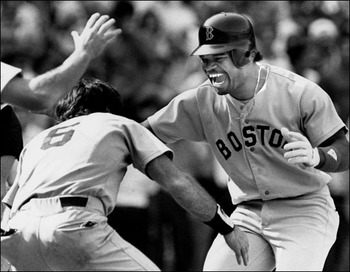
Dave Henderson is always smiling.  At least that's the way every picture you will ever see of him portrays it.  He has one of the most infectious grins you will ever see and it just screams out how much fun this game is.  So you can forgive him if he smiled a little wider as he jogged out to Left Field in Shea Stadium for the bottom of the 10th inning of Game 6 of the 1986 World Series.  He had escaped the baseball grave yard that was Seattle with a late season trade on August 19 and now Dave Henderson had just saved the Red Sox's season for the second time in two weeks.  Just 13 days before the Red Sox were down to their last strike when "Hendu" took Donnie Moore deep to save the year.  Tonight, just a few moments before, Henderson led off the top of the 10th with the a Home Run off of Rick Aguilera.  Just like in Anaheim when he knew it was gone, he did a quick hop, smiled like a little boy, and jogged backwards towards first.  Four batters later the Red Sox added another run when Wade Boggs doubled and Marty Barrett singled him home. 


With Barrett on second Bill Buckner stepped in and was hit by a pitch. It hit him right in the hip and it stung.  On a cold October night that pitch hurt but it was fine.  The season was almost over.  As he reached first base he half expected a pinch runner.  With a two run lead and only three outs left he knew he wasn't coming back out for the bottom of the 10th and why take a chance that he would have to try and score if Jim Rice hit a ball in the gap.  There was no movement from the dugout so he stood on first.  When Jim Rice hit a fly ball to Left Field to end the inning he could relax.  In every important game this season, late in the game with a lead, Dave Stapleton took over first base.  Buckner took off his batting helmet and limped toward the visitors dugout but was stunned when the bat boy jogged his glove out to him. 

If you count the one game appearance at the age of 19 for the 1969 Dodgers, Buckner played for 22 years in the majors.  He had a lifetime average of .289 and 2715 hits.  Had he gotten just 13 more hits in each of his 22 years he would have broken the 3000 hit mark.  In 10 of his 22 years he played in less than 130 games, including only 92 during the prime of his career.  In fact, his 2715 hits put him just 6 hits behind Lou Gehrig.  It also places him ahead of at least 105 members of the Hall of Fame including Billy Williams, Fred Clarke, Nellie Foxx, Harry Heilman, Hank Greenberg, Yogi Berra and Ted Williams (2654).  His .289 average puts him ahead of at least 27 other Hall of Fame members including his contemporaries Andre Dawson, Robin Yount, Ryne Sandberg, Dave Winfield and Cal Ripken as well as legends Willie Stargell, Ernie Banks, Ron Santo and Billy Williams. If he had been healthy he surely would have reached the 3000 mark and the Hall of Fame.  He made an All Star team in 1981, received MVP votes five times and finished in the top 10 of MVP voting twice.  He knew, everyone knew, that this could be the end of a great career.  So John McNamara followed his heart, instead of his normal logic, and decided that when the final out of Boston's first World Series win since World War I was recorded Bill Buckner would be in the game at first base.


So there Buckner was.  In the cool Autumn evening in New York he saw the Mets fly out to Right Field and then center field on only seven pitches.  Now there was just one out left and Buckner stood at first.  Just moments from infamy.  Two run lead, two outs and no worries.  The video display board flashed a sign congratulating the Red Sox for their World Series win.  World Champion T-shirts and caps were being placed in each Red Sox locker.  Champagne was on ice and NBC Sports had Bob Costas in the locker room ready to interview the celebrating Red Sox.  The widow of Tom Yawkey was ready to let loose a torrent of emotions, finally celebrating what her husband had tried decades to achieve before succumbing to leukemia.

In the Mets' clubhouse Keith Hernandez sat in the trainers room, having flown out for the second out, with a beer and a cigarette waiting for the inevitable.  There was a shitty little television set and Hernandez sat sipping a beer, watching, thinking, wondering how this season had slipped away. 

Gary Carter kept the inning alive with a single.  Kevin Mitchell followed that with another single and suddenly things were uncomfortable.  Ray Knight singled for the third straight hit and Carter scored.  Boston still had a one run lead and needed only one out.  Even though Mitchell stood only 90 feet away the Mets had to have a clean base hit to score.  A sacrifice wouldn't do it. 


McNamara had seen enough.  He went to the mound and took the ball from Calvin Schiraldi and in came Bob Stanley.  He would face only one batter:  Mookie Wilson.  It was an epic at bat considering what was at stake. 

First pitch was a foul ball and the Mets had just two strikes left.   That was followed by ball one and it was all even.  Ball two and Mookie had the advantage.  Then a pitch fouled off Wilson's foot for strike two.  One strike left and the Red Sox were World Champions.  The next pitch was identical and was fouled off Wilson's foot a second time. That was followed by a third straight foul ball.

Then pitch number eight in the at bat changed everything.  Gedman, Boston's Catcher, set up on the outside corner expecting a pitch that would paint the black of the plate.  Wilson, to this point, had seemed to indicate that he could reach that pitch but not quite put it in play so if he got a hold of it he might do nothing worse than pop it up.  If he missed it or didn't swing at all it was strike three.  Gedman's target was set well before Stanley began his windup.  The pitch came in exactly the opposite of where Gedman, and Wilson, were looking for it.    The fact that it was so far inside confused Wilson.  The replay shows that it did not really come close to hitting him but as he spun out of the way he left his feet to avoid being hit.  As he left his feet the ball bounced off of Gedman's glove.  Wilson stayed on the ground but wildly motioned to Mitchell to run like hell.  Mitchell didn't need any help because he was barreling home.  Wilson gestured madly for Mitchell to slide but Mitchell was a big guy and he would be damned if he would be tagged out by Stanley.  If anything he would knock Stanley on his ass.  That plate was his.  But there was no throw to the plate.  Mitchell scored easily and the game was tied.


Ray Knight took second on the wild pitch and now a single from Wilson and the Mets might actually win it.  The crowd, quiet and sullen when Carter had stepped in to face Schiraldi, were crazed now.  The normal major league pitcher has about three pitches in his arsenal.  Some might have four but not usually more than that.  Having thrown 8 pitches already Wilson had seen everything Stanley had.  Now Gedman and Stanley just needed to catch Wilson guessing wrong on what was coming next.  Pitch number 9 of the at bat was fouled away and everyone settled in for what would possibly be a never ending at bat.  Then came the fateful pitch number ten.  It was put in play.  A small bouncing ground ball.  The kind you get in batting practice.

Have you ever heard 55,000 people go from loud to silent to deafening in a single breath?  Vin Scully had called nearly every great Dodger moment since the 1950's so he probably thought he had seen it all.  But what happened on pitch number 10 surprised even him. 

"Little roller up along first."  Ray Knight was running like hell to third not even looking at the play yet but he thought the game was probably over.  That was until he heard the crowd explode.  He turned his head to see what the hell had caused it.  He couldn't hear a thing except the third base coach yelling "Go! Go!"

"Behind the bag. It gets through Buckner!"  Vin was shocked.  Even he had never seen a game like this.  "Here comes Knight and the Mets win it!"


The Sox were stunned.  They silently gathered their things and walked to the clubhouse.  As Buckner walked off the field he may not have realized the importance of the play just yet.  There was still Game 7.  As the winter months moved on after the Game 7 loss the next night it became clear.  Bill Buckner's error was forever seen as the reason the Red Sox lost.  There are a million reasons you cannot blame Buckner for this loss but here are just a few:

1.  Buckner shouldn't have been on the field.  In games 1-5 Dave Stapleton became a defensive replacement for Buckner three times.  In each of those situations the Red Sox had a late inning lead.  It was fine to let Buckner bat for himself in the Top of the 10th but a pinch runner should have been sent out with the idea of a replacement fielder in the bottom of the 10th.  The pain that he was suffering through was evident to even the casual observer.  Every broadcast of every game pointed out the difficulty that Buckner had in moving around.  It is easy to see why McNamara wanted Buckner out there.  It would  have been a great thing  for Buckner to crown his career by being on the field for the last out but you have to win with the formula that got you there.

2.  Three runs scored in the bottom of the 10th. Only one of them was allowed by Buckner.  After two very quick outs the Mets sent only four more batters to the plate. Three of them scored.  Only one of them by benefit of a base hit.  Carter's base hit was followed by Mitchell's base hit which was followed by Knight's base hit. Carter scored on the single but Mitchell scored on the Wild Pitch . 

3. With Ray Knight at the plate and an 0-1 count he hit a slow roller down the third base line.  Wade Boggs had to make a quick decision: let it roll foul or try to make a play.  Knight was not the fastest runner in the world but he had decent speed.  Boggs decided to let the ball roll foul instead of making a play.  It was probably the smart play but knowing how things turned out it certainly would have changed things.  Had he fielded it and Knight had been safe the bases would be loaded with two outs but no runs would have scored.  Of course Boggs couldn't know that Knight would bang a single to center on the next pitch or that Mitchell would take the extra base and score on a wild pitch.  Had Boggs made the play Wilson may or may not have faced Stanley.

4.  Knight did a nice piece of hitting.  On an 0-2 count Knight had to protect the plate.  The pitch came in on the hands.  It was definitely a strike and Knight's swing was not the most beautiful but he fought off a very good pitch to drop a single into center field extending the inning and allowing Wilson to come to  the plate.

5.  In order for Buckner's error to lose the game Kevin Mitchell had to score from third on Stanley's wild pitch.  Mitchell, throughout history, has gained a reputation for being a difficult team mate, hard to deal with and not the brightest of baseball minds but you wouldn't be able to tell from this play.  When Knight knocked a  little bloop single into center with two outs Mitchell probably should have held at second.  Mitchell had good speed and he made a very smart aggressive decision in advancing to third base.  Aggressive base runners can sometimes appear foolish if they are thrown out but just like Enos Slaughter's mad dash, Mitchell decided to challenge the arms of the Red Sox outfielders and beat them easily.  A less aggressive runner would have stayed at second, meaning the Passed Ball  would have only advanced the runners to third and second.  It would not have tied the game.

6.  Wilson likely would have beaten the ball to the bag.   Wilson had great speed.  When the ball was hit he was tearing down the line.  With Buckner playing off the line he had to take several aching steps to reach the proximity of the ball.  Fielding the ball and beating Mookie to the bag was not an option.  He would have needed Bob Stanley over to the bag to cover.  On the video review Stanley appears to take a few steps towards first but for some reason he never enters the picture when Wilson is sprinting down the line.  That is because he has assumed Buckner has it.  Wilson knew that he could beat Buckner but  he felt that he would need to also beat Stanley to make it safely.  "My only thought was to beat the pitcher there.  I thought I had a good chance to beat the pitcher and I think Buckner saw that too and maybe he tried to rush a little bit."

7.  The Mets knew Calvin Schiraldi.  Calvin Schiraldi was drafted by the Mets in 1983 and played for them until 1985.  He had played with most of these same players. They clearly knew his tendencies and patterns.  They knew what pitches he had available and where he liked to throw them.  Schiraldi was put on the mound 7 times during the 1986 post season (including four against the Angels in the ALCS) and lost three games.  Schiraldi pitched just four innings in the World Series but gave up six earned runs. 

8.  The Red Sox had a lead late into Game 7 with their ace on the mound.  Just before the debacle that was the 10th inning of Game 6 turned into legend, an announcement had been made in the press box: Bruce Hurst had been named the World Series MVP. When the team collapsed over the next four batters Hurst was given a chance to improve on his already impressive numbers.  In the second inning the Red Sox jumped out to a 3-0 lead on back to back Home Runs from Dwight Evans and Barrett and an RBI single by Boggs.  At that point any momentum that was lost in Buckner's error the night before had swung back to the Red Sox.  Hurst was spectacular through 5 1/3 innings having allowed only one hit and no walks.  With one out in the bottom of the sixth it fell apart and he allowed three hits and a walk leading to three runs that tied the game.  He left after the sixth with the game tied and the Sox brought in none other than Calvin Schiraldi.  Schiraldi faced four batters only getting one out on a sacrifice bunt.  The other batters hit a solo home run, a single, a wild pitch scored a run, and another single. By the time Schiraldi left the game, the Mets had a two run lead.  One more of his runners would score after Schiraldi left giving him the loss in an 8-5 defeat.

Monday, June 24, 2013

Forgiving Baseball's Scapegoats: Donnie Moore

Don't forget to check out the other articles in the "Forgiving Baseball's Scapegoats" Series: Fred MerkleHack WilsonJohnny Pesky, Ralph Branca and Leon Durham.


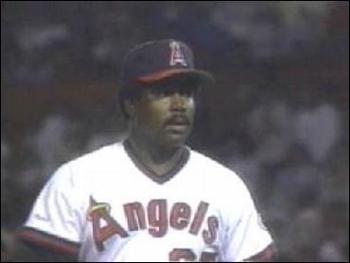
The term closer didn't really become a regular term until a few years later when Dennis Eckersley started his nightly appearances and Bobby Thigpen saved 57 games in 1989.  From the 1990's on every team had to have a closer but before that you just called it a reliable relief pitcher.  Donnie Moore was more than just a reliable relief pitcher for the California Angels, he was dominant.

Moore's career had started in 1975 with sporadic appearances for the Cubs.  He was traded to the Cardinals in 1981 for Mike Tyson (not that Mike Tyson).  His contract was then sold to the Milwaukee Brewers,who returned the contract back to the Cardinals a short while later and was then traded to Atlanta.  He played a few years in Atlanta and had slight success.  In 1985 Moore was signed by the Angels and it was a tremendous move for the Angels and Moore.


He finally put everything together as the Angels challenged the eventual World Champion Kansas City Royals down to the last few days of the season finishing just one game behind the Royals.  Moore was spectacular that season saving 31 with only 8 blown saves.  He also won 8, lost 8, made the All Star team, finished 7th in the Cy Young and 6th in the MVP voting.  Not bad for a relief pitcher. 

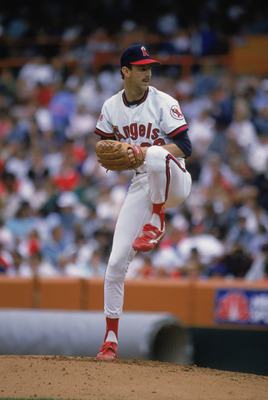
The 1986 season was not as strong but the Angels didn't need him to be that year as they won the American League West and moved on to the ALCS for the first time since 1982 and only the third time in their history.  The series started well for them as they got out to a quick 3 games to 1 lead and it looked like this may actually be the year for the "singing cowboy" to get his title. 

Game 5 looked like the moment of ascension for the halos.  Boston jumped out to a quick 2-0 lead in the second but the Angels fought back and when Bobby Grich hit a two run Home Run in the 6th to give California the lead, Angels Stadium sang a halo chorus.  It got louder an inning later when the Angels scored two more to go ahead 5-2 and there was no way this team could lose with Mike Witt on the mound. 


The 9th inning was nothing but tension.  It was dueling curses.  The Red Sox curse of the Bambino vs the Angels curse of unknown origins that had plagued them through the decades.  Now they just needed 3 outs without allowing 3 runs and they would be in the World Series.  Their young ace Mike Witt was tired but he came out for the 9th inning.  It started badly with a single by Bill Buckner but when Jim Rice struck out looking the Angels fans gave a sigh of relief.  Rice was the bat that scared everyone.  They should be fine now.  Just 2 outs left.  Don Baylor, the former Angel MVP and fan favorite, stepped in for the Red Sox and did what he had done for years in this stadium, what the fans had always loved to see.  He drove a pitch into the left field stands for a two run Home Run.  The fans didn't like it so much when he was wearing another uniform.

Still holding a one run lead and one out the Angels allowed Mike Witt to face Dwight Evans and Dewey popped out to third base.  Two out and the bases were empty.  Witt needed just one more out with the bases empty and he was on his way to Angels immortality.  Standing in his way was Rich Gedman who was 4-4 on the day with a Home Run, a double, two singles, two runs and two RBI but with the bases empty and an 0 for 1 Dave Henderson following Gedman to the plate, Witt felt he would get the chance to finish this thing off.  He felt he had earned at least that.  So when he turned around and saw Bob Boone pop up and head towards the mound he was a bit surprised.

"I thought I had a pretty good game plan going in for Gedman, but it wasn't working too successfully."  Witt said after the game.  Manager Gene Mauch was much more direct:  "The bottom line is that Rich Gedman could hit Mike Witt at midnight with the lights out."  So Mauch made the decision to go to the pen.  He brought in Gary Lucas who had great success against Gedman and despite the extra tension, the Red Sox figured this was it.  Game over.  Then Gary Lucas did what he had not done in the last 400 innings he had pitched.    He hit Rich Gedman.  On the very first and last pitch he threw that day Gary Lucas hit Rich Gedman with the pitch.

So the drama continued and Mauch trudged his way back out to the mound to call on another pitcher.  And here is where Donnie Moore enters the picture.  Bottom of the 9th.  Two outs.  One run lead.  Runner on first and stepping to the plate is Dave Henderson.  A player with power  and on the rise but not yet at the peak of his career.  Give it a few pitches and the peak of his career will begin (and won't end for another seven years).

The drama started with ball one, followed by a called strike one.  Henderson swung through the third pitch and now Moore had the advantage.  One more strike and it was all over.  Ball two evened the count.  Henderson couldn't afford to be picky now.  Anything close he had to get the bat on the ball to stay alive at the plate and in the season.  That is not the way a batter likes to approach an at bat.  Moore came back with a breaking ball and Henderson fouled it off.  Then another breaking ball and another foul ball.  It was a long at bat for a situation this tense.  Now it was time for Moore to decide.  He'd thrown two straight breaking balls and Henderson fouled off both of them.  Should they give him one more breaking ball and hope he hasn't got the timing or should they throw the split finger fastball and hope he swings through it?

The problem was that Moore's arm was hurting and the pressure the split finger put on the arm made the pain multiply.  Moore looked in at Boone who signaled for a forkball but Moore shook him off.  He thought Henderson has just missed the last two curves.  They needed an out not another foul ball.  Boone dropped a single digit, indicating the fastball and Moore nodded in agreement.  Moore lifted his leg to start the pitching motion and put everything he had on the pitch. 

The pitch was where he wanted it, on the outside part of the plate.  Watching the video Henderson looks like he starts his swing with a little question of what he's seeing.  His first shift in weight is the movement you normally see on an awkward swing.  The scouts call it hitting with your ass leaning towards the dugout.  The ball headed down, again, right where Moore wanted it.  Down and away with Henderson leaning back should be a strikeout and the Angels should be in the World Series.


Except that Henderson adjusted quickly and recovered.  He shifted his weight, dove into the swing and caught hold of it.  You could search for years and not find a more opposite emotional reaction to one single swing.  Moore immediately swings around to see where the ball goes while Henderson takes 3 steps down the line and leaps with a giant grin on his face.  The ball is still in the air and it could still be caught.  This was not one of those upper deck, no doubt Home Runs. Moore stands, motionless on the mound and watches.  Hoping, praying silently that Henderson had just missed it.  Henderson lands after his first leap and takes 5 more steps toward first.  He doesn't sprint to first.  It doesn't matter.  This is either going to be a Home Run or an out.  There are few other options.  Then it landed.  Three rows into the stands and Henderson literally jumps for joy then trots around the bases, smiling the whole time.  It would be his only hit of the Series. It takes a minute, literally, for the Red Sox celebration and greeting committee to escort Henderson back to the dugout.  Meanwhile, Moore stands there and watches.  Waiting for the game to resume. 


Moore got the last batter, Ed Romero, on a five pitch at bat.  Growing up my understanding was that this was it and from there the Red Sox went onto the World Series but as I get older and research the game more the importance of the Henderson home run becomes minimal (not in the sense of impact on the series because clearly it changed the series but in the sense of pinning the blame for the loss on Moore).  Sadly, unlike many of our previous forgiven scapegoats this does not end with a long successful career and happy life despite the lasting memory.  Moore struggled with injuries in 1987 and the Angels fans booed him relentlessly while the front office questioned his toughness.  He demanded a trade but no teams were in the market for a pitcher with an injured arm so he faded out of baseball, last pitching for the Angels on August 8, 1988.  The pain of being Donnie Moore finally became too much and on July 18, 1989 Donnie Moore shot his wife and himself in front of their children.  Thankfully his wife survived, however, it is truly a tragic ending for someone who just a few years before had been considered a fun loving, likable guy.


There are probably a million reasons you cannot blame Donnie Moore for losing this Series but here are just a few:
1.  Instead of blaming Donnie Moore we should be praising Dave Henderson for a hell of an at bat.  With the season on the line the Red Sox allowed a batter, who was hitless in the series to that point, face a pitcher at the top of his game.  Down to their last strike Henderson fought off two very good pitches and made a great adjustment on a good pitch by Moore.  Instead of looking at this as a bad pitch we should look at this as a great piece of hitting.

2.  This wasn't the end of the series, or even the game.  Historically we have seen the Angels as walking away and folding once Henderson hit the Home Run but that is certainly not the case.  Henderson hit the Home Run in the top of the 9th.  In the bottom of the 9th the Angels tied the game up.  With just one out and the bases loaded the Angels had Doug DeCinces and Bobby Grich (their 5th and 6th place hitter) at the plate and needed only one run to win it and end the Series.  DeCinces was 2-4 with two doubles on the day.  DeCinces flew out to Right field, not deep enough to score the run.  Grich followed.  He was 1-5 on the day with a two run Home Run.  He lined back to the pitcher and the Angels left the bases loaded.

3.  Moore pitched a scoreless 10th inning against the heart of the Red Sox order.  He also pitched in the 11th and after loading the bases with nobody out gave up a run when Dave Henderson (again) hit a sacrifice fly to right field to score the winning run.  Moore then got the second out of the inning before being relieved and the Red Sox won by one run.

4.  This was only Game 5 of the Series and the Angels had two more chances to win one game.  Their Game 6 starter, Kirk McCaskill lasted only 2 1/3 innings before finally being removed.  John Candaleria, their Game 7 starter lasted only 3 2/3.  With starting pitching like that it seems odd to pin the loss of a series on a tired relief pitcher.

5.  The Angels (not Moore) blew another lead in Game 6.  If the momentum had shifted as dramatically as we have been led to believe after Henderson's Home Run, the Angels don't seem to have noticed.  Not only did they fight back to tie Game 5 immediately after Henderson gave Boston the lead, they left the bases loaded and started off Game 6 in convincing fashion.  In the top of the first in Game 6 the Angels sent eight men to the plate and with a walk and back to back doubles by Reggie Jackson and Doug DeCinces, the Angels were out to a 2-0 lead.  The Angels gave the lead right back to Boston in the bottom of the first.  The Red Sox scored two runs on 0 hits in the inning with two walks, a passed ball, and two well placed ground balls to advance the runners.  Had the Angels avoided the wildness of that first inning the momentum could have swung right back to them.  While Oil Can Boyd would settle down and pitch six more strong innings for Boston, McCaskill would give up a total of 7 runs in less than three innings.

6.  The Mauch/Witt/Lucas trio have avoided blame almost entirely.  I am certainly not suggesting that we should start a campaign to turn these three (or anyone ever) into scapegoats but realistically these three led to the situation that Moore faced.  With a 5-2 lead going into the bottom of the 9th the Angels needed only three outs before giving up three runs.  Of the four runs scored in the inning, 2 belonged to Witt and one belonged to Lucas.  Only one belonged to Moore.  With Witt pitching well and a one run lead everyone believed Witt would get a chance to finish what he started.  Moore himself said "I thought it was Mike's game to win or lose.  I thought I wasn't going to pitch again until the World Series." 

7.  The Angels were missing a major part of their offense after Game 3.  Southern California hadn't gone this crazy over a rookie since Fernandomania.  With Disneyland just blocks away, Wally World was open for business at Angels Stadium.  Wally Joyner finished just 4 first place votes behind Jose Canseco in the Rookie of the Year voting and was hitting .455 in the first three games of the series.  He had 5 hits, 3 runs, 2 RBI, 2 doubles and a Home Run in games 1-3.  The Angels won 2 of those games.  Something happened, no one quite knows what, that caused Joyner to develop an infection.  He was in the hospital fighting off a fever when Donnie Moore faced off against Dave Henderson.  Although Gene and Jackie Autry told the press Joyner would be back for the final two games, the doctors had other ideas and Joyner listened to the doctors.  I am not questioning Joyner's decision not to play because he was very very seriously ill, but with the groove that Joyner was in through the first three games, Mike Witt may have had a lot more run support during Game 5 or McCaskill may have had a bigger lead in the first inning of Game 6.

Sunday, June 16, 2013

Forgiving Baseball's Scapegoats: Leon Durham

Don't forget to check out the other articles in the "Forgiving Baseball's Scapegoats" Series: Fred MerkleHack WilsonJohnny Pesky and Ralph Branca

Writers can be very competitive creatures.  They all need to come up with the headline that captures your attention.  Through this competition many of the great plays in history become known by a specific name.  Bobby Thomson's Home Run became the "Shot Heard Round the World".  Enos Slaughter's run around the bases became known as "Enos Slaughter's mad dash".  The focus of this week's article has come to be known simply as "Bull's Ole".

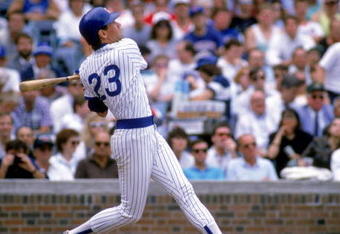
It had been quite some time since the Cubs had been in the post season.  39 years to be exact.  In fact, they had not reached the postseason since 1945 when the owner of the Billy Goats Tavern had been asked to remove his goat from the 1945 World Series and cursed the team.  So when the Cubs won the National League East over the heavily favored Cardinals and Phillies as well as the improving New York Mets, Chicago came alive.

Chitown saw this as a team of destiny.  They were well built from the parts of dismantled dynasties at most positions and young budding stars at others.  Ron Cey had come from the Dodgers.  Larry Bowa, Gary Matthews, Keith Moreland, Warren Brusstar, Ryne Sandberg and Bob Dernier had come from the Phillies.  Dennis Eckersley was acquired from the Red Sox for first baseman Bill Buckner.  Davey Lopes came in a late season trade from Oakland and Rick Sutcliffe came in a late season trade from Cleveland. Leon Durham had come from the Cardinals.  Very little talent was home grown but it somehow all worked together.


They took over first place on August 1 and never looked back, winning the division by 8 1/2 games.  The first two games of the NLCS were in Chicago and it looked certain that the curse had been nothing more than a joke.  Wrigley Field was a madhouse as the Cubs won the first game 13-0 and the second game 4-2.  The NLCS was a best of five until 1985 and the Cubs needed just one more win to advance to their first World Series since ten years before Disneyland existed.  They needed to win just one of the last three games against the San Diego Padres, another collection of fallen dynasties.  The Padres had Steve Garvey of the Dodgers and Graig Nettles and Goose Gossage of the Yankees.

When the Cubs jumped out to a quick 1-0 lead in the second inning of Game 3, the Padres were expected to fold up and just be satisfied with having made the playoffs for the first time in team history.  Dennis Eckersley had allowed only 4 hits through the first 5 innings and really had no trouble to this point.  Then the bottom of the 5th came and  the Padres exploded for three runs on 4 hits.  A 4 run 6th inning finished the scoring for a 7-1 win.  It was a disappointing loss but the Cubs needed to win just one of the next two.  The Cubs again jumped out to a lead and were tied at 5 heading into the bottom of the 9th when Steve Garvey hit a two run Home Run to win the game and force a final deciding game.

Now Cubs fans were worried and talk of the curse ramped up again.  Their fears seemed to be put to rest when Leon "Bull" Durham hit a big two run Home Run in the first and Jody Davis hit a solo Home Run in the second.  Another three run lead and the Cubs were relaxed.  There was no curse.  The Cubs took the three run lead into the 6th.  San Diego scored one but couldn't get any closer

Then came the moment everyone was waiting for:  the curse roared out.  Carmelo Martinez walked to start the inning.  He was sacrificed to second base.  Tim Flannery hit a ground ball right to Durham at First base.  It moved quickly but it should have been routine.  Durham missed.  It went right through his legs.  It was a play the two time All Star had made a thousand times but for whatever reason on this ground ball it went right past him.  Martinez scored from second and the game was tied.  A single, a double, another single and three runs followed.  The Padres led 5-3.  The Cubs put runners on in each of the last two innings but none of them scored and the Padres celebrated the greatest moment in franchise history while Cubs fans pointed to Durham's error as the reason they were headed home for another cold and windy winter.


There are many reasons you cannot blame Leon Durham for the series loss.  Here are just a few:
1.  A few years ago Bob Ibach, the PR Director of the Cubs at the time, gave an interview discussing the series.  He revealed that while the Cubs were at bat in the 7th a Gatorade cooler toppled over on the Cubs bench.  One of the victims of the Gatorade was Durham's glove.  The equipment staff did their best to dry the glove using hair dryers, towels and whatever else was available.  Apparently the glove oil, tobacco juice, dirt and leather along with the sugar of the Gatorade created an adhesive.  The Cubs equipment managers did what they could to fix the glove but it was barely serviceable.  Instead of trying to break in an unfamiliar glove, Bull took the familiar glove with him out to the field.  According to Ibach Durham looked down to see if the glove would even open and that was when he lost track of the ball.

2.  The Cubs had only 5 hits in Game 5 and only 2 after the second inning.  For an offense that won 13-0 in game 1 it was a very quiet deciding game.  One of those 5 hits was a two run Home Run by Durham himself.  If it hadn't been for Durham the Cubs wouldn't have been in the game at all.

3.  The Cubs lost three straight after winning the first two games of the series.  In each of those three games they had a lead and in one they were tied late in the game.  In the final 2 games Durham hit Home Runs, one of the few Cubs players hitting.  Although he only had three hits in the five games he made them count.

4.  Durham's error allowed only one run to score.  The two singles, double and three runs that came after had nothing to do with Durham.

Saturday, June 8, 2013

Forgiving Baseball's Scapegoats: Ralph Branca

Don't forget to check out other articles in the "Forgiving Baseball's Scapegoats Series:"

"1 out, bottom of the ninth, Branca pitching.  Bobby Thomson takes a strike call on the inside corner.  Bobby hitting at .292.  He's had a single and a double and he drove in the Giants' first run with a long fly to center..Brooklyn leads it 4-2...Branca throws..."  Everything was calm, matter of fact with just an edge of desperation in the voice of Russ Hodges to this point.  Not even a full beat later all hell broke loose at the Polo Grounds and the lives of two baseball players would forever be changed.

Some of the Dodgers questioned how it had ever gotten to this point.  In the first game of a doubleheader on August 11th, Ralph Branca beat the Braves to increase the Dodgers' first place lead to 13 games.  With just over a month and a half left the Dodgers started looking forward to their match up with the American League in the World Series.  They went 10-10 over the next 20 games.  Not terrible but it should be just fine to keep a fairly sizable lead in a pennant race.  The only problem was that during that time the Giants played 18 games and won 17 of them, including 16 in a row, and three head to head against the Dodgers.  Just a few weeks after reaching the 13 game lead the Giants were just six back and charging fast.  The lead hovered around five or six games for the next few weeks but on September 16th, with a doubleheader sweep of the Cubs, the Giants got it down to 4 1/2 games.  Then down to three, to two, to one and finally, on September 29th, the second to last day of the season the league was tied at the top.  The Giants had gone 12-1 to finish out the year and the season ended with a  tie for first.  The Dodgers had blown a 13 game lead and would have to play a best of three playoff against the Giants to see who would go on to the World Series. 

The first two games were a split so the entire year came down to these nine innings.  Don Newcombe entered the 9th inning with a 4-2 lead.  He had allowed only 4 hits and 2 walks to this point in the game and it looked like the Dodgers were in the clear.  Newcombe could have made our list of Baseball's scapegoats but the arguments against him are too ridiculous to even address at length.  Suffice it to say a few idiots decided to unfairly give him the reputation of being unable to win the big game.  So entering the 9th he was cruising to a win and the World Series. 


Just like the regular season the Giants kept after it.  The inning started with a single, followed by another single.  Brooklyn needed just three more outs without giving up two runs and they would be NL champs.  Newcombe had a history of tiring late in the game so Charley Dressen called to the bullpen after the two singles.  Clyde Sukeforth answered, listened, gave a quick answer and yelled out.  "Branca, Roe and Labine get loose."

There was immediate activity in the Brooklyn pen.  Seven bodies moved.  The jackets came off.  The arms started twisting and catchers masks got pulled on.  Fans in the outfield, Giants fans likely, hung over the wall of the outfield and taunted the Dodgers pitchers as the ball popped into the catchers gloves.  On the field, Newcombe got a pop out to Gil Hodges for the first out and everything seemed fine.  The pitchers, if they were watching the game, may have relaxed a bit but kept throwing to get loose.  When Whitey Lockman doubled to score Alvin Dark, Dressen had seen enough.  The phone in the bullpen rang again.  Dressen had little time.  "What do you got?"  Sukeforth knew the drill.  He gave a quick, succinct answer.  "Branca's throwing ok.  Labine just bounced a curve ball."


There was very little choice for Dressen.  "Gimme Branca."  Dressen ambled out to the mound and took the ball from Newcombe.  "Hell of a job Newk." He patted Newcombe on the ass as he walked off the mound, frustrated, knowing this would again go down as "another Newcombe collapse". Branca made the slow, very long walk from the bullpen in the Polo Grounds.  Standing at the mound, a welcoming committee, were the Dodger legends: Pee Wee Reese, Jackie Robinson, and Gil Hodges.  They were waiting to hear the strategy. How do we pitch this guy?  What does he like to hit?  Dressen's suggestion.  "Go get this guy."  That was it.


Cue Russ Hodges:  "1 out, bottom of the ninth, Branca pitching...Branca throws..."  Everything was calm, matter of fact with just an edge of desperation in the voice of Russ Hodges to this point.  Not even a full beat later all hell broke loose at the Polo Grounds and the lives of two baseball players would forever be changed.  "There's a long drive.  It's gonna be, I believe... The Giants won the pennant!  The Giants won the pennant!  The Giants won the pennant!  The Giants won the pennant!  Bobby Thomson hit one into the lower seats of the left field stands!  The Giants won the pennant! and they're going crazy. they're going crazy!"


There was silence in the Dodgers locker room.  It was another year of hearing "wait until next year."  Branca didn't make it to the locker room.  He tore uniform number 13 off and sat on the clubhouse steps weeping.  Whether he knew how long he would be remembered for the one pitch or whether it was just the emotion of another lost season, Branca had been with the Dodgers since 1944 and had struggled to get rid of the label of "Bums" with the rest of the Dodgers legends.

Similar to Pesky, Branca was a gracious, humble man who dealt well with the attention over the years.  Unfortunately for Branca, he did not become the living legend that Pesky did in Boston.  There are many reasons you can't blame Ralph Branca, here are just a few:

1.  The Dodgers blew a 13 game lead.  For a pitcher that only plays once every few days Branca cannot blow every game by himself.  Branca lost seven times between the first game of the August 11th double header (which he won putting the Dodgers up by 13 games) and the end of the season.  He also won three.  During his seven losses the team scored only 16 runs (4 times only scoring one run).

2.  Dodger pitchers were tired by that point.  The Dodgers only had three starting pitchers make more than 20 starts throughout the season.  Newcombe made 36 starts, Preacher Roe made 33 starts and Branca made 27 starts.  The next closest was Carl Erskine with 19.  Further, while most pitchers today have a pitch count or a season inning limit, pitchers of this era would pitch until their arm would break.  Newcombe ended the season with 272 innings pitched, Roe had 257 innings pitched and Branca 204 innings pitched.  Branca himself said years later "we had a short pitching staff.  Charley Dressen...had five guys who he used extensively, and the pitchers ran out of gas."

3. The two big hitters in the Dodgers lineup slumped at the same time.  Pee Wee Reese, the leadoff man, was hitting .314 as Branca won game two of the August 11 double header. From that point on his average would drop as low as .281 before rebounding for a .286 final season average.  Reese also hit a total of 10 Home Runs for the year (he was not a power hitter) but all of them came before August 11.  Duke Snider was, however, the power hitter in the lineup.  He would hit a total of 29 Home Runs in 1951, including one in each game of the August 11 double header.  After August 11, he would hit only three more for the season and only one during September.  Snider admitted in his autobiography that this helped the collapse:  "The Giants started coming like gangbusters, and at that same time, Pee wee and I both started to slump.  When a baseball team has its leadoff hitter and its number thee hitter in slumps at the same time, its not going to score many runs."  Snider's accuracy can be seen in Branca's low run support after August 11.  Snider also said in an interview years later: "I had a very bad September, felt very bad about it.  A couple of hits here, a couple of hits there, and we wouldn't have had a playoff.  You take it personally.  I think everyone did.  Pee Wee didn't have a good September and he and I would talk about it and try to analyze the situation driving to and from the ballpark.  It was something you had no control over; still at the time, I was very concerned."  I am definitely not implying that the blame should all shift to Snider and Reese.  I am just saying that in the overall collapse, their simultaneous slumps played a big part.

4. The Dodgers woke the sleeping Giants.  Charlie Dressen, Dodgers manager, was a disciple of Leo Durocher, from Leo's days with Brooklyn.  Dressen wanted nothing more than to prove that he had surpassed his former mentor.  On July 4 the Dodgers beat the Giants in both games of a double header.  Dressen made a comment after the game "Those two beatings we gave them knocked them out of it.  They'll never bother us again."  The real turning point again came in the first week of August.  The Dodgers swept the Giants in three games before facing off against Boston for the August 11 double header.  One of the quirks of Ebbetts Field was that the ventilation system allowed some conversation to be overheard from locker room to locker room.  It was a league wide "secret".  After the three game sweep the Giants' locker room was a somber place.  New York wasn't making a sound so the noise coming from the Dodger clubhouse was easily audible.  Several of the players took advantage of the situation and made sure their comments about how bad the Giants were (especially targeting Durocher) were spoken in the direction of the vents.  The Giants were angry and became determined on payback.  Add to that Dressen's published comment "the Giants is dead" and the sleeping Giant was definitely starting to wake up.

5.  Charley Dressen changed his pattern when Branca came into the game.  Dressen was a great strategist.  He would often tell his team "just hold them until the 7th inning.  I'll figure something out."  More often than not, he did.  In the years to come Gene Mach (keep reading this series of articles and you'll get there) would be accused of over managing a game.  Dressen may have been guilty of the same.  The pitchers coming in from the bullpen were used to the routine.  Dressen would take the ball from the pitcher.  Wait on the mound for the reliever to arrive and then discuss the batter before starting their warm ups.  Dressen would tell them where the hitter liked the ball, what type of pitch he liked and where to pitch him.  It happened every time...except this time.  The wording of his short statement to Branca vary from "Go get 'em." to "Get 'im out." but he not only didn't give Branca the normal information he didn't wait for him to reach the mound.  In his autobiography, Snider gave his view from Centerfield. "When Branca got about five feet from Charlie, Dressen flipped the ball to him...and headed back to the dugout...I noticed Dressen's absence and I'm sure some other Dodger players did too, and I thought to myself, 'Oh-oh. Charlie's worried'.  That made me worried too."  The problem wasn't just the broken routine, it was the difference in personnel.  Roy Campanella, one of the greatest Catchers to ever play the game, had one of the great baseball minds and could control a game from behind the plate as well as anyone in history.  Campanella had the complete confidence of the pitching staff and if he called a pitch the pitchers knew it was the right pitch to throw.  But Campy was not in the game.  He was injured and couldn't play so Rube Walker, the back up Catcher who would play in a total of 36 games in 1955 (including this one), was handling the catching duties.  Walker was a good Catcher but there was only one Campy.  Knowing that Branca and Walker had worked together so little Dressen needed to take charge and tell them both what Thomson would be looking for.  The talk may or may not have changed the course of history, but it likely would have helped steady the situation and bring some normalcy to the abnormal moment.

6.  Campy was not the only injured player. While many other players were out there despite the aches, pains, knicks and bruises that come with the long baseball season, others just couldn't make it through the year.  Campanella was a tough guy.  He won an MVP award while catching with a broken hand so severe that he couldn't squeeze the glove closed or grip the bat properly.  If he couldn't play you knew it was severe.  The important one (other than Campanella) was Clyde King.  The term closer didn't exist yet.  Relief pitchers were not "specialists" they were pitchers not good enough to start.  The late 1940's and 1950's saw the emergence of relief pitchers with players like Joe Page of the Yankees but the everyday use of relievers was over two decades away.  Clyde King appeared in 48 games for the 1951 Dodgers, the most of any of their pitchers, and only started three games.  King would save only six games that year but he went 14-6.  "I was 13-4 in early August.  I had a chance to win twenty games that year, and I came down with tendinitis...If I hadn't hurt my arm, I would have been the guy who would have pitched to Bobby Thomson."

7.  Probably the most important of all, the Giants were stealing signs.  Ever been at a game where the Catcher goes out to visit the mound, then after the next pitch goes right back out?  There's a reason for it.  Ever wonder why the Catcher drops so many different signs down before the pitcher decides to throw? There's a reason for it.  The other team is always trying to get an advantage and stealing signs is one of the oldest tricks to get the advantage.  Teams can develop some pretty elaborate systems to steal signs.  The Philadelphia Phillies, in the early 1900's, had a telegraph wire running from centerfield through the third base coach's box.  A Phillies' employee with a telescope would operate the system and give one pulse for a fastball and two pulses for a breaking ball.  This system was eventually discovered and the Phillies were punished (the punishment may have been that they had to still be the Phillies for the next 80 years).  The 1940 pennant winning Detroit Tigers used a rifle scope to steal signs.  Hank Greenberg (that's right, another Hank Greenberg reference, get used to it) told how they had a man standing at the bullpen wall "watching the game".  If he kept his right arm on top of the wall the batter could expect a fastball and if the right arm dropped down the batter could expect a curveball.  Some batters don't want signs.  The Tigers at the start of the 1900's had their own system and told Ty Cobb what to look for.  He told them he could hit without the help and, of course, he did.  Back to the 1951 Giants.  The Dodgers were convinced they were stealing signs.  Dodgers coach Cookie Lavagetto was positive:  "Hell, we knew they were getting them.  I talked about it with Charley Dressen.  I said 'Charley, you notice when we come here, we never fool anybody?  We throw a guy a change of pace, he seems to know what's coming.....Whatever he had out there he had a good system."

Monday, June 3, 2013

Forgiving Baseball's Scapegoats: Johnny Pesky

What the hell just happened?  That was the stunned general reaction of Red Sox fans at the conclusion of the play and the reaction seems to have been so strong that no two people seem to have seen the play the same way.

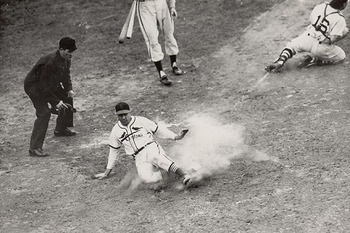
There was movement from first base, even before the pitch was delivered.  The Cardinals' Enos Slaughter was not the fastest runner, he had never stolen even ten bases in a season, but he was a smart base runner.  At this point in the season every step counted, every foot of ground was important (just ask Fred Merkle).  Game 7 of the 1946 World Series.  Top of the 8th inning.  The Red Sox had tied the game at 3 in the bottom of the 7th and the next run was the most important run in the career of whoever scored it. 


Slaughter had led off the inning with a single but was left there when a failed sacrifice bunt was popped to the pitcher and an easy fly ball to left held Slaughter in place.  As Bob Klinger started his motion to the next batter Slaughter took the chance and went full speed for second.  The Red Sox infield reacted.  Bobby Doerr at Second base and Johnny Pesky at Shortstop moved towards the second base bag to cover a possible throw from the Catcher.


Harry Walker, the batter, made contact with the ball and Slaughter, who had a great jump from first, was almost around second by the time Leon Culberson fielded the ball.  Similar to the Fred Merkle play, this is the last moment that anyone agrees on.  Reading about the details of this play is like playing a game of telephone.  No one can quite agree on what happened and how it happened.  Some said that the ball took a quick scoot on the grass and nearly reached the wall.  Others said Culberson didn't field it quickly or cleanly.  Some said it was an easy bloop single and that Culberson lobbed an easy toss back to the infield.  The participants themselves can't even agree on what happened.  Pesky claimed that Culberson bobbled the ball but Harry Walker said "Culberson didn't bobble the ball and he didn't throw it bad.  It was a perfect throw to Pesky."  Regardless, the fact is Culberson fielded the ball and threw the ball back to the infield. 

Footage of the play shows Pesky making a quick reaction.  He is almost motionless until Klinger starts his movement but once Slaughter is on the move so is Pesky.  He takes about three steps toward second base when Walker makes contact and immediately heads out towards left-center field to take a possible relay throw from Culberson.  By all sane baseball reasoning Slaughter should have held at third.  Slaughter ignored all reasoning and turned third heading for home.  No one could have expected that.  Several newspaper reports said that Slaughter ran despite his third base coach telling him to stop.  One writer said the coach "flapped the come-on sign like an excited mother hen."  Slaughter says the coach was telling him to stop.  Several others agreed that he was sent.  One writer even suggested that Slaughter had time to reach third, check on Pesky and make a planned decision to take the extra base.  Again, regardless, the fact is no one in their right mind thought Slaughter was going to try to score from first on a bloop base hit.

As Slaughter tore around third Pesky received the throw from Culberson and again the stories differ.  Some said that Pesky turned towards second base.  Some said he held the ball.  Some said he made a weak throw home.  Some said he dropped his hands, froze for a moment and then threw home.  The fact of the play is Slaughter scored well ahead of the throw from Pesky.


This all happened in the year of our lord 1946.  For Red Sox fans this happened in the year of our curse 26.  Red Sox fans had not seen a World Series team in nearly 30 years at this point and this was the first round in the 86 year "what if...?" game that followed.  The Red Sox nation screamed for years "what if Pesky hadn't held the ball?"  Fortunately for Pesky, a gracious and likable man, this was before the frustration of not winning a World Series had reached a boiling point so he didn't receive the pure hatred that Bill Buckner and Grady Little would experience in the coming decades.  In fact, up until he passed away just last August, Pesky worked for the Red Sox as a coach and special assistant for the club.  Further, Pesky will be remembered as long as Fenway Park operates.  The Right field Foul Pole has been called "Pesky's Pole" for years because Pesky, although only hitting 17 in his career, hit a big Home Run just around the pole while playing in Boston. 

Fortunately Pesky was able to overcome the label of scapegoat and become beloved by the fans, although, until his last day, he had to deal with the blame of losing the 1946 World Series.  There are plenty of reasons you cannot blame Johnny Pesky for the loss of the 1946 World Series.  Here are just a few:

1.  The Red Sox took a three games to two lead in the series and had to win only one of the final two games.  Despite seven hits and two walks in Game 6, the Red Sox grounded into three double plays and left four men on base while scoring only once.  The Cardinals had only one more hit and two more walks but took advantage of their opportunities and plated 4 runs.

2.  The Red Sox allowed the opportunity to go up three games to 1 slip by them.  Playing game 4 in Boston, the Red Sox had 20 game winner Tex Hughson on the mound facing off against a little used pitcher (only 2-2 on the year) Red Munger.  It was a total mismatch in Boston's favor but the Sox gave up three runs in the second and three runs in the third to allow the Cardinals an early 6-0 lead.  Helping several of these early runs were two errors by the Red Sox.  As the game went on two more Boston errors in the top of the 9th led to four more Cardinal runs.  The final score was 12-3.

3.  During the 1946 season Ted Williams hit .342 with 38 Home Runs scoring 142 runs and driving in 123.  That is one hell of an offensive season.  Hitting directly in front of Williams was Dominic DiMaggio hitting .316 with 73 RBI and hitting directly behind Williams was Rudy York with a .276 average but 119 RBI.  The Cardinals did their home work on Williams and noticed that most of his base hits went to right field and very few went to left field.  To defend against Williams the Cardinals utilised what has been known to history as the Williams shift.  Based on a strategy used by Indians' manager Lou Boudreau, the Cardinals pulled the Second baseman closer to first.  The Shortstop played on the right side of Second base, the Third baseman played a deep short stop and the Left fielder played shallow behind the Third baseman.  The message to Williams was clear.  "We dare you to hit it to the left side."  Instead of trusting the 119 RBI of Rudy York behind him and taking what the Cardinals were giving him by laying down a bunt for a single, Williams insisted on trying to hit everything  to the left side.  He ended the series with a .200 average and only 5 singles (one being a bunt to the left side with the shift on). York, on the other hand, had only six hits in the series but four were for extra bases including two Home Runs.  Had Williams laid down a few more bunts to third for singles York's RBI total may have been higher than the five he ended up with and the shift may have been defeated.  Williams was devastated by his performance and wept in the showers after Game 7 and in the entire cab ride home.

4.  This Cardinals team was a great team.  Although they had missed the 1945 World Series, mostly due to players serving time in the military, this was one of the great Cardinals dynasties and they had been in this position before.  The Cardinals had won the National League in 1942, 1943 and  1944 and had just completed a great pennant race with the Brooklyn Dodgers that ended in the first ever National League playoff.  The Cardinals were a team that had to fight all year to make the World Series, never getting more than a 2 1/2 game lead on the Dodgers after July 31.  The Red Sox, however, had not played a meaningful game coming into the World Series, having won the AL by 12 games.

5.  Slaughter's philosophy worked.  When you have the time to field a baseball and make a proper throw, something these men do almost mechanically, there are few simpler things.  However, when you are forced to catch, turn and throw, while determining how far the runner is from the plate and where the throw needs to be then things get much more complicated.  Possessing a strong arm does not always translate into being a great arm.  Ty Cobb would routinely take gambles on the base path and do the opposite of what the baseball strategies of the day said.  His theory was make them throw you out.  You know and they know that they have the ability to do it but can they do it when they have to do it.  This aggressive philosophy seems to be just what Slaughter had in mind and it could just as easily have backfired on him.  Slaughter had a great jump on the ball and took a gamble that he could surprise the Red Sox by making the turn.  His gamble and aggressive move forced the Red Sox to make a perfect field, throw, catch, turn, throw and tag to record the out.

6. Slaughter only made the gamble because Culberson was playing Center field.  The regular Center fielder was Dominic DiMaggio and he was a great fielding outfielder.  Probably one of the best of the era.  DiMaggio was responsible for sending the game into the 9th inning tied when he hit a two run double to tie the game.  Maybe this is where the curse talk should have started because DiMaggio hurt his leg rounding first on the double and was replaced by Culberson as the pinch runner.  Slaughter said later: "DiMaggio had a great arm but Culberson didn't have too good of an arm, and he wasn't as quick as DiMaggio.  DiMaggio would have gotten rid of it a lot quicker.  I don't think I would've even tried."  DiMaggio had even more confidence.  "He might not even have tried to go to third."

7.  Pesky did nothing wrong.  The video footage shows Pesky catching, turning and making a strong throw in a continuous motion.  The idea that Pesky turned towards second is ridiculous.  By the time Pesky even had the ball and had turned Slaughter was nearly a third of the way home.  Remember, this is a Game 7 of a World Series and the place is packed.  The home town team is about to score a winning run so it would be amazing if any fan had a voice left after this play.  The roar was deafening so although Culberson said that he and Williams were screaming that the play was at the plate and Bobby Doerr may or may not have notified Pesky as well, Pesky wouldn't have heard a thing.  He was on his own and given the circumstances the Red Sox were fortunate it was as close as it was.