Saturday, January 3, 2015

I Didn't Know He Played For: Reading

To many people living outside of Pennsylvania, the city of Reading, Pennsylvania may only be known for being featured as part of the original Monopoly board game as the "Reading Railroad" location.  Since the decline of the railroad industry the city of Reading has become known more for the signature Pagoda that sits on top of Mount Penn or for the reality T.V. show couple Jon and Kate.

I grew up in the greater Reading area and I can tell you personally what a great city it is.  There is of course the pretzels.  There are great family diners (Arner's and Paolo's) and the summer festivals ( Mifflin Days but my favorite was always Apple Dumpling Festival).  I can't leave out the Farmer's Markets where you can go and get Shoo-Fly Pie for a great price.  Reading from top to bottom is a great area.

One of the greatest traditions of Reading that many overlook is the Reading baseball team.  Since 1967 the team has been associated with the Philadelphia Phillies, however, prior to that they were also associated with the Red Sox, Indians and Dodgers.  The history of the Reading minor league franchise dates back to 1883 when the Reading Actives played in the Interstate League.  Since then they have been known as the Coal Heavers, Pretzels, Coal Barons, Aces, Keystones, Red Sox, Brooks, Chicks, Indians, Phillies and (currently) Fightin' Phils.

Throughout the tradition some big names have come through the city and gone on to big time baseball fame.  Names like Roger Maris, Earl Averill, Herb Score, Mudcat Grant, Ryne Sandberg, Mike Schmidt, Jimmy Rollins, Ryan Howard and many other legends that everyone associates with the team's rich history.  Today's article will be the start of an ongoing series to point out some of the people you never knew or may have forgotten made their way through the organizations of baseball.  We start with the great area known as Reading, PA.:

Morrie Rath:


Morrie Rath made his major league debut for Connie Mack's Philadelphia Athletics in 1909.  Having attended Swarthmore College,just 11 miles outside Philadelphia, Connie Mack would have had the inside track on finding him.  Mack had a great scouting system (especially for local talent), spent money when needed (the cross town Phillies rarely did) and loved signing college bred players (most other managers over looked these players). Rath split the 1908 season between the East Carolina League and the Virginia League before moving on to Reading, PA for the 1909 season.  While there he would play in 114 games and end the year with a .315 average.  It was good enough for a call up to the big leagues with Mack's Athletics.  Rath was not an All Star calibre player but would spend six seasons in the big leagues.  After 2 years with the A's, Rath was sent to the Indians during the 1910 season.  He landed in Chicago with the White Sox for 1912 and 1913.  While there he would play with six playes who would later be a part of the infamous 1919 season.  This would  be a connection oddly overlooked conisidering his claim to fame came as a member of the 1919 Reds team.  When the eight (or seven if you take out Buck Weaver) Black Sox agreed to throw the World Series, the gamblers needed a sign that they were going to go through with the plan.  The decided sign to the gamblers was that Eddie Cicotte would hit the first batter.  That batter, who took a fast ball to the middle of his back, was Morrie Rath.  Rath would play just one more year in the major leagues.


Dixie Walker:
Ewart Gladstone Walker, better known as Dixie, was actually born in Brownsville, PA.  Brownsville is a small town in southwest Pennsylvania in Fayette County.  He made his major league debut in September of 1909 and played parts of four Major League seasons, all with the Senators.  As a team mate of the great Walter Johnson, Walker  finished his major league career with a 25-31 record and a 3.52 ERA (fairly high for the dead ball era). After his final days in Washington Walker bounced around the minors playing a part of one season with the Albany Senators who shifted midseason 1916 and joined the Reading Pretzels.  Walker played a total of 43 games that year going  25-18.  Walker's career may not have been tremendous but baseball was a family business.  His brother Ernie played three years (1913-1915) with the St.Louis Browns.  He also had two sons that made large impacts on the Major Leagues.  His son Harry "the Hat" Walker was a big part of the St.Louis Cardinals' dynasty during the 1940's and would go on to manage for nine years.  His other son adopted the father's nickname of Dixie and would have a long successful career.  He would be the only player to spend time on the field with both Babe Ruth and Jackie Robinson and he would be forever remembered as the player who led the petition against Jackie Robinson.

Steve O'Neill:

Steve O'Neill was born and raised in Minooka, PA, a small town just south of Scranton, in the heart of mining country. O'Neill would have a long Major League career spent mostly with the Indians.  As the Catcher for the Indians from 1911-1923 he became very close friends with Shortstop Ray Chapman and was one of the most devastated when Chapman was killed.  As his career was winding down O'Neill started to become a journeyman moving from city to city trying to keep the baseball career rolling.  O'Neill moved to the Red Sox for 1924.  O'Neill played for the Reading Keystones for 34 games in 1925 before being picked up by the Yankees to end the year.  He did not help greatly as the Keystones finished 4th that season.  O'Neill would go on to a very successful managerial career with the Indians, Tigers, Red Sox and Phillies.  His most successful managerial year was 1945 when he led  the Tigers to a World Series title.   O'Neill would also be a long time popular broadcaster for the Indians.

Everett Scott:

The minor leagues are sometimes a book end to a career. They can sometimes launch a player onto the national baseball stage and can sometimes be the cushion at the bottom when that career starts coming back to earth.  Everett Scott was a great player in the major leagues, mostly with the Red Sox and Yankees.  Scott played on the great Red Sox teams in the 1910's and was one of the many players shipped to the Yankees in the early 1920's which gave the Yankees their start of dominance.  Scott was good enough to play in 1307 consecutive games.  That would be a record until a guy named Lou Gehrig passed him.  Gehrig and Scott were actually team mates until mid 1925.  On June 17 of that year, just over two weeks after Gehrig started his streak, Scott was released by the Yankees and signed by the Washington Senators.  He would spend the 1926 season with the White Sox and Reds.  Trying to hang on Scott would play for Toledo in 1927.  He rounded out his career in 1928 and 1929 in Reading, who were at that time Chicago Cubs affiliates.  Reading would finish 6th in 1928.  Scott did fairly well hiting .316 with 156 hits in 131 games, including 39 doubles.  His numbers dropped dramatically in 1929, his final year in professional ball.  He hit only .287 with 54 hits (18 of them doubles). One reason for his lack of playing time in 1929 may have been the presence of Shortstop Billy Jurges, future star short stop for the Chicago Cubs.

Whitey Witt:
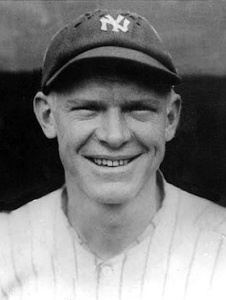
Whitey Witt had an interesting career. Of course he did! otherwise we wouldn't bother reviewing his brief stop in Reading here would we?  Witt started with the Philadelphia Athletics just as the Connie Mack dynasty in the early 1900s was being dismantled.  Instead of playing with the $100, 000 infield he played on one of the worst teams of all time.  From 1916-1921 Witt witnessed some of the worst baseball imaginable.  With this being an article about players in Reading you would think  his career would have started there.  It didn't.  Witt went right from the campus of Bowdoin College (the college where Civil War hero Joshua Lawrence Chamberlain was a professor) to Connie Mack Stadium.  Desperate for cash to keep the A's profitable, Mack sold one of his few stars to the Yankees before the 1922 season.  Witt joined a team that was just starting to become THE YANKEES.  It was a tough job.  He was joining an outfield with Bob Meusel and Babe Ruth and replacing popular power hitter Ping Bodie.  Witt would play a big part in that early Yankee success and was a key member of the Yankees first World Series team.  Midway through the 1925 season Witt was released.  His replacement would be Earle Combs, the next great Yankee Center Fielder.  Witt's career in the major leagues would end after the 1926 season with the Brooklyn Robins.  He would go on to play two years in the minors, the final one in 1929 with the Reading Keystones.  He would play in only 30 games but had 30 hits and batted .330.

Phil Cavarretta:

Cavarretta had a 22 year career with three All Star appearances and an MVP award.  He was the team leader for the Cubs for many years and was the star on the 1935, 1938 and 1945.  Cavaretta spent part of the 1934 season with Reading playing 85 games and hitting .308 with 4 Home Runs.  Cavarretta also spent three years as the Cubs Manager, never finishing higher than 5th.  He would continue to manage in the minor leagues until 1971 and had a one year managerial stint with the Lancaster Red Roses in 1960.

Joe Altobelli:

Joe Altobelli played parts of three seasons in the majors and had a mostly forgettable career.  He played 42 games for the 1955 Indians, 83 games for the 1957 Indians and 41 games for 1961 Twins. He spent much more time bouncing around the minor leagues, 18 seasons to be exact.  Two of those years were spent with the Reading Indians in the Eastern League.  Altobelli's mark on baseball was left more as a manager.  He managed the Giants for three seasons, never finishing higher than 4th.  In 1983 Altobelli took over for a retiring Earl Weaver in Baltimore and led the Orioles to their third (and so far last) World Series.


Rico Petrocelli:
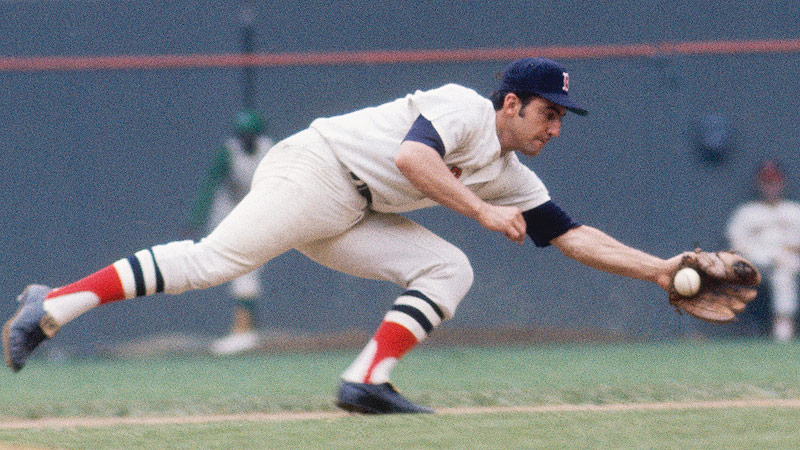
In the early to mid 1960's the Boston Red Sox had a strong farm system that started to produce quite a few talented players including Tony Conigliarro and Carl Yastrzemski.  Another important piece of that young group was the man known as "Petro".  Petrocelli was a product of Brooklyn, NY and started his minor league career in 1962 with the Winston-Salem Red Sox. After one year in Winston-Salem he was moved to the Red Sox AA team in Reading.  He spent the 1963 season with the Reading Red Sox and played 137 games.  He hit only .237 but showed good power with 19 Home Runs.  He would play the 1964 season in Seattle before being called up to Boston for good in 1965.  A two time All Star, Petrocelli helped lead two of the most famous Red Sox teams of all time: the 1967 "Impossible Dream" team and the 1975 Red Sox.


Ray Fosse;

Ray Fosse's major league career started ramping up in 1967 with the Indians but took off in full flight in 1970.  In his first full season with Cleveland he was an All Star and a Gold Glove winner at Catcher.  Fosse would make the All Star team again in 1971 and would be injured in an infamous collision with Pete Rose at the end of that game.  He would go on to help the A's win back to back championships in 1973 and 1974 (he was not there for the first of the three straight World Series) and is still an announcer for the Oakland Athletics.  But before all that, in 1965, Fosse played 55 games for the Reading Indians.  He hit only .219 but his defense helped him move along in the minor league ranks.

Dallas Green:


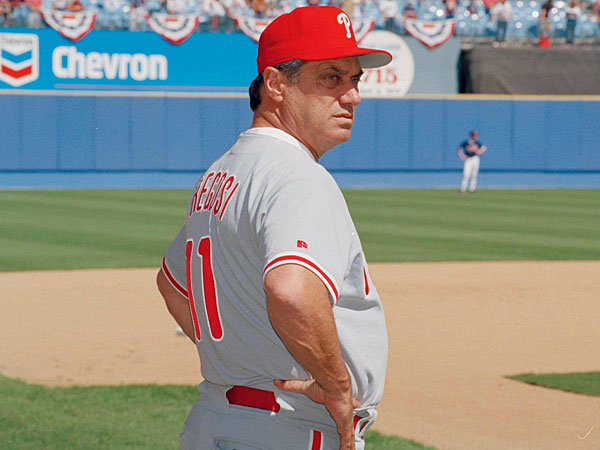
Dallas Green grew up in Delaware, not far from Phillies territory.  In 8 Major League seasons with the Phillies, Senators and Mets, Green was 20-22 as a pitcher.  Similar to Joe Altobelli, Green's claim to fame came as a manager.  Under Green's leadership the Philadelphia Phillies won their first ever World Series in 1980.  Green would also manage the Yankees for one year and the Mets for several seasons.  Green spent ten seasons in the minor leagues working his way up to the majors.  His final stop as a player was in Reading in 1967. Green started 8 games for the Reading Phillies that year and went 6-2 with a 1.88 ERA.

Stump Merrill:

Stump Merrill was a career minor leaguer. He did spend six seasons in the Phillies organization bouncing around their minor league ranks from 1966-1971. He made two stops in Reading.  The first was in 1968 where he played 42 games and hit .189.  He was then sent to the Phillies' San Diego affiliate (one year before the birth of the Padres) to finish the season.  Merrill then was sent back to Reading for the 1969 season. He played in 80  games that year and hit .252. He never reached the majors.  So who the hell is he?  Stump Merrill went from a minor league player to a minor league manager and spent a large amount of time in the Yankees minor league system.  At the end of the 1989 season Bucky Dent replaced Dallas Green as Yankees manager.  Near the end of the 1990 season, with the Yankees struggling again, Stump Merrill was named manager of the New York Yankees.  Merrill would manage the end of 1990 and all of 1991.  At the end of the year Merrill was replaced by Buck Showalter as Yankes manager.

Andre Thornton:
Andre Thornton was a highly under rated player in the 1970s and 1980s. Thornton spent most of his 14 year career with the Indians, not the best place to play in the 1980s.  He also spent time with the Cubs and Expos.  In 1565 career games Thornton made two All Star Games, won a Silver Slugger award and three times received MVP votes but he never played in a post season game.  Thornton played 116 games with the 1971 Phillies where he hit only .267 but he hit 26 Home Runs.  So if he was in the Phllies organization why did he end up with the Cubs?  On June 15, 1972 Thornton and Joe Hoerner were traded to the Atlanta Braves.  The Braves then traded Thornton to the Cubs in exchange for Joe Pepitone.  Midway through the 1976 season he was shipped to Montreal who then sent him to Cleveland in the offseason of 1976-77.  Thornton would play 10 years in Cleveland and would make a major impact on their organization.

Mike LaValiiere:

Fans of the Pittsburgh Pirates know Mike LaValliere better as "Spanky", the gritty Catcher for the Bucs during their stretch of success in from 1990-1992.  Spanky got his start in the Phillies organization in 1981 and he steadily moved his way up the organizational chart.  By 1983 he landed in Reading. He played in 83 games there the first year playing some at Third Base but also splitting time behind the plate with Darren Daulton.    When the Phillies signed Lance Parrish a few years later and decided on Daulton as their Catcher of the future, LaValliere was expendable and released. He signed with the Cardinals where he played during the 1985 and 1986 seasons.  Before the 1987 season the Pirates traded Andy Van Slyke, and Mike Dunne along with LaValliere to the Pirates for Catcher Tony Pena.  LaValliere would be a sometimes overlooked key in the Pirates' three straight division titles.  He worked with Don Slaught, the Pirates other Catcher, to direct the Pirate pitchers.  LaValliere moved on to the White Sox in 1993 where he gave veteran presence to a White Sox team who made the playoffs for the first time since 1993.

Gio Gonzalez:


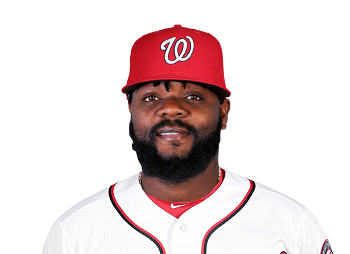
Gio Gonzalez is currently a star pitcher for the Washington Nationals.  He landed in the nation's capital in 2012 and helped the Nationals to their first ever playoff appearance.  The Nationals obtained Gonzalez from the A's.  In fact, Gonzalez's path to stardom was one of constant movement.  Gio was drafted in 2004 by the White Sox.  On November 25, 2005, just after the White Sox had won the World Series, the Phillies sent Jim Thome to the White Sox for minor leaguer Daniel Haigwood, star outfielder Aaron Rowand and a player to be named later.  Gonzalez was the player to be named later.  He spent the 2006 season in Reading where he pitched 154 2/3 innings with a 7-12 record.  Among his teammates in Reading that year were Michael Bourne and J.A. Happ.  In December 2006 Gio was sent back to the White Sox along with Gavin Floyd for Pitcher Freddy Garcia.  Before he could make it to the Majors with Chicago he was traded to the Oakland Athletics and it was on to stardom from there.


TRIVIA QUESTION;
The Reading Franchise had a one year affiliation with the Brooklyn Dodgers.  During the 1941 season the team was known as the Reading Brooks.  How many players from that 1941 team went on to play in the Major Leagues?

Answer to Last Week's Questions:
Hank Greenberg first played in the Major Leagues in 1930 but since he made only one appearance and there was no All Star Game we will leave that out as a year in the trivia question.  In total Greenberg made four All Star Games (1937, 1938, 1939 and 1940).  Of course he lost all but 19 games of 1941, all of 1942, 1943, 1944 and a significant amount of 1945 to the war.

Greenberg often made reference that he felt he had been snubbed in no being chosen for All Star Games so here is who made the team in his place, starting with the first All Star Game in 1933 (excluding the years he was out of the league for the war:
1933- Lou Gehrig (NYY), Jimmie Foxx (PHA)
1934- Lou Gehrig (NYY) (no other first basemen were on the roster)
1935-  Lou Gehrig (NYY) (no other first basemen were on the roster)
1936-Lou Gehrig (NYY), Jimmie Foxx (PHA)
1946- Mickey Vernon (WAS), Rudy York (BOS)
1947- Johnny Mize (NYG), Stan Musial (STL)
(1947 was Greenberg's final year in the league spent with the Pirates)

Thursday, December 25, 2014

Why I love Baseball More Than Football (Part 2)

Last week we looked at some of the reasons I personally enjoy baseball more than football.  Just as with last week, Just as with last year, I want to make it clear that I do not hate football and I am not anti-football.  Also, this is not a comprehensive list of reasons why I love baseball more than football.  These are my personal feelings of why baseball appeals more to me.  So here is part 2 of the article

The Home Field Advantage (innings):
Baseball gives the home team an advantage. They get the last chance to bat.    It is all fair though, because both teams are given the equal amount of outs and the equal chance to do something with those outs.

What home field advantage is given to the home team in football that can be equalized in the grand scheme of the game?  None.

The kick off is determined by the coin flip.  I suppose the home team has the advantage because they get to guess whether it will come up heads or tails but once the coin flips through the air it will be a 50-50 chance that they are right.  And what home field advantage do they win if they guess right?  They get to choose who gets the ball first.


The Home Field Advantage (stadium):
The Green Monster in Boston.

The Fountains at Kauffman Stadium.

The Palm Trees of Dodgers Stadium.

The Ivy at Wrigley.

The rock formations at Angels Stadium.

The Splash Zone in San Francisco.

The rings in the ceiling at Tropicana Field in Tampa Bay.

Those wierd little angles on the fences in Citizen's Bank Ballpark (not to mention the clanging of the Liberty Bell after a Ryan Howard Home Run)

The Big Apple in Shea Stadium.

The Warehouse in Baltimore.

Every stadium has some identifying uniqueness to it.  Some quirk that is immediately identifiable when you see it.  It is something identifiable that gives the team their identity.  A team builds their roster around the contours and features of their stadium.

What does a football field have?  They paint the team logo on the field and they paint the team name in the end zones.  Of course there are the fans who can make the noise level so loud the oppsoition can't hear but as the fan bases grow, the fans who are knowledgable about the nuances of the games decreases.  There are those who don't know to be quiet when your team is at the line of scrimmage and get loud when the other team has the ball.  In recent years I have heard the opposite happening as I watched games.

The Game's the Important Thing:
The NFL schedule is formulaic, Literally.  The day that your team finishes the regular season this year you will know exactly what teams will be on the schedule next year.  Of course you won't know what week they will play but you know who.

For those who have not figured it out here's how it goes.  Each team plays 16 games.  8 home and 8 away.  Each division has four teams and each team has a home and away game against each division opponent.  There is six games.  Next you will play four games against another division within your own conference on a rotating basis.  Now we are at 10 games.  Next you will play four games against the other Conference, all four against a single division and that division is also decided on a rotating basis.  That puts you at 14 games.  Now for the last 2.  What place did your team finish in last year?  Fourth, then you will play the last place teams from the remaining inter-conference divisions. Simple.

Don't believe me?  Let's take a look at the schedule of, oh let's say, the Vikings for this year.

Based on the formula the Vikings will play two games each against the Packers (Weeks 5 & 12), Bears (Weeks 11 & 17) and Lions (Weeks 6 & 15).  There are your divisional games.  One each at home and one each on the road.

Now, they will play an AFC Division from top to bottom.  This year will be the AFC East for the Vikes.  They played New England (Week 2), Buffalo (Week 7), the Jets (Week 14) and Dolphins (Week 16).  That puts us at 10 games.

Next there is an NFC Division from top to bottom. This year is the NFC South so it's the Saints (Week 3), Falcons (Week 4), Buccaneers (Week 8) and the Panthers (Week 13).  That puts us at 14 games.

That leaves 2 games left.  At 5-10-1 last year the Vikings finished last in the NFC North.  That means this year they will play the last place team from the NFC East last year (Redskins, Week 9) and the NFC West (Rams, Week 1).

So it is all decided on the last day of the season.  So tell me why the NFL Network had a three hour "special"  on the schedule release?  It turns the sport into a spectacle focusing on the events around the sport and not the sport itself.

The game itself is almost an afterthought to commercials, binge eating and binge drinking.  In fact as I am writing this article and I sit here watching the NFL network on "Game Day Live" and the last five minutes have been a live demonstration of how great the new Papa John's Chilli and Frito's pizza is.  So while the Dolphins have 4th and goal with a chance to tie the Lions after Detroit had jumped out to a 10-0 lead, instead I get to see Brian Billick eating pizza and staring at the computer in front of him saying nothing becuase his mouth is full.

Super Bowl Sunday has become almost a holiday.Think about the last time you watched the Super Bowl. Whether you watched at home with your family or went to a Super Bowl party with friends.  While you watched the game more attention was probably paid to the commercials and the half time show.  I admit that I enjoy the performances of Beyonce but do I really want a half hour concert that ends up causing a power failure during the third quarter and ultimately effects the game?

The NFL loves it.  The pregame show gets attention because the fans of what ever performer is playing the pregame show tunes in to see them perform.  They stay tuned in to watch the commercials.  Of course the commercials come after every change of possession so there are plenty of them.  (My wife loves the Clydesdales.  That and possibly the half time performer are the only reasons the game is allowed on or TV).  So that takes us up to the half time show where the "headliner" may be Aerosmith.  Yet the Aerosmith half time show turns into the Aerosmith/N'Sync/Brittney Spears/Mary J. Blige/Nelly half time show that lasts :45 minutes.  Then of course there are the second half commercials and then the post game "super bowl" episode of what ever hit show is on the network showing the game.

So the Super Bowl will be the most watched event of the year and the NFL gets to say that its because the game is America's Game.  So millions of TV's are tuned into the event but how many of these fans actually watch the game.  You know, the champhionship of the whole season.  The reason the players are there.  The whole point of the day.

I don't want this to sound like a bashing article because it is not intended that way at all.  I love the game of football but I love the game not the spectacle.   My point is that baseball focuses on the game itself.  The World Series is about the championship of the sport.  It is not about the commercials or the national anthem or the spectacle.  It is about the actual performance of the teams on the field.  It is about who can manage their bullpen.  Who can get a clutch base hit. It is about who will come out on top after seven months (eight if you count Spring Training).


The Length of the Season:
I love hearing people say "I don't worry about baseball until July."  It makes me laugh because it is so ridiculous.  I always hear people say it doesn't matter what you do until the end of August anyways.  Yet, nothing could be further from the truth.  The Tigers and Cardinals both won their divisions on the last weekend of the season. The teams following them, the Royals and Pirates, were red hot at the end of the season and came up short.  Why?  Because the Tigers got off to a very hot start and the Cardinals were able to make adjustments during their season to replace injured players.  The Pirates and the Royals did not get off to hot starts so any game that they lost throughout the season could have changed the race.

Let's go back to 2001.  By the end of May the Phillies had an 8 game lead in the division.  The Phillies who had not reached the post season since 1993, were an improving young team.  They had just split a four game series with Montreal. That was fine.  A split series against a strong division rival is acceptable. They lost 2 of 3 to the Mets. Not great but the Mets had represented the NL in the World Series the year before.  They followed that up by losing 2 of 3 to the Red Sox on the road.  Again, not something to brag about but Fenway is a tough place to play.  Next up was the Tampa Bay Devil Rays.  Coming into the game Tampa Bay was 19-44, 18 1/2 games out of first.  They were easily the worst team in the league.  Just the type of team that a playoff contender likes to see.  So the young Phillies instead got swept by Tampa Bay.  Once the Phillies left town the Rays went on to lose 8 straight and 10 of the next 11 games.  The Braves, the eventual winners of the division, won two out of three in that same span.  The final difference in the division?  The Braves won on the final weekend by 2 games.  That series being swept by the worst team in the league made the difference.

The best part of the baseball scheduele?  The length of it.  You absolutely must be good over a long stretch.  It is not enough to win 6 in a row.  You need to be good over the full season.  The Blue Jays of 2014 are a perfect example.  Near the end of May 2014  the Blue Jays won 9 straight games.  They lost just one game then won 6 more.  That would made 15 of 16.  Where did they get?  It got them a 6 game division lead.  Where did they end up?  Out of the playoff picture.

Now translate that into football. Dating back to 1988 (with only four exceptions) at least one team has made the playoffs with a 9-7 record.  Once, a team won a division with an 8-8 record and another year a team won their division with a 7-9 record and one team won a division with an 8-7-1 record.  So what does that mean?  It means you really only need to win one more game than you lose to have a legitimate chance to make the playoffs.  That means a six game winning streak like the Blue Jays had (which did nothing more than mean they had to keep winning for another 4 months) would mean you only need to win three other games the rest of the year.  If you get a 6 game win streak in the NFL you can go 3-7 the rest of the way and still reach the playoffs.

The "Maddenization" of Football:
John Madden coached 10 years in the NFL.  His Raiders made the playoffs in all but one season (although that one season was still a winning season) and he even won a Super Bowl as a coach.  Today's generation may not realize it but Madden was truly one of the great coaches in football history and had he continued to coach (possibly for an owner that allowed him to run his team without interference) who knows how many games he would have won.

Instead Madden moved into the broadcasting booth where he became famous for his unique brand of commentary.  He used the telestrator to break down plays on the air and became famous for his on screen drawings.  It became a bit of a joke.  Madden drawing lines on the screen to show the viewer the development of the play.  What came through on the Madden break downs was his passion for the game.  Similar to Tommy Lasorda or Pete Rose or even currently Harold Reynolds, what always came through, regardless of how it came out, was the passion the man had for the game of football along with his knowledge of how things worked in the game.

Disliking Madden is almost impossible.  He is a happy, upbeat, knowledgable passionate guy who worked extremely hard to become successful.  So please do not take this section as a negative against John Madden.  I loved listening to John Madden work with Pat Sumerall or Al Michaels call a game.

What I don't like hearing are the commentators who think they can be successful just by imitating John Madden without giving the knowledgable perspective of the game.  Quite often Madden's passion led him to narrate a collision while illustrating on the replay along the lines of "he comes here and then he comes there and then bam!"  Taken out of context it doesn't quite make sense but in the process of the game it helped to show how a runner broke loose or was stopped from breaking loose by the defense.

Because Madden used his knowledge and passion to help promote the game he loved and became popular, others have copied him.  Unfortunately the copies do not have the knowledge that Madden had.  What that has led to is a lot of commentators who simply watch a replay and simply say "watch this hit."  That is usually followed by "boom" or "bam" or "pop" and then a laugh.  What is not seen on those replays is how the defensive player came to be in that position.  What type of defense were they playing?  What route was the receiver running?  Sure the Quarterback got "popped" but why?  Which lineman missed his assignment?

Of course not all announcers are like this.  In fact, Troy Aikman is probably one of the best announcers in football as far as his knowledge of the game and being fair and balanced (ironically he's on FOX) and not "rooting" for one team over another.  Even when it comes to his Cowboys Aikman seems to have no bias.


The "tranquility" of the game:
Obviously football is a contact sport.  You can't watch a single game without seeing two people colliding.  There is a misperception that baseball is a tranquil game with long periods of inaction, waiting for something to happen and no contact.

The truth is, if you are watching things right, there is constant movement and constant action.  There is a constant silent communication between the pitcher and catcher.  Constant communication between the bench and the fielders.  The same between the base coaches and the batters or runners.
The twitching of the fingers by the catcher.  The constant hand gestures by the base coach.  It is all a secret language that we get to be a part of.

There of course is the more obvious action.  An inside pitch where the batter must hit the dirt to avoid being hit.  The hard slide at second base to break up a double play. Even players on the same team can break the tranquility.  Two fielders chasing the same ball nearly colliding.  The unexpectedness of this type play that can happen at any moment makes it all the more exciting.


The All Star Game vs The All Pro Game
The All Star Game means something.  I know that's the promotional aspect of the All Star Game since the game ended in a tie in 2002 but it really does and it always has.  Being an All Star means something.  Hank Greenberg was always upset when he did not make the team.  Every year we have a debate when the teams are announced of who got snubbed and some player will express his displeasure at not being named to the team.

Why?  What does it mean?  What makes the All Star Game so special?  First of all, it is a showcase of the sport as a whole. Each team is represented.  Each team is honored.  Even a last place team sends a representative that can help their league beat the other league.  The hatred between the American and National League dates back to the birth of the American League.  It was a bitter hatred that still lingers, although it is greatly lessened.  The leagues came to an agreement in 1903 which led to the birth of the World Series but the hatred always simmered there.  When Ted Williams, Joe DiMaggio or even Hank Aaron or Willie Mays played in an All Star Game they wanted to destroy and embarrass the other league.

The NFL merged with the AFL in 1966 and formed the NFC and the AFC comprising one joint league.  Within five years of their merger the league rivalries essentially disappeared.  Long time NFL teams the Browns, Colts and Steelers had moved to the AFC essentially ending long time rivalries.

The All Pro game, the NFL's equivalent of the All Star Game has never had that intensity or rivalry that the MLB All Star Game has managed to maintain.  While baseball's All Star Game has carried with it a feeling of honor at being chosen, the NFL pro bowl game carries with it a sense of burden.

While the MLB All Star Game sees players going all out like a regular game, the NFL Pro Bowl has turned into a flag football game.


The fun of the game:
Baseball has a reputation as a game for conservatives.  Not quite as conservative as golf fans, but conservative none the less.  It is often looked at as boring and slow.  What people who believe this miss, is the fun that can be found in the most mundane or the most stressful of situations.

The fun in the game can come at any given moment.  In Game 3 of the 2001 World Series with the Yankees tailing and in danger of falling behind 3 games to 0 the Yankees felt a Diamondback runner had missed the bag.  Before the next pitch Derek Jeter appealed the play.  He took the throw from the pitcher and stepped on the bag.  The umpire asked him "which runner."  Jeter smiled, "the first one" he said laughing. The umpire signaled safe.  Jeter, thinking about the question while he prepared to throw the ball back to the pitcher, turned laughing and said "the second one".  The umpire, now laughing in the middle of a World Series game that could end the Yankee dynasty threw out his arms again and said safe.  It was one of those unexpected humorous moments that can happen at any time.

In 2013 when Juan Uribe was caught off second by the hidden ball trick his team mates gave him a special trophy of a baseball shoe duct taped to a base.

In the 1980s Lloyd Moseby of the Blue Jays stole second base.  He thought, incorrectly, that the batter had popped the ball up. Not wanting to get doubled off, he headed back to first base.  Seeing the runner heading backwards on the base paths was odd but the Catcher threw to first.  Surprised by the throw coming down to first, the first baseman reacted slowly and the throw went down the first base line.  Seeing the ball bouncing free, Moseby headed for second and then third.  On one play Moseby stole second, then first, then second and third.

In the 1930s Lefty Gomez was known to have a quirky personality.  The Yankees had Tony Lazzeri playing second, Frankie Crosetti playing Short Stop and Joe DiMaggio in Centerfield.  With a runner on second Grove turned to attempt a pick off and when neither of the infielders reacted the ball went into Center Field where DiMaggio retrieved it while the runner advanced.  When asked what happened Grove said "They told me to throw it to the dago but they didn't say which one,"

Lefty and Joe were famously good friends.  Grove used to tell people "I'm the guy who made Joe DiMaggio famous."  When his playing days were near an end he said "I'd like to thank my teammates who scored so many runs and Joe DiMaggio who ran down so many of my mistakes."

There are a million baseball stories over the years that defy the theory that it is a boring game. These are just a few.  Stories like these are ones we don't often hear out of the NFL.  Stay tuned to baseball eras blogs for more in the future.

TRIVIA QUESTION:
Mentioned today was Hank Greenberg's frustration when he was not honored with an All Star Game appearance.  How many times did Hank Greenberg make the All Star team in his career?  (For imaginary bonus points, what first basemen were chosen over Greenberg in the years he was not selected?)

Answer to Last Week's Trivia Question:
Since the Super Bowl started there have been only three occassions where the Super Bowl Winner and World Series winners came from the same city in the same calendar year.

On January 12, 1969 the New York Jets beat the Baltimore Colts 16-7 in a big upset in Super Bowl III.  In October of 1969 the New York Mets would shock the heavily favored Baltimore Orioles with a World Series victory.

On January 29, 1979 the Pittsburgh Steelers won Super Bowl XIII with a 35-31 win over the Dallas Cowboys.  In October of that same year, the Pittsburgh Pirates, led by Willie Stargell, won the 1979 Wolrd Series after coming back from a 3 games to 1 deficit against the Baltimore Orioles?

On February 1, 2004 Patriots, the New England Patriots won a dramatic game over the Carolina Panthers on a last second field goal by Adam Vinatieri for Tom Brady's second Super Bowl victory and only the second in franchise history.  In October of 2004 the Red Sox over came a 3 games to 0 deficit in the ALCS and went on to sweep the World Series over the Cardinals.

Sunday, December 21, 2014

Why I Love Baseball More Than Football (Part 1)

Let's not get this twisted.  I do consider myself a football fan.  I actually chose the title of this article very very carefully.  It is not what is wrong with football or why I hate football.  In fact, this article is one of the more personal articles I have written for this blog.  This is why I personally love baseball more than football.  so anything I say here is not a way to criticize football.  It is just a way for me to explain to you why I personally connect more with baseball.

There are probably a million reasons why baseball is my favorite sport.  Here are just a few.

The Utilization of the Personnel:
Football is a great game.  The strategy is intricate and intriguing.  There is constant movement.  Players need to constantly focus on their opponent.  Whether it is a receiver watching the defense to tell whether a defensive back is coming in or trying to pick up a hint that the linebacker is falling back into coverage in a spot where his route will take him.  Or a Quarterback surveying the defense trying to anticipate where the defense will be, who will be coming at him and where his escape route will be if it all falls down around him.  The strategy is often visual and you can see it happening.
Based on what personnel are in you can guess what type of play is coming.  That doesn't make it easy to stop.

Take the final play of Super Bowl XXXIV.  (Don't immediately know which one I mean? We'll discuss that in the next section) This was the Super Bowl that was played in January 2000 between the Rams and the Titans.  As a Titans fan I am still still haunted by the images of this play but I will put my personal pain on hold and indulge the readers to show you the beauty of the sport of football.

With six seconds left the Titans needed to score a Touchdown to tie the game.  They lined up with Chris Sanders and Derrick Mason to the left and Kevin Dyson and Frank Wycheck to the right.  Wycheck was the "go to" for Steve McNair, his favorite target who was always reliable in clutch situations.  Dyson was lined up wide of Wycheck. Before the snap Dyson went in motion to his left, passing Wycheck but turning and heading back towards his original position stopping almost directly behind Wycheck.  As the ball was snapped Dyson followed Wycheck off the line and as Wycheck broke towards the end zone Dyson broke towards the center of the field.  Following all this movement was Linebacker Mike Jones.  The play was designed to deceive the Rams into following Wycheck and leaving Dyson free to catch and run towards the goal line.

At the snap Jones backpeddled, keeping pace with Wycheck, leaving Dyson uncovered.  Jones saw Dyson and had to make a split second decision: follow Wycheck or follow Dyson.  Any hesitation on Jones's part would have changed history (and saved me from waking up in a cold sweat the night before every Super Bowl yelling "Half a yard!")  A half a step, even a little lean in the other direction may have changed everything.  Jones decided to follow Dyson and because he made that immediate decision the Rams held off the Titans and ruined my night.

What the Rams had to think about on that play was not personnel.  The teams in football have situational lineups.  If it's 3rd and 10 or more, this group knows they are in the game.  If it is a short yardage situation the "jumbo" group comes in the game.

This is where I think baseball excels above all other sports in this category.  In baseball, unlike any other sport I know of, you can substitute once.  My wife and I were watching Game 3 of the World Series this year.  With a one run game and a speedy runner on first base the Royals Relief Pitcher Kelvin Herrera was due up.  Herrera had already pitched a full inning and preserved the one run lead.  Herrera is not a long relief man and rarely goes more than an inning.  So now with baseball rules comes the strategy.  Does Ned Yost allow Herrera to hit so he can go back out for the 7th inning, or does he send up a Pinch Hitter, removing Herrera from the game but giving the speedy runner a chance to score on a ball in the gap?  I turned to my wife and asked "Would you pinch hit for him here or send him back out to pitch?"  My wife's response was a blank stare back but I'm sure that was just because she was thinking over her options from the bench before Yost made the decision for her.

This is the great strategy of the game (and something that is lost with the Designated Hitter).  The inability to switch an individual in and out of the game has given us some of the greatest and most infamous decisions in baseball.  Here are just a few ways history might be different if players could come in and out of games:


Moose McCormick in the 1912 World Series.  In the late innings when John McGraw needed his best Pinch Hitter he was out of luck since Moose had been used earlier in the game and had failed to come through.  What if Moose could pinch hit again?

Curly Ogden in the 1924 World Series,  In Game 7, knowing John McGraw would load his lineup with left handed hitters against the Right Hander Curly Ogden, Bucky Harris started Ogden.  After 1/3 of an inning Ogden was replaced by George Mogridge, a Left Handed Pitcher.  McGraw then had to decide: start using right handed pinch hitters early in the game or see what my left handed batters can do against the lefty?  If the managers had been able to shuffle their lineup at will, the Ogden start wouldn't have made a difference.

Babe Ruth in 1926.  In Game 7 with the Yankees trailing by a run with two outs in the 9th Ruth reached first.  Miler Huggins had to make a decision:  Pinch run for the great Bambino or leave him in to run the bases knowing that he could change the game with his bat in extra innings.  Huggins left Babe in and he got thrown out stealing to end the Series.

 Hack Wilson in the 1929 World Series.  What if he had been removed for defensive purposes but allowed to go back in the game later to hit when the Cubs needed him?

Dale Mitchell in 1956.  Mitchell was a great hitter and had faced Don Larsen many times before in the American League.  What if the Dodgers could have used Mitchell as a pinch hitter, say around the third or sixth inning and still allowed Maglie to come back in the game to pitch? Would Larsen have gotten Mitchell out three times?  Don't forget Mitchell always felt that strike three was actually a ball.  Would the umpire's strike zone have been so generous if Larsen was in the 6th inning of a perfect game as opposed to one strike away?

Mike Witt in 1986.  With Mike Witt rolling and Rich Gedman stepping to the plate, Gene Mauch of the Angels went to Gary Lucas because, in Mauch's words Gedman could hit Witt "in the middle of the night with the lights out".  What if Mauch could have brought Lucas in to get Gedman and then brought Witt back out?

Curt Schilling in 2001.  With Curt Schilling rolling Bob Brenly brought in Byung Hyung Kim in the 8th innning.  Kim would give up game and series changing hits.  What if he could have changed his mind after a few batters?

Of course these are just a handful of incidents in the most pressure packed situation but it is a decision that every manager makes every game.  The standings at the end of every year could be dramatically different without these decisions.

uReturning to the Titans-Rams story, der baseball rules Mike Jones would not have been in the game (and under baseball rules football and hockey would need a roster of 600 people to meet the physical demands of the game).  Don't get me wrong.  I am not arguing the physical part of the game here.  The constant motion of Football and Hockey as opposed to baseball's physical demands are different.  Of course if you skate the ice at full speed for a minute and a half you need a breather.  Chasing a wide receiver for 80 yards just to go back to the line because the ball was over thrown or dropped would send anyone to the sidelines gasping for air.

The point is that the inability to shuffle an individual player in and out of the lineup makes the sport of baseball more intriguing to me personally as I sit there and try to outguess the managers.


The Roman Numerals:
"Class please, if you don't learn Roman Numerals you'll never know the date certain motion pictures were copyrighted."

That was Mrs. Krabappel's reasoning to the children of Springfield for the importance of knowing Roman Numerals.  In truth, the Roman Numerals used to identify the Super Bowls were charming and unique at first.  They gave a connection to the Roman Gladiators, those manly warriors, that football loves to compare themselves to whenever possible.  After all, Super Bowl I was played at the Los Angeles Coliseum.  When Super Bowl I took place no one knew whether the merger between the AFL and NFL would be successful.  Professional football was still in flux.

The Simpsons would nail that one too. "I'm trying to watch the Super Bowl.  If people don't support this thing it might not make it."

 In a flashback scene the Simpsons used Super Bowl III as the perfect example of the two sides of the divided country at the time.  Super Bowl III.  You remember that one.  Jets vs Colts.  Broadway Joe.  "Look at them sideburns."  Abe Simpson yelled at the TV.  "He looks like a girl.  Now, Johnny Unitas.  There's a haircut you can set your watch to."  (We can ignore the fact that the Simpsons were a bit inaccurate in that joke.  Unitas was hurt so Earl Morrell started the game for the Colts and Unitas did not come in until late in the game, since the contrast was perfect).

So Super Bowl III, what year was that?  It took place on January 21, 1969.  It was less than a year after the death of Martin Luther King, Jr's assassination.  Just over six months after Bobby Kennedy's assassination.  In the six months leading up to Super Bowl III the country was tearing itself apart.  Chicago, Detroit, Washington DC, Baltimore, Louisville, Kentucky, York, Pennsylvania, Orangeburg, South Carolina were all torn apart by riots.  It was the clash of the old vs the young.  The establishment vs the anti establishment.  It was the veteran Unitas (the clean cut, respected veteran) vs Namath (the young, brash, irreverant youth).  Yet when you say Super Bowl III there is no connection to the world around it.

If someone mentions the 1927 Yankees I immediately think of the events of the time (I didn't live them but of course as a history buff I know them): Lindbergh, Mickey Mouse, Trotsky, Sacco and Vanzetti and Al Jolson.  If I hear about the 2001 Diamondbacks I can immediately think of the emotions that went along with baseball in New York just after the terrorist attacks of 9/11.

Let's try that with football.  Remember the 1972 Dolphins?  Of course.  The 1972 Dolphins went undefeated and won the 1972 Super Bowl.  Except that's not exactly true.  The 1972 Dolphins won Super Bowl VII.  It was played on January 14, 1973.

And those '85 Bears.  That was one of the greatest teams ever.  Remember when they destroyed the Patriots in the 1985 Super Bowl.  Wrong.  They won Super Bowl XX on January 26, 1986.

Few fans have an actual connection to the Super Bowl numbers.  Let's try this.  Of these four Super Bowls can you tell me which were classics and which were boring blow outs or what they have in common?: XVI, XIX, XXIII and XXIV.

Well you may not know it immediately but Super Bowl XVI was a great one. The 49'ers defense put up a goal line stand and stopped the Bengals four times at the one yard line.  San Francisco won 26-21.

Don't remember Super Bowl XIX?  That was the year Marino reached his only Super Bowl.  The Dolphins lost 38-16 to Joe Montana and the 49'ers.

Super Bowl XXIII was one of the greatest I ever saw.  Jerry Rice seemed to be everywhere but the Bengals had a lead with 2:00 left.  Montana took the ball 92 yards and connected with John Taylor for a game winning touchdown.

Super Bowl XXIV.  Well that was another classic Quarterback matchup.  Elway and the Broncos turned the ball over 4 times, including two Elway interceptions and a fumble.  On the other side Montana completed 22 passes for 297 yards and threw for 5 touchdowns in one of the worst blow outs ever, 55-10

By now you've realized that the common thread is Joe Montana winning a Super Bowl but of course the Roman Numerals don't tell you that.  The fact that fans can't connect to one of the greatest achievements of one of the game's greatest players of all time is an issue for me.  Yet for baseball if I ask you about 1960 you would probably automatically say "Mazeroski".  If I ask you about 1975 you might bring up Luis Tiant, Carlton Fisk, Johnny Bench or Joe Morgan.  Point is you would immediately know what I am referring to as opposed to trying to decipher the numerals.

Pitch selection vs play selection:
One of the great communal aspects of watching any game with other fans is the"what would you do here?"  It can be a part of any sporting event.  When would you pull your goalie in hockey?  When do you start fouling to save time on the clock in basketball?  The great thing about football and baseball are the intricate details that allow you to explore that even further.

In football the questions are usually: would you run or pass here?  punt or try for the first? Am I close enough to try for a field goal?  If I am out with friends and someone asks that question most of the time (let's say close to 90% of the time) I can tell you the answer that question accurately with just a few pieces of information:  What is the down and distance?  What two teams are playing?  What is the score?  How much time is left in the half or game?  Who's the home team?

Let's take the 1991 Oilers as an example because it gives me an opportunity to mention Warren Moon.  (If I had a Football Blog I have a feeling that Warren Moon would make as many appearances as Hank Greenberg has on the baseball blog.  And yes, I just brought up Hank Greenberg again because it had been way too long since I reminded you about Hank Greenberg).  So the Oilers were known as a "Run and Shoot" offense which basically meant they moved quickly and relied mostly on the pass.  On November 3, 1991 the 7-1 Houston Oilers took on the 8-0 Washington Redskins.  Warren Moon completed 25 of 44 passes for 250 yards and threw two interceptions.  In total the Oilers ran the ball 16 times.  Based on the fact that the Oilers relied so heavily on the pass I could have looked in on that game at any given point and been able to guess what the Oilers would do:  If it was any down other than third down they will pass automatically.  If it is third down and anything above 2 yards it will be a pass.  Knowing that their kicker, Ian Howfield was not a particularly strong kicker I would guess that anything over 35 yards would likely be a punt, or, if it was short yardage and it would be over 35 yards they would go for it.

Can you do that with baseball?  If you are out with friends and you are watching the game but also having a conversation and a friend turns to you and says "what would you throw this guy here?"  Can you do it?  I couldn't.  Why not?  Well if I am looking at it in the middle of an at bat there are a lot that needs to go into it.

To start, what pitches does the pitcher have available and of those what is his best pitch?  Fastball, curveball, slider, knuckler, sinker, cut fastball?

Are there runners on base?  Does the runner on base have good speed?  Is the runner on first likely to take off on this count?  If there is a runner on base, how does this pitcher do out of the stretch as opposed to the wind up?  Is this a pitcher who gets a lot of ground balls and can induce a double play?

Who is the batter?  What type of pitch does he like to hit?  How many times has he been up to hit this game?  Did he get a hit, walk or make an out last time (or the two times) before this at bat?  What did he get a hit off of  (or what got him out) last time he was up?  Is this particular hitter slumping or on a hot streak?  Is he likely to chase a ball out of the zone?  If he is and I want him to chase a ball in the dirt, do I have a defensive catcher who can keep the ball in front of him?

The most important question is what have I thrown him so far this at bat?  Have I been working him on the outside corner to stretch the zone a little bit?  Or have I been working the inside to back him off the plate a little bit?

There is no way to even make an educated guess unless you have been paying attention to the details of the game and that is what makes it a great game.

The misperception of time (the last minute drive vs. the rally):
There is this idea that gets floated around that a baseball game could, theoretically, go on forever without end.  This comes from the fact that there is no clock.

Football fans will tell you that there is nothing in baseball that can equal the excitement and intensity of the last minute drive.  John Elway was the master of it.  Tom Brady has pulled off quite a few in his time as well.  Hell, I can't argue it is a great thing to watch.  Who doesn't love the pressure situation of watching a team manage the clock while they try to move the length of the field with less than two minutes left.  It is truly one of the best things to watch in sports.

Yet the idea that there is no equivalent in baseball is not true.  There may be no clock but there are constraints.  Of course there is the 9 innings, that is one constraint but there is more.  In Hockey you get three sets of 20 minutes to win a game.  In Basketball it is 48 minutes.  In Football you get 60 minutes (or two sets of 30) to score.

In baseball you get 27 outs.  You damn well better use them to your advantage because when you get down to the last 6 of them you may have wasted too many of the ones that came before to make a difference with the last few that you have.

But my belief is that a rally (in the early, middle or late innings) is just as exciting as a last minute drive.  Let's look at an example.  Game 1 of the ALCS this past season.  Kansas City had won an emotional Wild Card game over Oakland and swept through a very strong Angels team.  They are on a streak believing that nothing can go wrong.  The Orioles need to take advantage of every opportunity by making every out count.

In the bottom of the second Nelson Cruz had a 7 pitch at bat that ended with a single.  With a runner on base Steve Pearce had a five pitch at bat that ended in a fly ball out.  The Orioles have two outs left to work with.  Not excited yet?

J.J. Hardy was up next and moved Cruz to second with a single.  Two on one out.  The Orioles have a great chance to get some runs, put Kansas City on the ropes and disrupt the magic that seems to be working on the Royals' side.  Ryan Flaherty strikesout swinging.  That is a wasted out.  Instead of putting the ball in play and at least getting a fly ball to advance a runner, he did nothing more than give away an out.

The Orioles now have one out left to score.  Nick Hundley gets an infield single to load the bases.  The pressure is now on both sides.  Baltimore may not have many more chances to score.  Who knows how the game will play out?  Kansas City needs to get out of this mess.  If the Orioles get a base hit will they keep scoring and blow this thing wide open?

On the first pitch to Jonathan Schoop he swings through it for strike one.  Baltimore doesn't even count how many outs they have left now.  They count how many strikes they have left.  They have 2 strikes left to do something.  Schoop takes the next pitch for strike 2.  They have one strike left.  The next two are pitches in the dirt.  The Royals are hoping he will chase something out of the zone.  Everytime the ball is in the dirt the Orioles are hoping for a passed ball that will allow the runners to advance.  The Royals are worried that their pitcher might be nervous.  The Orioles are hoping he is.  Schoop connects on the fifth pitch of the at bat.  As the ball leaves his bat it is high in the air.  The runners are all moving on contact.  The fielders are in motion.  The ball looks like it will be an easy out but it has to actually be executed.  The entire inning, from the time Cruz got on base, has been intense.  When the ball settles in the glove of Omar Infante the Royals breathe a sigh of relief.  The Orioles just wasted three outs.

The history:
I'll do my best to be brief and concise on this one.  Football does not have the connection to the history of the sport that baseball does.

You can argue all you want that the dead ball era of baseball cannot be compared to the post deadball era.  That is a great argument and one that we can explore another time.  Yet if I mention Ty Cobb, Tris Speaker, Joe Jackson, Honus Wagner and Cy Young (just to name a few) almost everyone knows who I am talking about.

Why?  Because baseball history is ingrained in the American culture.  Good or bad everyone knows who Ty Cobb was.  Everyone knows who Babe Ruth was.  They are the pioneers of the game that made today's game what it has become.  They are the link from Wagner to Cobb to Ruth to DiMaggio to Robinson to Aaron to Clemente to Reggie to Ripken to Jeter.

Harold Reynolds has a saying on MLB Network when career numbers are compared.  He always says you know it's a big deal when you start seeing the black and white photos as your competition.

Now let's look at football.  The sport has been around for over a century.  Other than the reference to the Colts-Giants overtime game in the late 1950s, when was the last time anyone referenced the pre-Super Bowl era?  It seems as though the sport didn't count until we started counting rings.

Despite the rich history of the league there is little reference or connection to it for the NFL.  When was the last time you heard Bronco Nagurski, Crazy Legs Hirsch, Red Grange, Steve Van Buren, Frank Gifford, Otto Graham or Y.A. Title mentioned in the course of a game?  Even more recent legends are all but ignored.  Watch an NFL game this weekend.  I don't mean at the bar with the sound off.  I mean actually watch the game and listen to what is being discussed. Count how many times today's game is put in context of the history of the sport.  How many references will you hear to Hall of Fame players like Jim Taylor, Gale Sayers, John Riggins, Ozzie Newsome, Lynn Swann or Warren Moon.

I doubt you will hear any.  The few times a year you do hear references to the pre-Super Bowl era it usually is in a negative connotation.  The greats of the early days (with few exceptions) are referred to almost like someone's crazy old grand parent who they are forced to acknowledge but embarassed about.  There is very little respect for the legends of old.

TRIVIA QUESTION:
How many times have teams from the same city won the World Series and the Super Bowl in the same calendar year?

Answer to Last Week's Trivia Question:
Of the nearly 20,000 players to appear in a Major League game 47 have listed their birth as the United Kingdom.  A separate 47 listed their place of birth as Ireland.  

Saturday, December 13, 2014

Beatles Baseball Tour

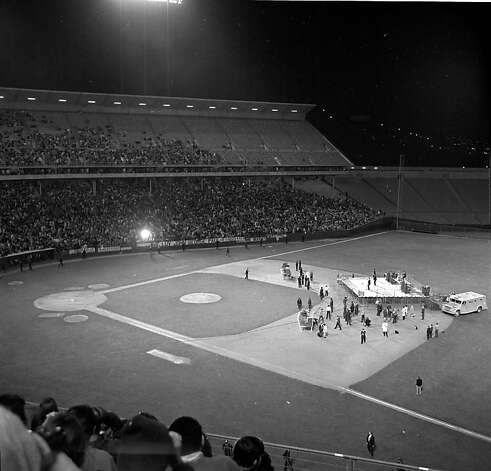
I was recently fortunate enough to go see Paul McCartney perform at Dodger Stadium.  Yes.  I do have interests other than just baseball.    As I watched  Sir Paul perform "I Saw Her Standing There", one of the earliest Beatles songs, I started to wonder had the Beatles played Dodger Stadium?  Had the four Liverpudlians ever stood on the mound where Sandy Koufax would have been pitching the day before or after?  After all, they had toured the country during the same years that the Dodgers were trying to win three straight World Series.

From there my thoughts led me to wonder what other baseball stadiums the Fab Four would have played.  What years were they in each one and what were the teams' fortunes when they appeared there?  Had they played in a stadium of a World Series Champion?

Why don't we take a look at their tour schedule and see what we can find about their tour of baseball stadiums:

1/12/64:  The Beatles had been riding the success of "She Loves You" as they toured the UK in late 1963.  Their new single, "I Want to Hold Your Hand" was released in the UK on 11/29/1963, just about a month before the US release.  There had been a million pre orders for the song and when it was actually released in the US on 12/26/1963  it stood at #45 on the charts.  The Beatles had already conquered  Germany and Sweden and were wrapping up a UK tour.  The boys were home For the holidays in 1963, playing Liverpool on 12/22 and London on 12/24 and 12/26.  The London stay extended trough the first few weeks of January and on 1/12 they played the second night of a two night stand at the Palladium in London.  It was the last stop on the UK tour.  The next leg would be in France.

2/4/1964:   The tour was enjoying success in France as they had in Sweden, Germany and at home.   The tour kicked off in France in Versailles on 1/15.  While they played France for a few weeks the US was starting to suffer from Beatlemania.  The demands for the Beatles was increasing and on 2/1 the US charts revealed the Beatles were a the top, ahead of "You Don't Own Me" by Leslie Gore.  On 2/4 the Beatles played the last show of their French tour. On 2/7 they boarded Pan Am Flight 101, known as the  "Yankee Clipper" and left for America.  Of course they played the Ed Sullivan Show. They later moved on to play the Washington Coliseum, Carnegie Hall and the Deauville Hotel in Florida.  Don't forget this was a winter time tour, mostly in the northeast and before Major League Baseball was played in Florida so there were no baseball stadium stops on their first trip.


8/19/1964:  After a brief return to England it was off to Scotland, Denmark and Hong Kong then on to Australia and New Zealand.  Beatlemania was now a world wide phenomenon.  On June 3 Ringo had been admitted to the hospital and missed part of the Australian tour, replaced by Jimmy Nicol.  Realizing it had only been a few years since he had replaced Pete Best, Ringo rushed to return to the group. The tour continued back to England with a few days here and there in Sweden and it was time to return to the US.  The first US visit had focused on the east coast.  Now they would move on to the west coast.  Their first stop this time was Daly City, CA.  It was only a month  after the release of the "Something New" US album but the set list did not reflect the new album.  The set featured "Things We Said Today" from the new album but the US Single (set for release in a week) "Matchbox" and the B-side "Slow Down" were not featured. Instead, Ringo performed "Boys".  Heavily featured were songs from their current film "A Hard Days Night" including the title track, "Can't Buy Me Love" and "If I Fell".  From Daly City it was on to Vegas, Seattle and Vancouver but still no baseball stadium visits

8/23/1964: On August 23rd in Los Angeles the Dodgers took on the Reds at Dodgers Stadium.  It was a Sunday afternoon game.  The Dodgers were having a poor season thanks to arm problems for Koufax and Drysdale.  The Reds, on the other hand, were in second place behind the surprising Phillies.  The Reds were red hot, having won six straight, but were in a tumultuous season.  Their fiery leader Fred Hutchinson had announced on 1/3/1964, just before the Beatles headed off to France, that he had been diagnosed with throat cancer.  On 8/12, just before the start of the current winning streak, a weak and tired Hutch stepped down.  The Reds now had a purpose and a rallying cry.  On 8/23 they faced the Dodgers at the stadium.  The Reds sent Jim O'Toole to the mound to keep the streak alive.  The Dodgers countered with Phil Ortega, Not exactly Koufax.  The game was scoreless in the bottom of the third when Nate Oliver opened the inning with a double.  Phil Ortega sacrificed Oliver to third and the Reds walked Maury Wills.  Dick Tracewski singled scoring Oliver. It would be the only run of the game and the Reds winning streak ended.  As the Dodgers fans left the stadium their euphoria may have quickly melted into frustration.  The 101 freeway would have been a parking lot.  Just 8 miles away just off the same 101 that feeds into Dodger Stadium, Beatlemania was erupting at the Hollywood Bowl.  Of course the Hollywood Bowl is not a baseball stadium.  although this concert would be one of the most famous in the Beatles history.  In 1977, as the world was still clamoring for anything new from The Beatles, who had disbanded nearly a decade before, Capitol Records released "The Beatles Live at the Hollywood Bowl".  The album would include the 8/23/1964 performances of "Things We Said Today", "Roll Over Beethoven", "Boys", "All My Loving", "She Loves You" and "Long Tall Sally".


From Hollywood it was on to Red Rocks Amphitheatre in Colorado, Cincinnati (they did not make a stop at Crosley Field where the Reds had lost to the lowly Mets the day before), two nights at the Forest Hills Tennis Stadium in New York (just three weeks before Bob Dylan had debuted on the same stage with a backing band known as "The Hawks" but would later go on to become The Band), Atlantic City, Convention Hall in Philadelphia, the Indiana State Fair, Milwaukee Arena, the International Amphitheatre in Chicago, Olympia Stadium in Detroit, Maple Leaf Gardens in Toronto.  The tour seemed to go on forever. Montreal, Jacksonville, Boston  (The Gardens, not Fenway), Baltimore, Pittsburgh, Cleveland and New Orleans.  By now it was mid September.  The Beatles baseball stadium tour was about to make the first ever stop.

9/17/1964: Kansas City has long been a baseball town, although it was not always a Major League baseball town.  As far back as 1884 the Kansas City Cowboys played in the Union Association.  The Kansas City Monarchs proudly represented the city in the Negro Leagues with players like Buck O'Neil and Jackie Robinson.  As the 1940' turned to the 1950's cities could no longer support two teams.  Boston now belonged to the Red Sox and the Braves moved on to Milwaukee.  St.Louis now was only Cardinal territory as the Browns moved to Baltimore.  Philadelphia was no different.  The once powerful Athletics of Connie Mack were now a financial mess.  They were purchased by banker Arnold Johnson and moved to Kansas City in 1955.  Five years later, as Johnson was watching the A's spring training camp, he passed away. Enter Charles O. Finley. One of the least liked owners in the game (by commissioners, owners and players) Finley made his fortune in insurance sales.  When Johnson passed away Finley swooped in and bought the struggling franchise.  He knew the A's were not very good and he knew there had to be ways to bring fans to the stadium.  He would invent ways, some called them gimmicks, to get attention.  There was the mechanical rabbit named Harvey that popped up behind home plate to hand the new balls to the umpire.  There was the Donkey for a mascot named Charlie O (leading to the obvious joke of Finley naming a jack ass after himself).  Finley wanted to get people to the stadium and nothing in the world could draw people like the Fab Four.  The Beatles had one open date on their tour: September 17.  The tour had become a long nightmare.  Ear splitting screams.  Trains, Cars, Planes.  Hotels.  Hiding from fans.  They were all looking forward to the day off.  Finley didn't care.  The Beatles reluctantly signed on, giving up their off day.  Not only was it a work day, it was a long one.  It started with a press conference.  In proper Beatle fashion the boys gave quick, humorous answers.  When a reporter began to ask what they would do after the mania ended,  George finished his question with "after the bubble bursts?" Paul said that he and John would continue songwriting but George would go on to play basketball.  "Or roller skating.  I haven't decided yet," George continued. So why basketball and not baseball?  One reporter asked if they liked baseball.  John responded "Not particularly." Paul responded with "Ooh, very good game Mr. Finley.  Very nice."  John explained himself "only on TV."  Ringo was more direct.  "You throw the ball and then another ten minutes you smoke a cigarette then throw another ball."  Whether they liked baseball or not, they liked Kansas City enough to open up the Municipal Stadium set with "Kansas City/Hey Hey Hey".  It was followed with "You Can't Do That", "All My Loving", "She Loves You", "Things We Said Today", "Roll Over Beethoven", "Can't Buy Me Love", "If I Fell", "I Want to Hold Your Hand", "Boys", "A Hard Day's Night" and "Long Tall Sally".  The set lasted roughly thirty minutes meaning the boys were paid about $5000 per minute.


As the baseball season moved along so did the tour.  In the American League the White Sox fought the Yankees down to the wire with the Yankees narrowly winning the pennant.  In the National League the Phillies had one of the greatest collapses of all time as the Reds and Cardinals closed the gap in one of the tightest races ever.  On the tour the Beatles juggernaut was wrapping up.  They played Dallas on September 18 and New York on September 20.  Then it was back to Australia briefly before returning home to the UK.

Their 1965 tour would take them all over Europe.  Italy, Spain, Germany, France.  They would return to the United States for another concert tour and another appearance on the Ed Sullivan Show on 8/14.  The next concert would be one of their most iconic.

8/15/1965:  The Beatles had released the US version of their soundtrack for their film "Help!" the day before (the UK version had been released on 8/6) and their popularity had never been higher.  The Beatles were having every moment of their lives documented setting a new precedent for hysteria over celebrity.  A film crew followed them as they prepared for a concert at Shea Stadium.  To this point in the history of the stadium there were few positive memories.  There was Opening Day of the stadium in 1964.  Then of course there was the All Star Game in 1964.  Other than that it had only seen a lot of losing baseball by the home team.  The Mets play got more laughs than a Beatles press conference.  In their fourth season the Mets saw little improvement and just a month before the Beatles took the stage the New York icon Casey Stengel had stepped down as manager.While Stengel's legend was ending, The Beatles'  legend was about to grow.  On a hot summer New York night the band kicked off the evening with "Twist and Shout".  The set list that followed heavily reflected their recent release with songs from the soundtrack.  The set included "Everybody's Trying to Be My Baby", "Act Naturally", "Help!", "Ticket to Ride" and "Dizzy Miss Lizzy". The final song of the evening provided an iconic Beatles moment.  As Paul sang "I'm Down" John started playing the organ with his elbow causing the other members to break into hysterics.


8/20/1965: The tour continued and the traveling strain must have been tremendous.  They went to Toronto, Atlanta (still a year from getting the Braves) and Houston.  On 8/20 they played in Chicago.  The home town White Sox were on the road and were red hot.  In fact, while the Beatles were playing in Comiskey Park, the White Sox were busy in Kansas City winning their seventh straight in what would become a ten game winning streak.  The fifth place White Sox, who had finished a close second the year before, would finish the 10 game winning streak by climbing into second place but were still  6 1/2 games out of first. The team they were chasing would be the resident of the next stop for the tour.

8/21/1965:  Baseball in Minnesota was relatively new.  In 1961 The state had attracted the failing Washington Senators, a team that had not reached the post season since 1933.  Although they had left the nation's capital as a joke, they actually had a nice collection of talent.  They would not immediately compete in their new surroundings but they were building to something.  1965 was when it all came together.  The Twins took over first place in the American League on July 3 and would not relinquish the lead.  On August 21, as the Beatles played Metropolitan Stadium, the home town Twins were beating the Angels to maintain an 8 game lead over first.  A few months later, this same facility would see one of the great Game 7 pitching duels in World Series history.

The 1965 tour would wind up with stops in Portland, San Diego (still a minor league town), two nights at the Hollywood Bowl and ending in Daly City, CA.  By the time the Beatles came back to the states the attitude of fans would be drastically different.

For the next several months the group stayed close to home playing all over England and recording their next album, Rubber Soul.  The summer tour would start in England but quickly headed to Germany and Japan followed by the infamous stop in Manila.

In March of 1966 John Lennon had made a comment in an interview in London claiming that at that time the Beatles were more popular than Jesus.  The discussion was about the issues the Catholic Church in England was having with attendance at services and not about Lennon's inflated view of the band.  The discussion was taken out of context in the United States as the band prepared for their tour of the states.  In early August the southern states erupted in a fury over the interview and "Beatle Burning" parties were very popular events.  The tour went on  regardless. It kicked off on 8/12 in Chicago then on to Detroit (though they again avoided Tiger Stadium).

8/14/1966: Their next stop was Cleveland where they played at Municipal Stadium.  The Indians were in 3rd place, although at 13 games behind the league leading Baltimore Orioles they were not exactly in contention.  The Indians had been on the downward trend over the last few years and it was a slide that would continue for quite some time. While the Beatles were more popular than Jesus, the Indians were struggling for popularity in their own backyard.  The Beatles played 11 songs, none of which came from the Revolver album which had been released just a few weeks before.

8/15/1966: While the Beatles tour left Cleveland and landed in DC, the new Senators landed in Cleveland.  The Senators were a struggling team.  They had been added to the league when the original Senators left for Minnesota.  They would lose that night, something they would do 88 times that year.  The Beatles would give fans at Washington Stadium (later renamed Robert F. Kennedy Stadium) something to cheer about.  Playing a set identical to the one in Cleveland the night before the Beatles continued to thrill the young fans, although the band themselves were growing tired.  They moved on to Philadelphia where they played JFK Stadium.

8/21/1966:   The next stop for the Beatles was Crosley Field in Cincinnati.  While the Beatles were having their ears blown out by ear piercing screams, the Reds were in Houston getting blown out by the Astros. The Reds had traded their star Frank Robinson before the start of the year and the results this season were not what they expected.  The Reds sat in 6th place.  They would finish in 7th.  For the Beatles, they were focusing on an end to the tour that had become a burden to them rather than an exciting adventure.  They played the same set as they had in Cleveland and DC.

8/22/1966: It was now on to St.Louis and Busch Stadium.  It was the same set of songs.  It was the same process.  The tour was getting to be a nightmare.  The Cardinals were suffering through a nightmare season themselves.  Just two years removed from a World Series title, the Cardinals now sat in 5th place, nearly ten games out of first.

8/23/1966: From Busch it was on to New York and a return to Shea Stadium.  While the Beatles' had suffered a tumultuous year since they had last played there, the Mets' fortunes had taken a slight upturn.  Very slight.  They were still a very bad team but at least they were not in last place.  Even better, they lost less than 100 games this year.

8/28/1966: The tour moved on to Seattle on 8/25 then moved to southern California for an 8/28 stop at Dodger Stadium.  Los Angeles was the defending World Champion.  While the Beatles were ready to set up the stage in the outfield the Dodgers were engaging in a struggle with their rival, the San Francisco Giants.  The two teams were in a fierce struggle with the Pirates and were separated by only one game.  The Dodgers won that day, giving them two of the three games in the series.  The Beatles took to the stage that evening knowing that their tour was almost done.


8/29/1966: This was it.  While the Dodgers moved on to New York to play the Mets, the Giants moved on to play the Phillies in Philadelphia and the Beatles moved into Candlestick Park.  They had not told anyone yet, and had not really even discussed it as a group, but this was the end of the tour and the end of touring.  The set list was the same as it had been all tour, with one exception. the final song of the tour was "In My Life".


The Beatles would not play live in public again until January of 1969.  It would be their swan song on the rooftops of London.  The world had changed quite a bit in the time that the Beatles toured the US and so had the game of baseball.  When the Beatles came to the US the Yankees were the dominant team.  By the time they were done touring the Orioles and Cardinals were on their way to a league domination and the Yankees were headed into one of the darkest periods of their history.


TRIVIA QUESTION:
As the great American game, the majority of players in Major League Baseball history were born in the United States (nearly 88%).  How many players in MLB history were born in the UK?

Answer to Last Week's Question:
Congratulations to TJD for answering last week's trivia question.
A.L. East: Red Sox (71-91)
AL: Central:Twins (70-92)
A.L. West:Rangers (67-95)
N.L. East:Phillies (73-89)
N.L. Central:Cubs (73-89)
N.L. West: Diamondbacks (64-98)

Saturday, December 6, 2014

The Tragedy of 2014

Like all seasons the 2014 season had some great moments, as we reviewed last week.  Of course, as with every year,  it also had some sad and some controversial moments.  Not all the moments listed were tragic but the moments listed below were definitely the negative moments of the year.

Alex Rodriguez:
It seemed, for quite some time, that this was the story that would never go away.  Alex Rodriguez was threatening to sue everyone in the world.  Even after his suspension was announced he still said he was going to show up to the Yankees' Spring Training camp.  Rodriguez was suspended for the entire 2014 season and has not been heard from in months.  What will happen when his suspension is lifted?  No one knows.


Jean Segura's infant passes:

Jean Segura is an up and coming shortstop with the Milwaukee Brewers. His name is not one the casual fan necessarily knows immediately, but Segura was in the middle of a great season (his second straight great season) when his whole life changed.  Segura's son, just short of his first birthday, passed away suddenly. As the rest of the league was heading home for the All Star Break, Segura was heading home for his son's funeral.

Fernando Rodney's hat:

Fernando Rodney wears his hat slightly cocked to the side.  He is not the only person.  There are  plenty of players who wear the hat just slightly off center.  It has been questioned as far as the fashion sense but no one ever really had a problem.  Rodney had alternately described his reasoning as a tribute to his deceased father or just a fashion choice.  The controversy arose when Joe Buck stated during the All Star Game that Rodney had said he did this to confuse the batter.  Since the pitcher is not permitted to deceive the batter the hat became an issue.  In the end the talk about the hat was loud on sports talk radio but not really a blip on the league's radar to this point.

Wainwright's All Star Game:
Adam Wainwright was chosen sot start the All Star Game for the National League.  There were many who felt that the Dodgers' Clayton Kershaw was the better choice and that Wainwright was only chosen because his manager Mike Matheny was the manager of the NL team.  It is a controversy that happens at least once a year.  The real controversy came when social media ran with a story that Wainwright implied that he had grooved a pitch to Derek Jeter, making his final All Star Game appearance.  The fact that there was a controversy over a simple base hit in an All Star Game shows that baseball gets it right when it comes to their All Star Game.

Jerry Coleman (9/14/1924 - 1/5/2014):

Coleman played nine years in the Major Leagues, all of them with the New York Yankees.  In 8 of those nine years he played on a team that reached the World Series.  In six of those seasons he saw time in the fall classic and won.  He finished third in the Rookie of the Year voting in 1949 (behind Roy Sievers of the Browns and Alex Kellner of the A's).  He was an All Star in 1950 and he was a popular player in the Yankee locker room.  Coleman had also lost several years worth of baseball time while serving in the military in World War II and the Korean War.  Coleman spent several years in the front office of the Yankees and did play by play for the pinstripes as well as CBS' Game ofthe Week.  He really gained his notoriety in San Diego.  From 1972 until 2013 Coleman broadcast the Padres' radio games and put his personal touch on each game.  He became famous for his humorous statements, much in the vein of Yogi Berra.  Some examples were saying a player was "not hurt as much as he is"  or that a player "started out here with the Astros and before that was with the Orioles" and that someone "stole second standing up.  He slid but he didn't have to". Listening to Coleman was always entertaining and it was a tremendous loss to the Padres' organization.  It was just the start of a dark year for the Padres.

Jim Fregosi (4/4/1942 - 2/14/14)

Fregosi managed for 15 years.  He twice won the Manager of the Year (1988 and 1993). He managed the Angels to their first ever playoff appearance in 1979 and the Phillies to their first World Series appearance in 10 years 1993.  That is how our generation knows him but he was much more than that.   He also played the game for 18 years with the Angels, Mets, Rangers and Pirates. He was a 6 time All Star, received votes for MVP 8 times and won a Gold Glove.  At one time Fregosi was considered potentially one of the great Short Stops of all time.  Fregosi was one of the first Angels' stars but was traded to the Mets as part of a deal that brought Nolan Ryan to Anaheim.  Later, when Ryan was dominating the AL for the halos, Fregosi was his manager.  Few managers in the 1980's and 1990's were more sought after.  Fregosi suffered a stroke this past winter and passed away.

Ralph Kiner (8/27/1922- 2/6/2014)

Ralph Kiner played 10 years in the Major Leagues and made 6 All Star Games and received MVP votes seven times.  Kiner led the National League in Home Runs every year from 1946-1953 and finished his career with 369 Home Runs.  At one time the Pirates organization was not sure of the direction Kiner's career would take.  Fortunately for him Hank Greenberg, in his only year in Pittsburgh, took Kiner under his wing and helped him reach his potential.  Following his retirement Kiner entered broadcasting and broadcast for the Mets beginning in their first year of 1962.  He was elected to the Hall of Fame in 1975.

Bob Welch (11/3/1956 - 6/9/2014):

Bob Welch played 17 years in the Major Leagues and won more than 200 games.  He was a two time All Star, 1990 Cy Young Award Winner and played on 8 playoff teams.  Starting with the Dodgers in 1978 Welch made a postseason impact as a rookie when he struck out Reggie Jackson in the World Series.  It would be the first of many great postseason moments for him as he helped the Dodgers win the 1981 World Series.  He was traded to the A's in 1987 as part of a giant three team trade.  He teamed with Dave Stewart to help the A's dominate the American League from 1988-1990.  Welch was also the pitching coach for the 2001 World Series Champion Arizona Diamondbacks. He passed away from a heart attack at only 57.


Don Zimmer (1/17/1931 - 6/4/2014):

Few people have the longevity of a career like Don Zimmer.  As a player Zimmer played in 12 years for the Dodgers, Cubs, Mets, Reds and Senators.  In 1961 he represented the Cubs as an All Star.  His legacy came mostly after his playing days.  He managed the Padres, Red Sox, Rangers and Cubs.  He managed the Red Sox during the 1978 season that resulted in Bucky Dent's famous Home Run.  He also managed the Cubs to the 1989 NLCS.  Zim's impact was most felt as a coach.  Wherever he went success seemed to follow.  He helped Don  Baylor on the Rockies staff as the young organization made the playoffs in 1995.  He more famously served as the bench coach for the Yankees dynasty in the late 1990's-early 2000's.  He passed away this year at 83.

Tony Gwynn (5/9/1960 - 6/16/2014):

It was a tough year for the Padres family. They lost Jerry Coleman in January then lost Tony Gwynn in June.  Both were referred to as Mr. Padre.  Gwynn made his debut with San Diego in 1982 and was an integral part of the team's only 2 World Series teams.  Gwynn won 8 batting titles, made 16 All Star games, won 5 Gold Gloves and 6 Silver Sluggers, 10 times won player of the week, 5 times won player of the month and was an obvious first ballot Hall of Famer.  More than that Gwynn changed the way players approach the game of baseball.  Gwynn was the first player to regularly use video to break down opposing pitchers.  Gwynn was also one of the classiest, most likable players the game has ever known.

Machado vs A's:
This all started with the Orioles-A's series in mid June.  Machado was on his way to third when Josh Donaldson of the A's tagged him out.  Machado took offense to the tag and the benches cleared.  Everything settled but as the series progressed the A's claimed Machado hit the A's catchers with exaggerated back swings.  In the final game of that series A's pitchers started throwing inside to Machado, which he felt was intended as intimidation.  Machado's response was to lose his grip on the bat and send it hurtling towards third base.  The benches emptied again but no punches were thrown.  After the series the A's had plenty to say about Machado and he apologized.  Fast forward to the end of July when the Orioles traveled to Oakland for a weekend series. In the first game of the series Machado hit a late inning Home Run that looked like it would give the O's the win.  Instead, the A's won it with a walk off, 3 run Home Run from Donaldson.  The war of words was an ugly exchange that led to suspensions and was definitely not one of the positive moments of 2014.

Giancarlo Stanton:
The Marlins surprised a lot of people this year (including myself) by hanging in the Wild Card race deep into the season.  The main reason for their success was the leadership and performance of Giancarlo Stanton.  With just a few weeks left in the season Stanton took a fastball to the face, effectively ending what was arguably an MVP season.

Think I missed something from the 2014 season?  Let me know in the comments.

TRIVIA QUESTION: 
Since we're focusing on the negatives of the 2014 season, we'll make this week's trivia question a negative as well.  Although it is almost two full months since the start of the playoffs I hope everyone still remembers that the Nationals, Cardinals and Dodgers were division winners in the NL with the Giants and Pirates as wild cards.  In the AL the Orioles, Tigers and Angels won their division while the Royals and A's were the Wild Card teams.  So the question is what teams finished in last place in each division for 2014 and which had the worst record?

Answer to Last Week's Question:
The Brewers organization has had some success as an organization although the last 10 years have likely been their most sucessful.  The Brewers last made the playoffs in 2011.  They beat the Diamondbacks in the NLDS and lost to the Cardinals in the NLCS.

The Seattle Mariners went 116-46 in 2001.  It is one of the great regular seasons in history.  They beat Cleveland 3 games to 2 in the ALDS but lost to the Yankees 4 games to 1 in the ALCS.They have not been back since.

The Blue Jays are the youngest team in this group although they have really had the most success historically.  The Jays entered the league in 1977.  Their playoff appearances became fairly regular things.  The Jays made the playoffs in 1985, 1989, 1991, 1992 and 1993 with near misses in 1987, 1988 and 1990.  Toronto won back to back World Series in 1992 and 1993 but have not been back since.

Kansas City reached the World Series this year.  It had been a long drought for the Royals franchise.  The franchise joined the league in 1969 and made the playoffs in 1976, 1977, 1978, 1980, 1981, 1984 and 1985.  Although they played well in other seasons and came close to playoff berths, the franchise made the post season this year for the first time since 1985.