Showing posts with label Game 6. Show all posts

Saturday, November 3, 2012

Greatest World Series Moments: Greatest Game Ever Part 2

"Into deep centerfield for Mitchell...and we'll see you tomorrow night!"

Jack Buck made the now famous call as Kirby Puckett blasted a walk off home run in the 11th inning of Game 6 of the 1991 World Series.  Buck had made some of the most famous home run calls in history.  He had told St.Louis fans to go crazy when Ozzie Smith hit a game winning LCS home run.  As Kirk Gibson struggled around the bases he told the world that he couldn't believe what he just saw.  The Metrodome was deafening with shouts of "Kirby! Kirby! Kirby!".  It was the first time a World Series game ended on a home run since Carlton Fisk hit his famous Game 6 home run in 1975.

Regardless of what happened in Game 7, this could hardly be called anything but the greatest World Series of all time.
  • Two of the first six games were decided in extra innings.
  • Nearly every game had a controversial play.
  • Tempers flared on several occasions as players collided at the plate, tangled on the base path and disputed umpire decisions.
  • With the exception of the Game 5 14-5 blowout, every game was decided by 3 runs or less, 4 of them by one run.
  • 4 games were decided on the last at bat (and another was decided with a tie breaking bottom 8th inning run by the Twins).
  • Both teams could be considered underdogs.  It was the first time in history a team had jumped from last place the previous season and reached first place.  Both of these teams had done it in the same year!

(Dan Gladden collided with Greg Olson at the plate early in the series.  One of many plays that caused tempers to flare.  Gladden would play a big role in Game 7)
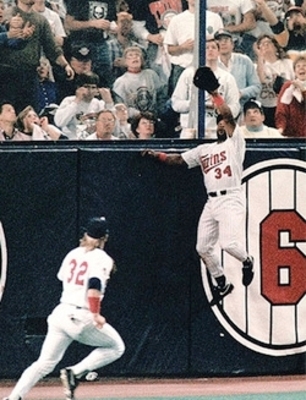
 
If Game 6 had ended this World Series it would have been impossible for anyone to be disappointed, yet, if it had ended after Game 6 we never would have seen the greatest World Series game ever played.

(Kirby Puckett, seen here making a game saving catch in Game 6, carried the Twins to a season saving Game 6 win.  In one of the greatest World Series of all time Game 6 was a close second to Game 7 for the best game of the Series).
 
This series was a convergence of the World Series past and the World Series future.  The Braves were a young team but they had plenty of players who had played in a World Series before: Terry Pendleton (1985 and 1987 Cardinals), Lonnie Smith (1980 Phillies, 1982 Cardinal, 1985 Royals), Charlie Leibrandt (1985 Royals).  The Twins had much more experience in the World Series: Brian Harper (1985 Cardinals) Kent Hrbek, Greg Gagne and Kirby Puckett (1987 Twins), Jack Morris (1984 Tigers).

There were also players on both teams who were young, inexperienced and with a bright future.  The list of names would tell the story of the World Series for the next ten years:  John Smoltz, Tom Glavine, Steve Avery, David Justice, Ron Gant, Mark Lemke, Chuck Knoblauch, Chilli Davis.
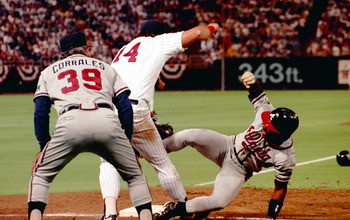
(In game 2 controversy erupted as Ron Gant was called out.  On a play at first Gant's momentum seemed to pull him off the bag as Hrbek kept the tag on Gant's leg.  Replays are hard to tell but Gant has always argued that Hrbek Pulled him off the bag.)


The series also made clear the impact of free agency on the league.  Trying to draw a family tree to connect all of these people would look like a spider web.  For example, Lonnie Smith had played with Terry Pendleton as a Cardinal, then played against Pendleton as a Royal in 1985 and now played with Pendleton again as a Brave.  Similarly, Brian Harper had played with Lonnie Smith and Pendleton as a Cardinal, then played against Smith in the 1985 World Series and now played against both as Braves. 

The connections like these were endless but no two players were more connected than the two starting pitchers.  John Smoltz was born and raised in Detroit as a Tigers fan.  If you were a pitcher in Detroit at that time there was no one you idolized more than Jack Morris.  Smoltz's childhood dream came true when he was drafted by the Tigers in 1985.  Unfortunately for Smoltz, he was traded before he had a chance to pitch with his idol.  On August 12, 1987 he was traded to the Braves for Pitcher Doyle Alexander.

(John Smoltz grew up in Detroit idolizing Jack Morris.  He wanted nothing more than to pitch with Morris as a Tiger.  He was traded to the Braves in 1987.  In the greatest game ever played Smoltz got to face off against his childhood idol.)


Jack Morris grew up in the Minneapolis area.  He had pitched for the Detroit Tigers his entire career.  But being a free agent and less than impressed with the offer from Detroit, Jack Morris came home.  Morris was the winningest pitcher in the decade of the 1980's, won a World Series title for the Tigers in 1984, threw a no-hitter and now he tried to bring a World Series title home. 

There was no bigger stage in the world and no better way to live out a child hood dream than to beat your idol face to face.  What we were about to watch would be passed down in history as the John Smoltz/Jack Morris show but it was anything but that.  In a World Series where excitement came from everywhere, the final game would give nearly every player on either team a chance to impact the outcome.

The game started with Lonnie Smith offering a handshake to Brian Harper as Smith stepped into the batters box.  Unbeknownst to everyone, that was the sign that this game would be different than anything you've ever seen.  Jack Buck compared it to two heavyweights shaking hands before they beat each others brains in.  If Buck only knew what a good comparison it would be...

Both teams went easily in the first, although Morris was less than happy with the balls and strikes being called by the home plate umpire.  In the first few innings Morris would continually stare in at the plate after close pitches were called balls.  Morris was pitching masterfully but that doesn't mean Atlanta didn't have chances to score.  In the second Dave Justice reached second but was stranded there.  Atlanta left 2 on in the third and and another in the 4th.  Jack Buck reminded everyone that "you only get so many chances."

Smoltz had the same success.  The Twins had two runners on in the third and couldn't score.  Dan Gladden led off the third with a double but  could not score.  In the 4th Kent Hrbek, who seemed to always be around the controversy in this series, was told by the umpire that he was hit by a pitch.  It was not hard, it may have grazed his forearm.  Hrbek hadn't reacted but the umpire told him to get down to firstbase. Hrbek wouldn't argue but Bobby Cox, the Braves manager, loved to argue everything.  He came out and berated the home plate umpire to no avail.  It didn't matter anyways, Hrbek never moved past first.  The game was almost half over and no one had scored. 

A playoff game that remains tied through the first three innings begins to increase in intensity as each at bat comes and goes.  In a Game 7 of a playoff series the emotions are amplified.  In Game 7 of a World Series the emotions are off the chart. Some players start to envision themselves as the conquering hero and stride to the plate with confidence, then walk back to the bench like everyone else.  Other players start to fight the fear that any minor mistake could lead to the big run and start to envision themselves  as the next Bill Buckner.  Fans start to inch up on the edge of their seats, rock back and forth to suppress stomach cramps, any sort of movement to momentarily calm their strained nerves.  It becomes less of a confidence of what your team will do and more a worry about what the other team will do.

They moved to the 5th scoreless.  It looked like things were starting to tip in the Atlanta's favor.  Mark Lemke, who had been a part time player for three years with the Braves and was forced into a starting role due to a late season injury to Jeff Treadway would hit .417 in the series, led off with a single and moved to second on Rafael Belliard's sacrifice bunt.  Lonnie Smith followed and seeing the Twins thirdbaseman playing back, laid down a bunt and beat out a close play.  Lemke moved up to third.  Pendleton followed this with a pop fly to shortstop.  That brought up Ron Gant, one of the young rising stars in this Atlanta lineup. He had been compared to a young Willie Mays with unlimited potential.  He hadn't had a bad series but he was 0 for his last 7.  This was his chance to put the Braves ahead.
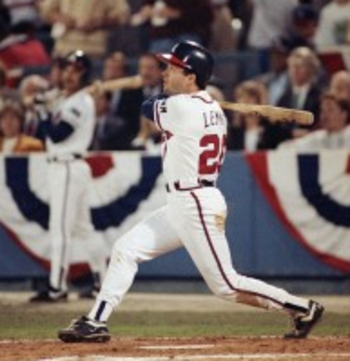
(Mark Lemke was the unexpected hero of the Braves World Series team.  He hit .417 in the series.  He would go on to have a strong major league career but would always be remembered for his performance in this series.)

But first, on the 1-1 pitch, Morris threw a split finger fastball in the dirt.  It was a bad pitch and it was not where Harper expected it.  It hit the dirt, bounced up, hit Harper's mask and rolled out in front of the plate.  The ball was rolling slowly towards Morris, away from Harper.  Harper was undecided on whether to go out after the ball and leave the plate unguarded, or let Morris get it.  Meanwhile, Lemke, sensing the hesitation came screaming down the line.  Morris leapt off the mound and grabbed the ball, Lemke stopped, turned and ran back to third.  Morris threw the ball to Pagliarulo at third.  Pags was a veteran and few played the bag better.  He waited for the ball with one knee on the ground, blocking the bag.  Lemke launched himself, feet first, toward Pags.  Lemke and the ball arrived simultaneously.  Lemke, somehow, found the one spot left open at the bag and slid in as Pagliarulo fell over top of him showing the ball to the umpire with outstretched arms.  The Braves hadn't scored but there was still danger.  Before making another pitch Morris tried a pick off to first.  Lonnie Smith dove back on a close play but he was safe.  Two near third outs  now Morris had to face Gant.  The count went to 3-1.  Morris didn't want to walk Gant and face Justice with the bases loaded.  Gant fouled off the next pitch for a 3-2 count.  The next pitch was a fastball on the outside corner.  The umpire hesitated, just slightly, then called Gant out.  Gant dropped his bat, stared at the umpire.  Morris leapt off the mound, pumped his fist and screamed at the top of his lungs.  Still scoreless.

The bottom of the fifth and the sixth went quickly.  Kirby Puckett reached first in the sixth but any chance at a Twins rally was erased as Sid Bream, the Braves firstbaseman, turned a 3-6-3 double play (that's firstbase to shortstop to firstbase for the casual fan).  It is one of the most unusual and difficult double plays to turn.  Both pitchers were starting to hit their stride.  Morris retired 8 in a row and Smoltz cruised through the middle innings.

The stress and pressure continued to grow as the game progressed.  Someone had to score sometime.  Philosophically the game could go on infinitely if no one scored but realistically at some point some one would score.  It was impossible to believe that every time someone came close to scoring some miracle play would keep the game scoreless.  And yet...

Lonnie Smith led off the 8th with a single. Pendleton appeared to have struck out but the thirdbase ump ruled that he had fouled the ball and Harper had failed to hold onto it.  Given a second life, Pendleton, the 1991 MVP of the National League, ripped a pitch into left-center.  Smith was moving on contact and with his speed he should score easily, nothing could stop that.  1-0 Braves.  As the ball left Pendleton's bat, Jack Buck was speechless, confused for a second.  "Lonnie Smith is held at third and he didn't do very good baserunning there."  What the hell happened?  He should have been able to jog home!

As the ball left Pendleton's bat Smith lost track of the ball.  He knew it was a hit but he couldn't see where.  The next thing he saw was Chuck Knoblauch at secondbase, throwing to Greg Gagne, the shortstop.  How the hell did the ball get from left-center to the right side of second?  It didn't.  Knoblach made a last ditch effort to confuse Smith and it actually worked.  Smith realized there was no ball, too late, now he had to figure out where it was.  Jimmy Williams, the third base coach, was screaming, almost shrieking to get Smith to run.  Smith rounded second, and stopped, looked to the outfield, leaned towards third, leaned some more.  It took five seconds but he saw it.  There it was!  He took off for third and reached it easily, angry at himself.  No problem.  Second and third, no out.  The Braves were in business. 

Gant came up, again with the chance to be the hero.  He grounded to Hrbek at first.  1 out.  Runners hold.  David Justice was walked to load the bases.  It was a desperate move by a desperate team.  Only a strike out or a double play could really help the Twins.  Sid Bream bounced a ball down to Hrbek at first.  Smith was off from third base on contact.  He had good speed.  Hrbek fielded it and threw home to Harper.  2 outs, good enough but not good enough for Hrbek and Harper.  Knowing that Bream was a horrible runner (he had a brace on each knee), Hrbek threw the ball home and immediately got to the bag.  Harper had the same thought.  As soon as he heard the umpire call Smith out on the force at home he turned and fired the ball right back to Hrbek.  A 3-2-3 double play (that's firstbase to catcher to firstbase)!  It's almost unheard of to complete this play.  Hrbek took the trow, pumped his fist and screamed as he showed the ball to Morris, almost not believing it himself.  Another miracle play.
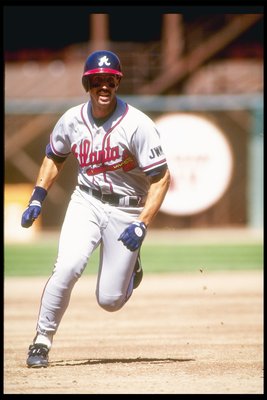
(Sid Bream was in his first year with the Braves after having left the Pirates.  Bream was an underrated, important part of Atlanta's drive to the pennant.  Casual fans saw him as a slow runner but few realized the pain he played with in both knees on a daily basis.)

Now it was the Twins' turn to threaten.  Randy Bush pinch hit for Gagne and led off the bottom of the 8th with a single.  He was replaced at first by Al Newman.  Gladden popped out leaving Newman at first but Knoblach, the 1991 AL rookie of the year, singled to right sending Newman to third.  Still only one out and Kirby Puckett, the Twins legend, at the plate.  That was all for Smoltz.  7 1/3 innings and no runs in a game 7 on the road.  You couldn't ask for more from a rookie.  With the crowd chanting "Kirby!, Kirby!, Kirby!" the Braves walked Puckett to face Hrbek with the bases loaded.  Here was the moment.  It had to happen here.  There was no way another miracle play could keep this thing scoreless.  And yet...

Hrbek connected on a 2-1 pitch and sent what looked like a sure hit towards second.  Lemke sprinted in and caught the ball in stride.  2 out.  Without hesitation he continued running and beat Knoblach back to second base.  Another miracle double play!  Game 7 of the greatest series of all time was moving to the 9th inning scoreless.

Morris was still pitching.  He was 36 years old, had thrown 246 innings in the regular season.  What was one more?  He got the Braves in order in the ninth.  The fans now knew that this was it.  The Twins would win.  Bottom of the ninth 0-0.  Chilli Davis led off with a single.  Harper tried to sacrifice him to second.  The ball found a little seam between the pitcher, firstbaseman and second baseman.  Mike Stanton, the Braves pitcher, chased the ball toward the hole between second and first, fielded it and as he turned and saw there was no play, he caught his spikes in the turf. He was carried off the field and replaced by Alejandro Pena.  All Pena did was get Shane Mack to ground into a double play.  2 outs but the runner moved to third.  A single would win it.  Pags was walked intentionally and Paul Sorrento had a chance to win it.  He didn't. 

(36 year old Jack Morris pitched all of Game 7 for the Twins.  No pitcher won more games during the 1980's than Morris.  1991 was his first year pitching for his home town team.)


Into the 10th inning. 0-0.  Each team had several chances, and other than Lonnie Smith getting stuck at second, there had been few mistakes.  These weren't blown chances.  These were miracles.  One after the other.  Morris came out and pitched the 10th and the Braves went down in order.  People wondered how long this could last.  At what point would someone blink?  When would someone make a mistake? When would someone be able to make it all the way around the bases?

Gladden started the bottom 10th with a broken bat, bloop hit into center.  Rounding first, Gladden saw Keith Mitchell ,the left fielder, jump to field the odd hop off the turf.  The ball hit off Mitchell's glove and got past Mitchell.  Gladden took off, full speed, for second.  What he couldn't see was Ron Gant directly behind Mitchell.  Gant fielded the ball immediately.  He was already in position to throw and he fired to second.  Lemke took the throw and smacked the tag on Gladden a second too late.  Gladden was safe and the Metrodome erupted.

Knoblach bunted Gladden to third and with one out Kirby Puckett walked to the plate.  Puckett was walked intentionally and Hrbek stepped to the plate.  Hrbek was walked intentionally.  Two straight intentional walks to load the bases with one out?  Why the hell not?  There were no rules right now.  Miracles were everywhere.  Because they had pinch run for Chilli Davis back in the 9th, Gene Larkin limped to the plate as the DH.  Larkin could barely walk.  His knee had been injured and was visibly swollen.  If there was a miracle double play left Larkin's lack of mobility would sure help.  The Braves pulled their outfielders in for a possible play at the plate.

Larkin swung at the first pitch and lifted a fly ball to left field.  Keith Mitchell ran after it but it was hopeless.  On contact Jack Buck screamed out "The Twins are going to win the World Series!  It's a 1-0, 10inning victory!"

i
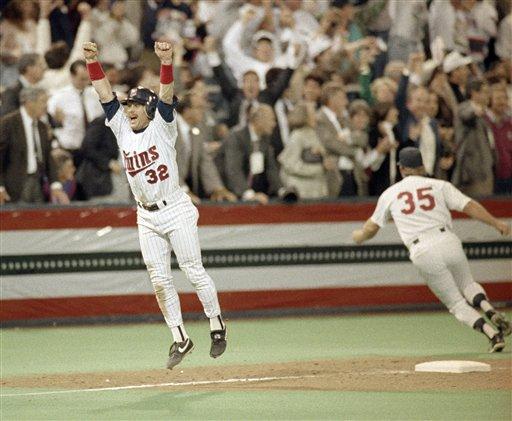
(Dan Gladden celebrates as Gene Larkin's pinch hit fly ball falls safely.  Gladden came home to score the winning run in the bottom of the 10th inning.  Gladden is currently a radio announcer for the Twins and is one of the most entertaining radio announcers in the league.  He often tells stories about the 1991 Twins and his days spent in Minnesota.)
 
As Gladden and Larkin were mobbed at home plate by their teammates, Mitchell slowly walked after the ball in left field.  Alejandro Pena dropped his head and walked slowly off the mound.  On the bench, John Smoltz stared in disbelief.  Greg Olson, the Braves young catcher, leaned back on the Braves bench next to pitching coach Leo Mazzone.  Stunned.

The Twins had won the greatest World Series in history but it would be hard to call the 1991 Braves losers.

Sunday, October 28, 2012

Greatest World Series Moments: Greatest Game Part 1

The Reds were ahead in the 1975 World Series three games to two.  Fenway Park was oddly quiet.  Even with a three run lead in the top of the fifth and one out the fans in Boston seemed to be waiting for something bad to happen.  At the half way mark there was little about this game that would lead anyone to think this was a classic.   

Ed Armbrister pinch hit for pitcher Jack Billingham, already the Reds third pitcher of the game, and walked.  Pete Rose followed with a single and suddenly, with Ken Griffey, Joe Morgan, Johnny Bench and Tony Perez due up next, the Fens buzzed with anxiety.

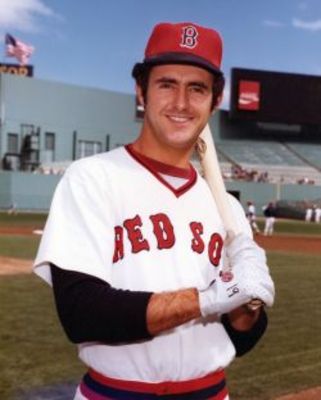
Fred Lynn was on the move with the crack of the bat.  He had already put the Red Sox ahead 3-0 with a first inning 3 run home run and now he had a chance to break the Reds' back with another sensational catch.  This was a rookie but you couldn't tell from his performance in the biggest week of the baseball season.  He tracked the ball towards left-center field, that big green wall.  It wasn't headed to the monster, it was that little angle where the odd dimensions of Fenway converge.  Fred Lynn had only played in this park for a year but he had learned to trust his abilities and trust the other outfielders.

(Fred Lynn had an amazing rookie year in 1975.  He became the first player to earn Rookie of the Year and MVP honors in the same year.  Not until Mike Trout, for the 2012 Angels, would another rookie have the impact that Lynn had for the 1975 Red Sox)

Griffey had driven the ball hard but Lynn knew that he had it.  Even if he didn't reach this ball Dwight Evans and Yaz would be there to play the ball off the wall.  He had the ball timed perfectly.  He took two strides onto the warning track and jumped toward the wall.  It was an amazing effort to reach the ball in the first place but this was what Freddie had done since he came up from the minors.  He stuck out his right foot to brace himself against the wall.  It was his first mistake all year.  The metal cleats hit the concrete wall.  No traction.  Moving at full speed the foot slipped straight down and his momentum twisted his body.  Suddenly, the back that had carried the Red Sox to one of the most improbable championship runs smashed against the concrete wall and Fred Lynn crumpled to the warning track motionless.  Fenway went silent, like a funeral. 


(Ed Armbrister was involved in a controversial play in game 3 that led to a Reds win.  He pinch hit in Game 6 and earned a walk, scoring on Ken Griffey's triple)

The ball shot off the wall and Dwight Evans was there to field it and fire it back into the infield but not before Armbrister and Rose had scored and Griffey stood on third with a triple.  New England held their collective breath as Yastrzemski, Evans, manager Darrell Johnson and the team trainer stood over a body.  It was a bad sign when Yaz had to help Lynn straighten out his legs which had staid in that position since he had hit the wall.

Eventually Lynn was helped up.  He rolled his head around a few times, did a few bends and nodded to the trainer that he was OK.  He got a quiet, reserved standing ovation from the Boston fans, but the moment had come.  This was the beginning of the end, Sox fans were sure.  Just like every other disappointing year since 1918. 

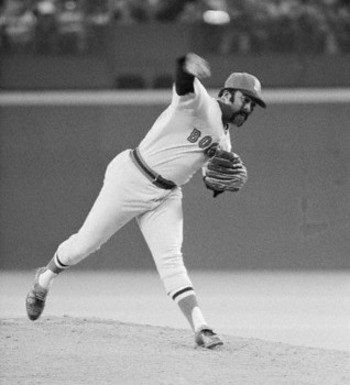
The Reds were able to tie the score in that inning but that was it.  The Sox weren't losing, but still, there was a sense of doom hanging over Boston as the city waited for the other shoe to drop.  It came in the top of the 7th.  Luis Tiant was the heartwarming story of the series.  His career had been resurrected in Boston after some tough years in Cleveland and Minnesota.  He now had a chance to become the first pitcher to win three games in one World Series since Denny McLain for the Tigers in 1968 and had a chance to do it in front of his parents.  After leaving Cuba to become a Major League pitcher over ten years ago, he had not seen his parents, who still lived in Cuba.  That was until a deal was made with Castro to allow the senior Tiants to visit the US to see their son perform in the World Series.  He had not disappointed but the tired arm could hold out only so long. 

He had breezed through the first 4 innings.  Gave up three in the fifth after Lynn's crashing attempt but had settled down in the 6th.  The Reds batters didn't like his pace.  It was too quick.  So they started to slow the game down themselves.  Calling time late.  Stepping out of the box late.  Taking time in between pitches.  Making Tiant work.  He gave up two runs in the 7th but got out of further trouble then gave up a lead off home run to Cesar Geronimo to start the 8th.


(Luis Tiant used a deceptive pitching motion to keep batters off balance.  Leading up to the series the Reds argued through the press that Tiant's motion was a balk.  In Game 1 he was called for a balk.  Tiant nearly became the first pitcher since 1968 to win three World Series games.)

Suddenly the Sox were three runs down, their pitching star demoralized and only six outs left to save their season.  The conversation went from Tiant being able to win three games in one world series and turned instead to Rawly Eastwick of the Reds having a chance to win three games in one series.  As the game moved to the bottom of the 8th it seemed like little more than a wake for the World Series hopes of the 1975 home town heroes.

Lynn started the 8th with a single to leftfield and Rico Petrocelli worked a walk.  Runners on 1st and 2nd.  0 out.  Any momentum that was being built was quickly quieted as Evans struck out swinging and Rick Burleson flew out to leftfield.  That brought up the pitchers spot.  Darrell  Johnson went to his bench for a pinch hitter.  Bernie Carbo walked to the plate.  He had hit a pinch hit home run in Game 2 and Johnson hoped he might be able to do it again.

Eastwick's 2-2 pitch was low and inside.  Carbo couldn't decide what to do: take it or swing.  Too close to take and now too late to get a good swing.  The ball was nearly in Bench's glove when Carbo finally decided he better do something, so he awkwardly dropped the bat head in the direction of the pitch and fouled the ball off.  Tom Adelman, in his great book The Long Ball:  The Summer of '75- Spaceman, Catfish, Charlie Hustle and Greatest World Series Ever Played (honestly one of the greatest books I have ever read), would call this the ugliest swing in the history of baseball, and it is hard to argue.    Red Sox fans had essentially thrown in the towel.  The next 2-2 pitch came in and Carbo swung again.

Dick Stockton had called every Red Sox game that year and watched the ball off the bat.  "Deep centerfield!  Way back, way back!  We're tied up!"

Fenway erupted as the wake ended and the crowd awoke.  Carbo clapped his hands as he rounded second, knowing he would be a Red Sox legend for life.

(Bernie Carbo was originally drafted by the Reds.  When Reds manager Sparky Anderson cut him several years later Carbo was bitter.  Carbo hit two pinch hit home runs in the 1975 World Series tying Chuck Essegian (1959 Dodgers) for most pinch hit home runs in one series)
A game six in any playoff series is a bizarre animal.  One team has to be ahead three games to two.  One team has a chance to gain a series win.  One team has to fight with everything they have to avoid having their season end.  This game six had now gone from a good game to a desperate struggle and each team had three outs left to decide if this was the end or if they would play tomorrow for all the glory.

It would be hard to say that the Big Red Machine could ever be desperate with a future hall of fame manager, three future hall of fame players (two or three others that should be in the hall of fame and one more who would be in the hall of fame if not for his own poor life choices).  This team would not give up and the big bats would be coming up.  Morgan, Bench, Perez.  If anyone would scare the Red Sox relievers, these guys would.  If anyone was scared on the Red Sox they didn't show it.  Morgan, Bench and Perez went down quickly raising the pressure on the Red Sox.

(The 1975 Big Red Machine lineup: Catcher Johnny Bench (5), First Baseman Tony Perez (14), Second Baseman Joe Morgan (5), Shortstop Dave Concepcion (13), Third Baseman Pete Rose (14), Outfielder Ken Griffey (30), Outfielder Cesar Geronimo (20) and Outfielder George Foster (15).  The team won the World Series in 1975 and 1976.)
Score one run and the game is over, the series moves to tomorrow.  Fail to score and the momentum switches right back to the Reds.  The bottom of the ninth had a promising start.  Denny Doyle drew a walk.  Yaz, the legend in the flesh, shot a single to right field, sending Doyle to third.  1st and 3rd.  0 out.

Baseball fans immediately recognize the situation.  Bottom 9th.  Tie Game.  Runner on third. Less than 2 outs.  A fly ball wins the game.  The Reds had few choices with Fisk, Lynn and Petrocelli due up next.  Sparky Anderson paced the dugout trying to decide what to do.  He finally held out his hand with four fingers extended and Fisk was walked to load the bases.  Facing Lynn was certainly no less dangerous than facing Fisk but at least it set up a force play at any base that might save the day.

Lynn just needed a fly ball to get the run in from third.  He got it, but as soon as it was hit he could tell it wasn't deep enough.  Foster ran to the foul line and lined up the catch.  Fenway's odd dimensions came into play again.  The foul line along leftfield runs very close to the wall and gives a right handed outfielder throwing home a hard time to get good arm extension on a throw. 

Before the pitch Don Zimmer, coaching third base, had yelled in Doyle's ear:  "Anything in the air you tag up immediately.  Wait for me to tell you if you're going."  Doyle stood on third watching Foster come in to make the catch.  Zimmer knew right away it wasn't deep enough so he was surprised when he turned and saw Doyle heading toward home.

"NO, NO, NO!" Zimmer yelled to Doyle.  Doyle later said he heard Zimmer yelling "Go, Go, Go!"

Foster made the catch at the wall, took one step back and fired a perfect strike to Bench at home.  Doyle's out, double play and the momentum back to the Reds.  Petrocelli grounded out to end the inning and the stadium fell silent again.  This game was getting better as it went along.  Pinch hit home runs, plays at the plate, extra innings.  If the fans there only knew what they were about to see they would have laughed at how excited they were getting over these small things.

(Denny Doyle took off from third on George Foster's catch in the bottom of the ninth.  Bench waited with the tag.)


The game moved to the 10th.  The Reds got a one out single and a steal of second by Dave Concepcion but they stranded him there. Momentum to Red Sox.  Boston sent Evans, Burleson and Carbo to the plate.  They went down in order.  Momentum back to Reds. 

Rose was hit by a pitch to start the 11th.  Or was he?  The pitch was inside and Rose spun  around but there was no clear contact with any part of his body or his uniform.  Never one to argue with a free base, Rose tossed his bat and sprinted down to first.  Who knows what it hit but the umpires gave Rose first. Griffey tried to sacrifice Rose to second.  The bunt was in front of the plate and slightly down the third base line.  Fisk moved quickly, made eye contact with Burleson, grabbed the ball and fired down to second.  Burleson stepped on second and forced Rose.  It wasn't a double play but it was an amazing reaction nonetheless.  With Griffey on first, Joe Morgan stepped up.  Joe Morgan, little Joe as his teammates knew him, was the engine that powered the Big Red Machine. Anytime something happened, he was driving the momentum for the Reds.  Morgan drove a 1-1 pitch to right field.  This was it.  The moment that would turn the game and put the Reds up. 


                                                    Photo Courtesy of Bleacher Report
 (Joe Morgan was the leader of the Big Red Machine. He was a 10 time All Star, 2 time MVP (1975 and 1976) and was inducted into the Hall of Fame in 1990.  After his playing career, Morgan became a highly successful analyst for ESPN)


Griffey moved on contact.  It wasn't what the fundamentals said but it was clear that this was over the head of Dwight Evans.  At worst extra bases and a run scores.  At best a two run home run.  Evans had been playing in and broke back on contact.  He ran back.  Straight back.  Turned his back to the plate and just ran.  Kept running.  He knew it was hopeless.  He just ran.  The ball was over his head, headed to the freakishly short wall, a sure home run.  Evans made a desperate jump as he hit the warning track.  Not only was it over his head when he jumped, the ball was moving behind him.  He just threw his hands up and back.  The ball stuck in the glove. Evans landed, stumbled to the wall and braced himself awkwardly. It was one of the greatest catches ever made in a World Series game but Evans didn't have time to celebrate.  It was only out number 2. 

Griffey was past second by the time he realized the ball was caught.  He slammed on the brakes and came back around second.  Evans steadied himself, turned to the infield and heaved a throw towards first.  After having made one of the best catches in history, he now made one of the worst throws.  It was not only off line, Yaz had to come past the firstbase coach's box to field it.   Over 35,000 people in the stadium held their breath as Griffey came tearing back towards first.  There was no way they would catch him and Johnny Bench would walk to the plate.

Yaz heard someone yelling.  "First base, first base!"  It was Burleson.  The shortstop had sprinted across the diamond, racing Griffey back to the bag.  The Reds firstbase coach was screaming to Griffey to get back.  Griffey didn't know what was happening or where the ball was.  It was hard enough to believe Evans had reached the ball but to believe that the throw back to the bag was so far off line and then to look at first and see the shortstop standing there  It was chaos.  Yaz tossed to Burleson in plenty of time.  Double Play. Inning Over.

(Dwight Evans was one of three rookie outfielders to make a significant impact for the 1975 Red Sox.  Along with Lynn and Jim Rice, the Red Sox appeared to have a trio of Outfielders for decades to come.  Rice did not play in the 1975 Series because of a broken wrist.  Evans, seen here making one of the greatest catches in World Series history, followed the catch with one of the worst throws ever.)
It was one of those moments that make fans think their team is destined to win.  For this unbelievable play to happen Evans had to make an unbelievable catch.  To save the Red Sox from allowing Griffey to get back to the bag, Yastrzemski had to be aware that Fisk had not moved up to back up first base, that the pitcher had backed up third on the play and that he had to get off the bag to save the throw from going wild.  To allow for the double play Burleson, whose job was to cover second (Doyle would be the cut off man) had to realize as soon as the ball left Evans's hand, that the poor throw would leave firstbase uncovered.  Momentum back to the Red Sox. 

If ever momentum would give a team a kick in the rear this had to be it.  Rick Miller pinch hit for Dick Drago to start the bottom of the 11th.  Miller, Doyle and Yaz went down in order.  Momentum back to the Reds.  It was well into Sunday morning by this time.  Late night programming was being delayed but no one in the stadium could have cared less.  Back and forth.  This game seemed like it would never end.  This game had gone from constant runners on base and big hits to a pitchers duel with no warning.  The Reds fighting to not have to play later today and to celebrate tonight, or what was left of tonight.  The Red Sox punching back to get one more chance at the title.

The Reds put two runners on in the top of the 12th but couldn't move anyone along.  Momentum back to the Red Sox but momentum was getting tired.  Everyone was getting tired.  The Red Sox had Fisk, Lynn and Petrocelli due up this inning but at this time of night it didn't seem to matter.  It was late.  It was cold.  It was damp October weather and everyone was exhausted.

Pat Darcy warmed up on the mound and Bench could see his pitches were not sharp.  Fisk and Lynn tried to stay warm in the on deck circle, watching Darcy warm up.  Fisk used the weighted bat, swinging it one armed like a windmill.  Fisk turned again and watched Darcy.  He watched another flat fastball barely pop Bench's mit.  Fisk turned to Lynn, pounded the knob of the bat on the ground to dislodge the weight and said:  "I got a good feeling.  I'm going to drive one off the wall.  You drive me in, OK?"  Pudge wasn't joking.  Pudge never joked about baseball.  This was serious.  Lynn smiled.  Nodded his head.  Didn't say anything.  What can you say to a guy calling his shot?

Fisk stepped into the batters box.  He had a routine.  Used the right hand to lift the jersey off the left shoulder, it got rid of the constriction on the swing.  Arms up to shoulder height.  Jerk them back quickly with a severe motion to loosen the shoulder muscles.  One.  Two.  Hold the bat above the head, bend back, bend to the left bend to the right.  Adjust the jersey on the shoulders again so it doesn't constrict the swing.  Now you're ready.  First pitch was a ball.  Bench was concerned.  If Fisk had told Lynn he had a good feeling Bench would have told someone he did not.  Fisk stepped out and repeated the routine.  He stepped back in to the plate.

The 1-0 pitch came in belt high over the plate and he turned on it.  He drove it towards the wall, that big green monster of a wall in left.  Depending on the angle of where you sat it was fair, it was foul, it was off the wall, it was an out, it was a home run.  Fisk had the perfect view straight down the line.  So did Bench and the umpires.  It was high.  It was far.  Fair or Foul?

Fisk hopped down the line once.  Fair or foul? He waved his arms across his body towards first base, hoping, begging, pleading for the ball to stay fair.  Fair or foul? He hopped again, waved his arms toward first base again.  Desperate for anything that would help that ball get fair.  He hopped again, waved his arms.  Hopped again waved his arms.  Fair or Foul?  The ball bounced off the bright yellow pole above the green monster.  Fair ball!


(Carlton Fisk begs the ball to stay fair as he hops down the first base line.)
(Fisk celebrates as the ball hits the foul pole.  Fisk waving the ball fair is one of the greatest images of all time, sports or otherwise.  It is almost impossible to watch this play and not be excited.)

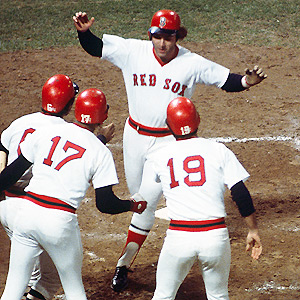
The stadium exploded.  It was bedlam.  Fisk went crazy.  Hopping each step of the way down to first base.   Fans poured onto the field.  Fisk had to fight his way through the  madness. Pushing people out of the way.  Fans patting him on the back, wanting to shake his hand.  He still had to reach home plate for the run to count.  He almost had to elbow two teens as he ran down the third base line.  The hallelujah chorus played on the stadium organ as Fisk landed on home plate.

Outside the stadium New England was full of crazed fans.  Church bells rang.  Bars emptied. People poured into the streets.  Children were woken up to experience the thrill that would never be experienced again.

This was only Game 6.  What would game 7 have in store?