Showing posts with label Jack Morris. Show all posts

Sunday, January 5, 2014

The Hall of Fame Controversy Part 3: What Makes a Hall of Fame Player?

Over the last two weeks I hope I have opened up for discussion some of the issues that exist in the Hall of Fame process.  Even if you don't agree with everything (or anything) I have said I hope it has at least made you reflect on your own views a little.  Whether it has made you think a little bit deeper or even if it has made you a little more firm in your original opinion I hope you have enjoyed the articles.  This week we will end our three part series by asking what is probably the most basic question of the Hall of Fame Controversy:  What does it take to become a Hall of Fame player?

There are specific guidelines provided to the voters.  The Baseball Writers Association of America says that consideration for the Hall of Fame is based on the following guidelines in Rule 3 of the voting procedure:

A. A baseball player must have been active as a player in the Major Leagues at some time during a        period beginning twenty (20) years before and ending five (5) years prior to election.

B. Player must have played in each of ten (10) Major League championship seasons, some part of which must have been within the period described in A.

C. Player shall have ceased to be an active player in the Major Leagues at least five (5) calendar years preceding the election but may be otherwise connected with baseball.

D. In case of the death of an active player or a player who has been retired for less than five (5) full years, a candidate who is otherwise eligible shall be eligible in the next regular election held at least six (6) months after the date of death or after the end of the five (5) year period, whichever occurs first.

E. Any player on Baseball's ineligible list shall not be an eligible candidate.

These instructions under Rule 3 are fairly straight forward.  Under Rule 5 there comes a bit of a gray area.  Rule 5 states:  "Voting shall be based upon the player's record, playing ability, integrity, sportsmanship, character, and contributions to the team(s) on which the player played."

This is the extent of the information the voters have to go on for deciding who gets into the Hall of Fame.  There are certain milestones that "guarantee" (or used to anyways) a player will reach the Hall of Fame.  For a batter a .300 lifetime average, 3000 career hits or 500 career Home Runs usually get you into the Hall of Fame automatically.  For a pitcher 300 wins generally is considered the magic number.

So if the only guidelines are the ones set forth above how do we decide what actually makes someone a Hall of Fame player?  Supposedly the voting is based on "integrity, sportsmanship, character" as well as the actual performance.  The voters last year took a moral stand and wouldn't vote for anyone from the "steroid era" based only on them having played in the steroid era.  At the same time the same people seem to have no issues with having Ty Cobb (a racist, vicious, angry man who was hated by most of his era), Rogers Hornsby (a member of the KKK) or Phil Niekro (a notorious junk ball pitcher often suspected of doctoring the ball) as Hall of Fame members.

It would be interesting to see how these members would vote on players who did what they could to stand in the way of Jackie Robinson breaking the color barrier.  Enos Slaughter, who notoriously spiked Jackie at first base in Jackie's first season is an example.  Enos is definitely not the only Hall of Fame member who reacted strongly against Jackie but his interaction with Jackie was the most notorious.  It would be interesting to see how voters who took a moral stand against the "cheaters" of the current era would have felt about voting for someone like Slaughter.

This all still doesn't answer what makes a Hall of Fame player.  Is it just numbers?  If a pitcher wins a certain number of games does it make them a Hall of Fame player?  If so why are Red Ruffing (273), Burleigh Grimes (270), Jim Palmer (268), Bob Feller (266) , Eppa Rixey (266) and Ted Lyons (260) Hall of Fame members but Jim Kaat (283) is not a member?

There are some extra criteria that are generally accepted (but not written into the rules) as reasons to place someone in the Hall of Fame.  If someone was considered dominant at their position for their era they are considered a Hall of Famer. If you cannot tell the story of the game without mentioning their name they are considered a Hall of Fame player.  If they played a considerable part in the success of a long  lasting playoff run (Yankees, Giants, Dodgers, Cardinals dynasities are heavily represented) or they revolutionized the game in some way they are considered a Hall of Fame player.  If you have a single, defining moment that all fans instinctively pointed to when the player's name is mentioned it is considered a great credential.

Keep in mind as well that there are different levels of Hall of Fame caliber players.  Clearly players like Babe Ruth, Henry Aaron, Joe DiMaggio, Walter Johnson, Willie Mays and Jackie Robinson are in the top 1% of players all time. Players like Richie Ashburn, Orlando Cepeda, Johnny Mize, Arky Vaughn and Rick Ferrell are great players in the history of the game and belong in the Hall of Fame but they are not on the same level as the top 1% of all time.

I have two examples for you that should draw attention to the question of what makes a Hall of Fame player.  Keep in mind that both examples are of players who have not made the Hall of Fame as of this posting.

Example 1:
If a player won more games than any other pitcher during the 1980s (at the same time that pitchers like Nolan Ryan, Bert Blyleven and Roger Clemens were pitching)  would you consider them a Hall of Fame pitcher?

If that same player ended their career with 254 victories (more wins than Carl Hubbell, Al Spalding, Bob Gibson, Vic Willis, Joe McGinity, Amos Rusie, Juan Marichal, Herb Pennock, Three Finger Brown, Clark Griffith, Waite Hoyt, Whitey Ford, Jim Bunning, Catfish Hunter, Stan Coveleski, Chief Bender, Jesse Haines, Don Drysdale, Bob Lemon, Hal Newhouser, Rube Marquard, Dazzy Vance, Ed Walsh, Rube Waddell, Lefty Gomez, Sandy Koufax, John Montgomery Ward, Candy Cummings and Hoyt Wilhelm) including a no-hitter, would that person be a Hall of Fame player?

That same player won 20 games or more three times in his career (including 21 at the age of 36).  This pitcher never won a Cy Young award but he finished in the top five in voting five times in his career.  Three of those years the winner was a future Hall of Fame member.  Would you consider that Hall of Fame credentials?

This player was the unquestioned ace on four playoff teams, including three World Series winners.    During his time in the playoffs he won a total of seven games (including two of the four wins in the 1984 World Series and two of the four World Series wins in the 1991 World Series).    Finally, if this pitcher, at the age of 36, pitched a 10 inning complete game shut out in the deciding game of the World Series would that be a Hall of Fame pitcher?

This resume belongs to Jack Morris.  Jack Morris is still not in the Hall of Fame mostly because people feel his 3.90 career ERA is too high and because he was not friendly to the media.  So despite all of his credentials Jack Morris is not a Hall of Famer because, despite winning more games (remember last week we all agreed that the point of the sport is to win games) than anyone in an entire decade, he gave up more runs (despite winning)  than the experts thought was acceptable.

Example 2:
Let's look at another player.  This player finished his career with 2111 hits (more than Arky Vaughn, Monte Ward, Gary Carter, Harmon Killebrew, Chuck Klein, Deacon White, George Kell, Bobby Doerr, Earl Averill, Bill Mazeroski, Johnny Mize, Dave Bancroft, Jimmy Collins, Sam Thompson, Bill Dickey, Gabby Hartnett, Tony Lazzeri, Home Run Baker, King Kelly, Ernie Lombari, Lou Boudreau, Travis Jackson, and Elmer Flick).

This player finished with 1266 RBI.  This puts this player only 10 behind Hank Greenberg and 7 behind Pie Traynor.  It also places him  ahead of Zack Wheat, Bobby Doerr, Frankie Frisch, Gary Carter, Bill Dickey, Jim O'Rourke, Chuck Klein, Heinie Manush, Tony Lazzeri, Gabby Hartnett, George Sisler, Earl Averill, Tony Gwynn, Roberto Alomar, Joe Morgan, Luke Appling, Rickey Henderson, Kirby Puckett, Bill Terry, Sam Rice, Bid McPhee, Kiki Cuyler, Ryne Sandberg, Hack Wilson, Joe Sewell, Rod Carew, Fred Clarke, Ralph Kiner, Wade Boggs,Ernie Lombardi, Deacon White, Home Run Baker, Jimmy Colliins, Edd Roush, Joe Gordon, Larry Doby and Barry Larkin.

This player finished with 1197 runs scored.  This places him ahead of Willie Stargell, Earle Combs, Pie Traynor, Jim Bottomley, Yogi Berra, Arky Vaughn, Chuck Klein, Billy Herman, Joe Sewell, Deacon White, Ron Santo, Orlando Cepeda, Bill Terry, Johnny Mize, Edd Roush, Bobby Doerr, Johnny Bench, Kirby Puckett, Tommy McCarthy, Bobby Wallace, Jimmy Collins, Hank Greenberg, Dave Bancroft, Mike Piazza, Gary Carter, John McGraw and Tony Lazzeri.

These stats by themselves are quite impressive, especially considering  that the player played in Atlanta when the Braves were the doormat of the league.  Contemporaries like Rickey Henderson played with Don Mattingly, Dave Winfield, Jose Canseco, Mark McGwire, Dave Henderson, Roberto Alomar and Paul Moltor and had pitching staffs including Dave Stewart, Bob Welch and Tommy John.  Gary Carter played with players like Andre Dawson, Darryl Strawberry, Keith Hernandez, Howard Johnson  and Doc Gooden.  Kirby Puckett played with Kent Hrbek and had pitchers like Frank Viola, Jack Morris and Rick Aguilera. The player in question played with players like Bob Horner, Chris Chambliss, Bruce Benedict and Rafael Ramirez.  With that lineup this player won two MVP's (1982 and 1983), made 7 All Star Games in 8 years (starting in five of them).  He also won five straight Gold Glove awards (1982-1986) as well as four straight Silver Slugger awards (1982-1985).

Add to that, this player was one of the most respected, highly thought of and overall considered one of the nicest guys to ever play the game.  Somehow, with all of these credentials Dale Murphy is not in the Hall of Fame.

So what is the point of all this? I know I just told you that numbers are not the only thing that matters and that we need to look more deeply at the performance than just at career numbers.  Then I immediately threw numbers for Morris and Murphy at you.  The point is this:  Look at what the numbers of Morris and Murphy tell you.

Morris won more games (never lose focus on the fact that the entire point of the game is for the team to win) than anyone else in the 1980's when several Hall of Fame pitchers were in their prime.  Morris was the ace pitcher on four playoff teams and when the team absolutely needed to have a win in the most pressure packed situation Morris threw 10 shutout innings to win the World Series.

Murphy won two MVP awards, started five All Star Games, won five Gold Glove awards and was ahead of many contemporary Hall of Famers.  He did all of this with very little support in the lineup at a time when Atlanta was not the best place to play baseball.

The point of all this is that we need to look at all of the player's career as a whole and not just the newly developed stats that are being focused on by the experts.  The funny thing about some experts is that they focus too much on certain statistics.  For example, several experts last year at the voting said they voted solely based on the WAR.  One expert later admitted that he didn't properly understand the statistic he used as his primary basis for his votes.

Bottom line, we need to dig deeper into the careers of the eligible players before using one or two statistics to rule someone out or induct them.

As I mentioned in the previous two weeks, I am sure that many of you readers disagree with me.  Please send me your views so we can continue to discuss the situation.

TRIVIA QUESTION:
The 1984 Tigers featured some of the best players in the game including Jack Morris, Allen Trammell, Lou Whitaker, Lance Parrish, Kirk Gibson and Darrell Evans.  How many Hall of Fame Players were on the 1984 Tigers?

Answer to Last Week's Question:
Congratulations to Hope who partially answered the question last week.
The number 2632 may not be the most immediately recognizable number in sports but it is important.  The number more recognizable would likely be 2131.  When Cal Ripken played in his 2131 consecutive game he passed Lou Gehrig for the all time record.  He continued playing until he reached 2632.


Saturday, November 3, 2012

Greatest World Series Moments: Greatest Game Ever Part 2

"Into deep centerfield for Mitchell...and we'll see you tomorrow night!"

Jack Buck made the now famous call as Kirby Puckett blasted a walk off home run in the 11th inning of Game 6 of the 1991 World Series.  Buck had made some of the most famous home run calls in history.  He had told St.Louis fans to go crazy when Ozzie Smith hit a game winning LCS home run.  As Kirk Gibson struggled around the bases he told the world that he couldn't believe what he just saw.  The Metrodome was deafening with shouts of "Kirby! Kirby! Kirby!".  It was the first time a World Series game ended on a home run since Carlton Fisk hit his famous Game 6 home run in 1975.

Regardless of what happened in Game 7, this could hardly be called anything but the greatest World Series of all time.
  • Two of the first six games were decided in extra innings.
  • Nearly every game had a controversial play.
  • Tempers flared on several occasions as players collided at the plate, tangled on the base path and disputed umpire decisions.
  • With the exception of the Game 5 14-5 blowout, every game was decided by 3 runs or less, 4 of them by one run.
  • 4 games were decided on the last at bat (and another was decided with a tie breaking bottom 8th inning run by the Twins).
  • Both teams could be considered underdogs.  It was the first time in history a team had jumped from last place the previous season and reached first place.  Both of these teams had done it in the same year!

(Dan Gladden collided with Greg Olson at the plate early in the series.  One of many plays that caused tempers to flare.  Gladden would play a big role in Game 7)
 
If Game 6 had ended this World Series it would have been impossible for anyone to be disappointed, yet, if it had ended after Game 6 we never would have seen the greatest World Series game ever played.

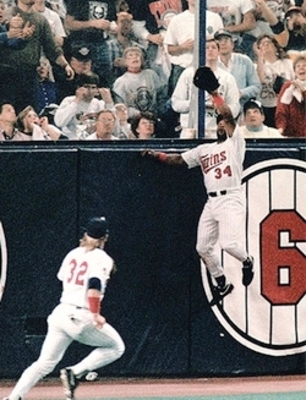
(Kirby Puckett, seen here making a game saving catch in Game 6, carried the Twins to a season saving Game 6 win.  In one of the greatest World Series of all time Game 6 was a close second to Game 7 for the best game of the Series).
 
This series was a convergence of the World Series past and the World Series future.  The Braves were a young team but they had plenty of players who had played in a World Series before: Terry Pendleton (1985 and 1987 Cardinals), Lonnie Smith (1980 Phillies, 1982 Cardinal, 1985 Royals), Charlie Leibrandt (1985 Royals).  The Twins had much more experience in the World Series: Brian Harper (1985 Cardinals) Kent Hrbek, Greg Gagne and Kirby Puckett (1987 Twins), Jack Morris (1984 Tigers).

There were also players on both teams who were young, inexperienced and with a bright future.  The list of names would tell the story of the World Series for the next ten years:  John Smoltz, Tom Glavine, Steve Avery, David Justice, Ron Gant, Mark Lemke, Chuck Knoblauch, Chilli Davis.

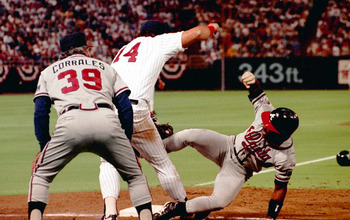
(In game 2 controversy erupted as Ron Gant was called out.  On a play at first Gant's momentum seemed to pull him off the bag as Hrbek kept the tag on Gant's leg.  Replays are hard to tell but Gant has always argued that Hrbek Pulled him off the bag.)


The series also made clear the impact of free agency on the league.  Trying to draw a family tree to connect all of these people would look like a spider web.  For example, Lonnie Smith had played with Terry Pendleton as a Cardinal, then played against Pendleton as a Royal in 1985 and now played with Pendleton again as a Brave.  Similarly, Brian Harper had played with Lonnie Smith and Pendleton as a Cardinal, then played against Smith in the 1985 World Series and now played against both as Braves. 

The connections like these were endless but no two players were more connected than the two starting pitchers.  John Smoltz was born and raised in Detroit as a Tigers fan.  If you were a pitcher in Detroit at that time there was no one you idolized more than Jack Morris.  Smoltz's childhood dream came true when he was drafted by the Tigers in 1985.  Unfortunately for Smoltz, he was traded before he had a chance to pitch with his idol.  On August 12, 1987 he was traded to the Braves for Pitcher Doyle Alexander.

(John Smoltz grew up in Detroit idolizing Jack Morris.  He wanted nothing more than to pitch with Morris as a Tiger.  He was traded to the Braves in 1987.  In the greatest game ever played Smoltz got to face off against his childhood idol.)


Jack Morris grew up in the Minneapolis area.  He had pitched for the Detroit Tigers his entire career.  But being a free agent and less than impressed with the offer from Detroit, Jack Morris came home.  Morris was the winningest pitcher in the decade of the 1980's, won a World Series title for the Tigers in 1984, threw a no-hitter and now he tried to bring a World Series title home. 

There was no bigger stage in the world and no better way to live out a child hood dream than to beat your idol face to face.  What we were about to watch would be passed down in history as the John Smoltz/Jack Morris show but it was anything but that.  In a World Series where excitement came from everywhere, the final game would give nearly every player on either team a chance to impact the outcome.

The game started with Lonnie Smith offering a handshake to Brian Harper as Smith stepped into the batters box.  Unbeknownst to everyone, that was the sign that this game would be different than anything you've ever seen.  Jack Buck compared it to two heavyweights shaking hands before they beat each others brains in.  If Buck only knew what a good comparison it would be...

Both teams went easily in the first, although Morris was less than happy with the balls and strikes being called by the home plate umpire.  In the first few innings Morris would continually stare in at the plate after close pitches were called balls.  Morris was pitching masterfully but that doesn't mean Atlanta didn't have chances to score.  In the second Dave Justice reached second but was stranded there.  Atlanta left 2 on in the third and and another in the 4th.  Jack Buck reminded everyone that "you only get so many chances."

Smoltz had the same success.  The Twins had two runners on in the third and couldn't score.  Dan Gladden led off the third with a double but  could not score.  In the 4th Kent Hrbek, who seemed to always be around the controversy in this series, was told by the umpire that he was hit by a pitch.  It was not hard, it may have grazed his forearm.  Hrbek hadn't reacted but the umpire told him to get down to firstbase. Hrbek wouldn't argue but Bobby Cox, the Braves manager, loved to argue everything.  He came out and berated the home plate umpire to no avail.  It didn't matter anyways, Hrbek never moved past first.  The game was almost half over and no one had scored. 

A playoff game that remains tied through the first three innings begins to increase in intensity as each at bat comes and goes.  In a Game 7 of a playoff series the emotions are amplified.  In Game 7 of a World Series the emotions are off the chart. Some players start to envision themselves as the conquering hero and stride to the plate with confidence, then walk back to the bench like everyone else.  Other players start to fight the fear that any minor mistake could lead to the big run and start to envision themselves  as the next Bill Buckner.  Fans start to inch up on the edge of their seats, rock back and forth to suppress stomach cramps, any sort of movement to momentarily calm their strained nerves.  It becomes less of a confidence of what your team will do and more a worry about what the other team will do.

They moved to the 5th scoreless.  It looked like things were starting to tip in the Atlanta's favor.  Mark Lemke, who had been a part time player for three years with the Braves and was forced into a starting role due to a late season injury to Jeff Treadway would hit .417 in the series, led off with a single and moved to second on Rafael Belliard's sacrifice bunt.  Lonnie Smith followed and seeing the Twins thirdbaseman playing back, laid down a bunt and beat out a close play.  Lemke moved up to third.  Pendleton followed this with a pop fly to shortstop.  That brought up Ron Gant, one of the young rising stars in this Atlanta lineup. He had been compared to a young Willie Mays with unlimited potential.  He hadn't had a bad series but he was 0 for his last 7.  This was his chance to put the Braves ahead.

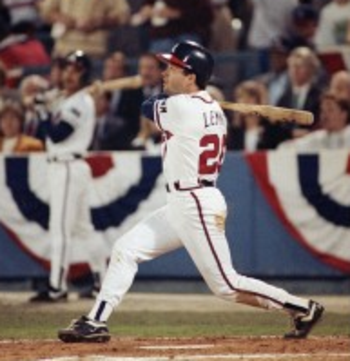
(Mark Lemke was the unexpected hero of the Braves World Series team.  He hit .417 in the series.  He would go on to have a strong major league career but would always be remembered for his performance in this series.)

But first, on the 1-1 pitch, Morris threw a split finger fastball in the dirt.  It was a bad pitch and it was not where Harper expected it.  It hit the dirt, bounced up, hit Harper's mask and rolled out in front of the plate.  The ball was rolling slowly towards Morris, away from Harper.  Harper was undecided on whether to go out after the ball and leave the plate unguarded, or let Morris get it.  Meanwhile, Lemke, sensing the hesitation came screaming down the line.  Morris leapt off the mound and grabbed the ball, Lemke stopped, turned and ran back to third.  Morris threw the ball to Pagliarulo at third.  Pags was a veteran and few played the bag better.  He waited for the ball with one knee on the ground, blocking the bag.  Lemke launched himself, feet first, toward Pags.  Lemke and the ball arrived simultaneously.  Lemke, somehow, found the one spot left open at the bag and slid in as Pagliarulo fell over top of him showing the ball to the umpire with outstretched arms.  The Braves hadn't scored but there was still danger.  Before making another pitch Morris tried a pick off to first.  Lonnie Smith dove back on a close play but he was safe.  Two near third outs  now Morris had to face Gant.  The count went to 3-1.  Morris didn't want to walk Gant and face Justice with the bases loaded.  Gant fouled off the next pitch for a 3-2 count.  The next pitch was a fastball on the outside corner.  The umpire hesitated, just slightly, then called Gant out.  Gant dropped his bat, stared at the umpire.  Morris leapt off the mound, pumped his fist and screamed at the top of his lungs.  Still scoreless.

The bottom of the fifth and the sixth went quickly.  Kirby Puckett reached first in the sixth but any chance at a Twins rally was erased as Sid Bream, the Braves firstbaseman, turned a 3-6-3 double play (that's firstbase to shortstop to firstbase for the casual fan).  It is one of the most unusual and difficult double plays to turn.  Both pitchers were starting to hit their stride.  Morris retired 8 in a row and Smoltz cruised through the middle innings.

The stress and pressure continued to grow as the game progressed.  Someone had to score sometime.  Philosophically the game could go on infinitely if no one scored but realistically at some point some one would score.  It was impossible to believe that every time someone came close to scoring some miracle play would keep the game scoreless.  And yet...

Lonnie Smith led off the 8th with a single. Pendleton appeared to have struck out but the thirdbase ump ruled that he had fouled the ball and Harper had failed to hold onto it.  Given a second life, Pendleton, the 1991 MVP of the National League, ripped a pitch into left-center.  Smith was moving on contact and with his speed he should score easily, nothing could stop that.  1-0 Braves.  As the ball left Pendleton's bat, Jack Buck was speechless, confused for a second.  "Lonnie Smith is held at third and he didn't do very good baserunning there."  What the hell happened?  He should have been able to jog home!

As the ball left Pendleton's bat Smith lost track of the ball.  He knew it was a hit but he couldn't see where.  The next thing he saw was Chuck Knoblauch at secondbase, throwing to Greg Gagne, the shortstop.  How the hell did the ball get from left-center to the right side of second?  It didn't.  Knoblach made a last ditch effort to confuse Smith and it actually worked.  Smith realized there was no ball, too late, now he had to figure out where it was.  Jimmy Williams, the third base coach, was screaming, almost shrieking to get Smith to run.  Smith rounded second, and stopped, looked to the outfield, leaned towards third, leaned some more.  It took five seconds but he saw it.  There it was!  He took off for third and reached it easily, angry at himself.  No problem.  Second and third, no out.  The Braves were in business. 

Gant came up, again with the chance to be the hero.  He grounded to Hrbek at first.  1 out.  Runners hold.  David Justice was walked to load the bases.  It was a desperate move by a desperate team.  Only a strike out or a double play could really help the Twins.  Sid Bream bounced a ball down to Hrbek at first.  Smith was off from third base on contact.  He had good speed.  Hrbek fielded it and threw home to Harper.  2 outs, good enough but not good enough for Hrbek and Harper.  Knowing that Bream was a horrible runner (he had a brace on each knee), Hrbek threw the ball home and immediately got to the bag.  Harper had the same thought.  As soon as he heard the umpire call Smith out on the force at home he turned and fired the ball right back to Hrbek.  A 3-2-3 double play (that's firstbase to catcher to firstbase)!  It's almost unheard of to complete this play.  Hrbek took the trow, pumped his fist and screamed as he showed the ball to Morris, almost not believing it himself.  Another miracle play.

(Sid Bream was in his first year with the Braves after having left the Pirates.  Bream was an underrated, important part of Atlanta's drive to the pennant.  Casual fans saw him as a slow runner but few realized the pain he played with in both knees on a daily basis.)

Now it was the Twins' turn to threaten.  Randy Bush pinch hit for Gagne and led off the bottom of the 8th with a single.  He was replaced at first by Al Newman.  Gladden popped out leaving Newman at first but Knoblach, the 1991 AL rookie of the year, singled to right sending Newman to third.  Still only one out and Kirby Puckett, the Twins legend, at the plate.  That was all for Smoltz.  7 1/3 innings and no runs in a game 7 on the road.  You couldn't ask for more from a rookie.  With the crowd chanting "Kirby!, Kirby!, Kirby!" the Braves walked Puckett to face Hrbek with the bases loaded.  Here was the moment.  It had to happen here.  There was no way another miracle play could keep this thing scoreless.  And yet...

Hrbek connected on a 2-1 pitch and sent what looked like a sure hit towards second.  Lemke sprinted in and caught the ball in stride.  2 out.  Without hesitation he continued running and beat Knoblach back to second base.  Another miracle double play!  Game 7 of the greatest series of all time was moving to the 9th inning scoreless.

Morris was still pitching.  He was 36 years old, had thrown 246 innings in the regular season.  What was one more?  He got the Braves in order in the ninth.  The fans now knew that this was it.  The Twins would win.  Bottom of the ninth 0-0.  Chilli Davis led off with a single.  Harper tried to sacrifice him to second.  The ball found a little seam between the pitcher, firstbaseman and second baseman.  Mike Stanton, the Braves pitcher, chased the ball toward the hole between second and first, fielded it and as he turned and saw there was no play, he caught his spikes in the turf. He was carried off the field and replaced by Alejandro Pena.  All Pena did was get Shane Mack to ground into a double play.  2 outs but the runner moved to third.  A single would win it.  Pags was walked intentionally and Paul Sorrento had a chance to win it.  He didn't. 

(36 year old Jack Morris pitched all of Game 7 for the Twins.  No pitcher won more games during the 1980's than Morris.  1991 was his first year pitching for his home town team.)


Into the 10th inning. 0-0.  Each team had several chances, and other than Lonnie Smith getting stuck at second, there had been few mistakes.  These weren't blown chances.  These were miracles.  One after the other.  Morris came out and pitched the 10th and the Braves went down in order.  People wondered how long this could last.  At what point would someone blink?  When would someone make a mistake? When would someone be able to make it all the way around the bases?

Gladden started the bottom 10th with a broken bat, bloop hit into center.  Rounding first, Gladden saw Keith Mitchell ,the left fielder, jump to field the odd hop off the turf.  The ball hit off Mitchell's glove and got past Mitchell.  Gladden took off, full speed, for second.  What he couldn't see was Ron Gant directly behind Mitchell.  Gant fielded the ball immediately.  He was already in position to throw and he fired to second.  Lemke took the throw and smacked the tag on Gladden a second too late.  Gladden was safe and the Metrodome erupted.

Knoblach bunted Gladden to third and with one out Kirby Puckett walked to the plate.  Puckett was walked intentionally and Hrbek stepped to the plate.  Hrbek was walked intentionally.  Two straight intentional walks to load the bases with one out?  Why the hell not?  There were no rules right now.  Miracles were everywhere.  Because they had pinch run for Chilli Davis back in the 9th, Gene Larkin limped to the plate as the DH.  Larkin could barely walk.  His knee had been injured and was visibly swollen.  If there was a miracle double play left Larkin's lack of mobility would sure help.  The Braves pulled their outfielders in for a possible play at the plate.

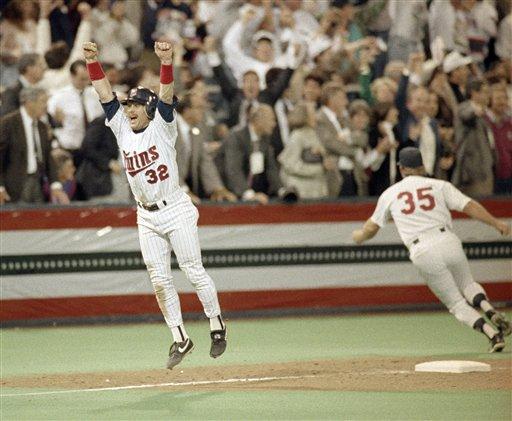
Larkin swung at the first pitch and lifted a fly ball to left field.  Keith Mitchell ran after it but it was hopeless.  On contact Jack Buck screamed out "The Twins are going to win the World Series!  It's a 1-0, 10inning victory!"


i
(Dan Gladden celebrates as Gene Larkin's pinch hit fly ball falls safely.  Gladden came home to score the winning run in the bottom of the 10th inning.  Gladden is currently a radio announcer for the Twins and is one of the most entertaining radio announcers in the league.  He often tells stories about the 1991 Twins and his days spent in Minnesota.)
 
As Gladden and Larkin were mobbed at home plate by their teammates, Mitchell slowly walked after the ball in left field.  Alejandro Pena dropped his head and walked slowly off the mound.  On the bench, John Smoltz stared in disbelief.  Greg Olson, the Braves young catcher, leaned back on the Braves bench next to pitching coach Leo Mazzone.  Stunned.

The Twins had won the greatest World Series in history but it would be hard to call the 1991 Braves losers.