Saturday, January 18, 2014

Rivalries: Bonds vs Kent

"No big deal."  Jeff Kent told the reporters in the aftermath of the insanity that had just occurred.  "Add this to the half dozen other times we've done it before."

Kent was answering questions just moments after his team had lost 10-7 to the San Diego Padres.   The loss dropped them four and a half games behind the division leading Dodgers and three games behind the Diamondbacks.  If Kent were speaking about the fact that the Giants were behind but within striking distance you could understand the lack of importance that Kent gave to the game.  In reality, Kent wasn't talking about the game at all.  His comments continued.
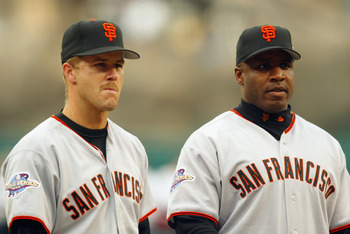


"Bonds and I have played together for five years.  If there is any dislike I don't think we'd be playing together.  So much has been made between the relationship between Barry and me.  We have a good relationship that I think works well on the field.  I think we do a lot of good things together on the field for this team that benefits him and benefits me.  I think you guys try to create a dysfunctional relationship, that's a farce too, because that's not true."

It seems funny that Kent should say that the implied poor relationship was a farce because Kent had previously and publicly said that Bonds was a selfish player who played by his own rules.  Sounds much less than a happy friendship to me.


So why was this being addressed now and why was Kent saying it was no big deal?

The Padres had scored first in the bottom of the first.  Reggie Sanders led off the Giants half of the second with a single but was stranded there.  Then things got bad.  The Padres part of the second started with a Bubba Trammell fly ball.  1 out.  Wiki Gonzalez singled to right and there was a runner on first.  Then things got worse.  There was one out and a runner on first.  Julius Matos hit a routine ground ball to David Bell at third base.  Jeff Kent assumed the play would be at first but Bell wanted to erase the lead runner.  So Kent jogged past second base.  He was shocked when the ball came to him and he was not in position to force the runner.

 Instead of a second out and runner on first, the Padres were in business.  When the next hitter struck out it looked like they might get away with everything.  Instead things got worse.  A single, a walk and two more singles and the Padres now led 5-0.  Mercifully Ray Lankford struck out looking to end the inning but the fun was about to begin.  Things had already gotten bad.  Now they got ugly.

Before Bell reached the dugout he could hear Kent barking.  The exact words were never disclosed but the intent and the meaning were clear.  Kent blamed Bell for the poor inning.  Bell barked right back and the dogs  were unleashed.  Say what you want about Bonds but he was not going to let Bell, or any of his team mates, be bullied.  Bonds stepped in to defend Bell and all hell broke loose. 

Kent and Bonds were arguing (again, no one knows who said what) and then came the push heard around the Bay Area.  Bonds pushed Kent.  Kent pushed back and the dugout was in full movement to separate the two.  Dusty Baker grabbed Kent and trainer Stan Conte grabbed Bonds and moved them towards the opposite ends of the dugout.  Apparently Kent wasn't done.  He said something to the normally quiet Baker and all of a sudden Baker was yelling at Kent.


All this happened while the Giants were supposed to be batting and fighting for a playoff spot.  The Giants batted in the top of the third and with one out Bell doubled.  Ramon Martinez walked and Bonds launched a three run Home Run to right-center.  Kent followed with a ground out and the Giants went on to lose the game.

The Giants would go on to success in the season.  They passed the collapsing Dodgers.  They took out the Braves in the Division Series.  They beat the Cardinals in the NLCS and advanced to the World Series for the first time since 1989.  They were heavily favored in the World Series against the Anaheim Angels.

Bonds, being one of the greatest hitters of all time, did what you would expect.  In his only World Series appearance Bonds hit .471, launched 4 Home Runs, drove in six runs and walked an amazing 13 times.  Kent wasn't terrible but his numbers didn't approach what Bonds did.  Kent hit three home runs, drove in 7 but struck out 7 times and hit .276.  (Just to be clear I am not blaming Jeff Kent for the World Series loss).  In Game 7 Bonds had one hit, Kent had none and the Angels shocked the heavens.


Following the off season the feuding teammates would be separated permanently.  Bonds continued to pound National League pitching into McCovey Cove while Kent moved on to play in Houston.  After two years in Houston Kent moved on to Los Angeles.  As Bonds neared Aaron's record and was well on his way to becoming hated by everyone outside of San Francisco, Kent was becoming hated by just as many.

As the Dodgers struggled toward the close of the 2004 season tensions in the clubhouse grew high.  On August 25th, with Milton Bradley on base, Kent doubled.  As he pulled into second he was shocked to see Bradley standing on third and not touching home plate.  Whatever his motivation, Kent confronted Milton Bradley in the clubhouse and according to the Los Angeles Times there was "an ugly confrontation".  The following day Bradley popped a ball up in the infield.  Bradley sprinted down to first in an exaggerated display of hustle.  After the out was recorded Bradley immediately turned and pointed at someone in the dugout.  The battle was just beginning.

The war of words flew.  Manager Jim Tracy called both players into a meeting and told them both to shut up and play.  Bradley gave an interview saying Kent was a "clubhouse trouble maker".  Kent fired back to defend himself.  Bradley had apparently accused Kent of not being able to deal with African American players because Kent's response was that he had plenty of former African American teammates that were close friends.  If you didn't believe him you could ask his close friend Joe Carter.  To paraphrase Joe Carter's response "Uh, what?  How did I get dragged into this?"  The confrontation ended when Bradley had season ending knee surgery and went home.

Kent remained in Los Angeles and Bradley moved on.  Kent continued to play well and put up near All Star numbers.  As the 2008 season dragged on and the Dodgers appeared to be underachievers yet again, they made a last minute trade deadline move by picking up Manny Ramirez.  Manny immediately destroyed National League pitching and as pitchers tried to avoid giving Manny pitches to hit, Kent's average skyrocketed.  A lot of people noticed, including someone who has watched nearly every Dodgers game since the 1950's, Vin Scully.  Kent heard what Vin thought, that Manny's presence led to Kent seeing better pitches, and he had a strong response.  Shut up Vin.


2008 was Kent's 17th and final season.  He retired as one of the best hitting Second Basemen in history.  His former sparring partner, Bonds had retired the previous season with the most Home Runs for a career (and a season) and a pending criminal case for perjury.  In an era where the public had changed from adoring athletes and overlooking their flaws, they were now villainizing them whenever possible.  Bonds became the most hated.  Every flaw the man had was magnified like the Bat Signal, while every good deed he ever did was ignored.

TRIVIA QUESTION:
Barry Bonds finished his career with 762 career Home Runs.  What three pitchers gave up a) Bonds' first career Home Run, b) Home Run 756 to pass Aaron and c) his final career Home run?

Answer to Last Week's Question:
The Dodgers and Giants moved to the West Coast to start the 1958 season.  The Dodgers faced the Yankees for the first time in the World Series as a West Coast team in 1963 with the Dodgers sweeping the series.  The Yankees faced the Dodgers in the World Series again in 1977, 1978 and 1981.  The Yankees won 1977 and 1978 but the Dodgers won 1981 making them even since the move.  The Giants faced the Yankees in the World Series once (1962) since leaving the East Coast.

Saturday, January 11, 2014

Rivalries:Mike Piazza vs Roger Clemens

When you have the first all New York World Series since 1956 the story kind of writes itself.  Dodgers-Yankees and Giants-Yankees was seemingly an every year tradition for nearly a decade but then the Dodgers and Giants up and left for the west coast and New York was given the pathetic Mets.  As the Mets started to improve, the Yankees collapsed until the Yankees dominated and the Mets rebuilt.  By the mid 1980's, as the Mets built a team around Strawberry, Gooden, Carter and Hernandez and the Yankees built around Mattingly, Winfield, Randolph and Rickey Henderson, experts dreamt of a Subway Series for the new generation.  It never came to be.  The Mets achieved some success but the Yankees underachieved every year.  Enter the Yankees dynasty of the late 1990's and the Mets resurgence around Mike Piazza.


As the 2000 World Series got under way the story for the professionals and the marketing geniuses was simple:  the first subway series since Robinson, Snider, Hodges and Reese took on Mantle, Ford, Berra and that guy named Larsen.  Instead, less than two minutes into the Game 2 broadcast as Roger Clemens warmed up, the story became clear.  This was a grudge match between two players.

The grudge had started a few months earlier.  In what was unheard of in the 1980's as the New York writers dreamt of a Subway World Series, the Mets and Yankees faced off in a regular season interleague series.  In the second game of a double header on July 8, Mike Piazza stepped to the plate in the second inning.  Facing off against Roger Clemens, Piazza took a called strike 1.  The second pitch caused everyone in the stadium to hold their breath.

"I truly believe that if I hadn't gotten my head down at the last instant, Clemens' two seamer would have struck me in the eye and possibly killed me."  Piazza said later.

As Piazza lay in the dirt, motionless, the fans at the stadium and viewers at home weren't sure yet that he wasn't dead.  It was a terrifying moment.  Piazza was removed from the game and taken to the hospital for examination.  Piazza survived the beaning but the war had started.

Piazza and the Mets held a press conference the next day, allowing the flood of interested reporters to ask all the questions they wanted.  "I don't want to say he intentionally hit me in the head, but I think he intentionally threw at my head.  There's no place for that in baseball."  After being told that Clemens had shown concern for Piazza, the response was clear.  "I have no respect  or appreciation for his comments.  Roger Clemens is a great Pitcher but I don't have respect for him now at all."

Clemens' response was even clearer.  "I don't care"


The anticipation built as the first inning of Game 2 got under way.  Piazza was in the lineup as the Catcher, batting third in the lineup.  As Clemens threw his warm up pitches the FOX broadcast crew ran a pregame interview with Clemens.

"I'm gonna go out there and battle and I expect the same from him.  It's my means of trying to get certain hitters out, to try and get in there.  It's not about intimidation or trying to hurt anyone in any shape or form.  I'm going to still be aggressive and try to pitch my game."

Clemens got Timo Perez swinging and got Edgardo Alfonso swinging at a ball in the dirt to start the first inning.  Alfonso was retired as Jorge Posada started chasing him down the line, then gave up on tagging him and just threw the ball to first base to end the brief chase.  Then it was the confrontation everyone was waiting for but realistically thought would be anticlimactic.

Camera flashes lit the stadium with every move either man made.  People wanted evidence of any history that was about to be made.

Piazza took the first pitch for a strike.

Piazza took the second pitch for a strike.

Piazza took the third pitch, low and outside, for a ball.

The 1-2 pitch came in and Piazza swung.  The pitch was in on Piazza's hands and jammed his powerful swing.  The bat shattered.  Piazza held the handle as he started running down to first.  One shard of the bat bounced in front of the plate and settled on the third base side of the field.  The barrel of the bat, the largest fragment, shot straight back to Clemens.  Clemens fielded the bat.  Set himself, pulled his arm back, and fired the jagged remains of the barrel of a baseball bat towards the same first base line that Piazza was running down.


As Piazza was running towards first he saw the motion of Clemens winding up.  He stopped.  The spear bounced about two feet in front of his two feet and rolled towards the first base dugout.  If the beaning was an accident, this one was clear.  Clemens just threw a weapon at Piazza.  Benches cleared.  People were pushed around but the only thing thrown at the enemy were curses.

Clemens found the umpire and explained his position.  "I thought it was the ball."  Amateur lip readers can clearly see it on the replay.  Clemens expected the umpire (and the world) to believe that he thought a two foot piece of jagged wood shot directly back to him was a horsehide ball with a diameter of 9 inches.  It is entirely possible, at the speed of the game, that as he saw something coming right back at him that his initial reaction was that the ball was coming back to him.  However, as soon as he fielded the bat it would be clear that this was a foul ball.  If he did in fact think it was the ball that he fielded, it is not clear why he would have fired it at the feet of the runner heading down to first and not turned to throw the ball to first base to retire the side.

Calm was restored, the at bat came to an end and the Yankees took their turn at bat.  As he left the field Clemens turned to the umpire and said clearly "my fault".  Clemens gave his version of the incident following the game.  "I came back into the dugout and I said 'I've got to get control of my emotions and calm down.  I told Charlie, the umpire, I didn't know Mike was coming out.  I guess it came close to him.  That was my emotions."

Piazza faced Clemens again in the fourth after Edgardo Alfonso was hit by a Clemens pitch.  On the sixth pitch of the at bat, Piazza popped out to first.  Piazza faced Clemens again in the 6th and lined out to left field on an 0-2 pitch.  Piazza was set to bat in the top of the 9th but Clemens was replaced by Jeff Nelson.  With a runner on first Piazza homered to left field cutting the Yankee lead to 6-2. 

Clemens would not appear in the 2000 World Series again, winning his only start as the Yankees won their third straight title.

Piazza may have gotten some minor payback, although it was only speculation on the part of some writers.  Clemens joined the Houston Astros in 2004 and was named the All Star Game starter for the National League as the Astros hosted the mid summer classic.  The National League lineup was strong:  Edgar Renteria (SS), Albert Pujols (1B). Barry Bonds (LF), Scott Rolen (3B), Sammy Sosa (RF), Mike Piazza (C), Lance Berkman (CF), Jeff Kent (2B).

The American League lineup was just as strong.  As Clemens prepared to face the AL stars, Piazza crouched behind the plate.  Leading off was Ichiro Suzuki who doubled to Left Field.  Batting second was Ivan Rodriguez who tripled to right field.  Vladimir Guerrero grounded back to Clemens for out number one but the next batter, Manny Ramirez, launched a two run Home Run.  It was 3-0 and the AL was just starting.  Alex Rodriguez struck out swinging but Jason Giambi reached on an error, Derek Jeter singled and Alfonso Soriano launched a three run Home Run.  Finally, Mark Mulder, the AL starting pitcher, struck out to end the inning but the American League had batted around and scored six runs.  The AL was well on their way to a 9-4 win.  It was only speculation but the question was, did the American League know what was coming?  Were they possibly getting tips from the Catcher who wanted to see the pitcher humiliated?

TRIVIA QUESTION:
I mentioned in today's article that the all-New York Fall Classic was a nearly annual event in the 1950's.  Since the Dodgers and Giants left for the west coast, how many times has there been a Dodgers-Yankees or Giants-Yankees World Series?
Answer to Last Week's Trivia Question:
Congratulations to Hope and TJD for their correct answer to last week's trivia Question.
The Detroit Tigers 1984 World Series Champion team featured some great players of the 1980's and some of the greatest players in the very successful history of the Tigers organization (at least one of which will be featured in an upcoming series of player profiles). The Tiger's everyday lineup included Lance Parrish (C), Darrell Evans (1B) who struggled in 1984, Lou Whitaker (2B), Alan Trammell (SS) who hit .450 in the World Series and win the series MVP, Kirk Gibson (RF), Chet Lemon (CF), Larry Herndon (LF).  On the bench was future star Howard Johnson.  In the rotation was Jack Morris, Walt Terrell and Milt Wilcox.  In the bullpen was Aurelio Lopez and Willie Hernandez who would win both the Cy Young and MVP award in 1984.  Although Morris and Trammell are borderline Hall of Fame players (and some have made a case for Whitaker as well) the 1984 Tigers are the only World Series champions from the 1980's decade not to have a Hall of Fame representative.


Sunday, January 5, 2014

The Hall of Fame Controversy Part 3: What Makes a Hall of Fame Player?

Over the last two weeks I hope I have opened up for discussion some of the issues that exist in the Hall of Fame process.  Even if you don't agree with everything (or anything) I have said I hope it has at least made you reflect on your own views a little.  Whether it has made you think a little bit deeper or even if it has made you a little more firm in your original opinion I hope you have enjoyed the articles.  This week we will end our three part series by asking what is probably the most basic question of the Hall of Fame Controversy:  What does it take to become a Hall of Fame player?

There are specific guidelines provided to the voters.  The Baseball Writers Association of America says that consideration for the Hall of Fame is based on the following guidelines in Rule 3 of the voting procedure:

A. A baseball player must have been active as a player in the Major Leagues at some time during a        period beginning twenty (20) years before and ending five (5) years prior to election.

B. Player must have played in each of ten (10) Major League championship seasons, some part of which must have been within the period described in A.

C. Player shall have ceased to be an active player in the Major Leagues at least five (5) calendar years preceding the election but may be otherwise connected with baseball.

D. In case of the death of an active player or a player who has been retired for less than five (5) full years, a candidate who is otherwise eligible shall be eligible in the next regular election held at least six (6) months after the date of death or after the end of the five (5) year period, whichever occurs first.

E. Any player on Baseball's ineligible list shall not be an eligible candidate.

These instructions under Rule 3 are fairly straight forward.  Under Rule 5 there comes a bit of a gray area.  Rule 5 states:  "Voting shall be based upon the player's record, playing ability, integrity, sportsmanship, character, and contributions to the team(s) on which the player played."

This is the extent of the information the voters have to go on for deciding who gets into the Hall of Fame.  There are certain milestones that "guarantee" (or used to anyways) a player will reach the Hall of Fame.  For a batter a .300 lifetime average, 3000 career hits or 500 career Home Runs usually get you into the Hall of Fame automatically.  For a pitcher 300 wins generally is considered the magic number.

So if the only guidelines are the ones set forth above how do we decide what actually makes someone a Hall of Fame player?  Supposedly the voting is based on "integrity, sportsmanship, character" as well as the actual performance.  The voters last year took a moral stand and wouldn't vote for anyone from the "steroid era" based only on them having played in the steroid era.  At the same time the same people seem to have no issues with having Ty Cobb (a racist, vicious, angry man who was hated by most of his era), Rogers Hornsby (a member of the KKK) or Phil Niekro (a notorious junk ball pitcher often suspected of doctoring the ball) as Hall of Fame members.

It would be interesting to see how these members would vote on players who did what they could to stand in the way of Jackie Robinson breaking the color barrier.  Enos Slaughter, who notoriously spiked Jackie at first base in Jackie's first season is an example.  Enos is definitely not the only Hall of Fame member who reacted strongly against Jackie but his interaction with Jackie was the most notorious.  It would be interesting to see how voters who took a moral stand against the "cheaters" of the current era would have felt about voting for someone like Slaughter.

This all still doesn't answer what makes a Hall of Fame player.  Is it just numbers?  If a pitcher wins a certain number of games does it make them a Hall of Fame player?  If so why are Red Ruffing (273), Burleigh Grimes (270), Jim Palmer (268), Bob Feller (266) , Eppa Rixey (266) and Ted Lyons (260) Hall of Fame members but Jim Kaat (283) is not a member?

There are some extra criteria that are generally accepted (but not written into the rules) as reasons to place someone in the Hall of Fame.  If someone was considered dominant at their position for their era they are considered a Hall of Famer. If you cannot tell the story of the game without mentioning their name they are considered a Hall of Fame player.  If they played a considerable part in the success of a long  lasting playoff run (Yankees, Giants, Dodgers, Cardinals dynasities are heavily represented) or they revolutionized the game in some way they are considered a Hall of Fame player.  If you have a single, defining moment that all fans instinctively pointed to when the player's name is mentioned it is considered a great credential.

Keep in mind as well that there are different levels of Hall of Fame caliber players.  Clearly players like Babe Ruth, Henry Aaron, Joe DiMaggio, Walter Johnson, Willie Mays and Jackie Robinson are in the top 1% of players all time. Players like Richie Ashburn, Orlando Cepeda, Johnny Mize, Arky Vaughn and Rick Ferrell are great players in the history of the game and belong in the Hall of Fame but they are not on the same level as the top 1% of all time.

I have two examples for you that should draw attention to the question of what makes a Hall of Fame player.  Keep in mind that both examples are of players who have not made the Hall of Fame as of this posting.

Example 1:
If a player won more games than any other pitcher during the 1980s (at the same time that pitchers like Nolan Ryan, Bert Blyleven and Roger Clemens were pitching)  would you consider them a Hall of Fame pitcher?

If that same player ended their career with 254 victories (more wins than Carl Hubbell, Al Spalding, Bob Gibson, Vic Willis, Joe McGinity, Amos Rusie, Juan Marichal, Herb Pennock, Three Finger Brown, Clark Griffith, Waite Hoyt, Whitey Ford, Jim Bunning, Catfish Hunter, Stan Coveleski, Chief Bender, Jesse Haines, Don Drysdale, Bob Lemon, Hal Newhouser, Rube Marquard, Dazzy Vance, Ed Walsh, Rube Waddell, Lefty Gomez, Sandy Koufax, John Montgomery Ward, Candy Cummings and Hoyt Wilhelm) including a no-hitter, would that person be a Hall of Fame player?

That same player won 20 games or more three times in his career (including 21 at the age of 36).  This pitcher never won a Cy Young award but he finished in the top five in voting five times in his career.  Three of those years the winner was a future Hall of Fame member.  Would you consider that Hall of Fame credentials?

This player was the unquestioned ace on four playoff teams, including three World Series winners.    During his time in the playoffs he won a total of seven games (including two of the four wins in the 1984 World Series and two of the four World Series wins in the 1991 World Series).    Finally, if this pitcher, at the age of 36, pitched a 10 inning complete game shut out in the deciding game of the World Series would that be a Hall of Fame pitcher?

This resume belongs to Jack Morris.  Jack Morris is still not in the Hall of Fame mostly because people feel his 3.90 career ERA is too high and because he was not friendly to the media.  So despite all of his credentials Jack Morris is not a Hall of Famer because, despite winning more games (remember last week we all agreed that the point of the sport is to win games) than anyone in an entire decade, he gave up more runs (despite winning)  than the experts thought was acceptable.

Example 2:
Let's look at another player.  This player finished his career with 2111 hits (more than Arky Vaughn, Monte Ward, Gary Carter, Harmon Killebrew, Chuck Klein, Deacon White, George Kell, Bobby Doerr, Earl Averill, Bill Mazeroski, Johnny Mize, Dave Bancroft, Jimmy Collins, Sam Thompson, Bill Dickey, Gabby Hartnett, Tony Lazzeri, Home Run Baker, King Kelly, Ernie Lombari, Lou Boudreau, Travis Jackson, and Elmer Flick).

This player finished with 1266 RBI.  This puts this player only 10 behind Hank Greenberg and 7 behind Pie Traynor.  It also places him  ahead of Zack Wheat, Bobby Doerr, Frankie Frisch, Gary Carter, Bill Dickey, Jim O'Rourke, Chuck Klein, Heinie Manush, Tony Lazzeri, Gabby Hartnett, George Sisler, Earl Averill, Tony Gwynn, Roberto Alomar, Joe Morgan, Luke Appling, Rickey Henderson, Kirby Puckett, Bill Terry, Sam Rice, Bid McPhee, Kiki Cuyler, Ryne Sandberg, Hack Wilson, Joe Sewell, Rod Carew, Fred Clarke, Ralph Kiner, Wade Boggs,Ernie Lombardi, Deacon White, Home Run Baker, Jimmy Colliins, Edd Roush, Joe Gordon, Larry Doby and Barry Larkin.

This player finished with 1197 runs scored.  This places him ahead of Willie Stargell, Earle Combs, Pie Traynor, Jim Bottomley, Yogi Berra, Arky Vaughn, Chuck Klein, Billy Herman, Joe Sewell, Deacon White, Ron Santo, Orlando Cepeda, Bill Terry, Johnny Mize, Edd Roush, Bobby Doerr, Johnny Bench, Kirby Puckett, Tommy McCarthy, Bobby Wallace, Jimmy Collins, Hank Greenberg, Dave Bancroft, Mike Piazza, Gary Carter, John McGraw and Tony Lazzeri.

These stats by themselves are quite impressive, especially considering  that the player played in Atlanta when the Braves were the doormat of the league.  Contemporaries like Rickey Henderson played with Don Mattingly, Dave Winfield, Jose Canseco, Mark McGwire, Dave Henderson, Roberto Alomar and Paul Moltor and had pitching staffs including Dave Stewart, Bob Welch and Tommy John.  Gary Carter played with players like Andre Dawson, Darryl Strawberry, Keith Hernandez, Howard Johnson  and Doc Gooden.  Kirby Puckett played with Kent Hrbek and had pitchers like Frank Viola, Jack Morris and Rick Aguilera. The player in question played with players like Bob Horner, Chris Chambliss, Bruce Benedict and Rafael Ramirez.  With that lineup this player won two MVP's (1982 and 1983), made 7 All Star Games in 8 years (starting in five of them).  He also won five straight Gold Glove awards (1982-1986) as well as four straight Silver Slugger awards (1982-1985).

Add to that, this player was one of the most respected, highly thought of and overall considered one of the nicest guys to ever play the game.  Somehow, with all of these credentials Dale Murphy is not in the Hall of Fame.

So what is the point of all this? I know I just told you that numbers are not the only thing that matters and that we need to look more deeply at the performance than just at career numbers.  Then I immediately threw numbers for Morris and Murphy at you.  The point is this:  Look at what the numbers of Morris and Murphy tell you.

Morris won more games (never lose focus on the fact that the entire point of the game is for the team to win) than anyone else in the 1980's when several Hall of Fame pitchers were in their prime.  Morris was the ace pitcher on four playoff teams and when the team absolutely needed to have a win in the most pressure packed situation Morris threw 10 shutout innings to win the World Series.

Murphy won two MVP awards, started five All Star Games, won five Gold Glove awards and was ahead of many contemporary Hall of Famers.  He did all of this with very little support in the lineup at a time when Atlanta was not the best place to play baseball.

The point of all this is that we need to look at all of the player's career as a whole and not just the newly developed stats that are being focused on by the experts.  The funny thing about some experts is that they focus too much on certain statistics.  For example, several experts last year at the voting said they voted solely based on the WAR.  One expert later admitted that he didn't properly understand the statistic he used as his primary basis for his votes.

Bottom line, we need to dig deeper into the careers of the eligible players before using one or two statistics to rule someone out or induct them.

As I mentioned in the previous two weeks, I am sure that many of you readers disagree with me.  Please send me your views so we can continue to discuss the situation.

TRIVIA QUESTION:
The 1984 Tigers featured some of the best players in the game including Jack Morris, Allen Trammell, Lou Whitaker, Lance Parrish, Kirk Gibson and Darrell Evans.  How many Hall of Fame Players were on the 1984 Tigers?

Answer to Last Week's Question:
Congratulations to Hope who partially answered the question last week.
The number 2632 may not be the most immediately recognizable number in sports but it is important.  The number more recognizable would likely be 2131.  When Cal Ripken played in his 2131 consecutive game he passed Lou Gehrig for the all time record.  He continued playing until he reached 2632.


Sunday, December 29, 2013

The Hall of Fame Controversy Part 2: SABRmetrics and the Hall of Fame

Last week I gave everyone a reason to hate me, or at least question my sanity and moral compass.  This week I will give you a reason to question my intelligence as we continue exploring the Hall of Fame controversy.


SABRmetrics and the new statistics defining our analysis:
For over a century baseball players have been judged based on their numbers.  Where did this come from?  This is a team game.  The point of the game is, and always has been, for one team to score more runs than the other team and win the game.  If we can all agree that the purpose of sending your top nine players against their top nine players is to work as a unit and win the game, why does it matter what individual stats a player reaches?

Simple.  Money.  Despite what we all love to believe, that at one time baseball was played for the love of the game and not for the money, this is mostly a myth.  From the time the Cincinnati Red Stockings fielded their all professional team in 1869 to the present day, statistics have been kept for the same reason: management's evaluation of salary.

As more and more professional teams developed, more and more players were paid salaries.  As an owner, how do you judge who gets a salary, a bonus or a raise and who doesn't?  You could simply say Player A is a good player and Player B is not as good as A but is better than C and fix a pay scale for one year for those three players based on that scale.  Then what?  How do you tell Player A that although he was better than Player B last year, Player B has improved and now is better than Player A so A needs a pay cut and B needs a raise?  Statistics.

The owners first started using basic statistics.  How many hits (walks were counted as hits) and how many runs did you accumulate in the season.  Cap Anson wants a raise? Sorry Cap.  In 1872 you scored 60 runs but in 1873 you only scored 53.  Your performance slipped by 7 runs so you get a pay cut.  Pure and simple. Statistics were developed by management to control salary.

The statistics developed over time and were retroactively applied.  Runs Batted In were calculated, bases on balls were moved to a separate category, then Intentional Bases on Balls were broken into their own category.  Pitchers were judged on wins and losses.   Then they were judged on how many runs they gave up.  Then they were judged an average of how many runs they gave up every nine innings.  Then just on how many runs they gave up that were earned by the other team and not allowed by fielding errors.

As each statistic developed management had a new way of evaluating the player's performance and arguing against giving a raise, or limiting how much of a raise they had to give.  While ownership used these numbers to keep the business running and profits high, baseball writers used it to sell papers.  With each new statistic that was developed they could compare performances based on numbers.  Who was better Nap LaJoie or Ty Cobb?  Just look at the stats and write an article to argue your point.  Everything that was written was analyzed by the baseball crazy society. The Detroit Free Press might run an article stating they had definite proof that Cobb was better.  Oh, by the way, Cleveland is playing the Tigers today.  Don't believe us?  Why not go to the stadium yourself and compare Cobb against LaJoie.  Who got more hits?  Who scored more runs?  Who came out on top?

Ownership and the papers came out on top.  More people bought papers and more people packed the stadium. 

Years went by and statistics became obsession.  Frank Baker hit two Home Runs in one World Series?  My god! Imagine that.  Two Home Runs.  "Home Run" Baker is amazing.  Discussion of the power displayed by Baker in the 1911 World Series brought up questions of how impressive it was.  Seven years later a man known for being a great pitcher hit 11Home Runs in a season.  The next season the same player hit 29.  It was unheard of, what next?  30?  In one season?  The public loved it.  They flooded stadiums to see how many Home Runs would fly out of the park.  The fans who couldn't get to the stadium read about it in the papers.  Then came 54 Home Runs in one season.  Home Runs were now the major statistic in the game.  It was nice that Cobb, Hornsby and Sisler could hit .400 but people came to watch the ball fly.  There's a reason Yankee Stadium was called the house that Ruth built.

The Home Run was the dominant statistic until the late 1960's when Koufax, Drysdale, Gibson, Seaver and Carlton became the dominant players in the league.  For decades pitchers were graded based on their number of innings pitched, wins-losses, and Earned Run Average.  As Koufax began to absolutely dominate hitters the number of strikeouts became the dominant stat for pitchers.  Walter Johnson was the definition of a speed pitcher until Koufax and Gibson came along.  As they racked up the strike out numbers the power pitcher became the star of the game.  Pitchers like Nolan Ryan, Mark Fidyrich and Ron Guidry emerged as stars.  Unfortunately, the draw back of the power pitcher was the stress that was put on the arm and the damage that was done in a short period of time.  With the power displayed by the pitchers the strikeout became the number one focus.  K's (the shorthand for strikeouts on a score card) started hanging in stadiums as the free swinging hitters sat down.  This led to pitchers who routinely threw over 100 miles per hour and routinely needed off season surgery to repair the stress put on their arms. 

With the birth of Tommy John surgery and the realization that the new flame thrower may not have a long lasting shelf life, the birth of the relief pitcher came about.  The bull pen had, to this point, been viewed as the place to put your pitchers who aren't good enough to start but can be used in an emergency.  As the study of the effect of hard throwing developed, so did the realization that every pitcher on your staff needed to have a purpose.  Sparky Anderson is generally acknowledged as the first manager to fully utilize his bullpen.  Of course, other managers had bullpens before that, however, Sparky was really the one who saw the bullpen as a full unit to be used as part of the game plan and not as an emergency stop gap.  As Sparky's use of the pitching staff gave him the nickname of Captain Hook, the rest of the league started to realize Sparky had something.  Thus developed the position of the closer and the emergence of pitchers like Rollie Fingers, Sparky Lyle, Goose Gossage and Bruce Sutter.  With the development of a new position came the development of new statistics to evaluate their effectiveness.  The save became the popular term in the 1980's.  This was followed by the blown save.  Eventually relief pitchers who were not in a save situation were judged by a hold, the ability to hold the lead until the closer could come in and get the save.

The 1970's also saw the emergence of a new organization that looked to further investigate and advance the study of the game.  They have infinitely improved statistical analysis and introduced countless new ways to analyze the game.  The Society for American Baseball Research has introduced new statistics like the Hold, OPS (On Base Percentage), Slugging Percentage, OPS+, WAR (Wins Above Replacement) and the PECOTA rating (Player Empirical Comparison and Optimization Test Algorithm). 

These statistics were around for years (the PECOTA only since the early 2000's) but with the success of Billy Beane and the A's "moneyball" system, the focus on the use of these statistics has become more intense.  This leads me to the point of  all this.  My problem with SABRmetrics is not with SABR.  My problem is the way that we use these statistics and the way we apply the statistics that SABR compiles.

The issue is that many of the people voting for the Hall of Fame appear to use the new SABRmetrics as their sole basis for voting.  Like any statistic (RBI, Stolen Bases, Batting Average, ERA, etc) statistics are not the only way to judge a Hall of Fame calibre player.  Career WAR is a clear example of the issue that the misuse of these stats creates.  If we were to use WAR (the newest miracle stat for voters) as the sole statistic then we would say that Joe DiMaggio was a far inferior player to Ken Griffey, Sr, Brooks Robinson, Jeff Bagwell, Wade Boggs and Cal Ripken.  Don't get me wrong, I am the biggest fan of both Brooks Robinson and Cal Ripken but I would never claim that either was a better player than DiMaggio.  If I am a manager and you tell me my team is in the bottom of the ninth with two outs in a playoff game and I need a hit or my season is over I would choose Joe DiMaggio over almost any other player in history to be at the plate.

An analysis several years ago showed that Derek Jeter was the worst defensive shortstop in the Major Leagues.  This analysis was done prior to the recent injuries that Jeter has suffered through.  As great as the statistical analysis is (and the teams love them because they can use them in the contract negotiations) is there anyone who truly believes that Derek Jeter is a poor fielder?  He may not have the range of some other shortstops.  His arm strength may not be the same as it used to be.  But seriously, when you watch Derek Jeter make a spectacular play that no one else would even try to make have you ever thought, that is the worst Shortstop in the league?

The problem is not with the development of these statistics.  I love the work that SABR does because it advances our understanding of the game and promotes further analysis of historical figures.  It keeps the history of the game alive and allows us to continuously evolve the baseball society.  SABR is an important part of our understanding of the game.  The problem is the way some people use the information that SABR give us.

One of the best examples for misuse of statistical data that I can think of is Joe Jackson in the 1919 World Series.  There is often a great deal of sympathy for Joe Jackson as a victim of the gamblers.  The argument is always that Jackson had a higher average and more hits than anyone in the series and hit the only Home Run and if he was that far superior he could not have been part of the conspiracy.  The statistics were impressive but there is no substitute for drilling down and looking at the situation of the hitting.  Players can pad their average in a meaningless situation and make their statistics look better and get the rewards later because many people look at statistics alone but is it fair to punish another player because in a tight situation he bunted to move the runner or purposely grounded a ball to the right side of the infield to advance the runner to third instead of swinging for the fences?

The bottom line is SABR metrics are great.  The way many of the experts are using them when voting for the Hall of Fame is not.

Just as with last week's article, I am sure that many of you readers disagree with me.  Please send me your views so we can continue to discuss the situation.

Don't forget to check back next week for part three of the Hall of Fame Controversy.

TRIVIA QUESTION
In today's article, it was mentioned that baseball fans are very in tune with numbers.  Some examples given in today's article were Maris's 61 Home Runs in a season as well as DiMaggio's 56 game hitting streak.  With this same idea in mind what does the number 2632 mean to baseball fans?

Answer to Last Week's Trivia Question:
Carl Erskine pitched a no hitter on June 19, 1952 against the Cubs.  Erskine also pitched a no hitter on May 12, 1956 against the hated Giants.  Sandy Koufax pitched his first no hitter on 6/30/1962 and pitched his second one year  later on 5/11/1963.  On 6/4/1964 Koufax pitched his third no hitter.  Koufax pitched his masterpiece on 9/9/1965, a perfect game against the Cubs.  The correct answer to last week's question is 6.

Saturday, December 21, 2013

The Hall of Fame Controversy Part 1: How Do We View a Potential Hall of Fame Player from the Steroid Era?

For those of you who have been enjoying the rivalries series, I apologize for the interruption of the series.  There are still two more articles coming in that series so please continue to check out.  Since the Hall of Fame voting will be revealed in a few weeks I thought this would be an appropriate time to start a discussion of the Hall of Fame controversy.

Since I started this blog a little over a year ago I have tried to give my honest opinion about things in baseball from the current happenings to historical perspectives and everything in between.  To this point I have avoided broaching some subjects for several reasons.  One of the topics I have avoided is the Hall of Fame and the place of steroid users in history.

First, I wanted to make sure that I thought out what my perspective is in detail so that I can properly give my views and second I needed to make sure I viewed this from as many perspectives as possible.  The biggest focus of the Hall of Fame controversy right now is on what to do with the steroid users but there are a few other issues clouding the nomination process.  So over the next three weeks we'll discuss three main points of the Hall of Fame controversy:

1) Steroids and the Hall of Fame:  How are we setting the parameters of the "steroid era" and what do we define as a Performance Enhancing Drugs?

2) SABRmetrics and the new statistics dominating our analysis.

3) What makes a Hall of Fame Player?:

I am sure that many of you will disagree with my opinions and I would love to hear your views.  The only way we, as baseball fans, will ever get past the controversy is to get as many perspectives as possible and respectfully discuss the issue.  So let's get started with part one.

Steroids and the Hall of Fame:
To start off, the big question is "how do we define the steroid era".  When people reference the steroid era they usually start the discussion with McGwire and Sosa's Home Run duel and end it with the start of drug testing around 2007 when testing became much stricter and better regulated.  There are a lot of problems with this but three main problems exist with the parameters that have been artificially drawn around the era.
  1. We have basically accepted that the "steroid era" is over (meaning that the rampant, unchecked use of the Performance Enhancing Drugs (PED) has stopped), yet in the last few years Bartolo Colon, Nelson Cruz, Alex Rodriguez, Johnny Peralta, Melky Cabrera and several other big stars have been embroiled in a performance enhancing drug ring that was only truly exposed because a disgruntled ex-employee of a South Florida clinic leaked information. How many other clinics similar to the one these players were associated with are out there and have not been discovered yet?  Also, there are many ways that PED users can get around the system.  When I worked retail we had to do whatever we could to stop shoplifters, however, we always knew that shop lifters were developing new ways to take things from under our noses and we were essentially playing catch up to their methods.  Essentially this is the same idea.  The PED users are always one step ahead of the people trying to catch them.  The use of PEDs may never be ended completely.
  2. If the steroid era "lasted" from the late 1990's through the mid 2000's, is it fair to exclude someone from the Hall of Fame because they played in the steroid era as we have defined it and they "looked like they used steroids"?  Last year there were no Hall of Fame members inducted on the normal ballot despite the presence of players like Mike Piazza, Jeff Bagwell and Craig Biggio on the ballot for the first time.  Several voters withheld their votes because they said they were "punishing" the steroid era players (whether or not they used steroids) because the players had known others were using and did nothing about it.  This argument has a few flaws to me, most importantly, how do we know that these players didn't go to the player's union and ask for testing.  Drug testing had been on the table for a very long time before it was finally put in place (it was part of the issues that caused the 1994 strike).  There had to be some players pushing for this testing for the Players' Union to finally agree to it.  In 1988, as Jose Canseco amazed everyone with his 40 Home Runs/40 Stolen Bases, Tom Boswell of the Washington Post wrote an article saying that it was time we started to look into the possibility that steroids were impacting the record books.  The reaction from his media colleagues was that Boswell, a very respected baseball writer and still a very respected historian, was out of line and had no proof.  The support for Canseco by the media made it clear that the media had no intention of pushing the issue and Boswell's reputation was damaged.  It is amazing that these same people are now punishing the players for not informing publicly on their teammates. In addition, the argument against players like Piazza and Bagwell was that there was no proof that they had used steroids but they "looked" like steroid users.  One writer even said he did not vote for Piazza because he had back acne which is sometimes associated with steroid use.  This argument turns the moral stand taken against those who didn't inform on the users into a way for writers to shift the blame from themselves for not pushing on an issue that they clearly were aware of as it happened. 
  3. Performance Enhancing Drugs are not new.  During the 1990's I had a subscription to Sports Illustrated.  One of the issues that I received in the mail had a picture of a gaunt Lyle Alzado, former defensive lineman for the Broncos and Raiders.  The article inside revealed that Alzado had a brain tumor that he linked directly to the use of anabolic steroids he took during his playing days.  He admitted using steroids as far back as 1969.  That's correct.  1969.  In addition to that there were players as far back as the late 1800's who drank "tonics" that were supposed to have properties that could improve your health and energy.  Pud Galvin reportedly drank "monkey testosterone" for better performance.  In the 1930's at least one player was said to have taken injections of an extract from bull testicles.  In the 1960's Mickey Mantle was trying to find a way to play through the knee pain that was destroying his career.  He went to a doctor recommended to him by Mel Allen.  The doctor's injection led to an infection that forced Mickey to miss the end of the 1961 season.  During the 1970's Doc Ellis reportedly pitched a no hitter while high on LSD.  In the 1980's players (including some Hall of Fame superstars) were using amphetamines as "pick me ups".  They would simply drop the "greenies" into their coffee and dissolve them.  We have  arbitrarily defined the steroid era as post 1994 strike or the 1998 Home Run race, when clearly steroids and PED's have been around for decades.  The voters who "punished" players for not demanding testing earlier have already voted for some players and elected players who very easily have done the same thing.  We can certainly continue to incorrectly define the steroid era from post strike to the mid 2000's and the voters can continue to "punish" players of the era who didn't reveal the deep dark secrets of the locker room, but Cal Ripken, Tony Gwynn, Paul Molitor, Kirby Puckett, Wade Boggs, Ryne Sandberg and others also played in that time period and are already in the Hall of Fame (I am not implying, accusing or suggesting any of these players used PED's but they certainly played well into the steroid era and likely played with teammates who were using PED's).  So it was a grand moral statement by the voters to "punish" last year's Hall of Fame candidates who didn't say anything about steroid use publicly, but if the issue truly bothered these individuals, why did they choose last winter to take their stand?
What are we defining as a performance enhancing drug?
We can start with the most rudimentary, first grade essay format and define the words Performance Enhancing Drug.
Performance: the execution of an action
Enhancing:  Heightening or improving, especially enhancing or improving in value, quality desirability or attractiveness.
Drug:  1) a substance that is used as a medicine or 2) an illegal and often harmful substance that people take for pleasure.

So basically what we are saying is that a Performance Enhancing Drug is any substance that improves your ability to perform.  Carl Erskine pitched for the Dodgers in the 1950's.  He often told a story of waking up a day after he had pitched not being able to raise his arm to comb his hair.  His arm was swollen, bent and in pain.  A friend on another team recommended Erskine see that team's trainer, who gave Erskine a shot.  When Erskine's turn came up in the rotation a few days later he was not only healthy, he threw a no-hitter.  If we apply the definition of performance enhancing drug, clearly the substance administered to Erskine enhanced Erskine's ability to recover from his sore arm and perform in his regular rotation spot.  I am not implying that Erskine did not have the ability to throw a no hitter without the shot. Nor am I implicating Erskine as a steroid user, cheater or in any way saying anything negative about Erskine.  In fact, Erskine is one of the most respected and well liked people from those Dodgers teams.  My point is only that without that shot he likely would not have been able to even make the start.  By definition that substance was a PED.  That substance was cortisone.  It is now used regularly by nearly every professional trainer in every major sport. 

The Dodgers trainers used this same treatment to keep Sandy Koufax in performance shape, along with applying hot capsolin (an extreme version of icy hot so severe that it caused blistering on Koufax's arm) that allowed him to get his arm loose enough to throw his breaking ball.  Again, I am in no way questioning the ethics, honesty or character of Sandy Koufax.  The things that Koufax was able to accomplish and the pain that he endured in doing so are amazing and I admire the man greatly but clearly, by our current definition, this would be another Performance Enhancing Drug. 

My point here is not that Erskine or Koufax should be viewed differently.  Erskine had a great career and was a big reason for the success of the Dodgers.  Koufax was a definite Hall of Fame player, one of the best pitchers in the history of the game and also one of the classiest people ever.  So what if they were using an applied treatment from the training staff? 

This is my point:  the arguments against allowing the PED users into the Hall of Fame is that they have an advantage that other players in their eras (and older eras) did not have.  This is another faulty argument.  I think we can all agree that cortisone, when administered by a trained professional, is an acceptable substance that can assist the the body in a quick recovery allowing athletes to perform.  But if we are using the argument that current PED users are cheating because they have an advantage that other players of previous eras did not, should we revise our view of the accomplishments of the 1950's to the present.  For example, Hal Newhouser, Bob Feller, Dizzy Dean, and Carl Hubbell were all great pitchers who dominated the hitters of their eras but how much better could they have been and how much longer could they have pitched if cortisone were available then?  The surgeries that are available now allow pitchers to simply repair a damaged arm that would have been beyond repair decades ago.  Should we punish pitchers like Tommy John and Ron Guidry who had great careers but fell short of Hall of Fame numbers because their arms broke down before the current medical technologies that could have kept them pitching for much longer?  As you can see the issue goes much deeper than a simple someone used steroids and someone else didn't.

Why do players look so much bigger than the old days?:
The first part of this answer feeds into the second answer.  Looking at pictures of Mark McGwire, David Ortiz and Prince Fielder it is definitely a logical conclusion that there are more players of larger build today than there were sixty, fifty, or even twenty years ago.  I have not done a percentage based analysis but it is definitely true that the players today are larger than most players of the past.  It is not true in all cases.  Two very specific examples are Jimmie Foxx and Ted Kluszewski.  Foxx was known as "the Beast" because of his gigantic arms.  Kluszewski was alternately known as "Big Klu" or "Killer" and had arms so big he had to cut the sleeves of his shirt to comfortably fit his arms into them.  He routinely asked pitchers not to pitch him low and inside.  It wasn't because he couldn't hit it.  He could.  He could hit it hard, but he couldn't control the fact that the ball always went right back up the middle and he was terrified he would kill a pitcher.

Foxx and Kluszewski are just a few examples.  The truth is there are more players of a larger build today and steroids obviously play a big part in that.  However, there has also been a significant philosophical shift in the training habits of the league in the last twenty to thirty years.  For the first 100 years of organized baseball there was a fear by management and coaches of weightlifting.  There was a fear that the development of muscles (specifically biceps and triceps) would hinder the movement of the arms and would lead to loss of fluidity in the swing.  For pitchers, it was assumed that adding muscle to an individual would hinder their pitching motion and lead to more arm injuries.  With the growth of the fitness industry, health and vitamin supplement improvements and a better study by baseball trainers of the human body, weight lifting is no longer off limits and is often added to off season training regimens under supervision of the team training staff.  The acceptance of weight lifting by the baseball community has had a big impact on the new vision of the baseball player.

Why are we focused on baseball's players using steroids while other leagues ignore or do cursory testing?
When the NFL went on strike a few years ago one of the big issues causing the strike was the Players Union's stance on how far the league could go in testing for illegal substances.  The league wanted to start testing for Human Growth Hormones (HGH) and the union refused.  I actually heard one player make the argument that "no one's using HGH so there is no need to test for it."  That is not an exaggeration, that was an actual argument a current player made.  It would be like applying for a job that required a lie detector test and telling them "I'm not a liar so you don't need to do a lie detector test."  It also sounded eerily like the argument that baseball players were making before the 1994 strike and before the drug testing policy went into place.

The NBA has a first offense penalty of 5 games. Second offense is a 10 game suspension.  A third offense is 25 games and a fourth offense is a two year suspension.  The problem with this system is that players can only be tested four times in a season so once that fourth test is up they are off limits.

The NFL suspends players for 4 games on first offense.  Second offense is eight games and third offense is a full season.
 
The NHL has a stronger policy of 20 games for a first offense, 60 games for a second offense and permanent suspension for a third offense.  The problem with the NHL's policy, similar to the NBA's, is that players can only be tested twice in a season. 

The MLB has the strongest (though clearly not perfect) process for punishing offenders.  The best part of it is the public and permanent shaming of the players.  Manny Ramirez was considered by many one of the greatest hitters in the history of the game.  When he was named as a violator of the MLB policy he went to an overnight pariah.  Raphael Palmeiro was on his way to the Hall of Fame but hasn't been heard from since his positive test in 2005.

In 2006 Shawne Merriman, linebacker for the San Diego Chargers, was suspended four games for violation of the league's policy.  Instead of being treated like a criminal and cheater, the way Palmeiro, Bonds, McGwire, Sosa and Clemens have been, Merriman was voted the league's Defensive Player of the Year...the same season that he had been suspended for four games.  Many of the people who voted for Merriman as the best defensive player that year are the same voters taking a moral stand against PED users in the Hall of Fame.  The Shawne Merriman example is just one of many situations where a player from another sport is given a clean slate when he returns from suspension while Major League Baseball players come back from suspension knowing that they have just thrown away their chance for a Hall of Fame career and the public's trust.

Why is all of this attention paid to MLB and not to the other sports?  Simple.  Baseball is still that national past time.  I will not question that the NFL is the most popular sport in the United States and has been for a long time.  However, baseball has a larger impact on our national psyche.  If you mention specific numbers to sports fans, regardless of what sport they follow, they can likely tell you who the number belongs to.  61 automatically refers to Roger Maris.  714 automatically brings up Babe Ruth. 755 is Hank Aaron.  These are the sacred numbers of baseball history.  These are the number chases that captured the nation's attention.

What is the equivalent to these numbers in other sports?  I recently asked a friend of mine, who is a big football fan, who held the record for all time rushing yards.  He had to look it up and then was surprised at the answer (Emmit Smith).  I asked him who threw the most career touchdown passes and who scored the most career points.  He had no idea.

Ask a sports fan what the number 56 means and more often than not without thinking about it they will just say DiMaggio.  Ask a hockey fan who has the record for most goals in a a season and you'll likely get a blank stare.

Say .401 to a baseball fan and they'll just tell you Teddy Ballgame.  Ask a basketball fan who had the highest Field Goal percentage in a season and most people won't have a clue.

Regardless of the current popularity of football, baseball is still the national past time.


The Cheaters argument:
Every time the topic of steroids and PED's comes up there is a parade of angry callers to sports radio shows who usually say something like "they're cheaters and cheating is wrong so these are bad people."  I am not condoning cheating and I am not condoning the use of PED's, despite what this next argument may say.

We cannot just automatically go with the simple argument that cheaters are bad and these players cheated so they are bad people.

We need to discuss this a little bit more thoroughly.  Yes.  It is absolutely wrong to cheat.  The argument I hear from a lot of people is this:  "I don't want my kids to think it is ok to cheat."  That's a great philosophy, but are the people blaming the players for teaching their children the wrong message teaching the right message themselves?  There are always gray areas to every argument and we seem to apply alternate severity to alternate situations.  Don't forget as a society (sports fans society) we allowed the cheating to flourish despite clear signals there were issues.  Now, after years of  watching this happen we are all of a sudden (in the last ten years) horrified at what is happening.

A few years ago Don Imus, a "shock jock" radio host, was embroiled in a controversy over some horrendous, disgusting remarks he made about the Rutgers Women's basketball team.  The comments he made were offensive and indefensible.  The problem in this discussion is not whether what he said was offensive, the problem is why he thought he could say them.  Imus had been in broadcasting since 1968, meaning by the time the Rutgers issue erupted in 2007 he had been in the field for nearly 40 years.  His entire on-air personality to that point was someone with politically incorrect outspoken and often offensive opinions.  This persona had gotten him high ratings and legions of fans.  Every time he made an off color, offensive statement he received supportive phone calls from fans, higher ratings and higher salary.  All of this not only condoned his outspoken behavior, it encouraged it.  So it is completely illogical for people to get up in arms over the disgusting comments made by Imus in 2007 when they had encouraged him to be offensive for years.  (again I am absolutely, positively not defending Imus or his comments.  I am just making a point that if we were offended by those comments, why were we not in an uproar over comments he had been making for years.)

Steroids are a similar issue. As far back as the 1970's it was widely known that baseball players were using amphetamines for "energy boosts".  There was little outrage or demand for penalties.  In the late 1980's Tony Mandarich played offensive line for Michigan State and it was a poorly kept secret that he used steroids.  Instead of punishing Mandarich the sports society named him "Michelin Man", put him on the cover of Sports Illustrated and chuckled as he was drafted second overall by Green Bay and became a "draft bust".  I had mentioned the article by Tom Boswell earlier in this article.  During the ABC broadcast of Game 1 of the 1988 World Series, moments before Jose Canseco blasted a Grand Slam to give the A's a lead, Joe Garagiola and Vin Scully discussed the article which mentioned the very real possibility that Canseco was using steroids.  Garagiola said that it was unfair for Boswell to question Canseco and Canseco had publicly said that Boswell was a liar.  Bottom line, Canseco was allowed to continue doing what he was doing and society punished Boswell for asking the question that everyone else ignored.  By ignoring it, as a sports society, we condoned Canseco's (and anyone else's) use of PED's.

We still do this.  We can argue all we like that cheaters are bad and cheating is bad and we don't like cheaters but what we say and what we do are completely at odds.  The old argument that actions speak louder than words is still true.  Use this past ALCS as an example.  I sat in my living room watching the Red Sox fans taunt the Tigers Johnny Peralta with stadium wide chants of "Steroids, steroids", clearly demonstrating that as a society we no longer accept this behavior.  Less than an hour later, when David Ortiz blasted a Grand Slam to put the Red Sox back in the game, the Fenway faithful erupted in ecstasy.  Had they forgotten that Ortiz failed a drug test back in 2003?  Likely not because Manny Ramirez who also failed a test in 2003 (and several since) is still persona non grata in Beantown.  Instead of booing the player who had previously failed a drug test, Boston residents actually voted for Ortiz in the recent mayoral election (he came in third by the way).  A similar example is Andy Pettite.  In 2007 Andy Pettite admitted that he had used HGH.  Since then Andy Pettite has been given several contracts, won a World Series and watched as his team mate Alex Rodriguez is treated like the worst human being in history.  Pettite is lauded and promoted while Roger Clemens, his former training partner, is vilified and subject to Federal prosecution.  These are just a few examples of the way every fan base of every team reacts.

Why?  As a society, isn't our position that cheaters are bad people?  So how do we justify turning Barry Bonds into the highest example of cheating while we vote for Ortiz as a public official.  Why have we drawn the distinction between the two?  I have never met any of these people and I am not able to judge them as human beings.  Everything I hear about Pettite and Ortiz is positive.  They are friendly, positive people who do a lot to benefit their communities (and help their teams win).  These are not bad people.  Yet every time someone tests positive for a banned substance, people bring out the same old angry argument that cheating is  bad and cheaters are bad people.

Bonds, on the other hand, was the focus of almost all steroid talk in the early 2000's and was portrayed as evil by the media.  I have never met Barry Bonds and I cannot judge him as a human being.  From everything I hear about Bonds he can be surly, angry, bitter, hard to deal with and down right mean.  I have also heard many times that he does many charitable things and donates large amounts of money that he does not discuss, take credit for or want anyone to know about.  When Bonds was an active player I was far from being a Bonds fan.  My opinion of him was that he was arrogant, selfish and over rated.  Admittedly, my opinion was based solely on the fact that Bonds always played on teams that were direct rivals of teams for whom I am a big fan.  Bonds also falls directly into the question of how we, as a society, react to cheaters.  Whispers of whether or not Bonds was using PED's started in the early 1990's, shortly after he signed with the Giants.  By that time Bonds was already a two time MVP, two time All Star, three time Gold Glove Winner and on his way to the Hall of Fame.  After the whispers and suspicion began (and continued) Bonds was voted as the National League Most Valuable Player five more times and finished second another time.  These votes come from the same people who vote for the Hall of Fame and took a moral stand against steroid users reaching the Hall of Fame last year.  If using steroids is the sin that the media has told us it is why were these same people voting for players they suspected of using steroids and therefore encouraging the cheating behavior.

My argument here is not that we should turn Pettite and Ortiz into villains or that we should view Bonds as a saint. The point is that it is not acceptable to shout from the mountain tops that all cheaters are bad and villains then pick and choose which people we want this to apply to.  We need to discuss this a little more before we just blindly start reacting to these situations.

I am sure that many of you readers disagree with me.  Please send me your views so we can continue to discuss the situation.

Don't forget to check back next week for part two of the Hall of Fame Controversy.

TRIVIA QUESTION:
Mentioned in today's article were Carl Erskine and Sandy Koufax.  How many combined no-hitters/perfect games did these two have in their career?

Answer to Last Week's Trivia Question:
Waiting on deck as Bucky Dent was recovering from the foul ball off his ankle was Mickey Rivers.  Rivers noticed a crack in Dent's bat and had the bat boy bring one of his own.  According to legend, Rivers told Dent "Hey homey, use this bat.  It has a lot of hits in it."  Dent used Rivers's bat to hit his infamous Home Run.  Years later Rivers made statements that implied the bat may have been corked.


Saturday, December 14, 2013

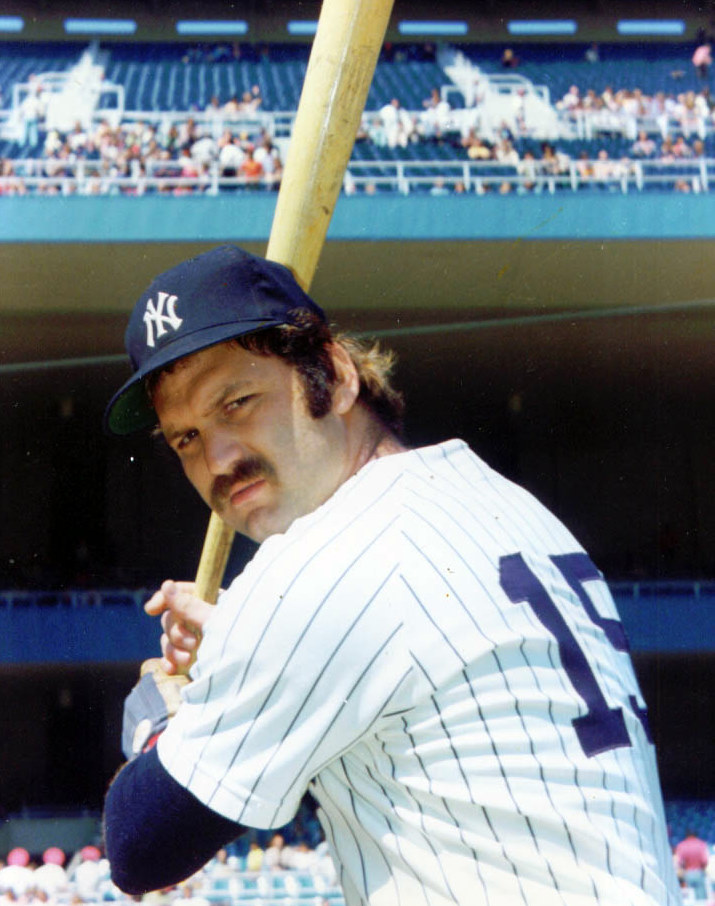
Rivalries: Fisk vs Munson

The American League East was a tight race at the top in 1973.  On August 1st there were four teams less than three games apart.  The Yankees were at the top.  The Orioles sat one game out, Detroit sat two games out and the Red Sox trailed by 3 1/2.  That night Boston faced off against the Yankees.  The rivalry had been in a relatively dormant state but as the teams were tied at 2 in the ninth inning, it was about to erupt.

Thurman Munson led off the Yankee 9th with a double and moved to third on a ground out by Graig Nettles.  Felipe Alou was walked intentionally and that brought up Gene Michael.  As the Red Sox Pitcher, John Curtis, went into the pitching motion, Munson broke for the plate.  Gene Michael squared around to lay down a bunt.  He missed it.  As the ball smacked into the glove of Carlton Fisk, crouched behind the plate, Michael knew he had failed.  Fisk knew they had Munson and Munson was angry.  Tearing down the line, knowing he would be out, Munson had one option and it was one he loved.  Knock Fisk on his ass and hope to God Fisk dropped the ball.  Basically Munson had been given a gift.  The opportunity to charge at the man he hated full speed with the goal of hitting him as hard as possible.  Fisk absorbed the collision and held the ball.  Munson was a smart baseball player.  He knew that if Fisk couldn't get up he couldn't stop Felipe Alou from advancing on the bases.  Fisk knew the same thing.  The result was Fisk pushing Munson off of him, punching Michael and igniting a ten minute brawl.  Fisk and Munson were both ejected and the Red Sox went on to win the game, tightening the AL East race even more.


This was an era of the storied rivalry that was still budding but it was fierce every step of the way.  Both players had come to the majors for short stints in 1969.  Munson played all of 1970 while Fisk spent the year in Pawtucket.  Fisk was a New Hampshire native who grew up wanting nothing more than to play for the hometown Red Sox and was living his dream.  Munson was an Ohio native who wanted nothing more than to play for the Indians, close to his wife and kids so he wouldn't have to be away so much.  Fisk was the good looking ladies' man with the face that magazines loved to display.  Munson was the snarling, mustachioed catcher alternately called Walrus, Tugboat, Squatty Body or Grumpy.

For a competitor as fierce as Munson, he was surprisingly sensitive.  He hated being looked at as second best.  It was partially determination and a competitive nature and partially an insecurity.  Munson's father wanted to play professionally but World War II had seen to it that he didn't make it.  Angry and jealous of the opportunity that his son had which he didn't, the father ridiculed his son to his face and often to others.  When the Yankees scout showed up to his house Munson's dad told the scout "Ya know he ain't too good on pop ups."


In a league filled with great Catchers Munson was clearly elite.  The question was how elite was he?Clearly above Catchers like Bill Freehan, Jim Sundberg and Darrel Porter, was he as good as Bench and Fisk?

He faced off against Fisk every year so it was easy to compare the two.  It was Bench that was considered the elite.  They faced off in the 1976 World Series.  The Yankees were swept by the Reds but Munson hit .529.  Following the final game reporters asked Sparky Anderson to compare the two.  "Thurman is an outstanding hitter, one of the best we have seen all year.  There is no question he would be a .300 hitter in our league but don't ask me to compare Johnny Bench with any other Catcher.  Don't embarrass anyone."  Munson was in the room when it was said, waiting for his own post game interview.  "For me to be belittled after my season and series, it hurts.  I don't appreciate it being rubbed in my face.

Munson worked hard to lead the Yankees.  He was named team Captain.  He was clearly the one who led by his example on the field.  All of a sudden he was called into question publicly.  In 1977 the Yankees signed Reggie Jackson and before spring training began Jackson had already offended Munson.  Jackson gave an interview to Sport Magazine in which he basically said the Yankees were good and Munson was good but they wouldn't be great until Jackson got in the mix.  What resulted was the team known as the Bronx Zoo, two World Series wins and one of the most iconic Yankee-Red Sox moments of all time.

At the end of the 1978 season the Yankees and Red Sox were tied for first.  There was a one game playoff for the American League pennant.  With two out in the seventh and runners on first and third, Bucky Dent hit a home run that defined a generation of heartbreak for Red Sox fans and a generation of winning for the Yankees.  Behind the plate, praying for the ball to bounce off the green monster was Carlton Fisk.  At the top of the dugout steps, praying for the ball to get up in the wind and sneak over the wall was Thurman Munson.


Although some of the rivalries we have seen in this series have been friendly, this one was not.  Munson and Fisk were extremely competitive with each other.  Constantly fighting for first place in the standings and for headlines.  Munson won the World Series twice.  Fisk never would.  Munson would show anger at the mention of Fisk's name and his teammates used that to their advantage.  Gene Michael would hang articles in Munson's locker that compared the two and he knew Munson would come out swinging that night. 

The press loved it because it sold papers.  The teams loved it because it fed into the Yankees-Red Sox feud.  Munson and Fisk just wanted to win.  They were competitive and may have hated losing to the other but it was business, not personal.  Once, as the two were warming up before a game, Thurman yelled over to Fisk. "Hey Fisk, I just wanted to let you know that I never said anything bad about you."

Fisk, possibly with the benefit of twenty years of reflection, said that he and Munson were rivals (and certainly not friends) but not enemies.  "We never hated each other. It was the uniform more than anything.  We were so much alike in our attitudes about baseball.  I think one of the things I regret most about my career is that Thurman and I were never teammates.  I know that if it wasn't for the Yankees uniform he wore, we would have gotten along great.  I never hated Thurman."

The question is, if they were teammates, which one would have moved from Catcher?

TRIVIA QUESTION:
Bucky Dent famously hit his Home Run after fouling the previous ball off his ankle.  Dent hobbled around, the trainers came out and checked on him and the game was delayed.  While Dent was getting treatment, the on deck batter noticed that Dent had cracked his bat on the last swing.  The on deck batter told the bat boy to go get a bat, one of his own, for Dent.  The bat that was handed to him was the one that launched the Home Run.  Who provided the bat for Dent?

Answer to Last Week's Question:
Casey Stengel first took part in a World Series in 1916 as a member of the Brooklyn Robins.  The Robins lost to the Boston Red Sox.  Stengel also played in two World Series as a member of the New York Giants in 1922 and 1923.  Although he managed nine seasons prior to taking over the Yankees he had no World Series appearances in that time.  Stengel took over the Yankees in 1949 and won the World Series in his first year.  Stengel would reach the World Series as the Yankees manager in 1949, 1950, 1951, 1952, 1953, 1955, 1956, 1957, 1958 and 1960.  He won the World Series in seven of those seasons.  This would give him a total of 13 World Series appearances.  

Saturday, December 7, 2013

Rivalries: Al Lopez vs Casey Stengel

Don't forget to check out our other articles in the Rivalries series:  Christy Mathewson vs. Three Finger Brown, Ty Cobb vs Babe Ruth, Joe DiMaggio vs. Ted Williams and Jackie Robinson vs Leo Durocher.

It was late.  Nearly 2:00 A.M.  It had not been a good season in Brooklyn but at least they had made Bill Terry and the Giants eat their words.  The Dodgers  may have been a horrible team in 1934, but, if nothing else, they had ruined the Giants' season on the final day.  Now, as the off season began the reality of just how bad they were set in.

The Dodgers had two All Star representatives in 1934.  Their pitcher Van Lingle Mungo, who took the loss in the game, and their Catcher, Al Lopez.  The rest of the team was mostly players who had shown little of what they would display later in their career or players who were past their prime.  Included in the former category were Tony Cucinello, Dutch Leonard, Lonny Frey and Freddie "Boom-Boom" Beck (known as Boom-Boom because when he pitched in Philadelphia there was the distinct boom of the ball being hit by the opponents followed immediately by the boom of the ball immediately hitting the tin wall in the Phillies' Baker Bowl stadium).  In the latter category were Hack Wilson and Tom Zachary.


As the management realistically evaluated the team and formulated a plan on how they were going to rebuild this disaster of a team, it was clear.  Only two people had trade value.

"Mr. Lopez,"  the conversation started.  It was odd because these two men were close friends, business partners away from the game.  "Something must be done to fix this team.  We have to make a trade.  Now, nobody wants anybody but my guy with the funny name that throws so well and my Catcher, that's you.  Now my guy with the funny name, people pay to see him pitch but no one ever pays to see a Catcher catch."

Al Lopez had interpreted Stengelese long enough to know what this meant.  He sat in Stengel's office listening to the man jabber on about clam chowder and winning tradition and Lopez knew he was likely going somewhere else to play for the next season.  Stengel was clearly upset about trading his friend but had no choice and Lopez told Stengel not to worry.  Changing jobs always brings on a variety of emotions and changing teams is no different.  You could go from a decaying organization in the basement to a chance at a pennant over night.  Or you could take a step down.  For Lopez, landing in Boston with the Braves organization, even after playing with a poor Brooklyn team, was a step down.

The parting of the two friends was only for a few years.  In 1935 and 1936 the Dodgers continued to struggle and Stengel paid for it with his job.  After sitting out the 1937 season he was hired by the Braves and was reunited with his pal Al Lopez.  The reunion was shorter than the first parting.  The Braves, in worse shape than the Dodgers had been, were desperate for cash.  Stengel had promised Lopez that he would not sell his contract but in the end a tearful Stengel announced to the press that Lopez had been sold to the Pirates, another bottom dweller.  He would play for the Pirates until 1946 and finish his playing career in 1947 with the Indians.

Stengel would manage the Braves for another few years, finally leaving the organization after the 1943 season and then he disappeared from the game.  That was until the Yankees started looking for a new manager to replace Joe McCarthy.  Stengel was given the job in 1949 and he immediately became a winner.  1949. 1950.  Two seasons, two World Series rings.

While Stengel was winning with the most successful organization, Lopez was showing his managerial talents in Indianapolis, the Pirates' minor league affiliate.  Then came the shock heard round the Cuyahoga.  The Cleveland Indians were under new ownership, led by Bill Veeck and his new General Manager Hank Greenberg.  The team itself was only a few years past their surprising 1948 World Series win and their leader was the fan favorite, Shortstop Lou Boudreau.  Greenberg called a press conference to announce the manager for the 1951 season.  The Cleveland press already knew it would be Boudreau, because how could you fire a living legend? 


Greenberg loved to tell the story of how he pulled one over on the Cleveland Press: 
  "I knew it would be very unpopular because the press had already been reporting that Lou Boudreau was going to be signed for another year.  Those were the headlines on the day I called for a press conference at Municipal Stadium...Reporters had come from the surrounding cities and out walked Al Lopez...I said 'Gentleman, here's your next manager of the Cleveland Indians, Mr. Al Lopez.' Well, you could have knocked the writers over with a feather."

The 1950 Indians had finished 4th and won 92 games.  In Lopez's first season they improved by one game and finished second, only five games behind Stengel's Yankees.  Not only did they finish only five games behind the Yankees, they had actually put up a fight.  As late as September 19, Cleveland was tied for first with the Yankees.  They lost five of their last six games while the Yankees went on a tear to take out the Indians and then the Giants.  Not a bad start for the Indians but Lopez hated losing to Stengel.

The 1952 Indians finished with the same 93 wins as the previous season but they finished three games closer to the Yankees. The Tribe went 19-5 in the final month to put serious pressure on the Yankees and finished only 2 games behind.  Another spectacular 90+ wins and another second place finish behind Stengel.  It was frustrating.  The Yankees had Allie Reynolds, Mickey Mantle, Yogi Berra, Vic Raschi,  Hall of Famers and a legacy of DiMaggio, Gehrig and Ruth.  The Indians had Al Rosen, Larry Doby, Ray Boone, Dale Mitchell and Bob Feller.  Superstar players but considered just one rung below the Yankees legends.

The Indians, to the Cleveland press, fell badly in 1953.  They won only one game less but the Yankees ran away with the pennant. Lopez finished second again, behind Stengel's Yankees, this time by 8 1/2 games.

This was getting ridiculous.  Cleveland loved the tight pennant races.  They were certainly exciting.  What they really wanted was a win over the Yankees.  Lopez was destroying himself internally.  He wasn't a big drinker.  He wasn't someone who stayed out late.  He was someone who wanted to win and coming this close without winning was causing him to suffer from ulcers.  He was tired of losing to the Yankees and worse, losing to his pal Stengel.  The Yankees had now won the American League in 1949, 1950, 1951, 1952 and 1953.  There was no reason to believe 1954 would be any different.

It was different.  On June 12 the Indians took over first place, 1/2 game ahead of the White Sox and 2 1/2 ahead of Stengel's Yankees. The Indians kept winning and they opened up a lead of 9 games, ending the year 8 games ahead of the Yankees.  Lopez had done it.  He had finally outdone his old friend but it was a small step.  The bigger step was the World Series and although Lopez could finally rest knowing that he had beaten Stengel's Yankees but his team would forever be known as the 1954 Indians, the team that won 111 games but lost to the Giants in the World Series.


Confidently, Lopez and the Indians went back to it for 1955.  Aggressively and determinedly, so did Stengel and the Yankees.  Just like every year since Lopez took over, it was neck and neck.  Eight games out on 7/2, Lopez got his team straightened out and got them back on top by August 10.  Back and forth it went.  The Yankees built a two game lead but Cleveland came back to tie.  The Yankees went back up by 1 1/2 but  Cleveland kept fighting.  With 9 games left Lopez had his team up by two games over the Yankees.  Just like 1950, they fell badly over the last two weeks.  They lost 6 of their last 9 and Stengel had again proven he knew how to beat his protege.

1956 was a disaster for Lopez.  The Tribe finished second but they never really had a chance.  They were tied for first on May 14 and although they would never fall farther back than second in the standings they would never threaten the Yankees, finishing 8 games out.  Stengel had again outsmarted Lopez. 

Heading into the end of 1956 the Cleveland Press was frustrated.  90+ win seasons were not what they were used to, and the consistency was nice but it wasn't a World Series.  Stengel himself recognized Lopez's talent.  He said "The big knock you hear about Al is that he has an outstanding record of finishing second.  One great ballplayer could make him recognized as a great manager."  Unfortunately, heading into the 1957 one of his best players, Larry Doby, was dealt to the White Sox.

Frustrated with finishing behind Stengel and the criticism of the Cleveland papers, Lopez resigned from the Indians. 

Lopez wasn't out of a job long.  Starting in 1957 he was on the bench for the White Sox, leading a team that had not appeared in a World Series since Joe Jackson, Chick Gandil and the Black Sox had been there in 1919.  Lopez immediately had them playing like champs.  They were in the race, and in first place, for most of the first half but Mantle, Stengel and company again took the pennant.  The ChiSox finished in second, eight games out. 


1958 seemed to be the start of something new.  They started off slow but climbed as high as second, again behind the Yankees, again Lopez finished directly behind Stengel.  Lopez still had hope.  "I'm not a failure but I still haven't accomplished what I wanted.  I want to win.  I keep saying the Yankees can be had because I keep thinking they can, and I want my guys to believe they can win.  I want to finish first!"

The White Sox were ready for a fight.  The Yankees were not.  There was little fight but Lopez came out on top with the Yankees in third, 15 games back.  Stengel had won the American League in 1949, 1950, 1951, 1952, 1953, 1955, 1956, 1957 and 1958.  Only twice had he missed out.  Both years he was beaten by his old business partner Al Lopez.  Both times Lopez would lose in the World Series.

1960 was the last year of the Lopez-Stengel rivalry.  The two old friends were both growing old, especially Stengel.  Lopez's Sox may have had a World Series hangover, or may have over achieved in reaching the fall classic, or may have just pissed off the Yankees by beating them.  Whatever the reason, 1960 didn't end well for either of the two old friends.  Lopez and the Sox were never really in the race.  The Yankees ran into Roberto Clemente, Bill Mazeroski and the Pirates in the infamous World Series of 1960. 

Stengel would be fired after the 1960 World Series.  Lopez would stay in Chicago for several years.  He would continue to battle the Yankees.  His White Sox would finish with 90 wins several times and as close as one game out in 1964, but would never again reach the World Series.

Managers would fight each other as "rivals" in the future.  Leo Durocher and Walter Alston.  Billy Martin and Earl Weaver.  Joe Torre and Terry Francona.  Even Roger Craig and Don Zimmer, lifelong friends and former team mates, would face each other in the 1989 NLCS.  But never again would two people, friends and former business partners, ever face each other year in and year out with only the two of them reaching the World Series for such an extended period of time.

TRIVIA QUESTION:
How many World Series (as player and manager) was Casey Stengel involved in?

Answer to Last Week's Trivia Question:
Congratulations to Hope and TJD for answering last week's trivia question.
Charlie Dressen was the manager of the Cincinnati Reds from 1934-1937.  In 1951, Dressen took over the Dodgers and led them to a three game playoff against the Giants, followed by back to back National League Championships in 1952 and 1953.  Dressen felt he deserved a vote of confidence from the Dodgers owners and demanded a three year contract.  Walter O'Malley declined that demand.  Instead he hired Walter Alston, a man with no prior Major League experience.  For the next 23 years, Alston worked on one year contracts and in the process he won seven National League Pennants (1955, 1956, 1959, 1963, 1965, 1966 and 1974) and four World Series (1955, 1959, 1963 and 1965).  Alston managed until the 1976 season.  He was replaced with only a few games left in the season by Tommy Lasorda.