"I can't do it." The voice was disappointed but still yearning for a positive result. "I just can't. The people here, the fans, would just kill me. They think Ted's a better ball player. Now, if you want to throw in that funny looking outfielder in the deal I might be able to sell this thing here in Boston."
The voice belonged to Tom Yawkey, owner of the Boston Red Sox. Sitting on the other end of the phone, just as disappointed, was Larry MacPhail, General Manager of the New York Yankees. The trade, discussed in the late spring of 1947 but never completed, could have changed baseball history up to the current time.
What had been proposed was this: the Red Sox would send Ted Williams, the greatest hitter who ever lived, the most identifiable person to wear Red Sox across his chest, to the New York Yankees. In return the Red Sox would receive two players: Joltin' Joe, the Yankees captain, and the funny looking outfielder who would go on to become a multiple MVP winner and one of the greatest Catchers in history, named Lawrence Peter "Yogi" Berra.
The trade, which might have brought a World Series to Boston decades before the 2004 "Reverse the Curse" team, was never made. DiMaggio would continue to patrol the Yankee Stadium center field until 1951. Williams would continue to destroy AL pitching in Fenway for much longer. The proposed trade, which was discussed (in varying states of inebriation, depending on the version you read) was just one of the many moments that intertwined the two legends in a decades long rivalry.
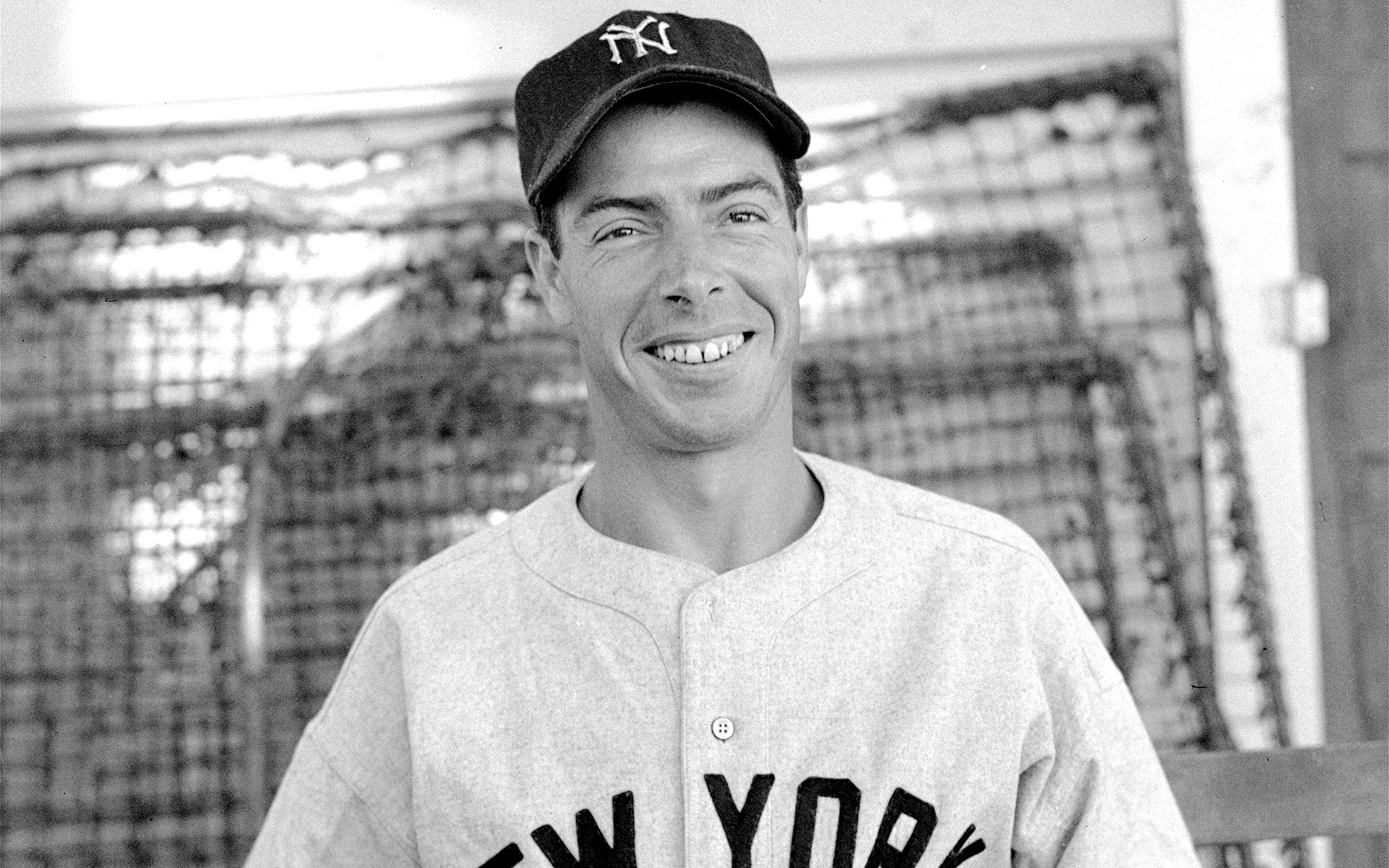
Joe DiMaggio, an immigrant's son known to his teammates and opponents as "the Dago", came to the major leagues in 1936 with the acclaim of having hit in 61 straight games while playing for the San Francisco Seals. He arrived in Yankees camp and was issued uniform #9. Wearing Joe's future #5 was Frankie Crosetti. (Crosetti would move to #1 for 1937 giving Joe his famous #5). DiMaggio first played for the San Francisco Seals at the end of the 1932 season. He had 2 hits in 9 at bats (a double and a triple). In the next three seasons in the minors Joe played in 460 games, had 657 hits and a .351 average. The stats were enough to have every team asking for him. That is until the knee injury and all of a sudden the Yankees were "taking a chance" on Joe.
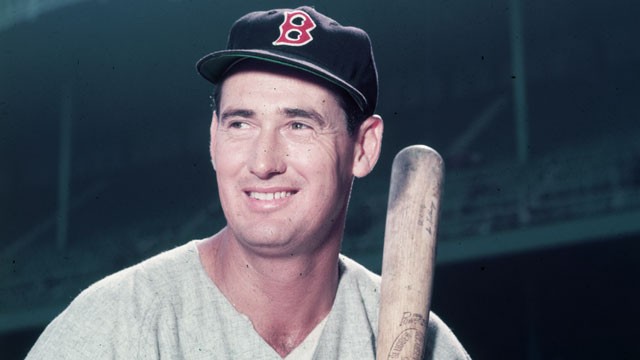
Ted Williams grew up in San Diego but anyone who claimed he was a privileged white kid didn't know Teddy. When the Red Sox scout came to his house Ted refused to stand up to shake his hand. It had nothing to do with lack of manners or social skills. It had to do with the fact that his parents didn't have enough money to replace the furniture so he was terrified the scout might see the hole in the upholstery of the chair Ted was sitting in.
The rivalry had so many facets. Both were poor kids from California. Both had the fast track to the majors with high expectations. It was Northern California vs. Southern California. Yankees vs. Red Sox. Team captain vs. team captain. The classy Joe DiMaggio vs the working class Williams.
The player rivalry lacked one thing: an actual player rivalry. "So much was made of my rivalry with Ted and yet I never felt it was there. There was rivalry with the Red Sox and frankly that was what it was about." That was DiMaggio's view.
If winning was what it was about then, hands down, DiMaggio won the rivalry. Williams and the Red Sox reached the World Series in 1946 and pushed the Cardinals to a seventh game but ultimately lost. Williams hit .200. The Red Sox reached a one game playoff to decide the American League in 1948. Williams went 1-4 and scored a run but the Indians came out on top. That was the extent of Ted's post season experience.
Joe played in the post season ten times. In Joe's first post season, 1936, he had nine hits. That's three more postseason hits than Ted would have in his career. In total Joe would play in 10 World Series and win 9. By the time Ted started his rookie year Joe already had two more World Series titles than Ted would have at the end of his 19 year career.
Still, although Joe and Ted may not have had a rivalry like Cobb and Ruth or like Munson and Fisk (check back in a few weeks) situations often create rivalries that the players unwittingly participate in. The Red Sox had not been good since, well, since the sale of Ruth, Mays, and most of the Red Sox to the Yankees. Now the transplanted Red Sox were gone. The owners of that Red Sox group was gone and a new attitude in Boston felt they could compete with the big bad Yankees. And they did.
Year after year, as DiMaggio and Williams fought each other for the batting title the Yankees and Red Sox fought each other to reach the World Series. Seemingly every year Williams would win the batting title (he won six, including two triple crowns) and DiMaggio's Yankees would win the American League. In 1946 the Red Sox won the AL by 12 games over the second place Tigers and the Yankees were 22 behind. In 1947 the Yankees beat the Tigers by 12 and the Red Sox were 16 behind. In 1948 the Red Sox tied for first with the Indians but the Yankees had their revenge.
With the 1948 pennant on the line in the last day of the regular season (and the Yankees out of the running) Joe McCarthy was concerned that DiMaggio would effect the Red Sox chances. He tried to anticipate DiMaggio, sitting on the bench because of an injury, pinch hitting. Three separate times in the final game McCarthy had his pitching ace up and throwing in the bull pen, ready for Joe. DiMaggio stayed on the bench. The problem was that because he had thrown so many warm up pitches in anticipation of an at bat that never happened, Boston's ace was not available for the playoff game against the Indians. Instead, McCarthy played a hunch and used Denny Galehouse in the playoff game. The Indians won.
1949 was the height of the rivalry. The teams entered the final two games, head to head with the Red Sox needing to take one of two to clinch the AL Pennant. They led in the first game until Birdie Tebbetts, the Red Sox Catcher, told Yogi (remember that funny looking outfielder) he was looking forward to sipping champagne in a few hours and taking tomorrow off. Yogi went back to the bench and told the Yankees what he heard and the Yankees went to work. They won that first game of the series, forcing a final day show down of the two teams. The Yankees won that final game and moved to the World Series.

If the personal rivalry was not the focus of the two players and winning was the ultimate goal, the numbers of the two legends tell the story of their careers. DiMaggio went 3-8 with a double and a triple in that final 1949 series. Williams, however, went 1-5.
Unlike the other rivalries we have reviewed in Ruth and Cobb or the ones you will see in the future of this series this was a mostly press driven rivalry but it continued well after they both had retired. Williams was known as the greatest hitter who ever lived. DiMaggio insisted on always being called "the greatest living ballplayer". The press and fan driven rivalry lasted even after their deaths. In 2012 the United States Postal Service released a series of stamps known as "All Stars Forever". Included in the series were Larry Doby, Willie Stargell, Joe and Ted. The post office tracked orders of each stamp to see which was more popular and decades after each had retired the rivalry was back on.
TRIVIA QUESTION:
In Joe DiMaggio's final World Series appearance of 1951 who was playing Right Field for the Yankees in Games 1 and 2?
Answer to Last Week's Trivia Question:
Claire Merritt was born in Athens, Georgia, not far from the hometown of Ty Cobb. Cobb and Merritt met and dated seriously as Cobb was on his way up to the Major Leagues. The seriousness of the relationship varies based on who is telling the story. It has been described simply as a friendship all the way up to near engagement. Many years later Claire Merritt (now known as Claire Hodgson. Her husband Frank Hodgson had died.) was introduced to Babe Ruth. On April 17, 1929 Claire Merritt Hodgson became Claire Merritt Hodgson Ruth.
Answer to Last Week's Trivia Question:
Claire Merritt was born in Athens, Georgia, not far from the hometown of Ty Cobb. Cobb and Merritt met and dated seriously as Cobb was on his way up to the Major Leagues. The seriousness of the relationship varies based on who is telling the story. It has been described simply as a friendship all the way up to near engagement. Many years later Claire Merritt (now known as Claire Hodgson. Her husband Frank Hodgson had died.) was introduced to Babe Ruth. On April 17, 1929 Claire Merritt Hodgson became Claire Merritt Hodgson Ruth.

