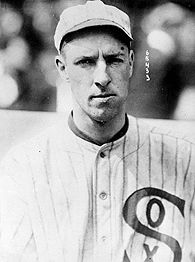
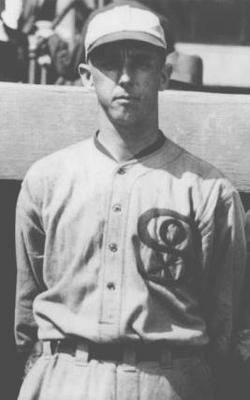
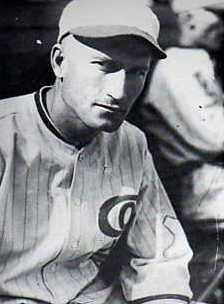
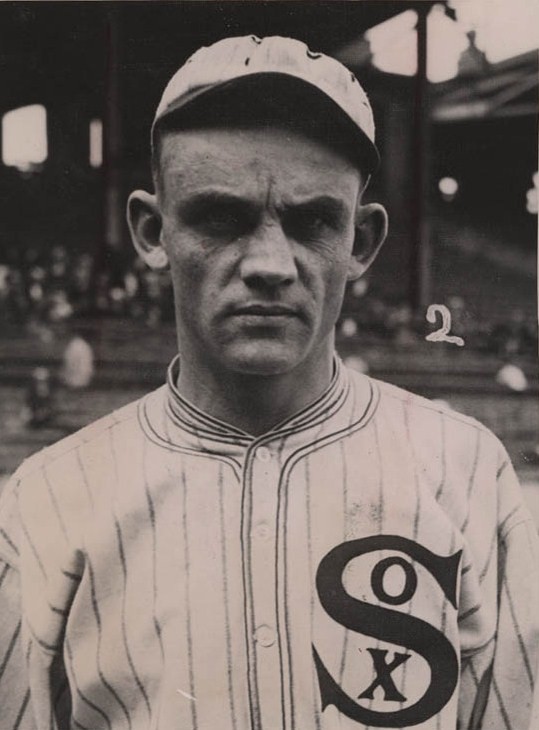
If you enjoy this article be sure to check out the previous articles in the Forgiving Baseball's Scapegoats: Fred Merkle and Fred Snodgrass
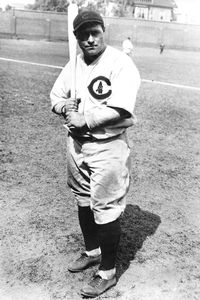
Just the thought of something like this would wake an outfielder up in a cold sweat. It would be a worst nightmare. Like the dream where you show up to class naked. Or you're trying to run away from something but your legs don't work. The difference for Hack Wilson was that this was no dream. It was actually happening.
Just a few minutes ago there was no doubt about the outcome of this game. The Cubs had an 8-0 lead in the seventh inning and they were going to tie up the 1929 World Series against the Philadelphia Athletics. The inning started poorly for the Cubs. A solo Home Run for Jimmie Foxx. So what. 8-1. That was followed by four straight singles and two more runs. Still no problem. 8-3. They only needed three outs without giving up 5 runs. The next hitter popped up to short. One out. That was followed quickly by another single. 8-4 and now the lead was cut in half. The Cubs changed pitchers, hoping this would make the difference. It looked like it might. Mule Haas lifted a fly ball to Center field. The A's were satisfied with that. The runner on third would likely tag up and come home. The Cubs were satisfied assuming they would trade one more out for a run but the moment Haas made contact Hack Wilson's nightmare began.
It was terrifying. The ball left the bat and he had no idea where it was. He could tell it was in the air and he could tell it was in his general area but he had no idea where. He needed help. He looked to the shortstop who pointed, then to the left and right fielders, sprinting, yelling, pointing. He still didn't see it. When you see a fly ball and react immediately you can estimate where it will come down. If you don't know where it is how can you expect to track it down? He finally saw it but it was well over his head and deep. He raced after it but there was nothing he could do. A three run, inside the park Home Run and the game was tied with still only one out.
The bases were now empty so all the Cubs needed was two more outs to keep the game tied. The A's weren't quite done. A walk, a pitching change, a single, another RBI single, another pitching change, a hit batter and two run double led to a 10- 8 deficit. Finally, two strikeouts and they were out of the inning. Instead of the 8-0 lead that they had started with they were down 10-8. It was the biggest inning in the history of the World Series and the blame was hung on the shoulders of Hack Wilson.
The Cubs came to bat looking to swing the momentum back to their side. They had some strong bats coming up. Charlie Grimm grounded out. Zach Taylor struck out and the Cubs used a pinch hitter, future Hall of Famer Gabby Hartnett, who struck out. The 8th inning was over for the Cubs and they were down to three offensive outs. The top of the order was up in the 9th. Norm McMillian struck out. Woody English struck out looking and Rogers Hornsby, the great "Rajah", one of the greatest hitters of all time, flew out to end the game.
It was the greatest collapse in a single game in World Series history. An eight run lead turned into a two run loss in a single inning. The Cubs lost Game 4 and Game5 and the 1929 Philadelphia Athletics fulfilled their destiny as one of the top teams in history. The entire Cubs team had collapsed but the blame immediately focused on Hack Wilson and his misadventure in Center field.
There are plenty of reasons why Hack Wilson does not deserve the blame for this loss or the loss of the series. Here are just a few:
1. Wilson's error allowed three runs to tie up the game in what had been an 8-0 lead. The other seven runs scored in the inning had nothing to do with Wilson's performance. Putting the blame on Wilson ignores a complete collapse by the pitching staff. Prior to the misplayed fly ball the Cubs pitchers had allowed five singles, a Home Run and four runs while recording only one out. Following the Wilson misplay the pitching staff allowed a walk, a hit by pitch, two singles, a double and three more runs before recording another out. the collapse was a complete team wide collapse and cannot be pinned on one person.
2. Wilson contributed significantly to the Cubs 8-0 lead. He went 2-3, including a single with a man on base, and scored a run in the Cubs own five run sixth inning.
3. The Cubs would not have made the World Series without the season contributions of Hack Wilson. Wilson drove in 153 and hit .345 while hitting 39 Home Runs. His following season (1930) may be the greatest offensive season in the history of the game.
4. Wilson was the Cubs' greatest offensive weapon in the 1929 World Series. Hack hit .471 in the five game series (well above the next closest Cubs regular) with 8 hits. His eight hits included a 3-3 day with 2 walks and a run in the Cubs only win in the Series.
5. Hack Wilson was the pin cushion of the league for several years. John McGraw let Wilson slip away because he felt Wilson's night life habits meant that Wilson couldn't perform. During his time in Chicago his night life continued unchanged and the papers made continued reference to his partying. The missed fly ball seemed to be one more way for the papers to pin the tail on Wilson.
Check back next week for the continuation of the Forgiving Baseball's Scapegoats series when we explore Johnny Pesky and his role in the 1946 World Series.
Saturday, May 25, 2013
Friday, May 10, 2013
Forgiving Baseball's Scapegoats: Fred Merkle
Dear sir,
In the game today at New York between New York and the Chgo Club, in the last half of the 9th inning, the score was a tie, 1 to 1. New York was at the Bat, with two men out, McCormick of N. York on 3rd base. Bridwell was at the Bat and hit a clean single Base-hit to Center Field...
___________________________________________________________________________________
The young rookie takes a modest lead off of first. Not too large. He knows that with two outs in a tie game and a runner on third he is not the important person. He just wants a big enough lead to get the pitcher's attention. He takes a step off the bag. Two steps. Now three, four, five and gets ready to run on contact. The pitcher steps off the bag and fakes a throw. The runner dives back.
The pitcher this day is Jack Pfister, known throughout the league as "Jack the Giant Killer". Even in a terrible season when he struggles with arm problems and he can't seem to beat anyone he can beat the hated rivals. His arm is killing him. He struggles all day and his curve ball, at least the three that he attempts to throw, are excruciating. He has little left to give but he keeps going anyway. He fakes the throw to first but never truly intends to throw over. It just takes too much out of him. It won't matter. The message is clear. Pfister is telling the runner without saying a word: "I know you're there." The runner's dive back to the bag tells Pfister, with no sound, "I know your moves."
This is the crucial moment of the crucial inning of the crucial series of the 1908 season. The Giants had sported a four and a half game lead just a few days ago. Then two losses to the Pirates and two losses to the Cubs heading into this game and the league was all tied up again. The seemingly lifeless Cubs came out of hibernation at the right time and fought their way back into contention. And who is the biggest beneficiary of all this Cubs/Giants battle? The Pirates, who were five games behind after losing a double header to the Giants on September 18th. That was the day the writers crowned the Giants. The Pirates reacted by winning their next five games and cut the lead behind the Cubs and Giants to one game. As the Cubs and Giants, the ugliest rivalry in the sports at that time, fight and claw at each other, the Pirates keep winning.
The runner takes another modest lead, maybe even a step further this time, confident that the pitcher will not throw over. The runner is a 19 year old kid from Toledo, OH. Going from small town to Giant city is a big change for a young man like him but he adjusted well in his limited playing time. He normally doesn't play but Fred Tenney, the regular first baseman, sat out this game with back problems. Tenney had not missed any games before today and he won't miss another after this one all year but this kid has done well today. He got the single that moved the winning run just 30 steps from home plate and now he is standing off first smiling, knowing he has made the difference.
To this point in his brief career Fred Merkle has been described as using his intelligence "in everything he does" and showing "good judgment on the base paths". The Chicago Tribune, just a few days earlier, told readers that if Tenney went down the Giants would be fine because Merkle is ready to step in to the First base role. He stands a few steps off first now. Watching Pfister. Waiting for the pitch.
Pfister swings his arm back and delivers the first pitch to Al Bridwell. Bridwell swings the bat and drives the ball to center field. With two outs Moose McCormick, the runner on third, ambles home. This is the last moment of the craziest season ever that made any sense. The game is over. Except it isn't.
It takes an estimated 30 steps to run the 90 feet between bases. If Fred Merkle, the base runner on first, has a slight lead of five or six steps and has taken even a slow trot towards second on contact, he is probably another eight or ten steps toward second. He is at least half way or more towards the base and this is where all hell breaks loose.
As McCormick pounds his foot emphatically on the plate to score the winning run the ecstatic fans pour onto the field like a wave. Their Giants have beaten the hated Cubs and climbed back into first place. They were going to celebrate, and maybe taunt a few Cubs in the process. Merkle has never experienced anything like this before and it is intimidating as hell to a young 19 year old kid. Many of them head straight for him to congratulate him on the hit that put McCormick on third. All he knows is that half crazed fans are all over the place and it is a long way to that Polo Grounds clubhouse entrance in center field. Since McCormick has already scored the winning run why take the extra 15 or so steps when those 15 steps get you closer to the safety of the clubhouse. And besides, the game is over. Except it isn't.
Johnny Evers, the Cubs second baseman, is the best in the league. In fact, other than Nap LaJoie, no one could remember someone playing second base better. One other thing about Evers. He is by far, without equal, the most fiery, competitive person the game has ever seen. Not even Cobb can equal the fighting spirit of Evers, known by some as the "Human Crab", in his prime. Baseball is this man's life and he knows every detail, every quirk, every loophole in the rule book and he'll be damned if anyone, especially a 19 year old rookie, steals a win from Johnny Evers. Every night, after the bars close of course, Evers comes home with a candy bar, the Sporting News and the baseball rule book and studies the game before bed. A few weeks before this, the Cubs were playing the Pirates when the same thing happened. Evers knows the rule. Even if the winning run scores the runner on first has to advance to second to erase the chance of a force out. Simple. If the runner doesn't touch second the play is still alive. In the Pirates game Evers had gotten the ball, stepped on second and told the umpire the runner was out. The umpire hadn't seen the play so the run in that game counted. But luck today is with the Cubs. The umpire from that game who had not been on the lookout for the runner touching second is behind the plate umpire. He knows that Evers knows the rules and he sees what Evers is up to.
The noise is unbelievable. How anyone hears anything clearly is amazing but Evers has a clear idea of what needs to be done. He is screaming, shrieking to Solly Hoffman. "Gimme the ball, damnit! Come on Solly!" People swarm everywhere. Fans, sportswriters and members of both teams running for the clubhouse. Police men, the few that are on hand, try to keep order but there are just not enough to really do anything about it. They basically try to make sure no one was getting trampled.
Hoffman tosses the ball to Evers but Joe McGinnity, one of the Giants' great pitchers, intercepts the throw. Evers, Joe Tinker and McGinnity wrestle for the ball while Pfister and Frank Chance try to get the umpire's attention. McGinnity gets free from the Cubs long enough to throw the ball somewhere into the crowd. If this were a cartoon (and it wasn't too far off) McGinnity would be dusting off his hands and walking proudly off. There is no way the Cubs will find the ball in that swirling mass of humanity and confusion. The Giants have won. The game is over. Except it still isn't.
Merkle is blissfully unaware at this point that anything other than a drunken bacchanal for the fans is taking place on the field. That is until Christy Mathewson, the "Christian Gentleman" comes desperately looking for Merkle to get him back to second base. As Merkle returns to the field, trying to rebuckle his pants as he runs, possibly just in socks, a Cubs relief pitcher (which in 1908 means a spectator in uniform) is fighting with a fan. Rube Kroh sees McGinnity throw the ball into the crowd and somehow sees who picks up the ball. Kroh sprints after the fan and wrestles with him. Undoubtedly, the drunken fans have no idea what the hell is happening and see only a hated rival attacking their brethren so this becomes a hell of a struggle. Kroh pounds the fan over the head, crushing his bowler hat, and steals the ball back. This is getting closer and closer to a cartoon every moment and you can almost envision stars and birds swirling around the fan's head while a bump slowly grows out of his head.
Kroh throws to Evers who holds the ball straight in the air for the umpire to see and jumps up and down on the bag. The Cubs have turned the never before or after seen Center field to opposing pitcher to fan to relief pitcher to second base force out play. The umpire at second base hasn't seen Merkle run for the clubhouse before reaching second but the home plate umpire has. "Merkle never reached second base. The runner is out. The run doesn't count. The inning is over."
New York's finest, the few on hand, already overwhelmed by the crazed fans, realize this is a bad situation that is about to get much much worse. As word circulates through the crowd jubilation turns to anger. The police encircle the umps, the rival Cubs can fend for themselves, and use their nightsticks forging a way through the crowd to safety.
The umpires immediately send off a letter to the league President. "Dear sir, in the game today at New York... Merkle did not run the Ball out; he started toward 2nd base but on getting half way there, he turned and ran down the Field toward the Club House. The Ball was fielded in to 2nd base for a Chgo Man to make the play."
Even if the umpires can clear the fans from the field there is not enough light and certainly not enough security, to resume the game. Game over. 1-1 tie. The Giants protest the decision. The Cubs counter protest. And still, they play the regularly scheduled game the next day without incident. The Giants win 5-4 to regain first place.
The headlines the next day are murderous towards the Cubs. The Cubs fire back. As the season churns on and the race remains tight all the way, Fred Merkle becomes the focus of everyone's hatred. The Giants fans start to despise him. Why the hell couldn't he have taken 15 more steps to finish the play? The terms "numbskull" and "bonehead" are introduced into the American vernacular to describe him. The Cubs' owner claims it was not the Cubs' fault the Giants were stupid. "We can't supply brains to New York's dumb players."
The Giants, Cubs and Pirates continue to fight for the pennant and at the end of the regular season the Cubs and Giants are tied, with the Pirates just a half game behind them both. The difference is that tied, disputed game from September 23rd that the Giants should have won if only Merkle had run a few more feet. The protests have gone back and forth and the league's investigation has sworn affidavit's from both sides swearing that "it happened this way" which is exactly the opposite of the way the other team swore it had happened. The final result is that the teams would "replay" the disputed tied game. Technically it is the first playoff in Major League history but it is only called a replay game. The Cubs win the replay game and go on to beat the Tigers in the World Series.
Merkle's reputation as a player is ruined. He will forever be known as the idiot who made the bonehead play of failing to touch second on a routine base hit and cost the Giants the 1908 pennant. The play is forever known as "Merkle's boner" and from this point to the end of his career every error he makes will immediately lead to a boo or the rude comment "It's that damn Merkle again!" or "What do you expect? It's Merkle."
Merkle's career is much more than 15 steps he didn't take on an apparent game winning base hit. As the Giants went on to reach the World Series in 1911, 1912 and 1913, Merkle makes major contributions to the Giants winning teams. He lands in the top ten in RBI four times, Home Runs three times and extra base hits five times. Merkle ends his career with 1580 hits and also helps the 1916 Brooklyn Dodgers reach the World Series, their first appearance ever, and helps the 1918 Cubs reach the World Series. He was not a hall of fame player but he was definitely not a bumbling idiot.
The Merkle mistake took place over 100 years ago, in fact the same year as the Cubs' last World Series victory, yet Merkle is still blamed for losing the 1908 pennant for the Giants. 115 years after the fact it is time for Merkle to shed the label of bonehead. There are plenty of reasons the lost pennant was not his fault. Here are just a few:
1. The Giants had a four and a half game lead with only a few weeks left in the season. Merkle's early turn towards the clubhouse may have cost the Giants one game head to head with the Cubs, but the Giants had already blown their lead by the September 23rd Merkle game. They were tied going into that game.
2. The Giants as a group had lost focus. On taking the four and a half game lead, the team started discussing who they would be playing in the Worlds Series and who would pitch the first game. They immediately lost the next two games to the Pirates, another big contender in the pennant race that year, and the first two games of the Cubs series.
3. The Giants won 5-4 the next day, putting them back into first place by one game. Regardless of the outcome of the Merkle game they had a chance to overcome the chaos and move forward. They had the advantage since the Cubs were chasing them.
4. The fact that the newspapers and Sporting News made a point of discussing the Pittsburgh-Chicago game of a few weeks earlier, where Evers attempted to get the same ruling, seems to show that batters failing to run all the way to second in this situation was fairly common. Merkle did what most players of the era did.
5. The Giants' closest competition in 1908 were the Pirates and Chicago. The Giants went 11-11 against Pittsburgh and 11-11 against Chicago (including two straight losses to the Pirates and two straight to the Cubs after reaching the four and a half game lead).
6. The Giants went just 11-10 in May and started June 7-8 leading to a six and a half game deficit. Their competition during the beginning of June included Boston, St.Louis (the 6th and 7th place teams at that time. St.Louis would finish dead last, winning only 49 games that year) Chicago and Pittsburgh (their competition). These records were long before Merkle started seeing playing time.
7. The Giants should have won the replay game. Christy Mathewson started the replay game for the Giants in New York with the intimidating support of an overflow crowd behind him. The Cubs had received death threats and several of them were nervous. Mathewson was the most dominant pitcher in the history of the game at that time. On the other hand, the Giants knocked Jack Pfister out of the game in the first inning after scoring a run and having two runners on base. The Giants not only blew a four and a half game lead in late September, they blew a lead with Mathewson on the mound in the replay game.
8. The Giants went on to reach the World Series in 1911, 1912, 1913, 1921, 1922, 1923 and 1924
under McGraw's leadership and in 1933, 1936 and 1937 under the leadership of Bill Terry. They won the Series in 1921, 1922 and 1933. Although they didn't win the 1908 pennant they had plenty of success in the years that followed while the Cubs have not won since.
9. The Giants never blamed Merkle so why should you? John McGraw said "It is criminal to say that Merkle is stupid and to blame the loss of the pennant on him. We were robbed of it and you can't say Merkle did that." Al Bridwell later said "I wish I'd never gotten that hit. I wish I'd struck out instead. If I'd done that it would have spared Fred a lot of humiliation."
10. Merkle nearly won the Giants the 1912 World Series with a tenth inning RBI double in the eighth game giving the Giants the lead. That World Series loss is blamed on next week's member of the scapegoat club.
Sunday, May 5, 2013
15 Myths of Baseball's Greatest Scandal
When I was in college a professor told me that history is a cause and effect study. Everything else is just trivia. The most significant historical moments are the ones that cause the most ripples in the time line of the future. There are obviously many events in the history of the game that are important, however, there are probably about five that stand head and shoulders above the rest as historically significant. The introduction of the American League in 1901. Jackie Robinson's successful 1947 season. The 1994 strike and the March 2005 congressional hearings are four of the five.
It will be 93 years ago this fall that the game of baseball suffered through the worst scandal and one of the most significant events in the history of all sports, let alone the game of baseball. Currently we are in the middle of the only scandal that has come close in comparison to what happened nearly a century ago but it still pales in comparison to the bomb that exploded in 1920.
Some wonder today if there is any way to get rid of steroids from the game forever and if we will be able to accurately compare the accomplishments of Barry Bonds to those of Babe Ruth or Hank Aaron. How do we know when the steroids era started and who was using before there was testing? All of these questions were quietly and nervously asked 93 Years Ago (obviously not comparing Ruth, Aaron and Bonds but comparing Honus Wagner and Johnny Evers to Joe Jackson and Buck Weaver) and the answers were never quite found. Yet somehow the sport has continued to thrive and will continue to thrive.
The fear today over the steroid issue is the same as the fear that was pervasive back then: this scandal strikes at the very integrity of the game and brings into question the validity of every win, every record and every championship in the record books.
If you haven't guessed yet the moment we are exploring this week is the 1919 World Series. There have been legends and misconceptions that have grown out of the event and as time goes on these become more and more accepted as the truth. Just like every scandal and historical event there are two sides to every story and every rule breaker has their supporters. For those of you interested in the history of the sport, or for those of you just interested in a good scandal, here are 15 myths that are generally accepted about the Black Sox scandal of the 1919 World Series:
THE BASICS:
I sort of take it for granted that everyone reading this knows exactly what I'm talking about but for those non-baseball fans who just want to read about a good scandal I will give you a bit of the back story. The 1919 Chicago White Sox are generally considered one of the greatest collections of talent in the history of the game. The team finished with a record of 88-52 and had a team that looked like it would become what the Yankees became just a few years later. The team included future Hall of Fame members Eddie Collins (quite likely the greatest second basemen of all time) and Ray Schalk and several players who were considered to be on their way to becoming Hall of Fame members. Eight members of the team conspired with gamblers to throw the World Series to the Cincinnati Reds. They did such a poor job of throwing the games and covering their tracks that rumors swirled before a pitch was thrown in the series and Ray Schalk along with Kid Gleason, their manager, made it clear to the players that they knew what was going on. Gleason attacked Chick Gandil in the locker room and Schalk attacked Lefty Williams in a separate incident. As a result of the fixed series eight players (1B Chick Gandil, SS Swede Risberg, 3B Buck Weaver, CF Happy Felsch, LF Shoeless Joe Jackson, P Eddie Cicotte, P Lefty Williams and IF Fred McMullin) were banned for life from the game. As with every historical event there are varying opinions, varying interpretations, misunderstandings and myths. Following are the 15 most common myths of the greatest scandal the game of baseball has ever experienced:
1. The 1919 White Sox were the first players banned for throwing games:
We hear about the Black Sox scandal because it was the most widely publicised betting scandal in history and because it involved some of the games most recognizable names at a time that the sport was starting to establish itself as the national pastime. This was not the first gambling scandal but it was definitely the biggest. Way back in 1865, literally at the dawn of organized baseball, the New York Mutuals had three players (William Wansley, Thomas Devyr and Edward Duffy) who were caught throwing a game to the Brooklyn Eckfords. The three were "banned for life" but just like today, if a player was talented and could help a team win, managers were willing to take a chance. Although banned for life, the Mutuals allowed Devyr to play with them (there were no contracts at this point because it was before the professional days) and teams that lost games to the Mutuals protested. A hearing took place at the 1867 National Baseball Convention in Philadelphia and Devyr begged to be reinstated stating he had been only 18 at the time and was in needy circumstances (a very similar argument to A-Rod's "young and dumb" argument to explain his use of steroids). Whatever Devyr said it must have been a good story because the commission reinstated himself and Duffy. Wansley was not reinstated though it is unclear based on the information available to me if he ever applied for reinstatement.
In 1877, in just their second season in the league, the Louisville Grays had a comfortable lead in first place, well ahead of the Boston Red Stockings (not today's Red Sox) when the team suddenly lost seven straight and tied in an 8th game. The play of several players was suspicious. Odd errors. Pitches that would have made batting practice look difficult. Sloppy plays. The Grays' collapse left them in second place, a distant seven games behind the Red Stockings. The owner felt something was wrong and ordered that every player authorize him to view any telegram they had received through Western Union during the season. Obviously this is long before Human Resources, workers rights or labor unions and the players had no choice. One player refused but all other players agreed. Most players had nothing spectacular (that we know of) in their telegrams, however three players continuously sent telegrams to the same individuals all of which contained the word SASH. As the investigation continued it was found that SASH was code for "Sure as Shit". Meaning the players would "sure as shit" throw the next game. As a result Pitcher Jim Devlin, LF George Hall and utility IF Al Nichols were banned. The one player who refused to allow his telegrams to be read may have had a great reason but the owners didn't care. Shortstop Bill Craver (who was also the captain of the team) was banned along with the other three. The Louisville Grays ended their existence after only two years. Unlike Devyr and Duffy, no hard luck stories would gain them reinstatement. This lifetime ban would stick.
2. The fix was an isolated incident:
By 1919 gambling was relatively common in the baseball world. The owners were in a bad position: how could they stop this from happening without revealing how prevalent it had become and without impacting the business? There were rumors on a fairly regular basis and even John McGrawwas known to associate with notorious gamblers, including Arnold Rothstein, historically considered the mastermind of the fix.
In the early days of the World Series the players were only given a share of the first 4 games' profits. Germany Scahefer of the Tigers asked what would happen if one of those games ended in a tie. The answer from the owners was that the players would add the profits of the tie game to their share of the first four games. Amazingly in the first game, the Tigers led 2-1 in the 9th, gave up 2 runs to tie the game at three. The inning went this way: single, hit by pitch, a sacrifice bunt, an error to load the bases, a ground ball to score a run and a passed ball on strike three that would have ended the game but allowed the tying run to score. The game was called due to darkness still tied at 3-3 after the bottom of the 12th.
The amazingly heavily favored Philadelphia Athletics were upset by the "Miracle Braves" of 1914. There have long been rumors that the A's players, many of whom jumped to the Federal League shortly after the series threw the series. Many of those who did not jump were traded away leading many more to speculate that the team was crooked.
Just the year before the White Sox lot to the Reds, the Cubs lost to the Red Sox. There were several questionable plays and when someone asked Eddie Cicotte why he felt the 1919 White Sox could get away with it he reportedly said "Why not? The Cubs did it last year."
Gambling and speculation of thrown games were not suspected only in World Series games. Christy Mathewson and Walter Johnson were known to bet on themselves to win. Hal Chase's crooked ways were legendary. Later there was speculation that the Reds being in the 1919 World Series was not necessarily because of their winning but more because of the Giants' poor play. (See #9 below). There are not the only suspicions that arose. There were other rumors associated with the 1903, 1905, 1921 and 1922 among others.
3. The players were taken advantage of by the gamblers:
Chick Gandil was the instigator of the entire fix. He approached a gambling contact in Boston named Sport Sullivan and asked how much Sullivan thought he could get if Gandil convinced some of his teammates to throw the series with him. Sullivan knew he didn't have the money available so he went to Arnold Rothstein for the cash. As Gandil was pitching the idea to Sullivan, Cicotte was also pitching the idea to Sleepy Bill Burns, who also went to Rothstein for money to pay off the players.
Although not all the players got all the money they expected it would be hard to say that the players were taken advantage of. Cicotte got his money up front. Gandil, Risberg and McMullin received several payments throughout the series, including the one that went to Lefty Williams and Joe Jackson. When it became clear that the money source had dried up the players decided not to continue on with the plan and go for the winners share instead. This can be clearly seen in the strong performance of games 5, 6 and 7. Lefty Williams prepared for Game 8 with the intentions of winning but when one of Rothstein's men threatened his wife, he knew he had to throw the final game.
4. The whole team was in on the fix:
The White Sox of this era were an amazingly divided team. Considering they won a World Series in 1917 and dominated the league in 1919, it is almost unbelievable how strained some of the relationships were on this team. Some have claimed the division was northerners vs. southerners. Others have said young vs. old. Still others claimed college bred vs uneducated. Regardless of what the dividing line was, there were two factions on this team. One faction consisted of Eddie Collins (2B), Ray Schalk (C), Red Faber (P) and rookie Dickie Kerr (P). The other faction was the group of eight involved in the fix. The feuds were so bad that Gandil and Risberg excluded Eddie Collins from the between inning warm ups. Once when Collins complimented one of the others on a good play he got the response "shut up college boy." The players throwing games would have known better than to let the other players know what was going on and they certainly would not have wanted to cut them in on the money they hoped to make. There were only eight players involved. No one else involved with the team knew about the fix but some other players certainly figured it out quickly.
5. Joe Jackson was playing on the level:
Joe Jackson testified before the Chicago Grand Jury investigating the rumors of gambling. Jackson was the third member of the "Black Sox" to confess. (Actually Jackson had tried to confess to Comiskey before he left for the winter but Comiskey refused to see him. Many Jackson supporters point to this as a way to prove his innocence but his testimony will show why he did it. He also attempted to confess after the World Series had been thrown which is a bit like closing the barn door after the horse has gotten out.) Ciccotte was the first to confess to the Grand Jury and he was followed by Lefty Williams and Jackson. Jackson, in his confession, said "I told them once 'I am not going to be in it.' I will just get out of it altogether...He said I was into it already and I might as well stay in it. I said "I can go to the boss and have every damn one of you pulled out of the limelight." He said it wouldn't be well for me if I did that."
In his testimony he also says that he was promised $20,000 but only given $5000. This was brought to him at his apartment before the team left for the fifth game of the series (before his above quoted conversation with Gandil). His bitterness towards Gandil shows through clearly in his testimony. He tells the Grand Jury "I don't think Gandil was crossed as much as he crossed us."
Another point Jackson supporters point to are Jackson's numbers in the series and it would be idiotic to say the numbers he had were not impressive. We sometimes get too bogged down in the impressiveness of the statistics and fail to look at the situational hitting or failure in situations. Stats are great to compare players or to mark milestones or just to find the odd anomalies in the game but we have to be a bit careful in how we use them. Sure we can figure out what someone hits with runners on base, with a 3-2 count at home against a right handed pitcher (and I personally love these kinds of stats) but the bottom line is: did the hitter help the team score a run by advancing the runners or starting a rally or taking a few pitches to get the pitcher out of a rhythm. If we look at the situational hitting for Jackson we can see he did not.
The only Chicago batter with a higher average was Fred McMullin (he was 1-2). Jackson led Chicago's batters in hits (12), doubles (4), RBI (6, only Cincinnati's Pat Duncan's 8 RBI was higher in the series) and he hit the only Home Run in the series. Statistics are great but you can't take statistics just at face value and it is important to look deeper into the situations surrounding the hits. For example, Jackson was 0-4 in the game one loss, definitely one of the games that was thrown. In game 2, another game that was definitely thrown, he was 3-4. Sounds great until you look at the situations. The first hit was a double to center with no one on base. The second was a single with a slow runner on first. The final was an infield ground ball that the first baseman threw away allowing Jackson a single and extra base on an error. The one time he did not get a hit he struck out looking at strike three with a runner in scoring position. Game 3 was a game the team won, Jackson was 2-3, with 2 singles. (This was the game where the players turned around on the gamblers, ruining their plans because they had not received the payments after games 1 and 2.). After game 4 most of the players were convinced they wouldn't be paid and decided to play for real. Jackson was 1-4 with a single, two ground balls, a K and reaching on an error. In game 5, after Jackson got his $5000, he popped out to third base with two men on in the first. He grounded out in the 4th and again in the 7th, both with the bases empty. In the 9th, with a runner on third, with 2 out, he grounded out again. By that time it didn't matter. They lost 5-0. Game 6 was one they were trying to win. Jackson went 2-4, walked once and had 1 RBI. The Sox won in 10 innings with Gandil driving in the winning run. Game 7 was the last one they were all legitimately trying to win. Jackson went 2-4 with 2 RBI. Finally in Game 8, the game was over before the White Sox had a chance to bat. The Reds scored 4 in the first and 1 in the second. By the time Jackson hit a solo home run in the third inning it didn't make a difference. He went 2 for 3 with 2 runs and three RBI, a double and a Home Run.
So what does all this mean? It may be a lot of gibberish to a lot of readers so here is a more telling break down. In 516 regular season at bats Jackson struck out a total of 10 times (roughly once every 52 at bats). In only 32 at bats in the World Series he struck out twice. Both in games the White Sox were told to lose and one of those with the runners in scoring position and the bat sitting on his shoulder. Of his 12 hits 7 came as a lead off hit or with no one on base. Knowing that the three batters hitting behind him were also in on the fix would certainly make it easier to hit freely. Especially when two of the batters were Risberg and Gandil, the two ringleaders of the fix. Further, in games one through five Jackson was 0 for 5 with runners in scoring position. In games six through eight (they played to win in games six and seven) he was 4-7 and reached on an error with runners in scoring position. The hit with runners in scoring position in game 8 came, as his Home Run did, well after the game was out of reach.
6. Joe Jackson was an unintelligent hick who had no idea what he was doing:
Most portrayals of Joe Jackson depict him as a country bumpkin. A dumb, illiterate almost a doofus character. True, he could not read or write and was very self conscious about that fact. He was not able to sign his own name and often had his wife sign it for him. All of this is true, however, being able to read and write does not mean that someone does not know right from wrong or cannot be successful in business. Jackson was a fairly shrewd business man. He toured on vaudeville in the off season and owned the legal rights to the show known as the "baseball girls". He was also owner of a profitable farm, a pool hall and an apartment house. One biographer referred to him as a "mini-conglomerate". Although the White Sox were one of the most underpaid teams in the league, Jackson was doing alright with his other businesses. He may not have been able to read and write but by the age of 32 he had lived and operated in the big city long enough to know a bit about business. Connie Mack felt that Jackson was tricked into going along and the sympathetic perception of "poor Joe" continued to grow. The problem with this perception is that it chooses to ignore the success that Jackson had in the world outside of baseball and reduces him to almost having the intelligence of an infant.
7. Joe Jackson had his whole career ahead of him:
Joe Jackson was originally signed by the Philadelphia Athletics in 1908 and played his first game in the majors at 21 that same year. He had never been away from home, and like a lot of people off on their own for the first time, missed his family and his girlfriend and wanted to go back home. He tried several times to jump trains going back home but each time Connie Mack stopped him before he could get away. Jackson played in only 5 games that season and he was unhappy. Lonely, shy, awkward on a team with established veterans, Jackson was miserable. One day while the team was in Reading, PA, waiting for the next train Jackson turned to Mack and said "I wish you'd send me down south." Jackson was getting little playing time so Mack shipped him back to New Orleans for more experience. In July 1910 the Athletics sent Joe Jackson to the Cleveland Naps (later the Indians) to complete a previous trade. He played for the Indians from 1910 to 1915 and was traded to the White Sox midway through the 1915 season. At the end of the 1920 season, when he was banned from the game, Jackson was 33. Certainly not an old man but he was far from a spring chicken. Jackson's numbers had not slipped, in fact he hit .382 in 1920, but those who suggested that he would have challenged Babe Ruth for power when the lively ball came into play may not take into account the age factor.
8. The players were acquitted in a court of law:
This is a tricky one. The answer to this is a yes and a no. Yes they were acquitted in a court of law on five charges: 1. A conspiracy to defraud the public, 2. A conspiracy to defraud Ray Schalk, 3. A conspiracy to commit a confidence game, 4. A conspiracy to injure the business of the American League and 5. A conspiracy to injure the business of Charles A. Comiskey. No one honestly believed the players intended to defraud the public or that their hatred for Schalk (which was more of a behind the scenes feud) would be enough to intentionally defraud him or to ruin the game itself. They never even took any of those into consideration when they came up with the plan. There was no law at the time making it illegal to bet on baseball. There was no law making it illegal to throw a game. Further, the trial was a circus. The legal fees for the players were paid for by Charles Comiskey, the man who supposedly was trying to have the players kicked out of the league. Three of the players (Cicotte, Williams and Jackson) confessed in front of the Grand Jury and gave specifics of the games and plays that were thrown and the payments that were made. Unfortunately, the three confessions "disappeared" just as they were set to be entered into evidence. So yes, they were acquitted in a court of law but they were never really tried based on whether or not they had thrown games and there were enough anomalies in the trial process to doubt whether the jury made an informed decision.
9. There were only 8 players banned because of the fix:
When the rumors started to circulate and gain more secure footing in reality, Charles Comiskey offered a reward of $20,000 to anyone who came forward with information that led to proof of a thrown World Series. There was one man who wanted that money and he was a good friend of Swede Risberg. Joe Gedeon, second baseman for the St.Louis Browns went to Comiskey and told him all he knew, which implicated himself as having knowledge of the fix. Not only did he not get the $20,000 he got himself banished from the game.
There were other anomalies revealed in the investigations. For example, the Giants of that same year had a significant lead on the Reds. During the collapse that followed there were numerous plays where Heinie Zimmerman played out of position. McGraw and the coaches would give him specific directions on the positioning but when the pitch was delivered he was out of position again. On the other corner of the Giants diamond, Hal Chase made some poor plays that led to opponent runs. The result was a Reds pennant by a 9 game margin. When Commissioner Landis handed out his punishments Gedeon, Zimmerman and Chase were banished as well.
10. None of the players were actually paid:
The exact total amount of money the players got from the fix is hard to calculate. With the players getting a promise of $100,000 from one set of gamblers and $100,000 from another group of gamblers then questions of whether or not the players were placing their own bets on the games, the confusion of where money was coming and going made it hard for the players to nail down their amounts. Cicotte insisted on getting $10,000 in advance, before a pitch was ever thrown. Had he not gotten it the fix would never have gone down. Buck Weaver did not take any cash and although he was aware of the fix, attended at least one meeting of the group and kept his mouth shut about it, few have ever claimed that Weaver played anything other than his best in the series. Joe Jackson and Happy Felsch received $5,000. Lefty Williams told Jackson he only received $5000 but Jackson always doubted he told the truth. Gandil, Risberg and McMullin were the three who controlled the intake of money. It was mostly Gandil's show but Risberg and McMullin were never far from his side. No one ever found out how much the three of them got but Gandil was able to walk away from the game and made a few purchases larger than would have been possible on his baseball salary.
11. The players only threw a few games in the World Series:
The general understanding of the banned players is that they threw the World Series and that was the end of that. The truth is the gamblers knew how to work the players. The players honestly believed they were done once the series was over but the gamblers knew that they could keep the cash flow coming. Using the fact that none of the players wanted the scandal to come out, they continued to pressure the eight players to continue throwing the games. The 1920 American League pennant race was one of the closest ever. With the Yankees riding the success of their first season with Babe Ruth and the Indians keeping pace even after the tragedy of Ray Chapman, no one can know how close the race would have actually been if the White Sox weren't constantly keeping the race artificially close with thrown games to appease the gamblers. We also will never know what the outcome would have been had the league not suspended the eight players with less than a week before the end of the playoff race.
12. The players are erased from baseball history:
Some people believe that being banned from the game from life means the statistics are just erased. Almost as though they believe you would open a statistics book and the teams would just have missing places. This is definitely not true. Their numbers still count. Their achievements are still recognized. Joe Jackson still has the 3rd highest average in the history of the game. Eddie Cicotte is still 81st all time with 249 complete games. Chick Gandil still ranks 163rd all time in Sacrifice Hits. What is even more amazing to some is that the Black Sox can be represented in the Hall of Fame. They are frequently mentioned in exhibits and several pieces of Joe Jackson's memorabilia pieces are prominently displayed. The lifetime ban stops them from being inducted as individuals in the members section but not as being in any way mentioned.
13. Fred McMullin was only a utility player who was cut into the deal because he overheard the talk in the locker room:
McMullin was a very close friend of both Gandil and Risberg. He is often portrayed as an unsophisticated rookie who just stumbled into the fix because he was in the right place at the right time (or wrong place depending on your view). Realistically, Gandil and Risberg likely would have cut him in. The other view of McMullin as simply a utility player is off the mark. McMullin was in his fourth full season with the White Sox. When the White Sox won the World Series in 1917 McMullin played Third base in all six of the games. Risberg played in only two games during the 1917 World Series both as a pinch hitter.
14. The term Black Sox was introduced to describe the black mark left on the game by the dirty players:
The White Sox owner Charles Comiskey was notoriously cheap. Considering the tremendous collection of talent the team had the payroll was almost non existent. Not only did he keep salaries low, he would find ways to avoid paying them. For example, he did not dry clean the uniforms like most owners did. He forced the players to do it themselves and pay for it out of their pocket. Some of the players decided to avoid the cost and just not have their uniform cleaned. The filth and grime that accumulated on the white uniforms obviously led to discoloration. The press started nicknaming the players with the dirty uniforms the "Black Sox". Comiskey did not like the image it portrayed and sent the dirty uniforms for cleaning. The cost of dry cleaning their uniforms was taken out of their paychecks.
15. When the public heard of the scandal, a young boy walked up to Joe Jackson and said "Say it ain't so Joe."
"The fellow who wrote that just wanted something to say. When I came out of the courthouse that day, nobody said anything to me." The story is that when Jackson left the courthouse, having given his confession, a young boy walked up to him and said: "It ain't so, is it Joe? Say it ain't so." It's a nice story but it is one of those things that was never said. Like General Sherman saying "War is hell" or Durocher's "nice guy's finish last." This is a myth.
Have any more questions about the Black Sox scandal? Have a differing opinion on the scandal or the impact it had on the game? Email me your comments or add a comment!
It will be 93 years ago this fall that the game of baseball suffered through the worst scandal and one of the most significant events in the history of all sports, let alone the game of baseball. Currently we are in the middle of the only scandal that has come close in comparison to what happened nearly a century ago but it still pales in comparison to the bomb that exploded in 1920.
Some wonder today if there is any way to get rid of steroids from the game forever and if we will be able to accurately compare the accomplishments of Barry Bonds to those of Babe Ruth or Hank Aaron. How do we know when the steroids era started and who was using before there was testing? All of these questions were quietly and nervously asked 93 Years Ago (obviously not comparing Ruth, Aaron and Bonds but comparing Honus Wagner and Johnny Evers to Joe Jackson and Buck Weaver) and the answers were never quite found. Yet somehow the sport has continued to thrive and will continue to thrive.
The fear today over the steroid issue is the same as the fear that was pervasive back then: this scandal strikes at the very integrity of the game and brings into question the validity of every win, every record and every championship in the record books.
If you haven't guessed yet the moment we are exploring this week is the 1919 World Series. There have been legends and misconceptions that have grown out of the event and as time goes on these become more and more accepted as the truth. Just like every scandal and historical event there are two sides to every story and every rule breaker has their supporters. For those of you interested in the history of the sport, or for those of you just interested in a good scandal, here are 15 myths that are generally accepted about the Black Sox scandal of the 1919 World Series:
THE BASICS:
I sort of take it for granted that everyone reading this knows exactly what I'm talking about but for those non-baseball fans who just want to read about a good scandal I will give you a bit of the back story. The 1919 Chicago White Sox are generally considered one of the greatest collections of talent in the history of the game. The team finished with a record of 88-52 and had a team that looked like it would become what the Yankees became just a few years later. The team included future Hall of Fame members Eddie Collins (quite likely the greatest second basemen of all time) and Ray Schalk and several players who were considered to be on their way to becoming Hall of Fame members. Eight members of the team conspired with gamblers to throw the World Series to the Cincinnati Reds. They did such a poor job of throwing the games and covering their tracks that rumors swirled before a pitch was thrown in the series and Ray Schalk along with Kid Gleason, their manager, made it clear to the players that they knew what was going on. Gleason attacked Chick Gandil in the locker room and Schalk attacked Lefty Williams in a separate incident. As a result of the fixed series eight players (1B Chick Gandil, SS Swede Risberg, 3B Buck Weaver, CF Happy Felsch, LF Shoeless Joe Jackson, P Eddie Cicotte, P Lefty Williams and IF Fred McMullin) were banned for life from the game. As with every historical event there are varying opinions, varying interpretations, misunderstandings and myths. Following are the 15 most common myths of the greatest scandal the game of baseball has ever experienced:
1. The 1919 White Sox were the first players banned for throwing games:
We hear about the Black Sox scandal because it was the most widely publicised betting scandal in history and because it involved some of the games most recognizable names at a time that the sport was starting to establish itself as the national pastime. This was not the first gambling scandal but it was definitely the biggest. Way back in 1865, literally at the dawn of organized baseball, the New York Mutuals had three players (William Wansley, Thomas Devyr and Edward Duffy) who were caught throwing a game to the Brooklyn Eckfords. The three were "banned for life" but just like today, if a player was talented and could help a team win, managers were willing to take a chance. Although banned for life, the Mutuals allowed Devyr to play with them (there were no contracts at this point because it was before the professional days) and teams that lost games to the Mutuals protested. A hearing took place at the 1867 National Baseball Convention in Philadelphia and Devyr begged to be reinstated stating he had been only 18 at the time and was in needy circumstances (a very similar argument to A-Rod's "young and dumb" argument to explain his use of steroids). Whatever Devyr said it must have been a good story because the commission reinstated himself and Duffy. Wansley was not reinstated though it is unclear based on the information available to me if he ever applied for reinstatement.
In 1877, in just their second season in the league, the Louisville Grays had a comfortable lead in first place, well ahead of the Boston Red Stockings (not today's Red Sox) when the team suddenly lost seven straight and tied in an 8th game. The play of several players was suspicious. Odd errors. Pitches that would have made batting practice look difficult. Sloppy plays. The Grays' collapse left them in second place, a distant seven games behind the Red Stockings. The owner felt something was wrong and ordered that every player authorize him to view any telegram they had received through Western Union during the season. Obviously this is long before Human Resources, workers rights or labor unions and the players had no choice. One player refused but all other players agreed. Most players had nothing spectacular (that we know of) in their telegrams, however three players continuously sent telegrams to the same individuals all of which contained the word SASH. As the investigation continued it was found that SASH was code for "Sure as Shit". Meaning the players would "sure as shit" throw the next game. As a result Pitcher Jim Devlin, LF George Hall and utility IF Al Nichols were banned. The one player who refused to allow his telegrams to be read may have had a great reason but the owners didn't care. Shortstop Bill Craver (who was also the captain of the team) was banned along with the other three. The Louisville Grays ended their existence after only two years. Unlike Devyr and Duffy, no hard luck stories would gain them reinstatement. This lifetime ban would stick.
2. The fix was an isolated incident:
By 1919 gambling was relatively common in the baseball world. The owners were in a bad position: how could they stop this from happening without revealing how prevalent it had become and without impacting the business? There were rumors on a fairly regular basis and even John McGrawwas known to associate with notorious gamblers, including Arnold Rothstein, historically considered the mastermind of the fix.
In the early days of the World Series the players were only given a share of the first 4 games' profits. Germany Scahefer of the Tigers asked what would happen if one of those games ended in a tie. The answer from the owners was that the players would add the profits of the tie game to their share of the first four games. Amazingly in the first game, the Tigers led 2-1 in the 9th, gave up 2 runs to tie the game at three. The inning went this way: single, hit by pitch, a sacrifice bunt, an error to load the bases, a ground ball to score a run and a passed ball on strike three that would have ended the game but allowed the tying run to score. The game was called due to darkness still tied at 3-3 after the bottom of the 12th.
The amazingly heavily favored Philadelphia Athletics were upset by the "Miracle Braves" of 1914. There have long been rumors that the A's players, many of whom jumped to the Federal League shortly after the series threw the series. Many of those who did not jump were traded away leading many more to speculate that the team was crooked.
Just the year before the White Sox lot to the Reds, the Cubs lost to the Red Sox. There were several questionable plays and when someone asked Eddie Cicotte why he felt the 1919 White Sox could get away with it he reportedly said "Why not? The Cubs did it last year."
Gambling and speculation of thrown games were not suspected only in World Series games. Christy Mathewson and Walter Johnson were known to bet on themselves to win. Hal Chase's crooked ways were legendary. Later there was speculation that the Reds being in the 1919 World Series was not necessarily because of their winning but more because of the Giants' poor play. (See #9 below). There are not the only suspicions that arose. There were other rumors associated with the 1903, 1905, 1921 and 1922 among others.
3. The players were taken advantage of by the gamblers:
Chick Gandil was the instigator of the entire fix. He approached a gambling contact in Boston named Sport Sullivan and asked how much Sullivan thought he could get if Gandil convinced some of his teammates to throw the series with him. Sullivan knew he didn't have the money available so he went to Arnold Rothstein for the cash. As Gandil was pitching the idea to Sullivan, Cicotte was also pitching the idea to Sleepy Bill Burns, who also went to Rothstein for money to pay off the players.
Although not all the players got all the money they expected it would be hard to say that the players were taken advantage of. Cicotte got his money up front. Gandil, Risberg and McMullin received several payments throughout the series, including the one that went to Lefty Williams and Joe Jackson. When it became clear that the money source had dried up the players decided not to continue on with the plan and go for the winners share instead. This can be clearly seen in the strong performance of games 5, 6 and 7. Lefty Williams prepared for Game 8 with the intentions of winning but when one of Rothstein's men threatened his wife, he knew he had to throw the final game.
The White Sox of this era were an amazingly divided team. Considering they won a World Series in 1917 and dominated the league in 1919, it is almost unbelievable how strained some of the relationships were on this team. Some have claimed the division was northerners vs. southerners. Others have said young vs. old. Still others claimed college bred vs uneducated. Regardless of what the dividing line was, there were two factions on this team. One faction consisted of Eddie Collins (2B), Ray Schalk (C), Red Faber (P) and rookie Dickie Kerr (P). The other faction was the group of eight involved in the fix. The feuds were so bad that Gandil and Risberg excluded Eddie Collins from the between inning warm ups. Once when Collins complimented one of the others on a good play he got the response "shut up college boy." The players throwing games would have known better than to let the other players know what was going on and they certainly would not have wanted to cut them in on the money they hoped to make. There were only eight players involved. No one else involved with the team knew about the fix but some other players certainly figured it out quickly.
5. Joe Jackson was playing on the level:
Joe Jackson testified before the Chicago Grand Jury investigating the rumors of gambling. Jackson was the third member of the "Black Sox" to confess. (Actually Jackson had tried to confess to Comiskey before he left for the winter but Comiskey refused to see him. Many Jackson supporters point to this as a way to prove his innocence but his testimony will show why he did it. He also attempted to confess after the World Series had been thrown which is a bit like closing the barn door after the horse has gotten out.) Ciccotte was the first to confess to the Grand Jury and he was followed by Lefty Williams and Jackson. Jackson, in his confession, said "I told them once 'I am not going to be in it.' I will just get out of it altogether...He said I was into it already and I might as well stay in it. I said "I can go to the boss and have every damn one of you pulled out of the limelight." He said it wouldn't be well for me if I did that."
In his testimony he also says that he was promised $20,000 but only given $5000. This was brought to him at his apartment before the team left for the fifth game of the series (before his above quoted conversation with Gandil). His bitterness towards Gandil shows through clearly in his testimony. He tells the Grand Jury "I don't think Gandil was crossed as much as he crossed us."
Another point Jackson supporters point to are Jackson's numbers in the series and it would be idiotic to say the numbers he had were not impressive. We sometimes get too bogged down in the impressiveness of the statistics and fail to look at the situational hitting or failure in situations. Stats are great to compare players or to mark milestones or just to find the odd anomalies in the game but we have to be a bit careful in how we use them. Sure we can figure out what someone hits with runners on base, with a 3-2 count at home against a right handed pitcher (and I personally love these kinds of stats) but the bottom line is: did the hitter help the team score a run by advancing the runners or starting a rally or taking a few pitches to get the pitcher out of a rhythm. If we look at the situational hitting for Jackson we can see he did not.
The only Chicago batter with a higher average was Fred McMullin (he was 1-2). Jackson led Chicago's batters in hits (12), doubles (4), RBI (6, only Cincinnati's Pat Duncan's 8 RBI was higher in the series) and he hit the only Home Run in the series. Statistics are great but you can't take statistics just at face value and it is important to look deeper into the situations surrounding the hits. For example, Jackson was 0-4 in the game one loss, definitely one of the games that was thrown. In game 2, another game that was definitely thrown, he was 3-4. Sounds great until you look at the situations. The first hit was a double to center with no one on base. The second was a single with a slow runner on first. The final was an infield ground ball that the first baseman threw away allowing Jackson a single and extra base on an error. The one time he did not get a hit he struck out looking at strike three with a runner in scoring position. Game 3 was a game the team won, Jackson was 2-3, with 2 singles. (This was the game where the players turned around on the gamblers, ruining their plans because they had not received the payments after games 1 and 2.). After game 4 most of the players were convinced they wouldn't be paid and decided to play for real. Jackson was 1-4 with a single, two ground balls, a K and reaching on an error. In game 5, after Jackson got his $5000, he popped out to third base with two men on in the first. He grounded out in the 4th and again in the 7th, both with the bases empty. In the 9th, with a runner on third, with 2 out, he grounded out again. By that time it didn't matter. They lost 5-0. Game 6 was one they were trying to win. Jackson went 2-4, walked once and had 1 RBI. The Sox won in 10 innings with Gandil driving in the winning run. Game 7 was the last one they were all legitimately trying to win. Jackson went 2-4 with 2 RBI. Finally in Game 8, the game was over before the White Sox had a chance to bat. The Reds scored 4 in the first and 1 in the second. By the time Jackson hit a solo home run in the third inning it didn't make a difference. He went 2 for 3 with 2 runs and three RBI, a double and a Home Run.
So what does all this mean? It may be a lot of gibberish to a lot of readers so here is a more telling break down. In 516 regular season at bats Jackson struck out a total of 10 times (roughly once every 52 at bats). In only 32 at bats in the World Series he struck out twice. Both in games the White Sox were told to lose and one of those with the runners in scoring position and the bat sitting on his shoulder. Of his 12 hits 7 came as a lead off hit or with no one on base. Knowing that the three batters hitting behind him were also in on the fix would certainly make it easier to hit freely. Especially when two of the batters were Risberg and Gandil, the two ringleaders of the fix. Further, in games one through five Jackson was 0 for 5 with runners in scoring position. In games six through eight (they played to win in games six and seven) he was 4-7 and reached on an error with runners in scoring position. The hit with runners in scoring position in game 8 came, as his Home Run did, well after the game was out of reach.
6. Joe Jackson was an unintelligent hick who had no idea what he was doing:
Most portrayals of Joe Jackson depict him as a country bumpkin. A dumb, illiterate almost a doofus character. True, he could not read or write and was very self conscious about that fact. He was not able to sign his own name and often had his wife sign it for him. All of this is true, however, being able to read and write does not mean that someone does not know right from wrong or cannot be successful in business. Jackson was a fairly shrewd business man. He toured on vaudeville in the off season and owned the legal rights to the show known as the "baseball girls". He was also owner of a profitable farm, a pool hall and an apartment house. One biographer referred to him as a "mini-conglomerate". Although the White Sox were one of the most underpaid teams in the league, Jackson was doing alright with his other businesses. He may not have been able to read and write but by the age of 32 he had lived and operated in the big city long enough to know a bit about business. Connie Mack felt that Jackson was tricked into going along and the sympathetic perception of "poor Joe" continued to grow. The problem with this perception is that it chooses to ignore the success that Jackson had in the world outside of baseball and reduces him to almost having the intelligence of an infant.
7. Joe Jackson had his whole career ahead of him:
Joe Jackson was originally signed by the Philadelphia Athletics in 1908 and played his first game in the majors at 21 that same year. He had never been away from home, and like a lot of people off on their own for the first time, missed his family and his girlfriend and wanted to go back home. He tried several times to jump trains going back home but each time Connie Mack stopped him before he could get away. Jackson played in only 5 games that season and he was unhappy. Lonely, shy, awkward on a team with established veterans, Jackson was miserable. One day while the team was in Reading, PA, waiting for the next train Jackson turned to Mack and said "I wish you'd send me down south." Jackson was getting little playing time so Mack shipped him back to New Orleans for more experience. In July 1910 the Athletics sent Joe Jackson to the Cleveland Naps (later the Indians) to complete a previous trade. He played for the Indians from 1910 to 1915 and was traded to the White Sox midway through the 1915 season. At the end of the 1920 season, when he was banned from the game, Jackson was 33. Certainly not an old man but he was far from a spring chicken. Jackson's numbers had not slipped, in fact he hit .382 in 1920, but those who suggested that he would have challenged Babe Ruth for power when the lively ball came into play may not take into account the age factor.
8. The players were acquitted in a court of law:
This is a tricky one. The answer to this is a yes and a no. Yes they were acquitted in a court of law on five charges: 1. A conspiracy to defraud the public, 2. A conspiracy to defraud Ray Schalk, 3. A conspiracy to commit a confidence game, 4. A conspiracy to injure the business of the American League and 5. A conspiracy to injure the business of Charles A. Comiskey. No one honestly believed the players intended to defraud the public or that their hatred for Schalk (which was more of a behind the scenes feud) would be enough to intentionally defraud him or to ruin the game itself. They never even took any of those into consideration when they came up with the plan. There was no law at the time making it illegal to bet on baseball. There was no law making it illegal to throw a game. Further, the trial was a circus. The legal fees for the players were paid for by Charles Comiskey, the man who supposedly was trying to have the players kicked out of the league. Three of the players (Cicotte, Williams and Jackson) confessed in front of the Grand Jury and gave specifics of the games and plays that were thrown and the payments that were made. Unfortunately, the three confessions "disappeared" just as they were set to be entered into evidence. So yes, they were acquitted in a court of law but they were never really tried based on whether or not they had thrown games and there were enough anomalies in the trial process to doubt whether the jury made an informed decision.
9. There were only 8 players banned because of the fix:
When the rumors started to circulate and gain more secure footing in reality, Charles Comiskey offered a reward of $20,000 to anyone who came forward with information that led to proof of a thrown World Series. There was one man who wanted that money and he was a good friend of Swede Risberg. Joe Gedeon, second baseman for the St.Louis Browns went to Comiskey and told him all he knew, which implicated himself as having knowledge of the fix. Not only did he not get the $20,000 he got himself banished from the game.
There were other anomalies revealed in the investigations. For example, the Giants of that same year had a significant lead on the Reds. During the collapse that followed there were numerous plays where Heinie Zimmerman played out of position. McGraw and the coaches would give him specific directions on the positioning but when the pitch was delivered he was out of position again. On the other corner of the Giants diamond, Hal Chase made some poor plays that led to opponent runs. The result was a Reds pennant by a 9 game margin. When Commissioner Landis handed out his punishments Gedeon, Zimmerman and Chase were banished as well.
10. None of the players were actually paid:
The exact total amount of money the players got from the fix is hard to calculate. With the players getting a promise of $100,000 from one set of gamblers and $100,000 from another group of gamblers then questions of whether or not the players were placing their own bets on the games, the confusion of where money was coming and going made it hard for the players to nail down their amounts. Cicotte insisted on getting $10,000 in advance, before a pitch was ever thrown. Had he not gotten it the fix would never have gone down. Buck Weaver did not take any cash and although he was aware of the fix, attended at least one meeting of the group and kept his mouth shut about it, few have ever claimed that Weaver played anything other than his best in the series. Joe Jackson and Happy Felsch received $5,000. Lefty Williams told Jackson he only received $5000 but Jackson always doubted he told the truth. Gandil, Risberg and McMullin were the three who controlled the intake of money. It was mostly Gandil's show but Risberg and McMullin were never far from his side. No one ever found out how much the three of them got but Gandil was able to walk away from the game and made a few purchases larger than would have been possible on his baseball salary.
11. The players only threw a few games in the World Series:
The general understanding of the banned players is that they threw the World Series and that was the end of that. The truth is the gamblers knew how to work the players. The players honestly believed they were done once the series was over but the gamblers knew that they could keep the cash flow coming. Using the fact that none of the players wanted the scandal to come out, they continued to pressure the eight players to continue throwing the games. The 1920 American League pennant race was one of the closest ever. With the Yankees riding the success of their first season with Babe Ruth and the Indians keeping pace even after the tragedy of Ray Chapman, no one can know how close the race would have actually been if the White Sox weren't constantly keeping the race artificially close with thrown games to appease the gamblers. We also will never know what the outcome would have been had the league not suspended the eight players with less than a week before the end of the playoff race.
12. The players are erased from baseball history:
Some people believe that being banned from the game from life means the statistics are just erased. Almost as though they believe you would open a statistics book and the teams would just have missing places. This is definitely not true. Their numbers still count. Their achievements are still recognized. Joe Jackson still has the 3rd highest average in the history of the game. Eddie Cicotte is still 81st all time with 249 complete games. Chick Gandil still ranks 163rd all time in Sacrifice Hits. What is even more amazing to some is that the Black Sox can be represented in the Hall of Fame. They are frequently mentioned in exhibits and several pieces of Joe Jackson's memorabilia pieces are prominently displayed. The lifetime ban stops them from being inducted as individuals in the members section but not as being in any way mentioned.
13. Fred McMullin was only a utility player who was cut into the deal because he overheard the talk in the locker room:
McMullin was a very close friend of both Gandil and Risberg. He is often portrayed as an unsophisticated rookie who just stumbled into the fix because he was in the right place at the right time (or wrong place depending on your view). Realistically, Gandil and Risberg likely would have cut him in. The other view of McMullin as simply a utility player is off the mark. McMullin was in his fourth full season with the White Sox. When the White Sox won the World Series in 1917 McMullin played Third base in all six of the games. Risberg played in only two games during the 1917 World Series both as a pinch hitter.
14. The term Black Sox was introduced to describe the black mark left on the game by the dirty players:
The White Sox owner Charles Comiskey was notoriously cheap. Considering the tremendous collection of talent the team had the payroll was almost non existent. Not only did he keep salaries low, he would find ways to avoid paying them. For example, he did not dry clean the uniforms like most owners did. He forced the players to do it themselves and pay for it out of their pocket. Some of the players decided to avoid the cost and just not have their uniform cleaned. The filth and grime that accumulated on the white uniforms obviously led to discoloration. The press started nicknaming the players with the dirty uniforms the "Black Sox". Comiskey did not like the image it portrayed and sent the dirty uniforms for cleaning. The cost of dry cleaning their uniforms was taken out of their paychecks.
15. When the public heard of the scandal, a young boy walked up to Joe Jackson and said "Say it ain't so Joe."
"The fellow who wrote that just wanted something to say. When I came out of the courthouse that day, nobody said anything to me." The story is that when Jackson left the courthouse, having given his confession, a young boy walked up to him and said: "It ain't so, is it Joe? Say it ain't so." It's a nice story but it is one of those things that was never said. Like General Sherman saying "War is hell" or Durocher's "nice guy's finish last." This is a myth.
Have any more questions about the Black Sox scandal? Have a differing opinion on the scandal or the impact it had on the game? Email me your comments or add a comment!
Monday, April 29, 2013
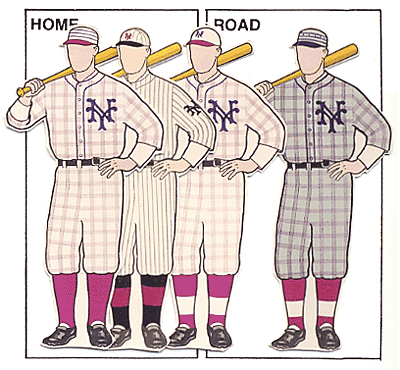
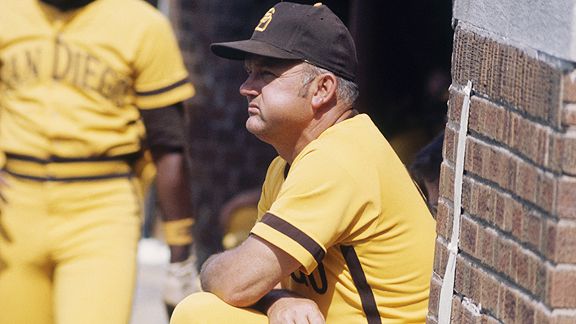
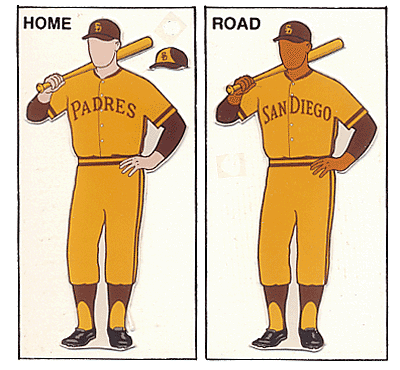
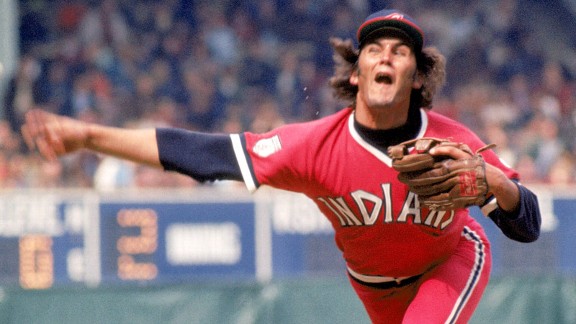
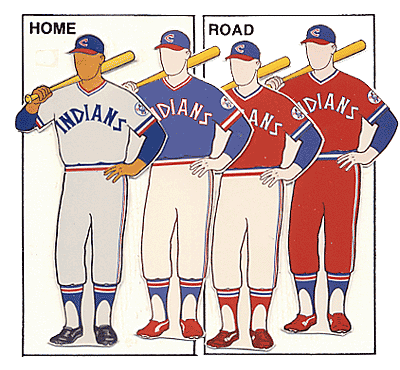
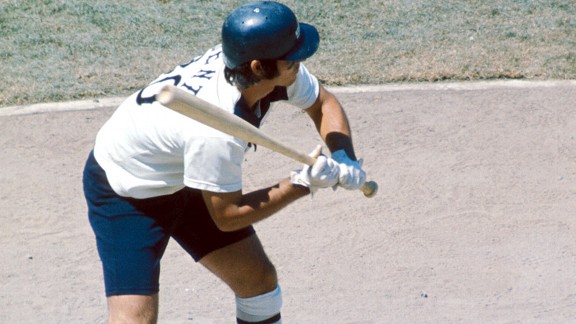
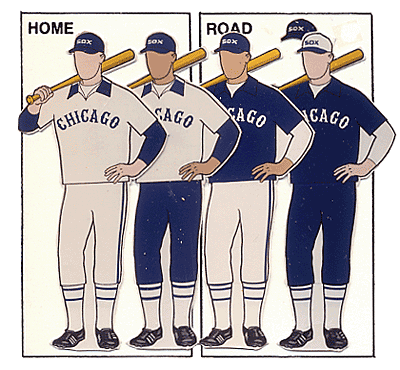
10 Ugliest Uniforms in Baseball History
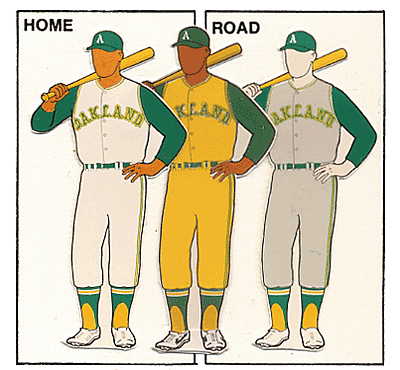
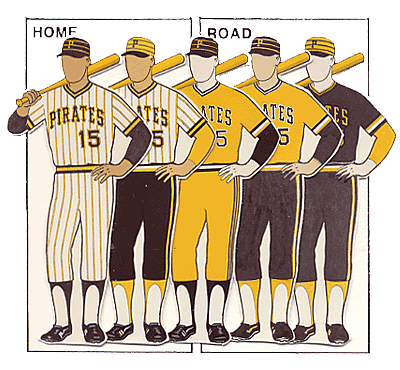
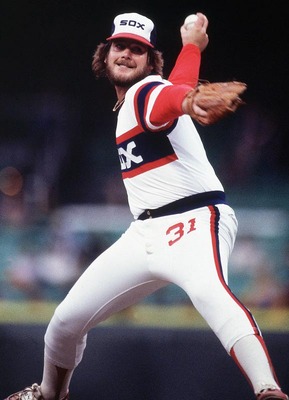
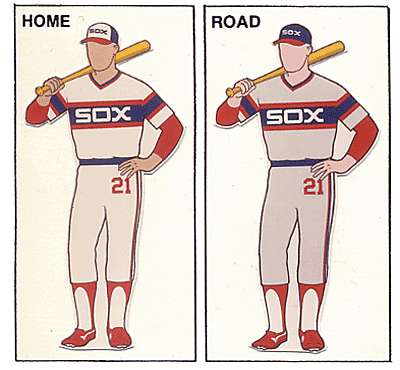
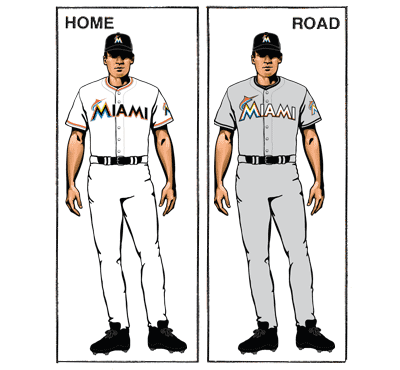
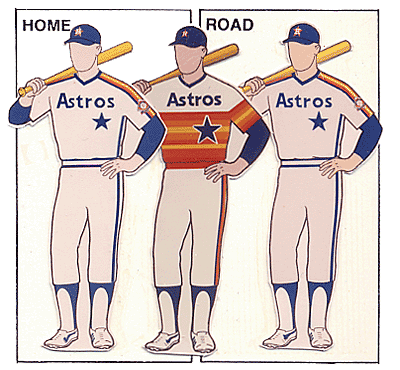
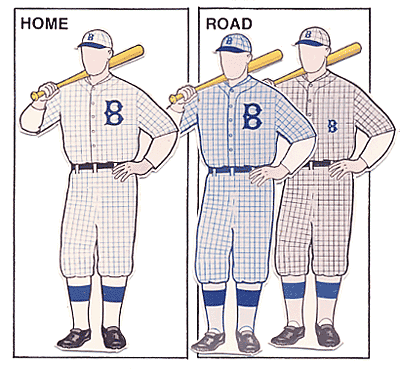
"There is more importance attached to the selection of a regular uniform for a base ball club than the fraternity generally think there is...one of the last things a club should do, is to change the colors or form of its uniform."These were the words of wisdom of Henry Chadwick, one of the founding fathers of organized baseball. Way back in 1869 Chadwick knew that the appearance of a team made a big difference in how the team is perceived by the public. Quite often people form allegiances based on locality, but just as often, appearance of the uniform makes a big difference in choosing sides. The eye catching colors of the Giants' black and orange, the crisp blue and white of the Dodgers, the classy look of the Tigers' olde English D, the traditional blue pinstripes of the Yankees all play a part in the image of the organization as a whole.
Twenty years later the 1889 Spalding's Baseball Guide and Official League Book, quoted Rule #17 as stating that "Every Club shall be required to adopt uniforms for its players, and each player shall be required to present himself upon the field during said game in a neat and cleanly condition..." Of course, Spalding's being a sporting goods company, the back of that guide to the upcoming season featured an ad urging "clubs not to make the mistake of entrusting the making of their uniforms to local dealers, whose experience in this kind of work is necessarily limited." At that time the top quality jersey would have cost you $5.00. That's a hell of a bargain considering a replica Josh Hamilton jersey, not the expensive authentic replica,would cost you $100 plus tax plus shipping and handling. The 1889 Brooklyn Bridegrooms (the ancestors of the Dodgers) could have clothed their first and second nines with top quality uniforms (with some left over) for that amount.
Over the years some teams have paid particular attention to the continuity of their uniforms (the Yankees have made only minor changes to their uniforms since the early 1920's) while others seem to change every ten years or so (the Padres, Mariners, Astros and Angels were all expansion teams but have all continuously changed uniforms, color schemes and logos).
Some uniform changes are widely successful and others are disastrous. Below are my choices for the ten ugliest uniforms in the history of the sport:
10. 1963-1974 Kansas City/Oakland Athletics
Charles Finley always tried to find new ways to draw attention to his teams. Frequent readers will remember his antics as they were chronicled during our focus on baseball in music series. Finley took over majority ownership of the Athletics in 1961 when they were in Kansas City. The A's were one of the original American League teams and had used red and white or blue and white (occasionally a combination of all three) since the league began in 1901. Just a few years after Finley took over the team , in 1963, the color scheme changed drastically to Kelly Green and Canary Yellow. The combination was usually used with a yellow shirt and white pants but as you can see from the picture of Vida Blue below, they sometimes used yellow pants with the yellow jerseys. As ugly as these uniforms were the A's were very successful during their use. In the time that they wore these uniforms the A's won division titles in 1971, 1972, 1973, 1974 and 1975 and won three straight World Series in 1972, 1973 and 1974.
9. 1979 Pittsburgh Pirates
Similar to the Athletics organization, the Pittsburgh Pirates used a varying red and white or blue and white color scheme for decades. Although we might find it hard to believe that any team in Pittsburgh would use any color scheme other than black and gold, Pirates legends Honus Wagner, Fred Clarke, Paul and Lloyd Waner and Pie Traynor never appeared in what we consider the traditional Pirates colors. In 1946 the Pirates were purchased by a group that included the legendary entertainer Bing Crosby and two years later the team adopted the now famous black and gold. The uniform had small variations throughout the years and were usually pretty nice looking but the 1979 "We Are Family" team used the gaudy all Canary Yellow combination seen in the below photo of Willie Stargell. Also similar to the Oakland A's, the Pirates won the World Series the year these uniforms were used, coming back from a 3 games to 1 deficit to defeat the Baltimore Orioles.
8. 1982-1986 Chicago White Sox
This won't be the last time you see the White Sox on this list but these uniforms (seen modeled below by Pitcher Lamaar Hoyt) are definitely hideous. It could be the font of the Sox across the chest, the odd positioning of the numbers on the leg or just the odd striping patterns that make these uniforms among the ugliest ever. Regardless, the ChiSox won the 1983 American League West but lost in the American League Championship Series to the Baltimore Orioles. These uniforms lasted until 1986. They were replaced for a few years by slightly nicer uniforms with the same color scheme but with a script "White Sox" on the home jersey and "Chicago" for the away jersey. The current black and white (a throw back to the days of the early years in the league) were debuted in 1990.
The Marlins have been in the league since 1993 and chose an odd Teal, Black and Gray color scheme to start off their existence. They used variations of that color scheme until 2012 when the team had a complete overhaul. As the team prepared to embark on a new chapter by moving into a brand new stadium with a new manager and a ton of new high priced free agents, they decided to change their uniforms and logo as well. The team must have had little left in the budget for uniforms after the price of the stadium and payroll because the uniforms looked like a company softball uniform. A debate can probably be started to discuss what was the bigger disaster: the uniforms or the play on the field?
6. 1975-1986 Houston Astros
When the Houston Colt .45's renamed themselves the Astros for the 1965 season, they switched their uniforms to a fairly simple "Astros" across the chest with a shooting star across the top. The color scheme changed from a blue and white (with hints of orange) to an orange and white combination for the 1970 season. Starting in 1975, they apparently couldn't bring themselves to decide on just two colors because their uniform had a little bit of everything but green in it. Amazingly, some of the greatest Astros in the history of the organization wore the rainbow uniforms. Nolan Ryan, Mike Scott, Glenn Davis and Jose Cruz all spent the best parts of their careers in hideous fashion. The results are what matter and the Astros won. The team reached the playoffs in 1980, 1981 and 1986. All three times they lost to the eventual World Series champions (1980 Phillies, 1981 Dodgers and 1986 Mets).
We rarely see major variations of the base color of uniforms. Throughout history home uniforms are usually solid white and road uniforms are solid gray with a logo, team name or city name across the chest. The most common drastic difference is the pinstriped look that we see on the Yankees, Phillies or White Sox uniforms, for example. When I was recently reading up on the 1916 World Series I came across these beauties (modeled below by manager Wilbert Robinson) with the checkered pattern. At any rate, they were only in use for two seasons but made an appearance in the 1916 World Series as the Dodgers lost to Babe Ruth and the Red Sox.
4. 1916 New York Giants
The Giants-Dodgers rivalry was in the infant stages but was rarely more vicious than at this time. The intensity of the rivalry at this period can largely be attributed to the hatred that grew between Wilbert Robinson and John McGraw, formerly the best of friends. Coincidence or not, the Dodgers and Giants both sported the checkered pattern uniforms during the 1916 season. The Dodgers had success with the pattern in 1916, reaching their first World Series. The Giants did not and switched back to their previous pinstripes in red with a gray road uniform in 1917. Apparently there is something to the success of a uniform as they returned to the World Series for 1917. The classic Giants black and orange (the reason Duke Snider would hate Halloween) would not come to the Giants until John McGraw had retired. The now famous Giants colors were introduced by McGraw's replacement, Bill Terry.
3. 1972-1973 San Diego Padres
The Padres may be able to consider themselves lucky that they weren't wearing floppy shoes and red wigs but we can doubt that any of them thought it could get any worse than these uniforms. The Padres were owned by Ray Kroc, owner of McDonald's, who decided to dress his players in the same color scheme as his hamburgers. The all beef colored brown with the mustard colored uniforms were only used for two seasons but the color scheme remained in variations up until 1985 when they moved to a more white, brown and orange scheme. In the picture below Don Zimmer is seen looking pensive. Considering Zimmer has worn the Dodgers, Red Sox, Yankees and Cubs classic uniforms it kind of makes you wonder how disgusted he was wearing this thing.
For the second ugliest uniforms in the history of baseball it was only fitting that the image used would be one of the ugliest pictures in the history of baseball. 1975 was a monumental year for baseball. The Big Red Machine dominated the National League. The Red Sox, led by Fred Lynn and Jim Rice won the American League. One of the greatest World Series of all time took seven classic games to be decided and Frank Robinson had the honor of being the first African American manager in major league history. Unfortunately for Frank he was manager of the Indians. Since 1960 the franchise had finished higher than 4th only once, which was a third place finish in 1968 (21 games behind the first place Tigers). Robby's bitter sweet appointment to the lowly Tribe can lead to the philosophical question: why do bad teams happen to great managers? Another great question would be why do bad uniforms happen at all? The 1975 Indians had a new look roster including Robinson as the DH Player/manager and a new first baseman in Boog Powell. Powell dressed in the uniform for the first time, looked in the mirror and told his team mates "I look like a massive blood clot." Given Powell's size and shape he probably could have better compared himself to a ripe tomato.
1. 1976 White Sox (3 games only)
Bill Veeck was very similar to Charlie Finley in some ways: always looking for ways to get people in the seats. He was the mastermind behind Disco Demolition night and Five Cent Beer Night. He once decided that the player's batting average was not as important a stat as their "failure percentage" and had his scoreboard operator display the percentage of times the batter had failed to get a hit. The players were not too happy about that one but they flat out revolted when they were forced to wear Softball style uniforms with shorts. Comiskey Park was not always well manicured so you can imagine the fear the players would have had of trying to slide in shorts. Fortunately for the ChiSox Comiskey realized the mistake, or realized his players would probably completely revolt if he didn't switch back to normal uniforms. After 3 games the shorts were gone.
Have any other suggestions or a different list? Email me your list or leave a comment.
Saturday, April 20, 2013
Reflections on the Movie 42
*** SPOILER ALERT! IF YOU HAVE NOT SEEN THE MOVIE "42" AND DO NOT WANT TO KNOW WHAT HAPPENS DO NOT READ PAST THIS LINE BUT PLEASE CHECK OUT THE PREVIEW THAT WAS COMPLETED LAST WEEK AND CHECK BACK HERE AFTER YOU HAVE SEEN THE MOVIE. ALSO, I AM NOT A MOVIE CRITIC OR MOVIE EXPERT SO THE INFORMATION THAT FOLLOWS IS NOT A PROFESSIONAL, OR EVEN NECESSARILY INTELLIGENT REVIEW OF THE MOVIE. IN FACT LET'S NOT EVEN CALL IT A REVIEW. WE'LL JUST CALL IT MY RAMBLINGS.***
Most of the time when I go into a movie with high expectations I walk away disappointed. It could be because I am just not a "movie person". I enjoy movies, I have nothing against movies but I am not someone who looks forward to movies or goes every weekend. In fact I would rather watch an Astros-Expos game from 1970 than watch a critically acclaimed "masterpiece". You can call me crazy (you wouldn't be the first or last) but I just don't enjoy movies that much. So it was odd for me to be as excited to see "42" as I was. Thankfully I can say I was not disappointed and enjoyed it even more than I expected.
Since my preview last week was based only on the IMDB page list of the cast I felt, while watching the movie, that last week's article did a fairly good job of preparing you for the movie. Had I been able to see the movie before hand I would have been able to cut down the bios I provided as some of the people listed never truly appeared or were mentioned only in passing. Although the information I provided to you in the preview was important in the grand scheme of the Jackie Robinson back story, the bios of Mallie Robinson, Jake Pitler (1st base coach), Carl Furillo, Rex Barney, Pete Reiser, Johnny Sain, Eddie Dyer, Stan Musial, Joe Garagiola, Billy Herman and the additional characters I expected would be mentioned, were not necessary as they were only mentioned in passing or not specifically mentioned but seen only briefly in the background. I apologize for the over load of extra information but hopefully it was still helpful in understanding Jackie's season or at least entertaining for you.
I have very few complaints about the movie, in fact, the only complaint I actually have is that it was too short. I would have loved to have seen more in the film about his season in Montreal with the minor league team and possibly the Dodgers' World Series appearance in 1947. Overall the portrayals of the characters were convincing. Harrison Ford truly looked like Branch Rickey and I never felt like I was watching Han Solo in a baseball movie. I always felt I was watching Branch Rickey. Also, Chadwick Boseman did a tremendous job of portraying Jackie Robinson. His movements on the base paths and almost lunging swings at times were dead on accurate. There was a moment where Jackie hits a single and is running down to first base. The running style and movement looked so authentic to me that it could have been a newsreel film of Jackie from the 1940's. As I mentioned above, I am not a film critic so you may read or hear the professionals disagree but in my opinion both main actors did a great job.
THE BEST MOMENT:
Hopefully if you are reading this you have already seen the movie. If you haven't then I hope this will inspire you to go out and see it. Without attempting to over personalize the moment, I have often tried to put myself in Jackie's position in this season and imagine how difficult the situation might have been but I never could quite wrap my head around it. The pressure, stress, isolation and frustration must have been unbearable. Not only was he facing the pressure of being the first African American in a game that was not necessarily ready for him, he had to learn Firstbase in the process. Suffering from stomach ulcers, losing his hair, dealing night after night with taunts, threats and abuse. He was constantly being told by one side, supporting him, that the fate of every African American with a dream of playing in the big leagues rested on his shoulders while constantly being pushed by the other side in attempts to make him fail.
The greatest moment of the movie was Jackie's reaction to Ben Chapman in the dugout tunnel as he breaks down. As Branch Rickey attempts to support Jackie, Rickey explains that he cannot understand what he is going through because no one else has that experience or responsibility. Even with his greatest supporters he is still all alone. The emotion of the scene is probably as close as any of us will come to being able to see the experience through Jackie's eyes and realize just what he had to deal with.
Historical inaccuracies:
My intention here is not to nitpick and criticize the film for some minor inaccuracies. I completely understand that it is not possible (or a good idea) to make a film that is a 100% word for word historical retelling of an event and still make the film entertaining. This film did an excellent job of telling the story quickly and the historical inaccuracies were done for specific effect. Here are a few inaccuracies that I noticed:
Film: Clyde Sukeforth was told before being sent to scout Jackie that he was bringing him to Brooklyn for the Major Leagues.
In the film, the movie opens with Branch Rickey, Harold Parrott and Clyde Sukeforth in Rickey's office when Rickey drops the bombshell that he will break the color line. Parrott immediately reacts by telling Rickey he can't do that. Rickey convinces them it will happen regardless and they begin pouring over names that may be a possibility to break the color barrier. Sukeforth is dispatched to bring Jackie back for a meeting and tracks him down at a gas station with the rest of his team.
Reality:
The reality is that Sukeforth was told to scout Jackie for the Brooklyn Brown Dodgers, a Dodgers negro league team. Sukeforth went to Kansas City to watch Jackie play and give an actual scouting report on Jackie's play. The scene of the team at the gas station was historically accurate in many points. The Kansas City Monarchs were once stopping at a gas station to fill up their bus on a road trip. When he was told that the players could spend their money on gas but not use the bathroom Jackie demanded that they move on to another station that would allow them full access. This was definitely not where Sukeforth tracked them down.
Film: Sukeforth, Parrott and Rickey pour over files of players trying to decide on what player to sign to a contract. They dismiss Roy Campanella as "too sweet" and Satchel Paige as "too old".
Reality:
Roy Campanella was signed to a contract not long after Jackie. He was much younger than Jackie and was not college educated as Jackie was. Campanella was signed to play for the Nashua, NH Dodgers farm club and was sent by Rickey to integrate the New England League. Campy once told Rickey: "I'm no pioneer. I'm a ballplayer." Campanella would go on to become one of the greatest Catchers of all time, a three time MVP, Hall of Fame member and was considered as managerial material twenty years before Frank Robinson became the first African American manager. The dismissal of Campanella as being too sweet was definitely not accurate. Campanella was a strong personality and was able to greatly control the game and take control of the pitching staff.Satchel Paige may have been dismissed as too old to break the color barrier but definitely would have been dismissed because of his quirky personality. With the attention focused on the first African American player Paige certainly would have been viewed more as a novelty with his age (he was 38 or 40 or maybe 43 or 45 depending on what day he was asked and who was asking). Something You May Have Missed in This Scene:
As the three Dodgers are discussing their options, there is a blackboard with a list of names. Several names are circled and starred as potential options. The men do not refer to the blackboard, it is just an incidental prop in the background. It appeared too briefly for me to see all the names listed but I did catch one name starred and circled: Josh Gibson. Gibson was only 33 at the time, was considered one of the greatest players the game has ever seen and was known as "the black Babe Ruth". Although it is likely that he was a recognizable name, it is not likely he was seriously considered as an option to break the color barrier because of health issues. In 1943 he was diagnosed with a brain tumor and refused surgery. Suffering excruciating headaches and with his mental state as a major question mark (whose wouldn't be in dealing with the constant pain?) they probably quickly ruled him out. Adding the pressure that Jackie faced would not have been something that Gibson could have handled in addition to his failing health. Larry Doby later said that Gibson was heartbroken at not being chosen to break the color barrier and missing the opportunity to play aganst the major league stars. Gibson passed away on January 20, 1947, just a few months before Jackie's debut in Brooklyn, from a stroke. He was only 35.
Film: The petition started by the players asking Branch Rickey not to bring Jackie to the majors was initiated by Kirby Higbe. Dixie Walker asks Higbe "Are you sure about this?"
Reality:
The petition was started by Dixie Walker. Higbe signed the petition but later felt guilty about it and told Harold Parrott about the petition. Parrott notified Rickey and Durocher which led to the speech by Durocher.
Film: Burt Shotton is portrayed as an almost feeble, bumbling old man. He gives a speech where he sounds more like a Mr.Magoo type character than a baseball manager.
Reality:
Burt Shotton did tell the team "don't worry about Burt Shotton getting in your way. You can win this pennant in spite of me", however, it was not quite the way it was portrayed in the movie. He said these comments more as an ice breaker to defuse a tough situation. The Dodgers were dealing with the attention of Leo Durocher's suspension as well as the added attention of Jackie's presence. Shotton was not known to the Dodgers players and was not familiar with their roster. He had not managed in the majors since a one game stint in 1934 in Cincinnati. The comments were meant more to put the players at ease and let them know to just keep playing the way they had been and that they did not have to worry about him trying to change their style of play. It was a savvy approach to a team that had very nearly reached the World Series the year before.
Film: The series against the Phillies when Chapman and the Phillies taunt Jackie non-stop is in Brooklyn. In between innings when Jack nearly has a breakdown Rickey comes and talks to him and comforts him telling him that he has to continue to fight through this.
Reality:
This Phillies series took place in Philadelphia. The verbal attacks on Jackie were very realistic and very difficult to watch. Jackie's reaction was very realistic. Jackie later said that he did consider punching Chapman and envisioned how that would play out, however, stayed strong and kept quiet. He felt that he was near a nervous breakdown at that point. Branch Rickey was not with the team on the road trip although Harold Parrott was keeping him up to date on the details of the series. Eddie Stanky did tell Chapman "Why don't you pick on someone who can yell back", but he did not leave the dugout to do it. It was done when the Dodgers were in the field. Stanky's reaction to Jackie's thank you was relatively accurate. Anyone who read the preview post will remember that Stanky told Jackie "I don't like you but we'll play together and get along because you're my teammate."
Film: Fritz Ostermuller hit Jackie in the head.
Reality:
Ostermuller certainly pitched high and tight to Jackie and he definitely did not have good intentions but the pitch that hit Jackie actually hit his arm. Jackie was able to get his arm up just in time to deflect the ball.
A FEW TRIVIAL THINGS YOU MAY HAVE MISSED:
These are certainly not key plot points or even important but there were several minor references and hidden props that you may not have noticed:
Branch Rickey's Ring:
Did anyone notice the ring that Branch Rickey wears throughout the movie? Rickey was the Manager, Business Manager and eventually General Manager of the St. Louis Cardinals until 1942. During the time he was involved with the Cardinals they reached the World Series in 1926, 1928, 1930, 1931 and 1942, winning the series in 1926, 1931 and 1942. The ring he wears in the film is a World Series ring from his time with the Cardinals.
Kirby Higbe's rant after his trade:
After learning he has been traded to Pittsburgh (the worst team in the league) he rants about the terrible fate of being sent to the baseball graveyard and mentions that he was traded for cash and "some Italian outfielder named Gionfriddo". Al Gionfriddo was a little known outfielder. In the World Series of that year Gionfriddo would make one of the greatest catches in World Series history. As game 6 moved into the sixth inning Shotton sent Gionfriddo out to play left field replacing Eddie Miksis. The Dodgers led 8-5, the Yankees put two men on with two out and Joe DiMaggio at the plate. DiMaggio hit a fly ball headed for the left field corner. Gionfriddo felt that the team had him positioned too shallow but he got a great reaction to the ball. "I started running with my back to home plate. I looked over my shoulder once, and I could see the ball was still coming and I put my head down again and kept running and running and when I got to where I thought the ball would come down, I reached my glove out...I was up in the air when I got it." It is one of the most replayed, spectacular catches of all time. Even more replayed was DiMaggio's reaction. As he rounded second in what most believed was a sure home run, DiMaggio kicked at the dirt in frustration.
Rachel Robinson walks down the street in Brooklyn:
The Dodgers in Brooklyn were truly a communal experience. This was a small town team playing in New York and struggling to remain a community property. It was often said that the entire city was in love with the team. Obviously that is an exaggeration because no matter where you go you will never get everyone to agree on anything but the point was the Dodgers were beloved in the city of Brooklyn. There is a legend in the Brooklyn Dodger literature that Red Barber (and later Vin Scully) were a part of the family and were invited into the home everyday by way of the radio. The radio broadcasts were so popular that someone could walk down the street in Brooklyn and keep track of the game based on the radio broadcasts they overheard out of the windows.
Assist by Ralph Branca:
Ralph Branca was portrayed in the film as Jackie's main support among the players and Branca was definitely a supporter for Robinson in the first year. However, he was credited with an assist at a key point in the movie that could not have happened. As Jackie is tracking a foul ball toward the dugout he looks at the dugout to get his bearings and check how much room he has to make the catch. Branca stands up, catches Jackie as he falls into the dugout and saves him from crashing into the dugout by tackling him onto the field. This is sort of false. Everyone has seen players stand up in the dugout to assist the player coming over to make the play, although there is a rule. The players in the dugout are not allowed to physically assist the player making the play. Had Branca actually gone onto the field the play would have been called interference. It would be a foul ball and any runners on base would advance one base. It is likely that Dodgers players would have helped Jackie to stop his momentum from carrying him into the dugout but he definitely would not have moved into the field of play.
The Abraham Lincoln of baseball:
Branch Rickey has often been called the Abraham Lincoln of baseball for obvious reasons. When Pee Wee Reese goes into Rickey's office there are bookends of Lincoln on the shelves behind his desk.
MY PETTY COMPLAINTS:
The first ever National League Playoffs:
There was a brief mention in the movie that the Dodgers had finished two games behind the Cardinals in 1946. What they failed to mention is that the Dodgers and Cardinals were actually tied at the end of the regular season and for the first time in the history of the National League two teams played a best of three playoff series to determine the league champion and World Series representative. The Cardinals won the first two games of the best of three meaning that they won two more games than the Dodgers. There was no mention of the impact this had on the 1947 team coming into the season. Regular playoffs did not occur until 1969 when the league went to a four division format.
Pete Reiser:
Pete Reiser was one of the stars of the Dodgers and a particular favorite of Branch Rickey. Frequent readers of the blog may remember the story that Rickey signed Reiser to a minor league contract with the Cardinals only to have Commissioner Landis void the contract. Reiser had seen Jackie before, during their military days and refused to sign the petition started by Dixie Walker. Although he was listed in the cast he played little or no part in the movie.
Walter O'Malley:
Walter O'Malley was a co-owner of the Dodgers and Rickey's arch rival. After a power struggle, O'Malley wrestled control of the team from Rickey. He has been villainized in Brooklyn for decades for his final decision to move the Dodgers to Los Angeles and the story of the Dodgers cannot be told without him. I did not notice any mention or reference of him in the film.
Hank Greenberg:
This is a truly personal petty complaint so you'll have to forgive me on this one. Since Greenberg retired long before anyone I know followed baseball there is no logical reason for my like of Hank Greenberg but for some reason (as frequent readers may notice) I love to make a reference to Greenberg who was truly one of the great players ever. Knowing the part that Greenberg played in his support of Jackie and the appreciation that Jackie showed towards him I was very disappointed that Greenberg was not seen. There was a very brief reference to Greenberg and it may have been missed. As Ben Chapman is defending his taunting of Jackie he mentions that it was something that was done to everyone. He mentions that DiMaggio was called a WOP and Greenberg was called a kike, as though that made everything ok. That was the only reference to Greenberg. As Jackie hit the dramatic home run off Ostermuller in Pittsburgh I was hoping to at least see a big old Pirates #5 as Jackie rounded first but sadly I didn't even see it there. What? I told you these were petty complaints!
Most of the time when I go into a movie with high expectations I walk away disappointed. It could be because I am just not a "movie person". I enjoy movies, I have nothing against movies but I am not someone who looks forward to movies or goes every weekend. In fact I would rather watch an Astros-Expos game from 1970 than watch a critically acclaimed "masterpiece". You can call me crazy (you wouldn't be the first or last) but I just don't enjoy movies that much. So it was odd for me to be as excited to see "42" as I was. Thankfully I can say I was not disappointed and enjoyed it even more than I expected.
Since my preview last week was based only on the IMDB page list of the cast I felt, while watching the movie, that last week's article did a fairly good job of preparing you for the movie. Had I been able to see the movie before hand I would have been able to cut down the bios I provided as some of the people listed never truly appeared or were mentioned only in passing. Although the information I provided to you in the preview was important in the grand scheme of the Jackie Robinson back story, the bios of Mallie Robinson, Jake Pitler (1st base coach), Carl Furillo, Rex Barney, Pete Reiser, Johnny Sain, Eddie Dyer, Stan Musial, Joe Garagiola, Billy Herman and the additional characters I expected would be mentioned, were not necessary as they were only mentioned in passing or not specifically mentioned but seen only briefly in the background. I apologize for the over load of extra information but hopefully it was still helpful in understanding Jackie's season or at least entertaining for you.
I have very few complaints about the movie, in fact, the only complaint I actually have is that it was too short. I would have loved to have seen more in the film about his season in Montreal with the minor league team and possibly the Dodgers' World Series appearance in 1947. Overall the portrayals of the characters were convincing. Harrison Ford truly looked like Branch Rickey and I never felt like I was watching Han Solo in a baseball movie. I always felt I was watching Branch Rickey. Also, Chadwick Boseman did a tremendous job of portraying Jackie Robinson. His movements on the base paths and almost lunging swings at times were dead on accurate. There was a moment where Jackie hits a single and is running down to first base. The running style and movement looked so authentic to me that it could have been a newsreel film of Jackie from the 1940's. As I mentioned above, I am not a film critic so you may read or hear the professionals disagree but in my opinion both main actors did a great job.
THE BEST MOMENT:
Hopefully if you are reading this you have already seen the movie. If you haven't then I hope this will inspire you to go out and see it. Without attempting to over personalize the moment, I have often tried to put myself in Jackie's position in this season and imagine how difficult the situation might have been but I never could quite wrap my head around it. The pressure, stress, isolation and frustration must have been unbearable. Not only was he facing the pressure of being the first African American in a game that was not necessarily ready for him, he had to learn Firstbase in the process. Suffering from stomach ulcers, losing his hair, dealing night after night with taunts, threats and abuse. He was constantly being told by one side, supporting him, that the fate of every African American with a dream of playing in the big leagues rested on his shoulders while constantly being pushed by the other side in attempts to make him fail.
The greatest moment of the movie was Jackie's reaction to Ben Chapman in the dugout tunnel as he breaks down. As Branch Rickey attempts to support Jackie, Rickey explains that he cannot understand what he is going through because no one else has that experience or responsibility. Even with his greatest supporters he is still all alone. The emotion of the scene is probably as close as any of us will come to being able to see the experience through Jackie's eyes and realize just what he had to deal with.
Historical inaccuracies:
My intention here is not to nitpick and criticize the film for some minor inaccuracies. I completely understand that it is not possible (or a good idea) to make a film that is a 100% word for word historical retelling of an event and still make the film entertaining. This film did an excellent job of telling the story quickly and the historical inaccuracies were done for specific effect. Here are a few inaccuracies that I noticed:
Film: Clyde Sukeforth was told before being sent to scout Jackie that he was bringing him to Brooklyn for the Major Leagues.
In the film, the movie opens with Branch Rickey, Harold Parrott and Clyde Sukeforth in Rickey's office when Rickey drops the bombshell that he will break the color line. Parrott immediately reacts by telling Rickey he can't do that. Rickey convinces them it will happen regardless and they begin pouring over names that may be a possibility to break the color barrier. Sukeforth is dispatched to bring Jackie back for a meeting and tracks him down at a gas station with the rest of his team.
Reality:
The reality is that Sukeforth was told to scout Jackie for the Brooklyn Brown Dodgers, a Dodgers negro league team. Sukeforth went to Kansas City to watch Jackie play and give an actual scouting report on Jackie's play. The scene of the team at the gas station was historically accurate in many points. The Kansas City Monarchs were once stopping at a gas station to fill up their bus on a road trip. When he was told that the players could spend their money on gas but not use the bathroom Jackie demanded that they move on to another station that would allow them full access. This was definitely not where Sukeforth tracked them down.
Film: Sukeforth, Parrott and Rickey pour over files of players trying to decide on what player to sign to a contract. They dismiss Roy Campanella as "too sweet" and Satchel Paige as "too old".
Reality:
Roy Campanella was signed to a contract not long after Jackie. He was much younger than Jackie and was not college educated as Jackie was. Campanella was signed to play for the Nashua, NH Dodgers farm club and was sent by Rickey to integrate the New England League. Campy once told Rickey: "I'm no pioneer. I'm a ballplayer." Campanella would go on to become one of the greatest Catchers of all time, a three time MVP, Hall of Fame member and was considered as managerial material twenty years before Frank Robinson became the first African American manager. The dismissal of Campanella as being too sweet was definitely not accurate. Campanella was a strong personality and was able to greatly control the game and take control of the pitching staff.Satchel Paige may have been dismissed as too old to break the color barrier but definitely would have been dismissed because of his quirky personality. With the attention focused on the first African American player Paige certainly would have been viewed more as a novelty with his age (he was 38 or 40 or maybe 43 or 45 depending on what day he was asked and who was asking). Something You May Have Missed in This Scene:
As the three Dodgers are discussing their options, there is a blackboard with a list of names. Several names are circled and starred as potential options. The men do not refer to the blackboard, it is just an incidental prop in the background. It appeared too briefly for me to see all the names listed but I did catch one name starred and circled: Josh Gibson. Gibson was only 33 at the time, was considered one of the greatest players the game has ever seen and was known as "the black Babe Ruth". Although it is likely that he was a recognizable name, it is not likely he was seriously considered as an option to break the color barrier because of health issues. In 1943 he was diagnosed with a brain tumor and refused surgery. Suffering excruciating headaches and with his mental state as a major question mark (whose wouldn't be in dealing with the constant pain?) they probably quickly ruled him out. Adding the pressure that Jackie faced would not have been something that Gibson could have handled in addition to his failing health. Larry Doby later said that Gibson was heartbroken at not being chosen to break the color barrier and missing the opportunity to play aganst the major league stars. Gibson passed away on January 20, 1947, just a few months before Jackie's debut in Brooklyn, from a stroke. He was only 35.
Film: The petition started by the players asking Branch Rickey not to bring Jackie to the majors was initiated by Kirby Higbe. Dixie Walker asks Higbe "Are you sure about this?"
Reality:
The petition was started by Dixie Walker. Higbe signed the petition but later felt guilty about it and told Harold Parrott about the petition. Parrott notified Rickey and Durocher which led to the speech by Durocher.
Film: Burt Shotton is portrayed as an almost feeble, bumbling old man. He gives a speech where he sounds more like a Mr.Magoo type character than a baseball manager.
Reality:
Burt Shotton did tell the team "don't worry about Burt Shotton getting in your way. You can win this pennant in spite of me", however, it was not quite the way it was portrayed in the movie. He said these comments more as an ice breaker to defuse a tough situation. The Dodgers were dealing with the attention of Leo Durocher's suspension as well as the added attention of Jackie's presence. Shotton was not known to the Dodgers players and was not familiar with their roster. He had not managed in the majors since a one game stint in 1934 in Cincinnati. The comments were meant more to put the players at ease and let them know to just keep playing the way they had been and that they did not have to worry about him trying to change their style of play. It was a savvy approach to a team that had very nearly reached the World Series the year before.
Film: The series against the Phillies when Chapman and the Phillies taunt Jackie non-stop is in Brooklyn. In between innings when Jack nearly has a breakdown Rickey comes and talks to him and comforts him telling him that he has to continue to fight through this.
Reality:
This Phillies series took place in Philadelphia. The verbal attacks on Jackie were very realistic and very difficult to watch. Jackie's reaction was very realistic. Jackie later said that he did consider punching Chapman and envisioned how that would play out, however, stayed strong and kept quiet. He felt that he was near a nervous breakdown at that point. Branch Rickey was not with the team on the road trip although Harold Parrott was keeping him up to date on the details of the series. Eddie Stanky did tell Chapman "Why don't you pick on someone who can yell back", but he did not leave the dugout to do it. It was done when the Dodgers were in the field. Stanky's reaction to Jackie's thank you was relatively accurate. Anyone who read the preview post will remember that Stanky told Jackie "I don't like you but we'll play together and get along because you're my teammate."
Film: Fritz Ostermuller hit Jackie in the head.
Reality:
Ostermuller certainly pitched high and tight to Jackie and he definitely did not have good intentions but the pitch that hit Jackie actually hit his arm. Jackie was able to get his arm up just in time to deflect the ball.
A FEW TRIVIAL THINGS YOU MAY HAVE MISSED:
These are certainly not key plot points or even important but there were several minor references and hidden props that you may not have noticed:
Branch Rickey's Ring:
Did anyone notice the ring that Branch Rickey wears throughout the movie? Rickey was the Manager, Business Manager and eventually General Manager of the St. Louis Cardinals until 1942. During the time he was involved with the Cardinals they reached the World Series in 1926, 1928, 1930, 1931 and 1942, winning the series in 1926, 1931 and 1942. The ring he wears in the film is a World Series ring from his time with the Cardinals.
Kirby Higbe's rant after his trade:
After learning he has been traded to Pittsburgh (the worst team in the league) he rants about the terrible fate of being sent to the baseball graveyard and mentions that he was traded for cash and "some Italian outfielder named Gionfriddo". Al Gionfriddo was a little known outfielder. In the World Series of that year Gionfriddo would make one of the greatest catches in World Series history. As game 6 moved into the sixth inning Shotton sent Gionfriddo out to play left field replacing Eddie Miksis. The Dodgers led 8-5, the Yankees put two men on with two out and Joe DiMaggio at the plate. DiMaggio hit a fly ball headed for the left field corner. Gionfriddo felt that the team had him positioned too shallow but he got a great reaction to the ball. "I started running with my back to home plate. I looked over my shoulder once, and I could see the ball was still coming and I put my head down again and kept running and running and when I got to where I thought the ball would come down, I reached my glove out...I was up in the air when I got it." It is one of the most replayed, spectacular catches of all time. Even more replayed was DiMaggio's reaction. As he rounded second in what most believed was a sure home run, DiMaggio kicked at the dirt in frustration.
Rachel Robinson walks down the street in Brooklyn:
The Dodgers in Brooklyn were truly a communal experience. This was a small town team playing in New York and struggling to remain a community property. It was often said that the entire city was in love with the team. Obviously that is an exaggeration because no matter where you go you will never get everyone to agree on anything but the point was the Dodgers were beloved in the city of Brooklyn. There is a legend in the Brooklyn Dodger literature that Red Barber (and later Vin Scully) were a part of the family and were invited into the home everyday by way of the radio. The radio broadcasts were so popular that someone could walk down the street in Brooklyn and keep track of the game based on the radio broadcasts they overheard out of the windows.
Assist by Ralph Branca:
Ralph Branca was portrayed in the film as Jackie's main support among the players and Branca was definitely a supporter for Robinson in the first year. However, he was credited with an assist at a key point in the movie that could not have happened. As Jackie is tracking a foul ball toward the dugout he looks at the dugout to get his bearings and check how much room he has to make the catch. Branca stands up, catches Jackie as he falls into the dugout and saves him from crashing into the dugout by tackling him onto the field. This is sort of false. Everyone has seen players stand up in the dugout to assist the player coming over to make the play, although there is a rule. The players in the dugout are not allowed to physically assist the player making the play. Had Branca actually gone onto the field the play would have been called interference. It would be a foul ball and any runners on base would advance one base. It is likely that Dodgers players would have helped Jackie to stop his momentum from carrying him into the dugout but he definitely would not have moved into the field of play.
The Abraham Lincoln of baseball:
Branch Rickey has often been called the Abraham Lincoln of baseball for obvious reasons. When Pee Wee Reese goes into Rickey's office there are bookends of Lincoln on the shelves behind his desk.
MY PETTY COMPLAINTS:
The first ever National League Playoffs:
There was a brief mention in the movie that the Dodgers had finished two games behind the Cardinals in 1946. What they failed to mention is that the Dodgers and Cardinals were actually tied at the end of the regular season and for the first time in the history of the National League two teams played a best of three playoff series to determine the league champion and World Series representative. The Cardinals won the first two games of the best of three meaning that they won two more games than the Dodgers. There was no mention of the impact this had on the 1947 team coming into the season. Regular playoffs did not occur until 1969 when the league went to a four division format.
Pete Reiser:
Pete Reiser was one of the stars of the Dodgers and a particular favorite of Branch Rickey. Frequent readers of the blog may remember the story that Rickey signed Reiser to a minor league contract with the Cardinals only to have Commissioner Landis void the contract. Reiser had seen Jackie before, during their military days and refused to sign the petition started by Dixie Walker. Although he was listed in the cast he played little or no part in the movie.
Walter O'Malley:
Walter O'Malley was a co-owner of the Dodgers and Rickey's arch rival. After a power struggle, O'Malley wrestled control of the team from Rickey. He has been villainized in Brooklyn for decades for his final decision to move the Dodgers to Los Angeles and the story of the Dodgers cannot be told without him. I did not notice any mention or reference of him in the film.
Hank Greenberg:
This is a truly personal petty complaint so you'll have to forgive me on this one. Since Greenberg retired long before anyone I know followed baseball there is no logical reason for my like of Hank Greenberg but for some reason (as frequent readers may notice) I love to make a reference to Greenberg who was truly one of the great players ever. Knowing the part that Greenberg played in his support of Jackie and the appreciation that Jackie showed towards him I was very disappointed that Greenberg was not seen. There was a very brief reference to Greenberg and it may have been missed. As Ben Chapman is defending his taunting of Jackie he mentions that it was something that was done to everyone. He mentions that DiMaggio was called a WOP and Greenberg was called a kike, as though that made everything ok. That was the only reference to Greenberg. As Jackie hit the dramatic home run off Ostermuller in Pittsburgh I was hoping to at least see a big old Pirates #5 as Jackie rounded first but sadly I didn't even see it there. What? I told you these were petty complaints!
Subscribe to:
Posts (Atom)