Sunday, November 18, 2012

12 Players You May Not Know from the 2000's But Should

It was the best of times.  It was the worst of times.

The decade of 2000-2010 was a roller coaster for baseball.  With some great trends that you may not have noticed and some terrible scandals no one could avoid.

In those ten years no team won back to back World Series and only two teams won more than one (the Yankees in 2000 and 2009 and Red Sox in 2004 and 2007).   The decade saw "newer teams" like the Diamondbacks, Angels and Marlins win the World Series and the Rockies, Astros, Rangers and Rays reached the World Series for the first time.  Some of the most memorable playoff moments in the history of the game took place: Rick Ankiel melted down on the mound in the 2000 NLDS, Luis Gonzalez's extra inning game winning hit in game 7 of the 2001 World Series ended one of the best World Series of all time, the miracle Angels used the power of a bizarre mascot and rallied from a 3 games to 2 deficit to stun the Giants, Aaron Boone stuck a dagger in the heart of the Red Sox in 2003 and the Red Sox got revenge the next year, the White Sox won their first World Series since 1917 (which quietly was a longer drought than the Red Sox had ended the year before), the Cardinals and Tigers squared off in a classic rematch of a World Series that stretches back to 1934, the Phillies and Rays played a World Series game that took 3 days and ended the Phillies 28 year drought, the Phillies and Yankees introduced replay to the World Series, Roy Halladay pitched the first postseason perfect game since 1956 and the Giants ended their own playoff drought winning their first World Series since moving to San Francisco.

The decade started with the first "Subway Series" since 1956 as the Yankees beat the Mets, continuing their domination of the history of the game.  The story of the decade quickly became ending long struggles to reach the top and the breaking of curses.  The Red Sox, White Sox, Angels, Phillies, Cardinals and Giants all ended droughts of 20 years or more (two of them stretching back to the 1910's). 

The decade was also a decade of comebacks.  The 2003 Tigers won only 43 games (that means out of 162 games they lost 119), one of the worst records in history.  Just three years later they were in the World Series.  The 2003 Red Sox blew a late 7th Game lead in the ALCS and fell behind 3 games to 0 in the 2004 ALCS then stormed back to win it all.  Three years later, the 2007 Red Sox did the same.  Those  2007 Red Sox faced a Rockies team that won 14 of their last 15 games to force a one game playoff with the Padres and then fought their way into the World Series.  In the process, they knocked off the up and coming Phillies, who themselves had rallied from seven games back on September 12 to topple the Mets.

The decade saw the revival of some long dormant rivalries as the Yankees-Red Sox, Dodgers-Giants, Phillies-Mets and Tigers-White Sox rivalries boiled over.  It also saw the birth of new rivalries that got heated as Cardinals-Astros, Angels-Athletics, Yankees-Rays and Red Sox-Rays battled each other throughout the decade.

Despite all the fun, exciting great stories in the decade, the focus of the sports world was on the steroids scandal that grew larger and larger through the decade.  As two of the most respected players in the history of the game, Cal Ripken and Tony Gwynn, stepped away from the  game in 2001, the league was struggling to hide the dirty gigantic secret.  At the start of the decade the league was dominated by players like Giambi, Bonds, McGwire, Palmeiro, Clemens, Pettite and Ramirez.  By the end of the decade each of them would be suspected, implicated or outright caught using steroids.  The game fought to move on and rid the game of steroids and repair the damaged reputation while Bonds was toppling the most revered record of all time.  It could have been one of the best moments of all time but it became an embarrassment.  As Bonds prepared to pass Hank Aaron the talk was not about Bonds taking his position among Ruth, Aaron and Mays, it was about whether or not the commissioner would even be on hand to witness it and whether it would be recognized as a true record.

Although the names of Bonds, McGwire, Clemens, Jeter, ARod and Griffey will be the names that are remembered thirty, forty, fifty years from now (or more), every decade has tremendously talented, successful players who make wonderful contributions to the success of their teams, organizations and the league as a whole.  Unfortunately many of the players who fall into this category will be forgotten, overlooked and generally ignored.  Here are 12 players* from the decade that you may not remember but you definitely should:

Catcher:
Victor Martinez


Career Teams: Cleveland Indians (2002-2009) Boston Red Sox (2009-2010) and Detroit Tigers (2011-Present)
All Star Appearances: 2004, 2007, 2009 and 2010
MVP Voting:  2004 (21st), 2005 (18th) , 2007 (7th), 2009 (21st) and 2011 (16th).
The position of Catcher is known for being a defensive stronghold and the most important position on the field.  The catcher is involved in every pitch of every at bat.  In between pitches he's flipping through his mental catalog of what pitch this guy can hit, where he hits it to, who's on base and what type of pitch does he like to run on.  The mental focus on defense usually leads to lack of focus at the plate and lower averages.  The 2000's seemed to confirm this theory with AL Catchers like Posada and Varitek.  Good hitters but not threatening to win a batting title.  Victor Martinez (and Joe Mauer in Minnesota) broke this mold.  Between 2005 and 2011 Martinez hit .300 in all but one season, including .330 in 2011.  Martinez's best year was 2007.  Hitting .301, 40 doubles and 25 home runs the Indians took a 3 games to 1 lead over the Red Sox.  Martinez hit .455 in the three Indians wins but only .188 in the four losses as the Red Sox stormed back and went on to their second World Series win in 4 years.  Martinez moved on to Boston in 2009 but struggled to help the Sox.  In 2011 he helped Detroit reach the ALCS.  He missed all of 2012 due to injury.  His bat in the Tigers lineup may have made a difference in the World Series.  He is expected back for 2013 and should be a great help to the Tigers as a DH.


First Base:
Richie Sexson
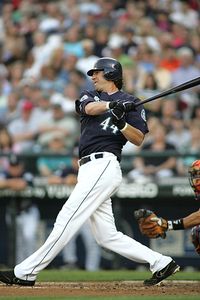

Career Teams: Cleveland Indians (1997-2000), Milwaukee Brewers (2000-2003), Arizona Diamondbacks (2004), Seattle Mariners (2005-2008), New York Yankees (2008)
All Star Appearances: 2002 and 2005
MVP Voting: 2003 (12th) and 2005 (15th)
The first base position during the decade of 2000-2010 was full of amazing talent.  Giambi, Palmeiro, Teixeira, Thome, Howard, McGwire, Fielder, Konerko.  It seemed that every team at some point in the decade had a hall of fame or MVP caliber first baseman.  Sexson was brought up by the Indians in 1998 to help fill in for an injured Jim Thome and immediately got noticed by pounding the ball.  His high strikeouts caused him to be a slight liability but he had several years of near 100 walks to offset the K's.  From 2001 to 2004 he was a borderline superstar but it was difficult to gain attention during an era when there were first base all stars everywhere and he was playing on a poor Milwaukee team.  After 2004 he became a free agent.  The Seattle Mariners had money to burn and hired Mike Hargrove to manage the team then signed Sexson and Adrian Beltre to fit in with established stars like Bret Boone and Ichiro.  Despite the high payroll Seattle failed miserably and all blame fell on Sexson and Beltre.  The most amazing thing about looking at the Seattle roster of these years are the young players who would later be stars: Felix Hernandez, Raul Ibanez, Shin Soo Choo, Greg Dobbs, George Sherrill, J.J. Putz and Rafael Soriano.  It's less disappointing that the high priced free agents didn't perform and more disappointing that nearly all the young talent was gone within 5 years.


Second Base:
Brian Roberts 


Career Teams: Baltimore Orioles (2001-Present)
All Star Appearances: 2005 and 2007
MVP Voting:  2005 (18th)
The first decade of the new century was an embarrassing disaster for the Baltimore Orioles.  The decade started with the retiring of the face of the organization when Ripken stepped away.  It went down hill from there.  For the first few years they could at least thank the baseball gods that Tampa Bay would finish behind them and they would chase Toronto for third.  After 2007 it was clear that they were the worst team in the league (proof enough is the 30-3 loss to Texas near the end of 2007).  For one brief half season in 2005 they were competitive and battled for first place.  Then as Rafael Palmeiro became a punchline in 2005 the decade hit a horrible downward spiral.  The Mitchell report that came out on steroid use listed numerous O's as steroid users including Palmeiro, Tejada, Jay Gibbons, Chris Richards, Jason Grimsley and Brian Roberts himself.  Through all this turmoil Brian Roberts was the spark plug of the team.  Roberts is not known for power but is routinely near the top of the league in steals (leading the AL with 50 in 2007) and is a great defensive second baseman.  Injuries slowed Roberts in the last few years and sadly when the O's finally made the playoffs in 2012 second base was a rotating position.  Roberts played only 17 games in 2012 as the organization he represented his entire career, through the dark years, had their best year since 1997.


Jose Vidro

Career Teams:  Montreal Expos (1997-2004), Washington Nationals (2005-2006) and Seattle Mariners (2007-2008)
All Star Appearances: 2000, 2002 and 2003
MVP Voting: 2002 (23rd)
The term "baseball graveyard" is a term that has floated around for over a century.  It refers to an organization that is in such bad shape that, regardless of how talented you are, your services are pointless.  The Houston Astros and Miami Marlins are currently referred to as a "baseball graveyard".  During the decade of 2000-2010 no team represented the league's graveyard better than the Montreal Expos.  After the player strike of 1994 the Expos fortunes took a nose dive.  Like any team, even with a terrible organization, there are bright spots.  Jose Vidro shone brighter than many players on better teams.  In looking at the three All Star appearances it would be easy to say that he only made it because every team has to be represented but Vidro's numbers are impressive and he even started the All Star game for the National League in Milwaukee in 2003.  Not known as a power hitter Vidro did have some nice power years, hitting 24 HR in 2000 and 19 in 2003 and he hit above .300 six times.  When the Expos moved to Washington in 2005 Vidro moved with them but was slowed by injuries.  He was traded to Seattle in 2007 and hit .314 for the Mariners.  His injuries continued to slow him and midway through 2008 he was released by the Mariners.  While most middle infielders are either great hitters or great fielders Vidro was both.  He never made more than 11 errors in one year.

Short Stop:
David Eckstein
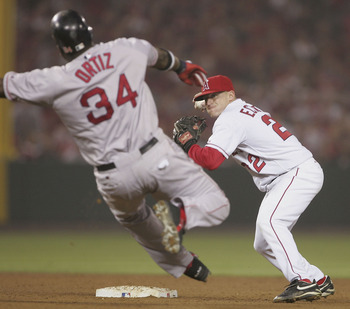

Career Teams:  Anaheim Angels (2001-2004), St.Louis Cardinals (2005-2007), Toronto Blue Jays (2008), Arizona Diamondbacks (2008) and San Diego Padres (2009-2010).
All Star Appearances:  2005 and 2006
MVP Voting: 2002 (11th) and 2005 (21st)
Great teams often have "motor guys" or "slump busters", players who seem to be wind up toys with high energy that never stop moving.  Usually these are not superstars but are guys who somehow find a way to spark the team when everyone else is slumping.  The 1988 Dodgers had Mickey Hatcher, the 1993 Phillies had Dave Hollins and two World Series teams had David Eckstein.  In 2001 he came in 4th in the Rookie of the Year voting (4th was no shame as he fell in behind Ichiro, who also won the 2001 MVP, C.C. Sabathia and Alfonso Soriano).   The Angels had spent 8 years building a team high in potential but even higher in underachieving.  With star players like Tim Salmon, Garrett Anderson, Darren Erstad, Troy Percival and Kevin Appier, Eckstein was an after thought.  When the Angels finally made the playoffs in 2002 no one expected much, especially facing the five time defending AL Champs, the Yankees in the first round.  Eckstein did well in the first round hitting .278 as the Angels stunned New York.  He improved in the ALCS against the Twins hitting .287 and finally .310 in the World Series as the Angels surprised everyone, including the Barry Bonds and Jeff Kent led Giants.  Eckstein scored 6 runs in that series.  The postseason often makes household names out of small time players, though they normally disappear quickly, remembered only by students of the game.  Eckstein was fortunate to get the opportunity again.  After leaving the Angels he landed in St.Louis in 2005 and made a huge impact.  The Cardinals reached the playoffs and beat the Padres in the first round with Eckstein hitting .385 in the series including 3 runs, 4 RBI and 1 HR.  The Cardinals lost in seven games to Houston in the NLCS and Eckstein hit only .200, though he scored 5 runs.  The Cardinals came back in 2006 and Eckstein led the way as they won the World Series.  Hitting .364, 3 doubles, 3 runs and 4 RBI Eckstein was named the MVP of the World Series.  He bounced from team to team after leaving the Cardinals but always made a major impact and improved the morale of the team.  Although they couldn't quite hold on, Eckstein made a strong contribution to the San Diego run at the playoffs in 2010.  He may not be a hall of fame player but it is not possible to tell the story of the World Series in the decade without his name.


Thirdbase:
Hank Blalock


Career Teams:  Texas Rangers (2002-2009) and Tampa Bay Rays (2010)
All Star Appearances: 2003 and 2004
MVP Voting:  2004 (18th)
Fans who only started following the league in the last 5 years may find it hard to believe but the Texas Rangers were a struggling franchise for a very long time.  The reputation of the organization in the 1980's was a team that did well in the first half of the season but melted when the summer heated up.  That reputation softened a little bit when the team made the playoffs in 1996, 1998 and 1999, though their record was 1-9 in those three playoff series.  The Rangers struggled to reclaim their identity through the early 2000's finishing no higher than third from 2000 to 2006.  As the decade moved on the Rangers had a powerful lineup with Alex Rodriguez, Rafael Palmeiro, Ivan Rodriguez, Juan Gonzalez, Michael Young and Mark Teixeira but they could never really improve in the standings.  The forgotten man in the powerful lineup was Hank Blalock.  Like nearly everyone else on this list, Blalock will never be confused for a Hall of Famer but he certainly represented the organization well as everyone of the above listed pieces of the powerful lineup, except Michael Young, moved on to other teams.  Despite playing with some future Hall of Famers, Blalock became a big name in the game of baseball.  In 2003 he made his first All Star Game.  Going into the bottom of the 8th of that game the NL led by 2 runs.  The NL brought in Eric Gagne, that year's contribution to  the "greatest closer ever" conversation.  The AL cut the lead to 1 .  With 2 outs and a 2-0 count Gagne tried to sneak a back door slider past Blalock.  Hank waited on it and crushed it for the game winning home run.  Hank made the All Star game again in 2004 and participated in the Home Run Derby.  His numbers began to slip in 2005.  Similar to the recent treatment of Josh Hamilton, the Rangers fans love affair with Hank started to fade.  Although he said nothing about it, he may have started experiencing the first symptoms of a nerve syndrome that caused him a lot of pain.  He had several trips to the DL and the Texas press had rumors sending him to nearly every team.  A move from third base to first base did not have the effect that was hoped.  He was released after the 2009 season and signed with the Rays.  In the 2010 playoffs the Rays lost to the Rangers in the playoffs but Blalock was not in either dugout.  He had been released in July after playing only 26 games with Tampa Bay.  Despite major contributions to the Rangers in the lean years Blalock never got to play in a playoff game. 

Outfield:
Dave Roberts


Career Teams: Cleveland Indians (1999-2001), Los Angeles Dodgers (2002-2004), Boston Red Sox (2004), San Diego Padres (2005-2006) and San Francisco Giants (2007-2008).
All Star Appearances: None
MVP Voting:  None
Dave Roberts never made an All Star team and never received an MVP vote but tell a Dodger or Red Sox fan that Dave Roberts was an insignificant player in the history of the majors and you will be looking for a fight.  Similar to David Eckstein further up on this list Dave Roberts was a "motor player".  As a very good Dodgers team chugged toward the playoffs in 2004, Roberts, at the top of the lineup, was driving the train.  At the trade deadline Dodgers fans were shocked when fan favorites Roberts, Paul Lo Duca and Guillermo Mota were shipped away.  Roberts was sent to the Red Sox where he played in a few games and made a slight impact but with a packed outfield Roberts got little playing time.  In the league championship series Roberts became a late inning pinch runner as the Red Sox limped their way to being swept in embarrassing fashion by the Yankees.  That is until Roberts got the motor running.  Down a run in the bottom of the ninth and 3 outs away from the end of the year Roberts stole second.  It was a close play but Roberts seemed to always light a spark when needed.  As he stood on second base clapping his hands and yelling "Let's Go" at the Sox dugout, Bill Mueller stepped in and stroked a single to right field.  Roberts came around to score, tying the game.  As he crossed the plate his energy seemed to ignite the Red Sox.  They not only won that game they won the next three, including 2 in New York, and four more against the Cardinals to win their first World Series since 1918.

Garrett Anderson
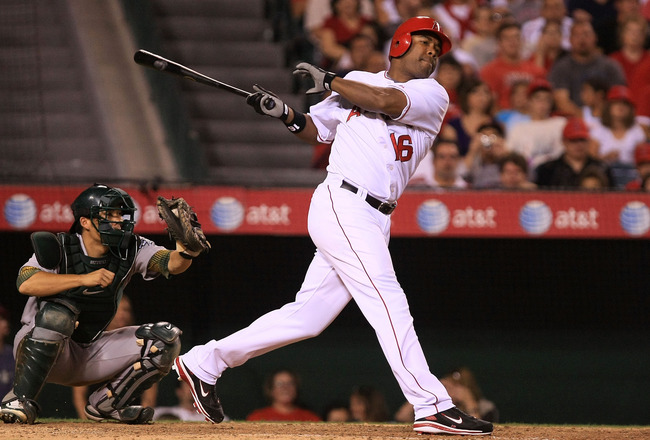

Career Teams:  California/Anaheim/Los Angeles Angels of Anaheim (1994-2008), Atlanta Braves (2009) and Los Angeles Dodgers (2010)
All Star Appearances:  2002, 2003 and 2005
MVP Voting:  2001 (21st), 2002 (4th), 2003 (14th)
In 1995 the Angels made the playoffs (technically) for the first time since 1986.  Well, it was a one game playoff against the Mariners to see who would win the division.  They lost...badly.  Although they collapsed down the stretch, the Angels future looked bright with players like J.T. Snow, Tim Salmon, Jim Edmonds and Anderson.  Anderson finished second in Rookie of the Year voting to Marty Cordova of the Twins.  As the 1990's ended the Angels failed to live up to their potential and as they made poor free agent signings, changed ownership and traded away Edmonds and Snow, it appeared they may be heading into a rebuilding phase.  2002 changed the history of the Angels organization and the story of baseball history as the Angels won an improbable World Series over the Giants.  Few contributed more to the Angels win than Anderson.  For many years Anderson was the face of the Angels.  Although the Anaheim and LA press ridiculed his fielding on an almost daily basis at times, Anderson was the team leader and the compass of the Angels.  Troy Glaus was the MVP of that 2002 series but in the deciding 7th game Anderson went 1-4 with a double and drove in 3 of the 4 Angels run.

Pat Burrell

Career Teams: Philadelphia Phillies (2000-2008), Tampa Bay Rays (2009-2010), San Francisco Giants (2010-2011)
All Star Appearances: None
MVP Voting: 2002 (14th) and 2005 (7th)
When the Phillies drafted Burrell they may as well have marketed him as Saint Patrick.  He was routinely referred to as the savior of the franchise.  He did not have the best speed  and was not a perfect fielder (he wasn't the worst either) but he could hit.  The Phillies are currently viewed as a dynasty in the NL East but until 2007 they were viewed as the team that always got close to making the playoffs but couldn't quite get in.  That was until 2007 when they stormed back in late September to overtake the imploding Mets.  The Phillies got every one's  attention in 2008 when they won the World Series for only the second time in their 100+ year history and Burrell was a big part of that team.  One of the great images of that postseason was Jimmy Rollins and Pat Burrell, the two stars on the team who had played together through all he tough years and come up short, celebrating together at the pitcher's mound in Los Angeles as the Phillies advanced to the World Series for the first time since 1993.  He struggled in the 2008 World Series and had only 1 hit (.087) but it was a big one.  With Game 5 tied after a bizarre two day rain delay Burrell stepped up to start the 7th.  He drove a 1-1 pitch to the weird angles in LF-CF of Citizens Bank Ballpark and stood on second with a double.  He was removed for pinch runner Eric Bruntlett, who scored the winning run on Pedro Feliz's single back up the middle.  Burrell's career seemed over after a poor 2009 with the Rays and a slow start to 2010.  In May of 2010 he was released by the Rays and signed by San Francisco.  The Giants appeared to just be collecting discarded, aging, spare parts from other teams but Burrell hit 18 HR for the Giants and drove in 51.  The Giants of 2010 surprised everyone, including Burrell's phormer phriends in Philadelphia, and won the World Series.  Burrell came back in 2011 but he just couldn't hit the way he used to and had a .230 average and only 7 HR in 92 games.  Burrell was a free agent after the 2011 season but hung up his spikes for good.  He will be remembered forever by two of the classic teams as a player who brought them long awaited World Series wins.


Starting Pitcher:
Brandon Webb


Career Teams:  Arizona Diamondbacks (2003-2009)
All Star Appearances: 2006, 2007 and 2008
MVP Voting: 2007 (17th) and 2008 (17th)
Cy Young Voting: 2006 (winner), 2007 (2nd) and  2008 (2nd)
His career was short and his numbers were not hall of fame character but it is mind boggling that Webb is not mentioned more as one of those "could have been" players.  He came into the league in 2003 as the Diamondbacks began to sell off the pieces of their World Series team.  He won 10 games and lost 9 as a rookie but was third in the Rookie of the Year voting behind Dontrelle Willis and Scott Podsednik.  The sophomore curse struck in 2004 as he struggled with control.  He walked more than he struck out and he lost more than he won with a bad Arizona team.    In 2006 Webb won the Cy Young award leading the league with 16 wins and 3 shutouts.  He came in a distant second in the 2007 voting to Jake Peavey of the Padres and in 2008 he should have won the Cy Young leading the league with 22 wins but lost out to Tim Lincecum. Arizona made the playoffs in 2007 and Webb won one game as the Diamondbacks beat the Cubs in the first round but lost his second playoff game against the Rockies as Colorado completed one of the great comebacks in league history to reach the World Series.  Webb appeared to be one of the future dominant pitchers in the game but on opening day 2009 he experienced shoulder pain and left the game after only 4 1/3 innings pitched.  Webb went on the DL and several shoulder surgery's later he was released by the Diamondbacks.  He tried a comeback with Texas but after one poor minor league appearance he was released.


Closer:
John Smoltz


Career Teams:  Atlanta Braves (1988-2008), Boston Red Sox (2009), St. Louis Cardinals (2009)
All Star Appearances:  1989, 1992, 1993, 1995, 2002, 2003, 2005 and 2007.
MVP Voting: 2002 (8th), 2003 (18th), 2004 (21st)
Cy Young Voting:  1996 (Winner), 1998 (4th), 2002 (3rd), 2006 (7th), 2007 (6th)
Everyone knows John Smoltz.  He retired after the 2009 season with 213 wins and in 2014 when his name is on the Hall of Fame ballot it would be embarrassing if he is not voted into the Hall of Fame on the first try.  So why is he on a list of forgotten players?  Everyone knows Smoltz was part of the great Braves teams from 1991-2005 but few people remember that for a few years he was actually the closer of the team.  He didn't want the role but he was great at it.  Smoltz returned after missing the 2000 season and worked out of the bullpen saving 10 games.  Bobby Cox saw the potential and moved him into the new role for the 2001 season.  In the three years he worked as the full time closer he saved 55, 44 and 45 games.  After those few seasons he went back to being one of the best starters in baseball for a few more years.

Designated Hitter:
Edgar Martinez


Career Teams: Seattle Mariners (1987-2004)
All Star Appearances: 1992, 1995, 1996, 1997, 2000, 2001, 2003
MVP Voting: 1992 (12th), 1995 (3rd), 1997 (14th), 2000 (6th), 2001 (16th).
There are a lot of people who don't like the Designated Hitter, myself included, and would like to see it gone from the game.  Yet, anytime I start to say something against the DH two names come to mind: Edgar Martinez (you'll have to wait until next week for the second name.  I'm sure you're all as excited as I am.)  There has never been a Hall of Fame Designated Hitter because the voters feel that the player does not contribute enough to the overall game.  If any DH deserves to make the Hall of Fame it is Martinez.   Martinez was a two time batting title winner in 1992 (.343) and 1995 (.356).  While Ken Griffey, Jay Buhner, Alex Rodriguez and Ichiro got the attention Martinez quietly went about his work getting hit after hit.  If his .312 career average and 2247 career hits aren't enough to prove what a great player he was this may put it into perspective.  In All Star competition a DH is not used if the game is being played in a National League park.  Of the seven All Star appearances for Martinez three of them were in games that his position was not even used.

* Author's note:  I tried to choose one player from each position.  Traditionally the game is defined as having only 9 positions but in the current era it would be hard to define a relief pitcher and starting pitcher as the same position and the traditional 9 positions excludes the Designated Hitter.  Because Jose Vidro and Brian Roberts both perfectly exemplified the player discussed in this article it was impossible to choose between them so they are both represented.  You may see this happen again as this series of articles progresses.  These are my choices  for the forgotten players of the 2000-2010 decade.  It probably differs from your choices.  Email me yours or leave a comment.

Monday, November 12, 2012

Top 10 Managers of All Time

The job of a major league manager is hard enough on a daily basis.  Put yourself in the shoes of Jim Leyland, the Tigers manager, during Game 1 of this year's World Series.  A week ago you were celebrating sweeping the Yankees to advance to the World Series.  You had this series set up perfectly with the best pitcher in baseball, well rested, starting Game 1.

In the top of the fifth you're already behind 3-0.  Verlander hasn't pitched horribly.  He gave up a home run in the first with two outs and two strikes.  In the third he had two outs and two strikes when the ball hits the third base bag allowing a runner to reach second on what is normally a ground ball out.  The next batter has two strikes and fights off every good pitch Verlander makes, then loops a hit to score two runs.  Verlander has thrown 98 pitches and is due up this inning. 

As you pace the dugout, hands in your pockets to fight off the chill in the San Francisco air,  you need to make a decision.  Do you accept that this is not Verlander's night, pinch hit for him in the hope of jump starting your offense and trusting a bullpen that has been shaky for the last month?  Or do you trust that Verlander can hold the Giants long enough for Jackson, Young, Cabrera and Fielder to get you right back into this?  Regardless of what you choose, one outcome is certain:  you'll have to explain this to the world in a few minutes and many of them won't accept your explanation.

As the manager you have to make the decision to sit your overpaid superstar, who is 0 for the last 24, for the good of the team.  Every move you make is torn apart and critiqued within moments.  Every move you decide not to make is pointed to as the one move everyone is certain would have won the game. 

If having to explain every minor decision isn't hard enough, imagine you have to defend decisions that aren't yours.  Players try to steal without permission and get caught.  Batters decide they can sneak in a bunt in for a base hit and ruin a scoring chance.  This all falls on the manager and no manager who wants the respect of his players would ever blame the player publicly for this.  The manager silently takes the blame.

It is a lonely job.  A job that you accept knowing that you have a shelf life.  Earl Weaver managed the Baltimore Orioles from 1968 to 1982.  Since he left the team after the 1982 season the Orioles have had only one manager last more than two years.  That would be their current manager Buck Showalter who has been there for 2 1/3 years.

What makes a manager great?  A manager has to be able to make the tough decision to sit a star player who is slumping or to tell a legend that someone younger can do the job better and be able to back up the decision with confidence.  A manager has to deal with a fan base that rebels when the ownership refuses to pay the star players big money and leaves them with a shallow talent pool  but Olympic sized expectations.  A manager has to deal with his own success and the perception that because you have made the playoffs five years in a row you have to make it a sixth year in a row or the year is a failure and you are the reason.

A manager has pressure from five sides:  the players, the owners, the press, the fans and themselves.

Despite all of these pressures some thrive in the job.  Here are the ten I consider the best of all time*:
10.  Earl Weaver:


Teams Managed:  Baltimore Orioles 1968-1982
Years in Playoffs:  1969, 1970, 1971, 1973, 1974, 1979
World Series Appearances:  1969, 1970, 1971, 1979
World Series Victories:  1970
Manager of the Year: 0 (Manager of the year was not awarded until 1983)
Earl Weaver was best known for arguing with umpires and being a cranky old man.  What he is also known for is winning.  Weaver developed "the Oriole Way", an organization wide philosophy that taught fundamentals from rookie ball all the way through to the big league team.  He also was a great judge of talent and use of the entire roster through player platoons.  During his time in Baltimore he managed hall of fame players such as Brooks Robinson, Frank Robinson, Eddie Murray, Jim Palmer and Cal Ripken.  His run of success nearly ended on a high note.  In 1982, his Orioles made a late season run to catch the Brewers in the AL East race.  The season came down to a four game series head to head in Baltimore.  The Orioles had to take all four to win.  They came up just short.  Weaver was also known for using foul language.  During a particularly tough stretch for the Orioles batters, Weaver went on a dugout tirade.  One player approached Earl and said "Earl, I'd like to see you walk with the lord." Weaver froze, stared down the player and said: "I'd f---ing like to f---ing see you walk with the f---ing bases loaded."


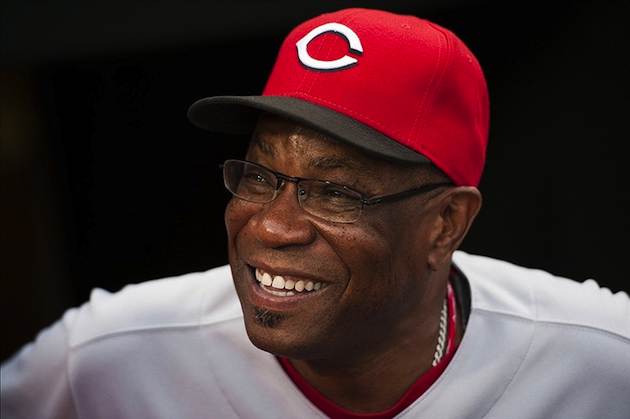
9.   Dusty Baker


Teams Managed:San Francisco Giants (1993-2002), Chicago Cubs (2003-2006), Cincinnati Reds (2008-Present)
Years in Playoffs: 1997, 2000, 2002, 2003, 2010, 2012
World Series Appearances: 2002
World Series Victories: 0
Manager of the Year:  1993, 1997, 2000
It seems blasphemous to think that one of the great Dodger players of the 1970's and early 1980's started his managing career as a Giant.  Although it has been a short managerial career compared to some other managers on this list, Baker has turned around three of the traditionally strong organizations in the history of the game.  Between 1958 when the Giants moved to San Francisco and 1993 when Baker took over, there were few bright years in the bay area.  Baker turned the rarely playoff bound Giants into a consistent force in the NL West pushing them one game short of a World Series ring.  After leaving the Giants he led the Cubs to their first playoff series victory (and if not for a fateful inning to their first World Series) since 1945.  Since leaving the Cubs he has turned the Reds into a two time playoff team in the NL Central (and they appear set to dominate the division for quite some time).  For some reason he doesn't seem to have the support of the Reds fan base but they will surely recognize his importance when he is gone.

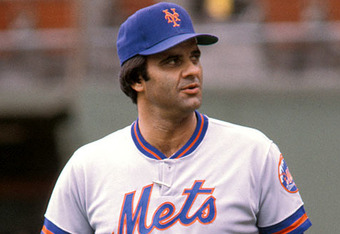
8.   Joe Torre


Teams Managed: New York Mets (1977-1981), Atlanta Braves (1982-1984), St. Louis Cardinals (1990-1995), New York Yankees (1996-2007), Los Angeles Dodgers (2008-2010)
Years in Playoffs: 1982, 1996, 1997, 1998, 1999, 2000, 2001, 2002, 2003, 2004, 2005, 2006, 2007, 2008 and 2009
World Series Appearances: 1996, 1998, 1999, 2000,  2001, 2003
World Series Victories: 1996, 1998, 1999, 2000
Manager of the Year: 1996, 1998
It may be hard to believe that Torre is not higher on the list.  The criticism of Torre was always that he had an unlimited budget to work with and anyone could win with the talent he was given.  That may be true but he certainly did more with less in 1982 in Atlanta and 2008 and 2009 with the Dodgers.  Torre's critics claim that he sat back and watched the Yankees win but Torre was constantly working his magic.  It takes a special manager to juggle the egos of David Wells, Gary Sheffield, Alex Rodriguez, Roger Clemens and any other random overpaid, under performing player Steinbrenner decided to drop on him.  Many of his coaches have gone on to become successful managers including Willie Randolph, Lee Mazzilli and Don Mattingly.

7.   Bobby Cox

Teams Managed: Atlanta Braves (1978-1981), Toronto Blue Jays (1982-1985), Atlanta Braves (1990-2010)
Years in Playoffs: 1985, 1991, 1992, 1993, 1995, 1996, 1997, 1998, 1999, 2000, 2001, 2002, 2003, 2004, 2005 and 2010.
World Series Appearances: 1991, 1992, 1995, 1996 and 1999.
World Series Victories: 1995
Manager of the Year:  1985, 1991, 2004 and 2005.
Sometimes a manager has a good group of players who are used to being told they can't win.  It's up to the manager to change the culture of the organization.  When Cox took over in Toronto they were in a division with the Yankees, Red Sox, Orioles, Tigers, Brewers and Indians.  At the start of every season they would be predicted to finish 6th if they were lucky (it was a dismal time for the Indians as well).  Cox changed all that and took Toronto to the playoffs for the first time in the history of the poor organization.  The Jays were one win away from reaching the Series when the 1985 Royals did what they do best and rallied (see the previous article Greatest World Series Moments: The Most Controversial).  1985 was the first year the LCS round was a best of seven as it had always been best of five.  The joke has always been that the Blue Jays didn't realize the series kept going after they reached three wins.  When Bobby Cox took over for Russ Nixon as manager of the Braves midway through the 1990 season, few thought the last place team had enough talent to get out of the cellar within the next ten years.  (See the previous article Greatest World Series Moments: Greatest Game Ever 2) Over the next 20 years Cox would continually develop players and recognize talent to fit into the Braves system.  Growing talent like David Justice, Ron Gant, Steve Avery, Tom Glavine, John Smoltz, Javy Lopez, Kevin Millwood and Chipper Jones he was also adept at finding small time players like Rafael Belliard, Mark Lemke, Jeff Blauser, Ryan Klesko and Alejandro Pena to fill roles.  Along with this he had the ability to find talent that had been discarded by other teams and resurrect their careers.  Among the long list are Terry Pendleton, Lonnie Smith, Sid Bream, Charlie Leibrandt, Mike Deveraux and Walt Weiss.

6.   Al Lopez

Teams Managed: Cleveland Indians (1951-1956), Chicago White Sox (1957-1965 and 1967-1969)
Years in Playoffs: N/A. (Yearly playoffs did not begin until 1969.  Until then the league winners would advance straight to the World Series)
World Series Appearances: 1954 and 1959
World Series Victories: 0
Manager of the Year: 0 (Manager of the year was not awarded  until 1983)
Probably one of the most forgotten great managers of all time.  Lopez was forced into an awkward position in taking over the Indians.  He replaced a fan favorite in Lou Boudreau and was dropped into a brewing feud between the Indians' GM Hank Greenberg and the Cleveland press.  Lopez rewarded Greenberg in 1954 by leading what many consider one of the top 10 teams of all time, the 1954 Indians.  Cleveland set the mark for most wins in a season but were swept out of the World Series by Willie Mays and the Giants in one of the greatest upsets of all time.  Lopez moved on to the White Sox and led them to their first World Series appearance since the 1919 Black Sox scandal.  Lopez was the first major league star to come out of the Tampa, FL area leading the way for players like Tony LaRussa, Lou Piniella, Tino Martinez and Luis Gonzales.  Why is he this high on the list when he only reached two World Series?  Compare the years he reached the World Series with the manager at number 4 on the list.  Lopez may not have the career wins of some of the people left off the list but he truly was the perfect example of getting more out of less.

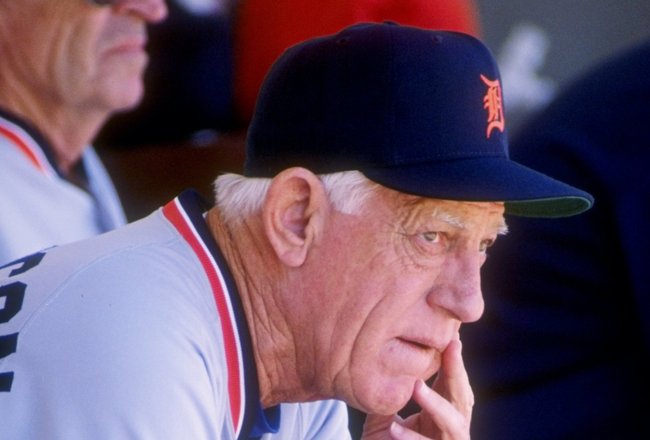
5.   Sparky Anderson

Teams Managed: Cincinnati Reds (1970-1978), Detroit Tigers (1979-1995)
Years in Playoffs: 1970, 1972, 1973, 1975, 1976, 1984
World Series Appearances: 1970, 1972, 1975, 1976, 1984
World Series Victories: 1975, 1976, 1984
Manager of the Year: 1984
Sparky may not have been an all star player but he was one of the brilliant strategists in the history of the game.  Anderson managed a short list of hall of famers (Bench, Morgan, Perez) and a long list of people who should be in the hall of fame (Griffey Sr, Concepcion, Trammell and Morris).  He also became the first manager to win a World Series in both the American and National League.  Sparky also managed three of the greatest teams in the history of the game:  1975 and 1976 Reds (see previous article Greatest World Series Moments: The Greatest Game Part 1) and 1984 Tigers.  His biggest contribution to the game was his use  of the bullpen.  Known as Captain Hook because of his habit of quickly pulling a pitcher, he was the first manager to truly use every pitcher available in every game.  Anderson is well known for his entertaining sound clips.  After the 1976 World Series he told the press that Thurman Munson was a great catcher "but don't never do no one the disservice of comparing 'em to Johnny Bench." (It's amazing that someone who can use that many double negatives in one sentence can pronounce disservice). In the 1984 World Series he told Kirk Gibson that Goose Gossage wasn't afraid of him.  "He don't wanna walk you."  Then, when Gibson hit a three run home run Anderson was yelling like a little kid: "No, don't walk 'im!  Don't walk 'im!"

4.  Casey Stengel


Teams Managed: Brooklyn Dodgers (1934-1936), Boston Braves (1938-1943), New York Yankees (1949-1960) and New York Mets (1962-1965)
Years in Playoffs: N/A  (Yearly playoffs did not begin until 1969. Until then the League winners advanced directly to the World Series)
World Series Appearances: 1949, 1950, 1951, 1952, 1953, 1955, 1956, 1957, 1958, 1960
World Series Victories: 1949, 1950, 1951, 1952, 1953, 1956, 1958
Manager of the Year: N/A (Manager of the year was not awarded until 1983)
The "Old Perfesser" was a jumbled up mess to the outside world but somehow managed to get the most out of his players.  It was like watching an episode of Mr. Magoo.  No one could explain it but somehow he succeeded. He was the first manager to successfully use a platoon system by switching right handed hitters vs left handed pitchers and left handed hitters vs. righties.  He was also unbelievably good at playing hunches.  He once decided to switch the rightie vs lefty system and played a Hank Bauer vs a right hand pitcher.  Bauer usually only played when lefties were pitching but he got a hit in each of his first three at bats.  When the other team brought in a lefty Stengel sent up Gene Woodling, who usually only hit agains righties. Woodling was furious at having sat the whole game and now only hitting against a lefty.  Bauer was furious at not getting a shot to get a fourth hit.  Stengel's explanation to Woodling:  "You'll play your position and do whatever the hell I tell you."  Stengel's explanation to Bauer:  "You ain't no 1.000 hitter.  And you're not a .500 hitter.  In fact, Mr. Bauer, you ain't even a .333 hitter.  So you had your 3 hits for the day and that's all it was gonna be.  That was your quota."  Stengel was fired after the Yankees lost the 1960 World Series in seven games.  Stengel was fired because he was seventy years old.  He told a reporter "I'll never make that mistake again."  He then took over the comical 1962 Mets.  When preparing for the expansion draft a reporter asked where you need to start building a team.  Casey's answer was a catcher, "otherwise you'll have to chase the ball the way to the backstop."  Before he passed away Casey would routinely attend old timers games where he once said "it's wonderful to meet so many friends I never used to like."

3.  Connie Mack

Teams Managed:  Pittsburgh Pirates (1894-1896), Philadelphia Athletics (1901-1950)
Years in Playoffs: N/A (Yearly playoffs did not begin until 1969. Until then the League winners advanced directly to the World Series)
World Series Appearances: 1905, 1910, 1911, 1913, 1914, 1929, 1930, 1931
World Series Victories: 1910, 1911, 1913, 1929, 1930
Manager of the Year: N/A (Manager of the year was not awarded until 1983)
It is definitely not a typo.  Connie Mack managed the A's for 50 years.  Many experts would probably place Mack at either number 1 or 2 on the list.  The reason I did not place him higher was due to the long stretches of truly terrible years between the World Series appearances.  Mack's golden years came in two separate eras.  The first was the era of the "$100,000 Infield" of Stuffy McInnis, Eddie Collins, Jack Barry and "Home Run" Baker as well as the great pitching of Eddie Plank, Eddie Rommel and Jack Coombs.  The second era in the late 1920's to early 1930's included the great teams of Al Simmons, Jimmie Foxx, Mickey Cochrane and Lefty Grove.  (See previous article Greatest Player Never to Win a World Series) Unfortunately, after he disbanded his 1914 World Series team (there are varying explanations why) he struggled to make enough money to rebuild.  He often signed great talent but had to sell them to other teams (usually Boston or New York) to offset another year in the red.  He finally rebuilt the team in the late 1920's but the Great Depression forced him again to sell off his stars.  From 1932 until the A's jumped to Kansas City there were few highlights.  Mack was the first manager to shift the position of his players in the field on a pitch by pitch basis.  He would stand on the top step of the dugout and waive his scorecard to direct his players into position.

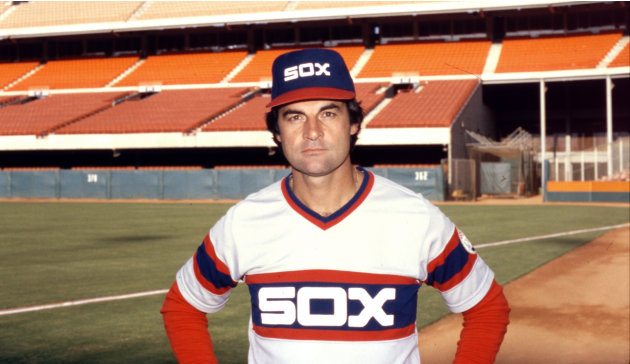
2.  Tony LaRussa


Teams Managed: Chicago White Sox (1979-1986), Oakland Athletics (1986-1995), St.Louis Cardinals (1996-2011)
Years in Playoffs: 1983, 1988, 1989, 1990, 1992, 1996, 2000, 2001, 2002, 2004, 2005, 2006, 2009, 2011
World Series Appearances: 1988, 1989, 1990, 2004, 2006, 2011
World Series Victories:  1989, 2006, 2011
Manager of the Year: 1983, 1988, 1992, 2002
LaRussa went out on top but he started at the bottom.  He took over a White Sox team in 1979 that had not made the postseason since Al Lopez (see number 6) led the "Go-Go White Sox" to the World Series in 1959.  The organization was in a tail spin but LaRussa got them back on track and by 1983 had them in the playoffs.  His White Sox team had Carlton Fisk and a young Harold Baines but few other stars, yet LaRussa guided them to a division title.  He was so highly regarded for his work in Chicago that the A's immediately fired their own manager and hired LaRussa when LaRussa left the White Sox in mid season 1986.  While in Oakland, LaRussa built a team that became one of the greatest of all time.  It combined aging greats like Don Baylor, Dave Parker and Willie McGee with young future greats like Canseco, McGwire and Terry Steinbach.  He also had a habit of claiming players that others had given up on and turning them into stars like Carney Lansford, Dave Stewart, Mike Moore, Bob Welch and Dennis Eckersley.  After taking Oakland to the playoffs in 4 out of 5 seasons (including 3 Series appearances and one Series win) LaRussa moved on to St.Louis where he replaced Joe Torre (see number 8)  as the Cardinals manager.  He had an immediate impact and took St.Louis  to a 3-1 NLCS lead over the Braves.  The Braves, led by Bobby Cox (see number 7) came back and won that NLCS.  He continued his ability to identify young talent like Albert Pujols and Rick Ankiel and resurrect players that others had given up on like Jim Edmonds, Larry Walker and David Eckstein.  During his 16 years in St.Louis they reached the playoffs 9 times, reached the World Series 3 times and won it twice.

1.  John McGraw

Teams Managed: Baltimore Orioles (1899, 1901-1902), New York Giants (1902-1932)
Years in Playoffs: 1908 (there was a one game "replay" at the end of the season because the Cubs and Giants were tied.  In one of he most famous moments in the history of the game, a regular season game was declared a tie game because of a protest by the Cubs). 
World Series Appearances:  1905, 1911, 1912, 1913, 1917, 1921, 1922, 1923, 1924.
World Series Victories:  1905, 1921, 1922
Manager of the Year: N/A (Manager of the Year was not awarded until 1923)
Few people in baseball history were as polarizing as John McGraw.  The list of players and managers who had long running feuds with "Mugsy" is like a  hall of fame roster.  Tinker, Evers, Chance, Ty Cobb, Babe Ruth, Frankie Frisch, Rogers Hornsby and Bill Terry all despised the man (some of them even played for him). His supporters are equally as impressive.  Christy Mathewson, Fred Lindstrom, Fred Merkle, Ross Youngs, Mike Donlin, Fred Snodgrass and a million others. The man himself was a paradox.  When he died his wife found a list of African American players he secretly wished he could have signed to play for the Giants, yet at the same time he carried a piece of string that had been used in a lynching as a good luck charm.  He was easy to hate.  There are rumors galore that he was involved in attempts to bribe other teams into throwing a few late season "meaningless games" the Giants' way.  He owned several pool halls with his business partner, Arnold Rothstein, the big money behind the Black Sox scandal.  Regardless of his personal life he was by far the most consistently successful manager in the game.  Connie Mack may have had two distinct eras of success but McGraw was constantly at the top of the league.  His list of World Series appearances could have at least three more years.  In 1904 his Giants won the National League but McGraw chose not to enter the World Series because he didn't feel he had to jeopardize his championship by playing "an inferior" American League.  In 1908 his team had one more regular season win than the Cubs but the Cubs protested a technicality and the game was ruled a tie.  When the season ended the teams were tied and played the first ever one game playoff, won by the Cubs.  In 1919, the year that would end in the Black Sox scandal, McGraw's Giants had a late season collapse.  Oddly, when the punishment from the gambling investigations came out McGraw lost his thirdbaseman and firstbaseman to life time bans.  No one who knew McGraw would ever accuse him of throwing games.  Anyone near him after a loss would tell you it wasn't pretty.  He also could have had two more World Series wins.  In 1912 one game was called a tie because of darkness (there was no night baseball at the time).  Game 8 was played in Fenway parking giving the Red Sox an extra home game, which they won.  McGraw argued that should have been played at the Polo Grounds.  In 1924, if it weren't for some supernatural assistance (see previous article Greatest World Series Moments: The Most Supernatural) he would have won another title.  Regardless of all the controversy McGraw was flat out the best manager of all time.

*Author's Note:  In choosing this list I not only took into consideration the amount of wins by the manager but the consistency of winning, the amount of teams that were led to the playoffs as well as the state of the organization when the manager took over.  I also took into consideration any major long lasting impact on the game. It was only the top 10 so I did leave off many great managers like Lou Piniella, Frank Chance, Bucky Harris, Tommy Lasorda, Walter Alston, Hughie Jennings, Wilbert Robinson and quite a few others.  This is my list.  I am certain your list would look different.  I'm anxious to hear who you would put on yours.  Email me yours at baseballeras (at) gmail (dot) com or leave me a comment in the box below.

Friday, November 9, 2012

The Life of Lee MacPhail

Leland Stanford MacPhail, Jr.
October 25, 1917-November 8, 2012


Larry MacPhail's relationship with Leo Durocher is legendary.  Someone once said of Larry: "With no drinks he was brilliant.  With one he was a genius, with two he was insane.  He rarely stopped at two."

As the baseball legends go, MacPhail would routinely call Durocher after a few drinks, argue over who was pitching or not playing or not hitting, the conversation would get heated and one of two things would happen:  Durocher would quit or Durocher would get fired.  The next morning MacPhail would call Durocher to find out what pitcher he was planning to start that day or when he was stopping by the office to discuss player personnel.  It was a routine

Like most baseball legends these stories are quite likely exaggerated.  It's unlikely that a man like MacPhail could be that erratic and still be as successful as he was. 

In 1941 Larry made one of his best hiring decisions.  He chose Leland Stanford MacPhail, Jr to run the Brooklyn farm team in Reading, PA.  The Dodgers organization bought the Reading franchise, as the story goes, for two reasons:  Carl Furillo and the air conditioned bus.  The Reading Brooks were in the Dodgers organization for one year, long enough for Lee MacPhail to get Furillo ready for the majors and to acquisition the bus.

It would be hard to imagine that the one year in Reading taught Lee everything he needed to know but he certainly learned quickly.  When he got out of the Navy after World War II he went to work for Larry MacPhail, now owner of the Yankees.  He was again asked to toil in the minor leagues and find talent to feed the Yankees dynasty with young talent.  During his time with this responsibility the Yankees won seven World Series.  Among the long list of talent discovered by Lee were Mickey Mantle and Whitey Ford.

After creating one of the greatest dynasties in the history of sports, Lee moved out on his own and started to shape the Baltimore Orioles franchise.  The O's had moved from St.Louis just a few years before where they had struggled for over 50 years as the American League's doormats.  The St.Louis Brown's made the World Series one time before moving to Baltimore in 1954.  The first five years in Baltimore did not seem to really bring any hope for the future.  Lee MacPhail changed that.  Lee used his tremendous organizational skills to build Baltimore into the best baseball organization of the late 1960's to 1970's.  He left before the Orioles won their first World Series in 1966 but the team was developed out of his talents.

For many years afterwards Lee worked in the game.  He returned to the Yankees during the dark CBS years and eventually became the American League president.  His most memorable moment as the AL President came from the infamous George Brett pine tar incident.  When Brett was called out for using too much pine tar on his bat the Royals filed a protest.  As President of the American League the protest came to MacPhail's desk and he sided with Kansas City.  It was one of the few times that a League President overturned an umpire's decision.

On Thursday, November 8, 2012 at the age of 95, Lee MacPhail passed away.  When legends pass on the conversation usually turns to their "legacy".  Lee MacPhail's legacy, including the connection of his father dating back to the 1930's spans nearly every era of baseball but it also expands into the present day and lives on.  Lee's son Andy MacPhail, Larry's grandson, was also a baseball executive and helped build the Twins world Series teams in 1987 and 1991, the strong Cubs teams of the late 1990's and helped lay the ground work of the current Orioles teams. 

Lee MacPhail passed away but the impact he left on the game of baseball is well marked in the past and will continue to reach well into the future.

Saturday, November 3, 2012

Greatest World Series Moments: Greatest Game Ever Part 2

"Into deep centerfield for Mitchell...and we'll see you tomorrow night!"

Jack Buck made the now famous call as Kirby Puckett blasted a walk off home run in the 11th inning of Game 6 of the 1991 World Series.  Buck had made some of the most famous home run calls in history.  He had told St.Louis fans to go crazy when Ozzie Smith hit a game winning LCS home run.  As Kirk Gibson struggled around the bases he told the world that he couldn't believe what he just saw.  The Metrodome was deafening with shouts of "Kirby! Kirby! Kirby!".  It was the first time a World Series game ended on a home run since Carlton Fisk hit his famous Game 6 home run in 1975.

Regardless of what happened in Game 7, this could hardly be called anything but the greatest World Series of all time.
  • Two of the first six games were decided in extra innings.
  • Nearly every game had a controversial play.
  • Tempers flared on several occasions as players collided at the plate, tangled on the base path and disputed umpire decisions.
  • With the exception of the Game 5 14-5 blowout, every game was decided by 3 runs or less, 4 of them by one run.
  • 4 games were decided on the last at bat (and another was decided with a tie breaking bottom 8th inning run by the Twins).
  • Both teams could be considered underdogs.  It was the first time in history a team had jumped from last place the previous season and reached first place.  Both of these teams had done it in the same year!

(Dan Gladden collided with Greg Olson at the plate early in the series.  One of many plays that caused tempers to flare.  Gladden would play a big role in Game 7)
 
If Game 6 had ended this World Series it would have been impossible for anyone to be disappointed, yet, if it had ended after Game 6 we never would have seen the greatest World Series game ever played.

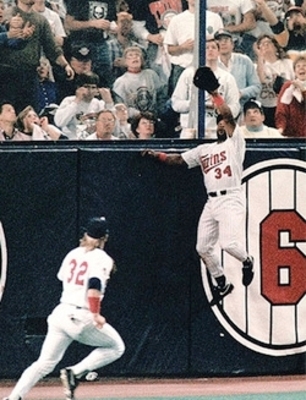
(Kirby Puckett, seen here making a game saving catch in Game 6, carried the Twins to a season saving Game 6 win.  In one of the greatest World Series of all time Game 6 was a close second to Game 7 for the best game of the Series).
 
This series was a convergence of the World Series past and the World Series future.  The Braves were a young team but they had plenty of players who had played in a World Series before: Terry Pendleton (1985 and 1987 Cardinals), Lonnie Smith (1980 Phillies, 1982 Cardinal, 1985 Royals), Charlie Leibrandt (1985 Royals).  The Twins had much more experience in the World Series: Brian Harper (1985 Cardinals) Kent Hrbek, Greg Gagne and Kirby Puckett (1987 Twins), Jack Morris (1984 Tigers).

There were also players on both teams who were young, inexperienced and with a bright future.  The list of names would tell the story of the World Series for the next ten years:  John Smoltz, Tom Glavine, Steve Avery, David Justice, Ron Gant, Mark Lemke, Chuck Knoblauch, Chilli Davis.

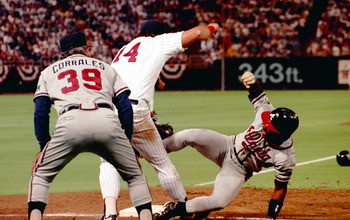
(In game 2 controversy erupted as Ron Gant was called out.  On a play at first Gant's momentum seemed to pull him off the bag as Hrbek kept the tag on Gant's leg.  Replays are hard to tell but Gant has always argued that Hrbek Pulled him off the bag.)


The series also made clear the impact of free agency on the league.  Trying to draw a family tree to connect all of these people would look like a spider web.  For example, Lonnie Smith had played with Terry Pendleton as a Cardinal, then played against Pendleton as a Royal in 1985 and now played with Pendleton again as a Brave.  Similarly, Brian Harper had played with Lonnie Smith and Pendleton as a Cardinal, then played against Smith in the 1985 World Series and now played against both as Braves. 

The connections like these were endless but no two players were more connected than the two starting pitchers.  John Smoltz was born and raised in Detroit as a Tigers fan.  If you were a pitcher in Detroit at that time there was no one you idolized more than Jack Morris.  Smoltz's childhood dream came true when he was drafted by the Tigers in 1985.  Unfortunately for Smoltz, he was traded before he had a chance to pitch with his idol.  On August 12, 1987 he was traded to the Braves for Pitcher Doyle Alexander.

(John Smoltz grew up in Detroit idolizing Jack Morris.  He wanted nothing more than to pitch with Morris as a Tiger.  He was traded to the Braves in 1987.  In the greatest game ever played Smoltz got to face off against his childhood idol.)


Jack Morris grew up in the Minneapolis area.  He had pitched for the Detroit Tigers his entire career.  But being a free agent and less than impressed with the offer from Detroit, Jack Morris came home.  Morris was the winningest pitcher in the decade of the 1980's, won a World Series title for the Tigers in 1984, threw a no-hitter and now he tried to bring a World Series title home. 

There was no bigger stage in the world and no better way to live out a child hood dream than to beat your idol face to face.  What we were about to watch would be passed down in history as the John Smoltz/Jack Morris show but it was anything but that.  In a World Series where excitement came from everywhere, the final game would give nearly every player on either team a chance to impact the outcome.

The game started with Lonnie Smith offering a handshake to Brian Harper as Smith stepped into the batters box.  Unbeknownst to everyone, that was the sign that this game would be different than anything you've ever seen.  Jack Buck compared it to two heavyweights shaking hands before they beat each others brains in.  If Buck only knew what a good comparison it would be...

Both teams went easily in the first, although Morris was less than happy with the balls and strikes being called by the home plate umpire.  In the first few innings Morris would continually stare in at the plate after close pitches were called balls.  Morris was pitching masterfully but that doesn't mean Atlanta didn't have chances to score.  In the second Dave Justice reached second but was stranded there.  Atlanta left 2 on in the third and and another in the 4th.  Jack Buck reminded everyone that "you only get so many chances."

Smoltz had the same success.  The Twins had two runners on in the third and couldn't score.  Dan Gladden led off the third with a double but  could not score.  In the 4th Kent Hrbek, who seemed to always be around the controversy in this series, was told by the umpire that he was hit by a pitch.  It was not hard, it may have grazed his forearm.  Hrbek hadn't reacted but the umpire told him to get down to firstbase. Hrbek wouldn't argue but Bobby Cox, the Braves manager, loved to argue everything.  He came out and berated the home plate umpire to no avail.  It didn't matter anyways, Hrbek never moved past first.  The game was almost half over and no one had scored. 

A playoff game that remains tied through the first three innings begins to increase in intensity as each at bat comes and goes.  In a Game 7 of a playoff series the emotions are amplified.  In Game 7 of a World Series the emotions are off the chart. Some players start to envision themselves as the conquering hero and stride to the plate with confidence, then walk back to the bench like everyone else.  Other players start to fight the fear that any minor mistake could lead to the big run and start to envision themselves  as the next Bill Buckner.  Fans start to inch up on the edge of their seats, rock back and forth to suppress stomach cramps, any sort of movement to momentarily calm their strained nerves.  It becomes less of a confidence of what your team will do and more a worry about what the other team will do.

They moved to the 5th scoreless.  It looked like things were starting to tip in the Atlanta's favor.  Mark Lemke, who had been a part time player for three years with the Braves and was forced into a starting role due to a late season injury to Jeff Treadway would hit .417 in the series, led off with a single and moved to second on Rafael Belliard's sacrifice bunt.  Lonnie Smith followed and seeing the Twins thirdbaseman playing back, laid down a bunt and beat out a close play.  Lemke moved up to third.  Pendleton followed this with a pop fly to shortstop.  That brought up Ron Gant, one of the young rising stars in this Atlanta lineup. He had been compared to a young Willie Mays with unlimited potential.  He hadn't had a bad series but he was 0 for his last 7.  This was his chance to put the Braves ahead.

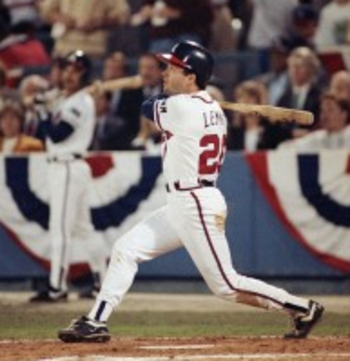
(Mark Lemke was the unexpected hero of the Braves World Series team.  He hit .417 in the series.  He would go on to have a strong major league career but would always be remembered for his performance in this series.)

But first, on the 1-1 pitch, Morris threw a split finger fastball in the dirt.  It was a bad pitch and it was not where Harper expected it.  It hit the dirt, bounced up, hit Harper's mask and rolled out in front of the plate.  The ball was rolling slowly towards Morris, away from Harper.  Harper was undecided on whether to go out after the ball and leave the plate unguarded, or let Morris get it.  Meanwhile, Lemke, sensing the hesitation came screaming down the line.  Morris leapt off the mound and grabbed the ball, Lemke stopped, turned and ran back to third.  Morris threw the ball to Pagliarulo at third.  Pags was a veteran and few played the bag better.  He waited for the ball with one knee on the ground, blocking the bag.  Lemke launched himself, feet first, toward Pags.  Lemke and the ball arrived simultaneously.  Lemke, somehow, found the one spot left open at the bag and slid in as Pagliarulo fell over top of him showing the ball to the umpire with outstretched arms.  The Braves hadn't scored but there was still danger.  Before making another pitch Morris tried a pick off to first.  Lonnie Smith dove back on a close play but he was safe.  Two near third outs  now Morris had to face Gant.  The count went to 3-1.  Morris didn't want to walk Gant and face Justice with the bases loaded.  Gant fouled off the next pitch for a 3-2 count.  The next pitch was a fastball on the outside corner.  The umpire hesitated, just slightly, then called Gant out.  Gant dropped his bat, stared at the umpire.  Morris leapt off the mound, pumped his fist and screamed at the top of his lungs.  Still scoreless.

The bottom of the fifth and the sixth went quickly.  Kirby Puckett reached first in the sixth but any chance at a Twins rally was erased as Sid Bream, the Braves firstbaseman, turned a 3-6-3 double play (that's firstbase to shortstop to firstbase for the casual fan).  It is one of the most unusual and difficult double plays to turn.  Both pitchers were starting to hit their stride.  Morris retired 8 in a row and Smoltz cruised through the middle innings.

The stress and pressure continued to grow as the game progressed.  Someone had to score sometime.  Philosophically the game could go on infinitely if no one scored but realistically at some point some one would score.  It was impossible to believe that every time someone came close to scoring some miracle play would keep the game scoreless.  And yet...

Lonnie Smith led off the 8th with a single. Pendleton appeared to have struck out but the thirdbase ump ruled that he had fouled the ball and Harper had failed to hold onto it.  Given a second life, Pendleton, the 1991 MVP of the National League, ripped a pitch into left-center.  Smith was moving on contact and with his speed he should score easily, nothing could stop that.  1-0 Braves.  As the ball left Pendleton's bat, Jack Buck was speechless, confused for a second.  "Lonnie Smith is held at third and he didn't do very good baserunning there."  What the hell happened?  He should have been able to jog home!

As the ball left Pendleton's bat Smith lost track of the ball.  He knew it was a hit but he couldn't see where.  The next thing he saw was Chuck Knoblauch at secondbase, throwing to Greg Gagne, the shortstop.  How the hell did the ball get from left-center to the right side of second?  It didn't.  Knoblach made a last ditch effort to confuse Smith and it actually worked.  Smith realized there was no ball, too late, now he had to figure out where it was.  Jimmy Williams, the third base coach, was screaming, almost shrieking to get Smith to run.  Smith rounded second, and stopped, looked to the outfield, leaned towards third, leaned some more.  It took five seconds but he saw it.  There it was!  He took off for third and reached it easily, angry at himself.  No problem.  Second and third, no out.  The Braves were in business. 

Gant came up, again with the chance to be the hero.  He grounded to Hrbek at first.  1 out.  Runners hold.  David Justice was walked to load the bases.  It was a desperate move by a desperate team.  Only a strike out or a double play could really help the Twins.  Sid Bream bounced a ball down to Hrbek at first.  Smith was off from third base on contact.  He had good speed.  Hrbek fielded it and threw home to Harper.  2 outs, good enough but not good enough for Hrbek and Harper.  Knowing that Bream was a horrible runner (he had a brace on each knee), Hrbek threw the ball home and immediately got to the bag.  Harper had the same thought.  As soon as he heard the umpire call Smith out on the force at home he turned and fired the ball right back to Hrbek.  A 3-2-3 double play (that's firstbase to catcher to firstbase)!  It's almost unheard of to complete this play.  Hrbek took the trow, pumped his fist and screamed as he showed the ball to Morris, almost not believing it himself.  Another miracle play.

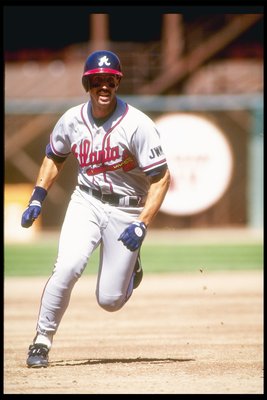
(Sid Bream was in his first year with the Braves after having left the Pirates.  Bream was an underrated, important part of Atlanta's drive to the pennant.  Casual fans saw him as a slow runner but few realized the pain he played with in both knees on a daily basis.)

Now it was the Twins' turn to threaten.  Randy Bush pinch hit for Gagne and led off the bottom of the 8th with a single.  He was replaced at first by Al Newman.  Gladden popped out leaving Newman at first but Knoblach, the 1991 AL rookie of the year, singled to right sending Newman to third.  Still only one out and Kirby Puckett, the Twins legend, at the plate.  That was all for Smoltz.  7 1/3 innings and no runs in a game 7 on the road.  You couldn't ask for more from a rookie.  With the crowd chanting "Kirby!, Kirby!, Kirby!" the Braves walked Puckett to face Hrbek with the bases loaded.  Here was the moment.  It had to happen here.  There was no way another miracle play could keep this thing scoreless.  And yet...

Hrbek connected on a 2-1 pitch and sent what looked like a sure hit towards second.  Lemke sprinted in and caught the ball in stride.  2 out.  Without hesitation he continued running and beat Knoblach back to second base.  Another miracle double play!  Game 7 of the greatest series of all time was moving to the 9th inning scoreless.

Morris was still pitching.  He was 36 years old, had thrown 246 innings in the regular season.  What was one more?  He got the Braves in order in the ninth.  The fans now knew that this was it.  The Twins would win.  Bottom of the ninth 0-0.  Chilli Davis led off with a single.  Harper tried to sacrifice him to second.  The ball found a little seam between the pitcher, firstbaseman and second baseman.  Mike Stanton, the Braves pitcher, chased the ball toward the hole between second and first, fielded it and as he turned and saw there was no play, he caught his spikes in the turf. He was carried off the field and replaced by Alejandro Pena.  All Pena did was get Shane Mack to ground into a double play.  2 outs but the runner moved to third.  A single would win it.  Pags was walked intentionally and Paul Sorrento had a chance to win it.  He didn't. 

(36 year old Jack Morris pitched all of Game 7 for the Twins.  No pitcher won more games during the 1980's than Morris.  1991 was his first year pitching for his home town team.)


Into the 10th inning. 0-0.  Each team had several chances, and other than Lonnie Smith getting stuck at second, there had been few mistakes.  These weren't blown chances.  These were miracles.  One after the other.  Morris came out and pitched the 10th and the Braves went down in order.  People wondered how long this could last.  At what point would someone blink?  When would someone make a mistake? When would someone be able to make it all the way around the bases?

Gladden started the bottom 10th with a broken bat, bloop hit into center.  Rounding first, Gladden saw Keith Mitchell ,the left fielder, jump to field the odd hop off the turf.  The ball hit off Mitchell's glove and got past Mitchell.  Gladden took off, full speed, for second.  What he couldn't see was Ron Gant directly behind Mitchell.  Gant fielded the ball immediately.  He was already in position to throw and he fired to second.  Lemke took the throw and smacked the tag on Gladden a second too late.  Gladden was safe and the Metrodome erupted.

Knoblach bunted Gladden to third and with one out Kirby Puckett walked to the plate.  Puckett was walked intentionally and Hrbek stepped to the plate.  Hrbek was walked intentionally.  Two straight intentional walks to load the bases with one out?  Why the hell not?  There were no rules right now.  Miracles were everywhere.  Because they had pinch run for Chilli Davis back in the 9th, Gene Larkin limped to the plate as the DH.  Larkin could barely walk.  His knee had been injured and was visibly swollen.  If there was a miracle double play left Larkin's lack of mobility would sure help.  The Braves pulled their outfielders in for a possible play at the plate.

Larkin swung at the first pitch and lifted a fly ball to left field.  Keith Mitchell ran after it but it was hopeless.  On contact Jack Buck screamed out "The Twins are going to win the World Series!  It's a 1-0, 10inning victory!"


i
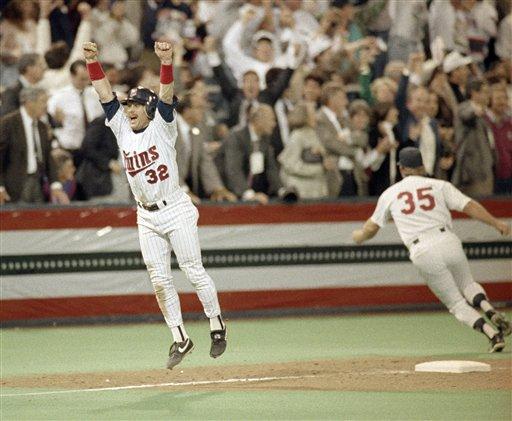
(Dan Gladden celebrates as Gene Larkin's pinch hit fly ball falls safely.  Gladden came home to score the winning run in the bottom of the 10th inning.  Gladden is currently a radio announcer for the Twins and is one of the most entertaining radio announcers in the league.  He often tells stories about the 1991 Twins and his days spent in Minnesota.)
 
As Gladden and Larkin were mobbed at home plate by their teammates, Mitchell slowly walked after the ball in left field.  Alejandro Pena dropped his head and walked slowly off the mound.  On the bench, John Smoltz stared in disbelief.  Greg Olson, the Braves young catcher, leaned back on the Braves bench next to pitching coach Leo Mazzone.  Stunned.

The Twins had won the greatest World Series in history but it would be hard to call the 1991 Braves losers.